


 Скачать презентацию Quality Assurance Procedures for CORIE Data Quality Flags
c55afc4c379806c408846902bbedfff3.ppt
- Количество слайдов: 23
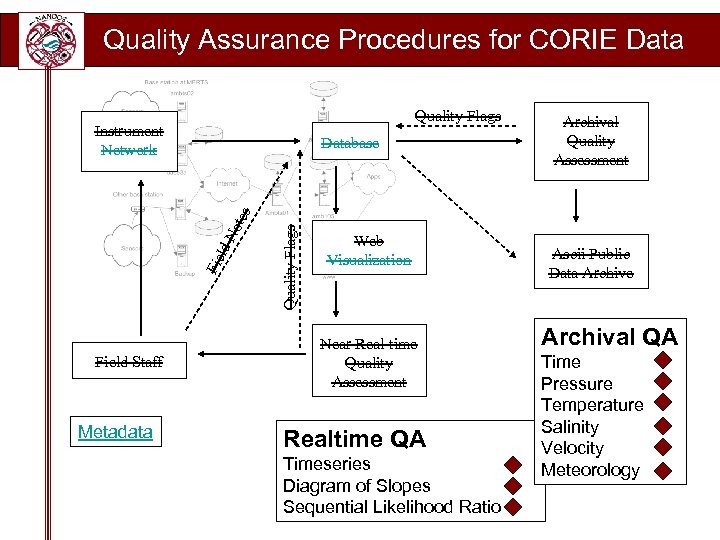 Quality Assurance Procedures for CORIE Data Quality Flags Instrument Network Field Staff Metadata Quality Flags Fie ld No tes Database Web Visualization Near Real-time Quality Assessment Realtime QA Timeseries Diagram of Slopes Sequential Likelihood Ratio Archival Quality Assessment Ascii Public Data Archive Archival QA Time Pressure Temperature Salinity Velocity Meteorology
 Real time Quality Assurance • • • Visual evaluation of data quality 4 times a week Automated testing for biofouling, checked by operator Real time checks result in notification of field staff No database storage of notification No incorporation of assessment into database quality flags • Non automated use of assessment to deactivate web display of real time data
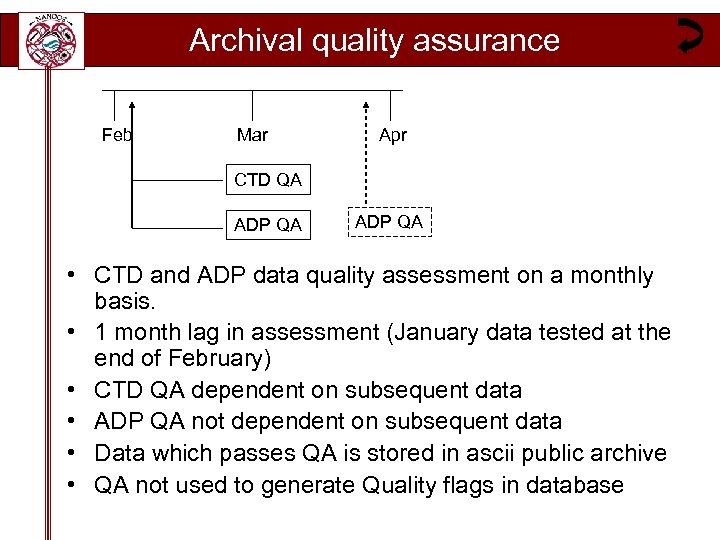 Archival quality assurance Feb Mar Apr CTD QA ADP QA • CTD and ADP data quality assessment on a monthly basis. • 1 month lag in assessment (January data tested at the end of February) • CTD QA dependent on subsequent data • ADP QA not dependent on subsequent data • Data which passes QA is stored in ascii public archive • QA not used to generate Quality flags in database
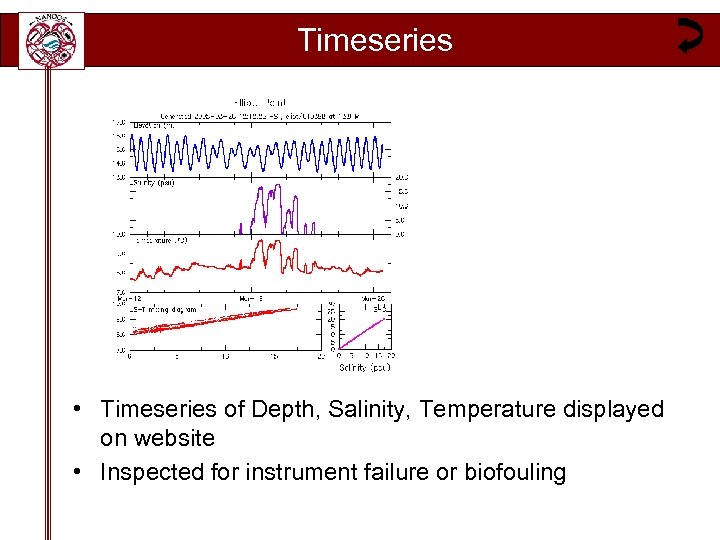 Timeseries • Timeseries of Depth, Salinity, Temperature displayed on website • Inspected for instrument failure or biofouling
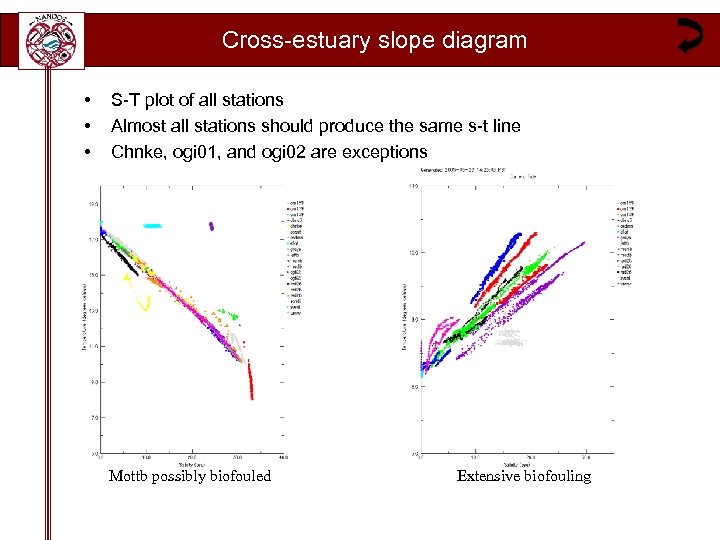 Cross estuary slope diagram • • • S T plot of all stations Almost all stations should produce the same s t line Chnke, ogi 01, and ogi 02 are exceptions Mottb possibly biofouled Extensive biofouling
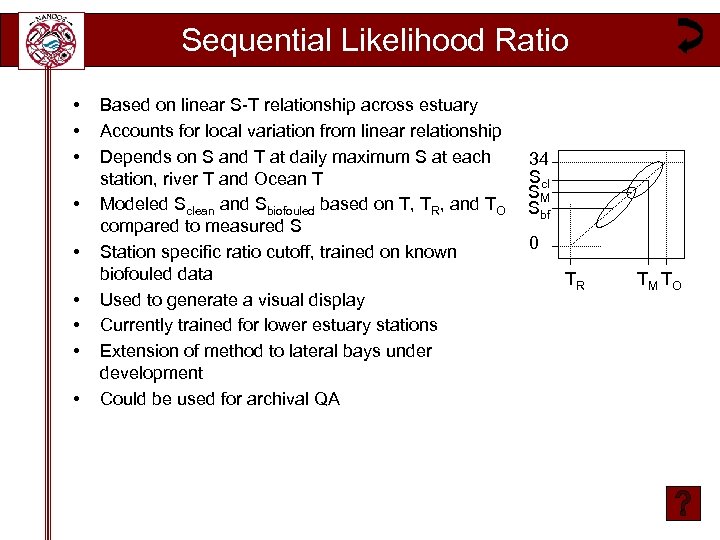 Sequential Likelihood Ratio • • • Based on linear S T relationship across estuary Accounts for local variation from linear relationship Depends on S and T at daily maximum S at each station, river T and Ocean T Modeled Sclean and Sbiofouled based on T, TR, and TO compared to measured S Station specific ratio cutoff, trained on known biofouled data Used to generate a visual display Currently trained for lower estuary stations Extension of method to lateral bays under development Could be used for archival QA 34 Scl SM Sbf 0 TR TM TO
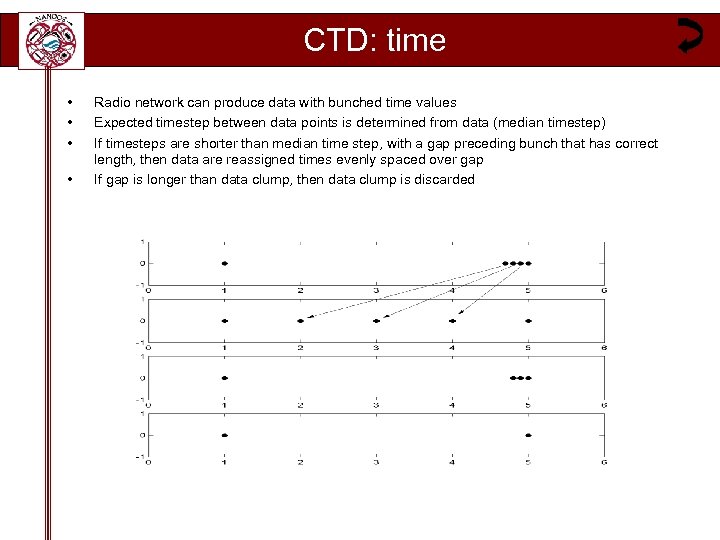 CTD: time • • Radio network can produce data with bunched time values Expected timestep between data points is determined from data (median timestep) If timesteps are shorter than median time step, with a gap preceding bunch that has correct length, then data are reassigned times evenly spaced over gap If gap is longer than data clump, then data clump is discarded
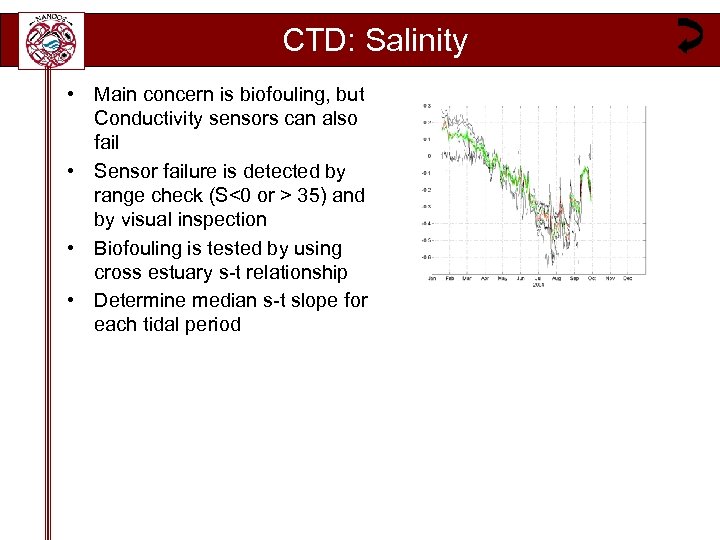 CTD: Salinity • Main concern is biofouling, but Conductivity sensors can also fail • Sensor failure is detected by range check (S<0 or > 35) and by visual inspection • Biofouling is tested by using cross estuary s t relationship • Determine median s t slope for each tidal period
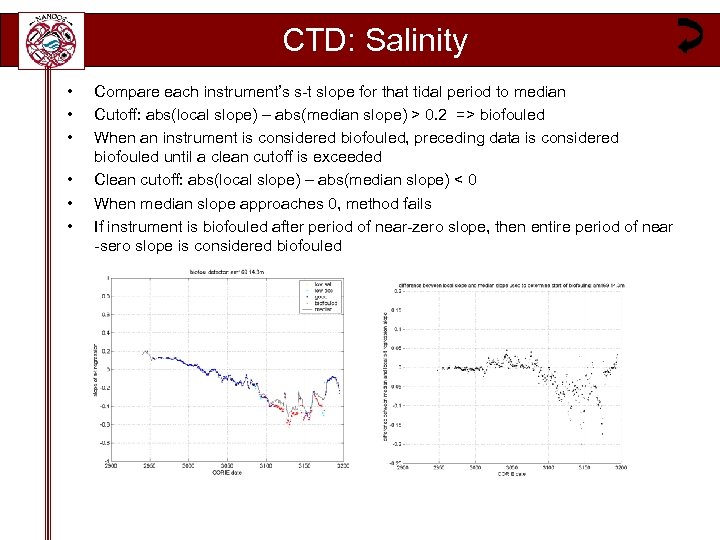 CTD: Salinity • • • Compare each instrument’s s t slope for that tidal period to median Cutoff: abs(local slope) – abs(median slope) > 0. 2 => biofouled When an instrument is considered biofouled, preceding data is considered biofouled until a clean cutoff is exceeded Clean cutoff: abs(local slope) – abs(median slope) < 0 When median slope approaches 0, method fails If instrument is biofouled after period of near zero slope, then entire period of near sero slope is considered biofouled
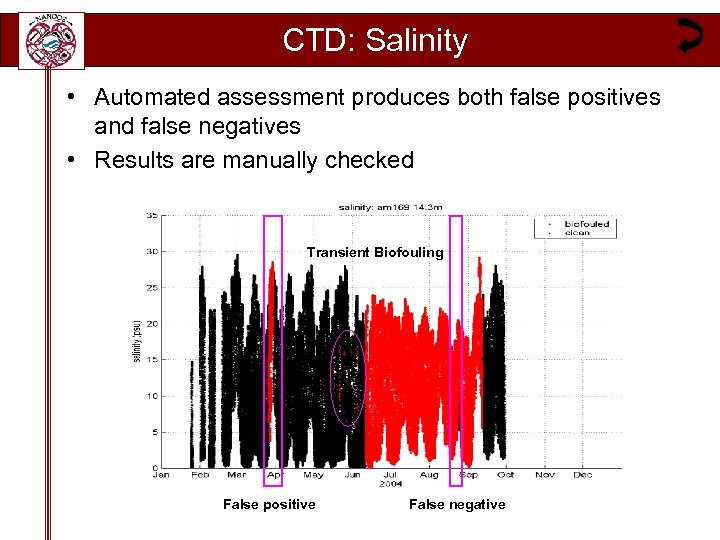 CTD: Salinity • Automated assessment produces both false positives and false negatives • Results are manually checked Transient Biofouling False positive False negative
 Storage of Quality Assessment • Data records which do not meet minimal quality standards are stored in the raw data files, but do not enter the database • Notices of observer suspicion of data quality are not currently stored in a formal manner, and are not entered into the database • Archival quality assurance procedures currently generate public archive files which contain only data which has passed the quality assurance tests • The quality assurance flagging is not currently stored in the database
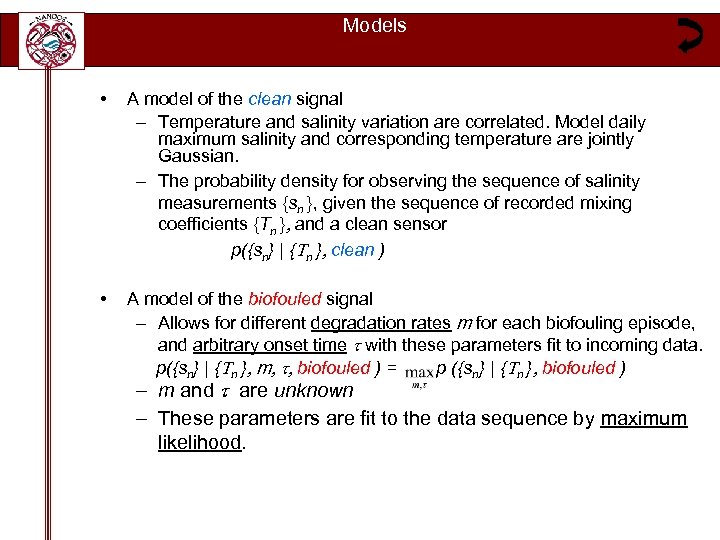 Models • A model of the clean signal – Temperature and salinity variation are correlated. Model daily maximum salinity and corresponding temperature are jointly Gaussian. – The probability density for observing the sequence of salinity measurements {sn }, given the sequence of recorded mixing coefficients {Tn }, and a clean sensor p({sn} | {Tn }, clean ) • A model of the biofouled signal – Allows for different degradation rates m for each biofouling episode, and arbitrary onset time t with these parameters fit to incoming data. p({sn} | {Tn }, m, t, biofouled ) = p ({sn} | {Tn }, biofouled ) – m and t are unknown – These parameters are fit to the data sequence by maximum likelihood.
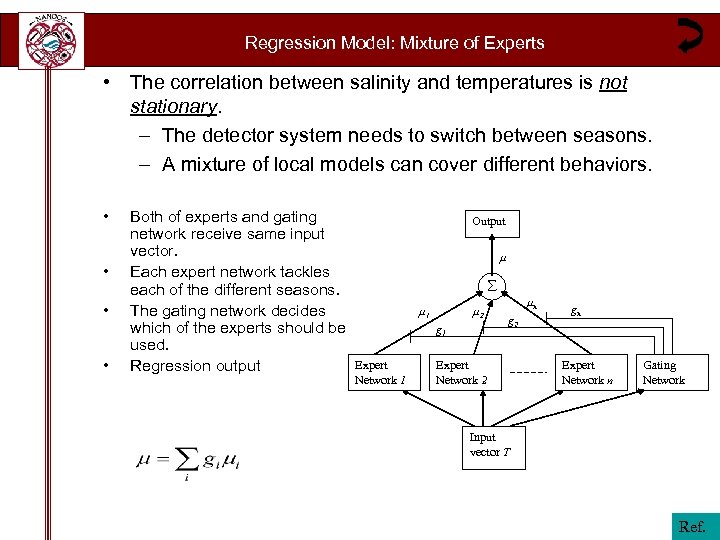 Regression Model: Mixture of Experts • The correlation between salinity and temperatures is not stationary. – The detector system needs to switch between seasons. – A mixture of local models can cover different behaviors. • • Both of experts and gating network receive same input vector. Each expert network tackles each of the different seasons. The gating network decides which of the experts should be used. Regression output Output m m 1 m 2 g 1 Expert Network 1 mn g 2 Expert Network 2 gn Expert Network n Gating Network Input vector T Ref.
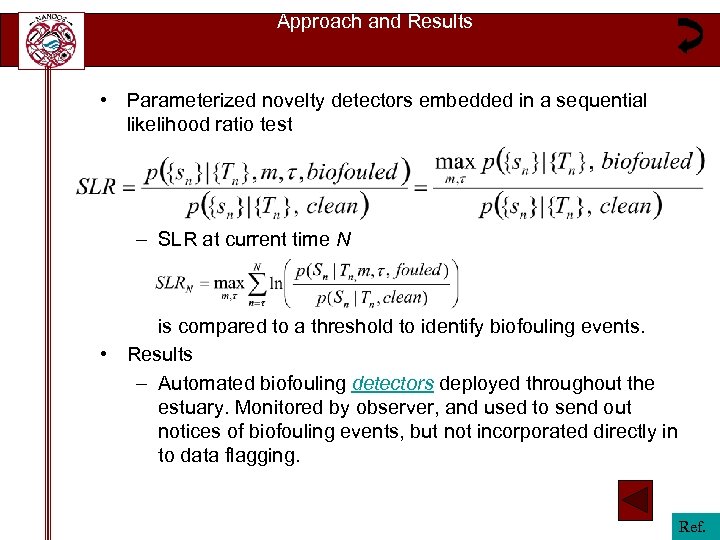 Approach and Results • Parameterized novelty detectors embedded in a sequential likelihood ratio test – SLR at current time N is compared to a threshold to identify biofouling events. • Results – Automated biofouling detectors deployed throughout the estuary. Monitored by observer, and used to send out notices of biofouling events, but not incorporated directly in to data flagging. Ref.
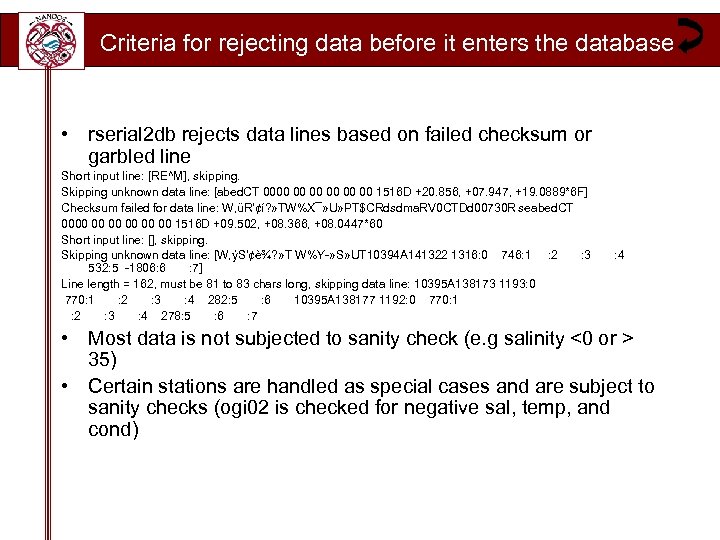 Criteria for rejecting data before it enters the database • rserial 2 db rejects data lines based on failed checksum or garbled line Short input line: [RE^M], skipping. Skipping unknown data line: [abed. CT 0000 00 00 1516 D +20. 856, +07. 947, +19. 0889*6 F] Checksum failed for data line: W, üR'¢í? » TW%X¯» U» PT$CRdsdma. RV 0 CTDd 00730 R seabed. CT 0000 00 00 1516 D +09. 502, +08. 366, +08. 0447*60 Short input line: [], skipping. Skipping unknown data line: [W, ýS'¢è¾? » T W%Y » S» UT 10394 A 141322 1316: 0 746: 1 : 2 : 3 532: 5 1806: 6 : 7] Line length = 162, must be 81 to 83 chars long, skipping data line: 10395 A 138173 1193: 0 770: 1 : 2 : 3 : 4 282: 5 : 6 10395 A 138177 1192: 0 770: 1 : 2 : 3 : 4 278: 5 : 6 : 7 : 4 • Most data is not subjected to sanity check (e. g salinity <0 or > 35) • Certain stations are handled as special cases and are subject to sanity checks (ogi 02 is checked for negative sal, temp, and cond)
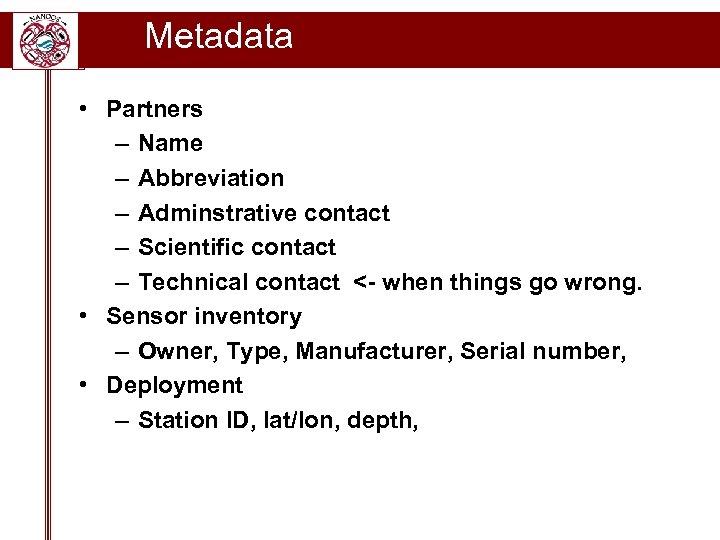 Metadata • Partners Metadata for Operational Resources – Name – Abbreviation – Adminstrative contact – Scientific contact – Technical contact <- when things go wrong. • Sensor inventory – Owner, Type, Manufacturer, Serial number, • Deployment – Station ID, lat/lon, depth,
 Metadata • Models Operational metadata (cont. ) – Owner, developer, version, domain • Output formats – Native binary? – Net. CDF (need CDL descriptions) – OPe. NDAP URLs or LAS if deployed • All operational metadata into Postgres with a web interface for modifications (this has been done, grab schema from SEACOOS or Go. MOOS? )
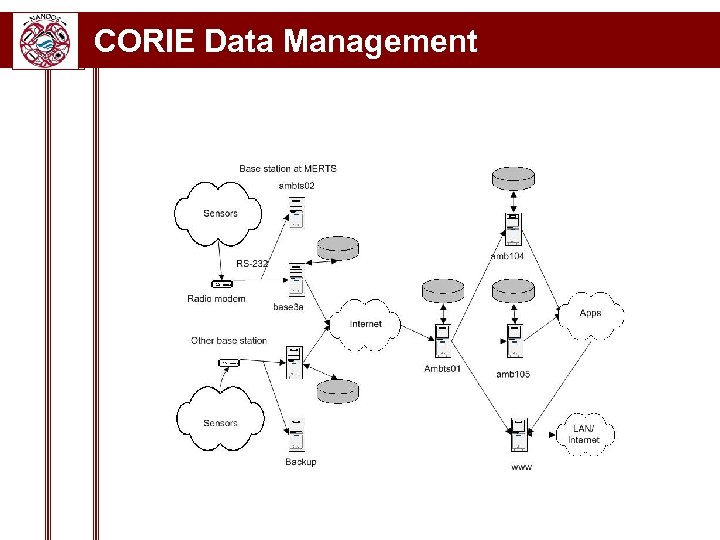 CORIE Data Management Data Flow
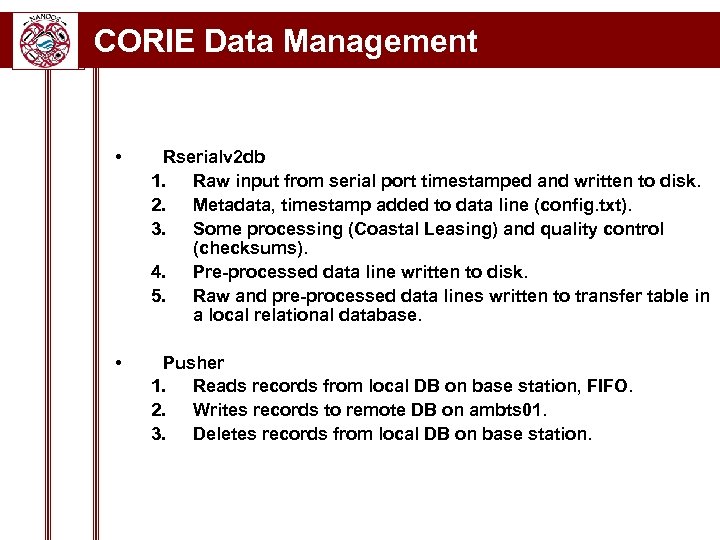 CORIE Data Management Base Station Processes • Rserialv 2 db 1. Raw input from serial port timestamped and written to disk. 2. Metadata, timestamp added to data line (config. txt). 3. Some processing (Coastal Leasing) and quality control (checksums). 4. Pre-processed data line written to disk. 5. Raw and pre-processed data lines written to transfer table in a local relational database. • Pusher 1. Reads records from local DB on base station, FIFO. 2. Writes records to remote DB on ambts 01. 3. Deletes records from local DB on base station.
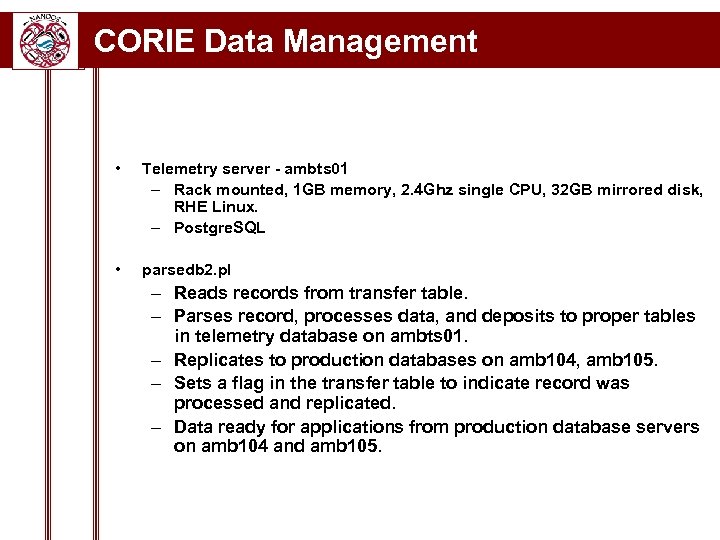 CORIE Data Management At OGI • Telemetry server - ambts 01 – Rack mounted, 1 GB memory, 2. 4 Ghz single CPU, 32 GB mirrored disk, RHE Linux. – Postgre. SQL • parsedb 2. pl – Reads records from transfer table. – Parses record, processes data, and deposits to proper tables in telemetry database on ambts 01. – Replicates to production databases on amb 104, amb 105. – Sets a flag in the transfer table to indicate record was processed and replicated. – Data ready for applications from production database servers on amb 104 and amb 105.
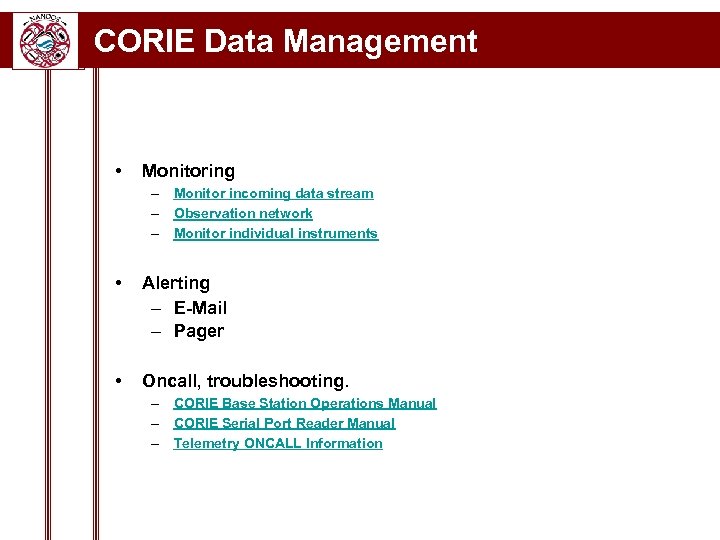 CORIE Data Management Monitoring and Alerting • Monitoring – Monitor incoming data stream – Observation network – Monitor individual instruments • Alerting – E-Mail – Pager • Oncall, troubleshooting. – CORIE Base Station Operations Manual – CORIE Serial Port Reader Manual – Telemetry ONCALL Information
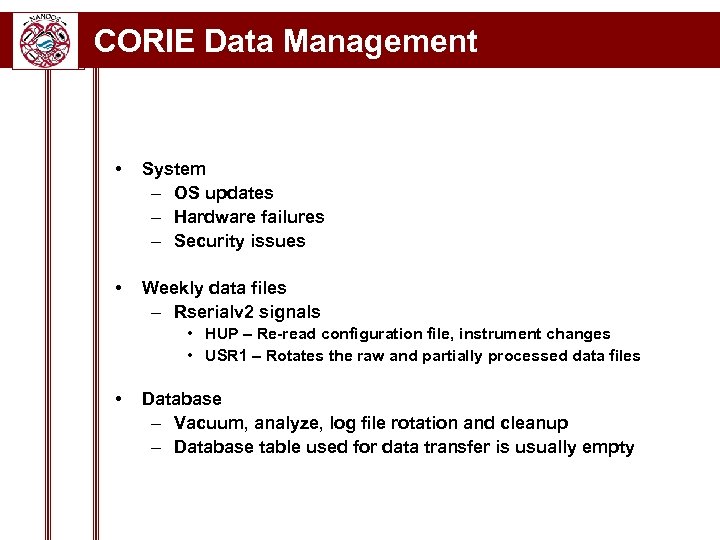 CORIE Data Management Maintenance on Base Station • System – OS updates – Hardware failures – Security issues • Weekly data files – Rserialv 2 signals • HUP – Re-read configuration file, instrument changes • USR 1 – Rotates the raw and partially processed data files • Database – Vacuum, analyze, log file rotation and cleanup – Database table used for data transfer is usually empty
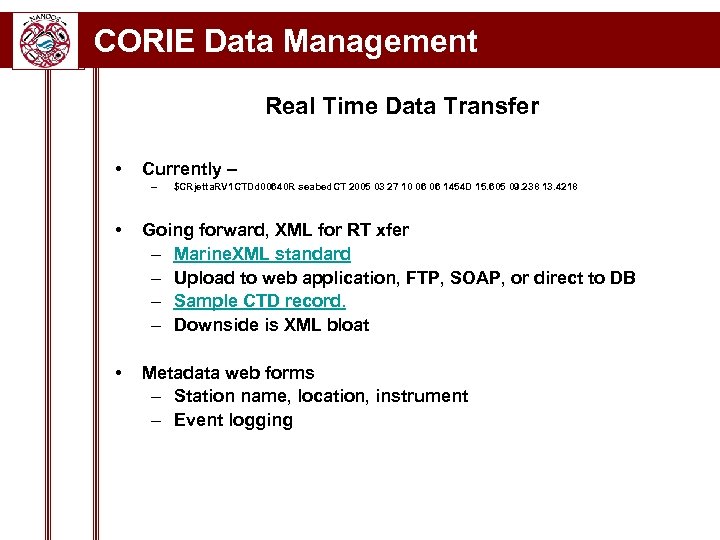 CORIE Data Management Real Time Data Transfer • Currently – – $CRjetta. RV 1 CTDd 00640 R seabed. CT 2005 03 27 10 06 06 1454 D 15. 605 09. 238 13. 4218 • Going forward, XML for RT xfer – Marine. XML standard – Upload to web application, FTP, SOAP, or direct to DB – Sample CTD record. – Downside is XML bloat • Metadata web forms – Station name, location, instrument – Event logging