


 Скачать презентацию Quality Assurance CSC 444 F 07 Lecture 6 1
4347568e475b3843384b3228015675db.ppt
- Количество слайдов: 13
 Quality Assurance CSC 444 F'07 Lecture 6 1
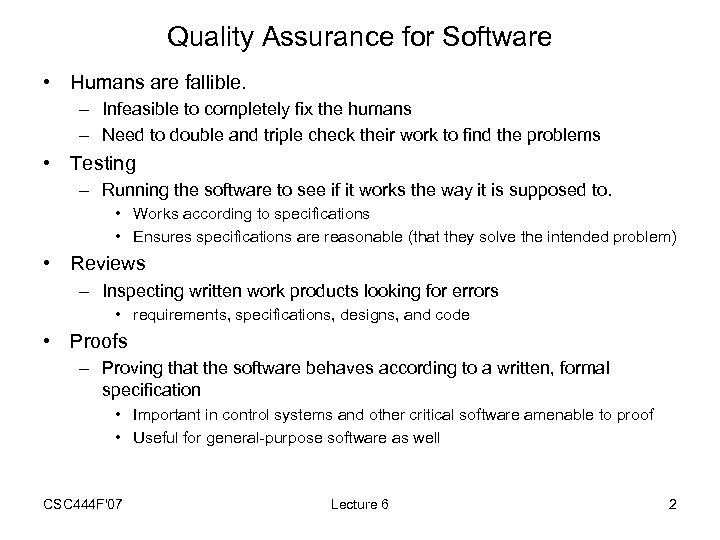 Quality Assurance for Software • Humans are fallible. – Infeasible to completely fix the humans – Need to double and triple check their work to find the problems • Testing – Running the software to see if it works the way it is supposed to. • Works according to specifications • Ensures specifications are reasonable (that they solve the intended problem) • Reviews – Inspecting written work products looking for errors • requirements, specifications, designs, and code • Proofs – Proving that the software behaves according to a written, formal specification • Important in control systems and other critical software amenable to proof • Useful for general-purpose software as well CSC 444 F'07 Lecture 6 2
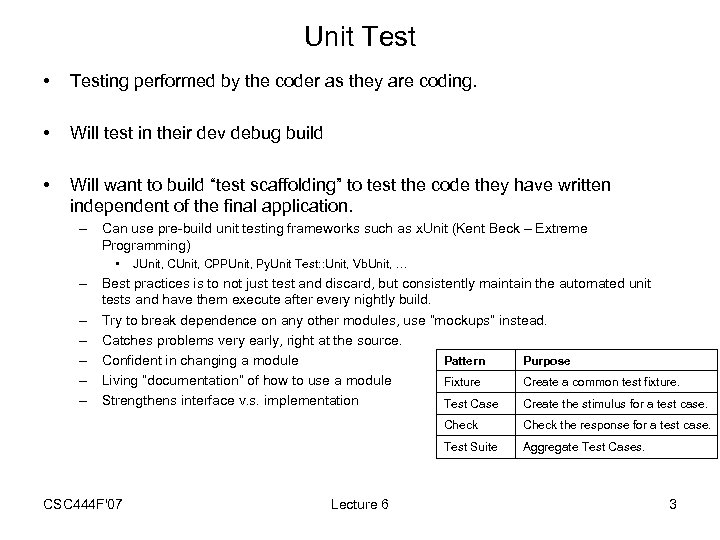 Unit Test • Testing performed by the coder as they are coding. • Will test in their dev debug build • Will want to build “test scaffolding” to test the code they have written independent of the final application. – Can use pre-build unit testing frameworks such as x. Unit (Kent Beck – Extreme Programming) • JUnit, CPPUnit, Py. Unit Test: : Unit, Vb. Unit, … – Best practices is to not just test and discard, but consistently maintain the automated unit tests and have them execute after every nightly build. – Try to break dependence on any other modules, use “mockups” instead. – Catches problems very early, right at the source. Pattern Purpose – Confident in changing a module – Living “documentation” of how to use a module Fixture Create a common test fixture. – Strengthens interface v. s. implementation Test Case Create the stimulus for a test case. Check Test Suite CSC 444 F'07 Lecture 6 Check the response for a test case. Aggregate Test Cases. 3
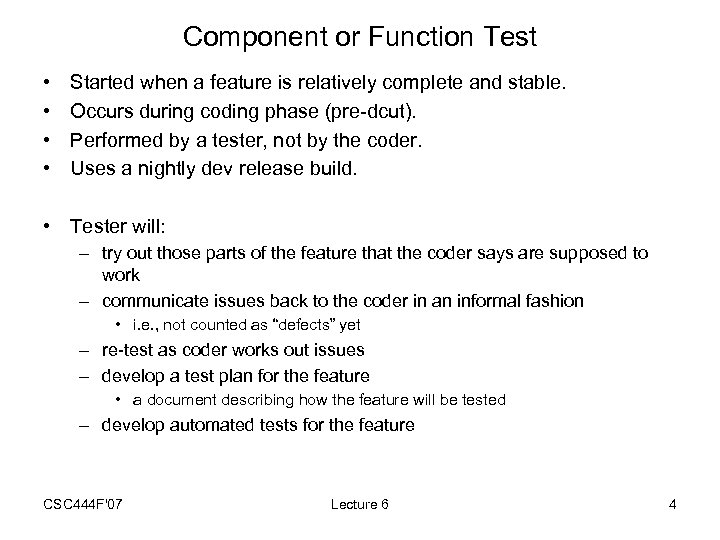 Component or Function Test • • Started when a feature is relatively complete and stable. Occurs during coding phase (pre-dcut). Performed by a tester, not by the coder. Uses a nightly dev release build. • Tester will: – try out those parts of the feature that the coder says are supposed to work – communicate issues back to the coder in an informal fashion • i. e. , not counted as “defects” yet – re-test as coder works out issues – develop a test plan for the feature • a document describing how the feature will be tested – develop automated tests for the feature CSC 444 F'07 Lecture 6 4
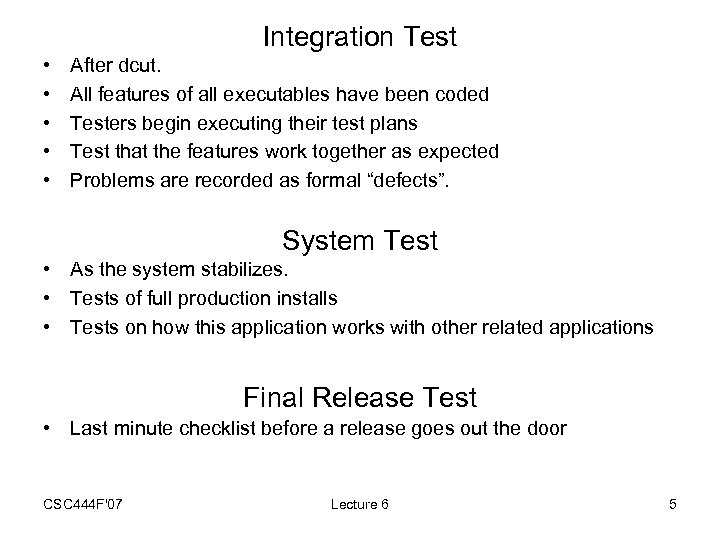 Integration Test • • • After dcut. All features of all executables have been coded Testers begin executing their test plans Test that the features work together as expected Problems are recorded as formal “defects”. System Test • As the system stabilizes. • Tests of full production installs • Tests on how this application works with other related applications Final Release Test • Last minute checklist before a release goes out the door CSC 444 F'07 Lecture 6 5
 Regression Testing • Tests made to ensure that functionality that once worked continues to work. • Test made to ensure that previously discovered and corrected defects do not re-appear. – a fertile source of defects • Can be performed manually – but would take too long CSC 444 F'07 Lecture 6 6
 Automated Regression Testing • An extension of the nightly builds • Software scripts will execute a set series of tests and report the results back into a database • QA will examine the results each morning – 4 reasons for a failure: • • the function was broken the function was changed the function was improved the test is faulty • The function of the test team is to ensure good coverage on automated regression tests – each new function should get a suite of regression tests • should be formalized in the feature creation process – each defect should get a test that would have caught it • should be formalized in the defect resolution process CSC 444 F'07 Lecture 6 7
 Performance Regressions • Easy to build test cases and forget to measure the time it takes to execute them • Systematically – collecting this information, – consolidating it, – and reporting on it will show up performance trends • Required because sometimes coders will check-in a change that looks to be functionally ok, but has very negative performance implications – e. g. , if coder only tested on a few simple test cases and did notice because the run-time was swamped by the overhead CSC 444 F'07 Lecture 6 8
 Memory Leak Regressions • Run a special version of the software, instrumented to find memory leaks, bad memory allocation errors, and bad pointer chasing – e. g. , Purify from IBM/Rational/Pure • Runs slowly, but can use a representative sample of the nightly regression tests. CSC 444 F'07 Lecture 6 9
 Benefits of Regression Testing • Locks-in quality – once you achieve quality, you don’t backslide – everybody focuses on new features and forgets the old • Finding defects sooner – finds the defect nearest the point in time it was injected – freshest in the coder’s mind – least expensive time to fix it • Development aid – can work on complex, central bits of the code without fear of breaking something major on not finding out • Releasing – if need a last minute critical defect fix to release – if no/poor a. r. t. , might have to delay until re-tested CSC 444 F'07 Lecture 6 10
 Regression Coverage • To manage a program to institute or improve automated regression testing, you require a coverage metric. • What % of the application is tested. – can count functions from the outside • coverage of all functions • # of tests per function – can count lines of code traversed • excellent coverage metric • will not necessarily get all combinations • Coverage may refer to – baselined • test to see if results are the same each day – validated • baselined + baseline has been validated to be correct CSC 444 F'07 Lecture 6 11
 GUI versus Scripting for A. R. T. • 2 general approachs to testing GUI-based apps: – use a GUI test tool • pumps UI events at the app • extracts results from text widgets, bitmaps, files • Problems: – – – – very sensitive to changes in the gui very sensitive to changes in gui sequencing many false positives costly to maintain easy to drive the app, hard to see if results are correct hard to get at the results throw it all away if make a big gui change – architect to test at a layer just beneath the GUI • create an a. r. t. API • might use an embedded interpreter – Perl, Python, VBScript • might hit the app from outside – COM – C/C++ API • Problems: – not testing the gui, testing something a bit different – coders need to develop and maintain APIs CSC 444 F'07 Lecture 6 12
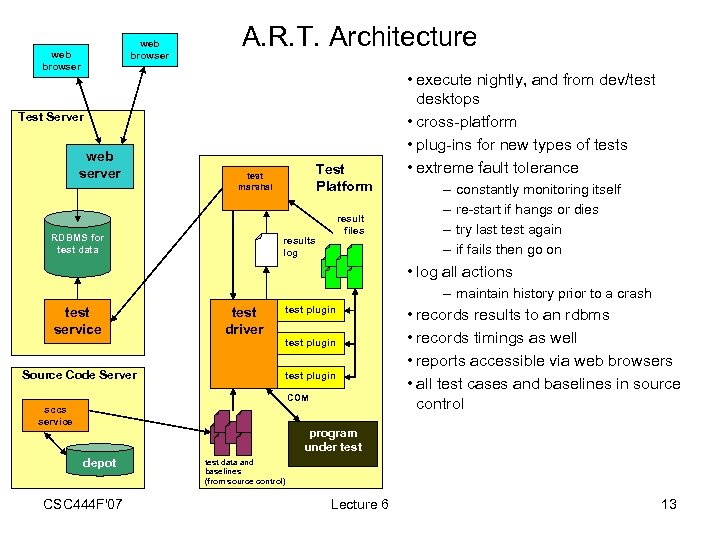 web browser A. R. T. Architecture Test Server web server Test Platform test marshal RDBMS for test data result files results log • execute nightly, and from dev/test desktops • cross-platform • plug-ins for new types of tests • extreme fault tolerance – – constantly monitoring itself re-start if hangs or dies try last test again if fails then go on • log all actions – maintain history prior to a crash test service test driver test plugin Source Code Server test plugin COM sccs service • records results to an rdbms • records timings as well • reports accessible via web browsers • all test cases and baselines in source control program under test depot CSC 444 F'07 test data and baselines (from source control) Lecture 6 13