


 Скачать презентацию Qualitative Evaluation of the Lone Parent Pilots PSI
d8d061ded08aed361197dfad614d9ea0.ppt
- Количество слайдов: 10
 Qualitative Evaluation of the Lone Parent Pilots PSI Work and Social Policy seminar series, 15 May 2007 Kathryn Ray & Sandra Vegeris Policy Studies Institute Ray, K. , Vegeris, S. , Brooks, S. , Campbell-Barr, V. , Hoggart, L. , Mackinnon, K. and Shutes I. (2007) The lone parents pilots: A qualitative evaluation of Quarterly Work Focused Interviews (12+), Work Search Premium and In Work Credit DWP Research report (http: //www. dwp. gov. uk/asd 5/rrs 2007. asp#lppilots)
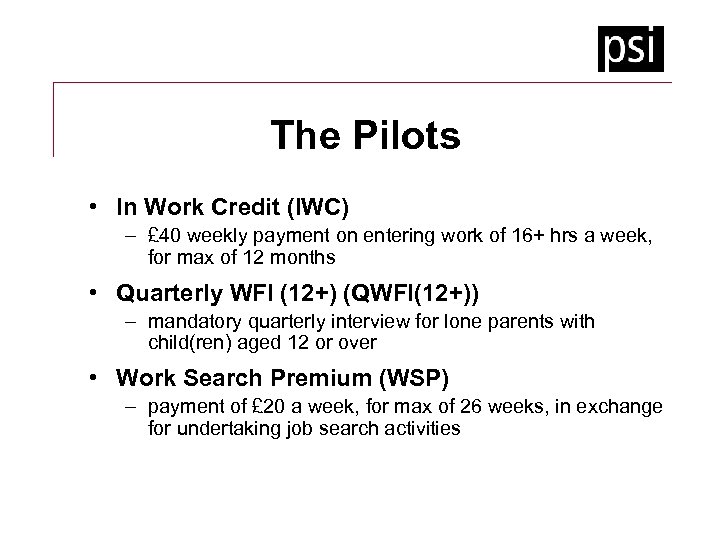 The Pilots • In Work Credit (IWC) – £ 40 weekly payment on entering work of 16+ hrs a week, for max of 12 months • Quarterly WFI (12+) (QWFI(12+)) – mandatory quarterly interview for lone parents with child(ren) aged 12 or over • Work Search Premium (WSP) – payment of £ 20 a week, for max of 26 weeks, in exchange for undertaking job search activities
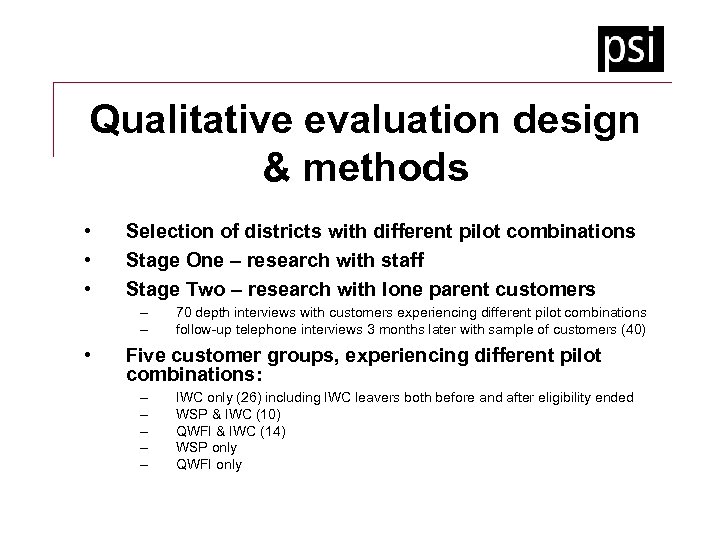 Qualitative evaluation design & methods • • • Selection of districts with different pilot combinations Stage One – research with staff Stage Two – research with lone parent customers – – • 70 depth interviews with customers experiencing different pilot combinations follow-up telephone interviews 3 months later with sample of customers (40) Five customer groups, experiencing different pilot combinations: – – – IWC only (26) including IWC leavers both before and after eligibility ended WSP & IWC (10) QWFI & IWC (14) WSP only QWFI only
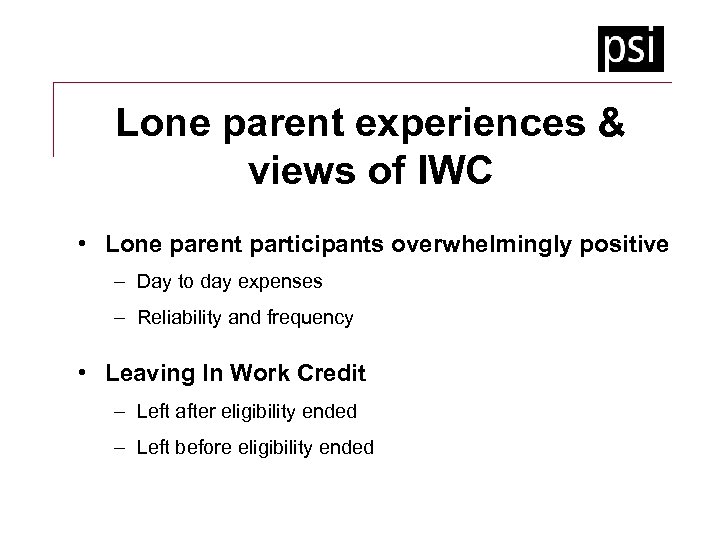 Lone parent experiences & views of IWC • Lone parent participants overwhelmingly positive – Day to day expenses – Reliability and frequency • Leaving In Work Credit – Left after eligibility ended – Left before eligibility ended
 Lone parent perceptions of impact • Effect on decision to look for work – Timing and lifecourse – Sampling issues • Effect on job search • Effect on work retention • Who did it make most difference to?
 Work journeys 1: Lauren • Background – Age: 43, 2 children aged 7 and 10 – Work history: worked in hotels as a housekeeper for a number of years, out of work to bring up children for around 4 years, completed a diploma in hotel management while on IS – Wanted to work only in school hours as did not want children to be in childcare outside the school day • Work journey: Steady – Working 16 hours a week as a catering assistant in a school – Prefers to work but finds the work unfulfilling.
 • Role of IWC – No incentive effect, only found out once accepted the job – But has made a real difference to financial wellbeing in work: “It hasn’t helped keeping me in my job, but it has helped me meeting my day-to-day bills in the house. … because like there are things that [normally] wait till the end of the month, but because with the £ 40 like, the normal weekly shopping in the house … you don’t have to wait for your payslip. ” – Since IWC finished has considered leaving work, problems with Housing Benefit and Council Tax, does not feel better off – Is unclear how increasing hours would impact on other in-work benefits
 Work journeys 2: Liesl • Background – Age: 20 s, 2 children aged 7 and 8 – Work history: factory work and care work then 5 years out of work bringing up children – Wanted PT work to fit round children’s school hours • Work journey: Broken – Worked for 2 years PT in retail – Left due to childcare arrangements breaking down (childminder left), also dissatisfaction with ‘flexible’ and antisocial hours, and problems with WTC – 6 mth gap then another PT retail job, again left because childcare arrangements broke down (father became ill). – Wave 2 interview: out of work but pursuing courses in teaching assistance and childminding
 “I thought the only job I might be able to get is maybe working in a shop, and that’s not my, that’s not where I want to be. So I thought I’d go and do the course, get the qualifications that I need, then I can do what I want to do, then I can be happy!” • Role of IWC – No incentive effect because found out after taken a job – Helped to make ends meet in first job – But interaction with tax credits: overpayments which were then deducted left her feeling worse off in work – Increased hours after IWC finished to make up shortfall in income
 Issues from the work journey analysis • Role of financial supplements • Progression in work – Adviser support at transition periods – Combining work and care • Multiple transitions in early stages of work