 Скачать презентацию QSO Absorbers in Radio Selected Samples Sara Ellison
462b02f83020b2a99103587bc61f9902.ppt
- Количество слайдов: 19



QSO Absorbers in Radio Selected Samples Sara Ellison - University of Victoria Max Pettini - Cambridge Chris Akerman - Cambridge Chris Churchill - NMSU Pat Hall - York U. Isobel Hook - Oxford Carole Jackson - ATNF Paulina Lira - U. Chile Samantha Rix - ING Peter Shaver - ESO Chuck Steidel - Cal. Tech Jasper Wall - UBC Lin Yan - IPAC
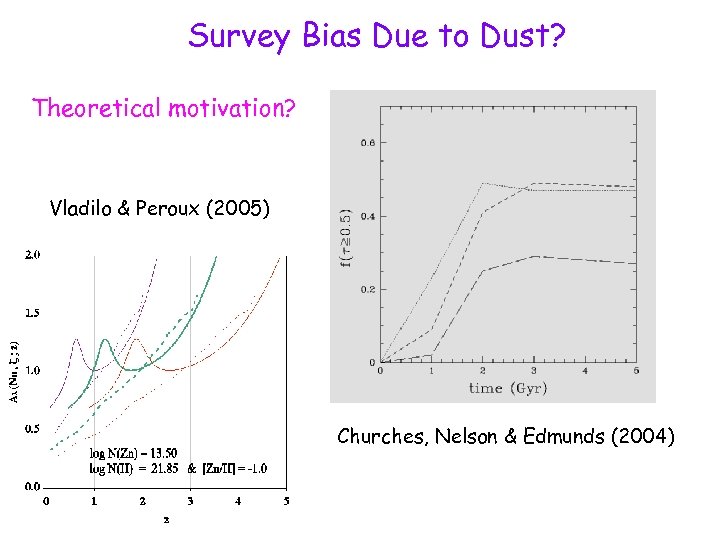
Survey Bias Due to Dust? Theoretical motivation? Vladilo & Peroux (2005) Churches, Nelson & Edmunds (2004)
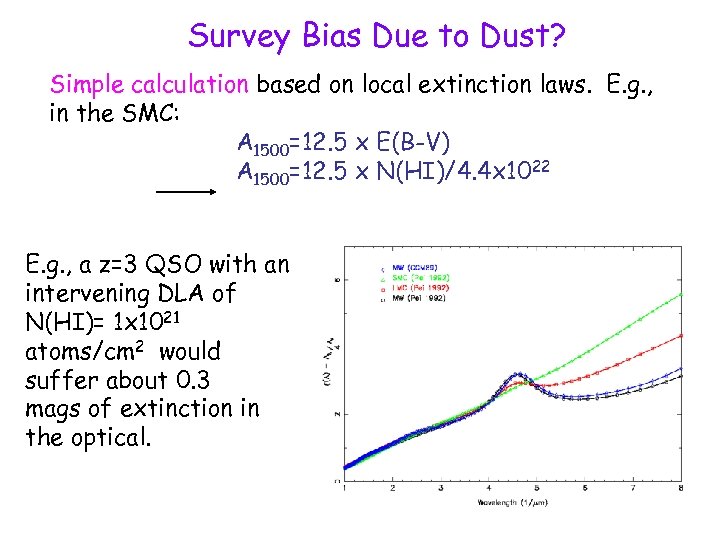
Survey Bias Due to Dust? Simple calculation based on local extinction laws. E. g. , in the SMC: A 1500=12. 5 x E(B-V) A 1500=12. 5 x N(HI)/4. 4 x 10²² E. g. , a z=3 QSO with an intervening DLA of N(HI)= 1 x 10²¹ atoms/cm 2 would suffer about 0. 3 mags of extinction in the optical.
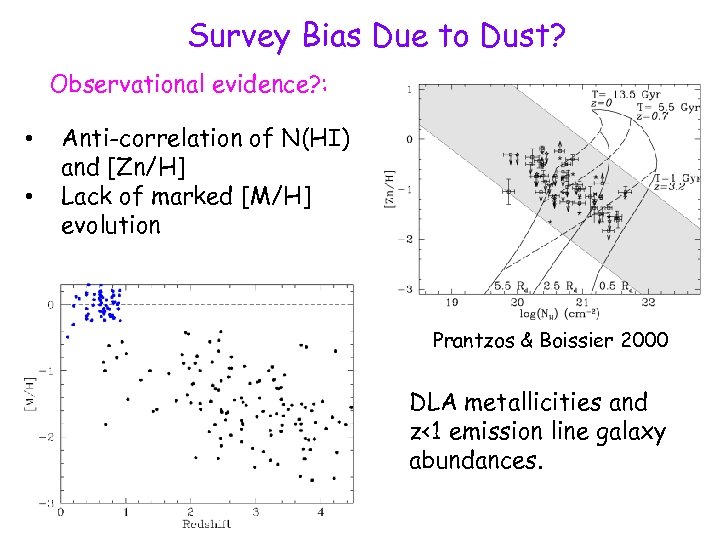
Survey Bias Due to Dust? Observational evidence? : • • Anti-correlation of N(HI) and [Zn/H] Lack of marked [M/H] evolution Prantzos & Boissier 2000 DLA metallicities and z<1 emission line galaxy abundances.
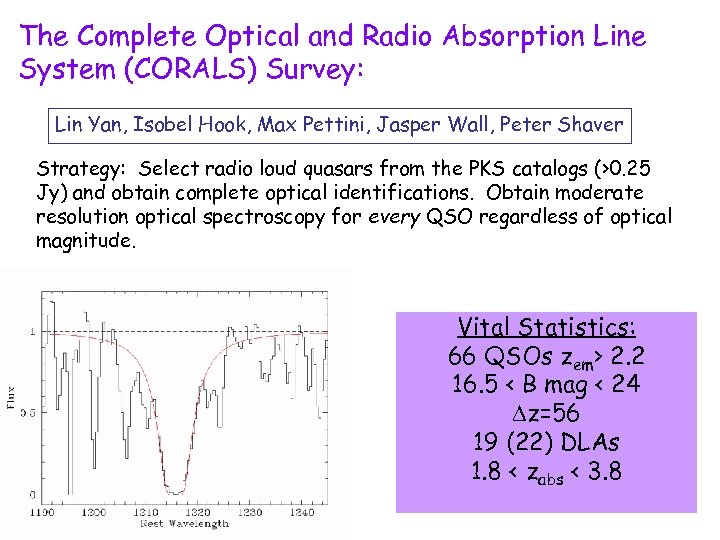
The Complete Optical and Radio Absorption Line System (CORALS) Survey: Lin Yan, Isobel Hook, Max Pettini, Jasper Wall, Peter Shaver Strategy: Select radio loud quasars from the PKS catalogs (>0. 25 Jy) and obtain complete optical identifications. Obtain moderate resolution optical spectroscopy for every QSO regardless of optical magnitude. Vital Statistics: 66 QSOs zem> 2. 2 16. 5 < B mag < 24 z=56 19 (22) DLAs 1. 8 < zabs < 3. 8
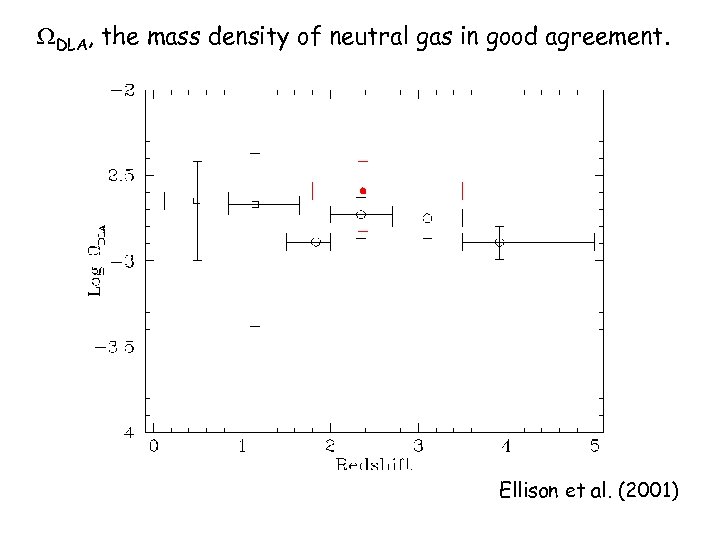
DLA, the mass density of neutral gas in good agreement. Ellison et al. (2001)
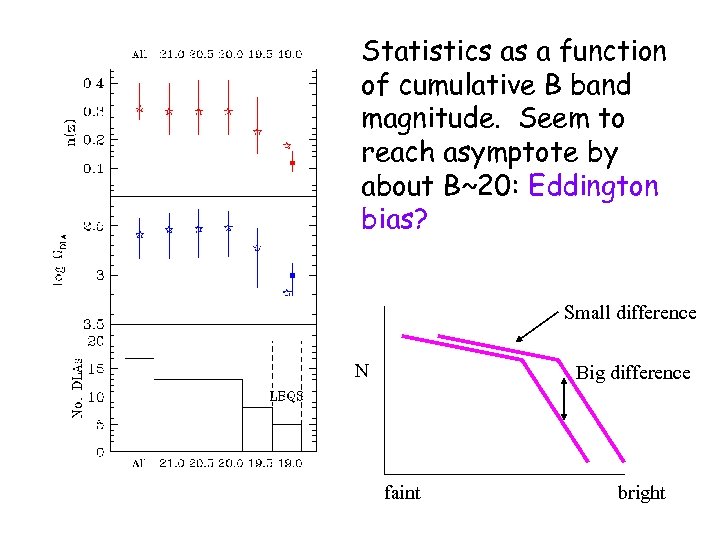
Statistics as a function of cumulative B band magnitude. Seem to reach asymptote by about B~20: Eddington bias? Small difference N Big difference faint bright
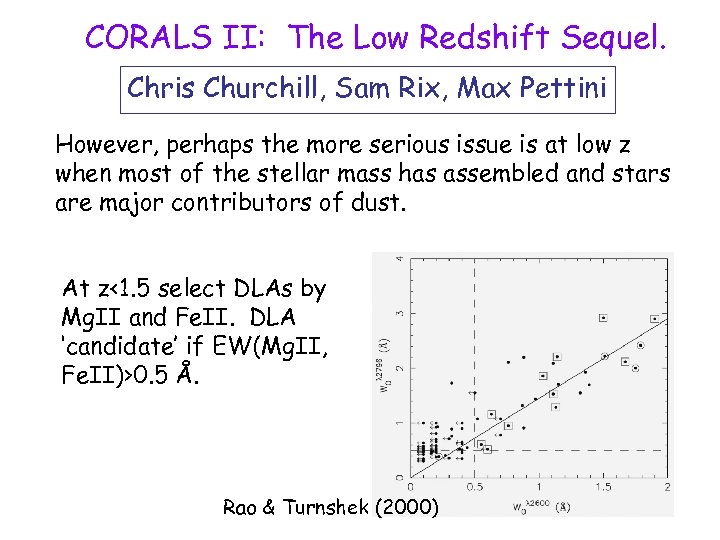
CORALS II: The Low Redshift Sequel. Chris Churchill, Sam Rix, Max Pettini However, perhaps the more serious issue is at low z when most of the stellar mass has assembled and stars are major contributors of dust. At z<1. 5 select DLAs by Mg. II and Fe. II. DLA ‘candidate’ if EW(Mg. II, Fe. II)>0. 5 Å. Rao & Turnshek (2000)
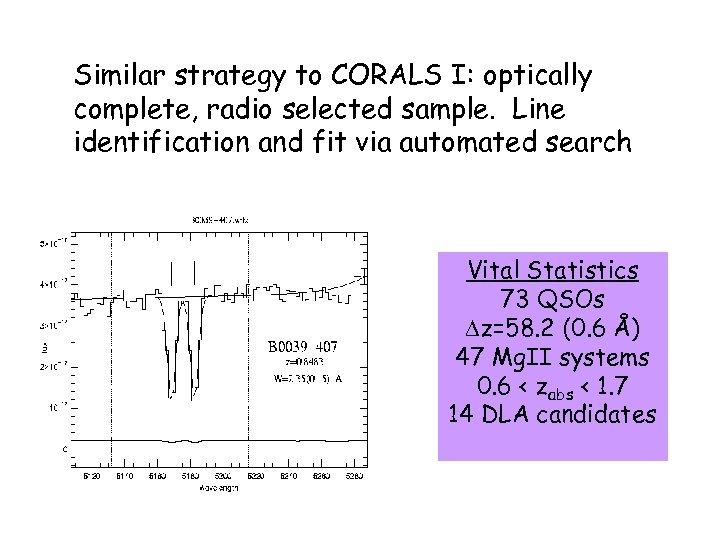
Similar strategy to CORALS I: optically complete, radio selected sample. Line identification and fit via automated search Vital Statistics 73 QSOs z=58. 2 (0. 6 Å) 47 Mg. II systems 0. 6 < zabs < 1. 7 14 DLA candidates
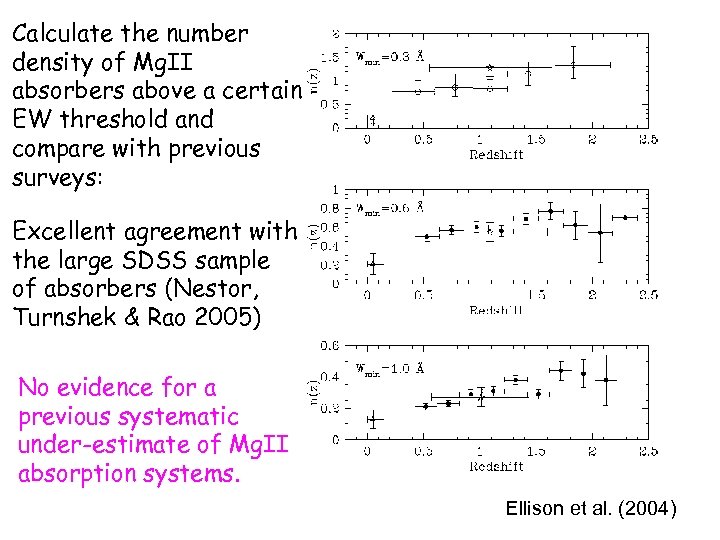
Calculate the number density of Mg. II absorbers above a certain EW threshold and compare with previous surveys: Excellent agreement with the large SDSS sample of absorbers (Nestor, Turnshek & Rao 2005) No evidence for a previous systematic under-estimate of Mg. II absorption systems. Ellison et al. (2004)
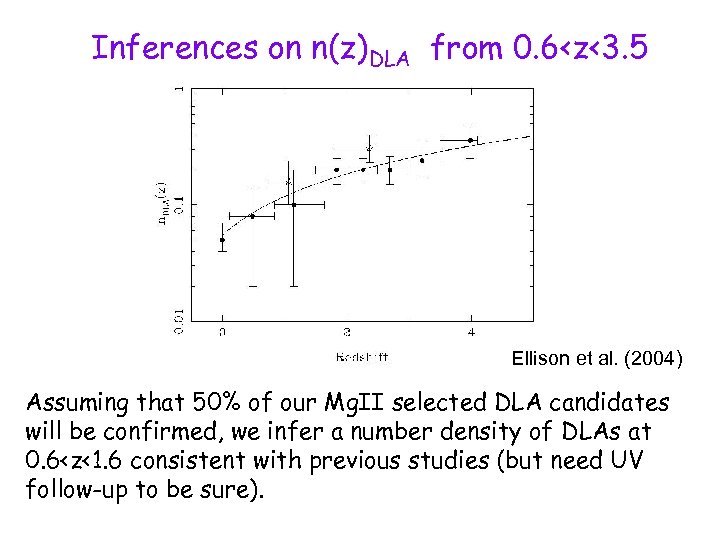
Inferences on n(z)DLA from 0. 6<z<3. 5 Ellison et al. (2004) Assuming that 50% of our Mg. II selected DLA candidates will be confirmed, we infer a number density of DLAs at 0. 6<z<1. 6 consistent with previous studies (but need UV follow-up to be sure).
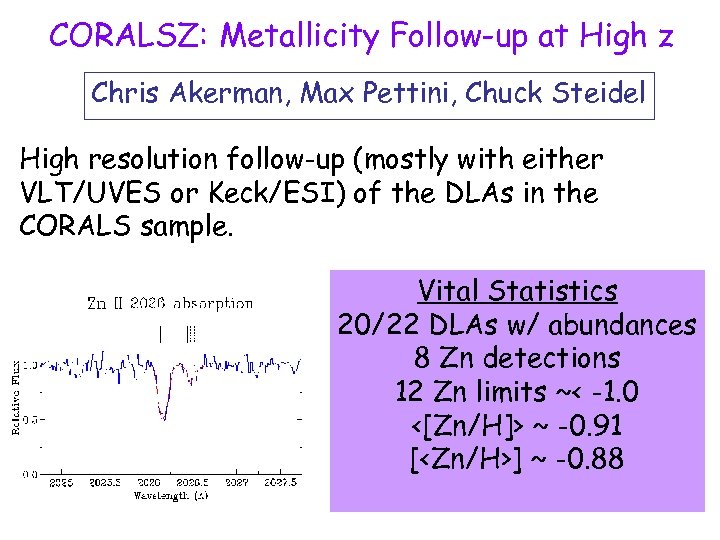
CORALSZ: Metallicity Follow-up at High z Chris Akerman, Max Pettini, Chuck Steidel High resolution follow-up (mostly with either VLT/UVES or Keck/ESI) of the DLAs in the CORALS sample. Vital Statistics 20/22 DLAs w/ abundances 8 Zn detections 12 Zn limits ~< -1. 0 <[Zn/H]> ~ -0. 91 [<Zn/H>] ~ -0. 88
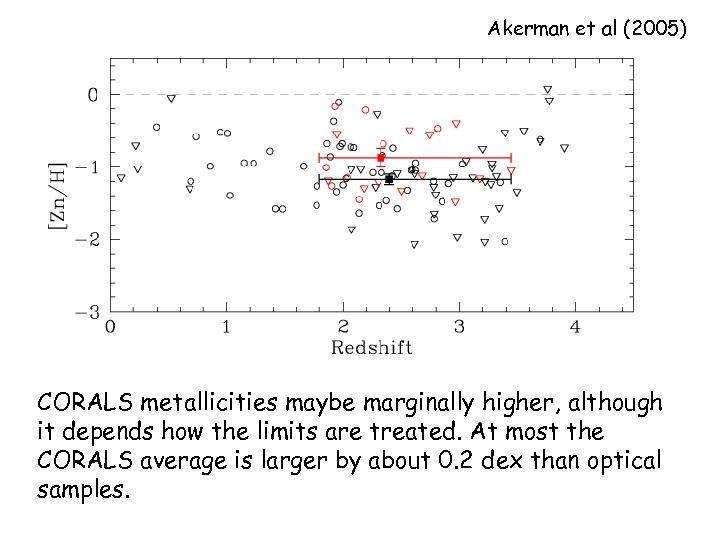
Akerman et al (2005) CORALS metallicities maybe marginally higher, although it depends how the limits are treated. At most the CORALS average is larger by about 0. 2 dex than optical samples.
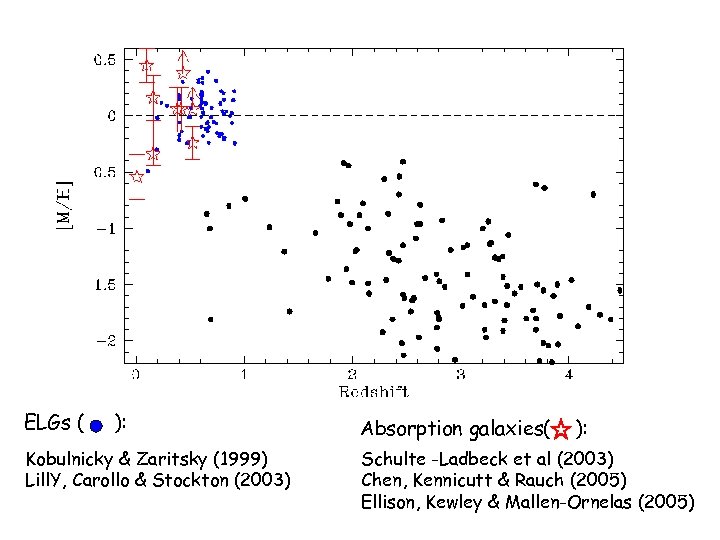
ELGs ( ): Kobulnicky & Zaritsky (1999) Lill. Y, Carollo & Stockton (2003) Absorption galaxies( ): Schulte -Ladbeck et al (2003) Chen, Kennicutt & Rauch (2005) Ellison, Kewley & Mallen-Ornelas (2005)
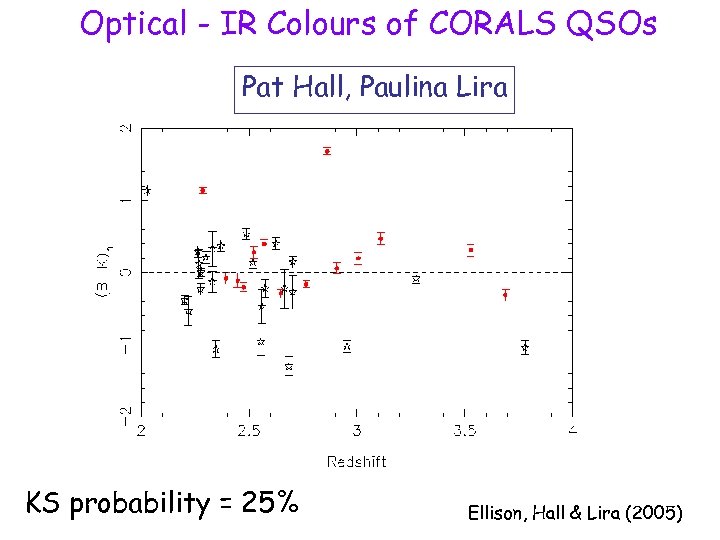
Optical - IR Colours of CORALS QSOs Pat Hall, Paulina Lira KS probability = 25% Ellison, Hall & Lira (2005)
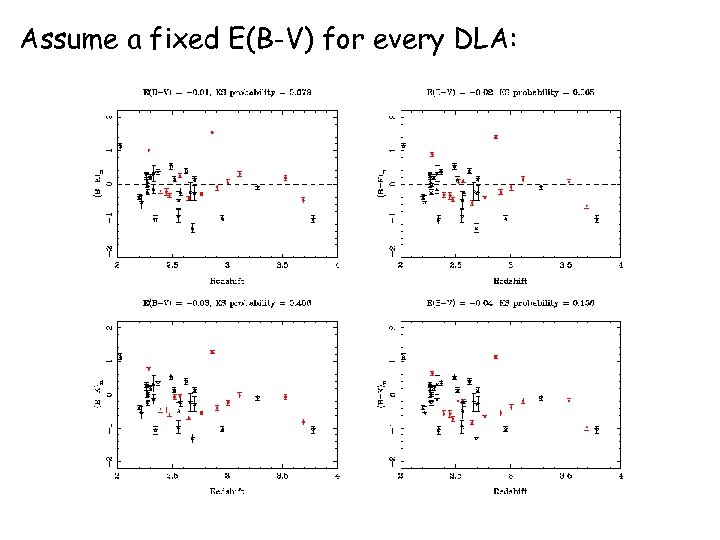
Assume a fixed E(B-V) for every DLA:
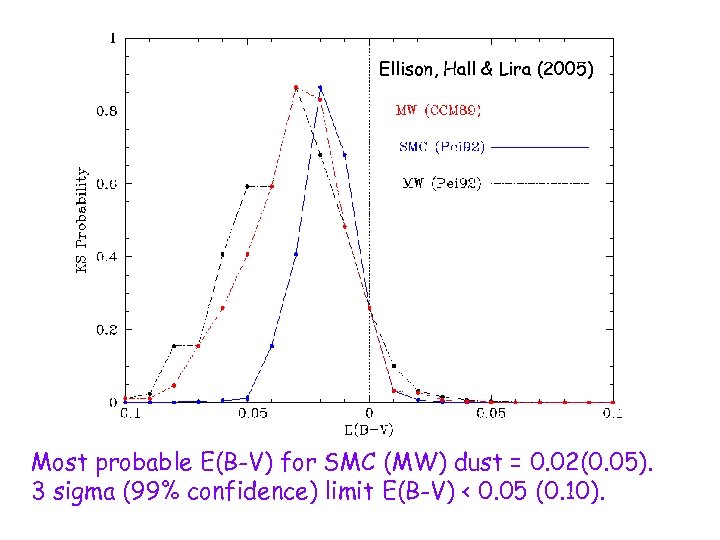
Ellison, Hall & Lira (2005) Most probable E(B-V) for SMC (MW) dust = 0. 02(0. 05). 3 sigma (99% confidence) limit E(B-V) < 0. 05 (0. 10).
![E(B-V) < 0. 05 Log(NHI) + [Zn/H] < 20. 46 Log(NHI) + [Zn/H] <](https://present5.com/presentation/462b02f83020b2a99103587bc61f9902/image-18.jpg "E(B-V) < 0. 05 Log(NHI) + [Zn/H] < 20. 46 Log(NHI) + [Zn/H] <")
E(B-V) < 0. 05 Log(NHI) + [Zn/H] < 20. 46 Log(NHI) + [Zn/H] < 21 E(B-V) < 0. 17 (Prantzos & Boissier 2000) E(B-V) = N(HI) x 10[Zn/H]/5. 8 e 21
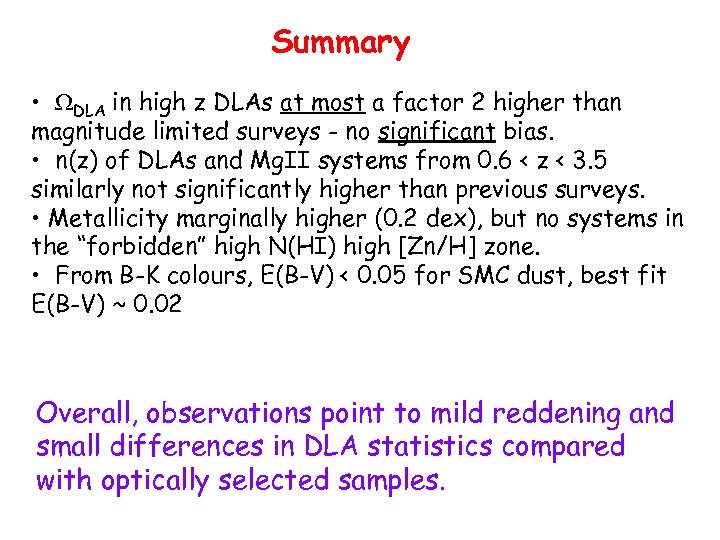
Summary • DLA in high z DLAs at most a factor 2 higher than magnitude limited surveys - no significant bias. • n(z) of DLAs and Mg. II systems from 0. 6 < z < 3. 5 similarly not significantly higher than previous surveys. • Metallicity marginally higher (0. 2 dex), but no systems in the “forbidden” high N(HI) high [Zn/H] zone. • From B-K colours, E(B-V) < 0. 05 for SMC dust, best fit E(B-V) ~ 0. 02 Overall, observations point to mild reddening and small differences in DLA statistics compared with optically selected samples.
Скачать презентацию QSO Absorbers in Radio Selected Samples Sara Ellison
462b02f83020b2a99103587bc61f9902.ppt