 Скачать презентацию Qo S interconnect best without effort Bob Briscoe
9f0c3d123114cb7fcb069b1316d5b18b.ppt
- Количество слайдов: 24



Qo. S interconnect best without effort Bob Briscoe Chief Researcher BT Sep 2009 This work is partly funded by Trilogy, a research project supported by the European Community www. trilogy-project. org
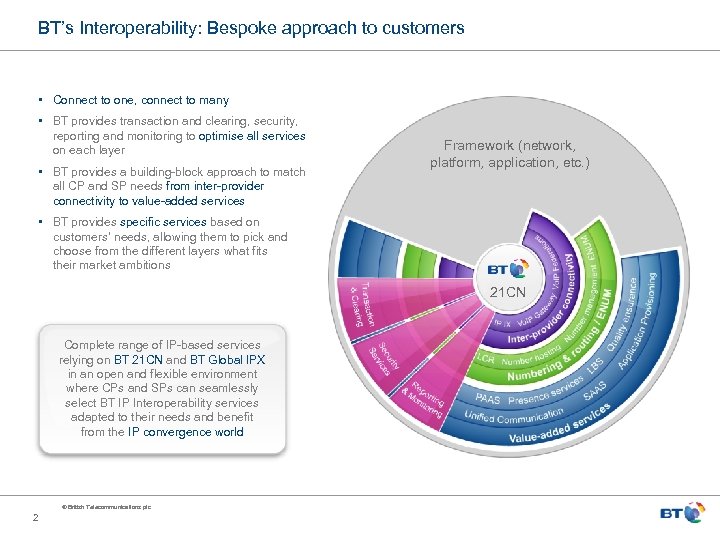
BT’s Interoperability: Bespoke approach to customers • Connect to one, connect to many • BT provides transaction and clearing, security, reporting and monitoring to optimise all services on each layer • BT provides a building-block approach to match Framework (network, platform, application, etc. ) all CP and SP needs from inter-provider connectivity to value-added services • BT provides specific services based on customers’ needs, allowing them to pick and choose from the different layers what fits their market ambitions 21 CN Complete range of IP-based services relying on BT 21 CN and BT Global IPX in an open and flexible environment where CPs and SPs can seamlessly select BT IP Interoperability services adapted to their needs and benefit from the IP convergence world © British Telecommunications plc 2
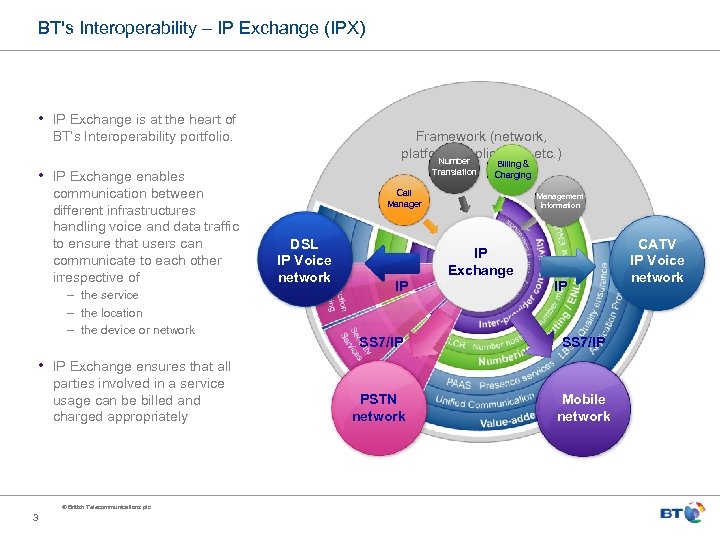
BT's Interoperability – IP Exchange (IPX) • IP Exchange is at the heart of BT‘s Interoperability portfolio. Framework (network, platform, application, etc. ) Number Translation • IP Exchange enables communication between different infrastructures handling voice and data traffic to ensure that users can communicate to each other irrespective of – the service – the location – the device or network Billing & Charging Call Manager DSL IP Voice network IP Management Information IP Exchange 21 CN IP SS 7/IP PSTN network Mobile network • IP Exchange ensures that all parties involved in a service usage can be billed and charged appropriately © British Telecommunications plc 3 CATV IP Voice network
Qo. S interconnect best without effort coming soon…?
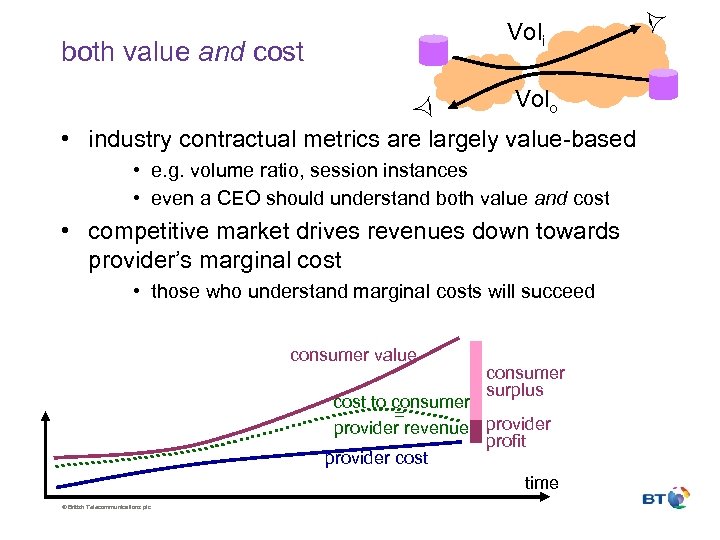
Voli both value and cost Volo • industry contractual metrics are largely value-based • e. g. volume ratio, session instances • even a CEO should understand both value and cost • competitive market drives revenues down towards provider’s marginal cost • those who understand marginal costs will succeed consumer value consumer surplus cost to consumer = provider revenue provider profit provider cost time © British Telecommunications plc
simplicity ahead! cannot be Qo. S on exit check mirrors – it was Qo. S © British Telecommunications plc
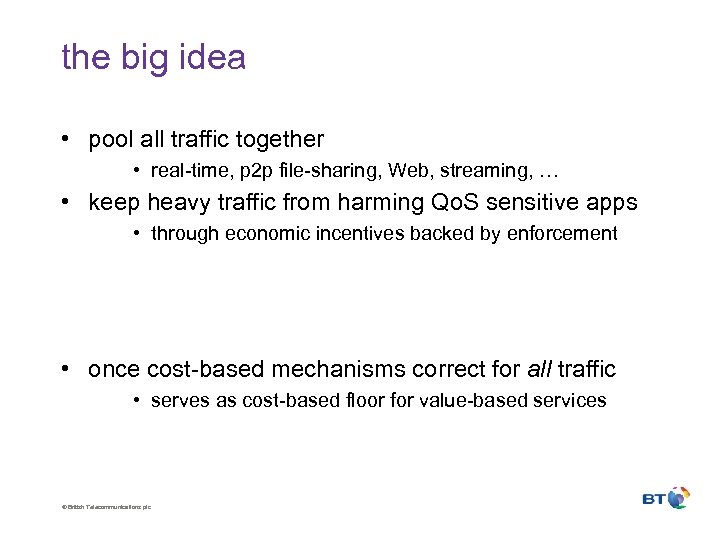
the big idea • pool all traffic together • real-time, p 2 p file-sharing, Web, streaming, … • keep heavy traffic from harming Qo. S sensitive apps • through economic incentives backed by enforcement • once cost-based mechanisms correct for all traffic • serves as cost-based floor for value-based services © British Telecommunications plc
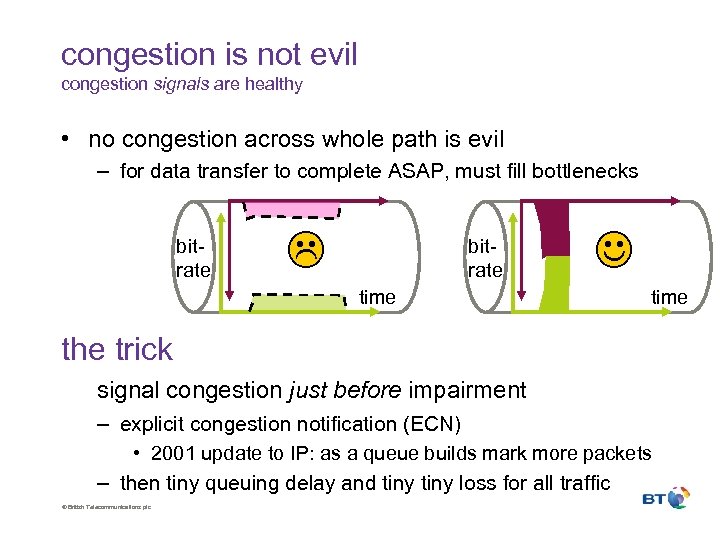
congestion is not evil congestion signals are healthy • no congestion across whole path is evil – for data transfer to complete ASAP, must fill bottlenecks bitrate time the trick signal congestion just before impairment – explicit congestion notification (ECN) • 2001 update to IP: as a queue builds mark more packets – then tiny queuing delay and tiny loss for all traffic © British Telecommunications plc
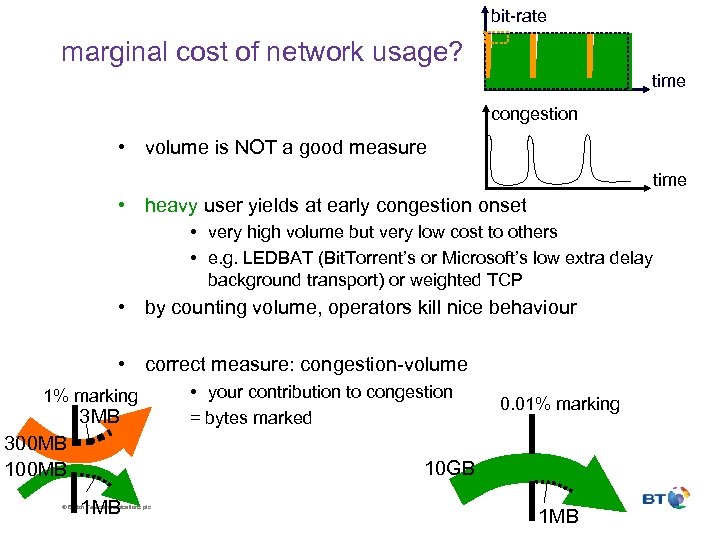
bit-rate marginal cost of network usage? time congestion • volume is NOT a good measure time • heavy user yields at early congestion onset • very high volume but very low cost to others • e. g. LEDBAT (Bit. Torrent’s or Microsoft’s low extra delay background transport) or weighted TCP • by counting volume, operators kill nice behaviour • correct measure: congestion-volume 1% marking 3 MB 300 MB 100 MB • your contribution to congestion = bytes marked 0. 01% marking 10 GB 1 MB © British Telecommunications plc 1 MB
!['Cost': Congestion-Volume: Total TCP Loss [Byte] þ congestion-volume user’s contribution to congestion : ING](https://present5.com/presentation/9f0c3d123114cb7fcb069b1316d5b18b/image-10.jpg "'Cost': Congestion-Volume: Total TCP Loss [Byte] þ congestion-volume user’s contribution to congestion : ING")
'Cost': Congestion-Volume: Total TCP Loss [Byte] þ congestion-volume user’s contribution to congestion : ING ation N AR valid data W s le uire samp q Re ore m ith w % 00 1 ý volume Initial results measured on Naples Uni net Each point is a user correlation coefficient: 0. 43 © British Telecommunications plc Volume: Total TCP Traffic Volume [Byte]
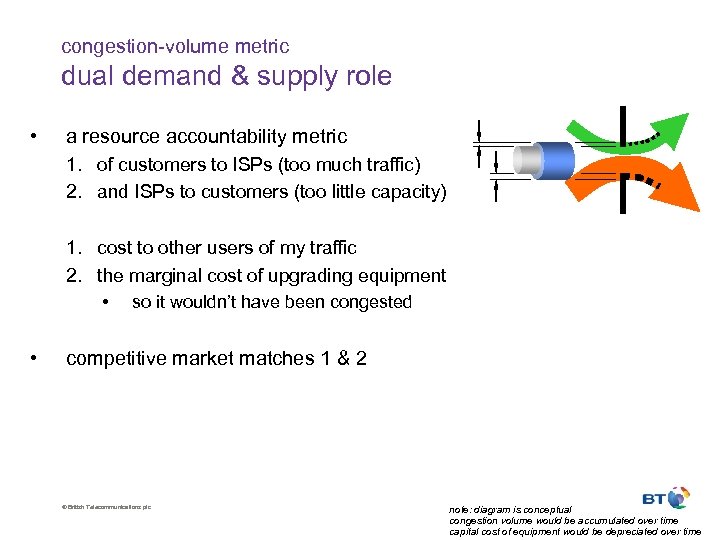
congestion-volume metric dual demand & supply role • a resource accountability metric 1. of customers to ISPs (too much traffic) 2. and ISPs to customers (too little capacity) 1. cost to other users of my traffic 2. the marginal cost of upgrading equipment • • so it wouldn’t have been congested competitive market matches 1 & 2 © British Telecommunications plc note: diagram is conceptual congestion volume would be accumulated over time capital cost of equipment would be depreciated over time
congestion exposure • by Internet design, endpoints detect & handle congestion • v hard for networks to see losses (the marginal cost) • explicit congestion notification (ECN) not enough • visible, but too late – as packets leave the network • proposed IETF working group: “congestion exposure” • re-ECN: sender marks IP headers to expose congestion • to measure traffic cost as easily as we measure volume • just count volume of marked packets in aggregate • >40 significant offers of help just in last fortnight • Microsoft, Nokia, Cisco, Huawei, Alcatel-Lucent, NEC, Ericsson, NSN, Sandvine, Comcast, DT, Verizon, … © British Telecommunications plc
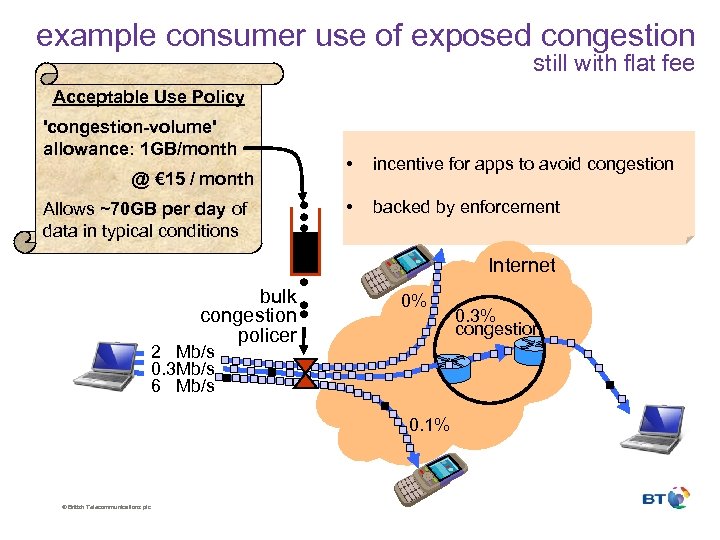
example consumer use of exposed congestion still with flat fee Acceptable Use Policy 'congestion-volume' allowance: 1 GB/month @ € 15 / month Allows ~70 GB per day of data in typical conditions • incentive for apps to avoid congestion • backed by enforcement Internet bulk congestion policer 0% 2 Mb/s 0. 3 Mb/s 6 Mb/s 0. 1% © British Telecommunications plc 0. 3% congestion
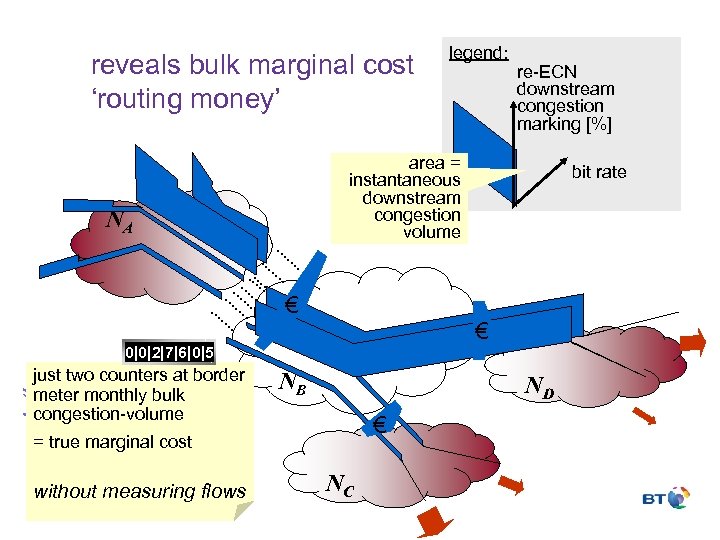
reveals bulk marginal cost ‘routing money’ € solution NB ND € = true marginal cost © British Telecommunications plc bit rate € 0|0|2|7|6|0|5 without measuring flows re-ECN downstream congestion marking [%] area = instantaneous downstream congestion volume NA just two counters at border meter monthly bulk congestion-volume legend: NC
I’m a conservative, get me out of here! • if we don’t listen to the economics, we’re all dead • shift from value-based to cost-based is unstoppable – competition • bit transport needs to be viable on its own (another talk) • as cost pressures grow • existing capacity sharing methods feed an arms race – TCP doesn’t share capacity fairly by any means • recent unanimous consensus in IETF Transport Area – ISPs have quietly been fighting TCP with piecemeal tools • WFQ, volume capping, deep packet inspection • with congestion in IP header, wouldn’t need to look deeper © British Telecommunications plc
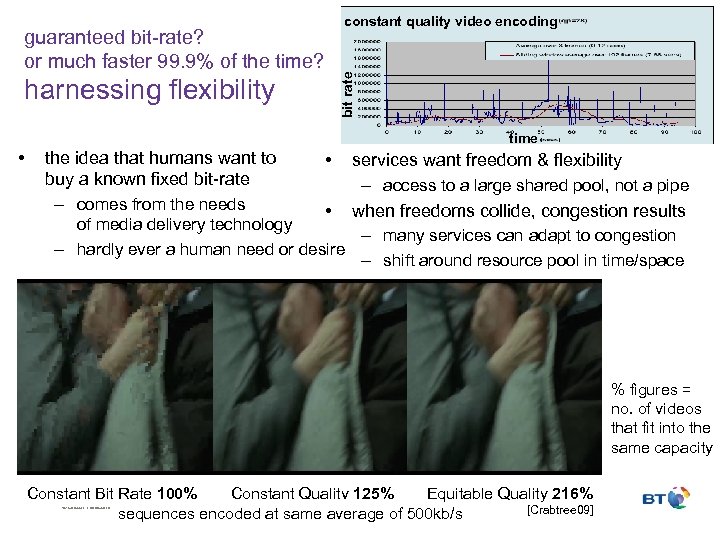
constant quality video encoding bit rate guaranteed bit-rate? or much faster 99. 9% of the time? harnessing flexibility time • the idea that humans want to buy a known fixed bit-rate – comes from the needs • services want freedom & flexibility – access to a large shared pool, not a pipe • when freedoms collide, congestion results of media delivery technology – many services can adapt to congestion – hardly ever a human need or desire – shift around resource pool in time/space % figures = no. of videos that fit into the same capacity Equitable Quality 216% Constant Bit Rate 100% Constant Quality 125% [Crabtree 09] sequences encoded at same average of 500 kb/s © British Telecommunications plc
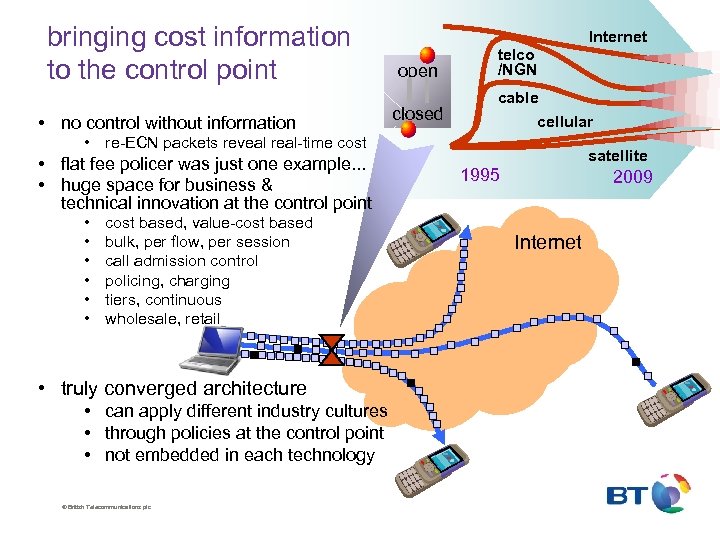
bringing cost information to the control point • no control without information open closed telco /NGN cable cellular • re-ECN packets reveal real-time cost • flat fee policer was just one example. . . • huge space for business & technical innovation at the control point • • • cost based, value-cost based bulk, per flow, per session call admission control policing, charging tiers, continuous wholesale, retail • truly converged architecture • can apply different industry cultures • through policies at the control point • not embedded in each technology © British Telecommunications plc Internet satellite 1995 2009 Internet
best without effort • did you notice the interconnected Qo. S mechanism? – endpoints ensure tiny queuing delay & loss for all traffic – if your app wants more bit-rate, it just goes faster – visible in bulk metric at every border (for SLAs, AUPs) • simple – and all the right support for operations • the invisible hand of the market – favours ISPs that get their customers to manage their traffic in everyone else‘s best interests • incentives to cooperate across Internet value chain – content industry, CDNs, app & OS authors, network wholesalers & retailers, Internet companies, end-customers, business, residential © British Telecommunications plc
more info. . . • BT IP Exchange • jens. specht@bt. com • White paper – the whole story in 7 pp • • Inevitability of policing • • Bob Briscoe and Steve Rudkin "Commercial Models for IP Quality of Service Interconnect" BT Technology Journal 23 (2) pp. 171 --195 (April, 2005) Re-architecting the Internet: • • Bob Briscoe et al, "Problem Statement: Transport Protocols Don't Have To Do Fairness", IETF Internet Draft (Jul 2008) Understanding why Qo. S interconnect is better understood as a congestion issue • • Kenjiro Cho et al, "The Impact and Implications of the Growth in Residential User-to-User Traffic", In Proc ACM SIGCOMM (Oct ’ 06) How wrong Internet capacity sharing is and why it's causing an arms race • • The Broadband Incentives Problem, Broadband Working Group, MIT, BT, Cisco, Comcast, Deutsche Telekom / T-Mobile, France Telecom, Intel, Motorola, Nokia, Nortel (May ’ 05 & follow-up Jul ’ 06) <cfp. mit. edu> Stats on p 2 p usage across 7 Japanese ISPs with high FTTH penetration • • Internet: Fairer is Faster, Bob Briscoe (BT), BT White Paper TR-CXR 9 -2009 -001 (May 2009) - an abridged version of this article appeared in IEEE Spectrum, Dec 2008 The Trilogy project Congestion Exposure (re-ECN) at the IETF <trac. tools. ietf. org/area/tsv/trac/wiki/re-ECN> © British Telecommunications plc
Qo. S interconnection best without effort Q&A. . .
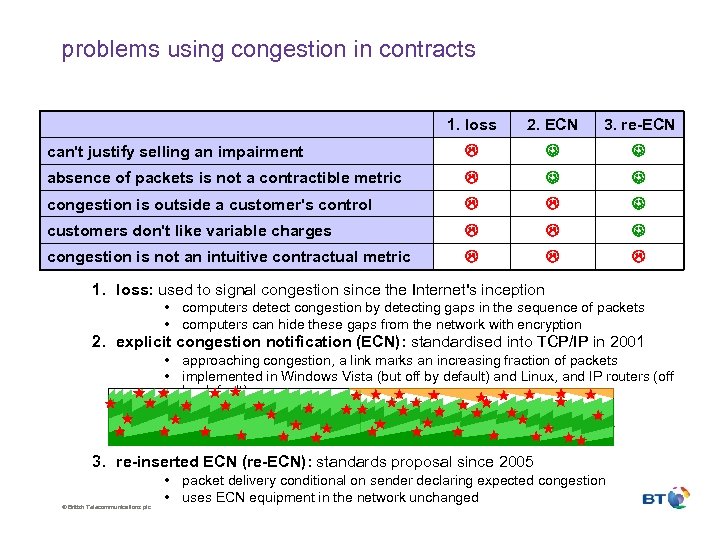
problems using congestion in contracts 1. loss 2. ECN 3. re-ECN can't justify selling an impairment absence of packets is not a contractible metric congestion is outside a customer's control customers don't like variable charges congestion is not an intuitive contractual metric 1. loss: used to signal congestion since the Internet's inception • computers detect congestion by detecting gaps in the sequence of packets • computers can hide these gaps from the network with encryption 2. explicit congestion notification (ECN): standardised into TCP/IP in 2001 • approaching congestion, a link marks an increasing fraction of packets • implemented in Windows Vista (but off by default) and Linux, and IP routers (off by default) 3. re-inserted ECN (re-ECN): standards proposal since 2005 © British Telecommunications plc • packet delivery conditional on sender declaring expected congestion • uses ECN equipment in the network unchanged
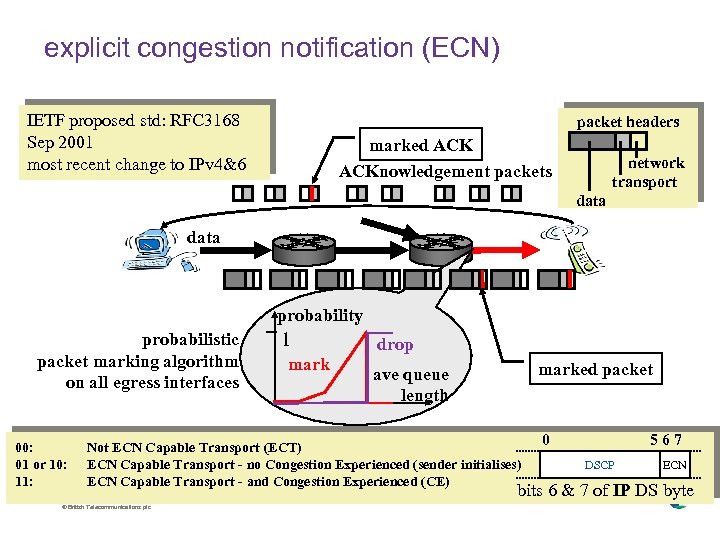
explicit congestion notification (ECN) IETF proposed std: RFC 3168 Sep 2001 most recent change to IPv 4&6 packet headers marked ACKnowledgement packets network transport data probability probabilistic packet marking algorithm on all egress interfaces 00: 01 or 10: 11: 1 mark drop marked packet ave queue length Not ECN Capable Transport (ECT) ECN Capable Transport - no Congestion Experienced (sender initialises) ECN Capable Transport - and Congestion Experienced (CE) © British Telecommunications plc 0 567 DSCP ECN bits 6 & 7 of IP DS byte
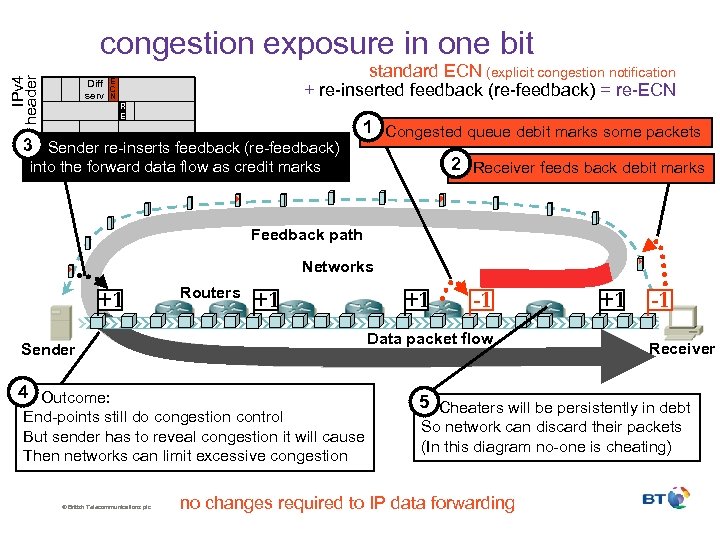
IPv 4 header congestion exposure in one bit Diff serv standard ECN (explicit congestion notification + re-inserted feedback (re-feedback) = re-ECN E C N R E 33. Sender re-inserts feedback (re-feedback) 1 Congested queue debit marks some packets 1. 2 Receiver feeds back debit marks 2. into the forward data flow as credit marks Feedback path Networks +1 Routers +1 -1 Data packet flow Sender 4 Outcome: 4. End-points still do congestion control But sender has to reveal congestion it will cause Then networks can limit excessive congestion © British Telecommunications plc +1 +1 -1 Receiver 5 Cheaters will be persistently in debt 5. So network can discard their packets (In this diagram no-one is cheating) no changes required to IP data forwarding
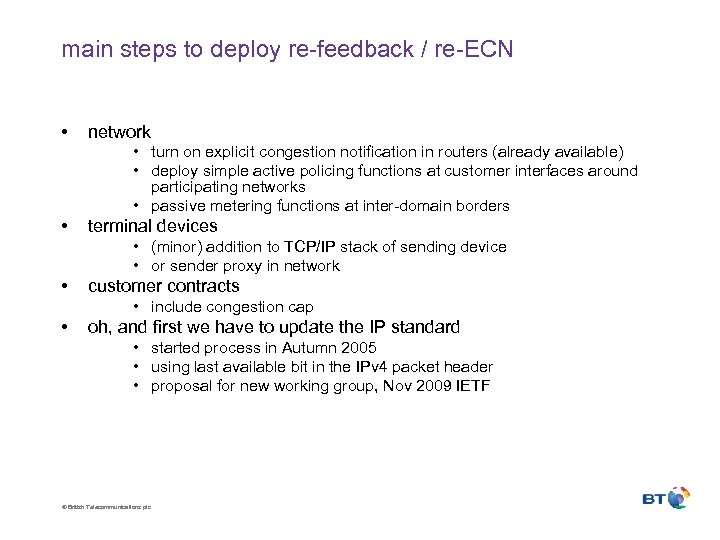
main steps to deploy re-feedback / re-ECN • network • turn on explicit congestion notification in routers (already available) • deploy simple active policing functions at customer interfaces around participating networks • passive metering functions at inter-domain borders • terminal devices • (minor) addition to TCP/IP stack of sending device • or sender proxy in network • customer contracts • include congestion cap • oh, and first we have to update the IP standard • started process in Autumn 2005 • using last available bit in the IPv 4 packet header • proposal for new working group, Nov 2009 IETF © British Telecommunications plc
Скачать презентацию Qo S interconnect best without effort Bob Briscoe
9f0c3d123114cb7fcb069b1316d5b18b.ppt