


 Скачать презентацию QNET A tool for querying protein interaction networks
23feda82e503c4ee0378e3e9b4e9e321.ppt
- Количество слайдов: 40
 QNET: A tool for querying protein interaction networks Banu Dost+, Tomer Shlomi*, Nitin Gupta+, Eytan Ruppin*, Vineet Bafna+, Roded Sharan* +University of California, San Diego *Tel Aviv University, Israel contact: bdost@cs. ucsd. edu
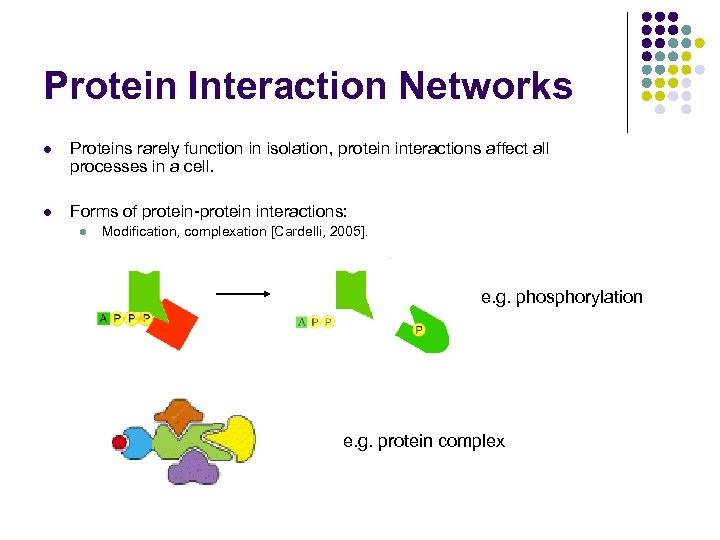 Protein Interaction Networks l Proteins rarely function in isolation, protein interactions affect all processes in a cell. l Forms of protein-protein interactions: l Modification, complexation [Cardelli, 2005]. e. g. phosphorylation e. g. protein complex
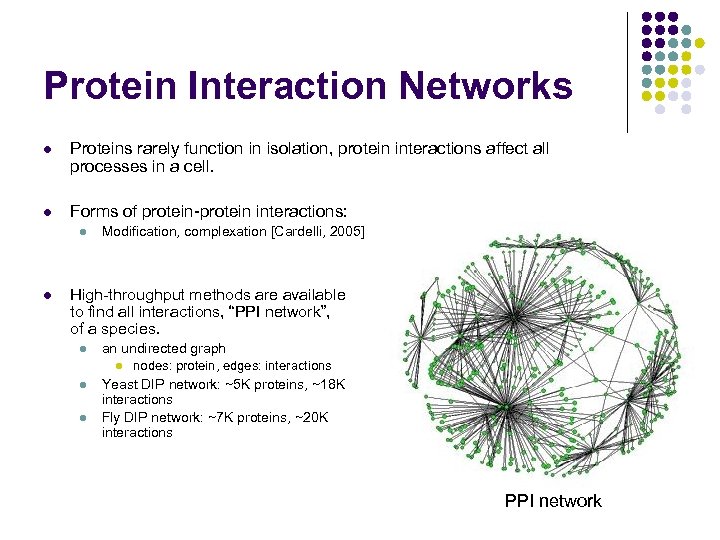 Protein Interaction Networks l Proteins rarely function in isolation, protein interactions affect all processes in a cell. l Forms of protein-protein interactions: l l Modification, complexation [Cardelli, 2005] High-throughput methods are available to find all interactions, “PPI network”, of a species. l an undirected graph l l l nodes: protein, edges: interactions Yeast DIP network: ~5 K proteins, ~18 K interactions Fly DIP network: ~7 K proteins, ~20 K interactions PPI network
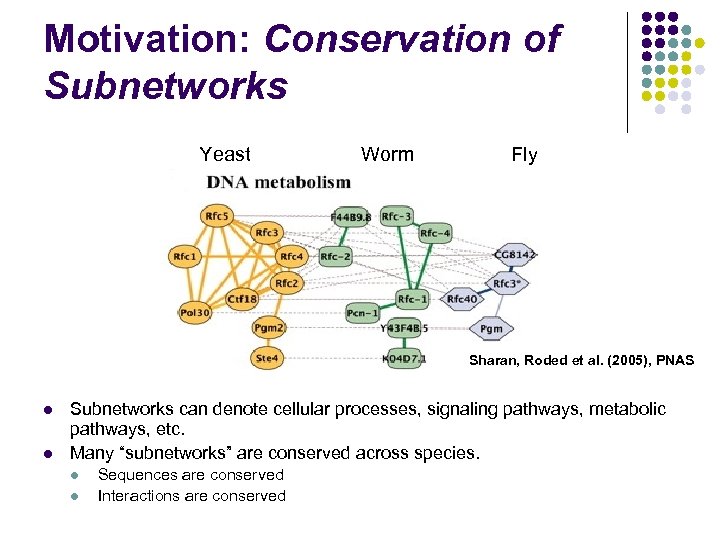 Motivation: Conservation of Subnetworks Yeast Worm Fly Sharan, Roded et al. (2005), PNAS l l Subnetworks can denote cellular processes, signaling pathways, metabolic pathways, etc. Many “subnetworks” are conserved across species. l l Sequences are conserved Interactions are conserved
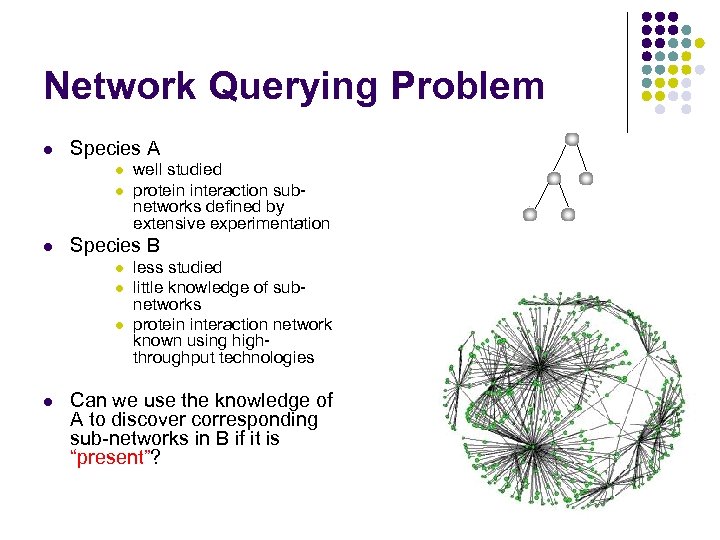 Network Querying Problem l Species A l l l Species B l l well studied protein interaction subnetworks defined by extensive experimentation less studied little knowledge of subnetworks protein interaction network known using highthroughput technologies Can we use the knowledge of A to discover corresponding sub-networks in B if it is “present”?
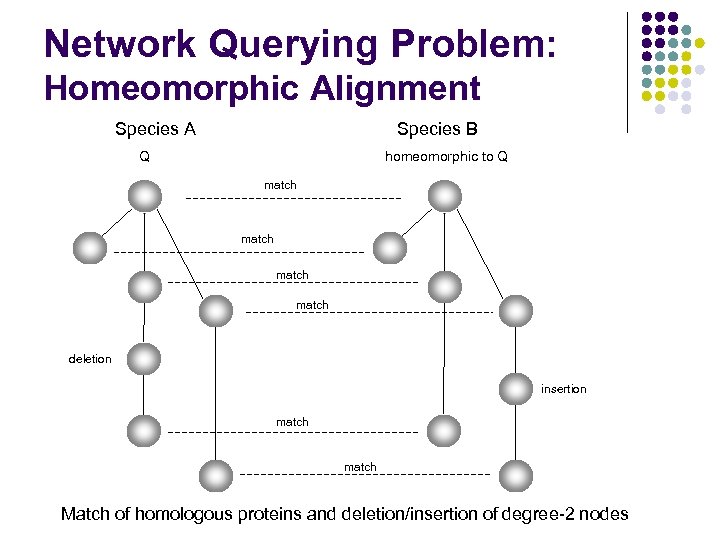 Network Querying Problem: Homeomorphic Alignment Species A Species B Q homeomorphic to Q match deletion insertion match Match of homologous proteins and deletion/insertion of degree-2 nodes
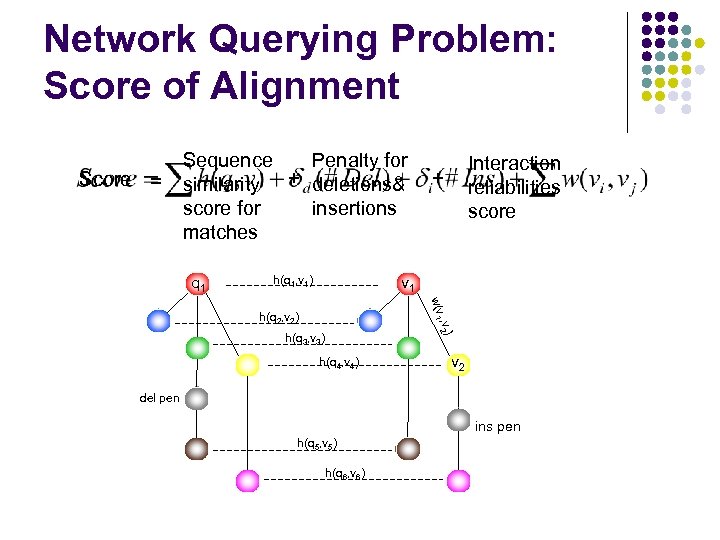 Network Querying Problem: Score of Alignment Score = Sequence Penalty for similarity + deletions& score for insertions matches q 1 h(q 1, v 1) Interaction reliabilities score + v 1 , w(v 1 v 2) h(q 2, v 2) h(q 3, v 3) h(q 4, v 4) v 2 del pen ins pen h(q 5, v 5) h(q 6, v 6)
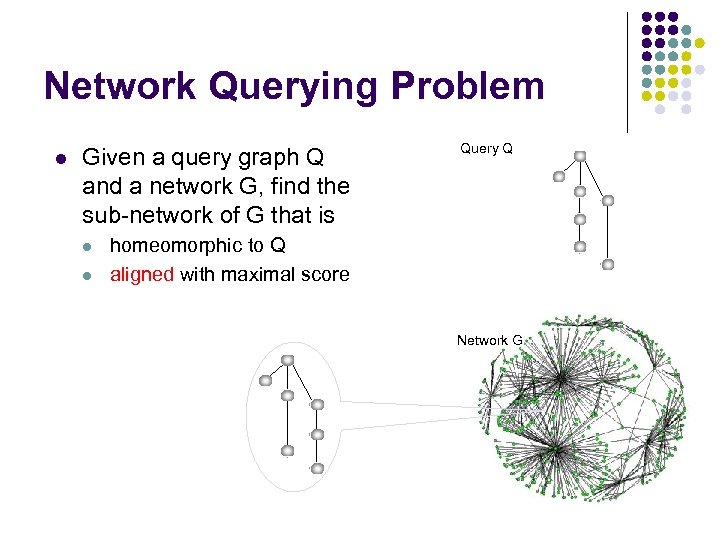 Network Querying Problem l Given a query graph Q and a network G, find the sub-network of G that is l l Query Q homeomorphic to Q aligned with maximal score Network G
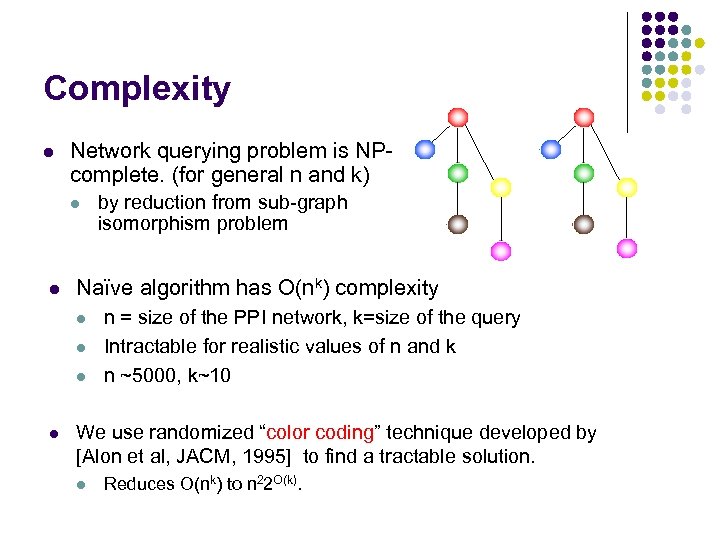 Complexity l Network querying problem is NPcomplete. (for general n and k) l l Naïve algorithm has O(nk) complexity l l by reduction from sub-graph isomorphism problem n = size of the PPI network, k=size of the query Intractable for realistic values of n and k n ~5000, k~10 We use randomized “color coding” technique developed by [Alon et al, JACM, 1995] to find a tractable solution. l Reduces O(nk) to n 22 O(k).
 Previous Work l Current Tools: l l l Path. Blast [Kelley et al. , 2003] Ma. Wish [Koyuturk et al. , 2006] Graemlin [Flannick et al. , 2006] Different alignment interpretation Some heuristics to search for the optimal solution
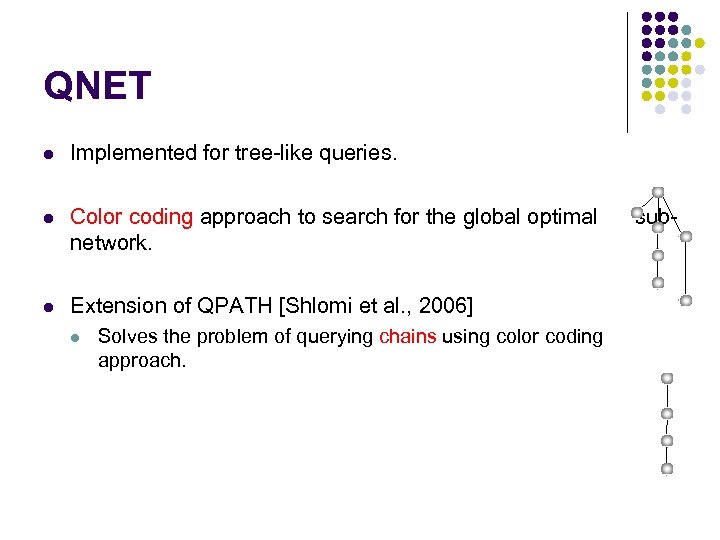 QNET l Implemented for tree-like queries. l Color coding approach to search for the global optimal network. l Extension of QPATH [Shlomi et al. , 2006] l Solves the problem of querying chains using color coding approach. sub-
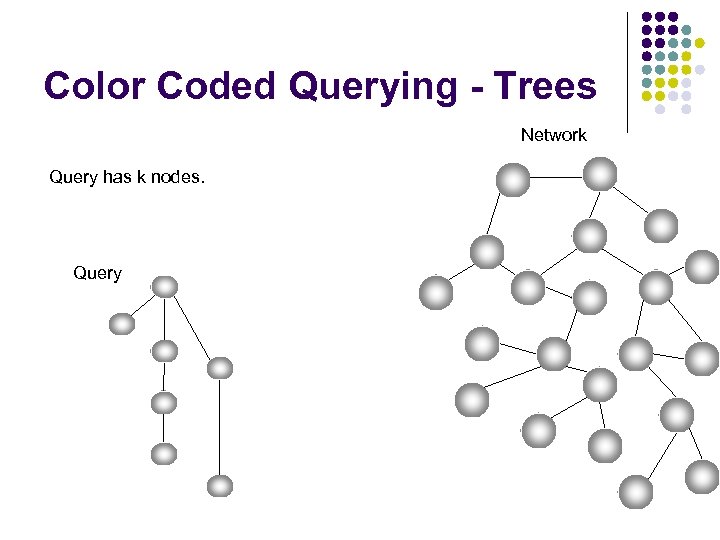 Color Coded Querying - Trees Network Query has k nodes. Query
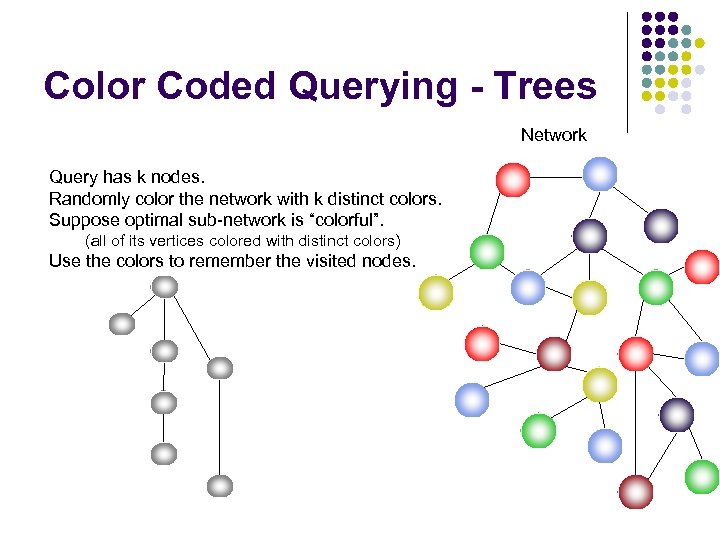 Color Coded Querying - Trees Network Query has k nodes. Randomly color the network with k distinct colors. Suppose optimal sub-network is “colorful”. (all of its vertices colored with distinct colors) Use the colors to remember the visited nodes.
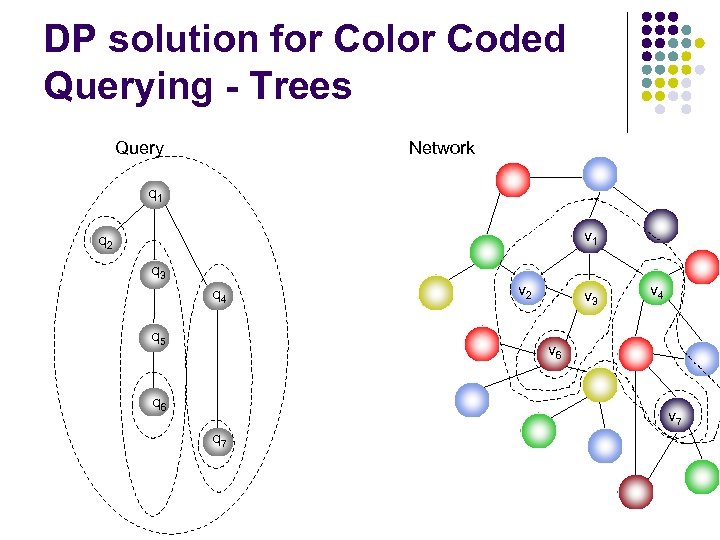 DP solution for Color Coded Querying - Trees Query Network q 1 v 1 q 2 q 3 q 4 q 5 v 2 v 3 v 4 v 6 q 6 v 7 q 7
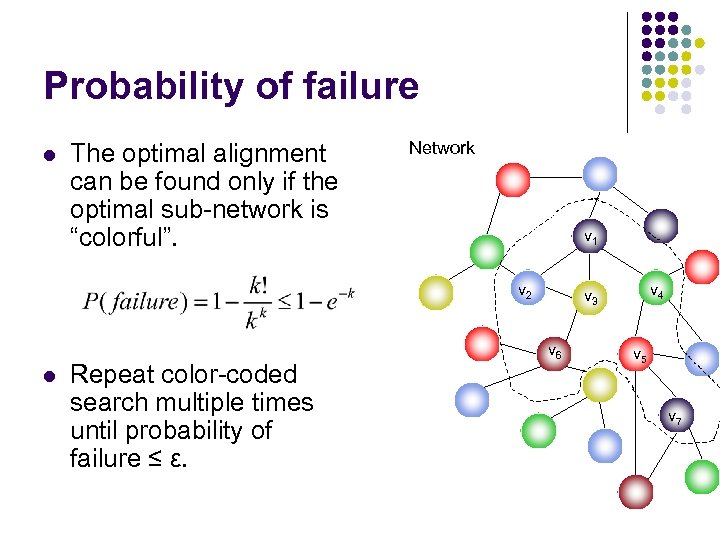 Probability of failure l The optimal alignment can be found only if the optimal sub-network is “colorful”. Network v 1 v 2 l Repeat color-coded search multiple times until probability of failure ≤ ε. v 4 v 3 v 6 v 5 v 7
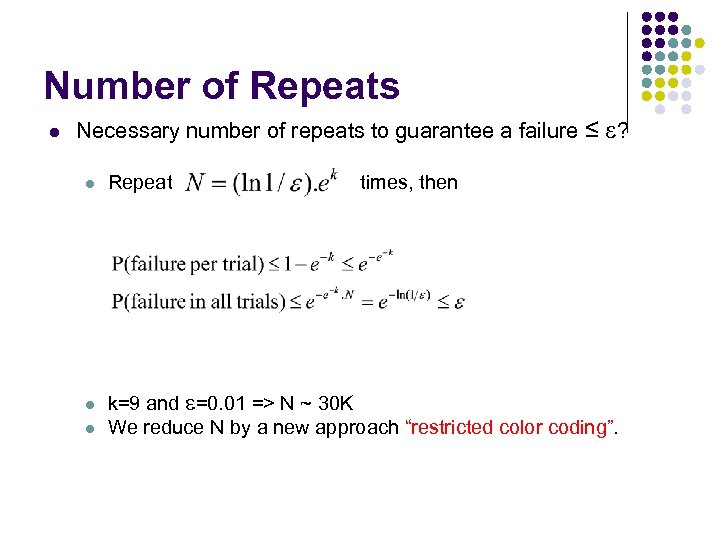 Number of Repeats l Necessary number of repeats to guarantee a failure ≤ ? l l l Repeat times, then k=9 and =0. 01 => N ~ 30 K We reduce N by a new approach “restricted color coding”.
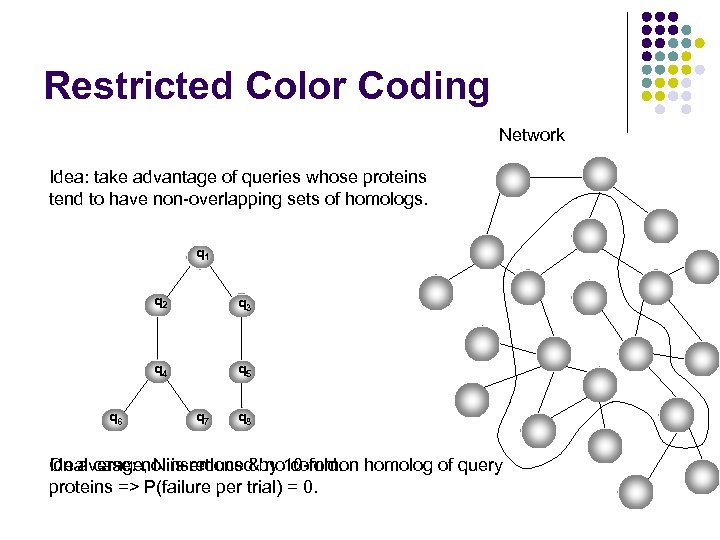 Restricted Color Coding Network Idea: take advantage of queries whose proteins tend to have non-overlapping sets of homologs. q 1 q 2 q 4 q 6 q 3 q 5 q 7 q 8 On average, N is reduced no common Ideal case: no insertions &by 10 -fold. homolog of query proteins => P(failure per trial) = 0.
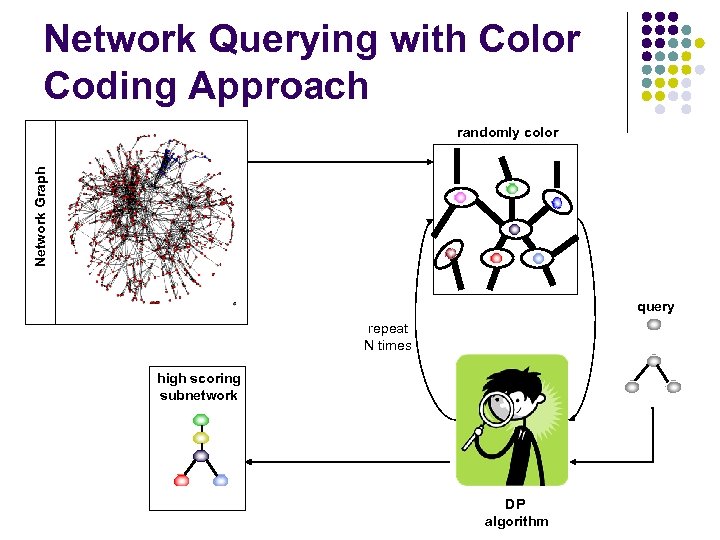 Network Querying with Color Coding Approach Network Graph randomly color query repeat N times high scoring subnetwork DP algorithm
 Querying General Graphs l We have extended the algorithm for also general graphs. l Idea: l l Map the original graph into a tree, i. e. tree decomposition. (Polynomial time for bounded-tree -width graphs) Solve the querying problem on this tree using DP.
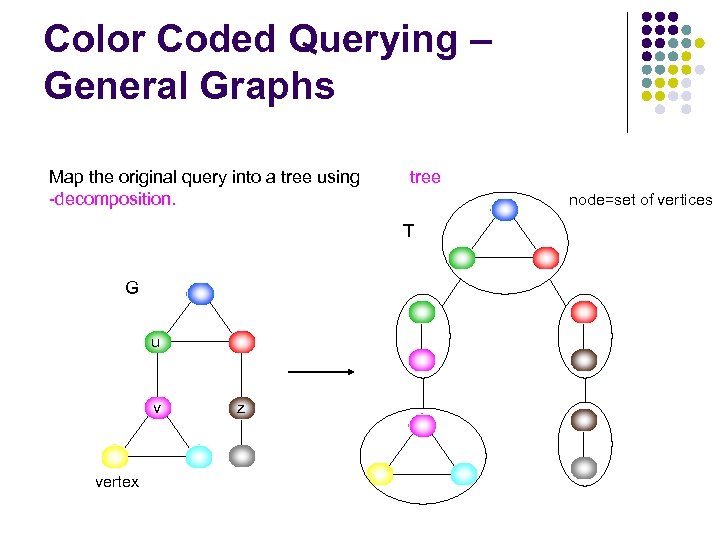 Color Coded Querying – General Graphs Map the original query into a tree using -decomposition. tree node=set of vertices T G u v vertex z
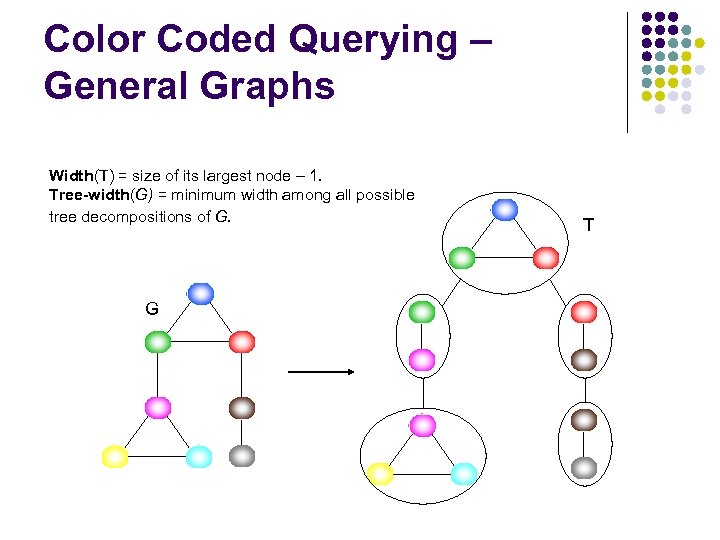 Color Coded Querying – General Graphs Width(T) = size of its largest node – 1. Tree-width(G) = minimum width among all possible tree decompositions of G. G T
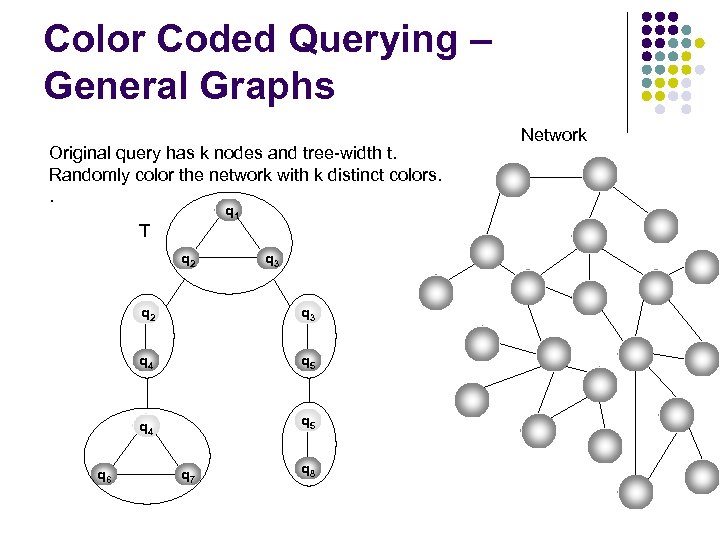 Color Coded Querying – General Graphs Original query has k nodes and tree-width t. Randomly color the network with k distinct colors. . q 1 T q 2 q 3 q 2 q 4 q 5 q 4 q 6 q 3 q 5 q 7 q 8 Network
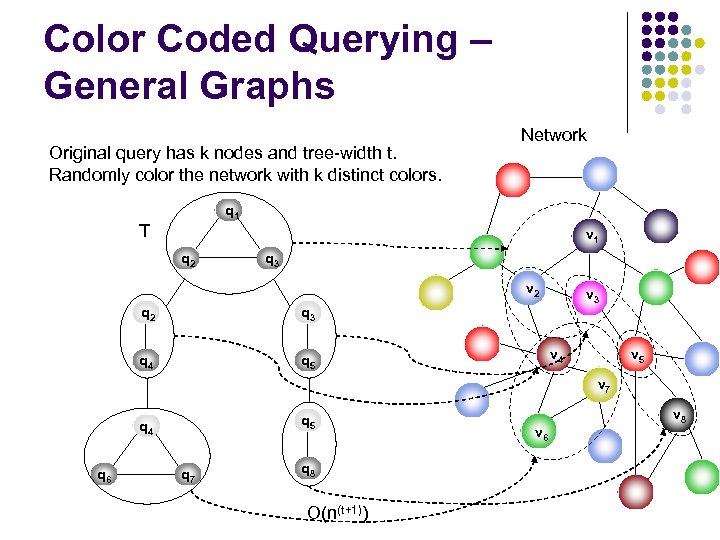 Color Coded Querying – General Graphs Original query has k nodes and tree-width t. Randomly color the network with k distinct colors. Network q 1 T v 1 q 2 q 3 v 2 q 3 q 4 q 5 v 3 v 4 v 5 v 7 q 5 q 4 q 6 q 7 q 8 O(n(t+1)) v 6 v 8
 Running time l n=size of network, k=size of query. l Tree queries: l l Reduces O(nk) to n 22 O(k). l Tractable for realistic values of n and k. l n ~5000, k~10 Bounded-tree-width graphs: l t : tree-width l n(t+1)2 O(k)
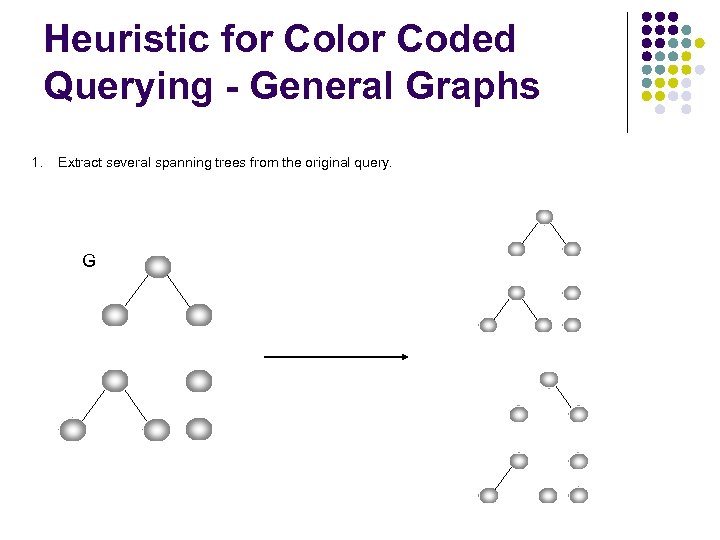 Heuristic for Color Coded Querying - General Graphs 1. Extract several spanning trees from the original query. G
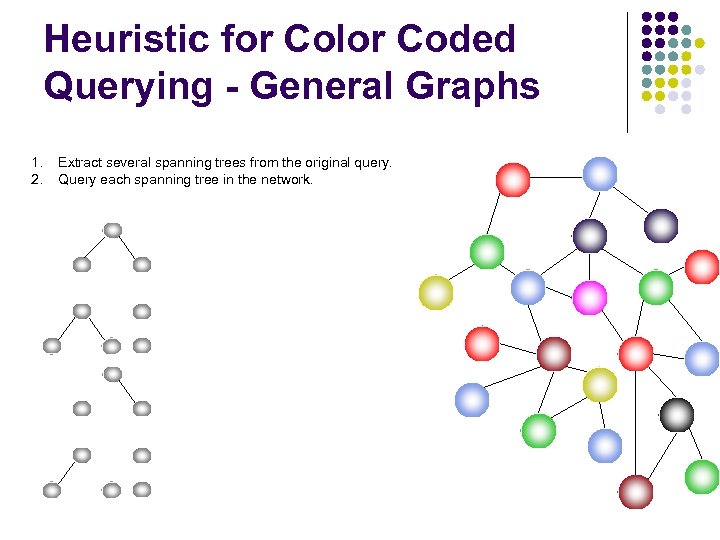 Heuristic for Color Coded Querying - General Graphs 1. 2. Extract several spanning trees from the original query. Query each spanning tree in the network.
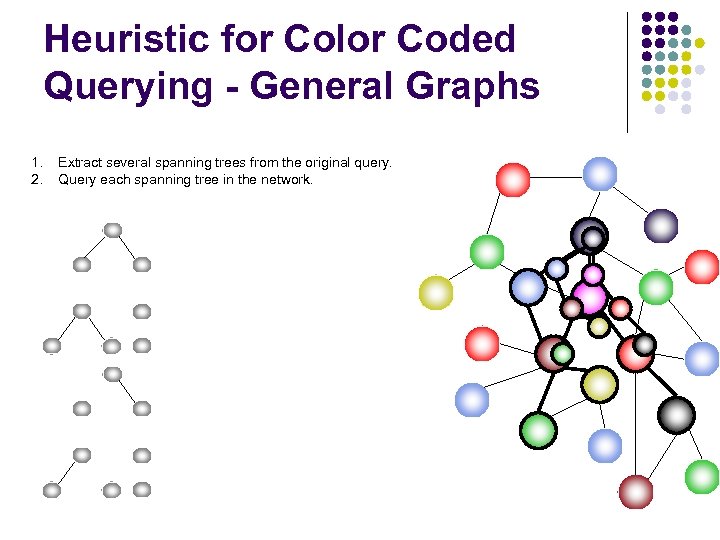 Heuristic for Color Coded Querying - General Graphs 1. 2. Extract several spanning trees from the original query. Query each spanning tree in the network.
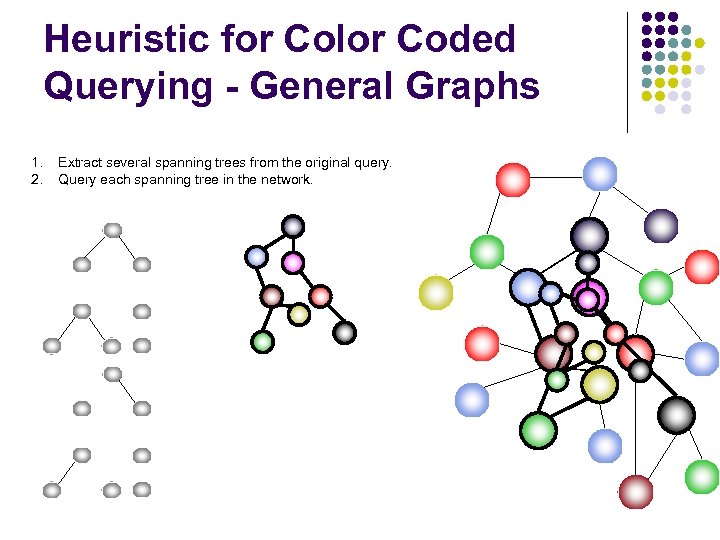 Heuristic for Color Coded Querying - General Graphs 1. 2. Extract several spanning trees from the original query. Query each spanning tree in the network.
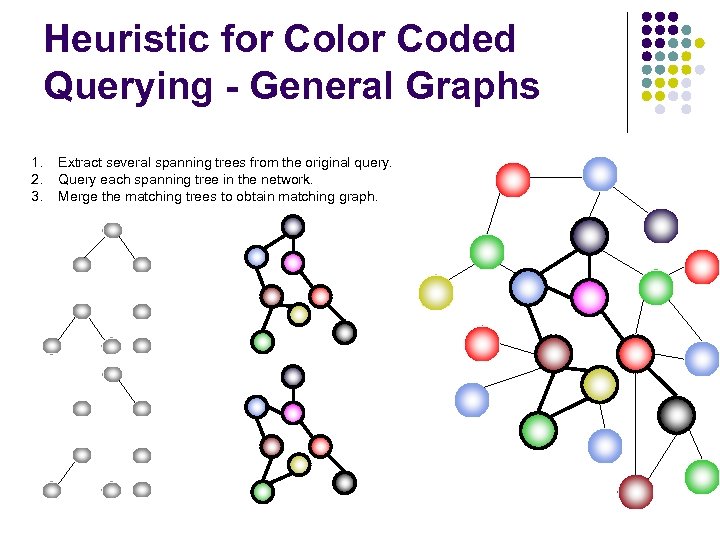 Heuristic for Color Coded Querying - General Graphs 1. 2. 3. Extract several spanning trees from the original query. Query each spanning tree in the network. Merge the matching trees to obtain matching graph.
 Testing l Time l Quality of solutions
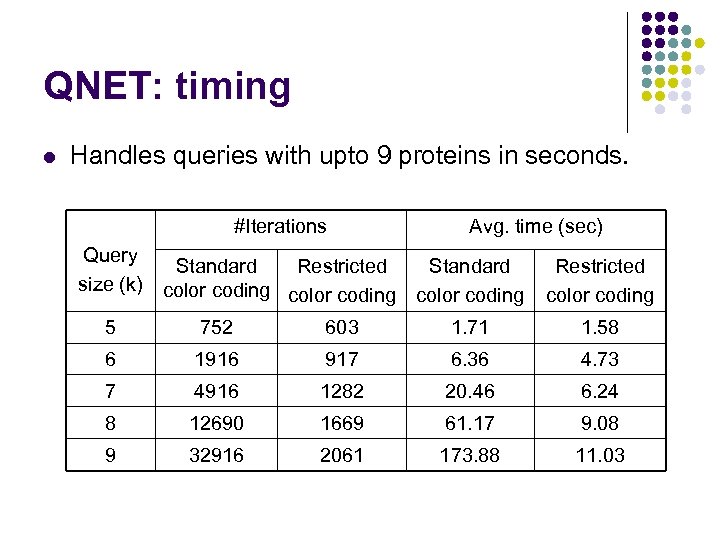 QNET: timing l Handles queries with upto 9 proteins in seconds. #Iterations Query Standard Restricted size (k) color coding Avg. time (sec) Standard color coding Restricted color coding 5 752 603 1. 71 1. 58 6 1916 917 6. 36 4. 73 7 4916 1282 20. 46 6. 24 8 12690 1669 61. 17 9. 08 9 32916 2061 173. 88 11. 03
 Test 1: Importance of Topology l Motivation: Is sequence similarity enough to find corresponding sub-network? l Queries: l l l Network: l l l Random tree queries from yeast DIP network [Salwinski, 2004] Topology perturbed (≤ 2 ins-dels). Yeast PPI Protein sequences mutated (50 -70 percent) How distant is the result from the original extracted tree?
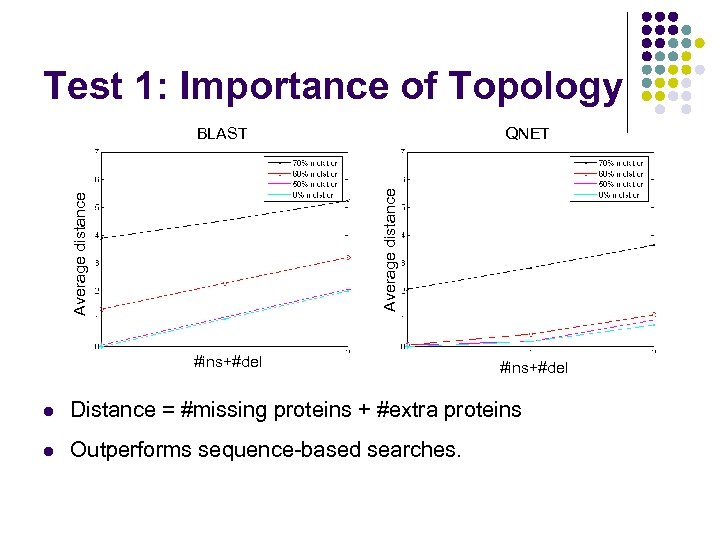 Test 1: Importance of Topology QNET Average distance BLAST #ins+#del l Distance = #missing proteins + #extra proteins l Outperforms sequence-based searches.
 Test 2: Cross-species comparison of MAPK pathways l Motivation: finding conserved pathways. l Query: human MAPK pathway involved in cell proliferation and differentiation. Network: fly PPI network l l ~7 K proteins ~20 K interactions Match: a known fly MAPK pathway involved in dorsal pattern formation. Query from human Match in fly
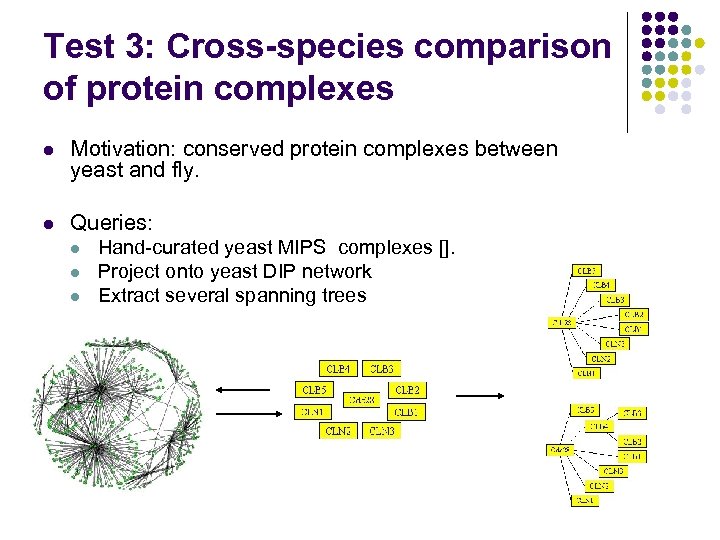 Test 3: Cross-species comparison of protein complexes l Motivation: conserved protein complexes between yeast and fly. l Queries: l l l Hand-curated yeast MIPS complexes []. Project onto yeast DIP network Extract several spanning trees
 Test 3: Cross-species comparison of protein complexes l Motivation: conserved protein complexes between yeast and fly. l Queries: l l Network: l l Hand-curated yeast MIPS complexes []. Project onto yeast DIP network Extract several spanning trees Fly DIP network Match l Consensus matching graph for each query complex.
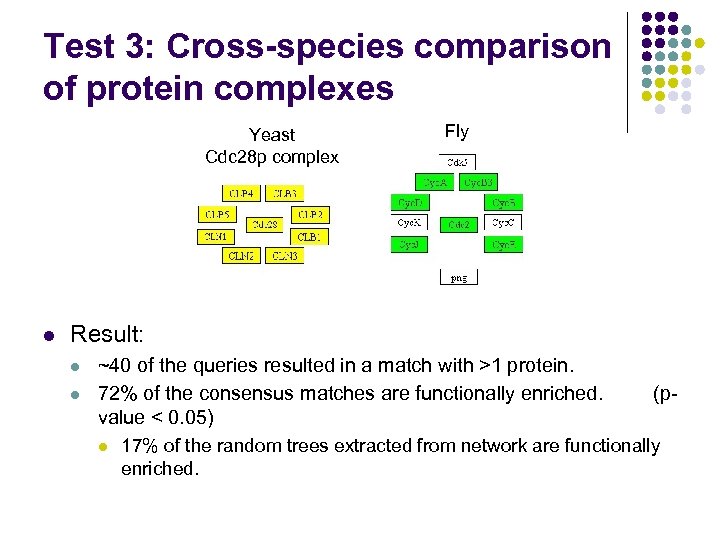 Test 3: Cross-species comparison of protein complexes Yeast Cdc 28 p complex l Fly Result: l l ~40 of the queries resulted in a match with >1 protein. 72% of the consensus matches are functionally enriched. value < 0. 05) l (p- 17% of the random trees extracted from network are functionally enriched.
 Summary l QNET: a tool for querying protein interaction networks l l Tree-like queries Randomized algorithm and heuristic proposed for querying general graphs.
 Future Work l Development of appropriate score functions to better identify conserved pathways. l Extending QNET for queries with more general structure. l bounded-tree-width graphs.
 Thank you l l University of California, San Diego bdost@cs. ucsd. edu