


 Скачать презентацию QI Culture and QI Planning May 8 th
7d359daeb5a7ee9ebf3281f11fd5247a.ppt
- Количество слайдов: 51
 QI Culture and QI Planning May 8 th, 1: 15 -3: 00 pm Erin Barkema, MPH Jack Moran, Ph. D
 Building A Quality Culture • It takes more than a clever catch phrase – – “Quality Is Job 1” “Everything We Do Is Quality” “Everything can be improved” “When you're out of quality, you're out of business” (C) Wallace Consulting, LLC
 What Is A Culture? • The sum of attitudes, customs, and beliefs that distinguishes one group of people from another • Culture is transmitted, through language, material objects, ritual, institutions, and art, from one generation to the next (C) Wallace Consulting, LLC
 Culture • Difficult to define and very elusive but you know that culture exists within your team or your organization • It’s that ethereal something that hangs in the air and influences how work gets done • It determines the overall mood of the workplace (C) Wallace Consulting, LLC
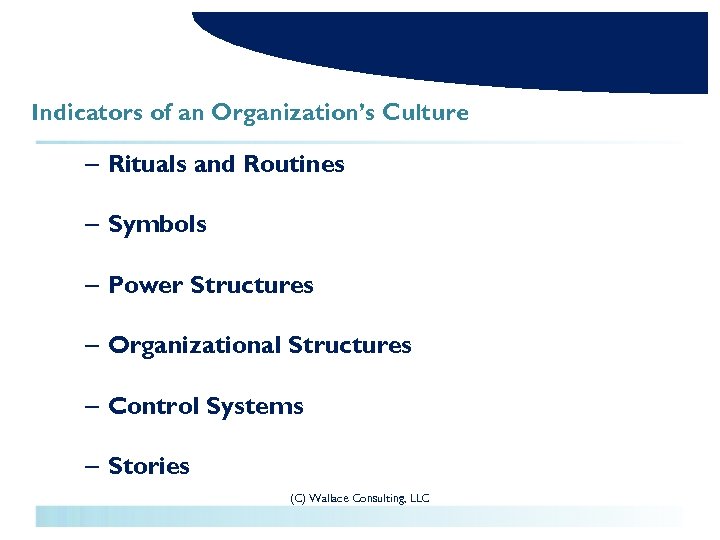 Indicators of an Organization’s Culture – Rituals and Routines – Symbols – Power Structures – Organizational Structures – Control Systems – Stories (C) Wallace Consulting, LLC
 Describe Your Culture of QI Today In Terms of Your Favorite TV Show (C) Wallace Consulting, LLC
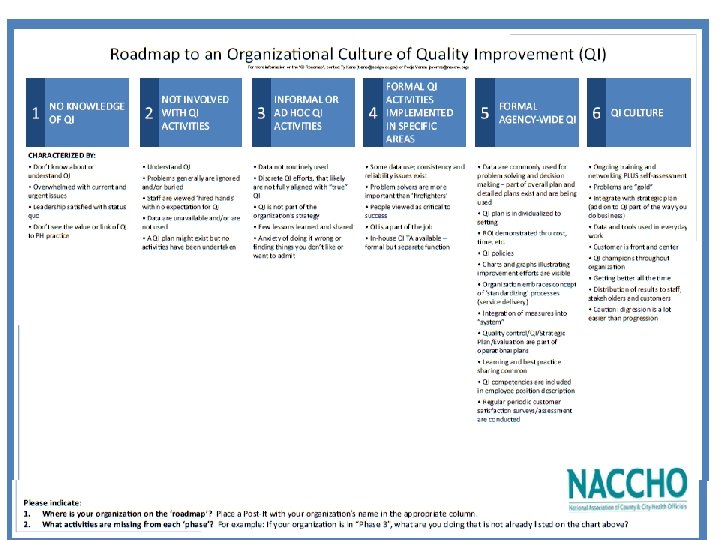
 Where are you?
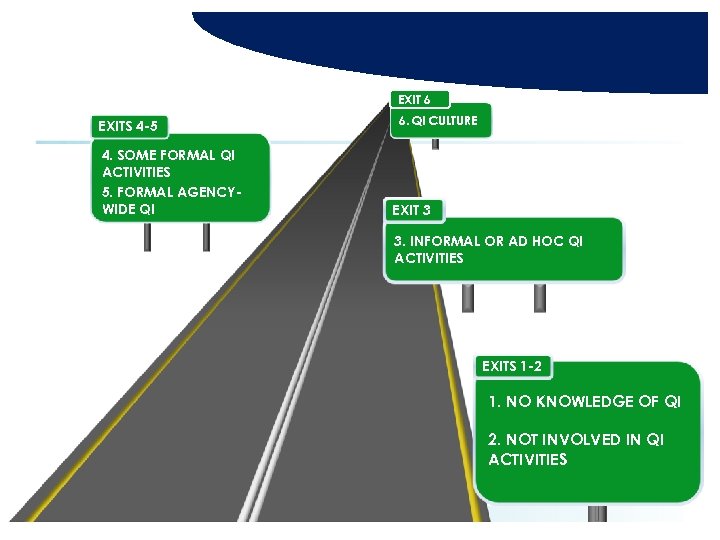 EXIT 6 EXITS 4 -5 4. SOME FORMAL QI ACTIVITIES 5. FORMAL AGENCYWIDE QI 6. QI CULTURE EXIT 3 3. INFORMAL OR AD HOC QI ACTIVITIES EXITS 1 -2 1. NO KNOWLEDGE OF QI 2. NOT INVOLVED IN QI ACTIVITIES
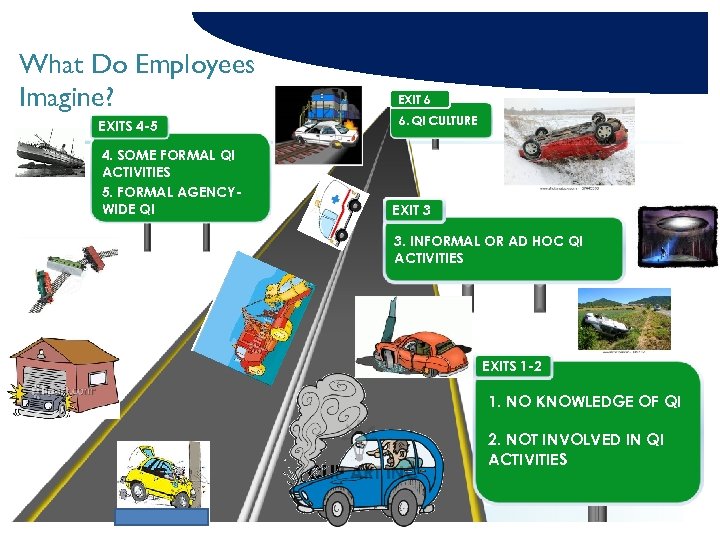 What Do Employees Imagine? EXITS 4 -5 4. SOME FORMAL QI ACTIVITIES 5. FORMAL AGENCYWIDE QI EXIT 6 6. QI CULTURE EXIT 3 3. INFORMAL OR AD HOC QI ACTIVITIES EXITS 1 -2 1. NO KNOWLEDGE OF QI 2. NOT INVOLVED IN QI ACTIVITIES
 How Do We Get To The Next Exit?
 How do you change an existing culture to one where it is a QI culture? • What are the Inhibitors (blocks and barriers ) that exist in your Organization that prevent your organization from having a Culture of Quality (C) Wallace Consulting, LLC
 Organizational Inhibitors Activity • Brainstorm a list of Inhibitors such as: – – Organizational Executive Team Personal Others • Prioritize the top 5 • For each of the top five inhibitors decide their: – Level of Importance – to the goal of having a Culture of Quality – Level of Resistance that is present in the organization – Capture the “Why” of each rating – summarize the team’s reasoning (C) Wallace Consulting, LLC
 Importance • Importance is the degree to which this item influences or impacts you from having a Culture of Quality – Low Importance – minor – Medium Importance – significant – High Importance – superior – much more significant (C) Wallace Consulting, LLC
 Resistance • Resistance is the amount of opposition to us having a Culture of Quality: – Low Resistance – minor opposition – Medium Resistance – some opposition – High Resistance – significant opposition (C) Wallace Consulting, LLC
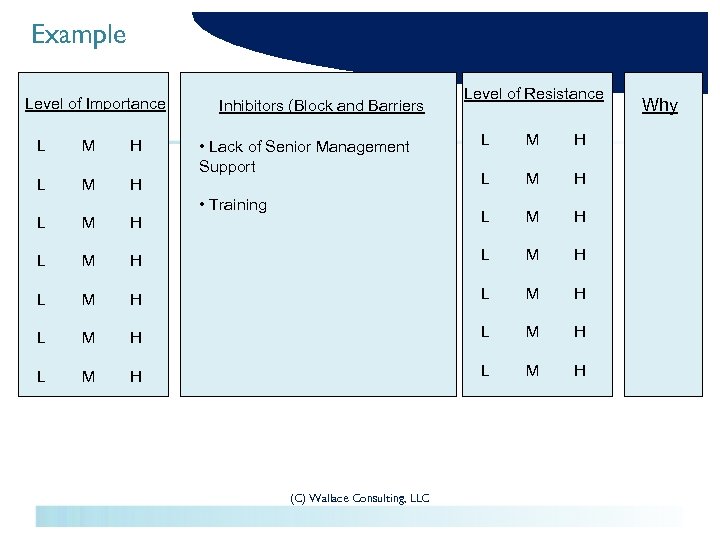 Example Level of Importance L M H L M Inhibitors (Block and Barriers H • Lack of Senior Management Support • Training Level of Resistance L M H L M H L M H (C) Wallace Consulting, LLC Why
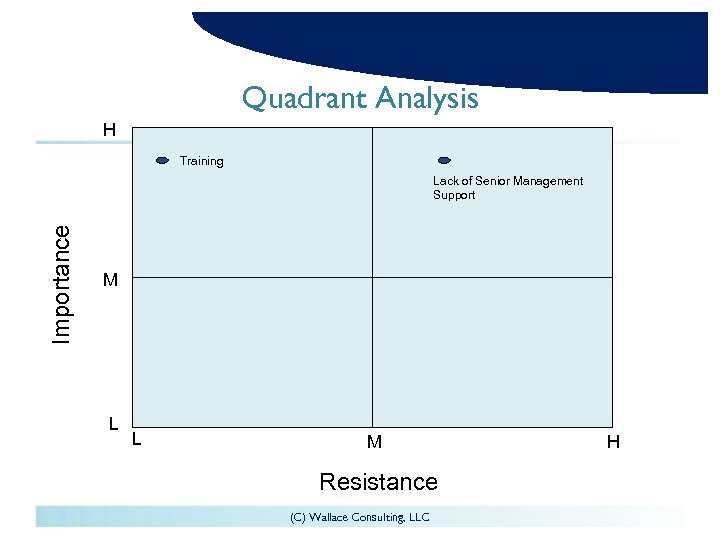 Quadrant Analysis H Training Importance Lack of Senior Management Support M L L M Resistance (C) Wallace Consulting, LLC H
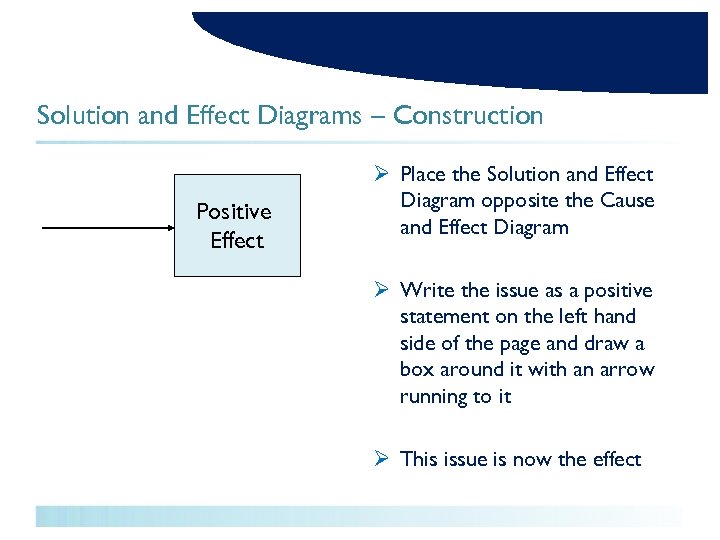 Solution and Effect Diagrams – Construction Positive Effect Ø Place the Solution and Effect Diagram opposite the Cause and Effect Diagram Ø Write the issue as a positive statement on the left hand side of the page and draw a box around it with an arrow running to it Ø This issue is now the effect
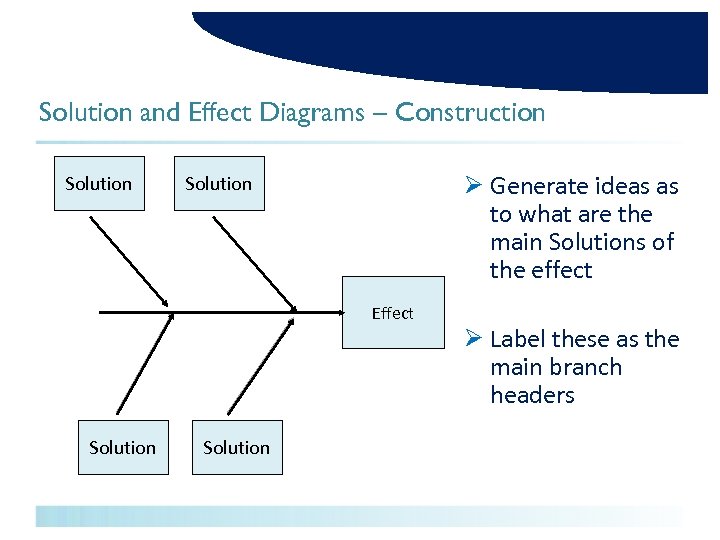 Solution and Effect Diagrams – Construction Solution Ø Generate ideas as to what are the main Solutions of the effect Solution Effect Solution Ø Label these as the main branch headers
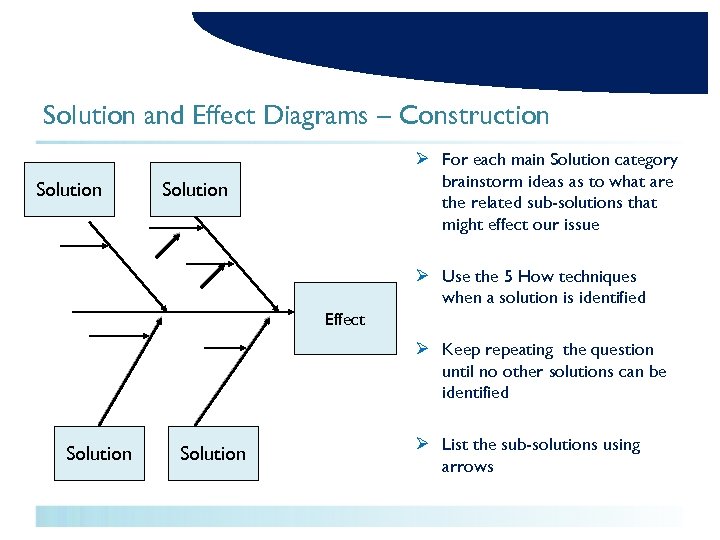 Solution and Effect Diagrams – Construction Solution Ø For each main Solution category brainstorm ideas as to what are the related sub-solutions that might effect our issue Ø Use the 5 How techniques when a solution is identified Solution Effect Ø Keep repeating the question until no other solutions can be identified Solution Ø List the sub-solutions using arrows
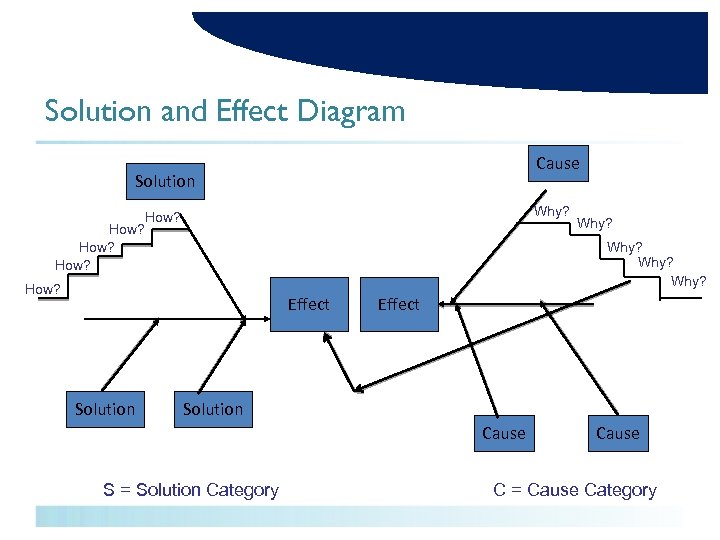 Solution and Effect Diagram Cause Solution How? Why? How? Effect Solution Why? Effect Solution Cause S = Solution Category Cause C = Cause Category
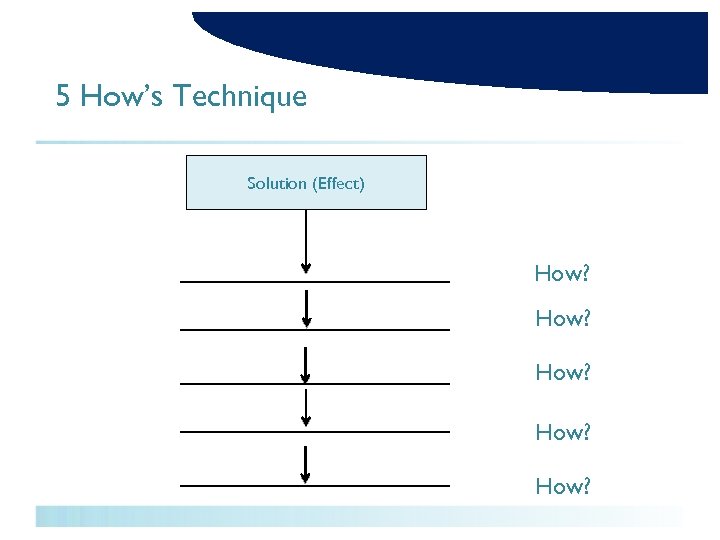 5 How’s Technique Solution (Effect) How? How?
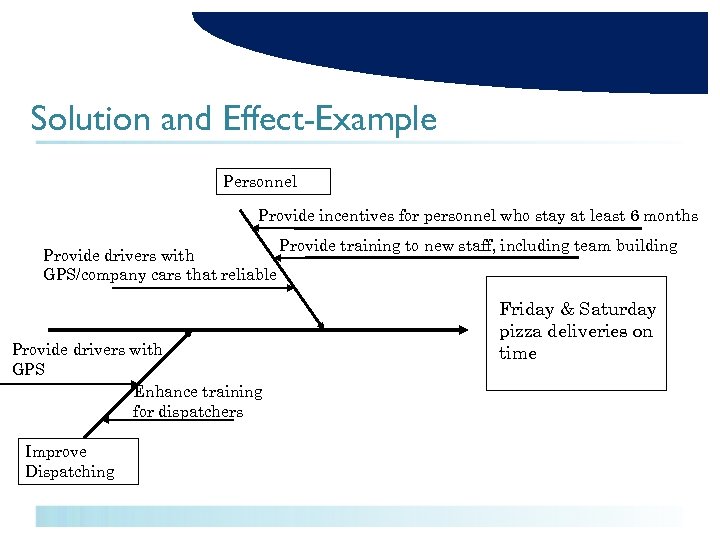 Solution and Effect-Example Personnel Provide incentives for personnel who stay at least 6 months Provide drivers with GPS/company cars that reliable Provide drivers with GPS Enhance training for dispatchers Improve Dispatching Provide training to new staff, including team building Friday & Saturday pizza deliveries on time
 What is the message to deliver to the rest of the organization on what is QI in our organization? – We know where we are on the QI Road map and where should we be in one year? – What do we expect of our managers and front line staff? – How will we help them achieve it? – What is our message to the organization on what QI will be in our organization? (C) Wallace Consulting, LLC
 What is the message to deliver to the rest of the organization on what is QI in our organization? • What is your vision of Your QI culture? – Develop a 30 second elevator speech on what QI is going to be in the organization • Do we believe it? • Will it be believable to others in the organization? • Does it support our core values? (C) Wallace Consulting, LLC
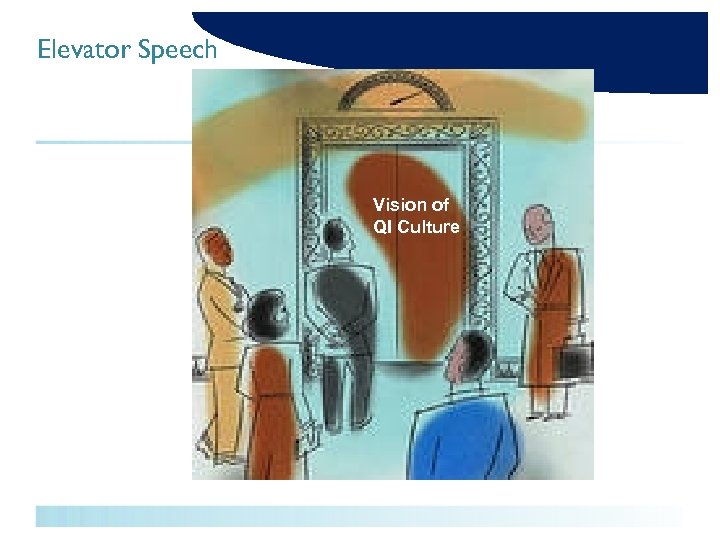 Elevator Speech Vision of QI Culture
 Now That We Have The Message • What is your role? • Do we have the will to do this throughout the organization? • Do we have the ability to deliver this consistently at all levels of the organization? • Do we have the resources to devote to this to make it a reality? • Will we support and use it? (C) Wallace Consulting, LLC
 QI Culture Statement • Once identified, the QI Culture Statement should be published and posted throughout the organization • When presenting them, it is important to make an emotional connection with the defined QI culture and all employees • Simply reading them to the staff or posting them without explanation is not effective (C) Wallace Consulting, LLC
 Start Making A Change Now • What can we do right now to reduce the inhibitors to that are preventing us from having a culture of Quality? • What should we: • • • Stop Doing? Start Doing? Continue Doing? • • Improve? When we return to the office? (C) Wallace Consulting, LLC
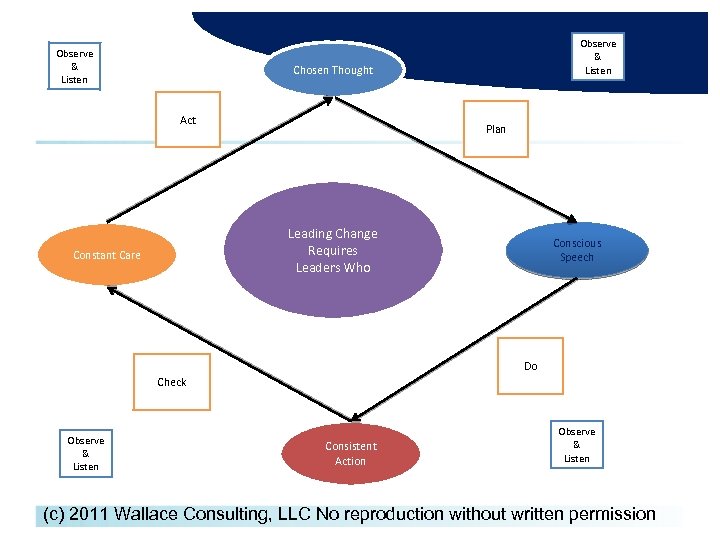 Observe & Listen Chosen Thought Act Plan Leading Change Requires Leaders Who Constant Care Conscious Speech Do Check Observe & Listen Consistent Action Observe & Listen (c) 2011 Wallace Consulting, LLC No reproduction without written permission
 Anchoring the Change (C) Wallace Consulting, LLC
 Why of a Quality Improvement Plan Ø Serves as the foundation of the commitment of a public health agency to continuously improve the quality of the services it provides to its community Ø Every public health agency must satisfy customers, stakeholders, and employees to survive in the future Ø Day-to-day details often divert attention from what is good for the agency and the QI Plan helps keep the focus Ø Conflicts in priorities and competition for resources can be a huge barrier to organizational excellence and the QI Plan can help mediate it
 Quality Improvement Plan Ø The initial plan is a basic document of what you are planning to accomplish and when: Ø provides written credibility to the entire process Ø is a visible sign of management support and commitment Ø Updated regularly to indicate what you are doing, how you are doing, and plan to do in the future Ø It is not a one time event
 Quality Improvement Plan Ø Overtime the Quality Improvement Planning, business planning, and strategic planning will integrate themselves into one aligned document Ø Initially the Quality Improvement Plan needs to be separate to give it the proper focus and attention throughout the organization
 Quality Improvement Plan Ø The Quality Improvement Plan is a basic guidance document about how a Public Health Department will manage, deploy, and review quality throughout the organization Ø The Quality Improvement Plan describes the processes and activities that will be put into place to ensure that quality deliverables are produced consistently
 Elements of the Quality Improvement Plan Need to Describe the Following: 1. The overall management approach to quality and what is to be accomplished (goals) over a defined time frame 2. Key terms so everyone has the same vocabulary when it comes to the terms we use when describing quality and quality improvement 3. The quality program will be managed and monitored by the organization
 Elements of the Quality Improvement Plan Need to Describe the Following: 4. The process for selecting quality improvement projects and selecting team leaders 5. The types of training and support that will be available to the organization 6. The quality process (i. e. : PDCA) and quality tools and techniques to be utilized throughout the organization 7. The ongoing communication plan
 Elements of the Quality Improvement Plan Need to Describe the Following: 8. Any quality roles and responsibilities that will exist in the organization (i. e. Sponsor, team leader, team member, facilitator, etc. ) during or after implementation. 9. How measurement and analysis will be utilized in the organization and how it will help define future quality improvement activities. 10. Any evaluation activities that will be utilized to determine the effectiveness of the Quality Improvement Plan’s implementation
 Summary of Quality Improvement Plan Development Ø It is a guidance document that informs everyone in the organization as to the direction, timeline, activities, and importance of quality and quality improvement in the organization Ø It is a living document and needs to be revised on a regular basis to reflect accomplishments, lessons learned, and changing organizational priorities Ø It is not a one time static document but one that should constantly be describing the current state and future state of quality in any Public Health Department
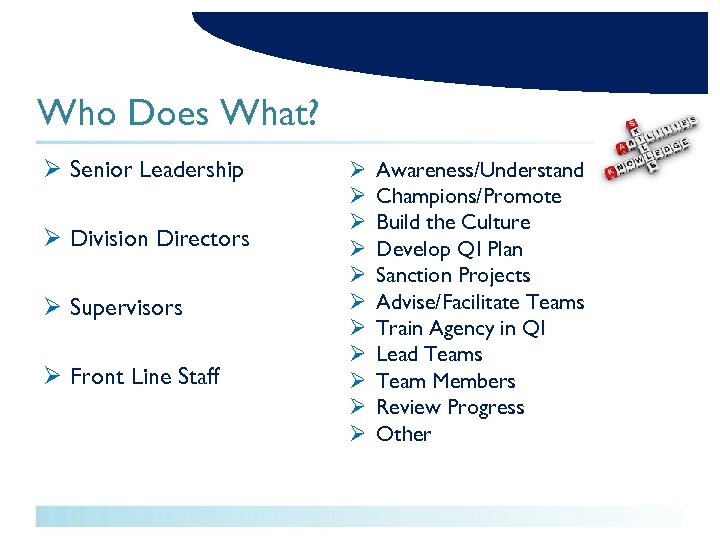 Who Does What? Ø Senior Leadership Ø Division Directors Ø Supervisors Ø Front Line Staff Ø Ø Ø Awareness/Understand Champions/Promote Build the Culture Develop QI Plan Sanction Projects Advise/Facilitate Teams Train Agency in QI Lead Teams Team Members Review Progress Other
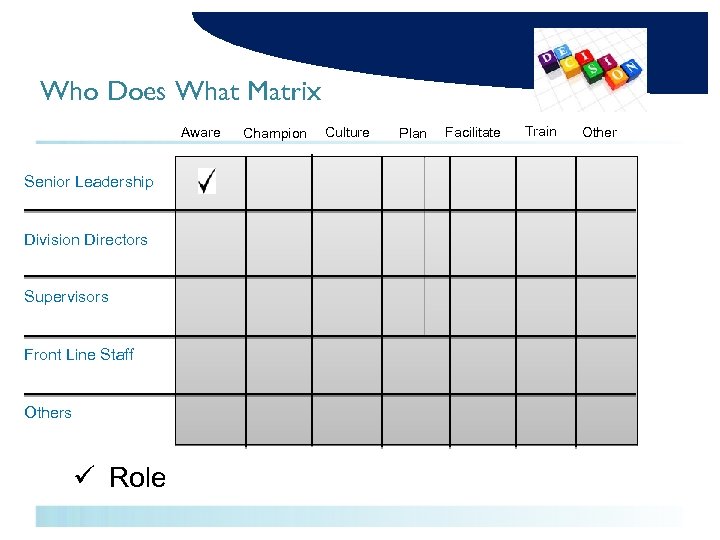 Who Does What Matrix Aware Senior Leadership Division Directors Supervisors Front Line Staff Others ü Role Champion Culture Plan Facilitate Train Other
 Ready To Flip The Switch? 666 Plan
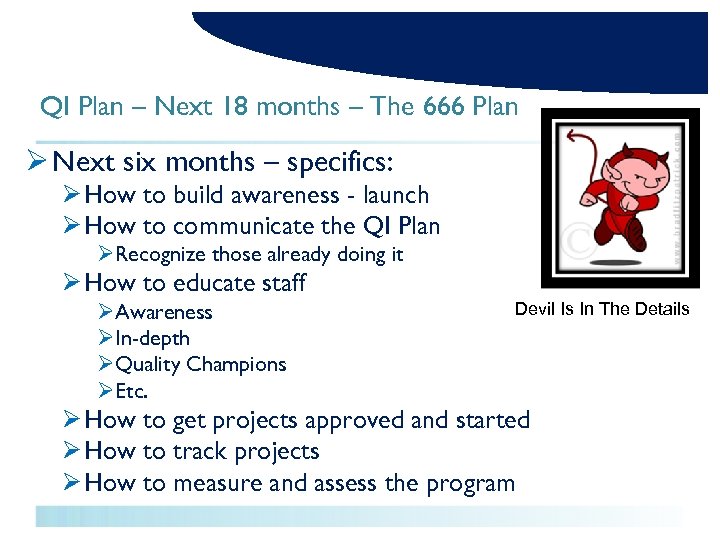 QI Plan – Next 18 months – The 666 Plan Ø Next six months – specifics: Ø How to build awareness - launch Ø How to communicate the QI Plan ØRecognize those already doing it Ø How to educate staff ØAwareness ØIn-depth ØQuality Champions ØEtc. Devil Is In The Details Ø How to get projects approved and started Ø How to track projects Ø How to measure and assess the program
 QI Plan – Next 18 months – The 666 Plan Ø 6 – 12 Months: Ø Assess progress Ø Lessons Learned Ø Next round of training Ø Next round of projects Ø Adjustments to QI Plan and Structure Ø Build QI Champion base Ø 12 – 18 Months: Ø Institutionalize it Ø Assess progress Ø Lessons Learned
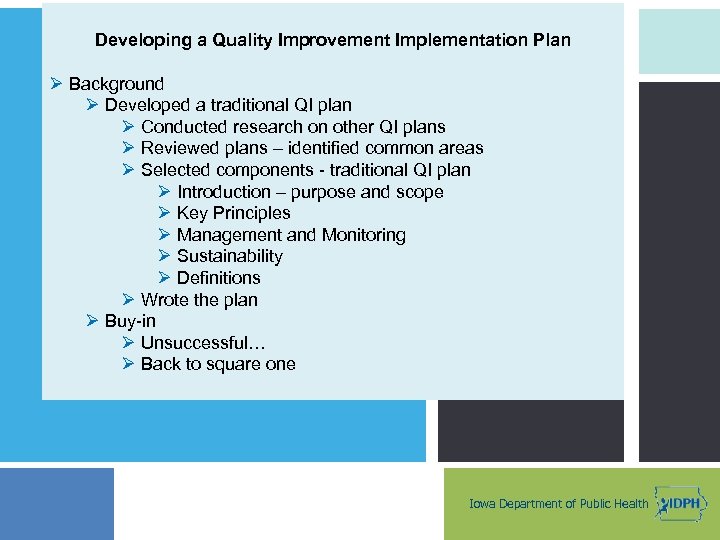 Developing a Quality Improvement Implementation Plan Ø Background Ø Developed a traditional QI plan Ø Conducted research on other QI plans Ø Reviewed plans – identified common areas Ø Selected components - traditional QI plan Ø Introduction – purpose and scope Ø Key Principles Ø Management and Monitoring Ø Sustainability Ø Definitions Ø Wrote the plan Ø Buy-in Ø Unsuccessful… Ø Back to square one Iowa Department of Public Health
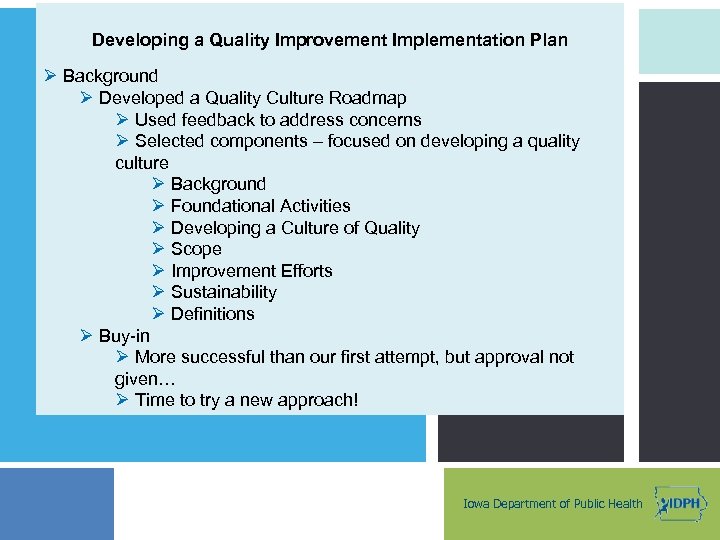 Developing a Quality Improvement Implementation Plan Ø Background Ø Developed a Quality Culture Roadmap Ø Used feedback to address concerns Ø Selected components – focused on developing a quality culture Ø Background Ø Foundational Activities Ø Developing a Culture of Quality Ø Scope Ø Improvement Efforts Ø Sustainability Ø Definitions Ø Buy-in Ø More successful than our first attempt, but approval not given… Ø Time to try a new approach! Iowa Department of Public Health
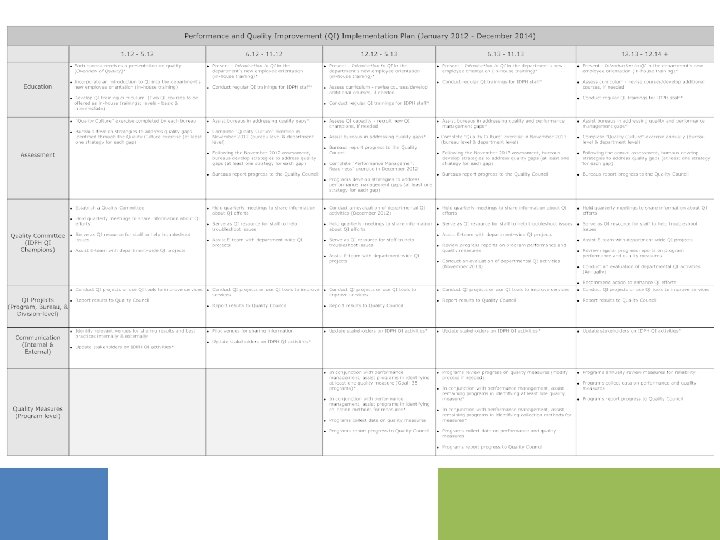
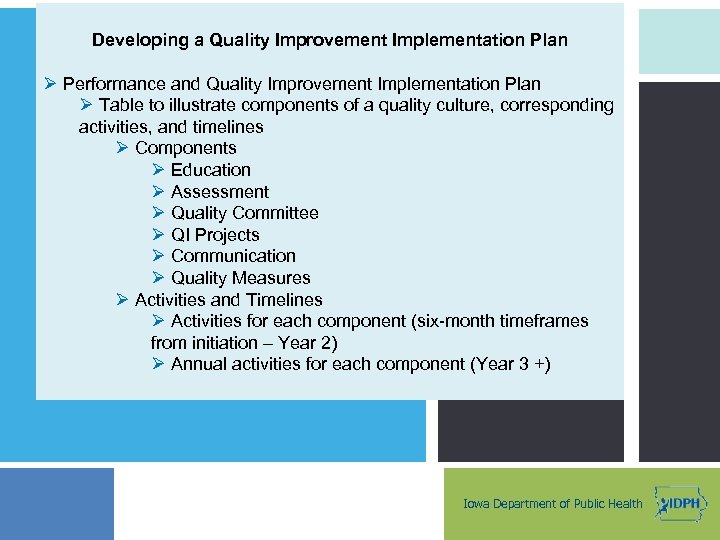 Developing a Quality Improvement Implementation Plan Ø Performance and Quality Improvement Implementation Plan Ø Table to illustrate components of a quality culture, corresponding activities, and timelines Ø Components Ø Education Ø Assessment Ø Quality Committee Ø QI Projects Ø Communication Ø Quality Measures Ø Activities and Timelines Ø Activities for each component (six-month timeframes from initiation – Year 2) Ø Annual activities for each component (Year 3 +) Iowa Department of Public Health
 Developing a Quality Improvement Implementation Plan Ø Result = SUCCESS!!! Ø Next Steps Ø Operationalize each of the components Ø Develop mechanisms to formally: Ø Assess, address, and monitor quality culture Ø Identify possible QI projects Ø Track QI efforts Ø Communicate results – both successes and lessons learned Ø Lessons Learned Ø Know your audience… Ø Don’t be afraid to try new approaches to encourage innovation!! Iowa Department of Public Health
 Helpful Resources • Public Health Improvement Resource Center: http: //www. phf. org/improvement • NPHPSP Online Resource Center: http: //www. phf. org/nphpsp • QI Results Resources: http: //www. phf. org/Quality. Improvement. Results/ • QI Quick Guide & Tutorial: http: //www. phf. org/quickguide/ • PHF QI Learning Series and Assistance: http: //www. phf. org/QIservices • Accreditation Preparation Resources (Domains 8 & 9): http: //www. phf. org/Accreditation • Public Health Quality Improvement Handbook and Other QI Resources: http: //bookstore. phf. org/index. php? c. Path=50 • TRAIN – 25, 000 public health courses offered by more than 4, 000 providers: https: //www. train. org/
 Questions? ? ?