 Скачать презентацию QAC PATTERN ARCHITECTURAL DESIGN HANDBOOK Initial discussion
aed1fb2af5fd60df90266d2ba3dcff15.ppt
- Количество слайдов: 20



QAC PATTERN & ARCHITECTURAL DESIGN HANDBOOK Initial discussion and preliminary research regarding addressing the Design Standards.
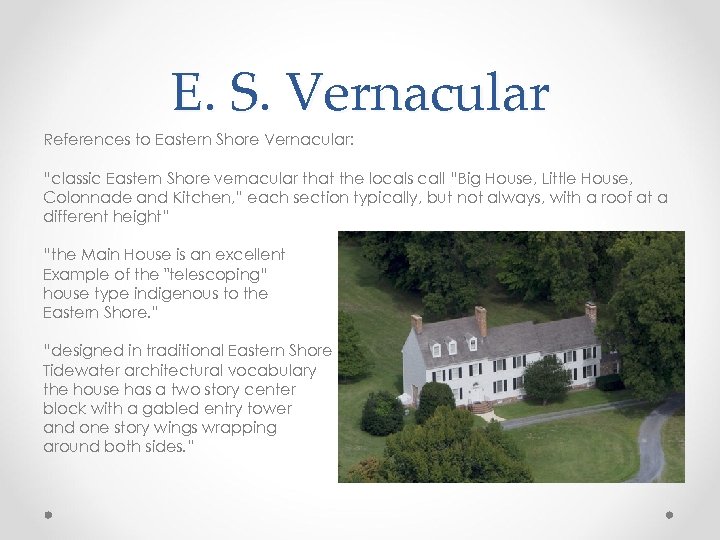
E. S. Vernacular References to Eastern Shore Vernacular: “classic Eastern Shore vernacular that the locals call “Big House, Little House, Colonnade and Kitchen, ” each section typically, but not always, with a roof at a different height” “the Main House is an excellent Example of the "telescoping“ house type indigenous to the Eastern Shore. ” “designed in traditional Eastern Shore Tidewater architectural vocabulary the house has a two story center block with a gabled entry tower and one story wings wrapping around both sides. ”
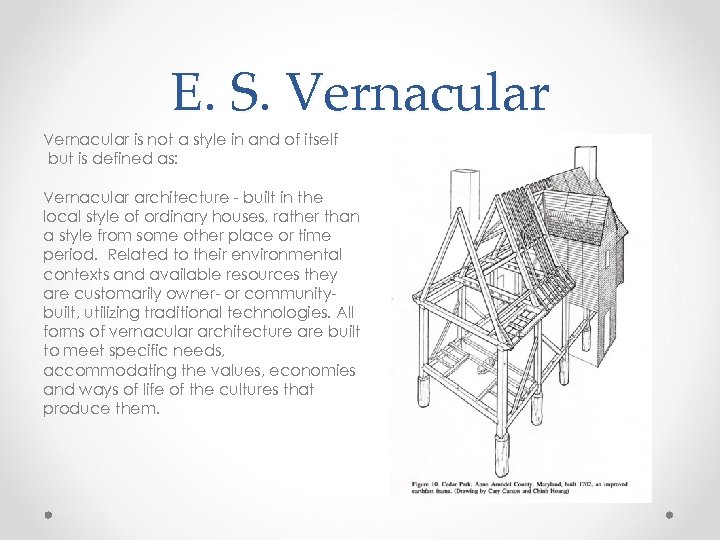
E. S. Vernacular is not a style in and of itself but is defined as: Vernacular architecture - built in the local style of ordinary houses, rather than a style from some other place or time period. Related to their environmental contexts and available resources they are customarily owner- or communitybuilt, utilizing traditional technologies. All forms of vernacular architecture are built to meet specific needs, accommodating the values, economies and ways of life of the cultures that produce them.
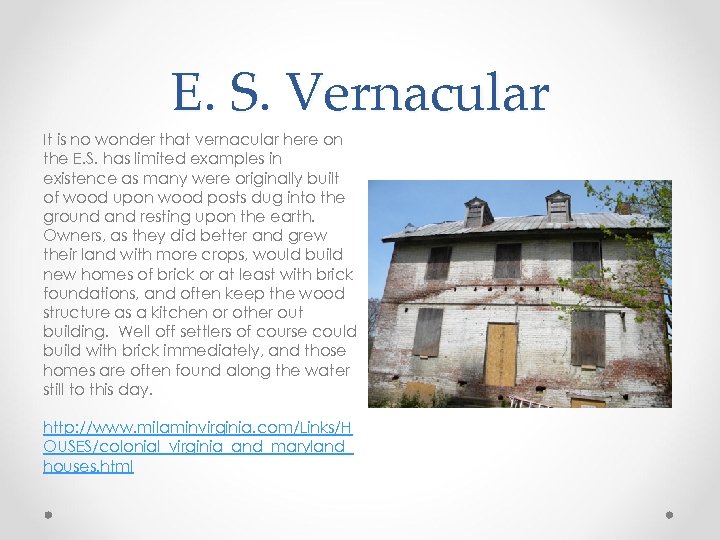
E. S. Vernacular It is no wonder that vernacular here on the E. S. has limited examples in existence as many were originally built of wood upon wood posts dug into the ground and resting upon the earth. Owners, as they did better and grew their land with more crops, would build new homes of brick or at least with brick foundations, and often keep the wood structure as a kitchen or other out building. Well off settlers of course could build with brick immediately, and those homes are often found along the water still to this day. http: //www. milaminvirginia. com/Links/H OUSES/colonial_virginia_and_maryland_ houses. html
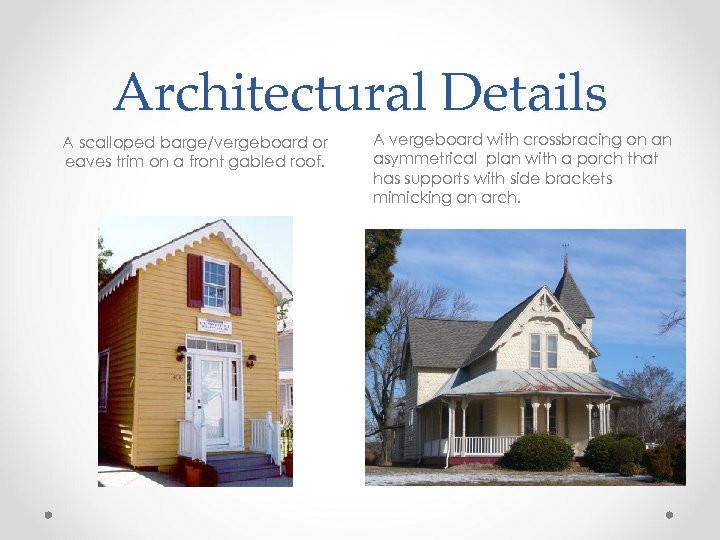
Architectural Details A scalloped barge/vergeboard or eaves trim on a front gabled roof. A vergeboard with crossbracing on an asymmetrical plan with a porch that has supports with side brackets mimicking an arch.
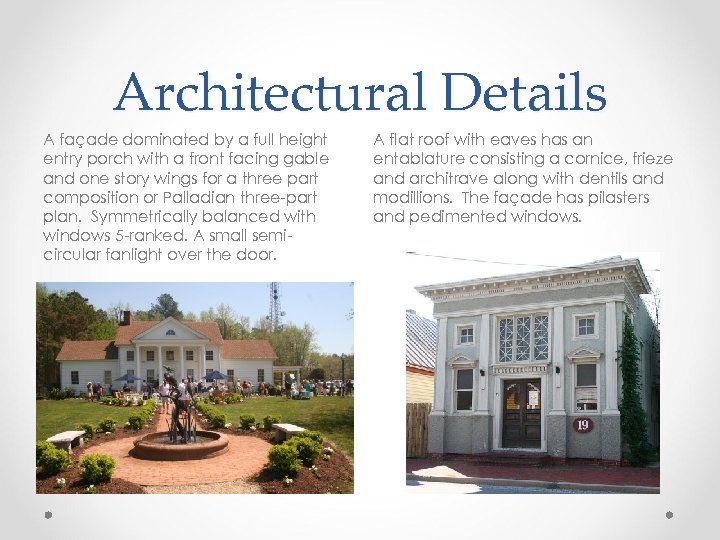
Architectural Details A façade dominated by a full height entry porch with a front facing gable and one story wings for a three part composition or Palladian three-part plan. Symmetrically balanced with windows 5 -ranked. A small semicircular fanlight over the door. A flat roof with eaves has an entablature consisting a cornice, frieze and architrave along with dentils and modillions. The façade has pilasters and pedimented windows.
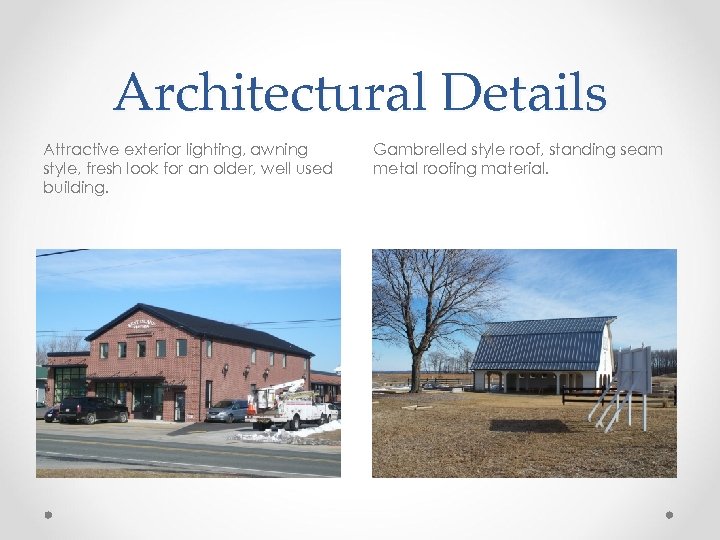
Architectural Details Attractive exterior lighting, awning style, fresh look for an older, well used building. Gambrelled style roof, standing seam metal roofing material.
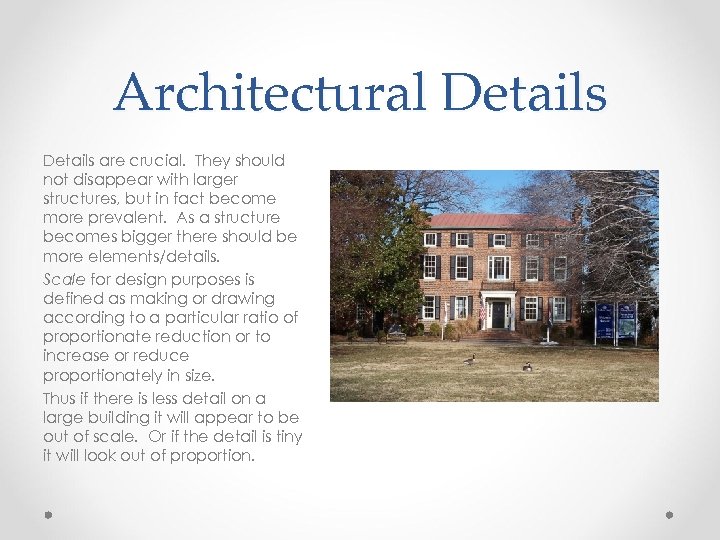
Architectural Details are crucial. They should not disappear with larger structures, but in fact become more prevalent. As a structure becomes bigger there should be more elements/details. Scale for design purposes is defined as making or drawing according to a particular ratio of proportionate reduction or to increase or reduce proportionately in size. Thus if there is less detail on a large building it will appear to be out of scale. Or if the detail is tiny it will look out of proportion.
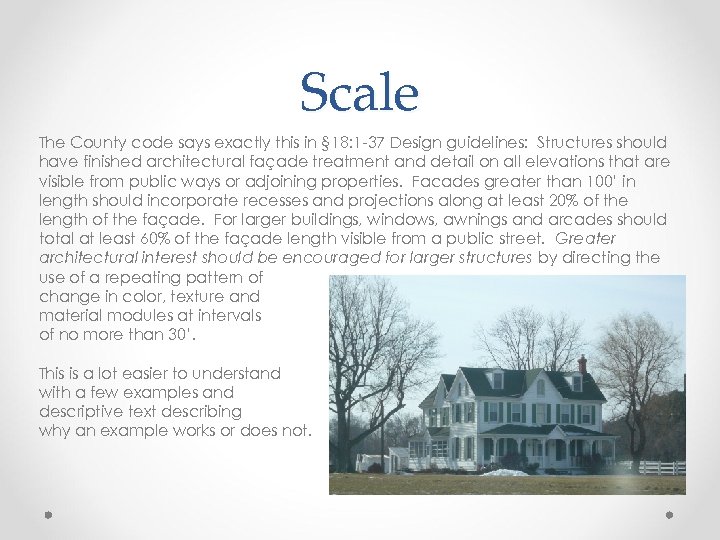
Scale The County code says exactly this in § 18: 1 -37 Design guidelines: Structures should have finished architectural façade treatment and detail on all elevations that are visible from public ways or adjoining properties. Facades greater than 100’ in length should incorporate recesses and projections along at least 20% of the length of the façade. For larger buildings, windows, awnings and arcades should total at least 60% of the façade length visible from a public street. Greater architectural interest should be encouraged for larger structures by directing the use of a repeating pattern of change in color, texture and material modules at intervals of no more than 30’. This is a lot easier to understand with a few examples and descriptive text describing why an example works or does not.
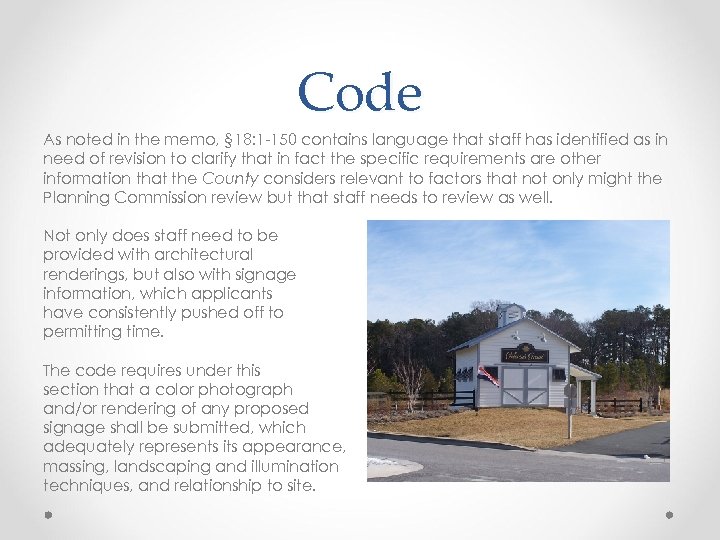
Code As noted in the memo, § 18: 1 -150 contains language that staff has identified as in need of revision to clarify that in fact the specific requirements are other information that the County considers relevant to factors that not only might the Planning Commission review but that staff needs to review as well. Not only does staff need to be provided with architectural renderings, but also with signage information, which applicants have consistently pushed off to permitting time. The code requires under this section that a color photograph and/or rendering of any proposed signage shall be submitted, which adequately represents its appearance, massing, landscaping and illumination techniques, and relationship to site.
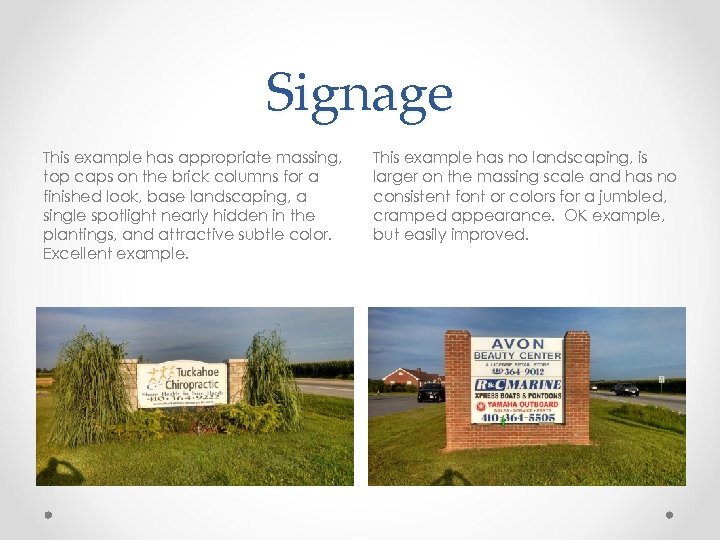
Signage This example has appropriate massing, top caps on the brick columns for a finished look, base landscaping, a single spotlight nearly hidden in the plantings, and attractive subtle color. Excellent example. This example has no landscaping, is larger on the massing scale and has no consistent font or colors for a jumbled, cramped appearance. OK example, but easily improved.
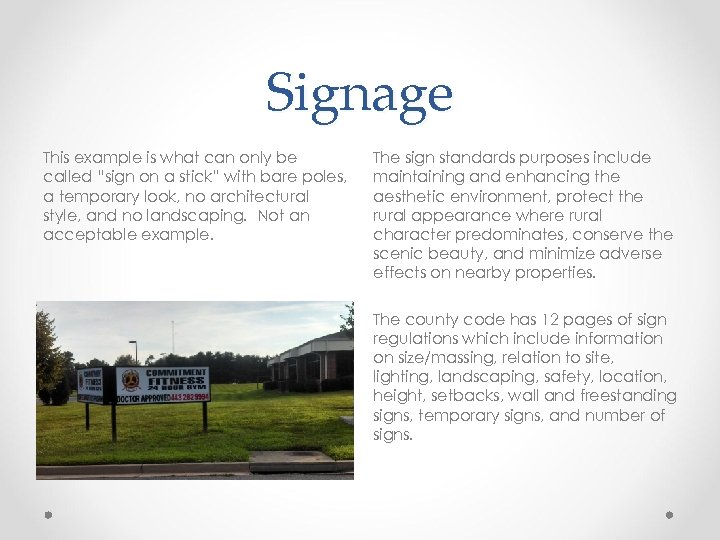
Signage This example is what can only be called “sign on a stick” with bare poles, a temporary look, no architectural style, and no landscaping. Not an acceptable example. The sign standards purposes include maintaining and enhancing the aesthetic environment, protect the rural appearance where rural character predominates, conserve the scenic beauty, and minimize adverse effects on nearby properties. The county code has 12 pages of sign regulations which include information on size/massing, relation to site, lighting, landscaping, safety, location, height, setbacks, wall and freestanding signs, temporary signs, and number of signs.
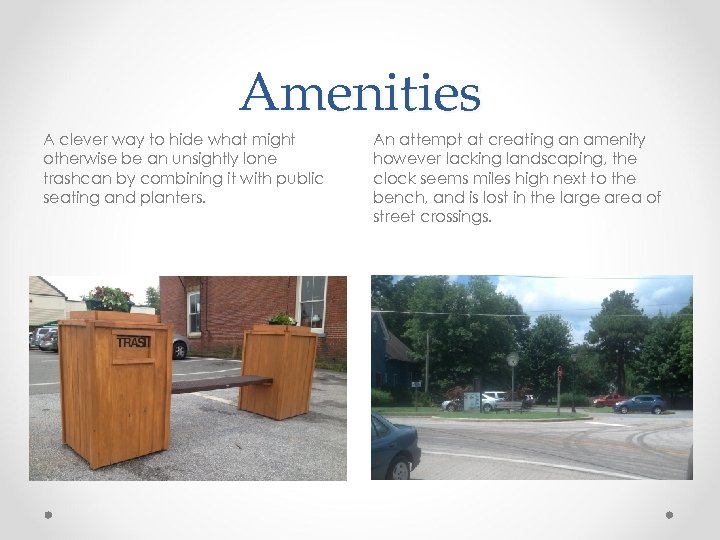
Amenities A clever way to hide what might otherwise be an unsightly lone trashcan by combining it with public seating and planters. An attempt at creating an amenity however lacking landscaping, the clock seems miles high next to the bench, and is lost in the large area of street crossings.
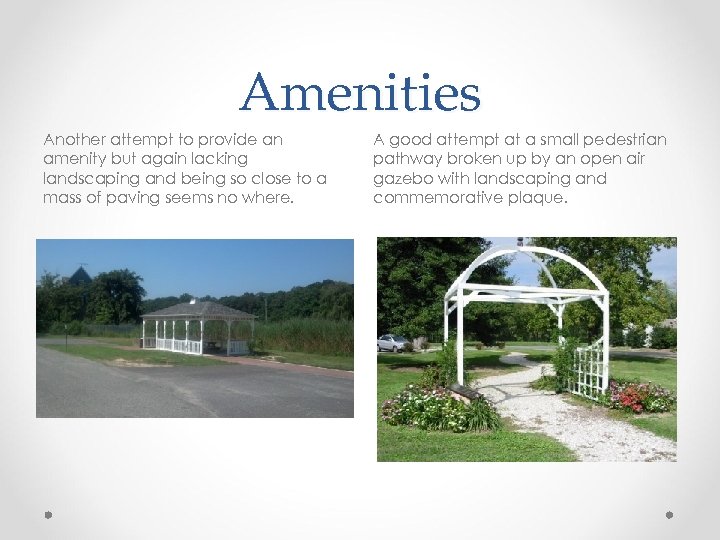
Amenities Another attempt to provide an amenity but again lacking landscaping and being so close to a mass of paving seems no where. A good attempt at a small pedestrian pathway broken up by an open air gazebo with landscaping and commemorative plaque.
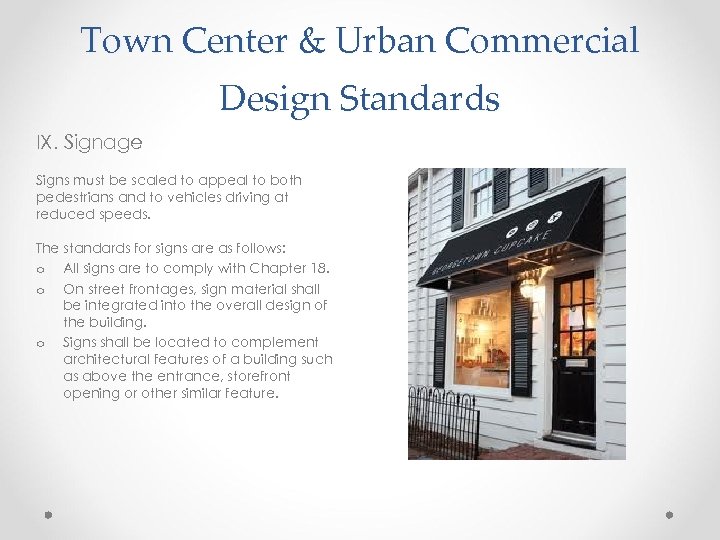
Town Center & Urban Commercial Design Standards IX. Signage Signs must be scaled to appeal to both pedestrians and to vehicles driving at reduced speeds. The standards for signs are as follows: o All signs are to comply with Chapter 18. o On street frontages, sign material shall be integrated into the overall design of the building. o Signs shall be located to complement architectural features of a building such as above the entrance, storefront opening or other similar feature.
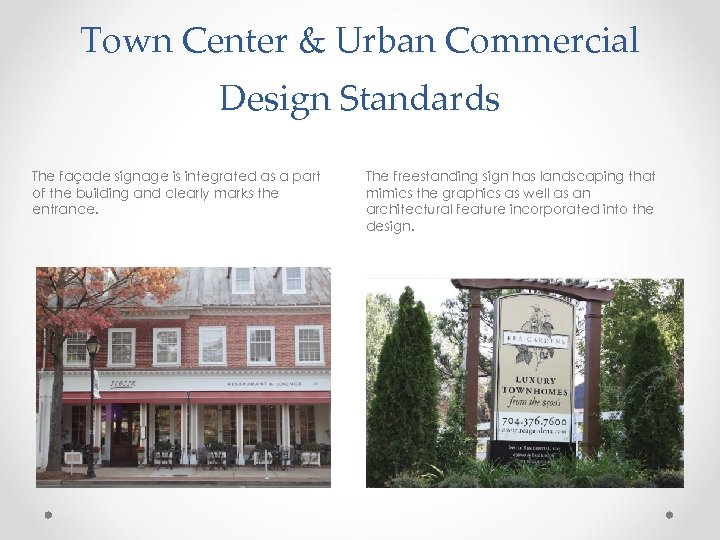
Town Center & Urban Commercial Design Standards The façade signage is integrated as a part of the building and clearly marks the entrance. The freestanding sign has landscaping that mimics the graphics as well as an architectural feature incorporated into the design.
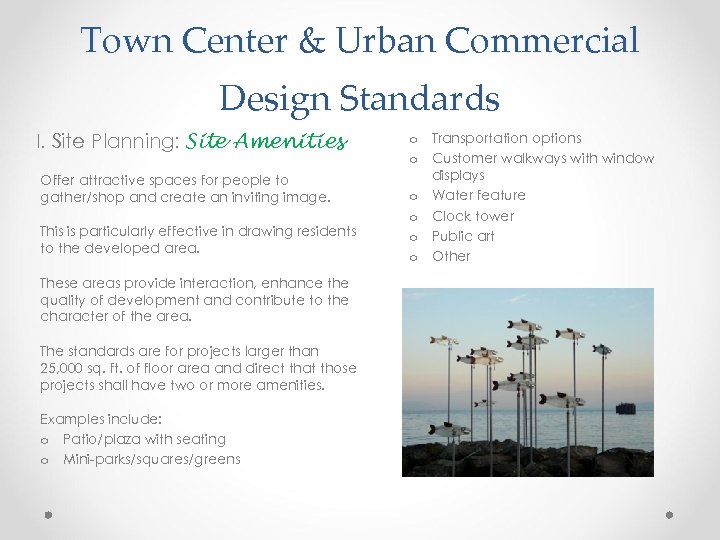
Town Center & Urban Commercial Design Standards I. Site Planning: Site Amenities Offer attractive spaces for people to gather/shop and create an inviting image. This is particularly effective in drawing residents to the developed area. These areas provide interaction, enhance the quality of development and contribute to the character of the area. The standards are for projects larger than 25, 000 sq. ft. of floor area and direct that those projects shall have two or more amenities. Examples include: o Patio/plaza with seating o Mini-parks/squares/greens o Transportation options o Customer walkways with window displays o Water feature o Clock tower o Public art o Other
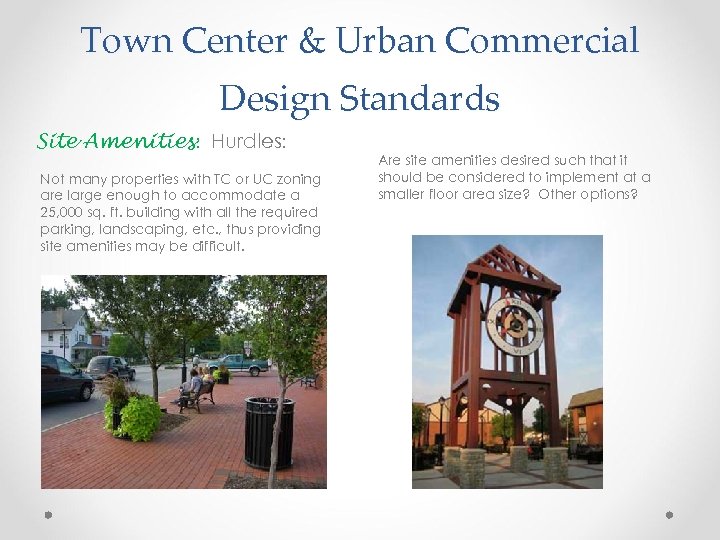
Town Center & Urban Commercial Design Standards Site Amenities: Hurdles: Not many properties with TC or UC zoning are large enough to accommodate a 25, 000 sq. ft. building with all the required parking, landscaping, etc. , thus providing site amenities may be difficult. Are site amenities desired such that it should be considered to implement at a smaller floor area size? Other options?
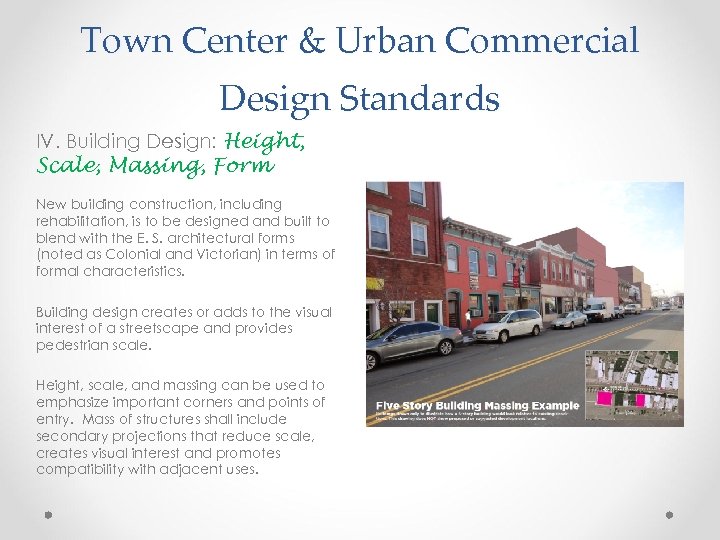
Town Center & Urban Commercial Design Standards IV. Building Design: Height, Scale, Massing, Form New building construction, including rehabilitation, is to be designed and built to blend with the E. S. architectural forms (noted as Colonial and Victorian) in terms of formal characteristics. Building design creates or adds to the visual interest of a streetscape and provides pedestrian scale. Height, scale, and massing can be used to emphasize important corners and points of entry. Mass of structures shall include secondary projections that reduce scale, creates visual interest and promotes compatibility with adjacent uses.
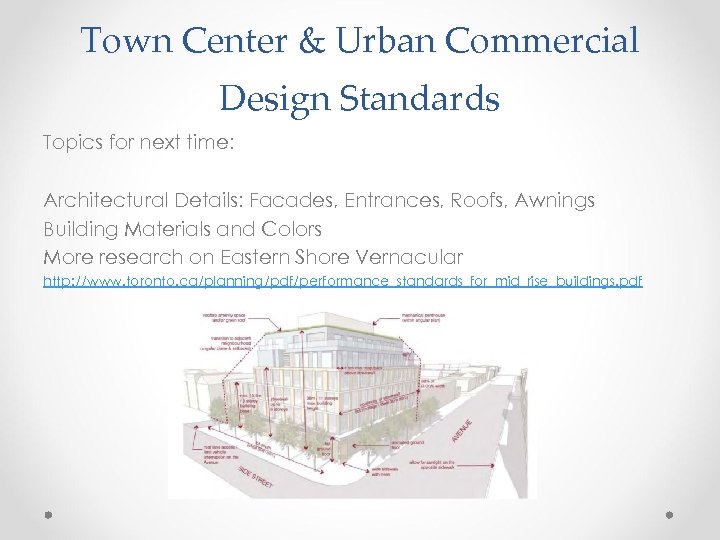
Town Center & Urban Commercial Design Standards Topics for next time: Architectural Details: Facades, Entrances, Roofs, Awnings Building Materials and Colors More research on Eastern Shore Vernacular http: //www. toronto. ca/planning/pdf/performance_standards_for_mid_rise_buildings. pdf
Скачать презентацию QAC PATTERN ARCHITECTURAL DESIGN HANDBOOK Initial discussion
aed1fb2af5fd60df90266d2ba3dcff15.ppt