


 Скачать презентацию Q 2010 course on Quality reporting and metadata
cfdb3e417e57916dcd9021305721ca52.ppt
- Количество слайдов: 178
 Q 2010 course on “Quality reporting and metadata” May 2010, Helsinki August Götzfried and Eva Elvers
 SESSION 2 09: 45 – 10: 15 THE ESS FRAMEWORK FOR QUALITY REPORTING (Code of Practice, Statistical Law, ESQR, Dat. Qam, etc. ) Eva Elvers 2
 European Statistics Code of Practice n June 2004: Council invited COM to make by June 2005 a proposal to develop minimum European standards on the independence, integrity and accountability of the European Statistical System n February 2005: adoption of the Code by the SPC based on the proposal of its Task Force n 25 May 2005: COM adoption of a Communication and a Recommendation on the independence, integrity and accountability of the national and Community statistical authorities incl. the Code of Practice (Co. P) 3
 European Statistics Code of Practice Co. P has two aims: n Improving trust and confidence in the independence, integrity and accountability of both National Statistical Authorities and Eurostat, and in the credibility and quality of the statistics they produce and disseminate (i. e. an external focus); n Promoting the application of best international statistical principles, methods and practices by all producers of European Statistics to enhance their quality (i. e. an internal focus). 4
 European Statistics Code of Practice n 15 Principles addressing the institutional environment, the statistical processes and their outputs (inspired by existing international standards and the ESS quality definition) n self-regulation of NSIs and Eurostat n indicators to provide a reference for periodical reviews of the implementation of the Code 5
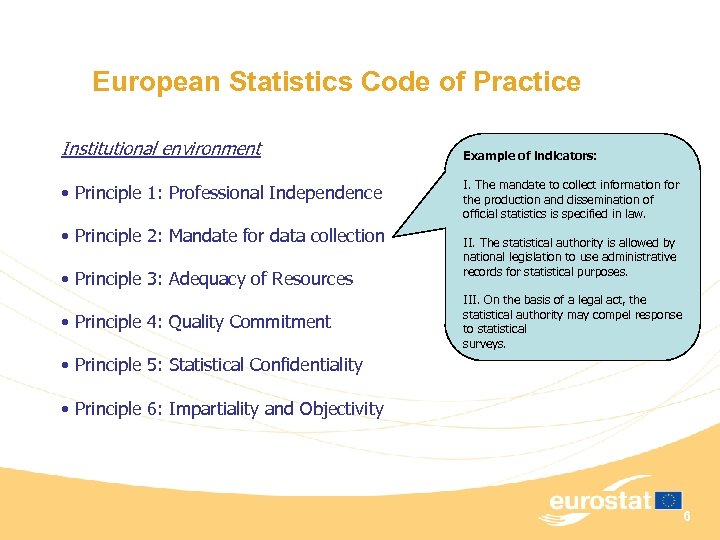 European Statistics Code of Practice Institutional environment • Principle 1: Professional Independence • Principle 2: Mandate for data collection • Principle 3: Adequacy of Resources • Principle 4: Quality Commitment Example of indicators: I. The mandate to collect information for the production and dissemination of official statistics is specified in law. II. The statistical authority is allowed by national legislation to use administrative records for statistical purposes. III. On the basis of a legal act, the statistical authority may compel response to statistical surveys. • Principle 5: Statistical Confidentiality • Principle 6: Impartiality and Objectivity 6
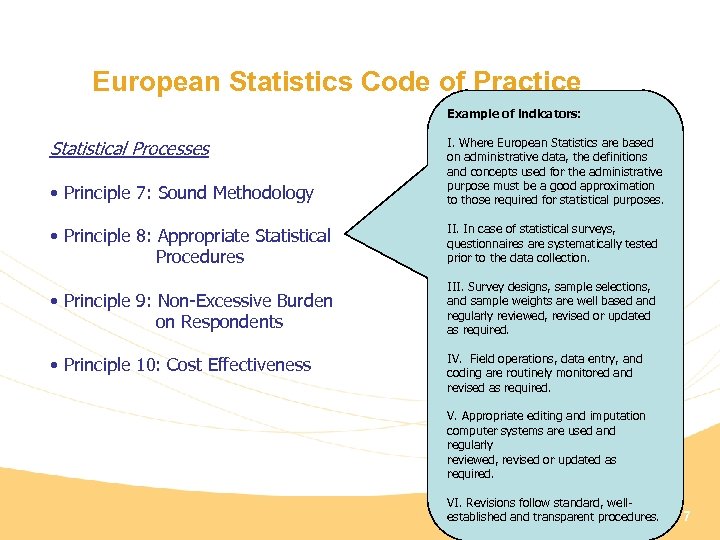 European Statistics Code of Practice Example of indicators: • Principle 7: Sound Methodology I. Where European Statistics are based on administrative data, the definitions and concepts used for the administrative purpose must be a good approximation to those required for statistical purposes. • Principle 8: Appropriate Statistical Procedures II. In case of statistical surveys, questionnaires are systematically tested prior to the data collection. • Principle 9: Non-Excessive Burden on Respondents III. Survey designs, sample selections, and sample weights are well based and regularly reviewed, revised or updated as required. Statistical Processes • Principle 10: Cost Effectiveness IV. Field operations, data entry, and coding are routinely monitored and revised as required. V. Appropriate editing and imputation computer systems are used and regularly reviewed, revised or updated as required. VI. Revisions follow standard, wellestablished and transparent procedures. 7
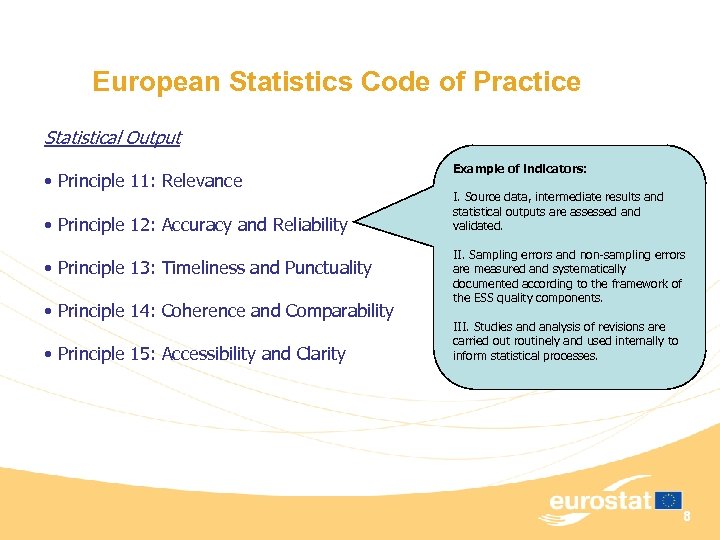 European Statistics Code of Practice Statistical Output • Principle 11: Relevance • Principle 12: Accuracy and Reliability • Principle 13: Timeliness and Punctuality • Principle 14: Coherence and Comparability • Principle 15: Accessibility and Clarity Example of indicators: I. Source data, intermediate results and statistical outputs are assessed and validated. II. Sampling errors and non-sampling errors are measured and systematically documented according to the framework of the ESS quality components. III. Studies and analysis of revisions are carried out routinely and used internally to inform statistical processes. 8
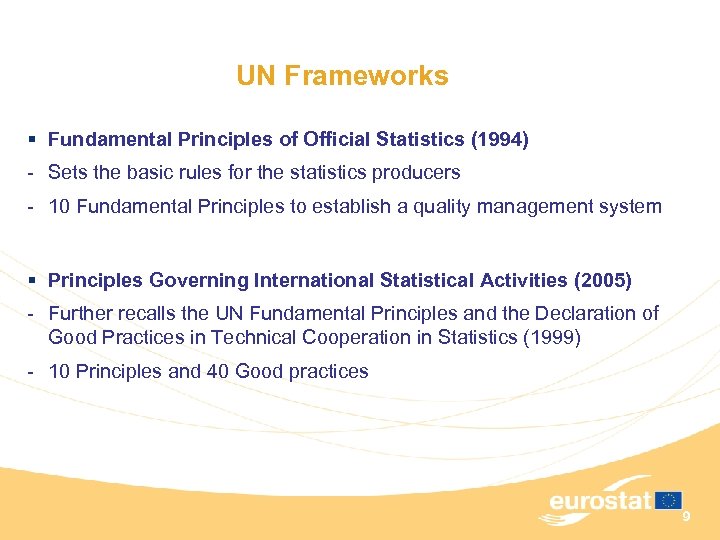 UN Frameworks § Fundamental Principles of Official Statistics (1994) - Sets the basic rules for the statistics producers - 10 Fundamental Principles to establish a quality management system § Principles Governing International Statistical Activities (2005) - Further recalls the UN Fundamental Principles and the Declaration of Good Practices in Technical Cooperation in Statistics (1999) - 10 Principles and 40 Good practices 9
 Total Quality Management n n LEG on Quality outputs as well as Co. P pinpoint two quality aspects: - Total quality management as a basic quality framework. - Promoting CBM’s in processes and outputs. Note the connections to ethical issues: - UN Fundamental Principles of Official Statistics (1994). - ISI Declaration on Professional Ethics (1985, upd. ). 10
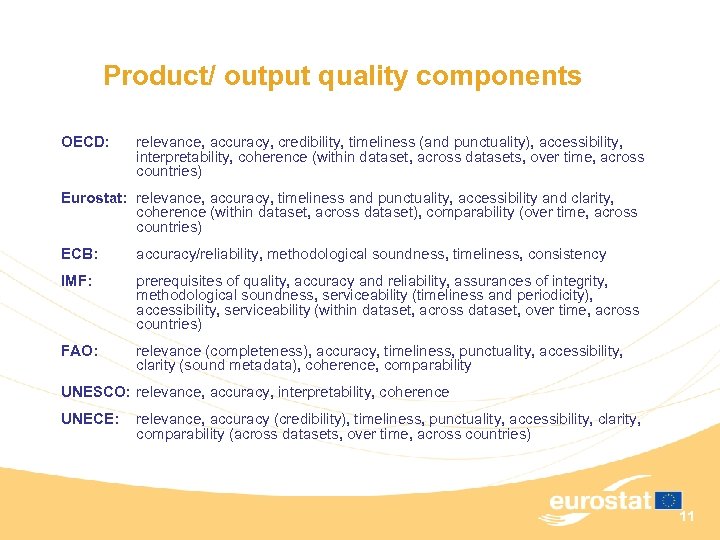 Product/ output quality components OECD: relevance, accuracy, credibility, timeliness (and punctuality), accessibility, interpretability, coherence (within dataset, across datasets, over time, across countries) Eurostat: relevance, accuracy, timeliness and punctuality, accessibility and clarity, coherence (within dataset, across dataset), comparability (over time, across countries) ECB: accuracy/reliability, methodological soundness, timeliness, consistency IMF: prerequisites of quality, accuracy and reliability, assurances of integrity, methodological soundness, serviceability (timeliness and periodicity), accessibility, serviceability (within dataset, across dataset, over time, across countries) FAO: relevance (completeness), accuracy, timeliness, punctuality, accessibility, clarity (sound metadata), coherence, comparability UNESCO: relevance, accuracy, interpretability, coherence UNECE: relevance, accuracy (credibility), timeliness, punctuality, accessibility, clarity, comparability (across datasets, over time, across countries) 11
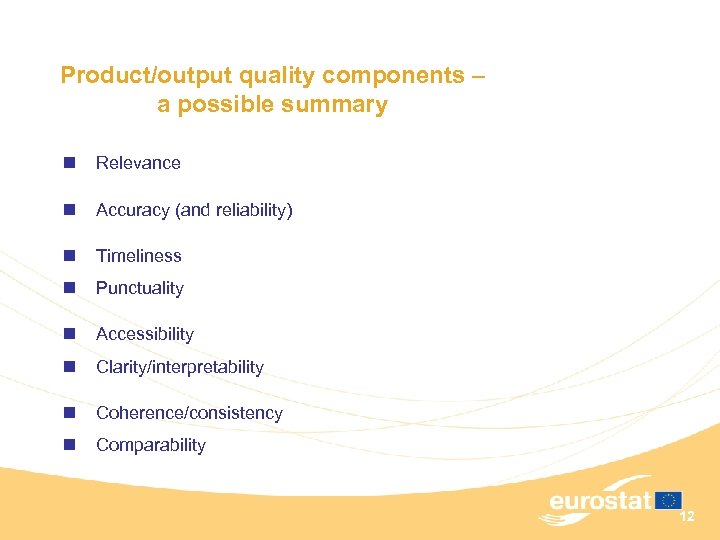 Product/output quality components – a possible summary n Relevance n Accuracy (and reliability) n Timeliness n Punctuality n Accessibility n Clarity/interpretability n Coherence/consistency n Comparability 12
 EU Legislation on Quality Reporting n Council/EP Regulations - Revision « Statistical Law » - Sectoral Regulations n Commission Regulations n Gentlemen’s agreements 13
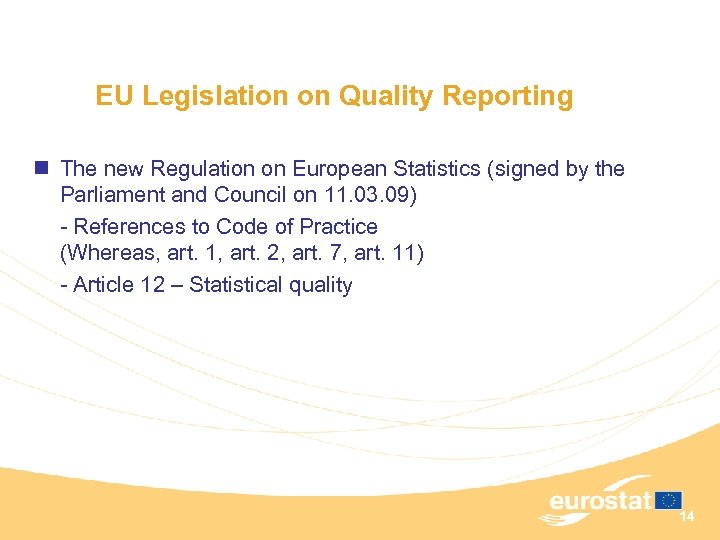 EU Legislation on Quality Reporting n The new Regulation on European Statistics (signed by the Parliament and Council on 11. 03. 09) - References to Code of Practice (Whereas, art. 1, art. 2, art. 7, art. 11) - Article 12 – Statistical quality 14
 EU Legislation on Quality Reporting n Article 12(1) specifies the quality criteria (relevance, accuracy, timeliness, punctuality, accessibility and clarity, comparability, and coherence) that should be applied. n Article 12(2) specifies that the modalities, structure and periodicity of quality reports provided for in sectoral legislation shall be defined by the Commission in accordance with (simple) regulatory procedure. 15
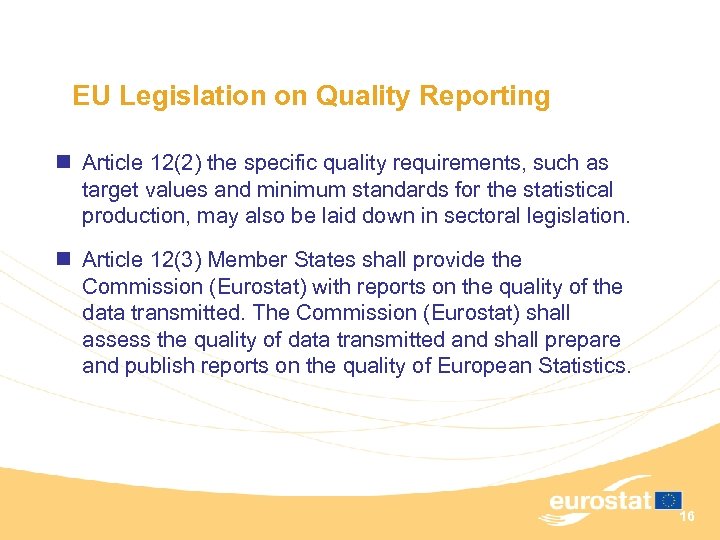 EU Legislation on Quality Reporting n Article 12(2) the specific quality requirements, such as target values and minimum standards for the statistical production, may also be laid down in sectoral legislation. n Article 12(3) Member States shall provide the Commission (Eurostat) with reports on the quality of the data transmitted. The Commission (Eurostat) shall assess the quality of data transmitted and shall prepare and publish reports on the quality of European Statistics. 16
 EU Legislation on Quality Reporting n Proposal for a Regulation of the Parliament and of the Council on population and housing censuses. Brussels, 11 January 2008 “ 1. For the purpose of this Regulation, the following quality assessment dimensions shall apply to the data transmitted: ”. . “ 4. The Commission (Eurostat), in cooperation with the competent authorities of the Member States, shall provide methodological recommendations designed to ensure the quality of the data and metadata produced, acknowledging, in particular, the Conference of European Statisticians Recommendations for the Censuses of population and Housing”. 17
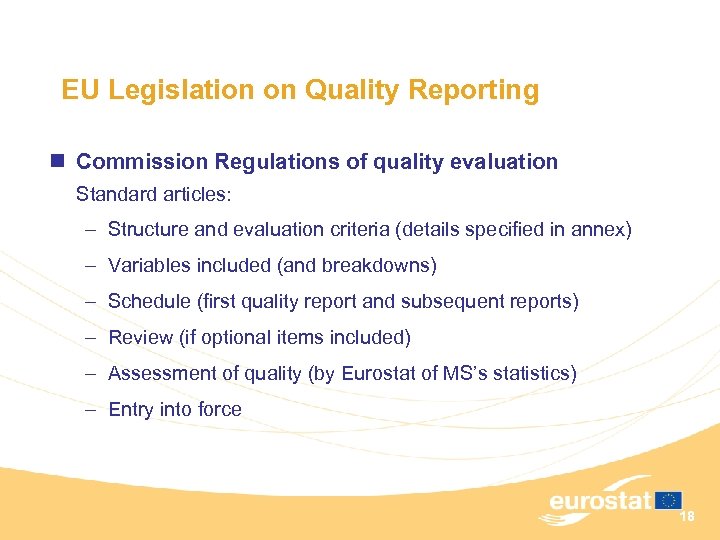 EU Legislation on Quality Reporting n Commission Regulations of quality evaluation Standard articles: – Structure and evaluation criteria (details specified in annex) – Variables included (and breakdowns) – Schedule (first quality report and subsequent reports) – Review (if optional items included) – Assessment of quality (by Eurostat of MS’s statistics) – Entry into force 18
 Self-Assessment Checklist for Survey Managers n The DESAP project (“Development of a Self-Assessment Programme for Surveys”), co-ordinated by DESTATIS (Germany), with Statistics Austria, Statistics Finland, ISTAT (Italy), Statistics Sweden and the ONS (UK) as partners, was carried out during the period October 2002 -October 2003. In response to the LEG on Quality recommendation nr. 15. n DESAP ü is tailored for statistics production and it aims to help survey managers to develop the survey that is under their responsibility ü is fully compliant with the ESS quality criteria ü applies to individual statistics collecting micro-data ü has questions with numerous response categories, assessment questions, and open questions 19
 Objectives of DESAP n Objectives of DESAP: – raising awareness for the quality components and survey quality concepts – to provide a tool for a systematic, even though subjective, assessment of statistical products and processes – to provide helpful guidance in the consideration of improvement measures n Additional potential applications: – assistance for a basic appraisal of the risk of potential quality problems – to provide a means for simple comparisons of the level of quality over time – to provide support for resource allocation within statistical offices or for the training of new staff 20
 Handbook on Improving Quality by Analysis of Process Variables n Then project was coordinated by ONS (UK), with INE Portugal, NSS Greece and Statistics Sweden as partners, and carried out June 2002 - June 2004. In response to LEG on Quality Recommendation nr. 3. n General approach to and useful tools for the task of identifying, measuring and analysing key process variables. n Explains how ‘the process quality is improved by identifying key process variables (i. e. those variables with the greatest effect on product quality), measuring these variables, adjusting the process based on these measurements, and checking what happens to product quality. n Includes many practical examples of the application of the approach to various statistical processes. n The handbook does not aim to provide a list of recommended key process variables across all statistical processes. 21
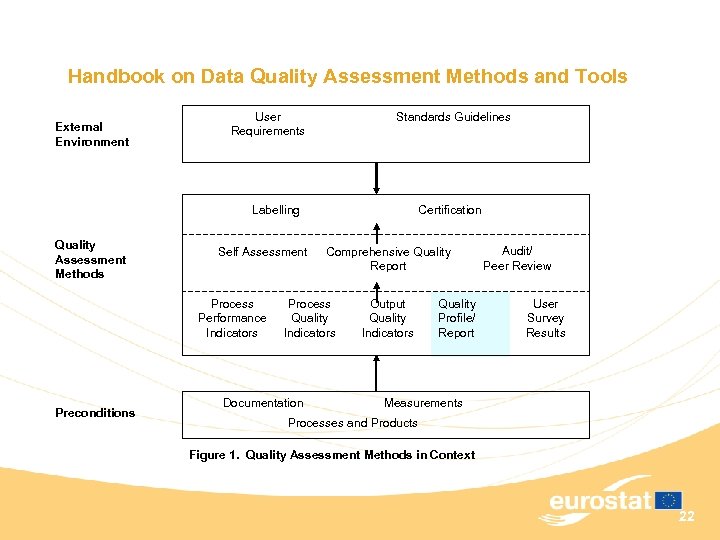 Handbook on Data Quality Assessment Methods and Tools External Environment User Requirements Standards Guidelines Labelling Quality Assessment Methods Self Assessment Process Performance Indicators Preconditions Certification Comprehensive Quality Report Process Quality Indicators Documentation Output Quality Indicators Quality Profile/ Report Audit/ Peer Review User Survey Results Measurements Processes and Products Figure 1. Quality Assessment Methods in Context 22
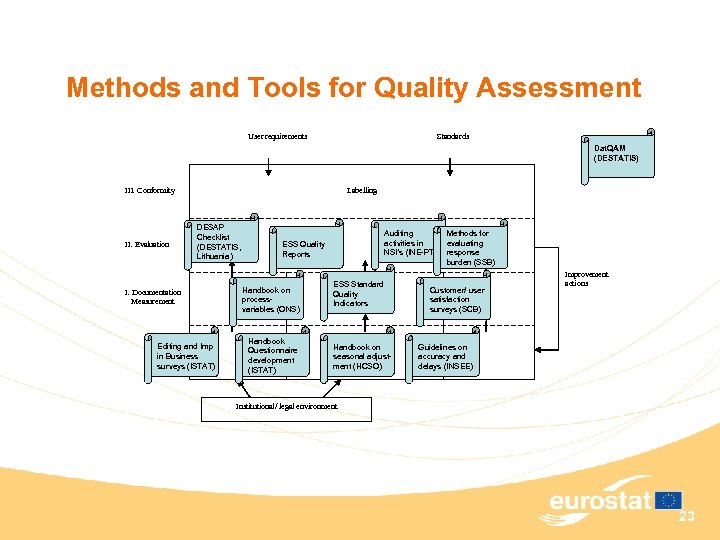 Methods and Tools for Quality Assessment User requirements Standards Dat. QAM (DESTATIS) III. Conformity II. Evaluation Labelling DESAP Checklist (DESTATIS, Lithuania) I. Documentation Measurement Editing and Imp in Business surveys (ISTAT) Auditing Methods for activities in reviews evaluating Quality NSI’s (INE-PT) response burden (SSB) Self ESS Quality assessments Reports Handbook on processvariables (ONS) Handbook Questionnaire development (ISTAT) ESS Standard Quality Indicators Handbook on seasonal adjustment (HCSO) Customer/ user satisfaction surveys (SCB) Improvement actions Guidelines on accuracy and delays (INSEE) Institutional/ legal environment 23
 SESSION 3 10: 15 – 11: 00 PROCESS QUALITY AND OUTPUT QUALITY Eva Elvers & August Götzfried 24
 Process Quality and Output Quality n Content a. To present ESS quality models in detail (Eva Elvers) b. GSBPM follows (August Götzfried) 25
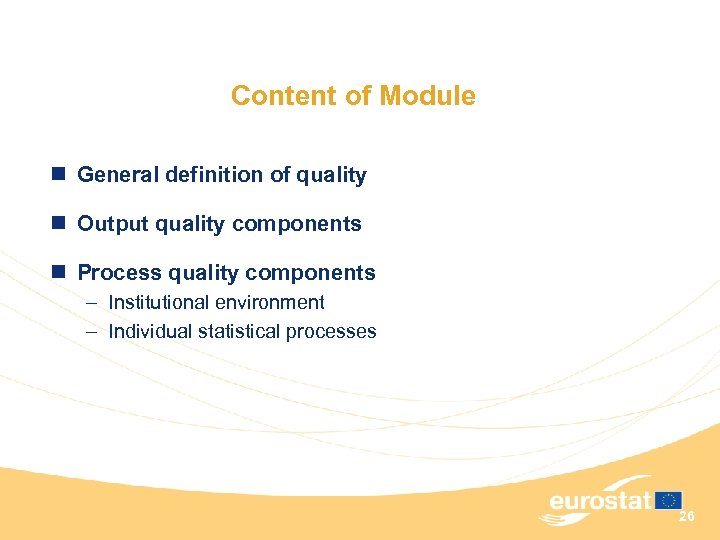 Content of Module n General definition of quality n Output quality components n Process quality components – Institutional environment – Individual statistical processes 26
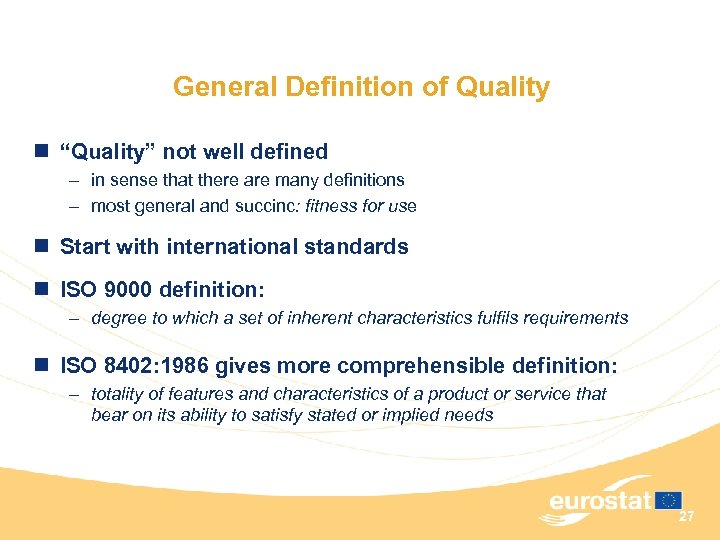 General Definition of Quality n “Quality” not well defined – in sense that there are many definitions – most general and succinc: fitness for use n Start with international standards n ISO 9000 definition: – degree to which a set of inherent characteristics fulfils requirements n ISO 8402: 1986 gives more comprehensible definition: – totality of features and characteristics of a product or service that bear on its ability to satisfy stated or implied needs 27
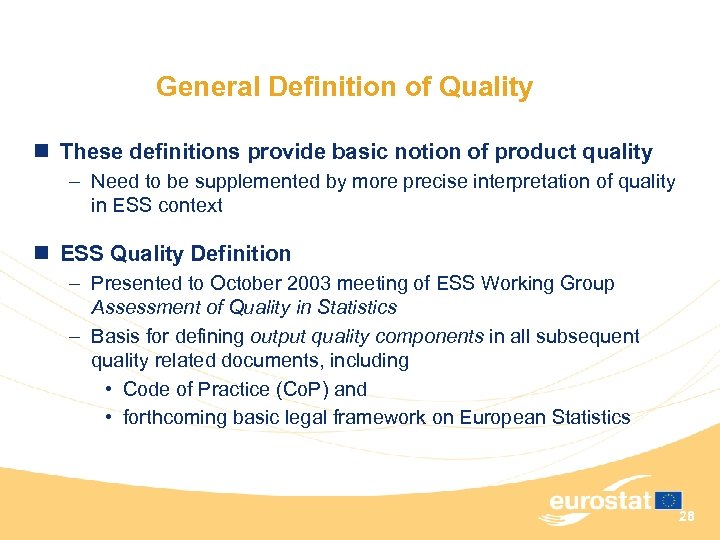 General Definition of Quality n These definitions provide basic notion of product quality – Need to be supplemented by more precise interpretation of quality in ESS context n ESS Quality Definition – Presented to October 2003 meeting of ESS Working Group Assessment of Quality in Statistics – Basis for defining output quality components in all subsequent quality related documents, including • Code of Practice (Co. P) and • forthcoming basic legal framework on European Statistics 28
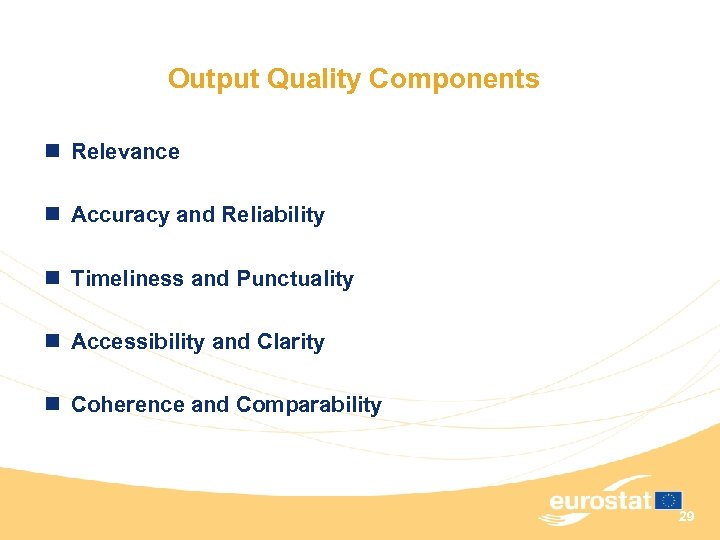 Output Quality Components n Relevance n Accuracy and Reliability n Timeliness and Punctuality n Accessibility and Clarity n Coherence and Comparability 29
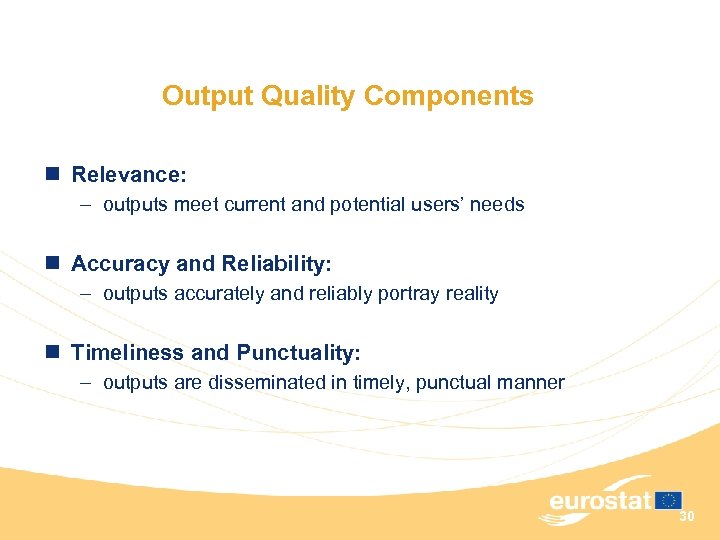 Output Quality Components n Relevance: – outputs meet current and potential users’ needs n Accuracy and Reliability: – outputs accurately and reliably portray reality n Timeliness and Punctuality: – outputs are disseminated in timely, punctual manner 30
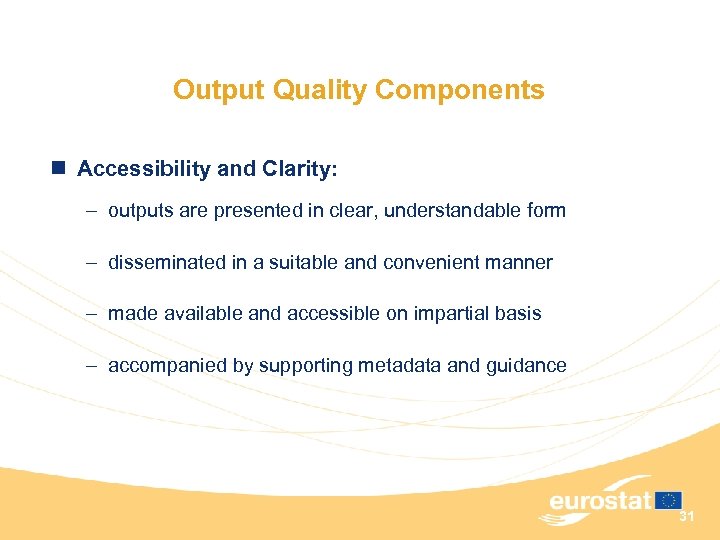 Output Quality Components n Accessibility and Clarity: – outputs are presented in clear, understandable form – disseminated in a suitable and convenient manner – made available and accessible on impartial basis – accompanied by supporting metadata and guidance 31
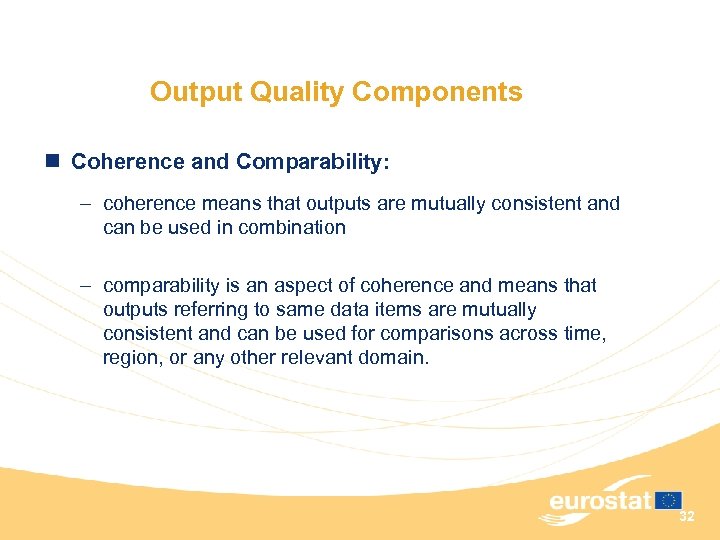 Output Quality Components n Coherence and Comparability: – coherence means that outputs are mutually consistent and can be used in combination – comparability is an aspect of coherence and means that outputs referring to same data items are mutually consistent and can be used for comparisons across time, region, or any other relevant domain. 32
 Process Quality Components n Output quality is achieved through process quality n Process quality has two broad aspects: – Effectiveness: which leads to the outputs of good quality; and – Efficiency: which leads to production of outputs at minimum cost to statistical office and to respondents that provide the original data 33
 Process Quality Components n Guidance on formulation of process quality components provided by first 10 principles in ESS Code of Practice (as previously described) n Principles formulated in two groups: – institutional environment - within which programme of statistical processes is conducted – individual statistical processes 34
 Process Quality Components Based on ESS Code of Practice n Institutional Environment – – – Professional independence Mandate for data collection Adequacy of resources Quality commitment Statistical confidentiality n Individual Statistical Process – – Sound methodology Appropriate statistical procedures Non-excessive burden on respondents Cost effectiveness: resources are effectively used 35
 Process Quality Components Institutional Environment n Professional independence – professional independence of staff from other policy, regulatory or administrative departments and from private sector operators – required to support credibility of outputs n Mandate for data collection – organisation has a clear legal mandate to collect the particular information required – For survey conducted under statistics act providers compelled by law to provide or allow access to data 36
 Process Quality Components Institutional Environment n Adequacy of resources – resources available are sufficient to meet systems and processing requirements n Quality commitment – staff commit themselves to work and cooperate according to principles in ESS Quality Declaration 37
 Process Quality Components Institutional Environment n Statistical confidentiality – guarantees of privacy of data providers, confidentiality of information they provide, and use only for statistical purposes n Impartiality and objectivity: – production and dissemination of statistics respect scientific independence – conducted in an objective, professional and transparent manner – in which all users are treated equitably. 38
 The Generic Statistical Business Process Model August Götzfried 39
 Contents n n n Background Modelling statistical business processes Applicability Structure and key features Relevance to SDMX Next steps 40
 Background n Defining and mapping business processes in statistical organisations started at least 10 years ago – – “Statistical value chain” “Survey life-cycle” “Statistical process cycle” “Business process model” 41
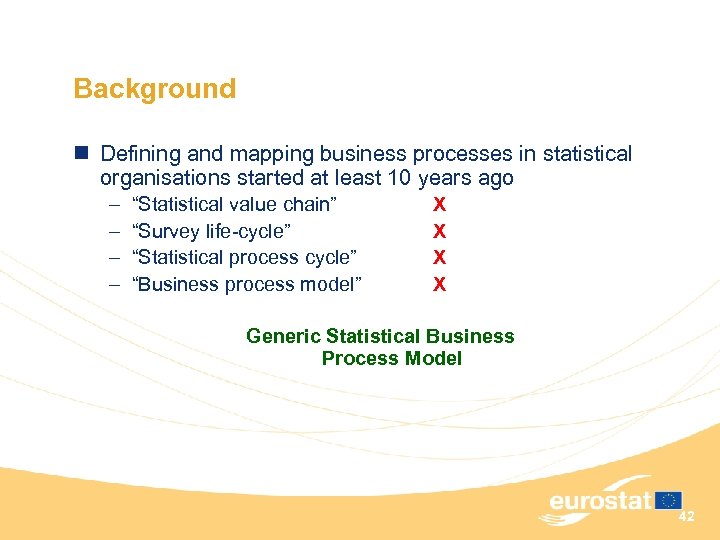 Background n Defining and mapping business processes in statistical organisations started at least 10 years ago – – “Statistical value chain” “Survey life-cycle” “Statistical process cycle” “Business process model” X X Generic Statistical Business Process Model 42
 Modelling Statistical Business Processes n Reached a stage of maturity where a generic international standard could be drawn up n Many drivers for a generic model: – – – “End-to-end” metadata systems development Harmonization of terminology Software sharing Process-based organization structures Process quality management requirements The Eurostat vision. . . 43
 Why do we need a model? n n n To define, describe and map statistical processes in a coherent way To standardize process terminology To compare / benchmark processes within and between organisations To identify synergies between processes To inform decisions on systems architectures and organisation of resources 44
 History of the GSBPM n Based on the business process model developed by Statistics New Zealand n Added phases for: – Archive (inspired by Statistics Canada) – Evaluate (Australia and others) n Three rounds of comments; now quite accepted; n Terminology and descriptions made more generic n Wider applicability? 45
 Applicability of the model n All activities undertaken by producers of official statistics which result in data outputs n National and international statistical organisations n Independent of data source, can be used for: – Surveys / censuses – Administrative sources / register-based statistics – Mixed sources 46
 Applicability of the model n Producing statistics from end-to-end (micro or macro-data) n Revision of existing data / re-calculation of time-series n Development and maintenance of statistical and administrative registers 47
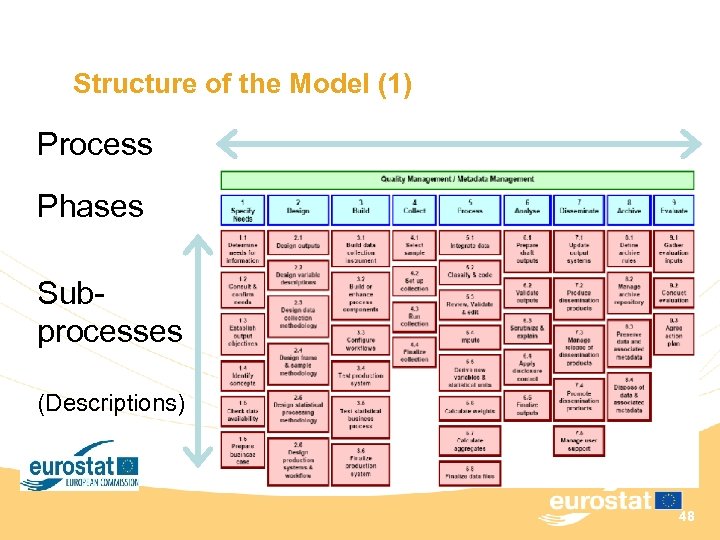 Structure of the Model (1) Process Phases Subprocesses (Descriptions) 48
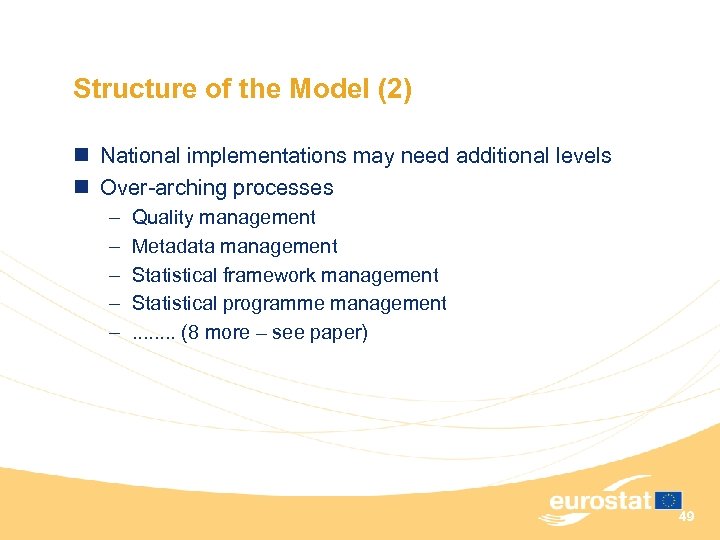 Structure of the Model (2) n National implementations may need additional levels n Over-arching processes – – – Quality management Metadata management Statistical framework management Statistical programme management. . . . (8 more – see paper) 49
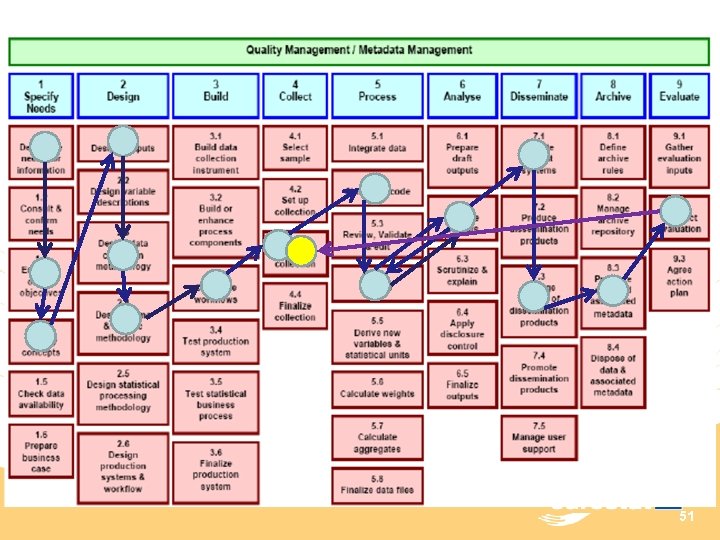
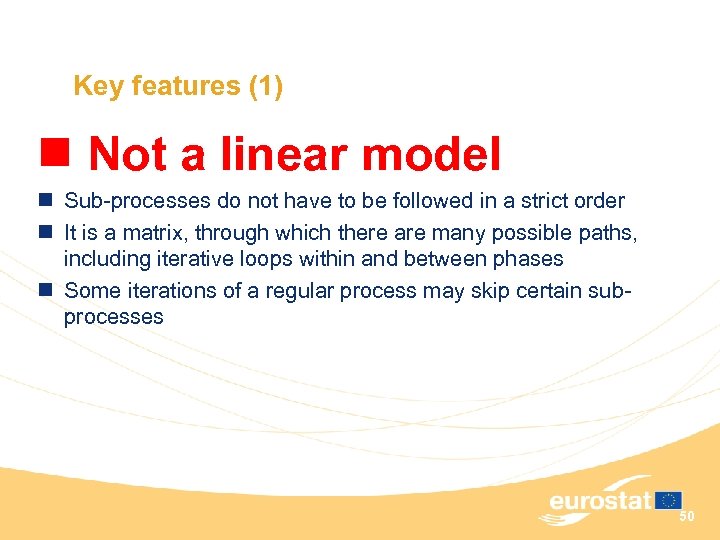 Key features (1) n Not a linear model n Sub-processes do not have to be followed in a strict order n It is a matrix, through which there are many possible paths, including iterative loops within and between phases n Some iterations of a regular process may skip certain subprocesses 50
 51
51
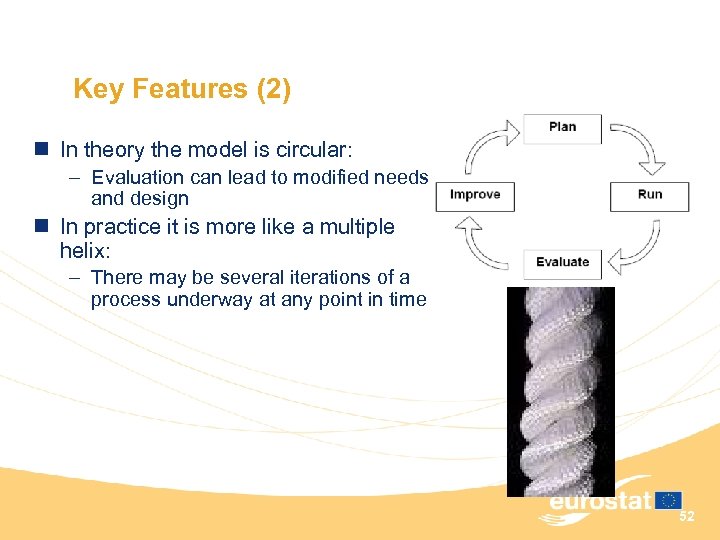 Key Features (2) n In theory the model is circular: – Evaluation can lead to modified needs and design n In practice it is more like a multiple helix: – There may be several iterations of a process underway at any point in time 52
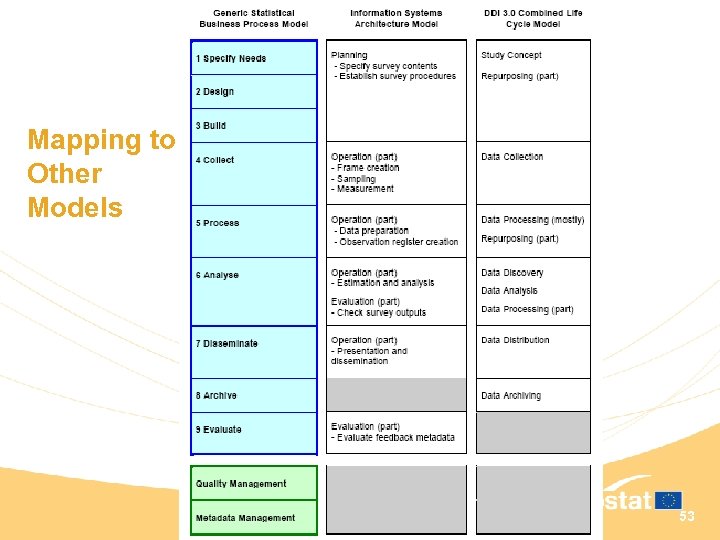 Mapping to Other Models 53
 Relevance to SDMX n Process modelling already mentioned in: – SDMX User Guide – SDMX Technical Standards (version 2. 0) – Euro SDMX Metadata Structure n Common terminology n If inputs and outputs use SDMX formats, why not the intermediate processes? 54
 Standardized process descriptions Harmonised processes Rationalization of software Use of open source and shared components SDMX between components Convergence of business architectures 55
 Next steps n The model is more and more commonly accepted n Several statistical organisations are implementing this model or similar ones n Gather implementation experiences and other comments as input for Part C of the “Common Metadata Framework” n Present to the Bureau of the Conference of European Statisticians n Role in SDMX? 56
 Questions and Comments? For more information see the METIS wiki: www 1. unece. org/stat/platform/display/metis 57
 SESSION 4 11: 30 – 12: 00 TYPES (USED) OF QUALITY REPORTS AND STATISTICAL PROCESSES Eva Elvers 58
 Types of Quality Report and Statistical Process n Purpose – To describe various aspects of a quality report • types of quality report • types of statistical process for which report prepared – To describe structure of ESQR 59
 Content n Types of quality report – Scope/level of quality report – User/producer orientation – Process/output orientation n Types of statistical process n Level of detail and role n Quality reporting structure used in ESQR and EHQR 60
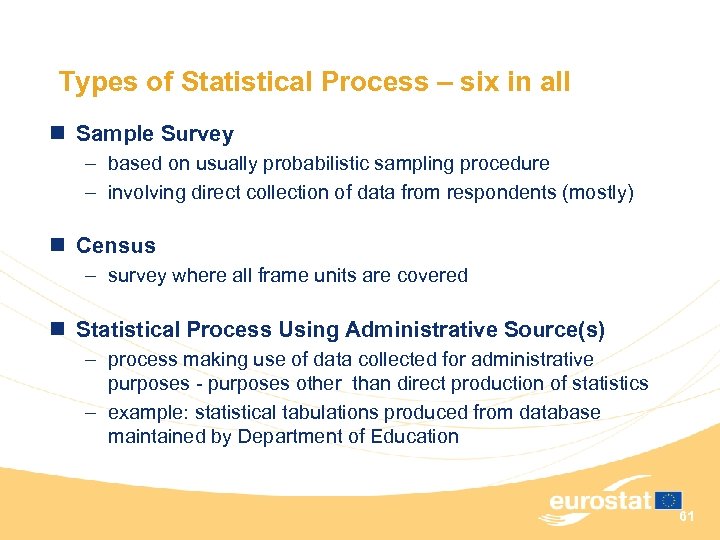 Types of Statistical Process – six in all n Sample Survey – based on usually probabilistic sampling procedure – involving direct collection of data from respondents (mostly) n Census – survey where all frame units are covered n Statistical Process Using Administrative Source(s) – process making use of data collected for administrative purposes - purposes other than direct production of statistics – example: statistical tabulations produced from database maintained by Department of Education 61
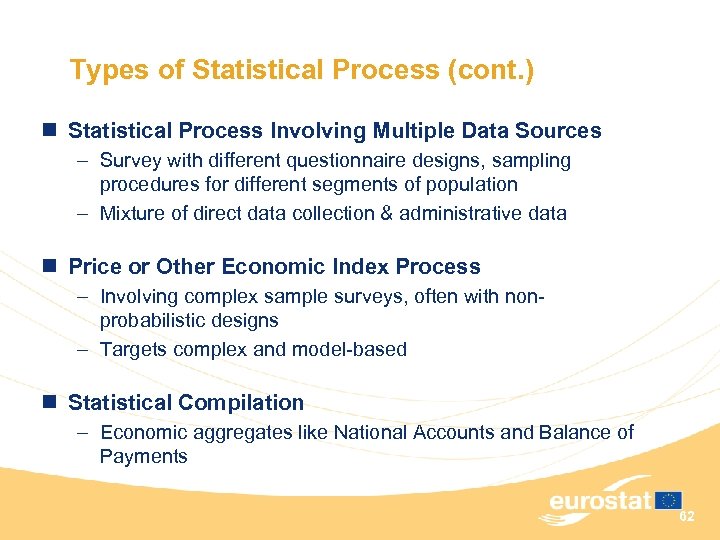 Types of Statistical Process (cont. ) n Statistical Process Involving Multiple Data Sources – Survey with different questionnaire designs, sampling procedures for different segments of population – Mixture of direct data collection & administrative data n Price or Other Economic Index Process – Involving complex sample surveys, often with nonprobabilistic designs – Targets complex and model-based n Statistical Compilation – Economic aggregates like National Accounts and Balance of Payments 62
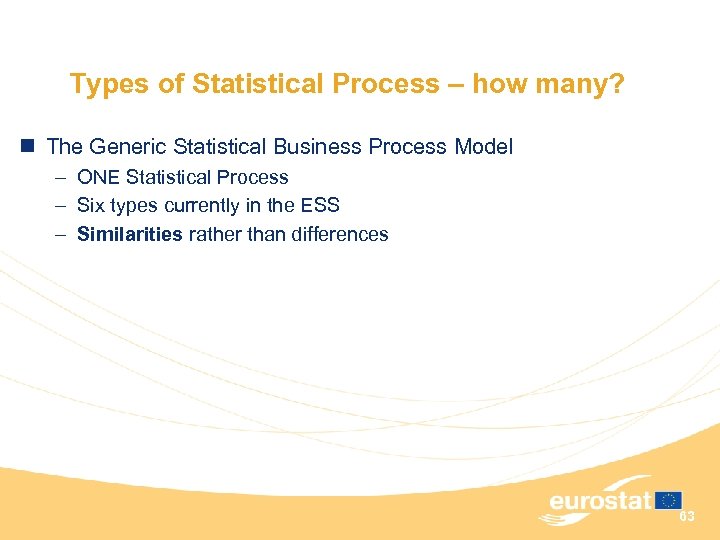 Types of Statistical Process – how many? n The Generic Statistical Business Process Model – ONE Statistical Process – Six types currently in the ESS – Similarities rather than differences 63
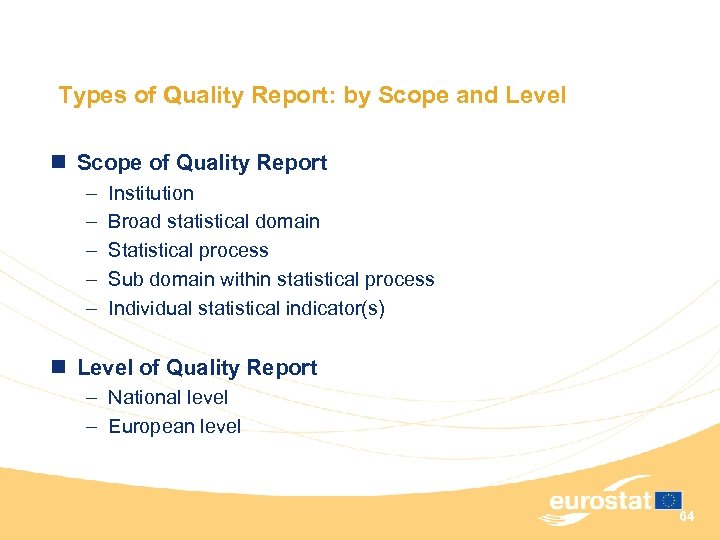 Types of Quality Report: by Scope and Level n Scope of Quality Report – – – Institution Broad statistical domain Statistical process Sub domain within statistical process Individual statistical indicator(s) n Level of Quality Report – National level – European level 64
 European Level Quality Report n European level statistics may include – aggregations of national estimates for European entity - EU-27, EEA, Euro area – comparisons and contrasts of national estimates n Possible objectives of an ESS quality report – quality of European aggregate statistics – quality of comparisons of national statistics – comparisons of qualities of estimates 65
 Types of QR Producer/User Orientation n Quality report may be user-oriented, produceroriented or both – May aim communicate quality between producers n Producer of statistics may also be user of other statistics n Users may be sophisticated/not – advanced analysts/researchers, or public at large 66
 Types of QR by Producer/User Orientation n ESQR is producer-oriented with focus what is needed to ensure quality of ESS n User-oriented quality reporting requires its own standard n Producer oriented report according to ESQR will include all information for user-oriented reports 67
 Types of QR by Process/Output Orientation n Quality report may focus on processes or outputs or both n ESQR has output orientation even though aimed at producers 68
 Types of QR by Level of Detail n Quality report can vary from brief to detailed – Quality profile covers only a few specific attributes and indicators – DESAP checklist covers all aspects but not in detail n ESQR is for the most comprehensive form of quality report commonly prepared – dealing with all important aspects of output and process quality including – descriptions of processes and quality measurements – quantitative quality measures and – discussions of how to deal with deficiencies 69
 Types of QR by Reporting Frequency n Quality reports may be prepared for every cycle, annually, or periodically – the more frequent the report, the less detail n ESQR is aimed at comprehensive document produced periodically – say every five years, or after major changes n In between less detailed reports envisaged – for example, quality and performance indicators for every survey occasion – checklist completed annually 70
 Role of Quality Reporting n Quality report is a means to an end, not an end in itself n Should provide – factual account of quality – recommendations for quality improvements, and – justification for their implementation 71
 ESQR: Reporting Structure n Process quality leads to product quality – if quality report contains an explicit assessment of quality in terms of each process and each output quality component – there must be considerable duplication n Reporting structure in ESQR – based on output quality components – supplemented by headings covering aspects of process quality not readily reported under any output components 72
 ESQR: Reporting Structure – 11 parts 1. Introduction to statistical process and its outputs - overview required to provide context for report 2. Relevance 3. Accuracy 4. Timeliness and punctuality 5. Accessibility and clarity 6. Coherence and comparability 73
 ESQR: Reporting Structure – 11 parts 7. Trade-offs between output quality components – Output quality components not mutually exclusive – Many cases where improvements with respect to one component may lead to deterioration with respect to another – Example: accuracy versus timeliness – Trade-offs that have to be made should be described 74
 ESQR: Reporting Structure – 11 parts 8. Assessment of user needs and perceptions – Users are starting point for quality considerations – Information regarding their needs and perceptions • obtained for all output components at the same time • not just each one individually • Need for a separate section 9. Cost, performance and respondent burden – important process quality components – not readily covered under output quality components – trade-offs versus output quality components 75
 ESQR: Reporting Structure – 11 parts 10. Confidentiality, transparency and security – also important process quality components – not readily covered under output quality components 11. Conclusion – summary of principal quality problems – improvements proposed to deal with them 76
 ESQR: Reporting Structure - Note n Aim of quality report is for producer to describe all aspects of statistical process and its outputs that influence the usefulness of the outputs n The key is to make use of the ESQR structure – but to be flexible in its application – to focus effort on the strengths and weaknesses likely to be of most importance – and on known issues and problem areas 77
 SESSION 5 12: 00 – 12: 45 QUALITY REPORTING STANDARDS (ESQR) AND GUIDELINES (EHQR) Eva Elvers 78
 Quality Reporting Standards and Guidelines In accordance with ESQR reporting structure n n Introduction Relevance, Accuracy, Coherence and Comparability, Timeliness and Punctuality, Accessibility and Clarity, Trade-offs, Performance, Cost and Respondent Burden Assessment of User Needs and Perceptions, Confidentiality, Transparency and Security 79
 Quality Reporting Standards and Guidelines Important: n n What to include How to measure, estimate, or assess Evaluation, possibly later QPI’s: Quality and Performance Indicators EG on Quality Barometer; not details here 80
 Introduction to the Statistical Process n (To provide context for report) n Historical background to process, objectives and outputs n Domain – broad – to which outputs belong n The quality report at hand; the boundary and references to related quality reports n Outputs produced – overview in general terms n References to other related reports 81
 Relevance n Relevance is the degree to which statistical outputs meet current and potential user needs. It depends on whether all the statistics that are needed are produced and the extent to which concepts used (definitions, classifications etc. , ) reflect user needs n Relevance depends on the use, and relevance may depend on user n So, not a single simple description, but a broad perspective 82
 Relevance Reporting n Content-oriented description of all outputs – key indicators, reference period(s) n Definitions of statistical target concepts – population, units – relation to target definitions that would be ideal from a user perspective – discrepancies between definitions used and accepted ESS or international definitions – trade-off between relevance and accuracy n Assessment of key outputs – Unmet user needs and reasons – Completeness relative to regulations 83
 Relevance Reporting (cont. ) n For administrative statistics – Definitions fixed, or influenced, by primary purpose of administrative regulation – Possible problems n For price indexes – (Discuss important issues) n For statistical compilations – Comparison of target concepts with definitions and concepts in international standards 84
 Accuracy n The accuracy of statistical outputs in the general statistical sense is the degree of closeness of estimates to the true values n Overall and error sources n Sampling errors and non-sampling errors n Process type? 85
 Overall accuracy n A presentation of the methodology sufficient for (i) judging whether it lives up to internationally accepted standards and best practice and (ii) enabling the reader to understand specific error assessments. n Identification of the main sources of error for the main variables. n A summary assessment of all sources of error with special focus on the key estimates. n An assessment of the potential for bias (sign and order of magnitude) for each key indicator in quantitative or qualitative terms. 86
 Sampling Errors: Always; Probability and Non-Probability Sampling n Presentation, formulas, . . . n Presentation device: CV, confidence interval n Sampling error cannot be estimated without reference to a model – model implying that sample is “effectively random” can sometimes be used – for example, for price indices n For cut-off random sampling – error for sampled portion should be reported – for non-sampled portion discuss sampling bias n Sampling biases may be significant – need to be assessed as well 87
 /Sample Surveys/ Coverage Errors n Information on survey frame – reference period, updating actions – references to other documents on frame quality n Quantitative information on overcoverage and multiple listing n Assessment (preferably quantitative) on – extent of undercoverage – associated bias risks n Actions taken to reduce undercoverage and bias risks 88
 /Sample Surveys/ Measurement Errors n Why ? n Data editing identifies inconsistencies due to – errors in the original data – processing errors due to coding or data entry n Inconsistencies removed by clerical correction and/or automatic imputation n Edit rule failure rates are indicative of – quality of data collection and processing – not of quality of final data n Attention paid to data editing should reflect significance of such errors 89
 Measurement Errors (cont. ) Methods of error evaluation n Comparisons with other data at unit level – requires common unit identification scheme – accounting for conceptual or timing differences n Re-interview with superior method – preferably for random sample of units 90
 Measurement Errors (cont. ) Methods of error evaluation (continued) n Replication – Differences between replicates indicate stability of measurement process – Analyses often assume replication errors are independent – rarely fully justified n Effects of data editing – Comparisons of original and edited data gives a minimum estimate of error levels 91
 /Sample Surveys/ Non-Response Errors n Non-response error – difference between statistics computed from collected data and those that would be computed if there were no missing values n Types of non-response: – unit non-response - no data are collected from unit – item non-response - some missing values in data collected from a unit 92
 /Sample Surveys/ Non-Response Errors Impact of nonresponse n Introduction of bias – nonrespondents not similar to respondents for all variables in all strata – whereas standard methods for handling nonresponse assume they are. n Increase in sampling error – as available number of responses is reduced n Many definitions of response rates – slightly different numerators and denominators 93
 Non-Response Errors Reporting n Definitions of response rates n Unit non-response rates for whole survey and important sub-domains n Item non-response rates for key variables n Breakdown of non-respondents by cause n Qualitative statement on risk of bias n Measures to reduce non-response n Treatment of non-response in estimation 94
 /Sample Surveys/ Processing Errors n Identification of main issues n Include manual coding of response data that are in free format – Quality control procedures n Analysis of processing errors (where available) otherwise qualitative assessment 95
 Accuracy: Censuses n Report non-sampling errors as for sample surveys n Include – Assessments of measurement, classification errors – Assessment of processing errors, especially where manual coding of data in free text format is used. n For censuses based on extensive field work: – Assessment of undercoverage and overcoverage (undercount and over- or double count) – Description of methods used to correct 96
 Accuracy: Statistics from Administrative Sources n Report non-sampling errors as for sample surveys n Include assessment of over- and under-coverage due to lags in register updating n Include assessment of errors in classification variables n For statistics based on event reporting include assessment of rate of unreported events 97
 Accuracy: Price and Other Economic Indices n Information on all sampling dimensions – for weights, products, outlets/companies etc. n Attempts at assessing sampling error – in all or some dimensions n Quality adjustment methods – including replacement and re-sampling rules – for at least major product groups n Assessment of other types of error – where they could have a significant influence 98
 Accuracy: Statistical Compilations n Information and indicators relating to accuracy required by IMF Data Quality Assessment Framework (DQAF) or equivalent. n Analysis of revisions between successively published estimates n For National Accounts – Analysis of causes for statistical discrepancy – Assessment of non-observed economy 99
 Other Issues Concerning Accuracy n Model Assumptions and Associated Errors n Seasonal Adjustment n Imputation n Mistakes 100
 Special Issues Concerning Accuracy: Revisions n Planned revisions should follow standard, wellestablished and transparent procedures – pre-announcements are desirable – reasons for revision and nature of the revision should be made clear – For example new source data available, new methods, etc 101
 Coherence and Comparability: Short Definitions n Coherence: capacity of outputs to be combined and reliably used in combination n Comparability: special case of coherence for outputs involving the same data items 102
 Coherence and Comparability: Explanation n The coherence of two or more statistical outputs refers to the degree to which the statistical processes by which they were generated used the same concepts - classifications, definitions, and target populations – and harmonised methods. n Coherent statistical outputs have the potential to be validly combined and used jointly. 103
 Coherence and Comparability: Explanation (cont. ) n Examples of joint use are where the statistical outputs refer to the same population, reference period and region but comprise different sets of data items (say, employment data and production data) or where they comprise the same data items (say, employment data) but for different reference periods, regions, or other domains. n Comparability is a special case of coherence and refers to the latter example above where statistical outputs refer to the same data items and the aim of combining them is to make comparisons over time, or across regions, or across other domains. 104
 Coherence and Comparability: Notes n Distinction between coherence and accuracy – Coherence measured in terms of design metadata – Accuracy depends upon operational metadata – Differences between preliminary, revised and final estimates are an accuracy issue n Reasons for lack of coherence/comparability – Concepts: target population – units and coverage, reference period, data item definitions, classifications – Methods: frame construction, sources of data and sample design, data collection, capture, editing, imputation, estimation 105
 Coherence and Comparability Reporting General n Descriptions of conceptual and methodological metadata elements that could affect coherence/ comparability n Assessment (preferably quantitative) of possible effect of each reported difference on outputs n Differences between statistical process and applicable European regulations/standards and/or international standards 106
 Timeliness and Punctuality Definition/Description n Timeliness: length of time between the event or phenomenon and the availability of the statistics. n Punctuality: time lag between the release date of data and the scheduled date for release. 107
 Reporting § Timeliness and punctuality profile for each version (preliminary, revised, final) whenever statistics are released in multiple versions. § Reasons for possible long production times and non-punctual releases and description of the efforts made to improve situation. § Timeliness : for annual or more frequent releases the average production time for each release of data; maximum production time to provide worst recorded case. § Punctuality : the percentage of releases delivered on time (based on scheduled release dates). 108
 Accessibility and Clarity Definition/Description § Accessibility : measure of ease with which users can obtain the data (where to go, how to order, delivery time, pricing policy, marketing conditions, availability of micro data etc). § Clarity : measure of the ease with which users can understand the data (depends upon the quality of metadata). Summary: both refer to the simplicity and ease with which users can access statistics with appropriate supporting information. 109
 Reporting § Description of the conditions of access to the data: media, support, pricing policies, possible restrictions, etc. § Summary description of the metadata accompanying the statistics (documentation, explanation, quality limitations, etc. ) § Description of how well both less sophisticated and advanced users needs have been addressed. § Summary of user feedback on accessibility and clarity. § Recent and planned improvements to accessibility and clarity. 110
 Trade-offs between Output Quality Components Definition/Description § Quality components are not mutually exclusive, there are relationships between the factors that contribute to them. § In some cases there are factors leading to improvements with respect to one component but result in deterioration with respect to another. § Decisions for trade-offs have to be made in such circumstances. 111
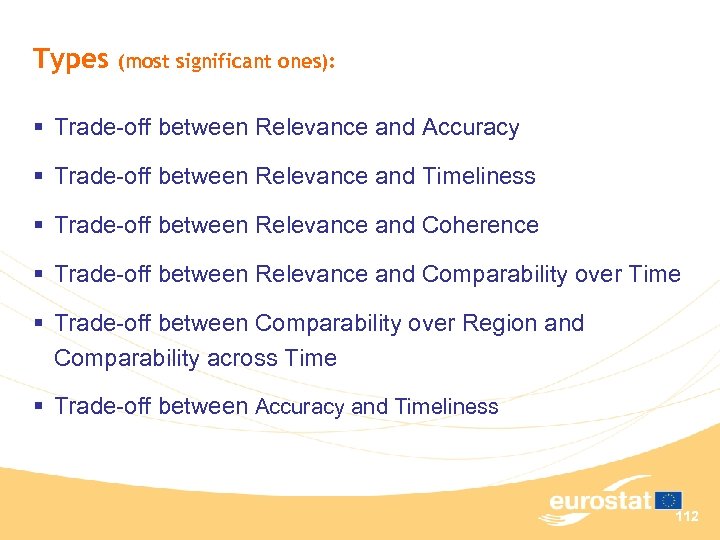 Types (most significant ones): § Trade-off between Relevance and Accuracy § Trade-off between Relevance and Timeliness § Trade-off between Relevance and Coherence § Trade-off between Relevance and Comparability over Time § Trade-off between Comparability over Region and Comparability across Time § Trade-off between Accuracy and Timeliness 112
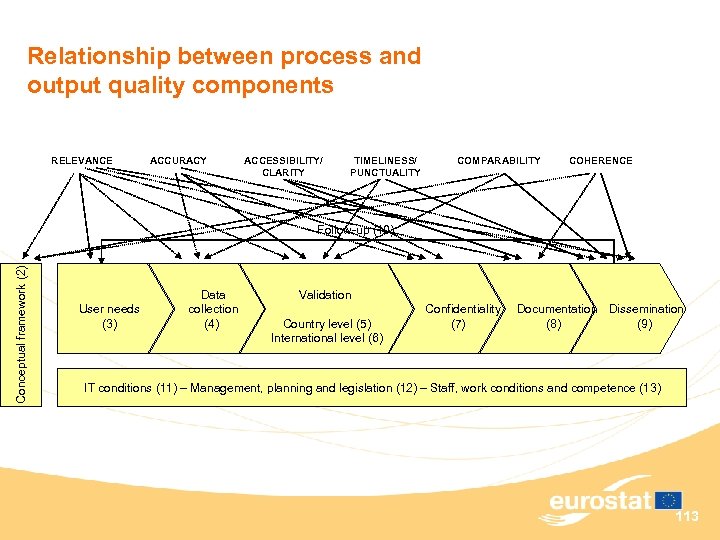 Relationship between process and output quality components RELEVANCE ACCURACY ACCESSIBILITY/ CLARITY TIMELINESS/ PUNCTUALITY COMPARABILITY COHERENCE Conceptual framework (2) Follow-up (10) User needs (3) Data collection (4) Validation Country level (5) International level (6) Confidentiality Documentation Dissemination (7) (8) (9) IT conditions (11) – Management, planning and legislation (12) – Staff, work conditions and competence (13) 113
 Performance, Cost, and Respondent Burden Definition/Description § Cost benefit analyses are required to determine the appropriate trade-off between costs and benefits of the output quality components. § Respondent participation must be viewed as a cost (to respondents) that has to be balanced against the benefits of the data provided. 114
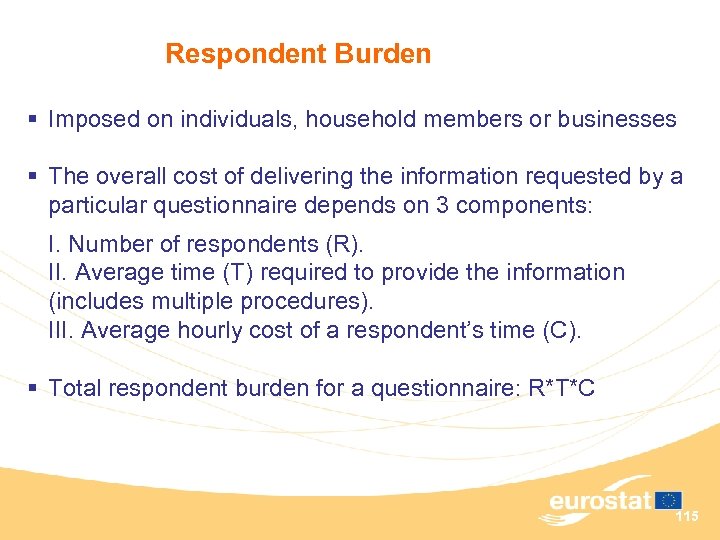 Respondent Burden § Imposed on individuals, household members or businesses § The overall cost of delivering the information requested by a particular questionnaire depends on 3 components: I. Number of respondents (R). II. Average time (T) required to provide the information (includes multiple procedures). III. Average hourly cost of a respondent’s time (C). § Total respondent burden for a questionnaire: R*T*C 115
 Assessment of User Needs and Perceptions n We provide our users with products and services that meet their needs. The articulated and non-articulated needs, demands and expectations of external and internal users will guide the ESS, its members, their employees and operations (ESS Quality Declaration - User Focus) 116
 Confidentiality, Transparency and Security n The privacy of data providers (households, enterprises, administrations and other respondents), the confidentiality of the information they provide and its use only for statistical purposes must be absolutely guaranteed. n Statistical authorities must produce and disseminate European statistics respecting scientific independence and in an objective, professional and transparent manner in which all users are treated equitably. n (European Code of Practice, Principles 5 and 6). 117
 ESS QPI’s – prerequisites for Quality and Performance Indicators n Quality indicators: summary measures for certain key elements (process variables or output characteristics) n Representative of the main quality criteria n Applicable to most statistical processes n Well defined and standardised methodology for the calculation n Easy to interpret and understand n No additional burden for the Eurostat production units 118
 Users and uses of the ESS QPI’s – e. g. a Quality Barometer (QB) n For production managers to evaluate their specific production process. n For domain managers to compare the quality indicators with average values for benchmarking across processes. n For top-management to have highly synthesised quantitative information for strategic decision making. n For users to analyse characteristics of the statistics and to compare the quality of different sets of statistics. 119
 QPI – characteristics n Indicator for quality component n Definition n Levels of aggregation n Formulae n Interpretation 120
 QPI – some examples n Relevance – Rate of available statistics n Accuracy – Coefficient of variation – Rate of over-coverage – Average size of revisions n Comparability and coherence – Length of comparable time series –. . . 121
 SESSION 6 14: 00 – 14: 30 SDMX – A STANDARD PLATFORM FOR EXCHANGE OF METADATA August Götzfried 122
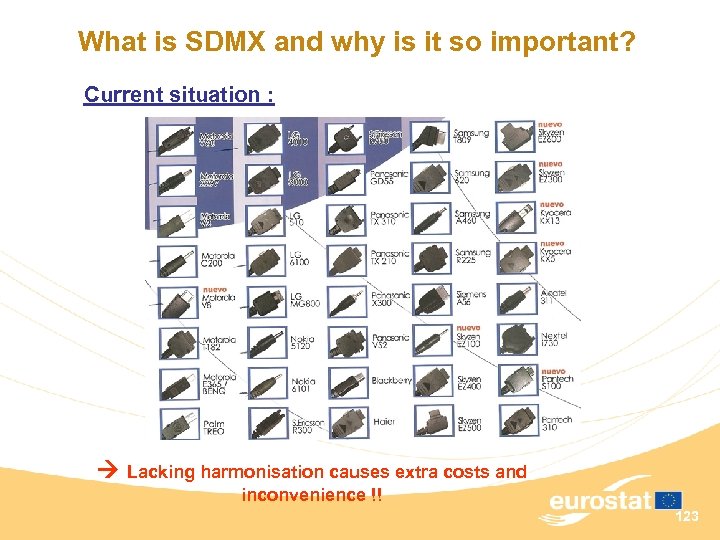 What is SDMX and why is it so important? Current situation : Lacking harmonisation causes extra costs and inconvenience !! 123
 What is SDMX and why is it so important? Solution: A common and harmonised phone charger Benefits : n For producers – One charger cheaper prod. costs – One package cheaper transport costs n For clients – One charger serves all convenience – Lower prod. Costs lower phone prices – Possible charging from computers n For everyone – Less chargers needed environmental benefits 124
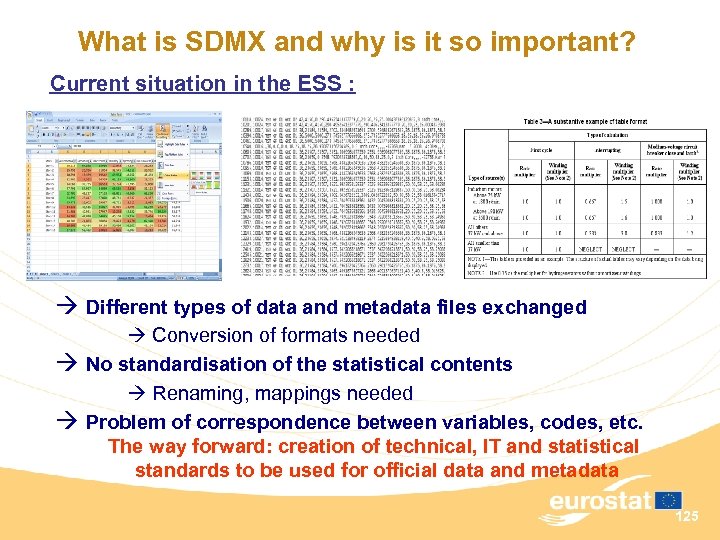 What is SDMX and why is it so important? Current situation in the ESS : Different types of data and metadata files exchanged Conversion of formats needed No standardisation of the statistical contents Renaming, mappings needed Problem of correspondence between variables, codes, etc. The way forward: creation of technical, IT and statistical standards to be used for official data and metadata 125
 What is SDMX and why is it so important? Seven international organizations (BIS, ECB, Eurostat, IMF, OECD, UN, World Bank) have joined forces, with the results of creating the SDMX technical and statistical standards and guidelines together with an IT service architecture and IT tools to be used for the efficient exchange and sharing of statistical data and metadata. These technical and statistical standards and guidelines are sufficiently mature now. They are used and implemented more and more by statistical organizations around the world. 126
 SDMX within the European Statistical System Ø In 03/2009, the Eurostat top management confirmed SDMX and its implementation within the ESS in stating: “As a first step before making SDMX compulsory for all domains in Eurostat, the use of SDMX would be made compulsory for all new or considerably changed datasets and reference metadata sets. ” Ø The SDMX technical and statistical standards and guidelines can be regarded as one of the main enablers for implementing the new Eurostat vision based on the Commission Communication (COM 404/2009). 127
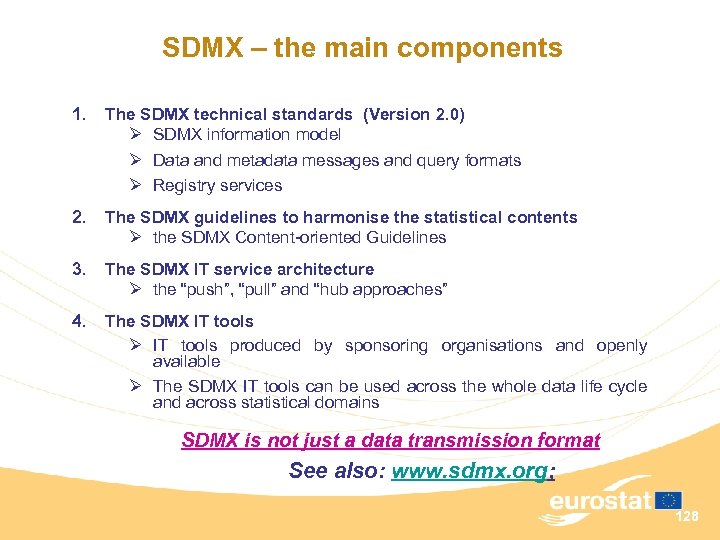 SDMX – the main components 1. The SDMX technical standards (Version 2. 0) Ø SDMX information model Ø Data and metadata messages and query formats Ø Registry services 2. The SDMX guidelines to harmonise the statistical contents Ø the SDMX Content-oriented Guidelines 3. The SDMX IT service architecture Ø the “push”, “pull” and “hub approaches” 4. The SDMX IT tools Ø IT tools produced by sponsoring organisations and openly available Ø The SDMX IT tools can be used across the whole data life cycle and across statistical domains SDMX is not just a data transmission format See also: www. sdmx. org; 128
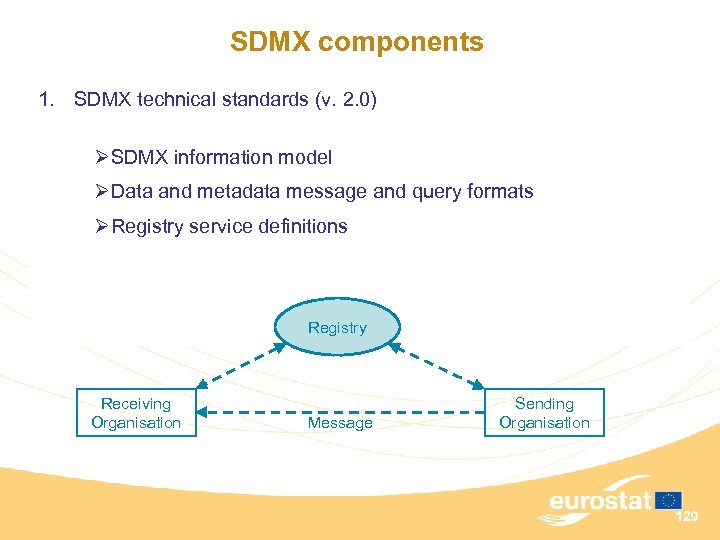 SDMX components 1. SDMX technical standards (v. 2. 0) ØSDMX information model ØData and metadata message and query formats ØRegistry service definitions Registry Receiving Organisation Message Sending Organisation 129
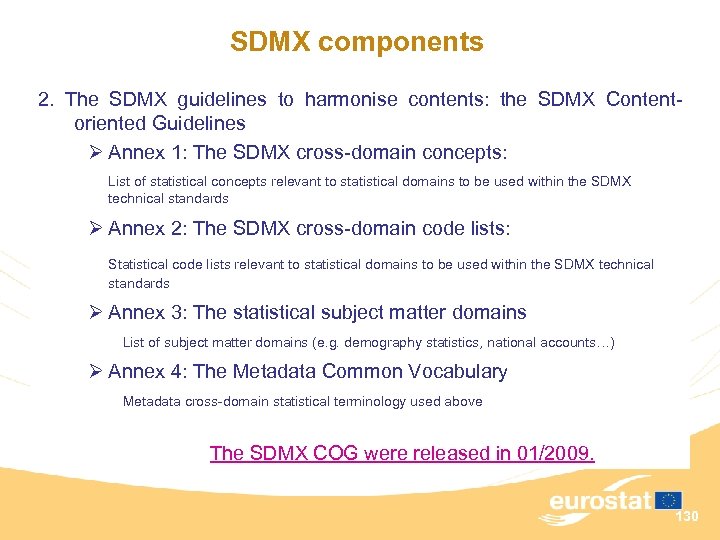 SDMX components 2. The SDMX guidelines to harmonise contents: the SDMX Contentoriented Guidelines Ø Annex 1: The SDMX cross-domain concepts: List of statistical concepts relevant to statistical domains to be used within the SDMX technical standards Ø Annex 2: The SDMX cross-domain code lists: Statistical code lists relevant to statistical domains to be used within the SDMX technical standards Ø Annex 3: The statistical subject matter domains List of subject matter domains (e. g. demography statistics, national accounts…) Ø Annex 4: The Metadata Common Vocabulary Metadata cross-domain statistical terminology used above The SDMX COG were released in 01/2009. 130
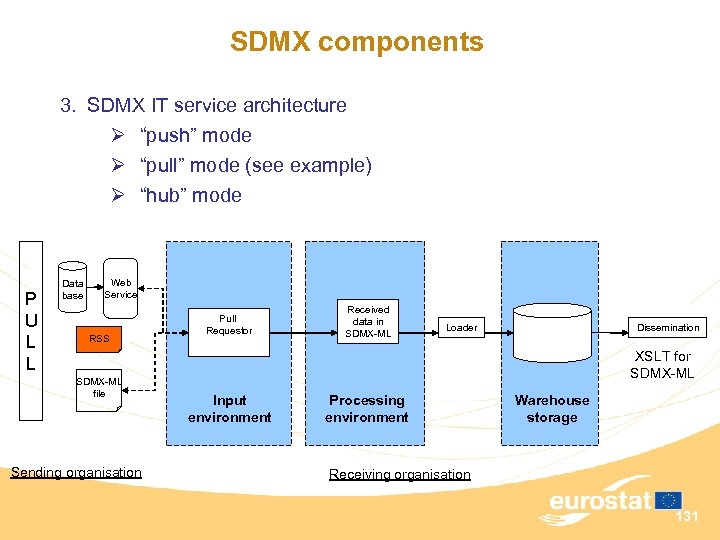 SDMX components 3. SDMX IT service architecture Ø “push” mode Ø “pull” mode (see example) Ø “hub” mode P U L L Data base Web Service RSS SDMX-ML file Sending organisation Pull Requestor Received data in SDMX-ML Loader Dissemination XSLT for SDMX-ML Input environment Processing environment Warehouse storage Receiving organisation 131
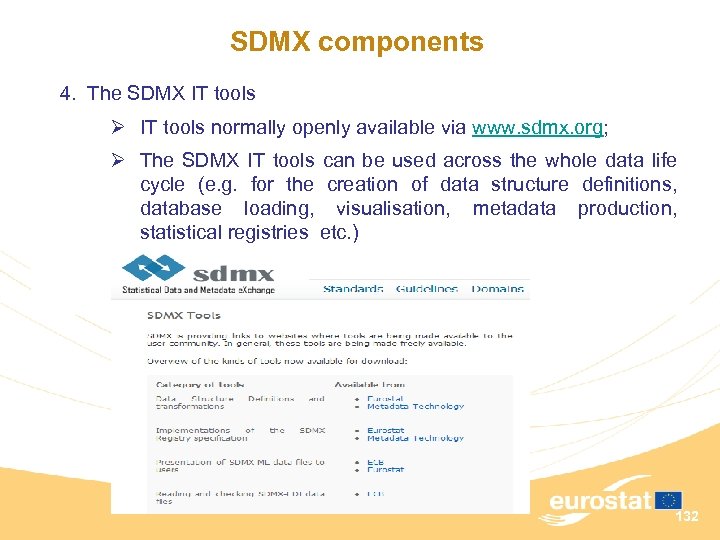 SDMX components 4. The SDMX IT tools Ø IT tools normally openly available via www. sdmx. org; Ø The SDMX IT tools can be used across the whole data life cycle (e. g. for the creation of data structure definitions, database loading, visualisation, metadata production, statistical registries etc. ) 132
 Benefits of SDMX Ø SDMX is the crucial instrument for rendering the production method of ESS statistics more efficient → new Eurostat vision Ø After a phase of low investment costs, the use of SDMX should reduce the burden on national and international statistical organizations. Ø Data and metadata messages produced by national and international organizations get more comparable and consistent. Ø National and international statistical processes get more harmonized and offer new ways of data and metadata exchange (such as data hubs). Ø Web-based dissemination formats are provided that are computer “readable” and easier to update. 133
 Costs of SDMX Ø Development/maintenance of the SDMX standards and guidelines done by the international sponsoring institutions (supported by NSIs) Ø Standards are public and open source Ø IT tools are created by sponsoring or other organizations and made freely available Ø Capacity building by sponsoring or other institutions Ø Input to the SDMX standards from the user community through open process Ø No need to radically change the IT and statistical systems: gradual SDMX implementation possible with low investment costs 134
 SDMX – latest progress More emphasis on the implementation of SDMX within the ESS (asked by the Eurostat senior management) Ø Accelerated implementation in statistical domains (new Data Structure Definitions created) Ø Harmonisation of structural and reference metadata (e. g. the ESMS and the harmonised code lists) Ø SDMX is also implemented into the Eurostat IT applications used within the Eurostat CVD (in the single entry point, reference database, metadata handler etc. ) Ø Many training and other capacity building actions organised (for IT staff, statisticians…) Ø Use of the hub/pull architecture (e. g. census hub) 135
 Summarising Ø SDMX is global Ø Good progress reached in creating the SDMX technical and statistical standards and guidelines Ø SDMX at the core of the harmonisation of the statistical business process, as outlined in the new Eurostat strategy Ø The implementation of SDMX in the different statistical domains requires the close involvement of Member states For more information please see under http: //www. sdmx. org 136
 SESSION 7 14: 30 – 15: 00 THE ESS METADATA STANDARDS August Götzfried 137
 1. The ESS Standards for Reference Metadata 1. 1 The Euro SDMX Metadata Structure (ESMS) 1. 2 The Quality Reporting within Eurostat and the ESS (ESQRS) 1. 3 Relation between ESMS, ESQR and ESQRS 2. The ESS Standards for Structural Metadata 2. 1 Harmonisation within Eurostat and the ESS 2. 2 Harmonisation within SDMX 138
 Reference and Structural Metadata Reference Metadata: – describe the contents and the quality of statistical data • conceptual metadata describing the concepts used • methodological metadata describing methods • quality metadata describing the data quality – are often linked to the data, but this is not mandatory Structural Metadata: – identify and describe the data • Name of the variables • Dimensions used in statistical cubes – must be associated to the data otherwise data are meaningless 139
 1. The ESS standards for Reference Metadata 1. 1 The Euro SDMX Metadata Structure (ESMS) § is the standard format for reference metadata in the ESS § replaces the former SDDS format since December 2008 All SDDS files disseminated on Eurostat’s website are being converted into ESMS format (ongoing process, soon finalised) § is the format to be used for the reporting of national reference metadata files to Eurostat (Commission Recommendation 2009/498/EC of June 2009) § covers 21 concepts selected from the 62 SDMX crossdomain concepts (also the main quality related concepts) § is fully SDMX compliant. 140
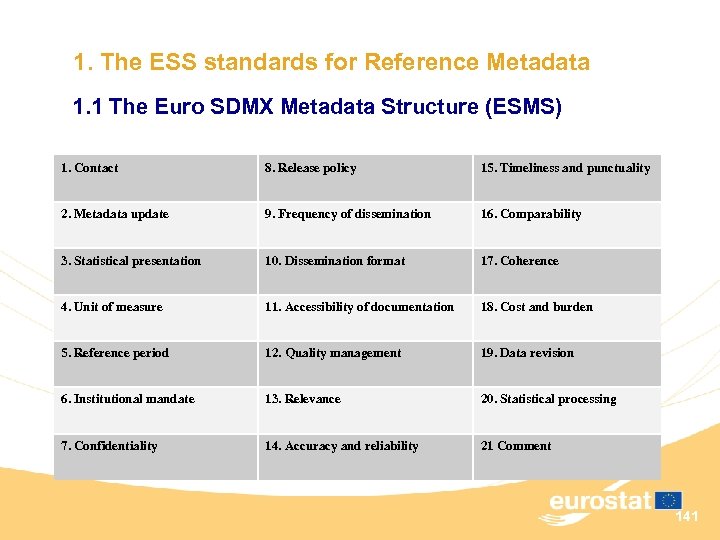 1. The ESS standards for Reference Metadata 1. 1 The Euro SDMX Metadata Structure (ESMS) 1. Contact 8. Release policy 15. Timeliness and punctuality 2. Metadata update 9. Frequency of dissemination 16. Comparability 3. Statistical presentation 10. Dissemination format 17. Coherence 4. Unit of measure 11. Accessibility of documentation 18. Cost and burden 5. Reference period 12. Quality management 19. Data revision 6. Institutional mandate 13. Relevance 20. Statistical processing 7. Confidentiality 14. Accuracy and reliability 21 Comment 141
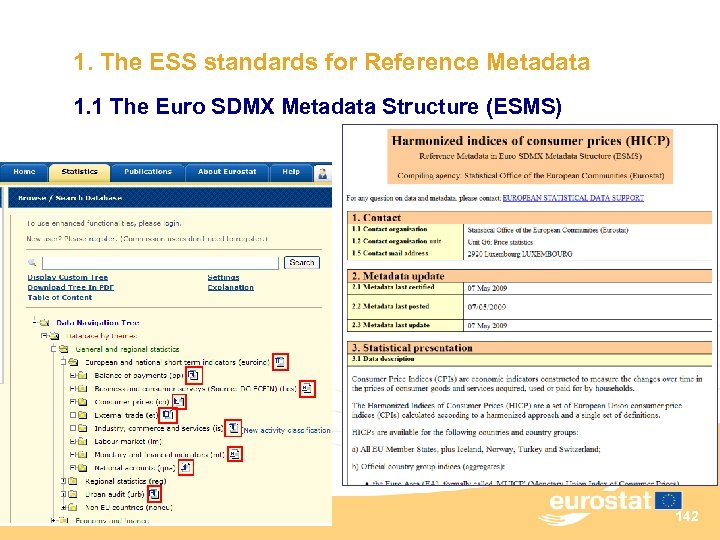 1. The ESS standards for Reference Metadata 1. 1 The Euro SDMX Metadata Structure (ESMS) 142
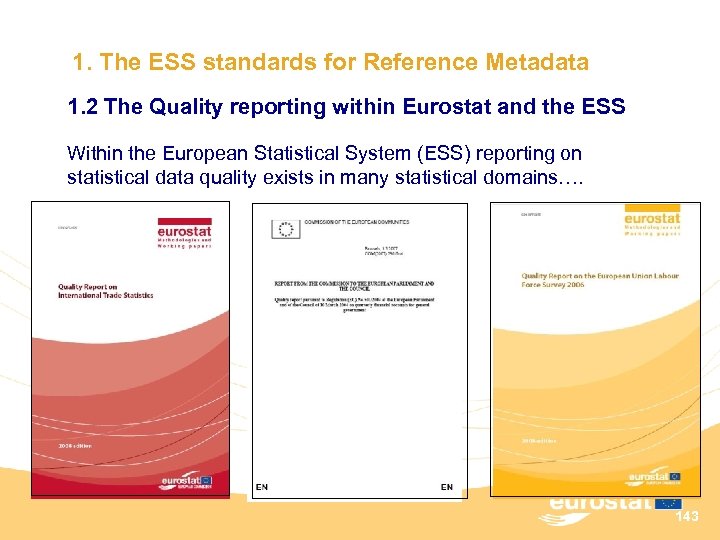 1. The ESS standards for Reference Metadata 1. 2 The Quality reporting within Eurostat and the ESS Within the European Statistical System (ESS) reporting on statistical data quality exists in many statistical domains…. 143
 1. The ESS standards for Reference Metadata 1. 2 The Quality reporting within Eurostat and the ESS … BUT : – Quality reports do not exist for all statistical processes within the ESS; – No homogeneity between the different report structures used for data quality reporting; – Not all the quality related information is made publicly available; – No common and standard IT infrastructure is used within the ESS; The new Eurostat vision: “Improving the production method of EU statistics” requires an improvement action. 144
 1. The ESS standards for Reference Metadata 1. 2 The Quality reporting within Eurostat and the ESS Progress made since 2008 : n 01/2009: release of the new version of the ESS quality reporting documents: • ESS Standard for Quality Reports (ESQR) • ESS Handbook for Quality Reports (EHQR) Detailed requirements following the European Statistics Code of Practice ESS Quality and Performance Indicators (QPI’s) defined n 03/09: EP/Council Regulation 223/2009 Article 12 defining the quality criteria to be reported 145
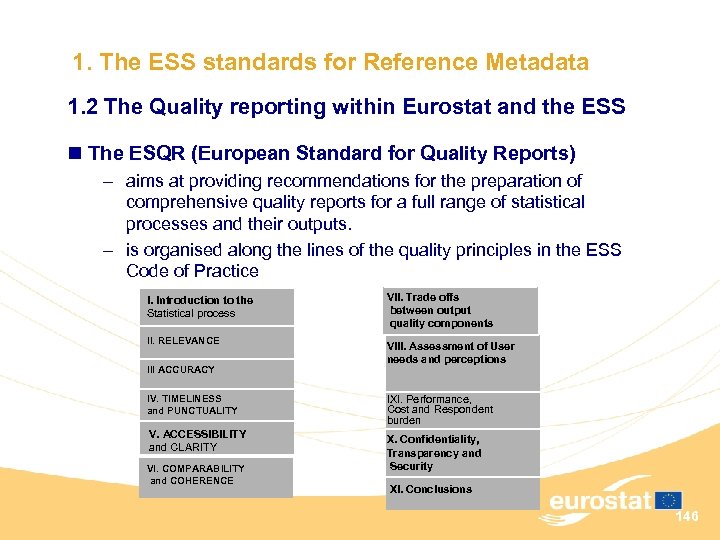 1. The ESS standards for Reference Metadata 1. 2 The Quality reporting within Eurostat and the ESS n The ESQR (European Standard for Quality Reports) – aims at providing recommendations for the preparation of comprehensive quality reports for a full range of statistical processes and their outputs. – is organised along the lines of the quality principles in the ESS Code of Practice I. Introduction to the Statistical process II. RELEVANCE III ACCURACY IV. TIMELINESS and PUNCTUALITY V. ACCESSIBILITY and CLARITY VI. COMPARABILITY and COHERENCE VII. Trade offs VII. Trade Output Quality between output Components quality components VIII. Assessment of User needs and perceptions IXI. Performance, Cost and Respondent Burden burden X. Confidentiality, Transparency and Security XI. Conclusions 146
 1. The ESS standards for Reference Metadata 1. 2 The Quality reporting within Eurostat and the ESS n The ESQRS (ESS Standard for Quality Reports Structure) – Based on the ESQR, a new report structure - the ESQRS - was created for harmonising the reporting on statistical data quality within the ESS. – The ESQRS is using the main statistical data quality criteria as listed in EP/Council Regulation 223/2009 and as being part of the ESMS and details them further : • • • Relevance Accuracy Timeliness and Punctuality Accessibility and Clarity Comparability Coherence – A subset of the Quality Performance Indicators (QPI’s) is also covered in the new ESQRS. 147
 ESS Guidelines n The guidelines for quality reporting from ESS Handbook for Quality Reports (EHQR) are already used in the “ESS Guidelines” for ESMS. n These guidelines will be further used in the ESQRS in order to provide detailed guidelines for 6 different statistical processes: • • • Sample survey Census Statistical Process using Administrative Sources Statistical Process involving Multiple Data Sources Price or other Economic Index Process Statistical Compilation 148
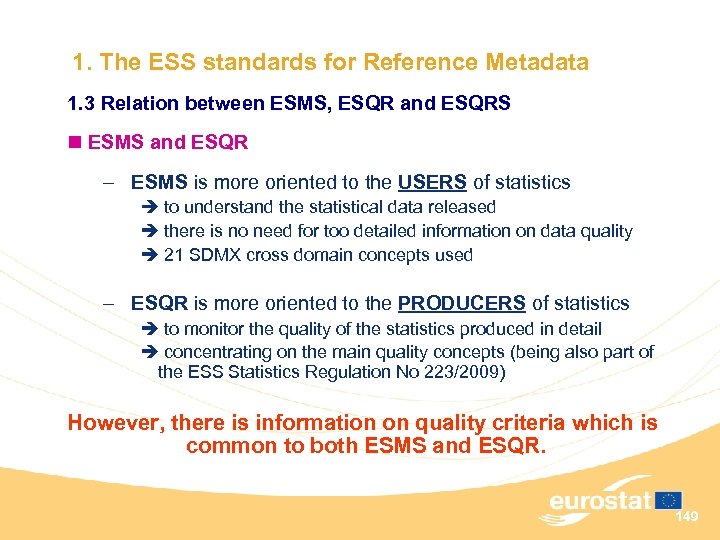 1. The ESS standards for Reference Metadata 1. 3 Relation between ESMS, ESQR and ESQRS n ESMS and ESQR – ESMS is more oriented to the USERS of statistics to understand the statistical data released there is no need for too detailed information on data quality 21 SDMX cross domain concepts used – ESQR is more oriented to the PRODUCERS of statistics to monitor the quality of the statistics produced in detail concentrating on the main quality concepts (being also part of the ESS Statistics Regulation No 223/2009) However, there is information on quality criteria which is common to both ESMS and ESQR. 149
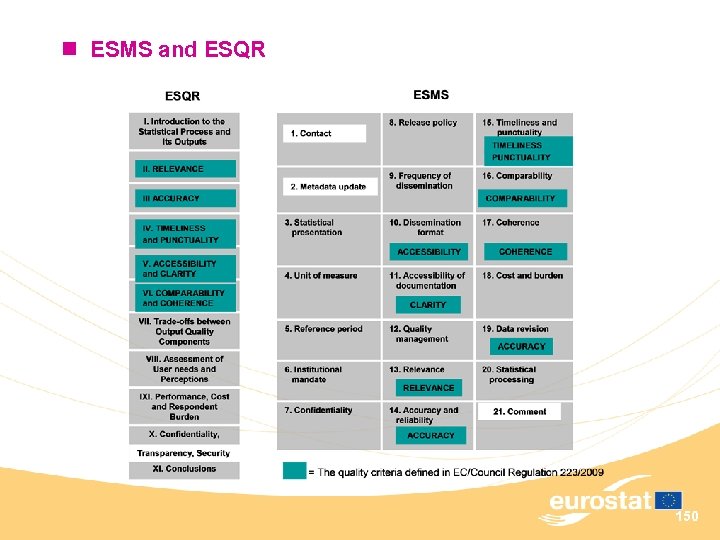 n ESMS and ESQR 150
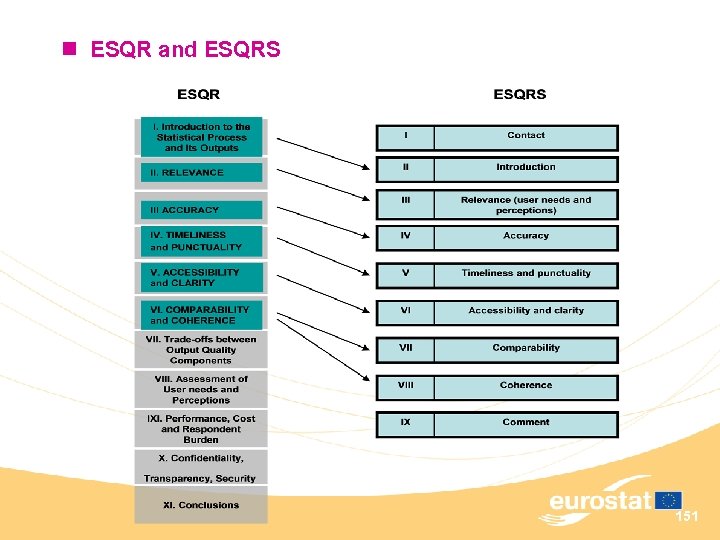 n ESQR and ESQRS 151
 n ESMS and ESQRS – The metadata produced in the ESMS and ESQRS need to be kept consistent. The ESQRS is based on the ESQR, but not taking up all the chapters contained in the latter one. – The information in the ESQRS is more detailed compared to the information on statistical data quality contained in the ESMS. ESQRS reports deeper in terms of data quality compared to the ESMS 152
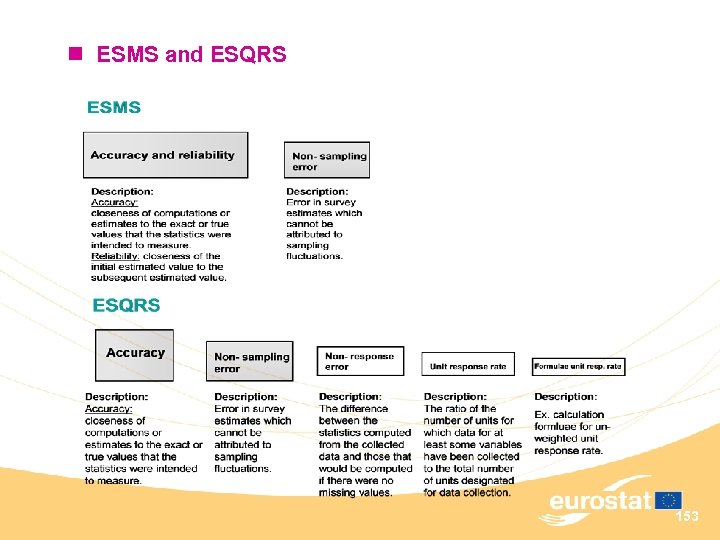 n ESMS and ESQRS 153
 2. The ESS standards for Structural Metadata Why is the harmonisation necessary? • • • To facilitate the exchange of data and metadata in Eurostat, within the ESS and beyond (e. g. within the SDMX sponsoring organisations); To support the further implementation of SDMX in statistical domains (data structure definitions or metadata structure definitions); To enable and facilitate the metadata driven statistical business process as a response to the new vision for the ESS. 154
 Two processes for harmonising structural metadata: n Harmonisation within the ESS Eurostat will produce and release harmonised structural metadata covering all the statistical domains. The main code lists will be proposed for inclusion into the SDMX at a the appropriate moment. n Harmonisation within SDMX The SDMX Content-oriented Guidelines (version 2009) also deals with the harmonisation of structural metadata. Annex 2 recommends some cross-domain code lists to institutions using SDMX. The two processes run in parallel with a “mutual” impact. The results of both processes need to be fully consistent. 155
 2. The ESS standards for Structural Metadata 2. 1 The harmonisation in Eurostat and in the ESS The need of faster progress on the harmonization of structural metadata (=harmonization of code lists) has become more and more evident. Unit B 6 (Reference databases and metadata) is working on the harmonisation of structural metadata to cover progressively all the statistical concepts used in Eurostat. Standard Code Lists are defined on the basis of official classifications or widely used standards, in cooperation with the users and taking into account the needs of all the statistical domains. 156
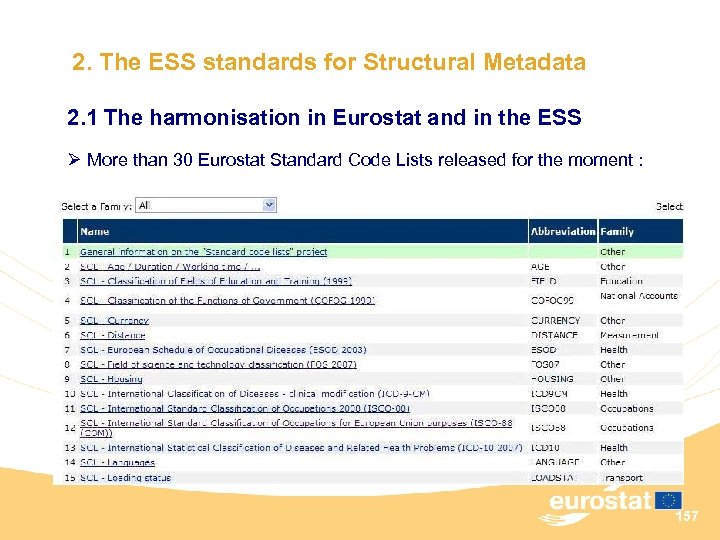 2. The ESS standards for Structural Metadata 2. 1 The harmonisation in Eurostat and in the ESS Ø More than 30 Eurostat Standard Code Lists released for the moment : 157
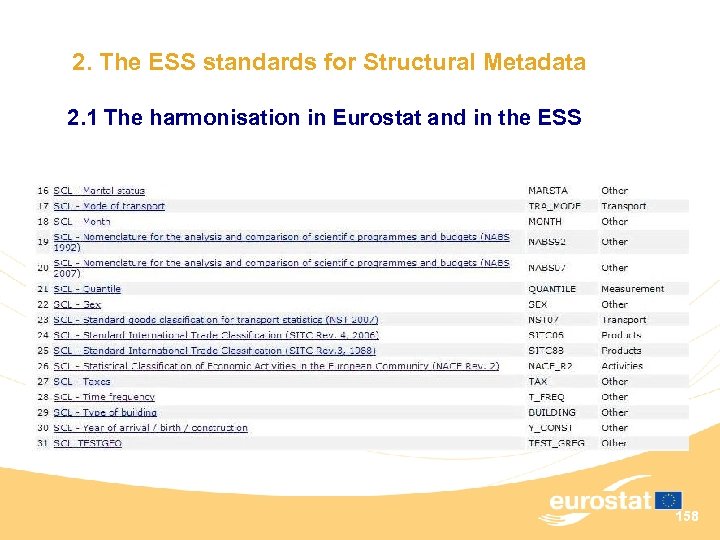 2. The ESS standards for Structural Metadata 2. 1 The harmonisation in Eurostat and in the ESS 158
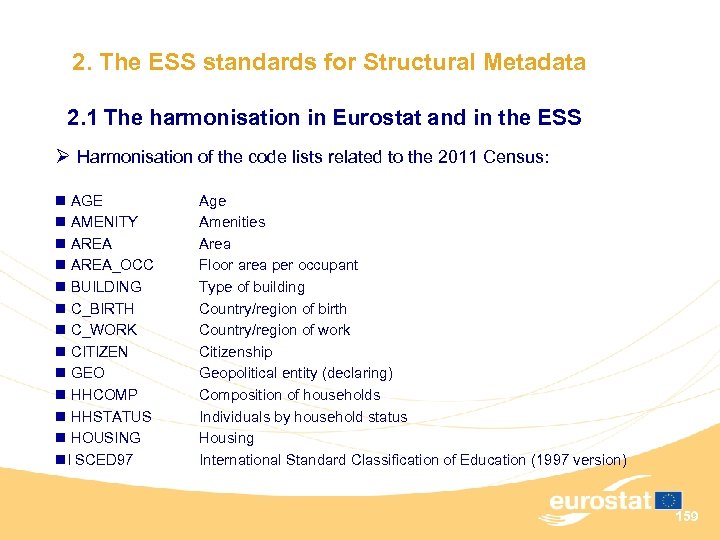 2. The ESS standards for Structural Metadata 2. 1 The harmonisation in Eurostat and in the ESS Ø Harmonisation of the code lists related to the 2011 Census: n AGE n AMENITY n AREA_OCC n BUILDING n C_BIRTH n C_WORK n CITIZEN n GEO n HHCOMP n HHSTATUS n HOUSING n. I SCED 97 Age Amenities Area Floor area per occupant Type of building Country/region of birth Country/region of work Citizenship Geopolitical entity (declaring) Composition of households Individuals by household status Housing International Standard Classification of Education (1997 version) 159
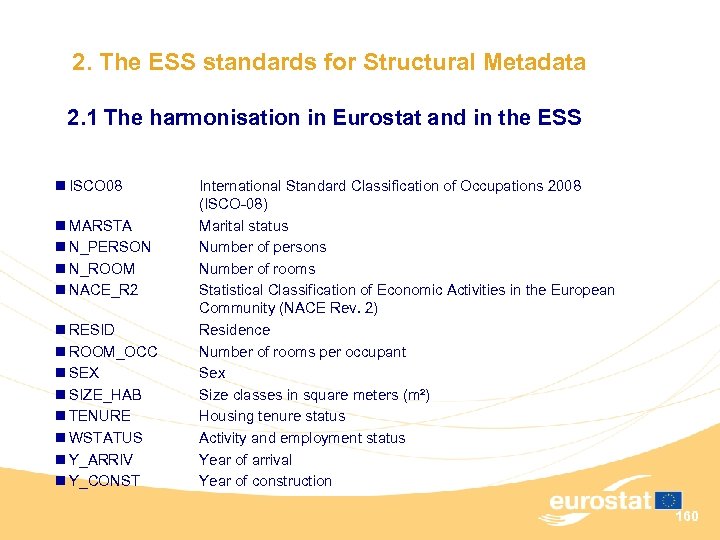 2. The ESS standards for Structural Metadata 2. 1 The harmonisation in Eurostat and in the ESS n ISCO 08 n MARSTA n N_PERSON n N_ROOM n NACE_R 2 n RESID n ROOM_OCC n SEX n SIZE_HAB n TENURE n WSTATUS n Y_ARRIV n Y_CONST International Standard Classification of Occupations 2008 (ISCO-08) Marital status Number of persons Number of rooms Statistical Classification of Economic Activities in the European Community (NACE Rev. 2) Residence Number of rooms per occupant Sex Size classes in square meters (m²) Housing tenure status Activity and employment status Year of arrival Year of construction 160
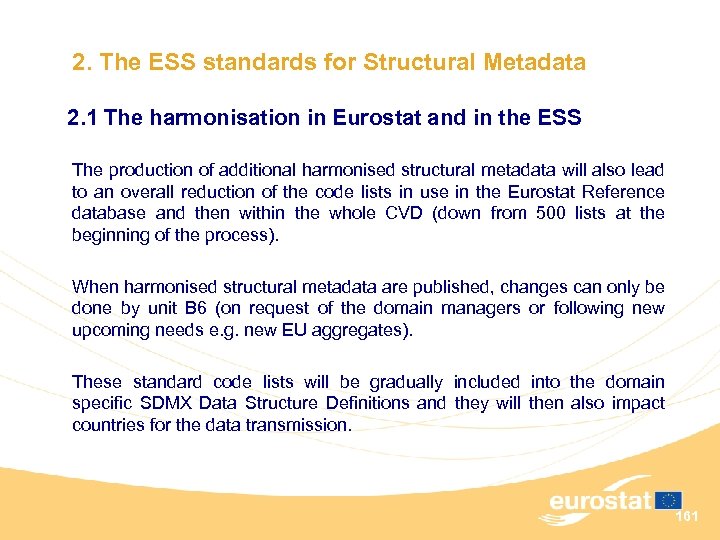 2. The ESS standards for Structural Metadata 2. 1 The harmonisation in Eurostat and in the ESS The production of additional harmonised structural metadata will also lead to an overall reduction of the code lists in use in the Eurostat Reference database and then within the whole CVD (down from 500 lists at the beginning of the process). When harmonised structural metadata are published, changes can only be done by unit B 6 (on request of the domain managers or following new upcoming needs e. g. new EU aggregates). These standard code lists will be gradually included into the domain specific SDMX Data Structure Definitions and they will then also impact countries for the data transmission. 161
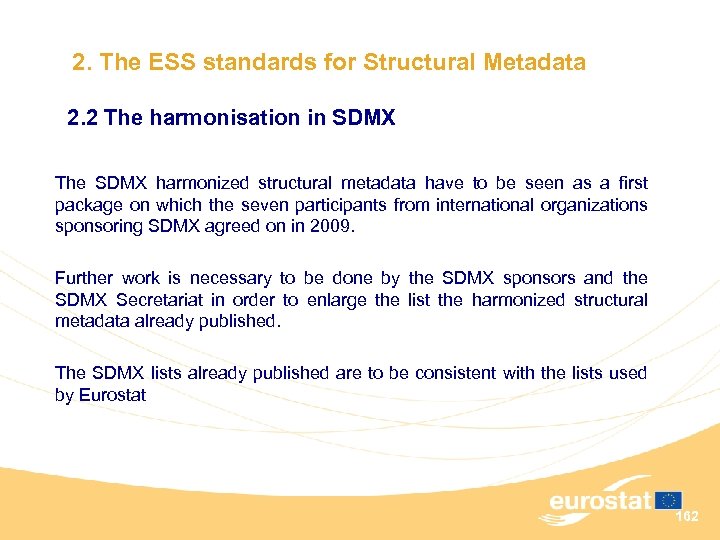 2. The ESS standards for Structural Metadata 2. 2 The harmonisation in SDMX The SDMX harmonized structural metadata have to be seen as a first package on which the seven participants from international organizations sponsoring SDMX agreed on in 2009. Further work is necessary to be done by the SDMX sponsors and the SDMX Secretariat in order to enlarge the list the harmonized structural metadata already published. The SDMX lists already published are to be consistent with the lists used by Eurostat 162
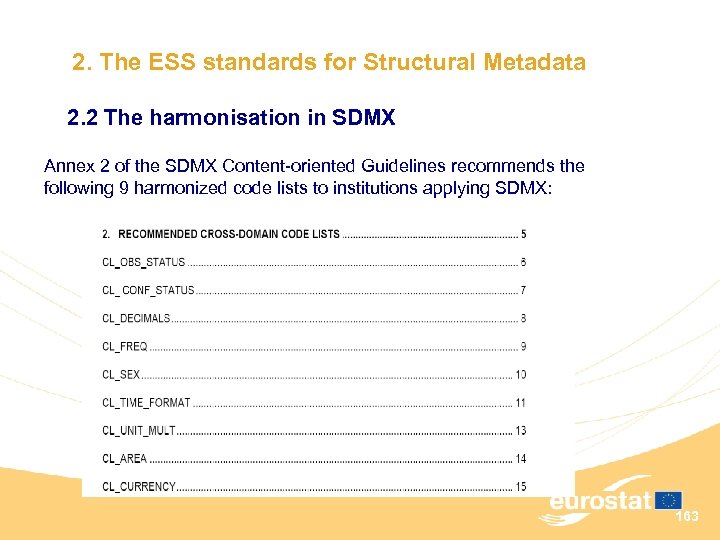 2. The ESS standards for Structural Metadata 2. 2 The harmonisation in SDMX Annex 2 of the SDMX Content-oriented Guidelines recommends the following 9 harmonized code lists to institutions applying SDMX: 163
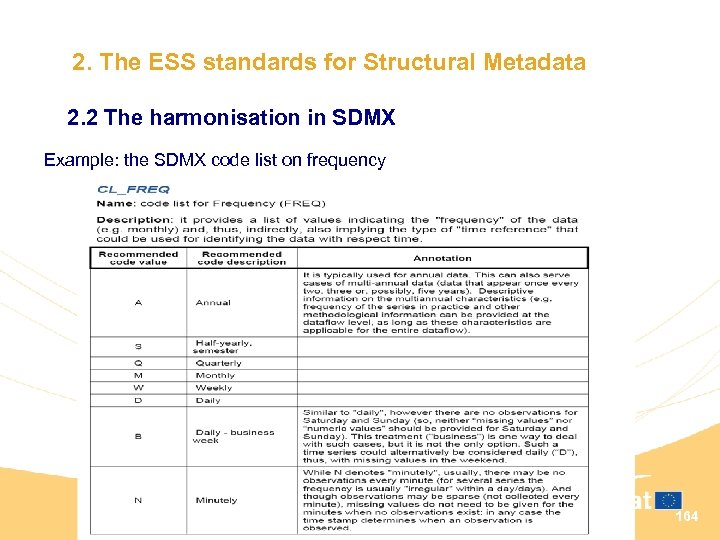 2. The ESS standards for Structural Metadata 2. 2 The harmonisation in SDMX Example: the SDMX code list on frequency 164
 Conclusions n Harmonisation of Metadata is crucial to facilitate the exchange of Data and Metadata between Institutions and National Statistical Authorities within the ESS and beyond n The standards for Reference Metadata and Quality Reporting are defined (ESMS, ESQRS…) and more implemented within the ESS n The harmonisation of Structural Metadata (standard code lists) is progressing and needs further implementation 165
 SESSION 8 15: 00 – 15: 30 THE EUROSTAT METADATA HANDLER August Götzfried 166
 The Eurostat Metadata Handler n is the backbone of a metadata-driven harmonised statistical business process at Eurostat and in the European Statistical System; n provides one central interface for accessing different types of metadata by Eurostat staff or by members of the European Statistical System; n provides services to other IT applications within the ESS; n is the primary source for different types of harmonised metadata to be used within Eurostat and the ESS. 167
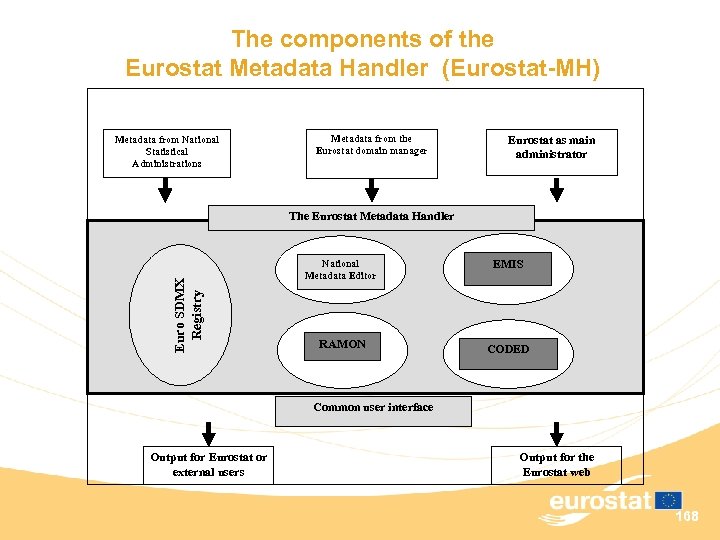 The components of the Eurostat Metadata Handler (Eurostat-MH) Metadata from National Statistical Administrations Metadata from the Eurostat domain manager Eurostat as main administrator Euro SDMX Registry The Eurostat Metadata Handler National Metadata Editor RAMON EMIS CODED Common user interface Output for Eurostat or external users Output for the Eurostat web 168
 The Euro SDMX Registry currently contains : • the Eurostat and ECB data structure definitions in use for GESMESbased data transmission; • the code lists currently used in the different GESMES-based data structure definitions; • the list of data and metadata flows (from countries to Eurostat); • the list of statistical concepts used in the abovementioned data structure definitions; • some additional information such as provision agreements, etc. The Euro SDMX Registry will contain in addition: • the agreed SDMX data and metadata structure definitions used in different statistical domains for data and metadata exchange; • the harmonized code lists used in SDMX data structure definitions; • national data structure definitions and code lists used in ESS countries (if uploaded by countries). 169
 National Statistical Authorities using the Euro SDMX registry The National Statistical Authorities will have access to the Euro SDMX Registry : • for storing the data and metadata structure definitions they are using at national level; • for storing the code lists they are using at national level; • for retrieving the agreed SDMX data and metadata structure definitions used within the ESS and beyond; • for retrieving the harmonised structural metadata (code lists) used within the ESS and beyond; • for retrieving information related to data and metadata flows etc. (e. g. the concepts used, the provision agreements, etc… ) 170
 The National Reference Metadata Editor • is the component dealing with national reference metadata; • will accommodate the current ESS standards for reference metadata such as the ESMS or the upcoming ESQRS (for quality reporting); • is addressed to the national producers of reference metadata, who will be able to compile their domain-specific metadata on-line and transmit them to Eurostat; • is the IT tool stimulating the harmonization of reference metadata within the ESS; • will be made available to the ESS later in 2010. 171
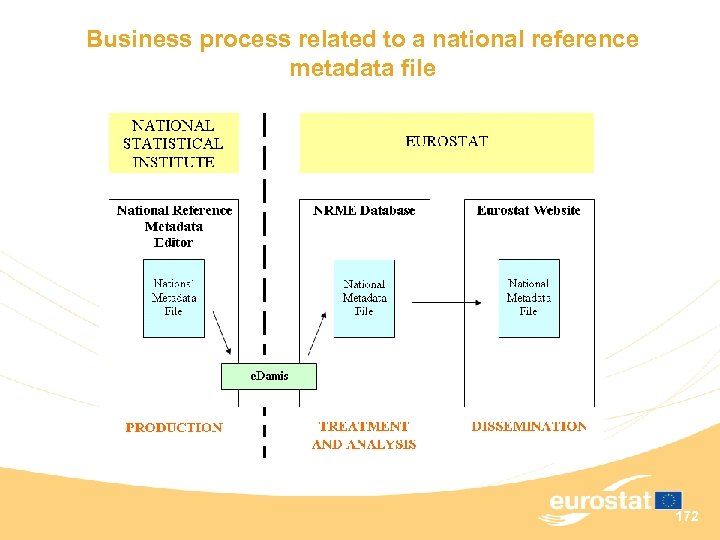 Business process related to a national reference metadata file 172
 EMIS n The Explanatory Metadata Information System (EMIS) is the component dealing with the production and dissemination of reference metadata files at Eurostat; n The Eurostat domain managers create their metadata files in EMIS by using the ESMS structure n Technical functionalities in EMIS enable flexible extractions of information stored in the metadata files n EMIS will also accommodate national metadata files using the ESMS structure; n In a later stage also the ESQRS will be incorporated. 173
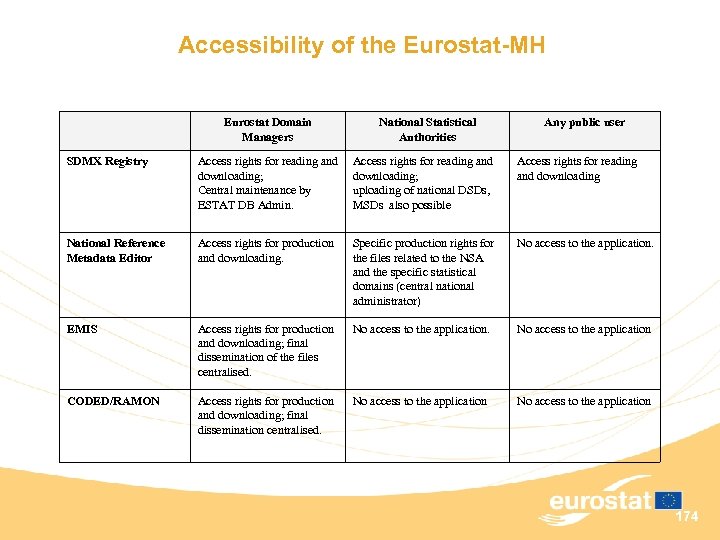 Accessibility of the Eurostat-MH Eurostat Domain Managers National Statistical Authorities Any public user SDMX Registry Access rights for reading and downloading; Central maintenance by ESTAT DB Admin. Access rights for reading and downloading; uploading of national DSDs, MSDs also possible Access rights for reading and downloading National Reference Metadata Editor Access rights for production and downloading. Specific production rights for the files related to the NSA and the specific statistical domains (central national administrator) No access to the application. EMIS Access rights for production and downloading; final dissemination of the files centralised. No access to the application CODED/RAMON Access rights for production and downloading; final dissemination centralised. No access to the application 174
 The Eurostat-MH and the harmonisation of the ESS statistical business processes The statistical standards and guidelines contained in the Euro SDMX Registry and in the National Reference Metadata Editor thoroughly contribute to the harmonisation and rationalisation of the statistical business processes used for data and metadata at national and international level. Examples • The use of the Nace Rev. 2 code lists in SDMX based data structure definitions from end-to-end of the statistical business process. • The use of the ESMS for national reference metadata production and dissemination often leads to an integration of the national business processes used for producing this metadata. 175
 Conclusions The Eurostat Metadata Handler is more and more in the centre of harmonising statistical business processes and metadata within the European Statistical System. National Statistical Authorities should increasingly use the contents and functionalities of the Eurostat Metadata Handler. The Eurostat Metadata Handler is one of the main responses to the new Eurostat vision dealing with improvements of the production methods of EU statistics. 176
 SESSION 9 16: 00 – 16: 30 IMPLEMENTATION ASPECTS (incl. future plans) August Götzfried Eva Elvers 177
 SESSION 10 16: 30 – 17: 00 WRAP – UP DISCUSSION AND QUESTIONS 178