 Скачать презентацию Python Henning Schulzrinne Department of Computer Science Columbia
ebed77d265feb68656bc5ac3457eedf0.ppt
- Количество слайдов: 67



Python Henning Schulzrinne Department of Computer Science Columbia University (based on tutorial by Guido van Rossum) Advanced Programming Spring 2002
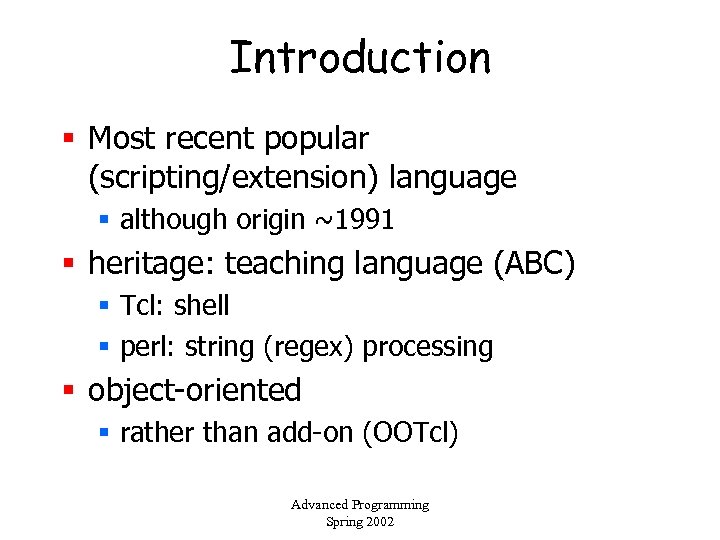
Introduction § Most recent popular (scripting/extension) language § although origin ~1991 § heritage: teaching language (ABC) § Tcl: shell § perl: string (regex) processing § object-oriented § rather than add-on (OOTcl) Advanced Programming Spring 2002
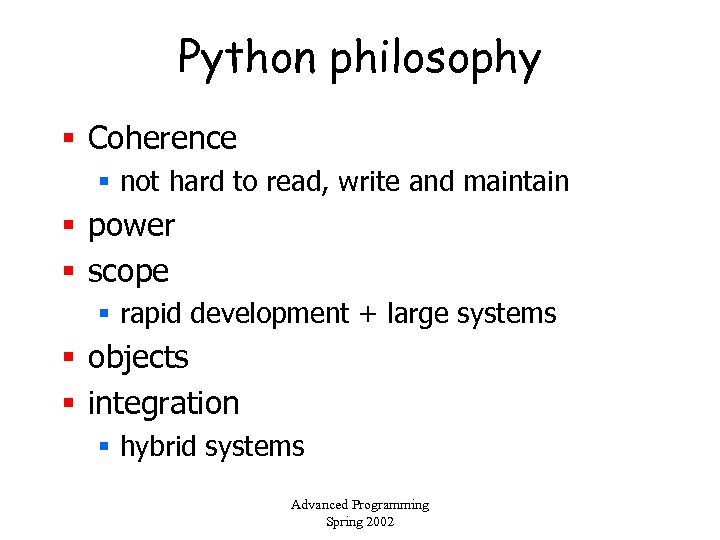
Python philosophy § Coherence § not hard to read, write and maintain § power § scope § rapid development + large systems § objects § integration § hybrid systems Advanced Programming Spring 2002
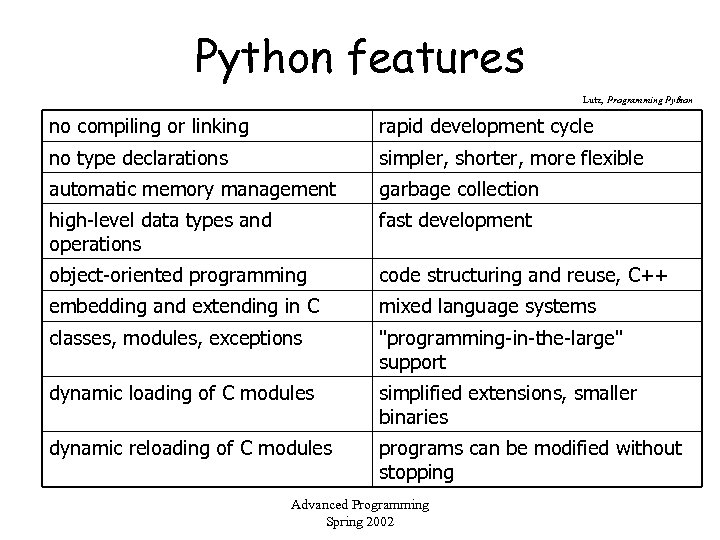
Python features Lutz, Programming Python no compiling or linking rapid development cycle no type declarations simpler, shorter, more flexible automatic memory management garbage collection high-level data types and operations fast development object-oriented programming code structuring and reuse, C++ embedding and extending in C mixed language systems classes, modules, exceptions "programming-in-the-large" support dynamic loading of C modules simplified extensions, smaller binaries dynamic reloading of C modules programs can be modified without stopping Advanced Programming Spring 2002
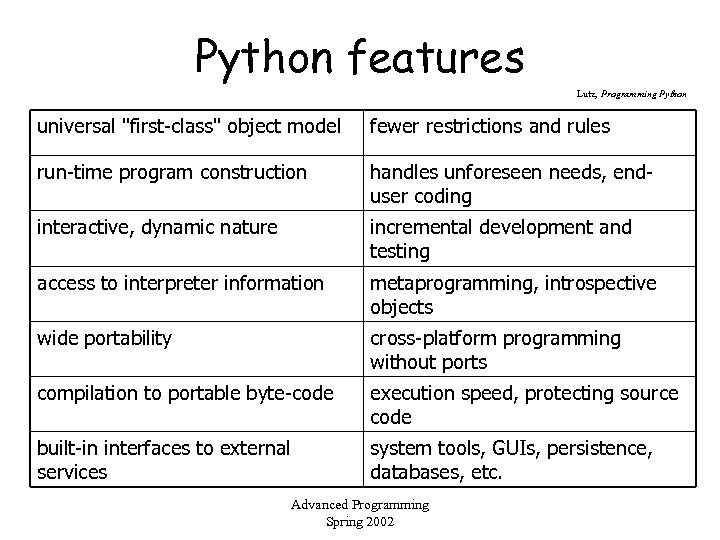
Python features Lutz, Programming Python universal "first-class" object model fewer restrictions and rules run-time program construction handles unforeseen needs, enduser coding interactive, dynamic nature incremental development and testing access to interpreter information metaprogramming, introspective objects wide portability cross-platform programming without ports compilation to portable byte-code execution speed, protecting source code built-in interfaces to external services system tools, GUIs, persistence, databases, etc. Advanced Programming Spring 2002
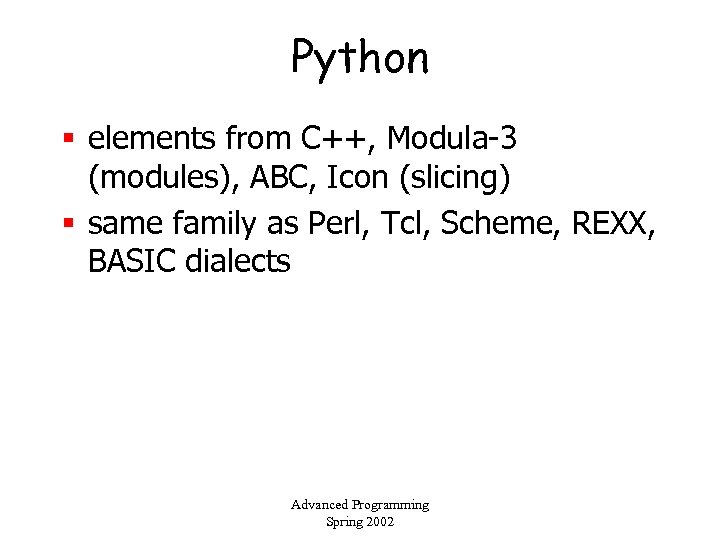
Python § elements from C++, Modula-3 (modules), ABC, Icon (slicing) § same family as Perl, Tcl, Scheme, REXX, BASIC dialects Advanced Programming Spring 2002
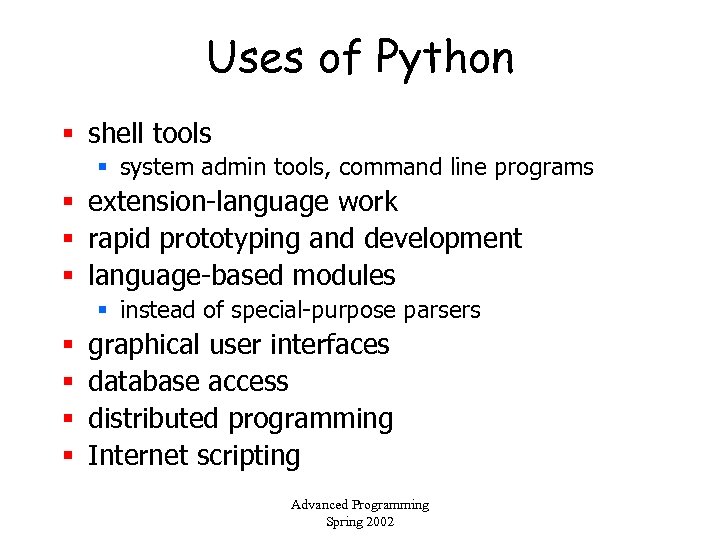
Uses of Python § shell tools § system admin tools, command line programs § extension-language work § rapid prototyping and development § language-based modules § instead of special-purpose parsers § § graphical user interfaces database access distributed programming Internet scripting Advanced Programming Spring 2002
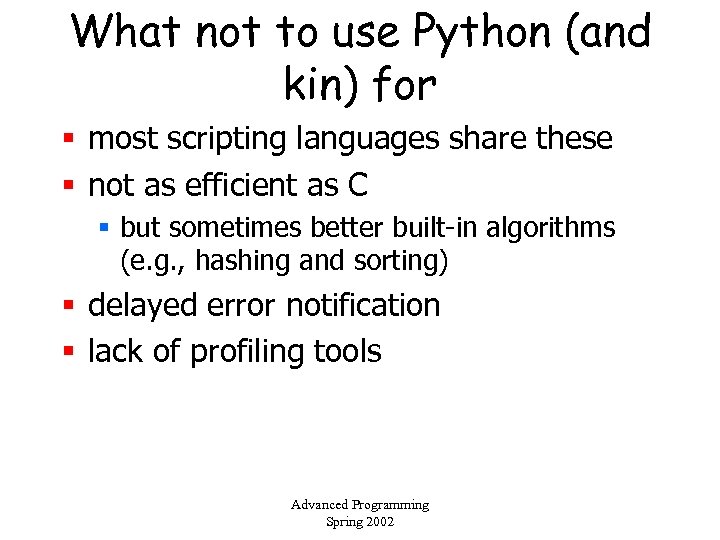
What not to use Python (and kin) for § most scripting languages share these § not as efficient as C § but sometimes better built-in algorithms (e. g. , hashing and sorting) § delayed error notification § lack of profiling tools Advanced Programming Spring 2002
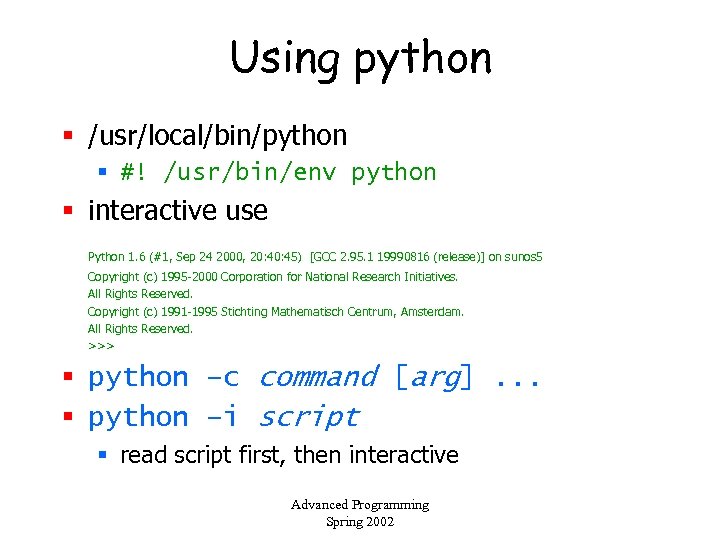
Using python § /usr/local/bin/python § #! /usr/bin/env python § interactive use Python 1. 6 (#1, Sep 24 2000, 20: 45) [GCC 2. 95. 1 19990816 (release)] on sunos 5 Copyright (c) 1995 -2000 Corporation for National Research Initiatives. All Rights Reserved. Copyright (c) 1991 -1995 Stichting Mathematisch Centrum, Amsterdam. All Rights Reserved. >>> § python –c command [arg]. . . § python –i script § read script first, then interactive Advanced Programming Spring 2002
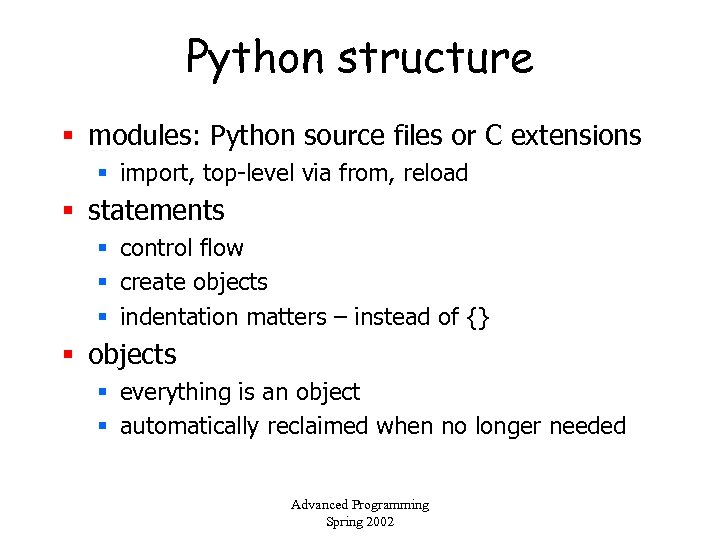
Python structure § modules: Python source files or C extensions § import, top-level via from, reload § statements § control flow § create objects § indentation matters – instead of {} § objects § everything is an object § automatically reclaimed when no longer needed Advanced Programming Spring 2002
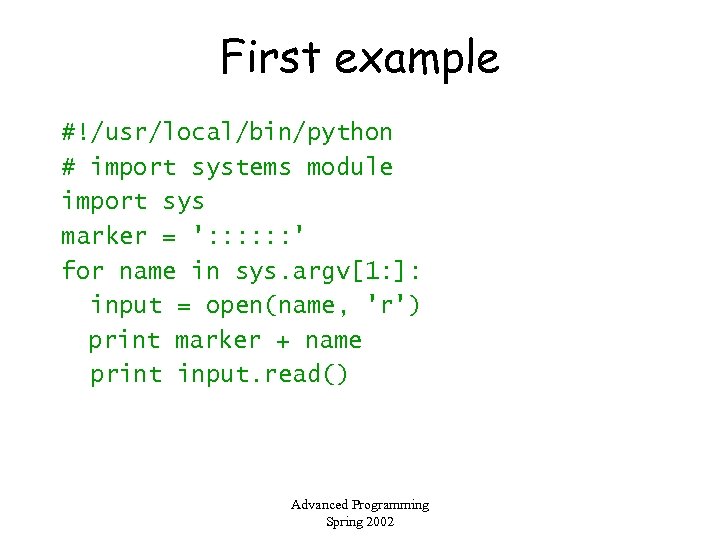
First example #!/usr/local/bin/python # import systems module import sys marker = ': : : ' for name in sys. argv[1: ]: input = open(name, 'r') print marker + name print input. read() Advanced Programming Spring 2002
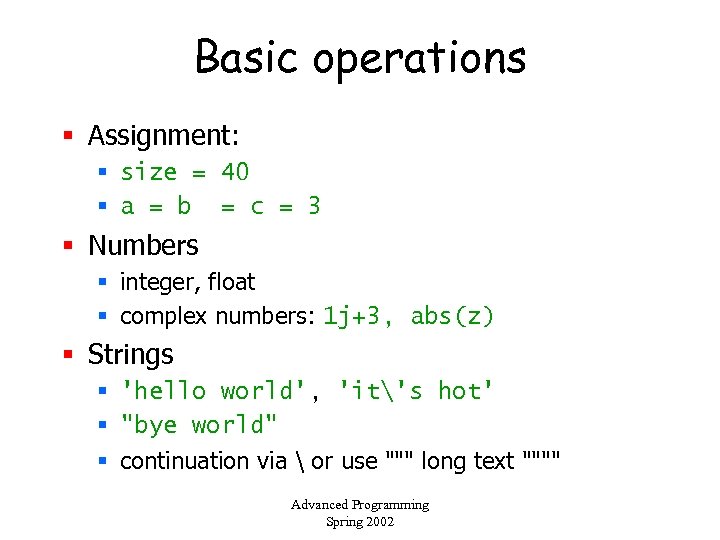
Basic operations § Assignment: § size = 40 § a = b = c = 3 § Numbers § integer, float § complex numbers: 1 j+3, abs(z) § Strings § 'hello world', 'it's hot' § "bye world" § continuation via or use """ long text """" Advanced Programming Spring 2002
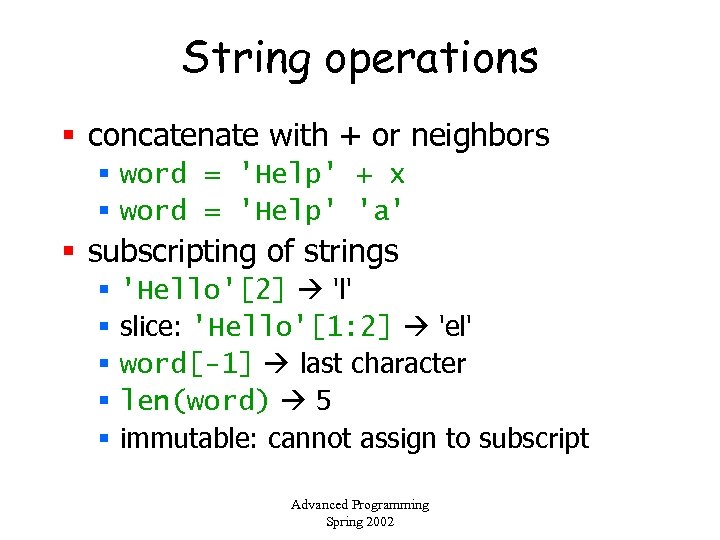
String operations § concatenate with + or neighbors § word = 'Help' + x § word = 'Help' 'a' § subscripting of strings § § § 'Hello'[2] 'l' slice: 'Hello'[1: 2] 'el' word[-1] last character len(word) 5 immutable: cannot assign to subscript Advanced Programming Spring 2002
![Lists § lists can be heterogeneous § a = ['spam', 'eggs', 100, 1234, 2*2]](https://present5.com/presentation/ebed77d265feb68656bc5ac3457eedf0/image-14.jpg "Lists § lists can be heterogeneous § a = ['spam', 'eggs', 100, 1234, 2*2]")
Lists § lists can be heterogeneous § a = ['spam', 'eggs', 100, 1234, 2*2] § Lists can be indexed and sliced: § a[0] spam § a[: 2] ['spam', 'eggs'] § Lists can be manipulated § § a[2] = a[0: 2] a[0: 0] len(a) a[2] + 23 = [1, 12] = [] 5 Advanced Programming Spring 2002
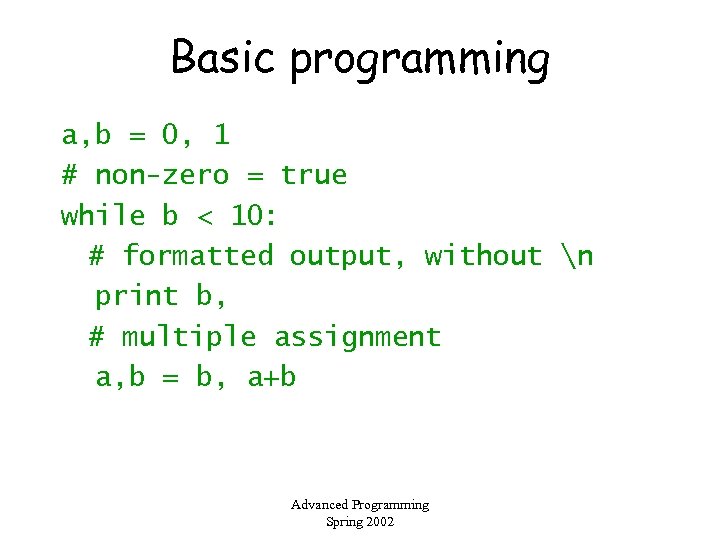
Basic programming a, b = 0, 1 # non-zero = true while b < 10: # formatted output, without n print b, # multiple assignment a, b = b, a+b Advanced Programming Spring 2002
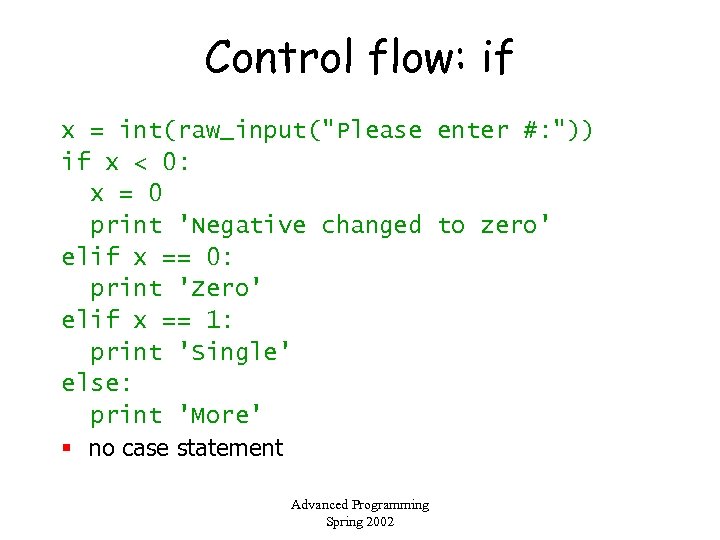
Control flow: if x = int(raw_input("Please enter #: ")) if x < 0: x = 0 print 'Negative changed to zero' elif x == 0: print 'Zero' elif x == 1: print 'Single' else: print 'More' § no case statement Advanced Programming Spring 2002
![Control flow: for a = ['cat', 'window', 'defenestrate'] for x in a: print x,](https://present5.com/presentation/ebed77d265feb68656bc5ac3457eedf0/image-17.jpg "Control flow: for a = ['cat', 'window', 'defenestrate'] for x in a: print x,")
Control flow: for a = ['cat', 'window', 'defenestrate'] for x in a: print x, len(x) § no arithmetic progression, but § range(10) [0, 1, 2, 3, 4, 5, 6, 7, 8, 9] § for i in range(len(a)): print i, a[i] § do not modify the sequence being iterated over Advanced Programming Spring 2002
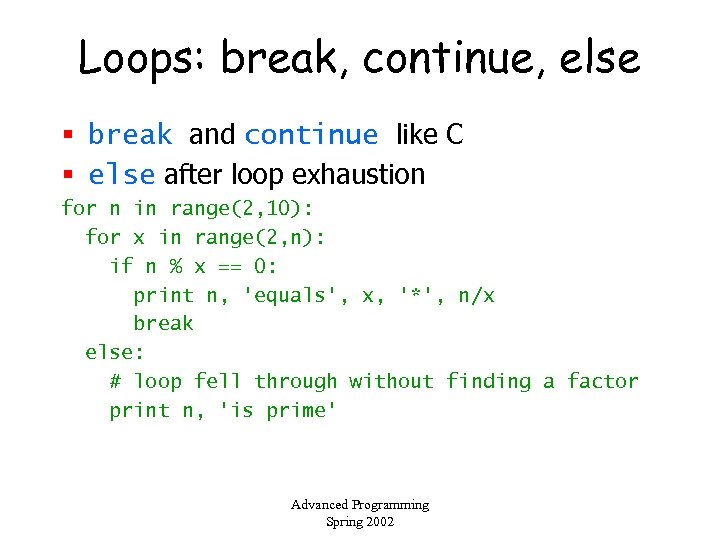
Loops: break, continue, else § break and continue like C § else after loop exhaustion for n in range(2, 10): for x in range(2, n): if n % x == 0: print n, 'equals', x, '*', n/x break else: # loop fell through without finding a factor print n, 'is prime' Advanced Programming Spring 2002
Do nothing § pass does nothing § syntactic filler while 1: pass Advanced Programming Spring 2002
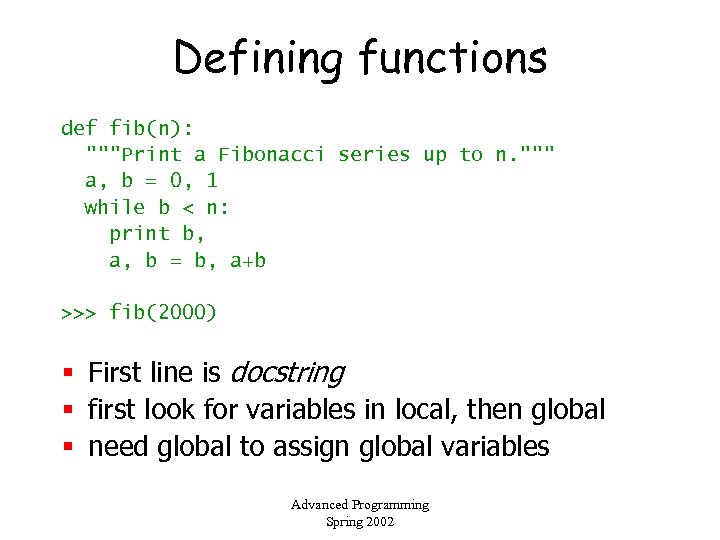
Defining functions def fib(n): """Print a Fibonacci series up to n. """ a, b = 0, 1 while b < n: print b, a, b = b, a+b >>> fib(2000) § First line is docstring § first look for variables in local, then global § need global to assign global variables Advanced Programming Spring 2002
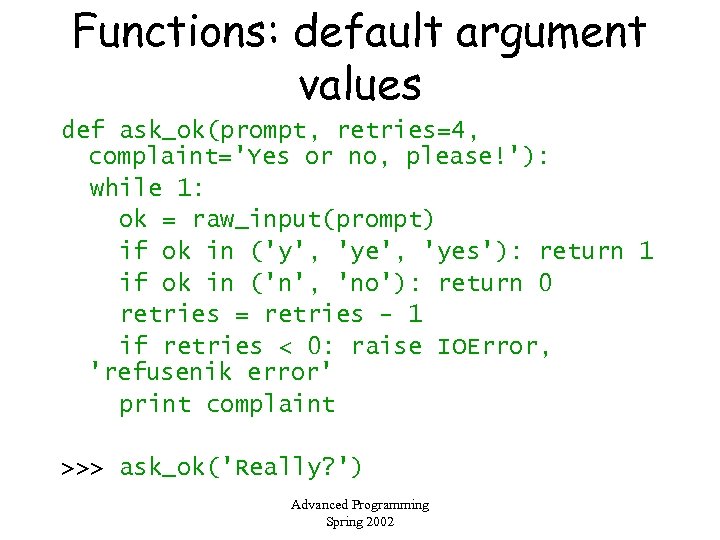
Functions: default argument values def ask_ok(prompt, retries=4, complaint='Yes or no, please!'): while 1: ok = raw_input(prompt) if ok in ('y', 'yes'): return 1 if ok in ('n', 'no'): return 0 retries = retries - 1 if retries < 0: raise IOError, 'refusenik error' print complaint >>> ask_ok('Really? ') Advanced Programming Spring 2002
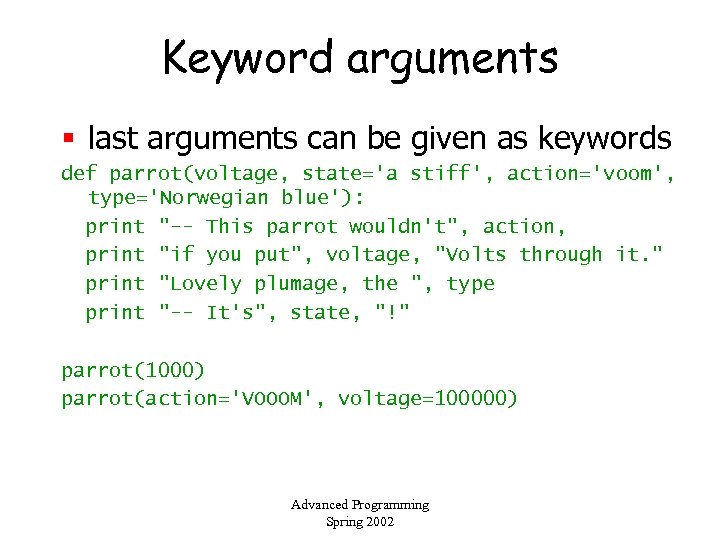
Keyword arguments § last arguments can be given as keywords def parrot(voltage, state='a stiff', action='voom', type='Norwegian blue'): print "-- This parrot wouldn't", action, print "if you put", voltage, "Volts through it. " print "Lovely plumage, the ", type print "-- It's", state, "!" parrot(1000) parrot(action='VOOOM', voltage=100000) Advanced Programming Spring 2002
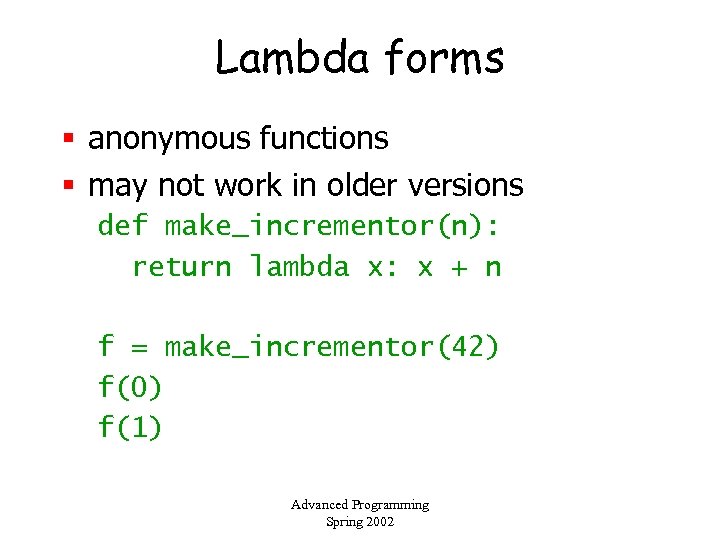
Lambda forms § anonymous functions § may not work in older versions def make_incrementor(n): return lambda x: x + n f = make_incrementor(42) f(0) f(1) Advanced Programming Spring 2002
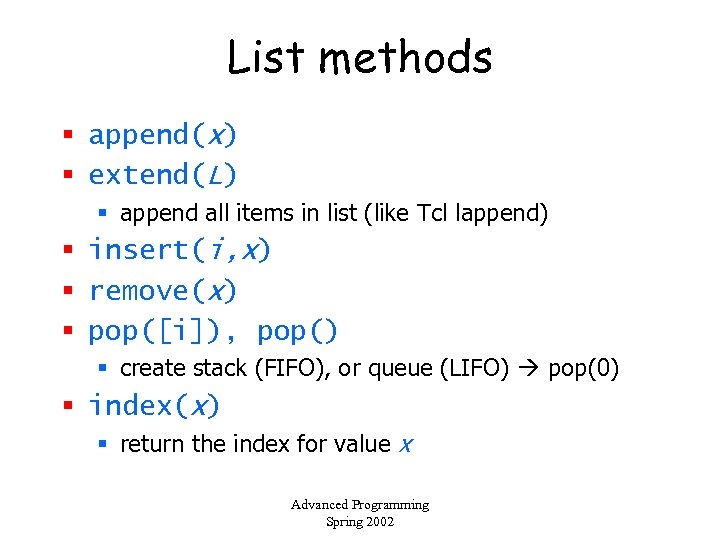
List methods § append(x) § extend(L) § append all items in list (like Tcl lappend) § insert(i, x) § remove(x) § pop([i]), pop() § create stack (FIFO), or queue (LIFO) pop(0) § index(x) § return the index for value x Advanced Programming Spring 2002
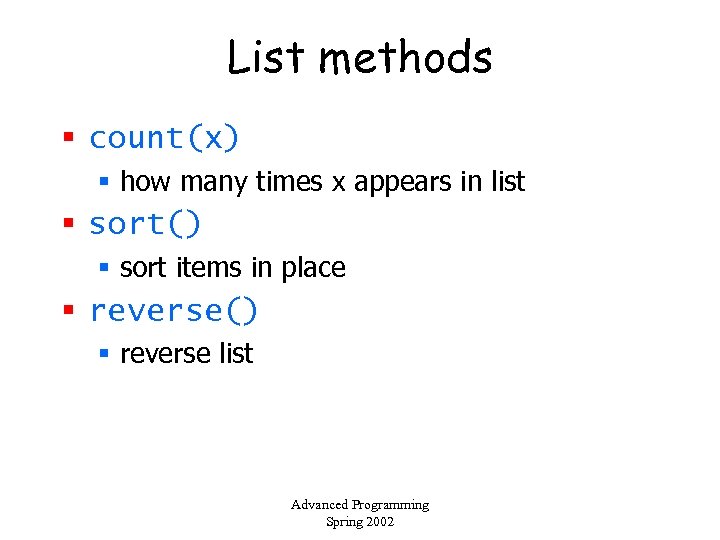
List methods § count(x) § how many times x appears in list § sort() § sort items in place § reverse() § reverse list Advanced Programming Spring 2002
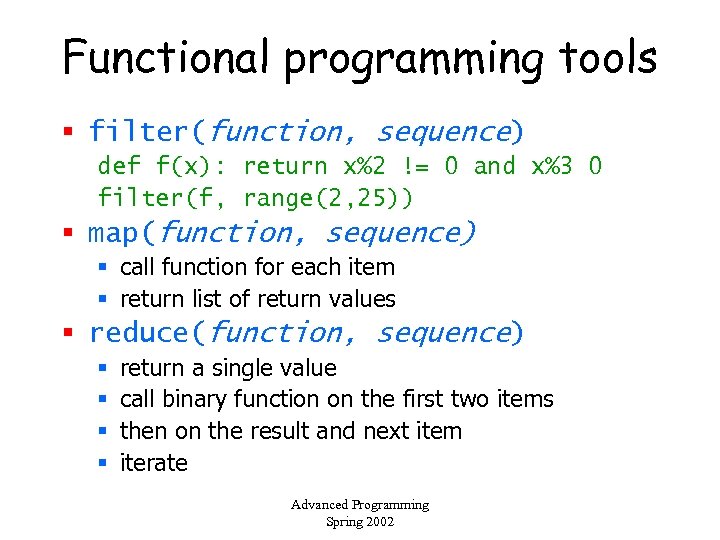
Functional programming tools § filter(function, sequence) def f(x): return x%2 != 0 and x%3 0 filter(f, range(2, 25)) § map(function, sequence) § call function for each item § return list of return values § reduce(function, sequence) § § return a single value call binary function on the first two items then on the result and next item iterate Advanced Programming Spring 2002
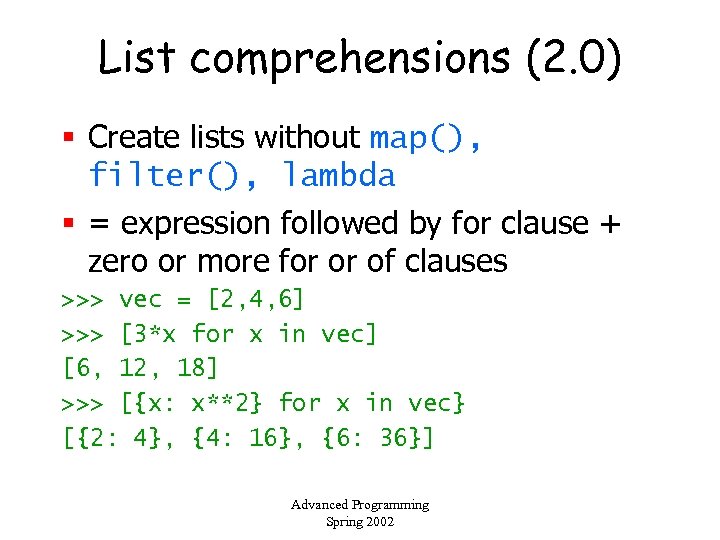
List comprehensions (2. 0) § Create lists without map(), filter(), lambda § = expression followed by for clause + zero or more for or of clauses >>> vec = [2, 4, 6] >>> [3*x for x in vec] [6, 12, 18] >>> [{x: x**2} for x in vec} [{2: 4}, {4: 16}, {6: 36}] Advanced Programming Spring 2002
![List comprehensions § cross products: >>> vec 1 = [2, 4, 6] >>> vec](https://present5.com/presentation/ebed77d265feb68656bc5ac3457eedf0/image-28.jpg "List comprehensions § cross products: >>> vec 1 = [2, 4, 6] >>> vec")
List comprehensions § cross products: >>> vec 1 = [2, 4, 6] >>> vec 2 = [4, 3, -9] >>> [x*y for x in vec 1 for y in vec 2] [8, 6, -18, 16, 12, -36, 24, 18, -54] >>> [x+y for x in vec 1 and y in vec 2] [6, 5, -7, 8, 7, -5, 10, 9, -3] >>> [vec 1[i]*vec 2[i] for i in range(len(vec 1))] [8, 12, -54] Advanced Programming Spring 2002
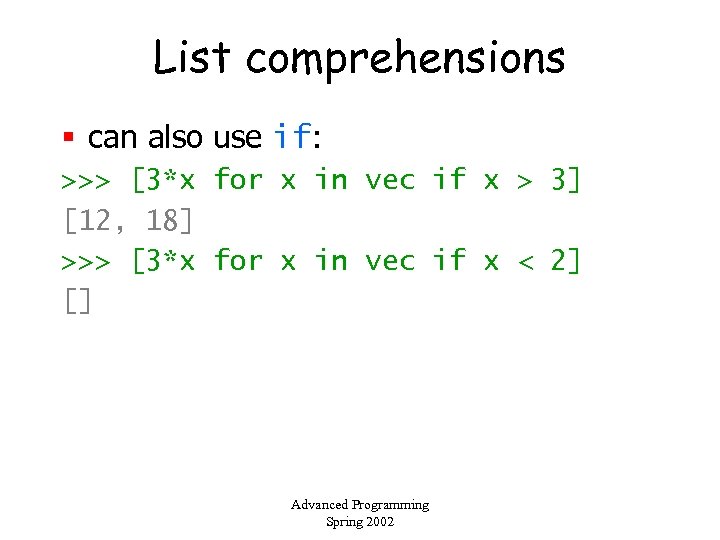
List comprehensions § can also use if: >>> [3*x for x in vec if x > 3] [12, 18] >>> [3*x for x in vec if x < 2] [] Advanced Programming Spring 2002
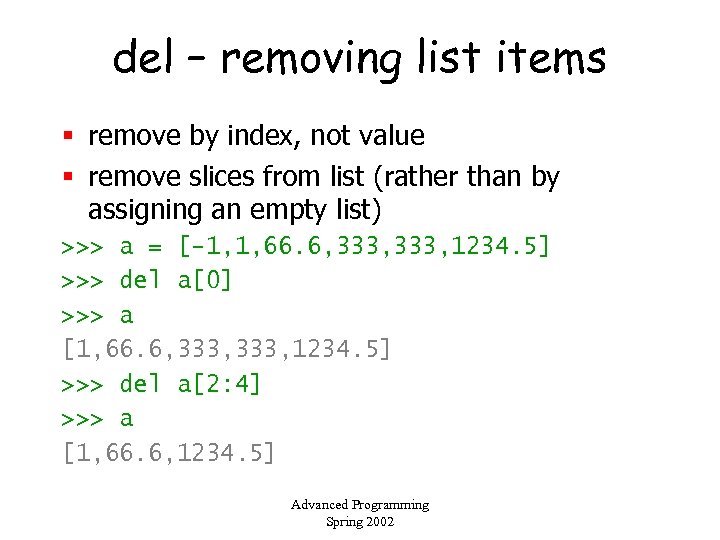
del – removing list items § remove by index, not value § remove slices from list (rather than by assigning an empty list) >>> a = [-1, 1, 66. 6, 333, 1234. 5] >>> del a[0] >>> a [1, 66. 6, 333, 1234. 5] >>> del a[2: 4] >>> a [1, 66. 6, 1234. 5] Advanced Programming Spring 2002
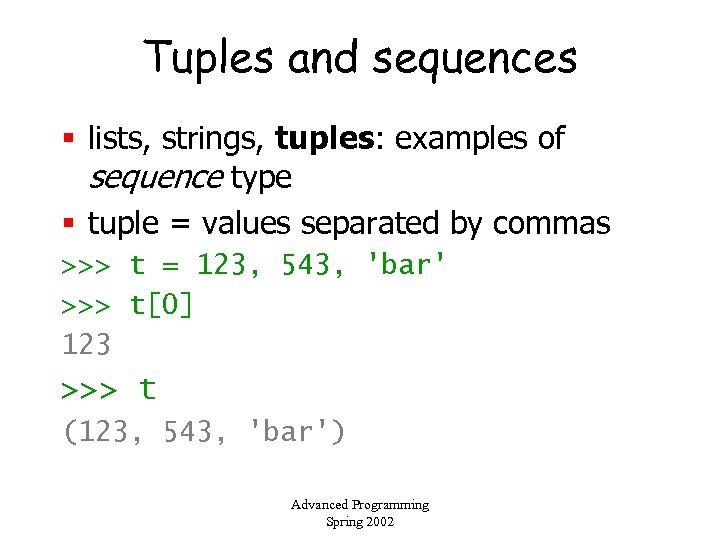
Tuples and sequences § lists, strings, tuples: examples of sequence type § tuple = values separated by commas >>> t = 123, 543, 'bar' >>> t[0] 123 >>> t (123, 543, 'bar') Advanced Programming Spring 2002
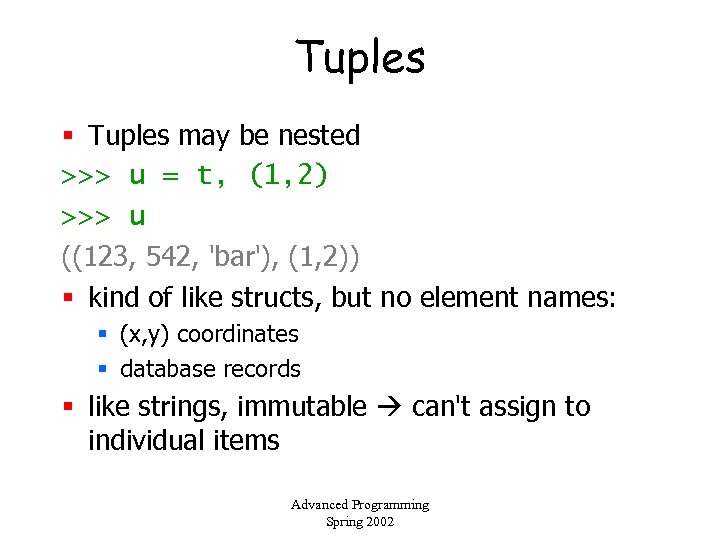
Tuples § Tuples may be nested >>> u = t, (1, 2) >>> u ((123, 542, 'bar'), (1, 2)) § kind of like structs, but no element names: § (x, y) coordinates § database records § like strings, immutable can't assign to individual items Advanced Programming Spring 2002
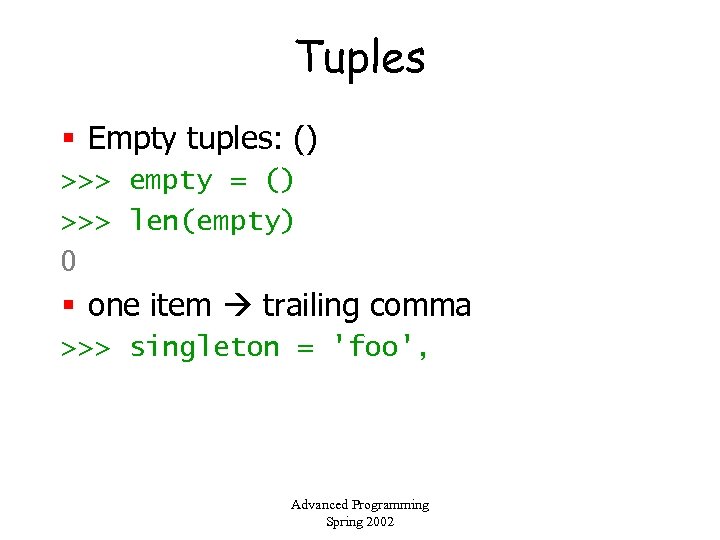
Tuples § Empty tuples: () >>> empty = () >>> len(empty) 0 § one item trailing comma >>> singleton = 'foo', Advanced Programming Spring 2002
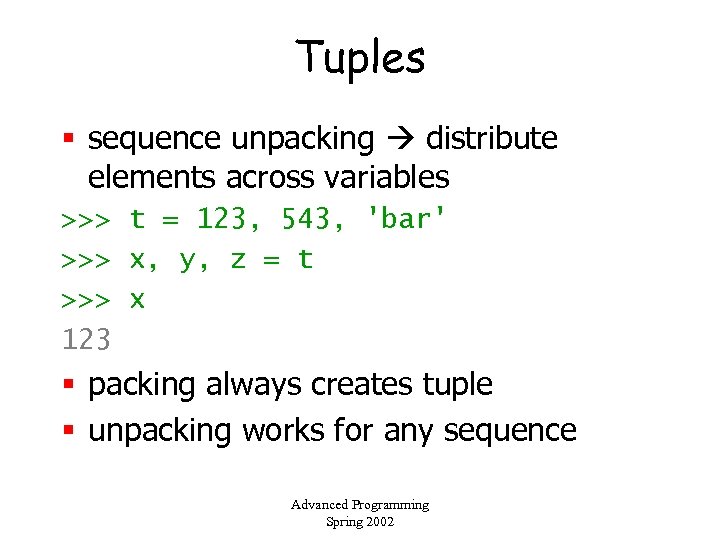
Tuples § sequence unpacking distribute elements across variables >>> t = 123, 543, 'bar' >>> x, y, z = t >>> x 123 § packing always creates tuple § unpacking works for any sequence Advanced Programming Spring 2002
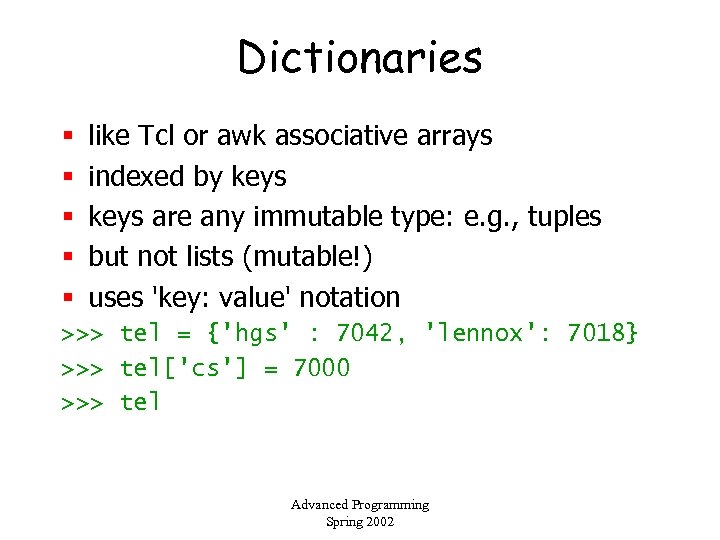
Dictionaries § § § like Tcl or awk associative arrays indexed by keys are any immutable type: e. g. , tuples but not lists (mutable!) uses 'key: value' notation >>> tel = {'hgs' : 7042, 'lennox': 7018} >>> tel['cs'] = 7000 >>> tel Advanced Programming Spring 2002
![Dictionaries § no particular order § delete elements with del >>> del tel['foo'] §](https://present5.com/presentation/ebed77d265feb68656bc5ac3457eedf0/image-36.jpg "Dictionaries § no particular order § delete elements with del >>> del tel['foo'] §")
Dictionaries § no particular order § delete elements with del >>> del tel['foo'] § keys() method unsorted list of keys >>> tel. keys() ['cs', 'lennox', 'hgs'] § use has_key() to check for existence >>> tel. has_key('foo') 0 Advanced Programming Spring 2002
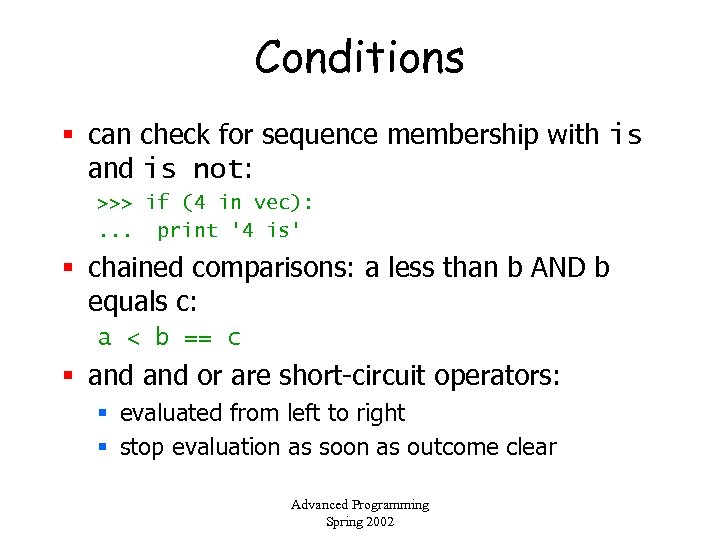
Conditions § can check for sequence membership with is and is not: >>> if (4 in vec): . . . print '4 is' § chained comparisons: a less than b AND b equals c: a < b == c § and or are short-circuit operators: § evaluated from left to right § stop evaluation as soon as outcome clear Advanced Programming Spring 2002
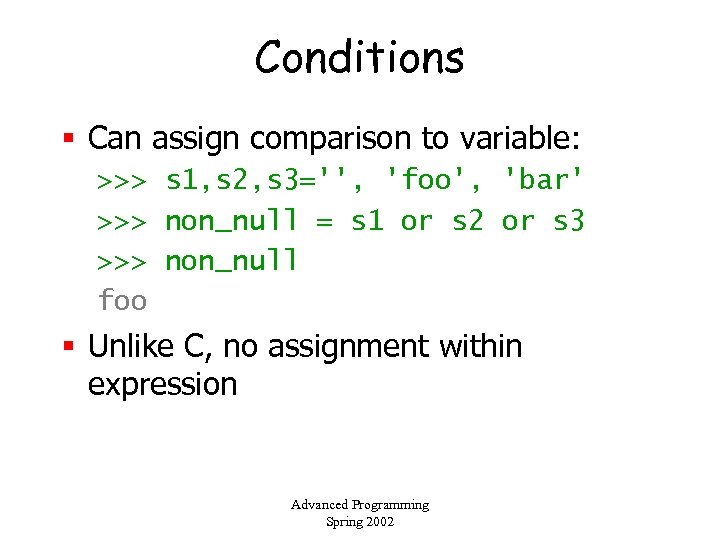
Conditions § Can assign comparison to variable: >>> s 1, s 2, s 3='', 'foo', 'bar' >>> non_null = s 1 or s 2 or s 3 >>> non_null foo § Unlike C, no assignment within expression Advanced Programming Spring 2002
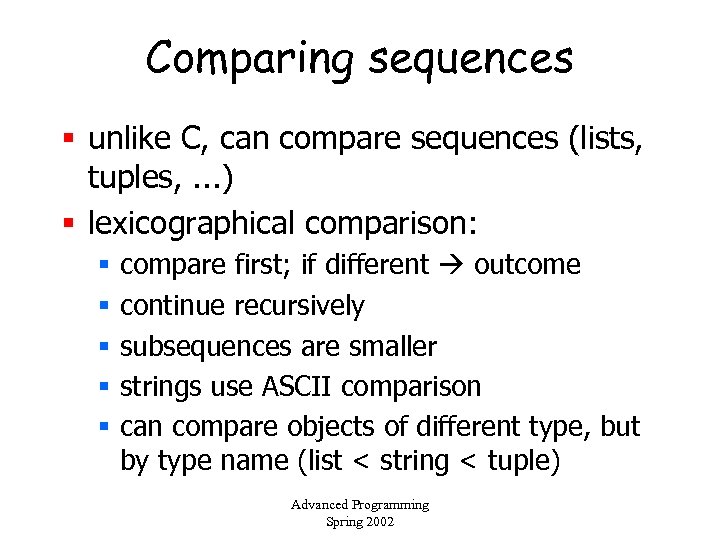
Comparing sequences § unlike C, can compare sequences (lists, tuples, . . . ) § lexicographical comparison: § § § compare first; if different outcome continue recursively subsequences are smaller strings use ASCII comparison can compare objects of different type, but by type name (list < string < tuple) Advanced Programming Spring 2002
![Comparing sequences (1, 2, 3) < (1, 2, 4) [1, 2, 3] < [1,](https://present5.com/presentation/ebed77d265feb68656bc5ac3457eedf0/image-40.jpg "Comparing sequences (1, 2, 3) < (1, 2, 4) [1, 2, 3] < [1,")
Comparing sequences (1, 2, 3) < (1, 2, 4) [1, 2, 3] < [1, 2, 4] 'ABC' < 'Pascal' < 'Python' (1, 2, 3) == (1. 0, 2. 0, 3. 0) (1, 2) < (1, 2, -1) Advanced Programming Spring 2002
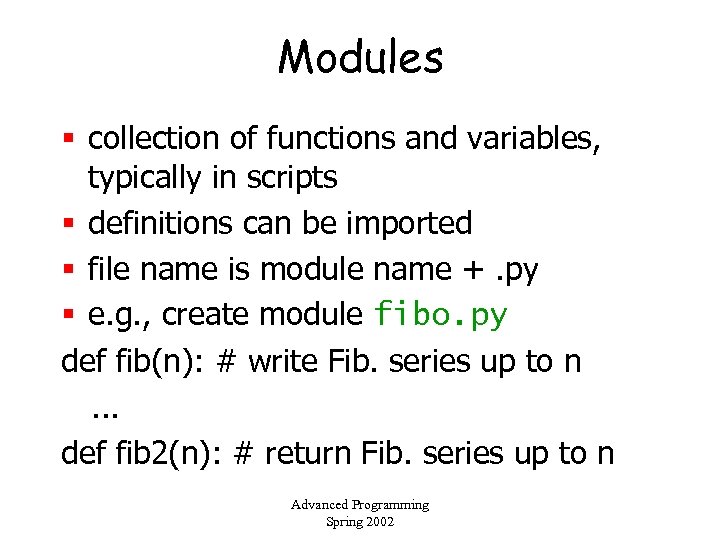
Modules § collection of functions and variables, typically in scripts § definitions can be imported § file name is module name +. py § e. g. , create module fibo. py def fib(n): # write Fib. series up to n. . . def fib 2(n): # return Fib. series up to n Advanced Programming Spring 2002
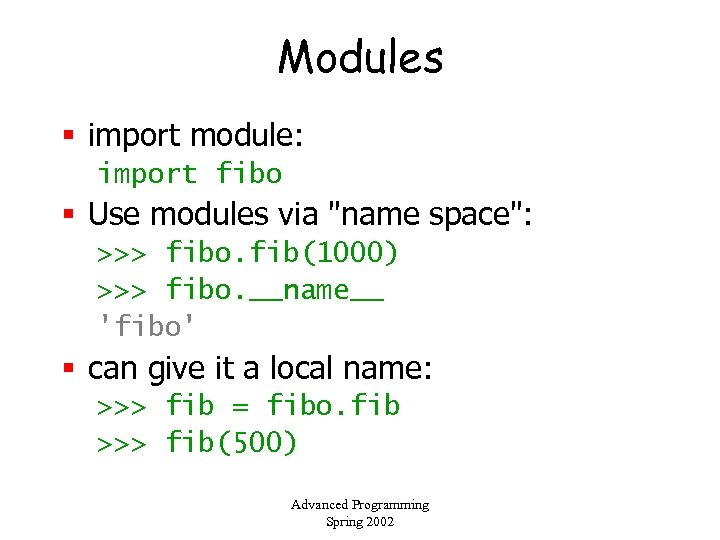
Modules § import module: import fibo § Use modules via "name space": >>> fibo. fib(1000) >>> fibo. __name__ 'fibo' § can give it a local name: >>> fib = fibo. fib >>> fib(500) Advanced Programming Spring 2002
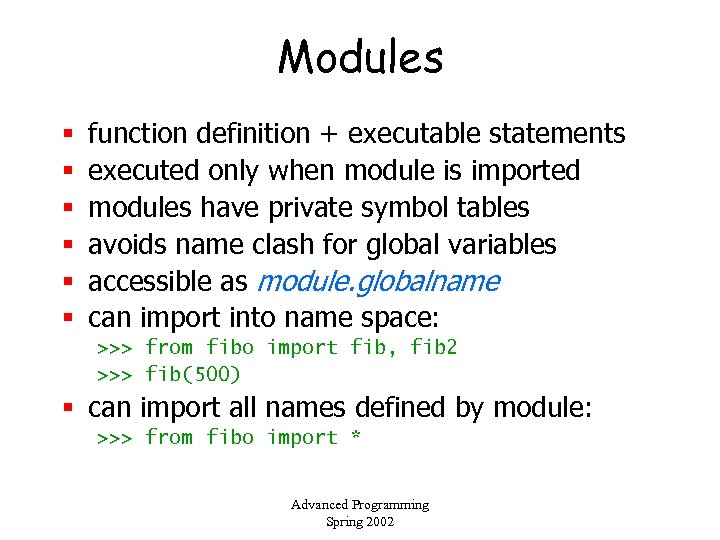
Modules § § § function definition + executable statements executed only when module is imported modules have private symbol tables avoids name clash for global variables accessible as module. globalname can import into name space: >>> from fibo import fib, fib 2 >>> fib(500) § can import all names defined by module: >>> from fibo import * Advanced Programming Spring 2002
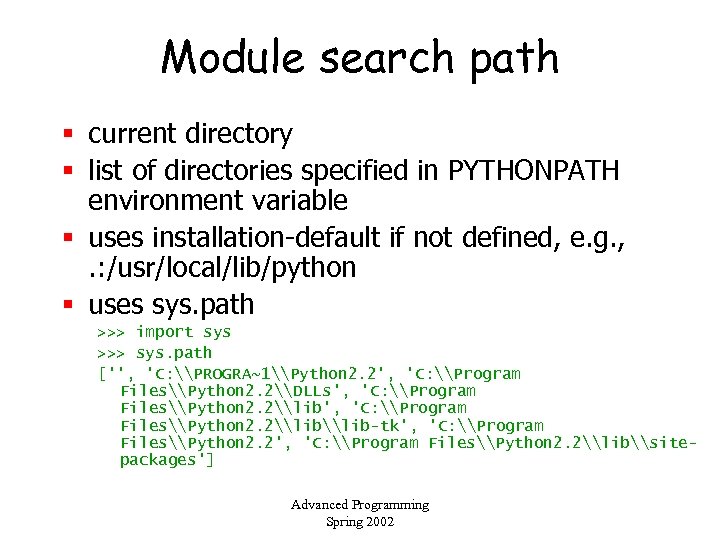
Module search path § current directory § list of directories specified in PYTHONPATH environment variable § uses installation-default if not defined, e. g. , . : /usr/local/lib/python § uses sys. path >>> import sys >>> sys. path ['', 'C: \PROGRA~1\Python 2. 2', 'C: \Program Files\Python 2. 2\DLLs', 'C: \Program Files\Python 2. 2\lib\lib-tk', 'C: \Program Files\Python 2. 2\lib\sitepackages'] Advanced Programming Spring 2002
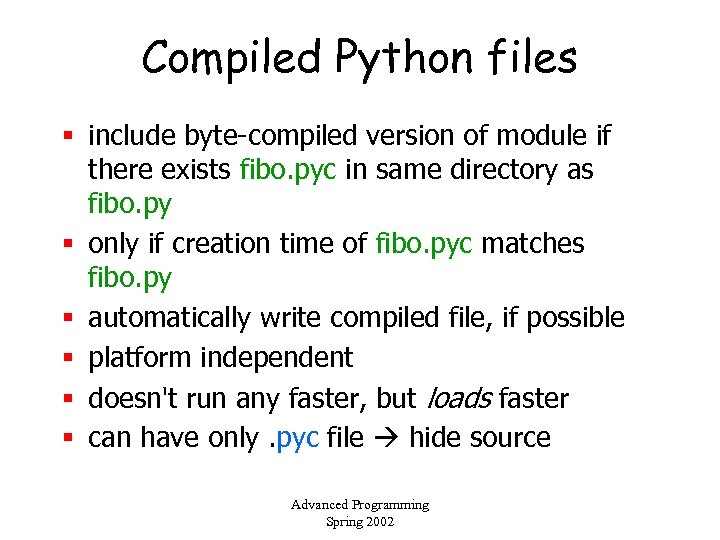
Compiled Python files § include byte-compiled version of module if there exists fibo. pyc in same directory as fibo. py § only if creation time of fibo. pyc matches fibo. py § automatically write compiled file, if possible § platform independent § doesn't run any faster, but loads faster § can have only. pyc file hide source Advanced Programming Spring 2002
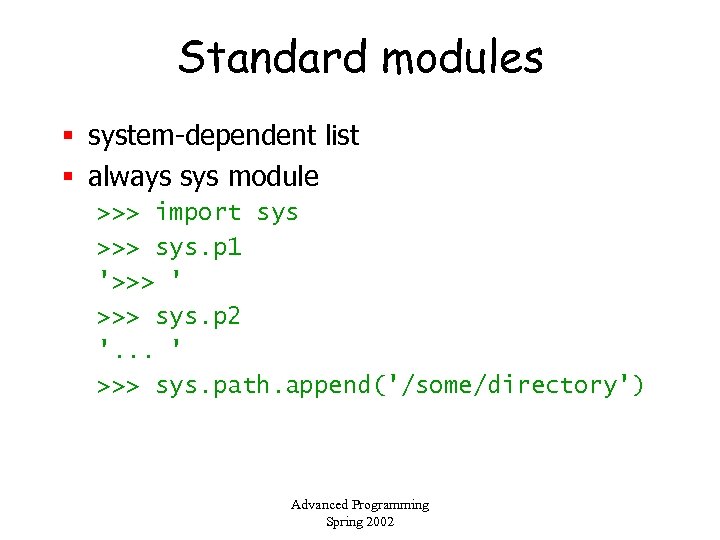
Standard modules § system-dependent list § always sys module >>> import sys >>> sys. p 1 '>>> ' >>> sys. p 2 '. . . ' >>> sys. path. append('/some/directory') Advanced Programming Spring 2002
![Module listing § use dir() for each module >>> dir(fibo) ['___name___', 'fib 2'] >>>](https://present5.com/presentation/ebed77d265feb68656bc5ac3457eedf0/image-47.jpg "Module listing § use dir() for each module >>> dir(fibo) ['___name___', 'fib 2'] >>>")
Module listing § use dir() for each module >>> dir(fibo) ['___name___', 'fib 2'] >>> dir(sys) ['__displayhook__', '__doc__', '__excepthook__', '__name__', '__stderr__', '__st din__', '__stdout__', '_getframe', 'argv', 'builtin_module_names', 'byteorder', 'copyright', 'displayhook', 'dllhandle', 'exc_info', 'exc_type', 'excepthook', ' exec_prefix', 'executable', 'exit', 'getdefaultencoding', 'getrecursionlimit', ' getrefcount', 'hexversion', 'last_type', 'last_value', 'maxint', 'maxunicode', ' modules', 'path', 'platform', 'prefix', 'ps 1', 'ps 2', 'setcheckinterval', 'setpr ofile', 'setrecursionlimit', 'settrace', 'stderr', 'stdin', 'stdout', 'version_info', 'warnoptions', 'winver'] Advanced Programming Spring 2002
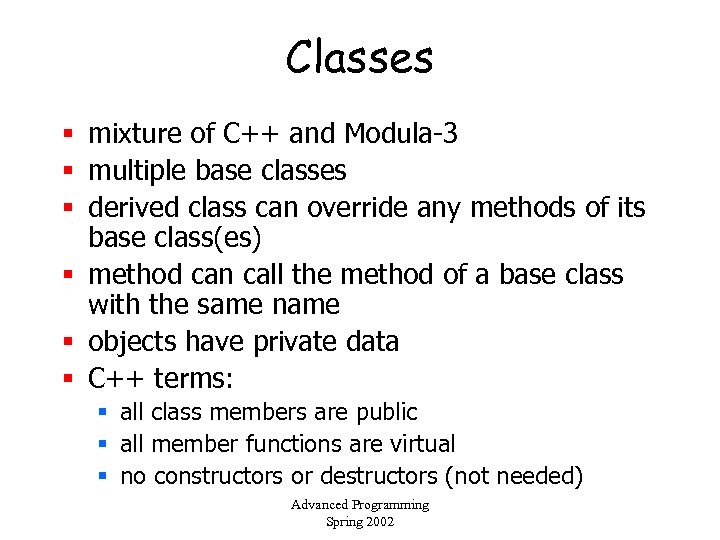
Classes § mixture of C++ and Modula-3 § multiple base classes § derived class can override any methods of its base class(es) § method can call the method of a base class with the same name § objects have private data § C++ terms: § all class members are public § all member functions are virtual § no constructors or destructors (not needed) Advanced Programming Spring 2002
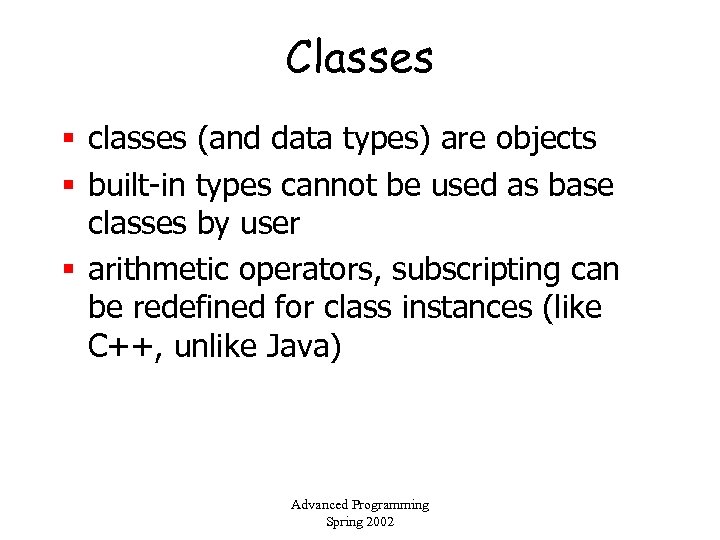
Classes § classes (and data types) are objects § built-in types cannot be used as base classes by user § arithmetic operators, subscripting can be redefined for class instances (like C++, unlike Java) Advanced Programming Spring 2002
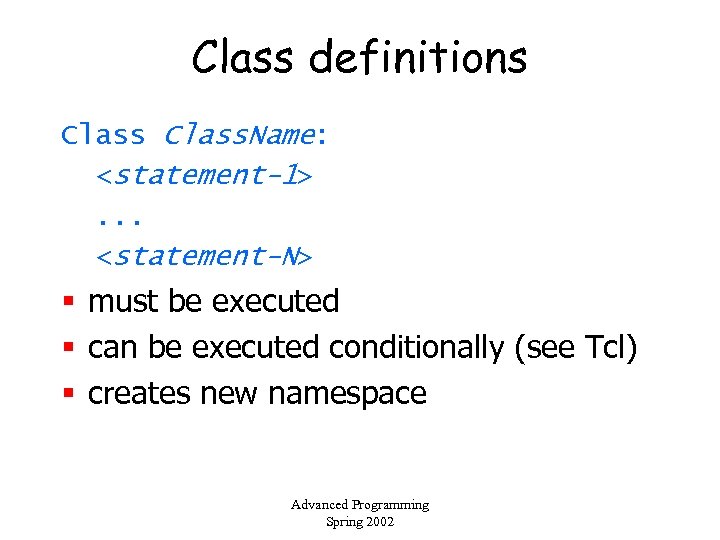
Class definitions Class. Name: <statement-1>. . . <statement-N> § must be executed § can be executed conditionally (see Tcl) § creates new namespace Advanced Programming Spring 2002
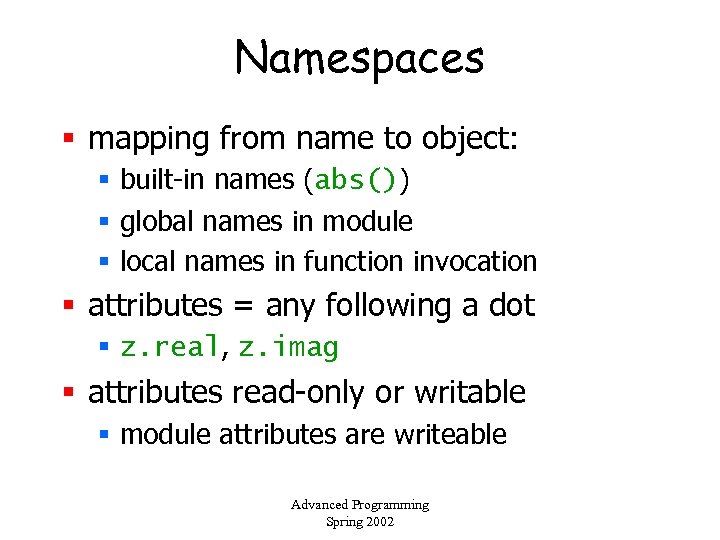
Namespaces § mapping from name to object: § built-in names (abs()) § global names in module § local names in function invocation § attributes = any following a dot § z. real, z. imag § attributes read-only or writable § module attributes are writeable Advanced Programming Spring 2002
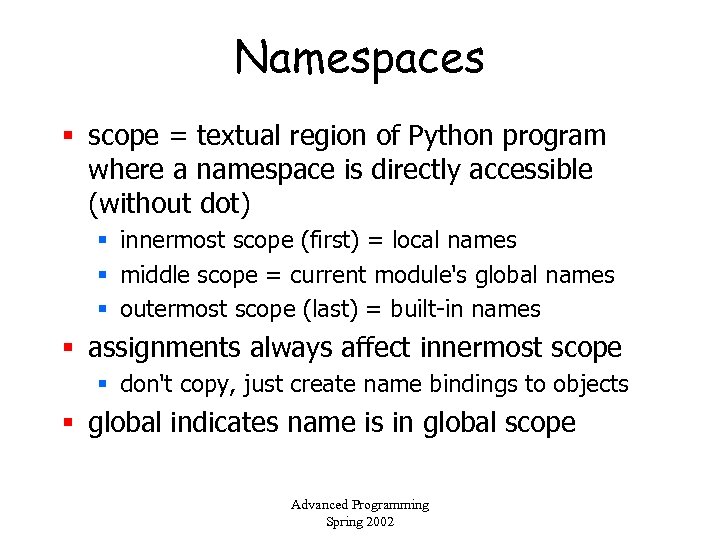
Namespaces § scope = textual region of Python program where a namespace is directly accessible (without dot) § innermost scope (first) = local names § middle scope = current module's global names § outermost scope (last) = built-in names § assignments always affect innermost scope § don't copy, just create name bindings to objects § global indicates name is in global scope Advanced Programming Spring 2002
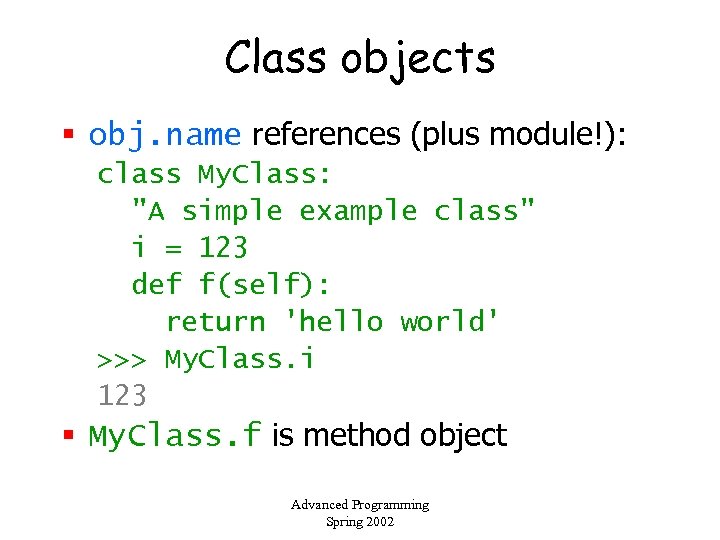
Class objects § obj. name references (plus module!): class My. Class: "A simple example class" i = 123 def f(self): return 'hello world' >>> My. Class. i 123 § My. Class. f is method object Advanced Programming Spring 2002
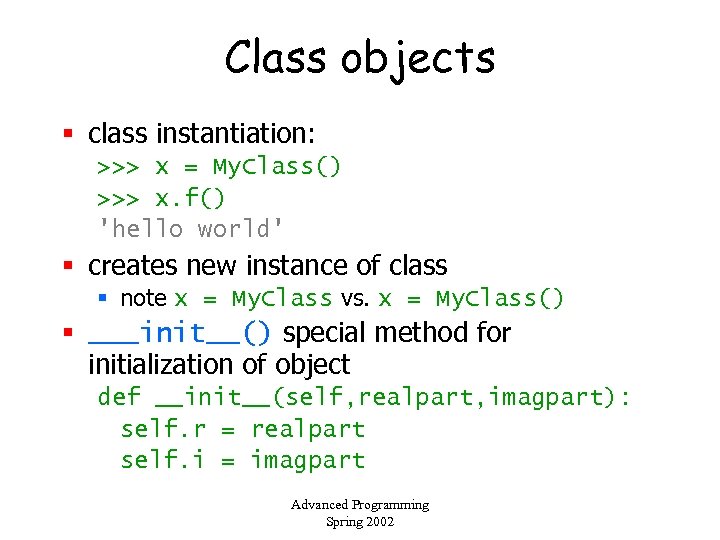
Class objects § class instantiation: >>> x = My. Class() >>> x. f() 'hello world' § creates new instance of class § note x = My. Class vs. x = My. Class() § ___init__() special method for initialization of object def __init__(self, realpart, imagpart): self. r = realpart self. i = imagpart Advanced Programming Spring 2002
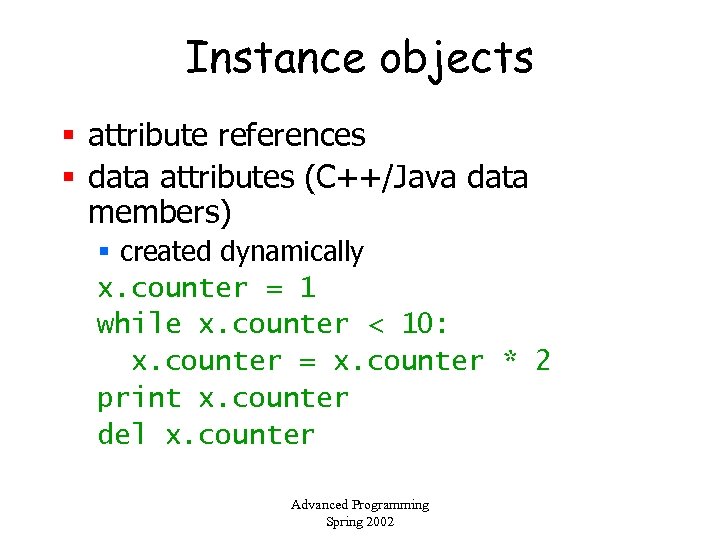
Instance objects § attribute references § data attributes (C++/Java data members) § created dynamically x. counter = 1 while x. counter < 10: x. counter = x. counter * 2 print x. counter del x. counter Advanced Programming Spring 2002
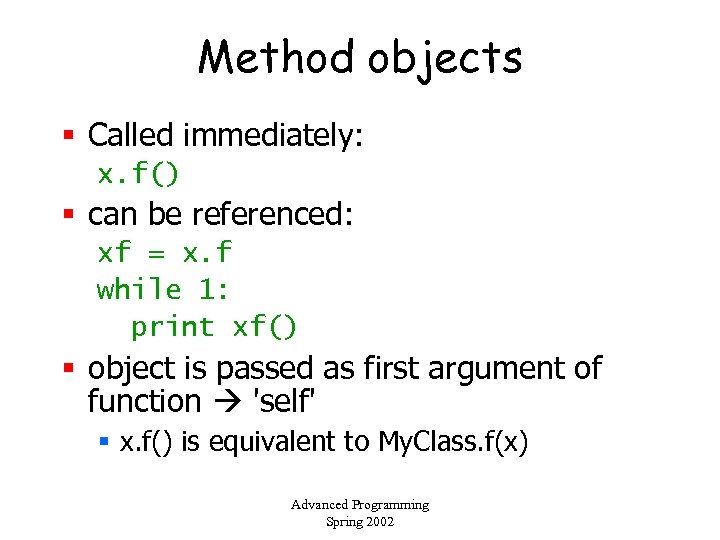
Method objects § Called immediately: x. f() § can be referenced: xf = x. f while 1: print xf() § object is passed as first argument of function 'self' § x. f() is equivalent to My. Class. f(x) Advanced Programming Spring 2002
Notes on classes § Data attributes override method attributes with the same name § no real hiding not usable to implement pure abstract data types § clients (users) of an object can add data attributes § first argument of method usually called self § 'self' has no special meaning (cf. Java) Advanced Programming Spring 2002
![Another example § bag. py class Bag: def __init__(self): self. data = [] def](https://present5.com/presentation/ebed77d265feb68656bc5ac3457eedf0/image-58.jpg "Another example § bag. py class Bag: def __init__(self): self. data = [] def")
Another example § bag. py class Bag: def __init__(self): self. data = [] def add(self, x): self. data. append(x) def addtwice(self, x): self. add(x) Advanced Programming Spring 2002
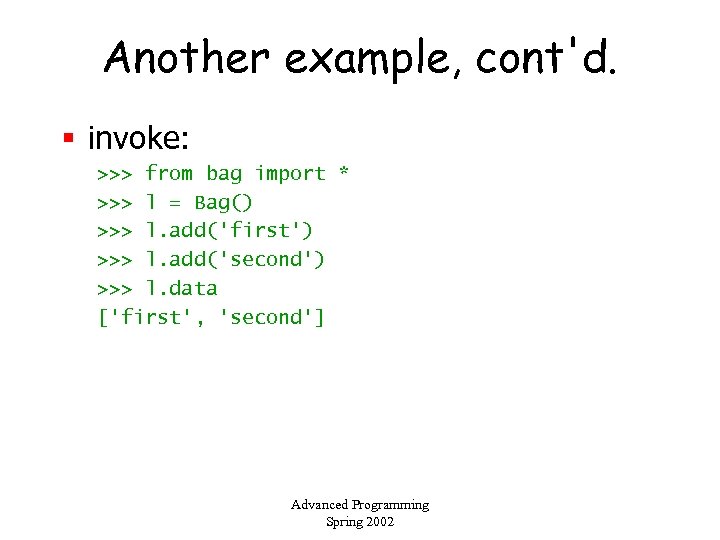
Another example, cont'd. § invoke: >>> from bag import * >>> l = Bag() >>> l. add('first') >>> l. add('second') >>> l. data ['first', 'second'] Advanced Programming Spring 2002
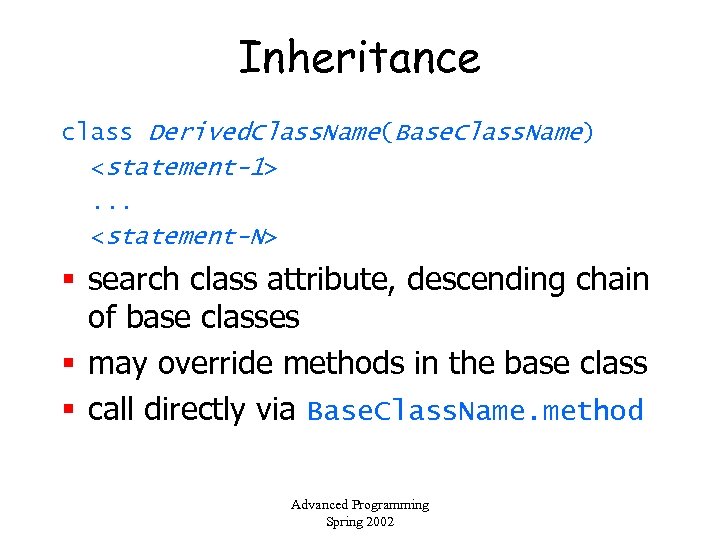
Inheritance class Derived. Class. Name(Base. Class. Name) <statement-1>. . . <statement-N> § search class attribute, descending chain of base classes § may override methods in the base class § call directly via Base. Class. Name. method Advanced Programming Spring 2002
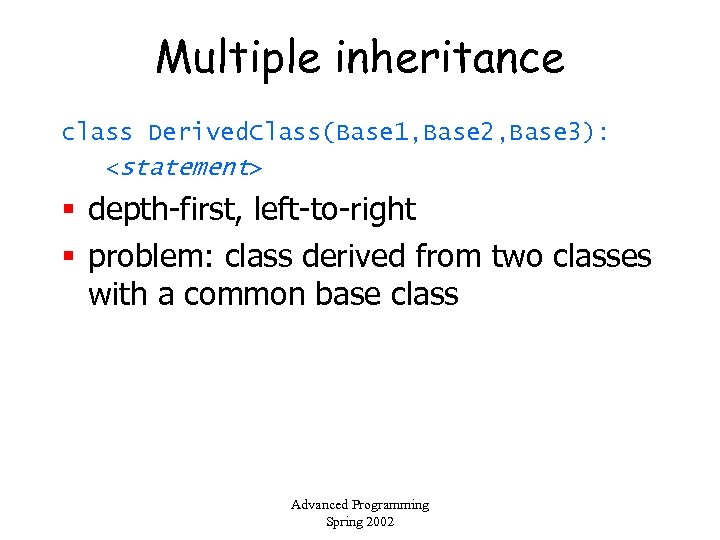
Multiple inheritance class Derived. Class(Base 1, Base 2, Base 3): <statement> § depth-first, left-to-right § problem: class derived from two classes with a common base class Advanced Programming Spring 2002
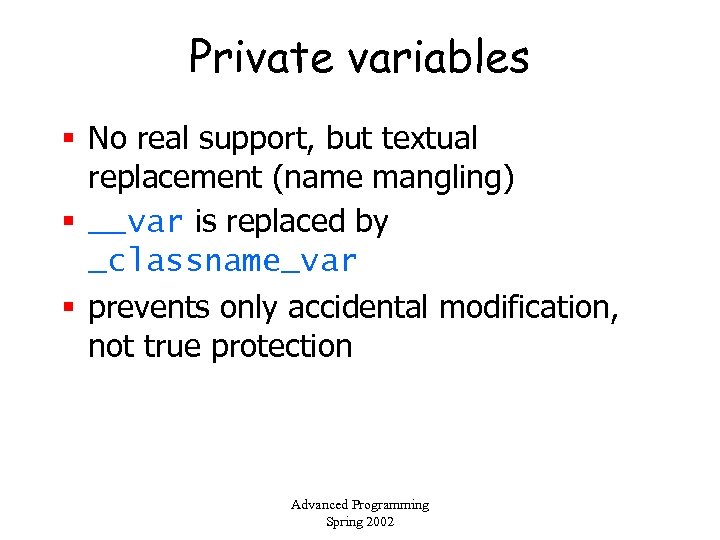
Private variables § No real support, but textual replacement (name mangling) § __var is replaced by _classname_var § prevents only accidental modification, not true protection Advanced Programming Spring 2002
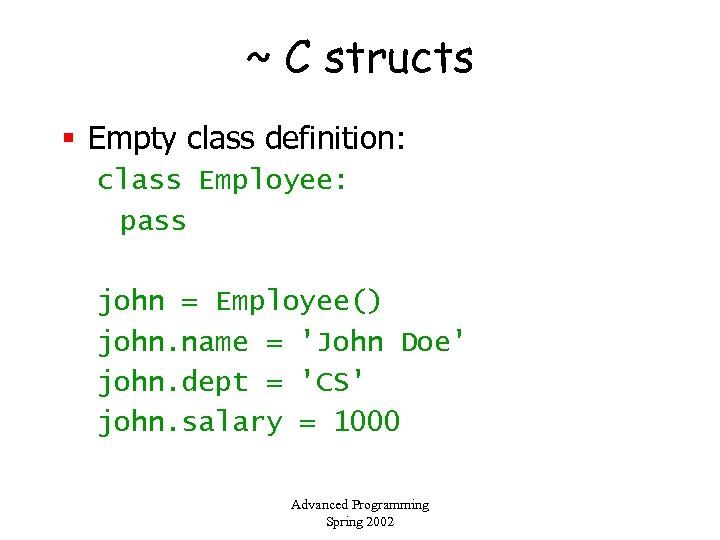
~ C structs § Empty class definition: class Employee: pass john = Employee() john. name = 'John Doe' john. dept = 'CS' john. salary = 1000 Advanced Programming Spring 2002
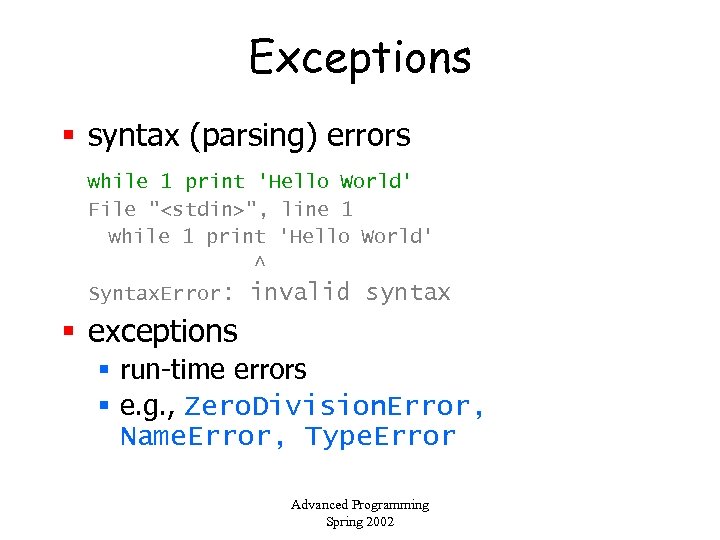
Exceptions § syntax (parsing) errors while 1 print 'Hello World' File "<stdin>", line 1 while 1 print 'Hello World' ^ Syntax. Error: invalid syntax § exceptions § run-time errors § e. g. , Zero. Division. Error, Name. Error, Type. Error Advanced Programming Spring 2002
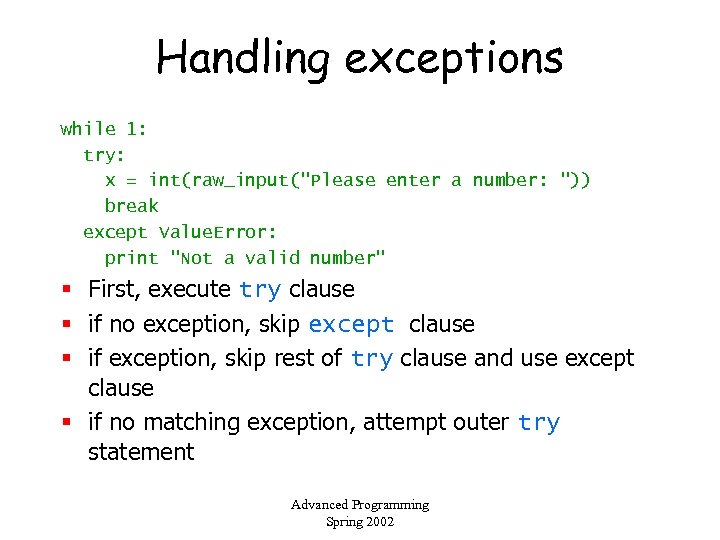
Handling exceptions while 1: try: x = int(raw_input("Please enter a number: ")) break except Value. Error: print "Not a valid number" § First, execute try clause § if no exception, skip except clause § if exception, skip rest of try clause and use except clause § if no matching exception, attempt outer try statement Advanced Programming Spring 2002
![Handling exceptions § try. py import sys for arg in sys. argv[1: ]: try:](https://present5.com/presentation/ebed77d265feb68656bc5ac3457eedf0/image-66.jpg "Handling exceptions § try. py import sys for arg in sys. argv[1: ]: try:")
Handling exceptions § try. py import sys for arg in sys. argv[1: ]: try: f = open(arg, 'r') except IOError: print 'cannot open', arg else: print arg, 'lines: ', len(f. readlines()) f. close § e. g. , as python try. py *. py Advanced Programming Spring 2002
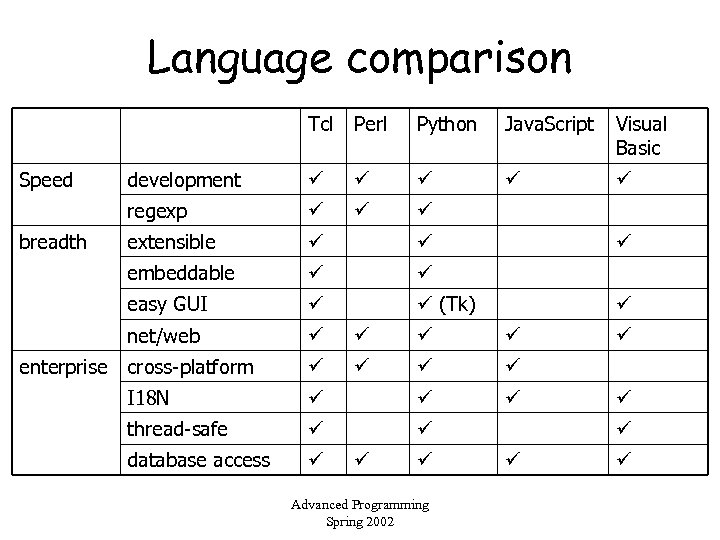
Language comparison Tcl Java. Script Visual Basic development extensible embeddable easy GUI (Tk) net/web breadth Python regexp Speed Perl enterprise cross-platform I 18 N thread-safe database access Advanced Programming Spring 2002
Скачать презентацию Python Henning Schulzrinne Department of Computer Science Columbia
ebed77d265feb68656bc5ac3457eedf0.ppt