Скачать презентацию Putting food allergy in to perspective Jan Sinclair
822844eff3da19b5f2ae26f4fa497761.ppt
- Количество слайдов: 26
 Putting food allergy in to perspective Jan Sinclair Paediatric Allergy & Clinical Immunology Starship
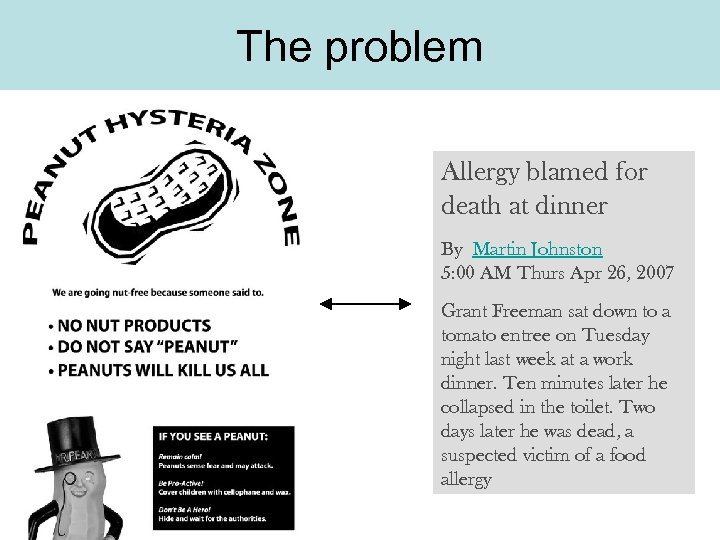 The problem Allergy blamed for death at dinner By Martin Johnston 5: 00 AM Thurs Apr 26, 2007 Grant Freeman sat down to a tomato entree on Tuesday night last week at a work dinner. Ten minutes later he collapsed in the toilet. Two days later he was dead, a suspected victim of a food allergy
 Outline • Food allergy risks – Available data – Factors influencing risk • Impact of food allergy – Quality of life – Resilience factors • Questions and discussion
 Risks • Aim of management to avoid reactions – Nuisance reactions – unpleasant but not dangerous – Life threatening reactions • Data difficult – Severe reactions not always recognized • Differentiation from asthma – Fatal reactions not always classified as such
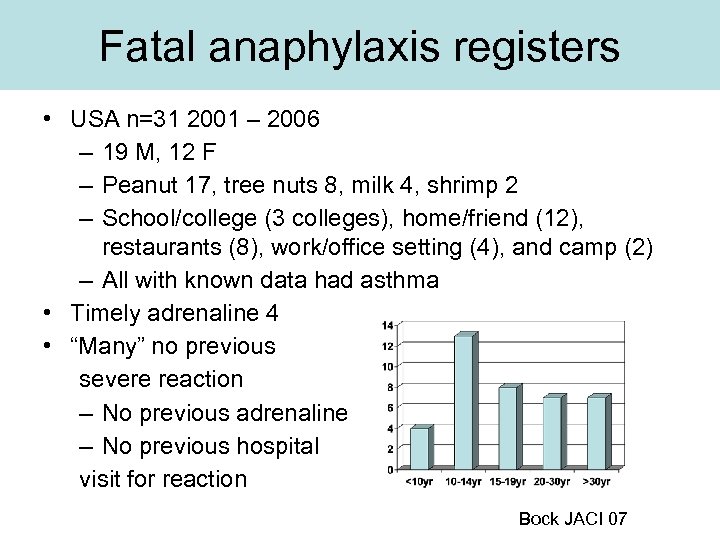 Fatal anaphylaxis registers • USA n=31 2001 – 2006 – 19 M, 12 F – Peanut 17, tree nuts 8, milk 4, shrimp 2 – School/college (3 colleges), home/friend (12), restaurants (8), work/office setting (4), and camp (2) – All with known data had asthma • Timely adrenaline 4 • “Many” no previous severe reaction – No previous adrenaline – No previous hospital visit for reaction Bock JACI 07
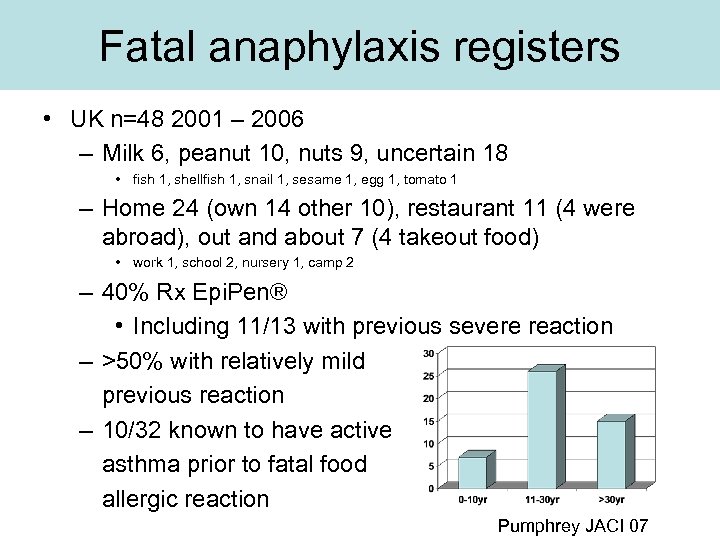 Fatal anaphylaxis registers • UK n=48 2001 – 2006 – Milk 6, peanut 10, nuts 9, uncertain 18 • fish 1, shellfish 1, snail 1, sesame 1, egg 1, tomato 1 – Home 24 (own 14 other 10), restaurant 11 (4 were abroad), out and about 7 (4 takeout food) • work 1, school 2, nursery 1, camp 2 – 40% Rx Epi. Pen® • Including 11/13 with previous severe reaction – >50% with relatively mild previous reaction – 10/32 known to have active asthma prior to fatal food allergic reaction Pumphrey JACI 07
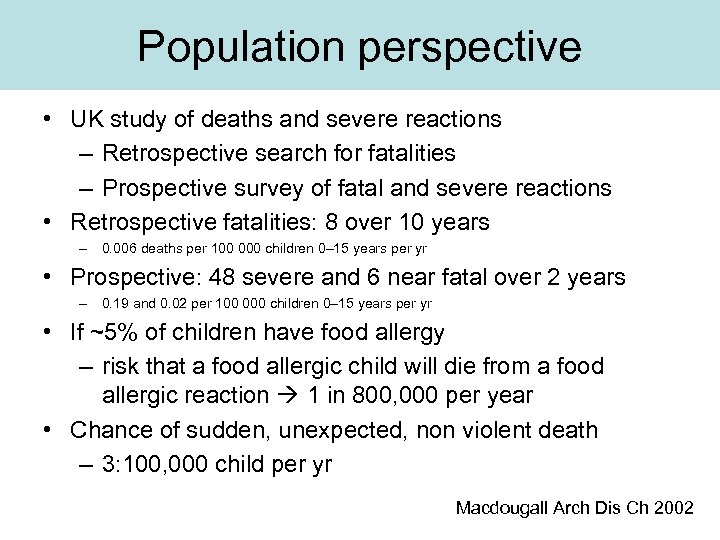 Population perspective • UK study of deaths and severe reactions – Retrospective search for fatalities – Prospective survey of fatal and severe reactions • Retrospective fatalities: 8 over 10 years – 0. 006 deaths per 100 000 children 0– 15 years per yr • Prospective: 48 severe and 6 near fatal over 2 years – 0. 19 and 0. 02 per 100 000 children 0– 15 years per yr • If ~5% of children have food allergy – risk that a food allergic child will die from a food allergic reaction 1 in 800, 000 per year • Chance of sudden, unexpected, non violent death – 3: 100, 000 child per yr Macdougall Arch Dis Ch 2002
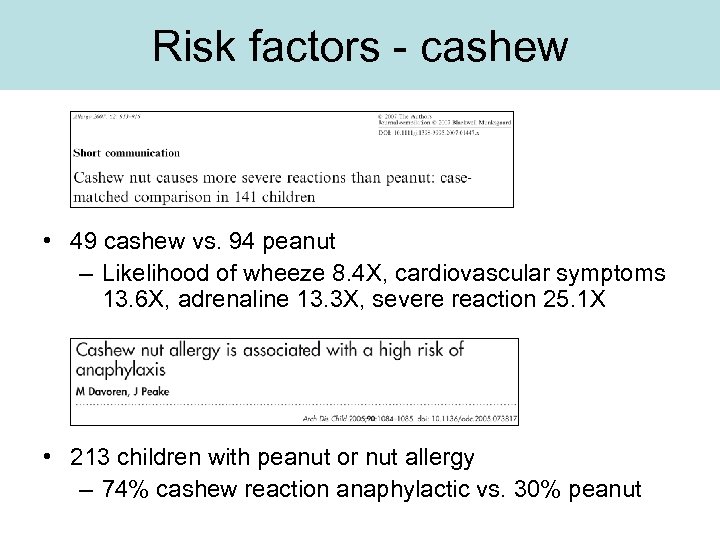 Risk factors - cashew • 49 cashew vs. 94 peanut – Likelihood of wheeze 8. 4 X, cardiovascular symptoms 13. 6 X, adrenaline 13. 3 X, severe reaction 25. 1 X • 213 children with peanut or nut allergy – 74% cashew reaction anaphylactic vs. 30% peanut
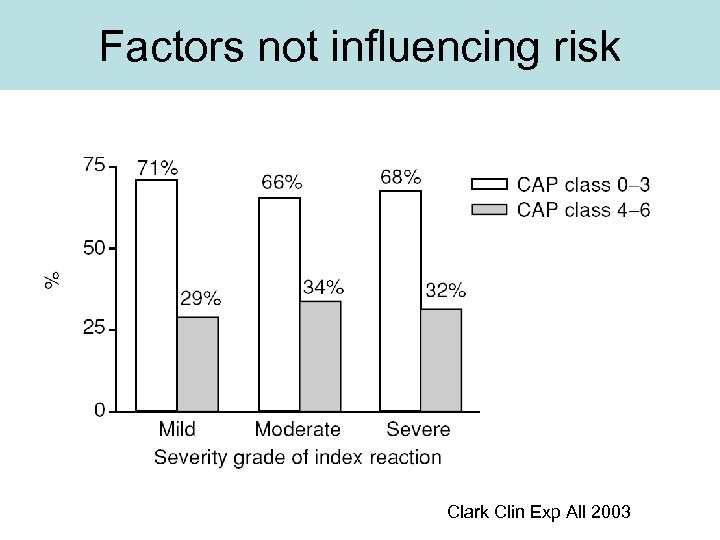 Factors not influencing risk Clark Clin Exp All 2003
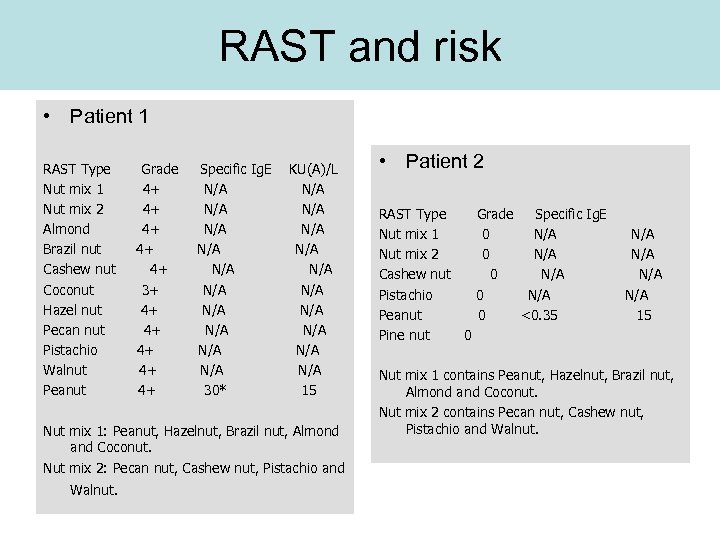 RAST and risk • Patient 1 RAST Type Nut mix 1 Nut mix 2 Almond Brazil nut Cashew nut Coconut Hazel nut Pecan nut Pistachio Walnut Peanut Grade 4+ 4+ 4+ 3+ 4+ 4+ 4+ Specific Ig. E N/A N/A N/A 30* KU(A)/L N/A N/A N/A 15 Nut mix 1: Peanut, Hazelnut, Brazil nut, Almond and Coconut. Nut mix 2: Pecan nut, Cashew nut, Pistachio and Walnut. • Patient 2 RAST Type Nut mix 1 Nut mix 2 Cashew nut Pistachio Peanut Pine nut 0 Grade Specific Ig. E 0 N/A 0 <0. 35 N/A N/A 15 Nut mix 1 contains Peanut, Hazelnut, Brazil nut, Almond and Coconut. Nut mix 2 contains Pecan nut, Cashew nut, Pistachio and Walnut.
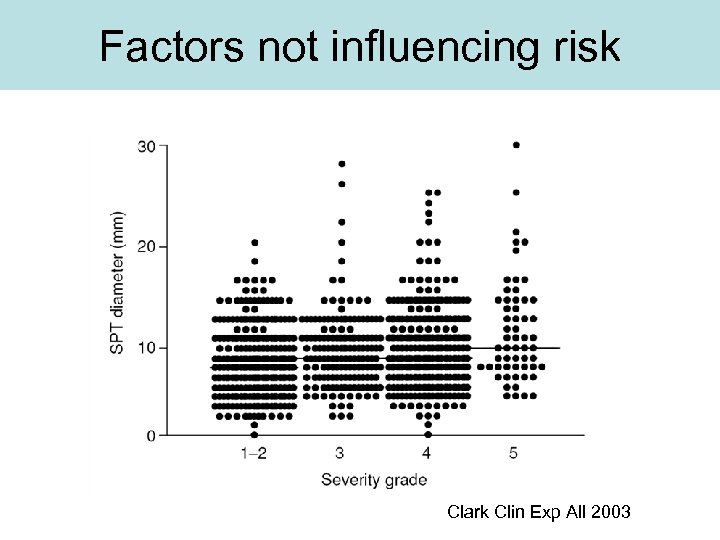 Factors not influencing risk Clark Clin Exp All 2003
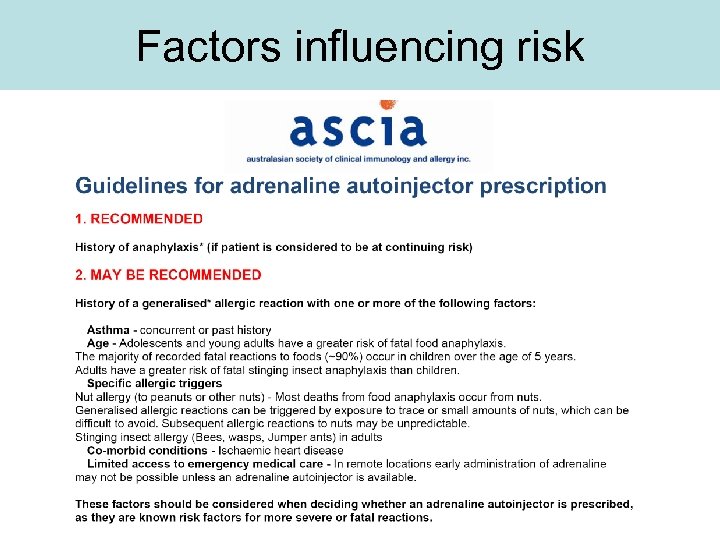 Factors influencing risk

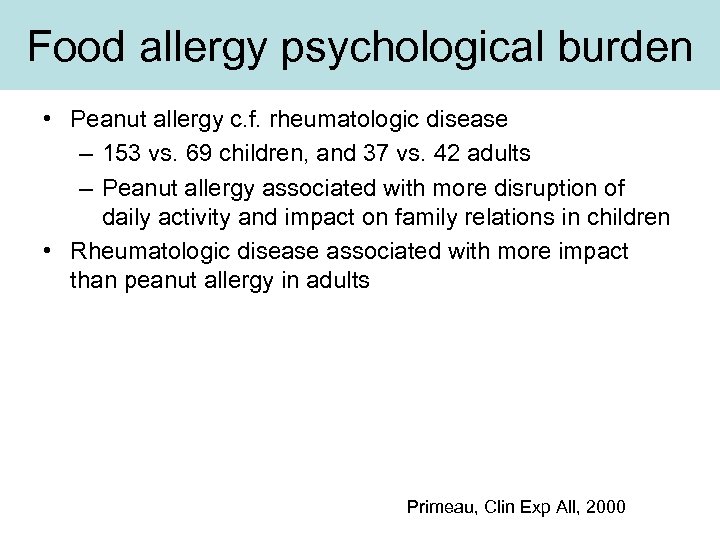 Food allergy psychological burden • Peanut allergy c. f. rheumatologic disease – 153 vs. 69 children, and 37 vs. 42 adults – Peanut allergy associated with more disruption of daily activity and impact on family relations in children • Rheumatologic disease associated with more impact than peanut allergy in adults Primeau, Clin Exp All, 2000
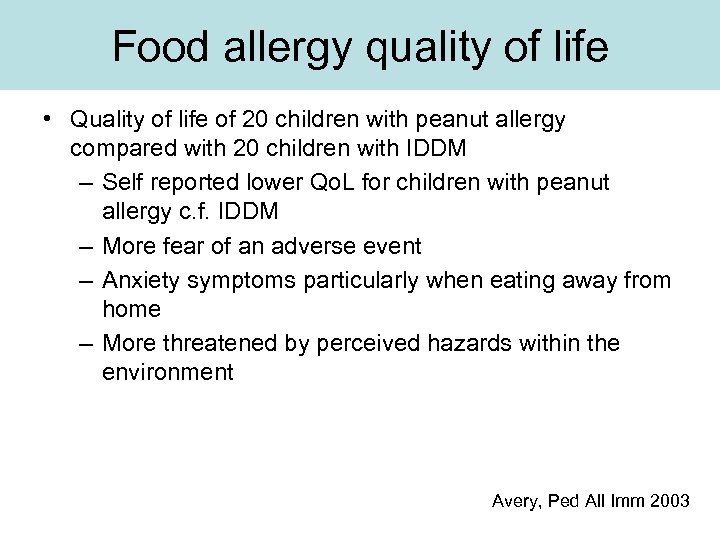 Food allergy quality of life • Quality of life of 20 children with peanut allergy compared with 20 children with IDDM – Self reported lower Qo. L for children with peanut allergy c. f. IDDM – More fear of an adverse event – Anxiety symptoms particularly when eating away from home – More threatened by perceived hazards within the environment Avery, Ped All Imm 2003
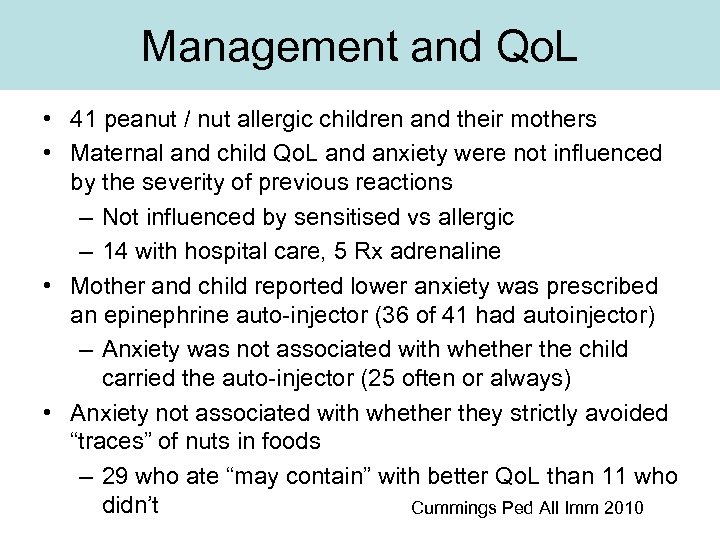 Management and Qo. L • 41 peanut / nut allergic children and their mothers • Maternal and child Qo. L and anxiety were not influenced by the severity of previous reactions – Not influenced by sensitised vs allergic – 14 with hospital care, 5 Rx adrenaline • Mother and child reported lower anxiety was prescribed an epinephrine auto-injector (36 of 41 had autoinjector) – Anxiety was not associated with whether the child carried the auto-injector (25 often or always) • Anxiety not associated with whether they strictly avoided “traces” of nuts in foods – 29 who ate “may contain” with better Qo. L than 11 who didn’t Cummings Ped All Imm 2010
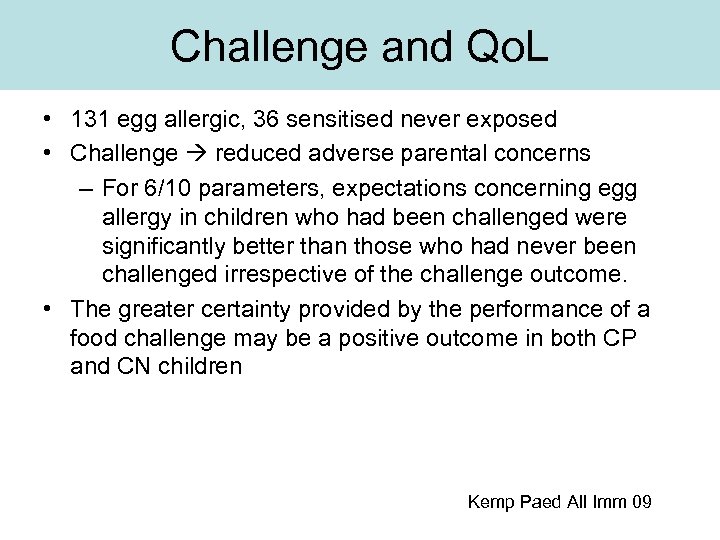 Challenge and Qo. L • 131 egg allergic, 36 sensitised never exposed • Challenge reduced adverse parental concerns – For 6/10 parameters, expectations concerning egg allergy in children who had been challenged were significantly better than those who had never been challenged irrespective of the challenge outcome. • The greater certainty provided by the performance of a food challenge may be a positive outcome in both CP and CN children Kemp Paed All Imm 09
 Education and Qo. L Vickers 1997
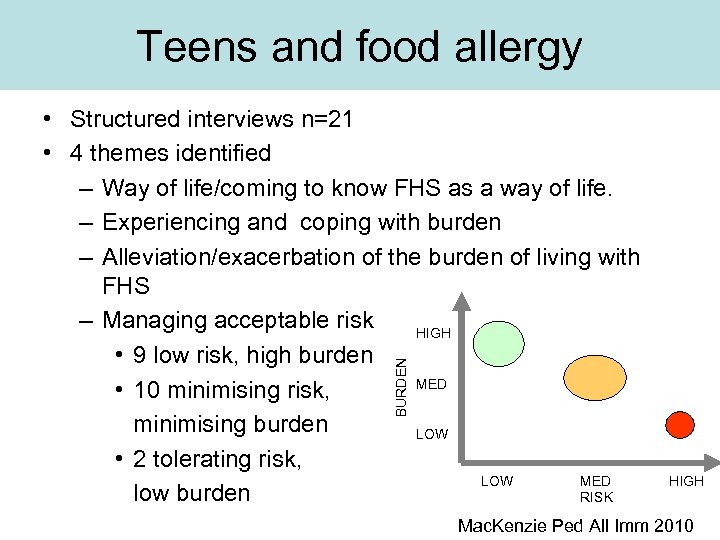 Teens and food allergy BURDEN • Structured interviews n=21 • 4 themes identified – Way of life/coming to know FHS as a way of life. – Experiencing and coping with burden – Alleviation/exacerbation of the burden of living with FHS – Managing acceptable risk HIGH • 9 low risk, high burden MED • 10 minimising risk, minimising burden LOW • 2 tolerating risk, LOW MED low burden RISK HIGH Mac. Kenzie Ped All Imm 2010
 Developmental trajectory • Children <8 – Own food is “special” – Confident in parent’s control • Around 8 -9 years – “Special” develops negative connotations – Awareness of uncertainty • Older and more independent – Increasing uncertainty – Reinforced by lack of awareness of others – Awareness of anxiety of parents – “Difference” as isolation Dunn. Galvin Adv Food Nutr Res 2009
 Strategy – avoidance – 40% • Specifically allergen related ↔ generalised of places, people, situations • Generalised related to high levels of anxiety and low levels of self efficacy – Not related to severity previous reactions “It is better to not go to restaurants. . . you never know…the waiters don't know” “I only go to places where I know I am safe” “We wouldn't go to restaurants because they are not safe” “I only go to friends houses who I know for ages. . . its safer that way” Dunn. Galvin Allergy 2009
 Strategy - minimisation • Minimisation strategies 30% – Rejection of food allergic identity, adopting risky behavior “I just want to be like the other kids…and bringing up about the allergy, that just makes you weird” “Sometimes I forget my pen on purpose; you just got to chance it will be ok…you'd go mad otherwise” “I was sitting in a friends house with a group of guys and they started firing peanuts at me…they didn't know, I don’t tell people but that was a freaky moment” Dunn. Galvin Allergy 2009
 Strategy - adaptive • Positive emotional, cognitive or behavioural strategies used to cope with the everyday experience of living with food allergy • Children whose parents encouraged independence and self-management were more likely to describe positive coping strategies “If there's food around, I will be careful, but otherwise I don't think about it” “I’m lucky cause I don't like cake…well if I tried it, I might like it, but I decided I didn't like it” “I always tell people I'm food allergic…its safer that way and then you don't have to keep explaining Dunn. Galvin Allergy 2009
 Building resilience • Age appropriate strategies – Peanut minimisation in preschools, won’t work by intermediate – Review and adapt with time and developmental progress • Focus on avoiding ingestion – Reactions to touch and inhalation possible but rare • Systemic reactions not reproduced with peanut smell • Education re allergen – Identification – Hidden sources – Following the family rules
 Building resilience • Confidence about – Avoidance strategies • Age appropriate – Child needs to be ready for these to change • Managing uncertainty – What won’t hurt • Recognition about – Reaction signs and symptoms – How to get help – Practice with autoinjector (parents older child)