


 Скачать презентацию Putting Competing Orders in their Place near the
b2d1cd743579450cdc98d1dfd43ea829.ppt
- Количество слайдов: 29
 Putting Competing Orders in their Place near the Mott Transition Leon Balents (UCSB) Lorenz Bartosch (Yale) Anton Burkov (UCSB) Predrag Nikolic (Yale) Subir Sachdev (Yale) Krishnendu Sengupta (Toronto) cond-mat/0408329, cond-mat/0409470, and to appear
 Mott Transition localized, insulating delocalized, (super)conducting • Many interesting systems near Mott transition – – Cuprates Nax. Co. O 2¢ y. H 2 O Organics: -(ET)2 X Li. V 2 O 4 • Unusual behaviors of such materials – Power laws (transport, optics, NMR…) suggest QCP? – Anomalies nearby • Fluctuating/competing orders • Pseudogap • Heavy fermion behavior (Li. V 2 O 4)
 Competing Orders • “Usually” Mott Insulator has spin and/or charge/orbital order (LSM/Oshikawa) • Luttinger Theorem/Topological argument : some kind of order is necessary in a Mott insulator (gapped state) unless there is an even number of electrons per unit cell - Charge/spin/orbital order - In principle, topological order (not subject of talk) • Theory of Mott transition must incorporate this constraint
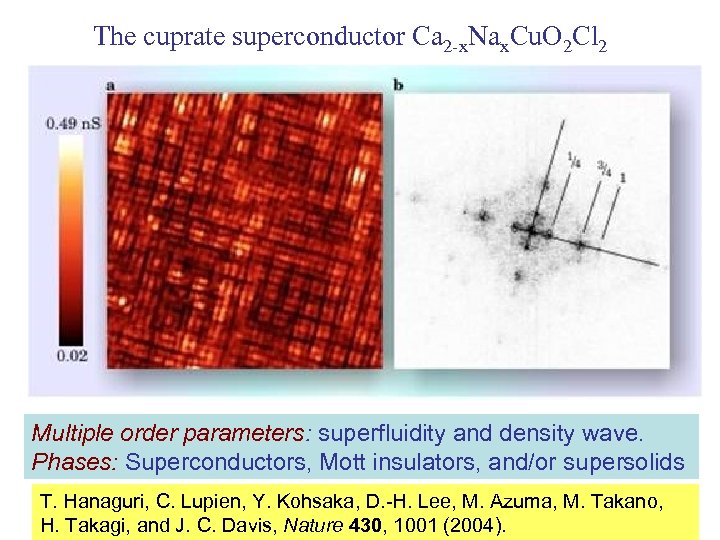 The cuprate superconductor Ca 2 -x. Nax. Cu. O 2 Cl 2 Multiple order parameters: superfluidity and density wave. Phases: Superconductors, Mott insulators, and/or supersolids T. Hanaguri, C. Lupien, Y. Kohsaka, D. -H. Lee, M. Azuma, M. Takano, H. Takagi, and J. C. Davis, Nature 430, 1001 (2004).
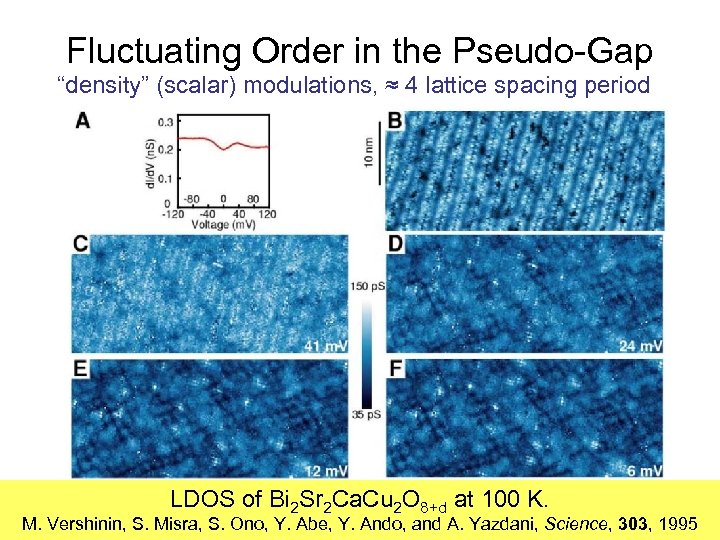 Fluctuating Order in the Pseudo-Gap “density” (scalar) modulations, ≈ 4 lattice spacing period LDOS of Bi 2 Sr 2 Ca. Cu 2 O 8+d at 100 K. M. Vershinin, S. Misra, S. Ono, Y. Abe, Y. Ando, and A. Yazdani, Science, 303, 1995
 Landau-Ginzburg-Wilson (LGW) Theory • Landau expansion of effective action in “order parameters” describing broken symmetries – Conceptual flaw: need a “disordered” state • Mott state cannot be disordered • Expansion around metal problematic since large DOS means bad expansion and Fermi liquid locally stable – Physical problem: Mott physics (e. g. large U) is central effect, order in insulator is a consequence, not the reverse. – Pragmatic difficulty: too many different orders “seen” or proposed • How to choose? • If energetics separating these orders is so delicate, perhaps this is an indication that some description that subsumes them is needed (put chicken before the eggs)
 What is Needed? • Approach should focus on Mott localization physics but still capture crucial order nearby – Challenge: Mott physics unrelated to symmetry – Not an LGW theory! • Insist upon continuous (2 nd order) QCPs – Robustness: • 1 st order transitions extraordinarily sensitive to disorder and demand fine-tuned energetics • Continuous QCPs have emergent universality – Want (ultimately – not today ) to explain experimental power-laws
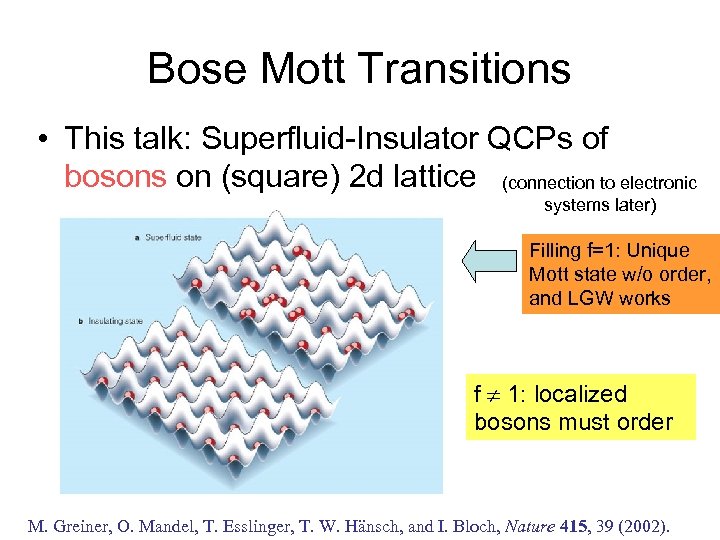 Bose Mott Transitions • This talk: Superfluid-Insulator QCPs of bosons on (square) 2 d lattice (connection to electronic systems later) Filling f=1: Unique Mott state w/o order, and LGW works f 1: localized bosons must order M. Greiner, O. Mandel, T. Esslinger, T. W. Hänsch, and I. Bloch, Nature 415, 39 (2002).
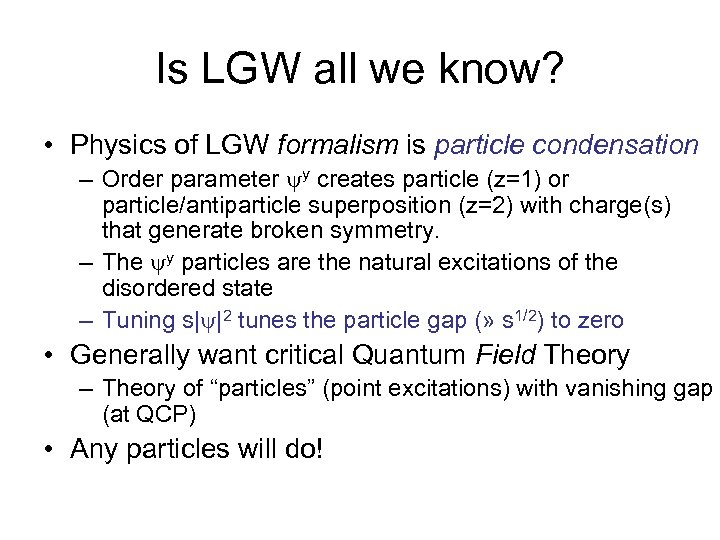 Is LGW all we know? • Physics of LGW formalism is particle condensation – Order parameter y creates particle (z=1) or particle/antiparticle superposition (z=2) with charge(s) that generate broken symmetry. – The y particles are the natural excitations of the disordered state – Tuning s| |2 tunes the particle gap (» s 1/2) to zero • Generally want critical Quantum Field Theory – Theory of “particles” (point excitations) with vanishing gap (at QCP) • Any particles will do!
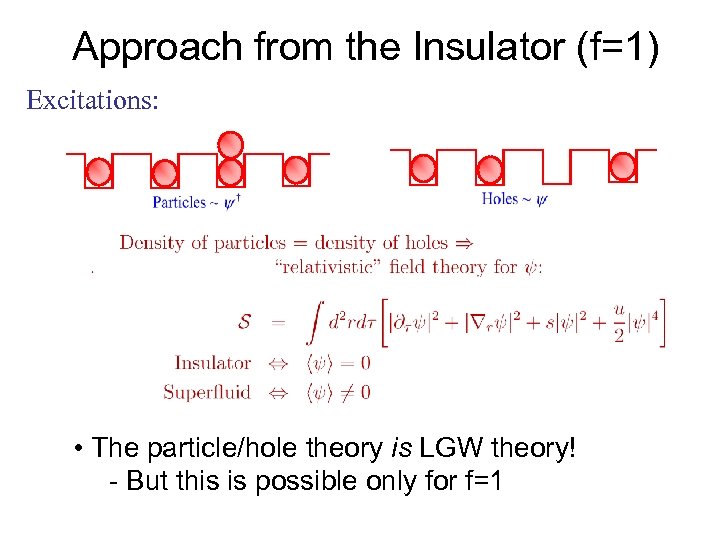 Approach from the Insulator (f=1) Excitations: • The particle/hole theory is LGW theory! - But this is possible only for f=1
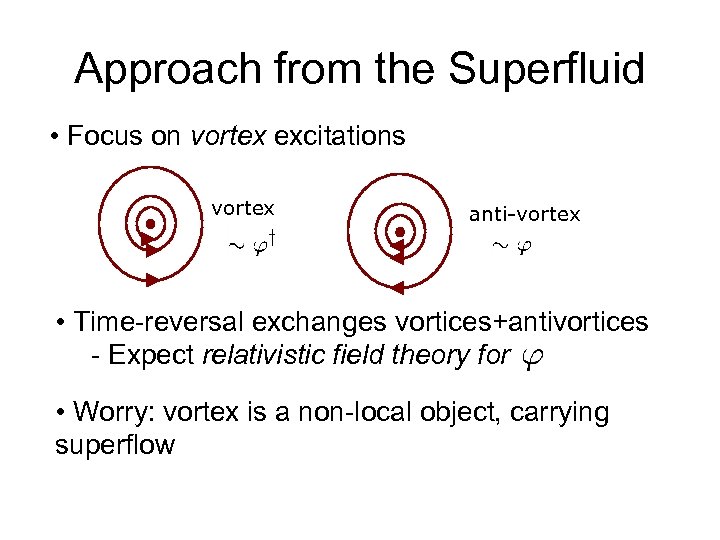 Approach from the Superfluid • Focus on vortex excitations vortex anti-vortex • Time-reversal exchanges vortices+antivortices - Expect relativistic field theory for • Worry: vortex is a non-local object, carrying superflow
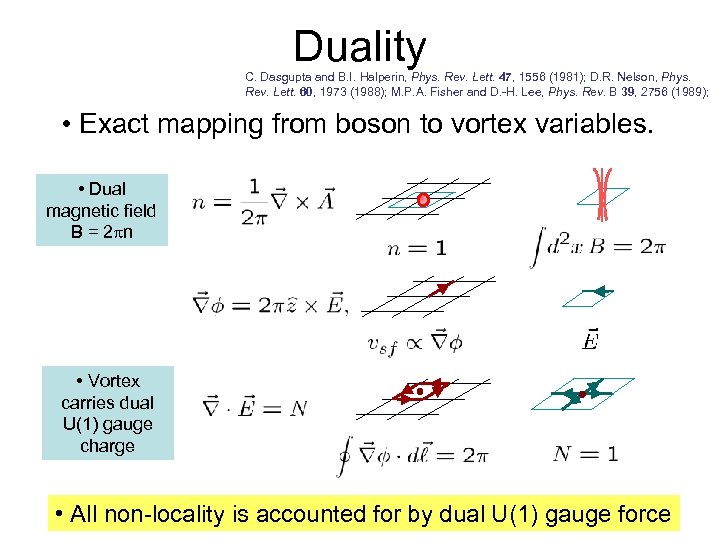 Duality C. Dasgupta and B. I. Halperin, Phys. Rev. Lett. 47, 1556 (1981); D. R. Nelson, Phys. Rev. Lett. 60, 1973 (1988); M. P. A. Fisher and D. -H. Lee, Phys. Rev. B 39, 2756 (1989); • Exact mapping from boson to vortex variables. • Dual magnetic field B = 2 n • Vortex carries dual U(1) gauge charge • All non-locality is accounted for by dual U(1) gauge force
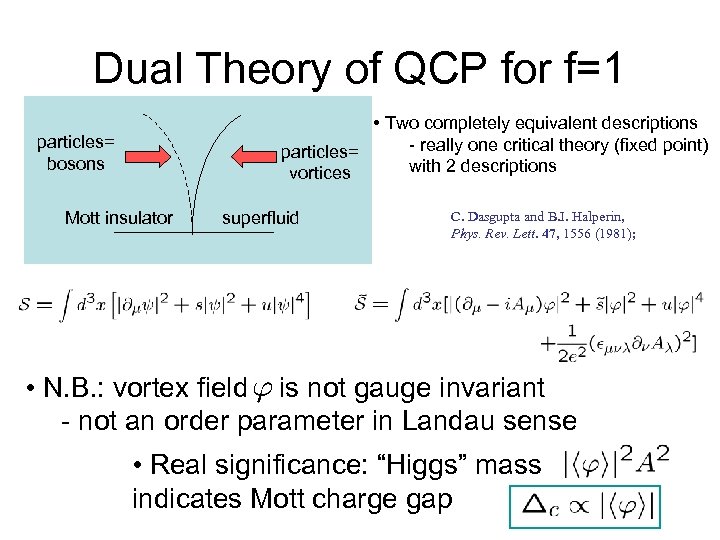 Dual Theory of QCP for f=1 • Two completely equivalent descriptions - really one critical theory (fixed point) particles= with 2 descriptions vortices particles= bosons Mott insulator superfluid C. Dasgupta and B. I. Halperin, Phys. Rev. Lett. 47, 1556 (1981); • N. B. : vortex field is not gauge invariant - not an order parameter in Landau sense • Real significance: “Higgs” mass indicates Mott charge gap
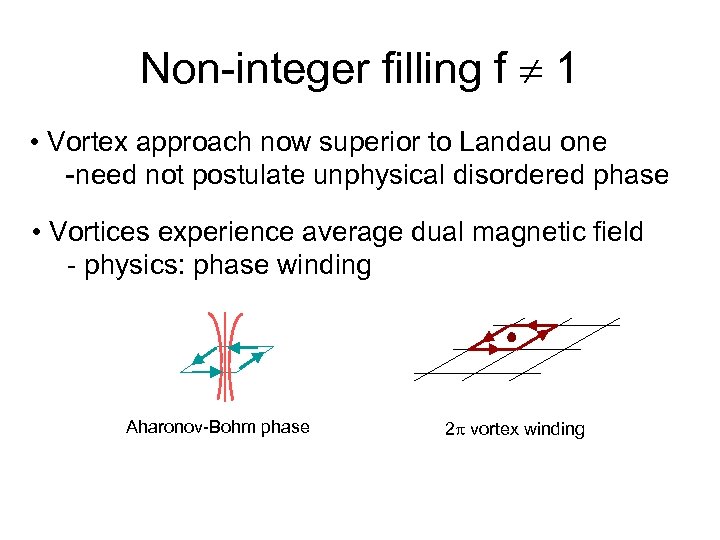 Non-integer filling f 1 • Vortex approach now superior to Landau one -need not postulate unphysical disordered phase • Vortices experience average dual magnetic field - physics: phase winding Aharonov-Bohm phase 2 vortex winding
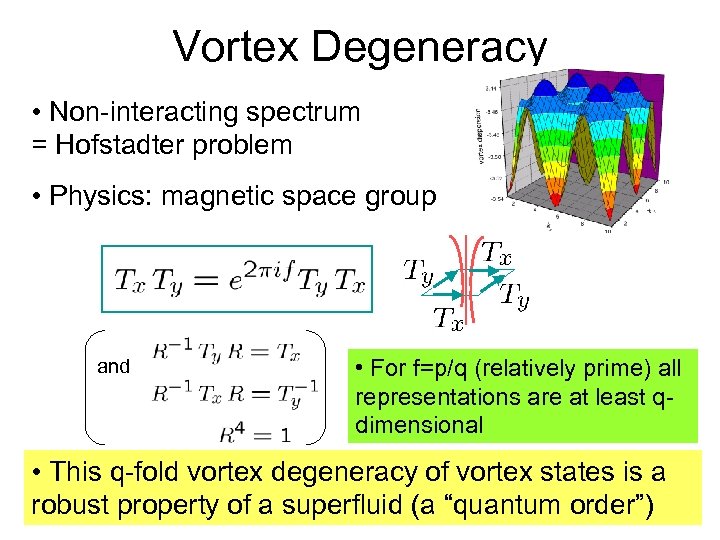 Vortex Degeneracy • Non-interacting spectrum = Hofstadter problem • Physics: magnetic space group and • For f=p/q (relatively prime) all representations are at least qdimensional • This q-fold vortex degeneracy of vortex states is a robust property of a superfluid (a “quantum order”)
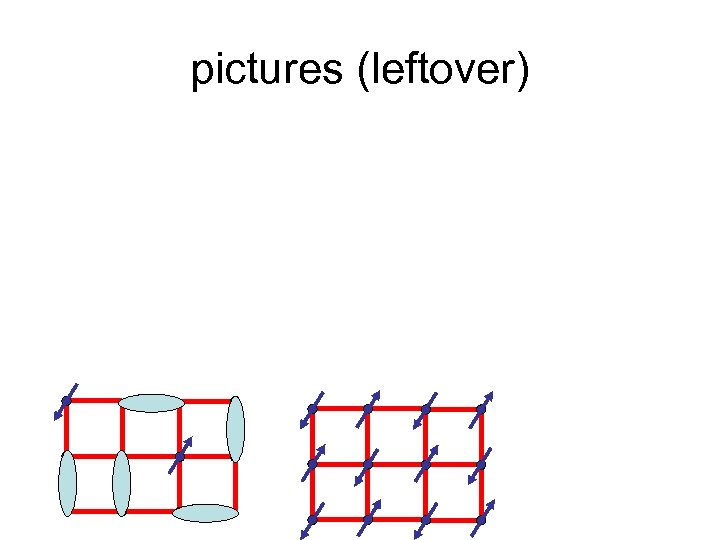
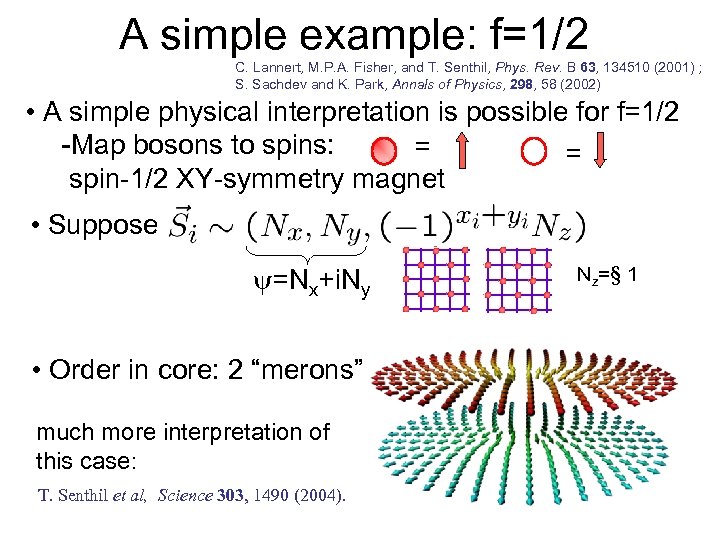 A simple example: f=1/2 C. Lannert, M. P. A. Fisher, and T. Senthil, Phys. Rev. B 63, 134510 (2001) ; S. Sachdev and K. Park, Annals of Physics, 298, 58 (2002) • A simple physical interpretation is possible for f=1/2 -Map bosons to spins: = = spin-1/2 XY-symmetry magnet • Suppose =Nx+i. Ny • Order in core: 2 “merons” much more interpretation of this case: T. Senthil et al, Science 303, 1490 (2004). Nz=§ 1
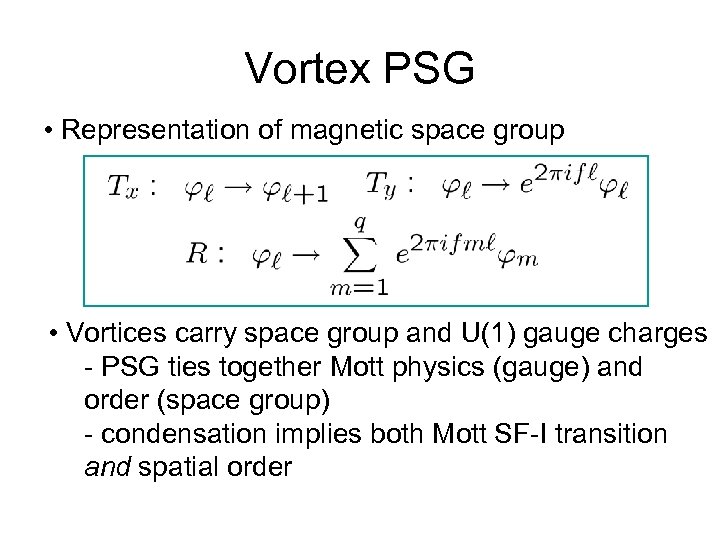 Vortex PSG • Representation of magnetic space group • Vortices carry space group and U(1) gauge charges - PSG ties together Mott physics (gauge) and order (space group) - condensation implies both Mott SF-I transition and spatial order
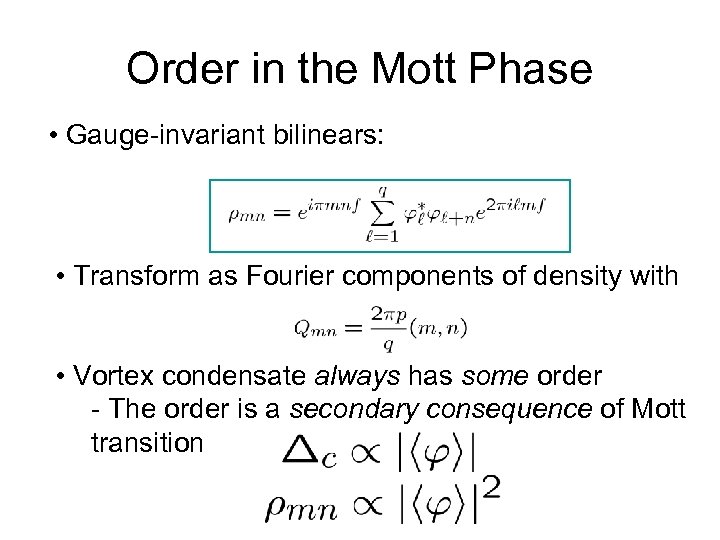 Order in the Mott Phase • Gauge-invariant bilinears: • Transform as Fourier components of density with • Vortex condensate always has some order - The order is a secondary consequence of Mott transition
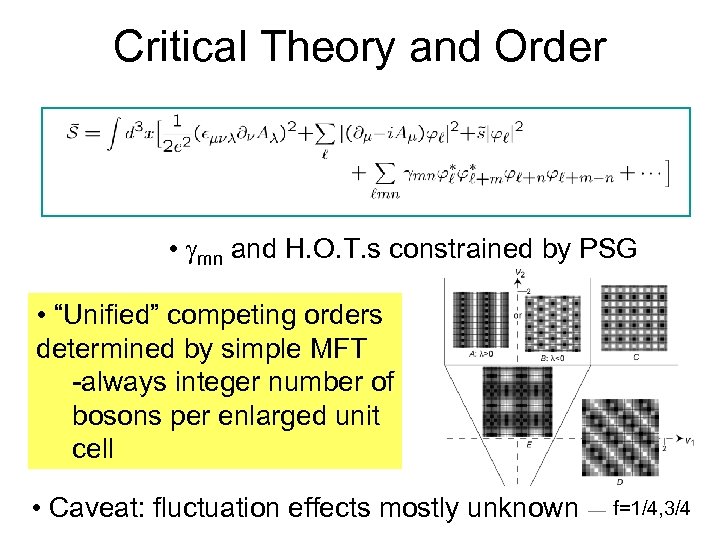 Critical Theory and Order • mn and H. O. T. s constrained by PSG • “Unified” competing orders determined by simple MFT -always integer number of bosons per enlarged unit cell • Caveat: fluctuation effects mostly unknown f=1/4, 3/4
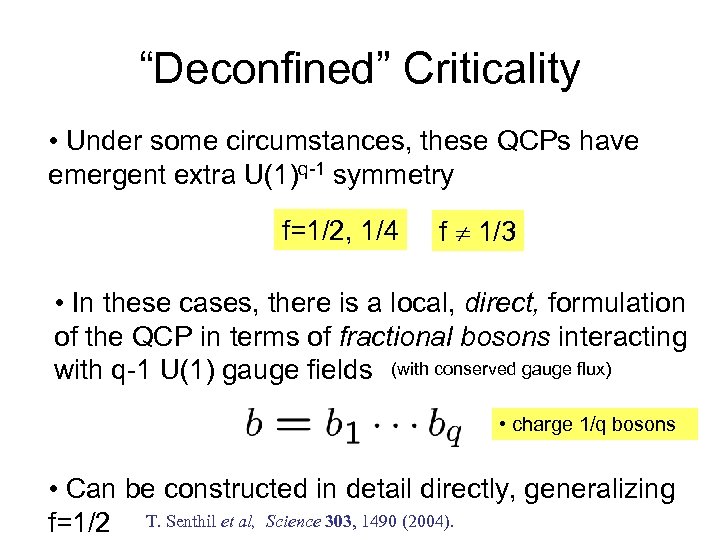 “Deconfined” Criticality • Under some circumstances, these QCPs have emergent extra U(1)q-1 symmetry f=1/2, 1/4 f 1/3 • In these cases, there is a local, direct, formulation of the QCP in terms of fractional bosons interacting with q-1 U(1) gauge fields (with conserved gauge flux) • charge 1/q bosons • Can be constructed in detail directly, generalizing f=1/2 T. Senthil et al, Science 303, 1490 (2004).
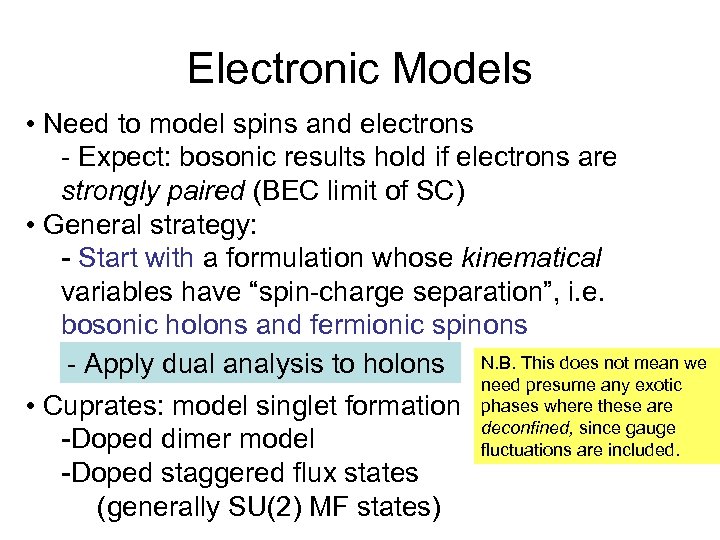 Electronic Models • Need to model spins and electrons - Expect: bosonic results hold if electrons are strongly paired (BEC limit of SC) • General strategy: - Start with a formulation whose kinematical variables have “spin-charge separation”, i. e. bosonic holons and fermionic spinons - Apply dual analysis to holons N. B. This does not mean we need presume any exotic • Cuprates: model singlet formation phases where these are deconfined, since gauge -Doped dimer model fluctuations are included. -Doped staggered flux states (generally SU(2) MF states)
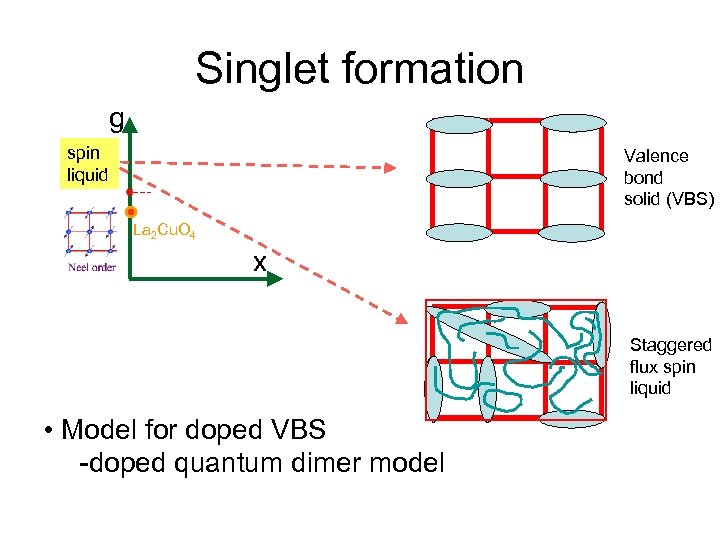 Singlet formation g spin liquid Valence bond solid (VBS) La 2 Cu. O 4 x Staggered flux spin liquid • Model for doped VBS -doped quantum dimer model
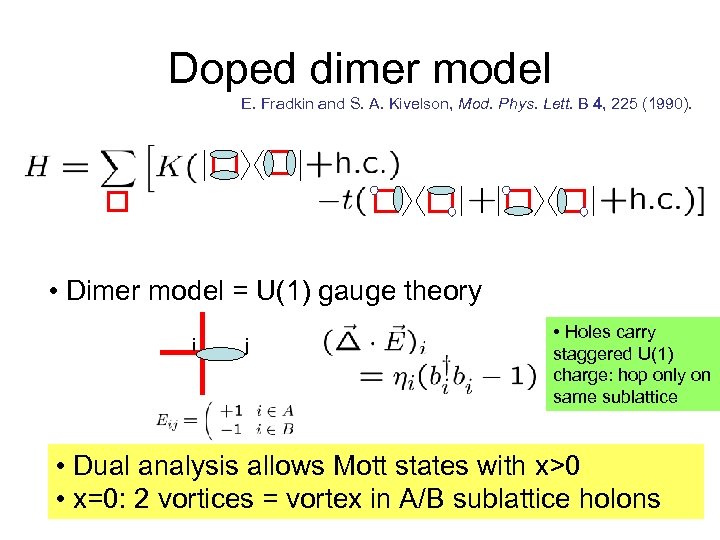 Doped dimer model E. Fradkin and S. A. Kivelson, Mod. Phys. Lett. B 4, 225 (1990). • Dimer model = U(1) gauge theory i j • Holes carry staggered U(1) charge: hop only on same sublattice • Dual analysis allows Mott states with x>0 • x=0: 2 vortices = vortex in A/B sublattice holons
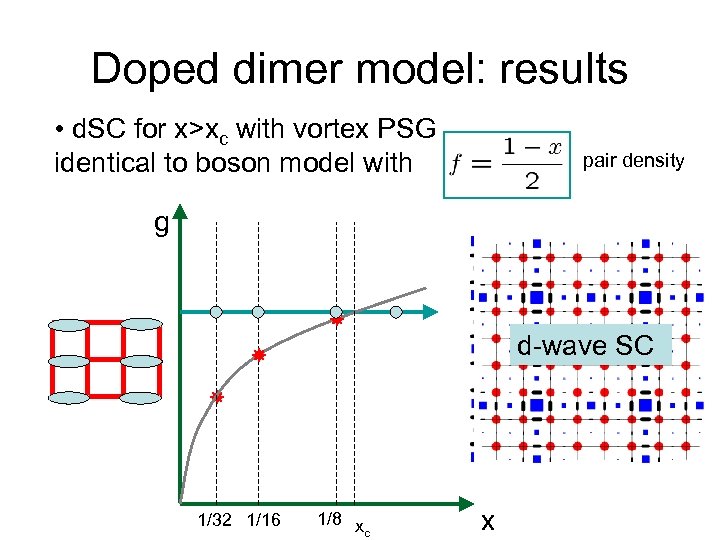 Doped dimer model: results • d. SC for x>xc with vortex PSG identical to boson model with pair density g d-wave SC 1/32 1/16 1/8 x c x
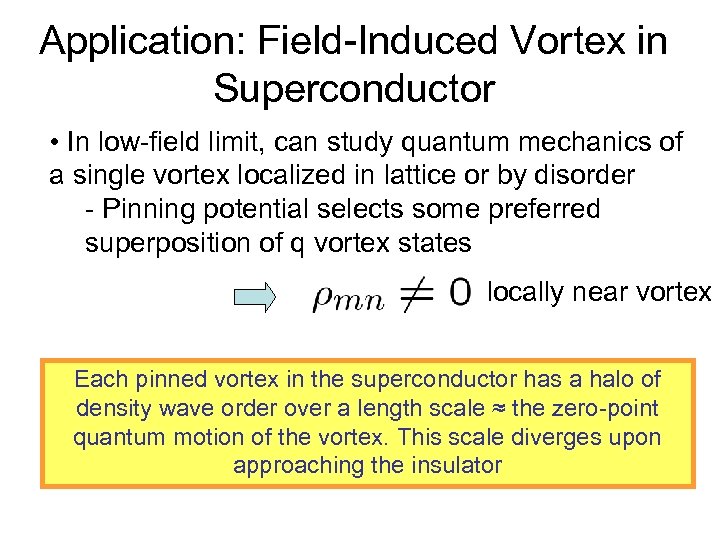 Application: Field-Induced Vortex in Superconductor • In low-field limit, can study quantum mechanics of a single vortex localized in lattice or by disorder - Pinning potential selects some preferred superposition of q vortex states locally near vortex Each pinned vortex in the superconductor has a halo of density wave order over a length scale ≈ the zero-point quantum motion of the vortex. This scale diverges upon approaching the insulator
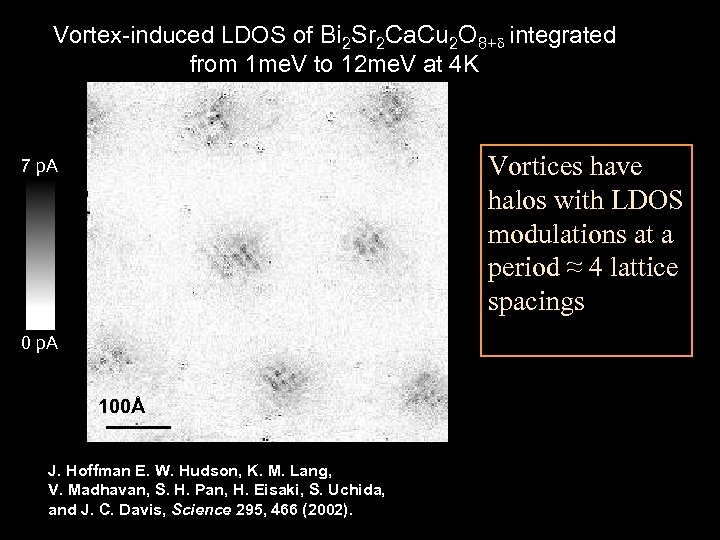 Vortex-induced LDOS of Bi 2 Sr 2 Ca. Cu 2 O 8+d integrated from 1 me. V to 12 me. V at 4 K Vortices have halos with LDOS modulations at a period ≈ 4 lattice spacings 7 p. A b 0 p. A 100Å J. Hoffman E. W. Hudson, K. M. Lang, V. Madhavan, S. H. Pan, H. Eisaki, S. Uchida, and J. C. Davis, Science 295, 466 (2002).
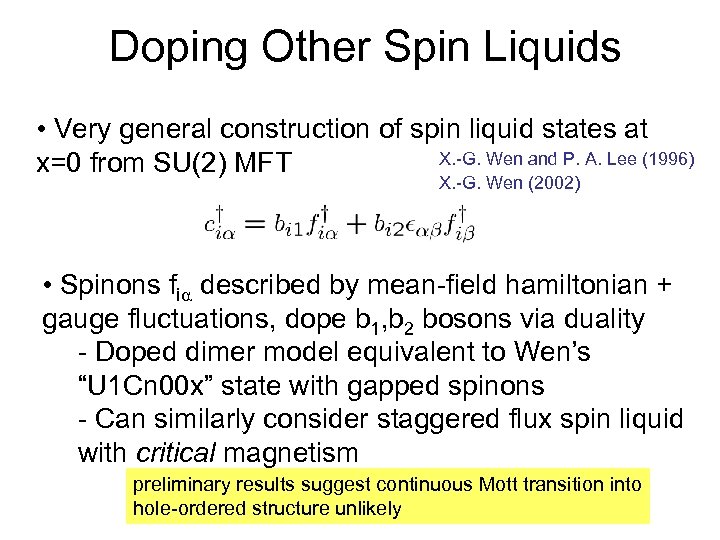 Doping Other Spin Liquids • Very general construction of spin liquid states at X. -G. Wen and P. A. Lee (1996) x=0 from SU(2) MFT X. -G. Wen (2002) • Spinons fi described by mean-field hamiltonian + gauge fluctuations, dope b 1, b 2 bosons via duality - Doped dimer model equivalent to Wen’s “U 1 Cn 00 x” state with gapped spinons - Can similarly consider staggered flux spin liquid with critical magnetism preliminary results suggest continuous Mott transition into hole-ordered structure unlikely
 Conclusions • Vortex field theory provides – formulation of Mott-driven superfluid-insulator QCP – consequent charge order in the Mott state • Vortex degeneracy (PSG) – a fundamental (? ) property of SF/SC states – natural explanation for charge order near a pinned vortex • Extension to gapless states (superconductors, metals) to be determined
 pictures (leftover)