


 Скачать презентацию Pursuits for today this week this month this
80df3c2c45d7adeccd054fb59c92f7a6.ppt
- Количество слайдов: 41
 Pursuits for today, this week, this month, this year, and for a lifetime • To meet various needs and desires. Slide 1 of 42 © 2015 Lyndon Laird All rights reserved
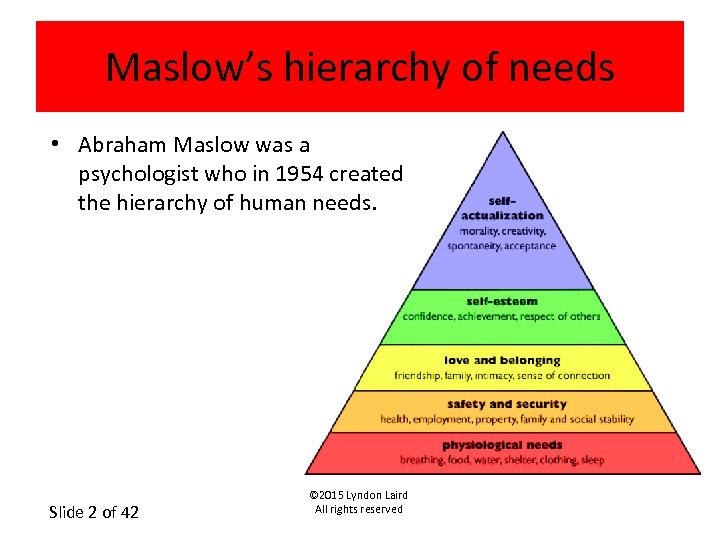 Maslow’s hierarchy of needs • Abraham Maslow was a psychologist who in 1954 created the hierarchy of human needs. Slide 2 of 42 © 2015 Lyndon Laird All rights reserved
 Humans are goal-seeing beings • Maslow’s hierarchy translates into goals in our lives. • Victor Frankl--we must have a goal or purpose. (“Man’s Search for Meaning”) • Much of our goal-seeking involves negotiation with others. Slide 3 of 42 © 2015 Lyndon Laird All rights reserved
 Negotiation • Rule # 1: People want what they can’t have and scorn that which they can have. Don’t be too eager. • Move slowly, patiently, are prepared to walk away (Rule # 1). • Stressful thus valuable-avoid “haggle-free” promotions. • Do your homework. • Take the initiative, dictate the rules, and win in advance. • Have a goal in mind a plan to reach it. (Slide 5) © 2015 Lyndon Laird • The best protection and the best way to get what we want is All rights reserved to bring something of value to the table. • Buy low, sell high, and shoot for the moon! • Push their "hot buttons"-their primary wants, fears, beliefs. • NEVER accept the first offer. Slide 4 of 42
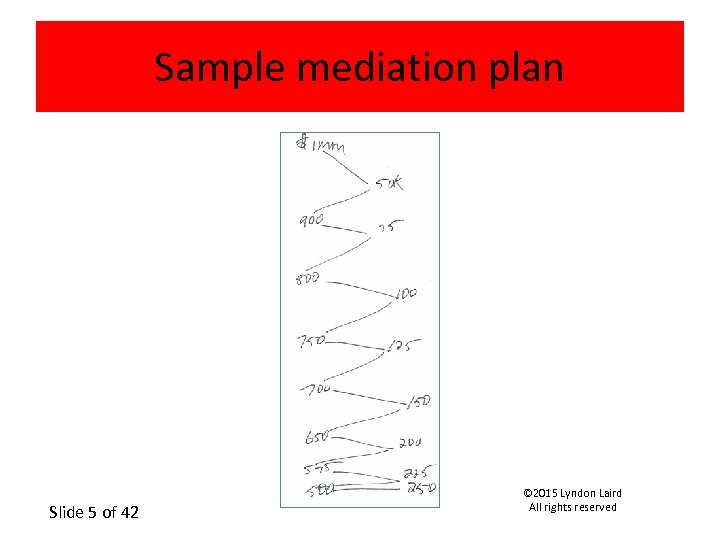 Sample mediation plan Slide 5 of 42 © 2015 Lyndon Laird All rights reserved
 Power of words Our words are the main tools of negotiation. God created the universe with his spoken words. Ge. 1 “The tongue has the power of life and death. ” Pr 18: 21 Disraeli: “With words we govern men. ” Understatement adds credibility- say it once, say it clearly, say it simply. • Characterization is effective–“He's in the drunk tank. ” • Tell stories-the oldest and best form of information sharing. • Ask, How can I most clearly, precisely, and persuasively express my thought? • • • Slide 6 of 42 © 2015 Lyndon Laird All rights reserved
 Reality • "Be as innocent as doves and as shrewd as a serpent. ” Mt. 10: 16 (There are wolves in the world). • Conventional wisdom is often wrong. • Knowledge is constantly changing. • Every rule has its exceptions and its opposites. • Question everything--especially assumptions, promises, assurances, bare statements, news stories. • “The race is not to the swift” (Ecc 9: 11) and life is not fair. – OJ Simpson was acquitted of murder, yet Andrea Yates drowned her 5 innocent boys. • Grasping reality requires an accurate understanding of human © 2015 Lyndon Laird nature. Slide 7 of 42 All rights reserved
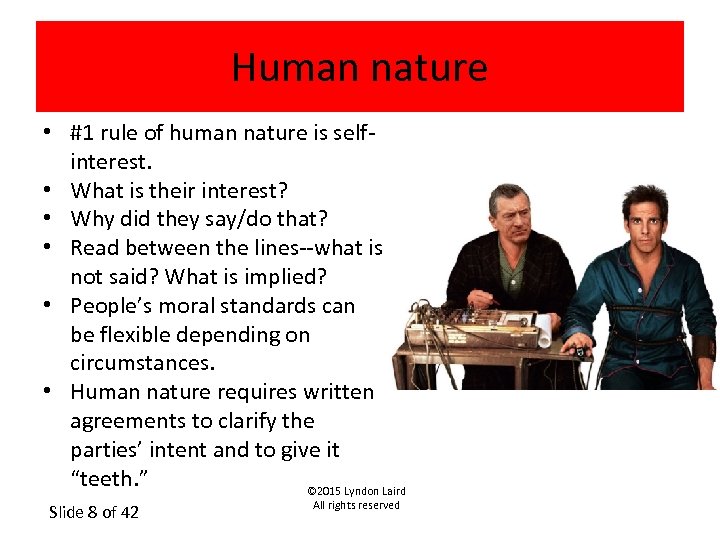 Human nature • #1 rule of human nature is selfinterest. • What is their interest? • Why did they say/do that? • Read between the lines--what is not said? What is implied? • People’s moral standards can be flexible depending on circumstances. • Human nature requires written agreements to clarify the parties’ intent and to give it “teeth. ” © 2015 Lyndon Laird Slide 8 of 42 All rights reserved
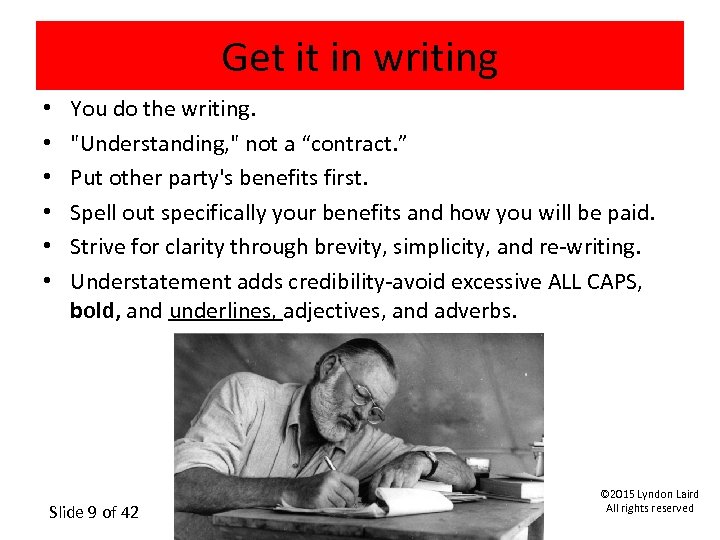 Get it in writing • • • You do the writing. "Understanding, " not a “contract. ” Put other party's benefits first. Spell out specifically your benefits and how you will be paid. Strive for clarity through brevity, simplicity, and re-writing. Understatement adds credibility-avoid excessive ALL CAPS, bold, and underlines, adjectives, and adverbs. Slide 9 of 42 © 2015 Lyndon Laird All rights reserved
 Definitions of strategy • Sir Lawrence Freedman, author of “Strategy: A History”: “Strategy is the art of creating power. ” • Laird: Strategy is the product of a mental activity calling upon many aspects of human intelligence and character— observation, experience, analysis, judgment, foresight, planning, flexibility, and mental toughness. • Laird: Strategy-making involves using these traits to coordinate ways, means, and their timing to reach our goals. Slide 10 of 42 © 2015 Lyndon Laird All rights reserved
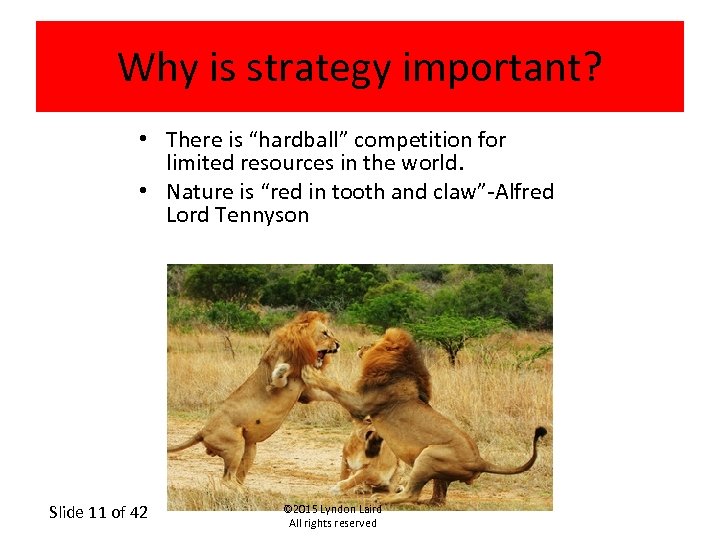 Why is strategy important? • There is “hardball” competition for limited resources in the world. • Nature is “red in tooth and claw”-Alfred Lord Tennyson Slide 11 of 42 © 2015 Lyndon Laird All rights reserved
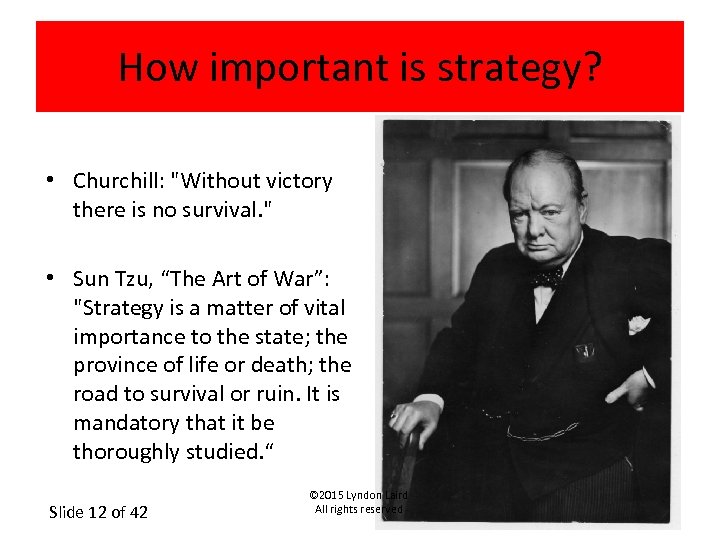 How important is strategy? • Churchill: "Without victory there is no survival. " • Sun Tzu, “The Art of War”: "Strategy is a matter of vital importance to the state; the province of life or death; the road to survival or ruin. It is mandatory that it be thoroughly studied. “ Slide 12 of 42 © 2015 Lyndon Laird All rights reserved
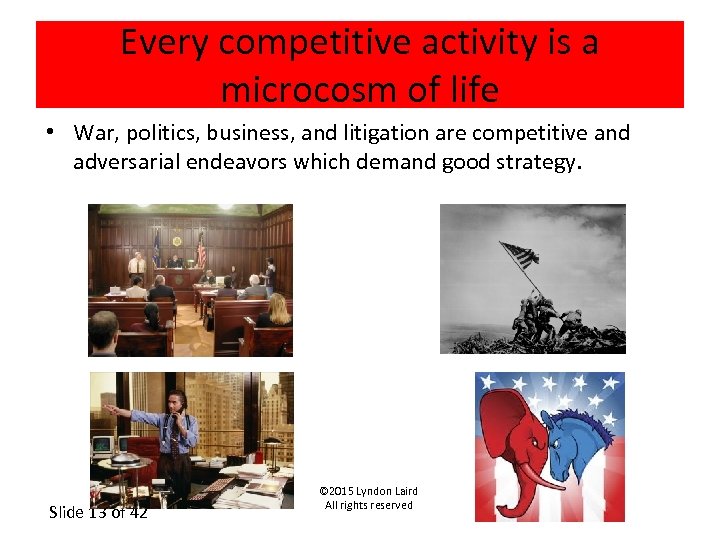 Every competitive activity is a microcosm of life • War, politics, business, and litigation are competitive and adversarial endeavors which demand good strategy. Slide 13 of 42 © 2015 Lyndon Laird All rights reserved
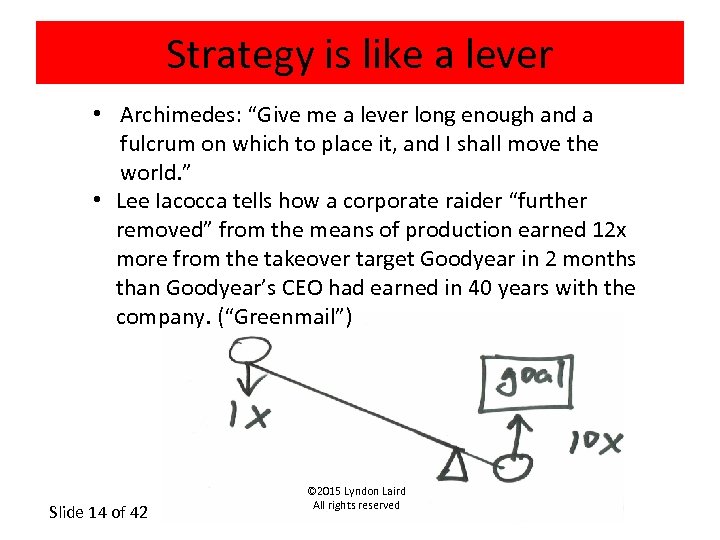 Strategy is like a lever • Archimedes: “Give me a lever long enough and a fulcrum on which to place it, and I shall move the world. ” • Lee Iacocca tells how a corporate raider “further removed” from the means of production earned 12 x more from the takeover target Goodyear in 2 months than Goodyear’s CEO had earned in 40 years with the company. (“Greenmail”) Slide 14 of 42 © 2015 Lyndon Laird All rights reserved
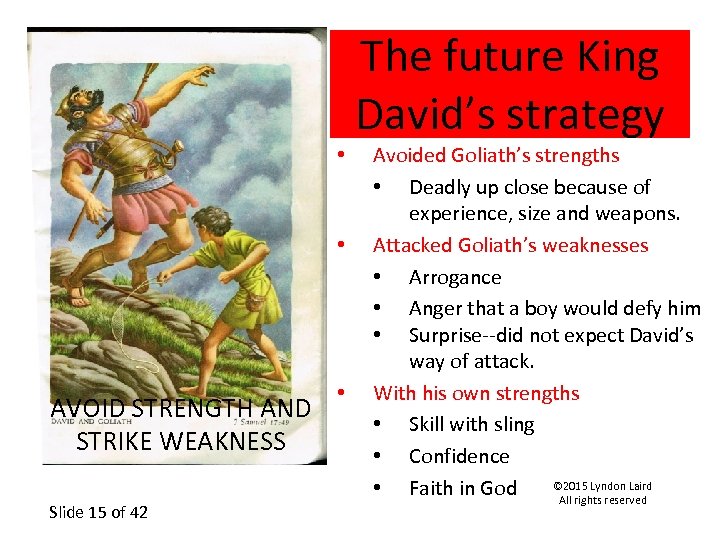 The future King David’s strategy • • AVOID STRENGTH AND STRIKE WEAKNESS Slide 15 of 42 • Avoided Goliath’s strengths • Deadly up close because of experience, size and weapons. Attacked Goliath’s weaknesses • Arrogance • Anger that a boy would defy him • Surprise--did not expect David’s way of attack. With his own strengths • Skill with sling • Confidence © 2015 Lyndon Laird • Faith in God All rights reserved
 Litigation phases • Each phase and the case overall have their own strategy and tactics. – – – Choice of forum and venue. Pleadings to set forth claims and defenses. Depositions and written discovery to discover the facts. Pretrial motions. jury selection. Opening statement. Direct and cross-examination. Evidence admitting and exclusion. Closing argument. Post-verdict motions. Appeals. © 2015 Lyndon Laird Slide 16 of 42 All rights reserved
 Two views of litigation • Conventional view of litigation: Judge applies the “law” to the “facts” to reach proper decision. – Uncertainty re the “law” and the “facts” • Strategic view of litigation: Adversarial advocates use strategy and tactics to win their case. Slide 17 of 42 © 2015 Lyndon Laird All rights reserved
 The importance of strategy in litigation • In Pennzoil v. Texaco, Texaco’s strategic blunders yielded a $10 billion verdict and bankrupted the company. • Background facts. – Failed to file prompt Answer, thus allowing Pennzoil to dismiss DE case and re-file in TX. – Angered the trial judge with a Motion to Disqualify. – Failed to rebut Pennzoil’s evidence of damages. Slide 18 of 42 © 2015 Lyndon Laird All rights reserved
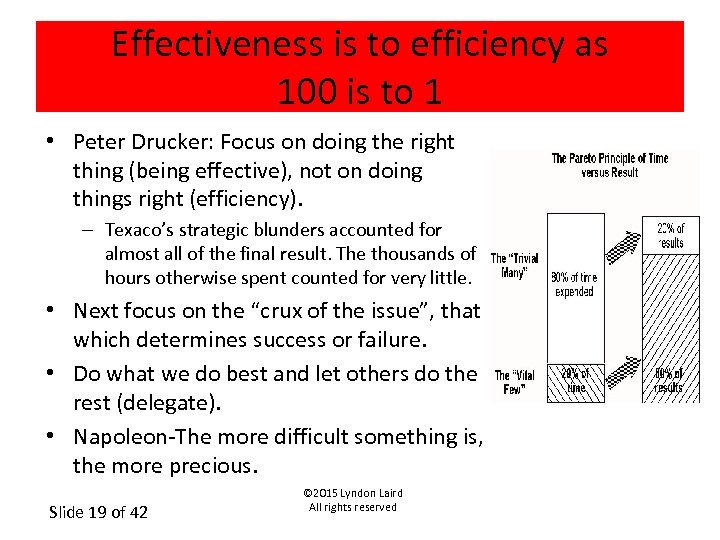 Effectiveness is to efficiency as 100 is to 1 • Peter Drucker: Focus on doing the right thing (being effective), not on doing things right (efficiency). – Texaco’s strategic blunders accounted for almost all of the final result. The thousands of hours otherwise spent counted for very little. • Next focus on the “crux of the issue”, that which determines success or failure. • Do what we do best and let others do the rest (delegate). • Napoleon-The more difficult something is, the more precious. Slide 19 of 42 © 2015 Lyndon Laird All rights reserved
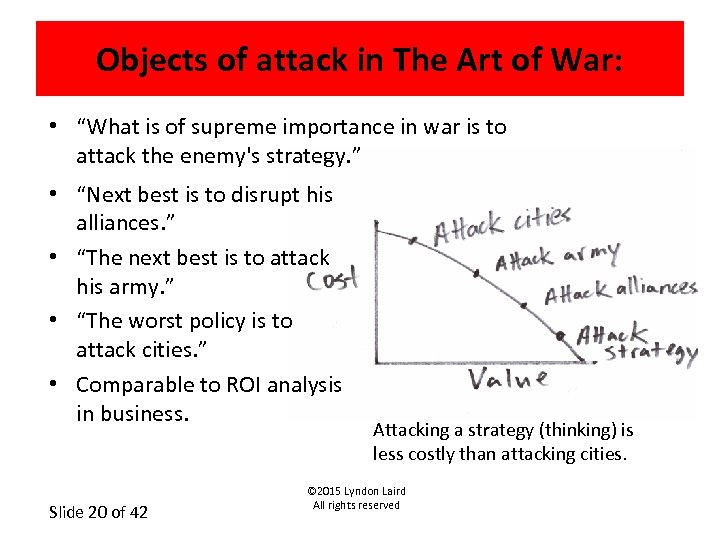 Objects of attack in The Art of War: • “What is of supreme importance in war is to attack the enemy's strategy. ” • “Next best is to disrupt his alliances. ” • “The next best is to attack his army. ” • “The worst policy is to attack cities. ” • Comparable to ROI analysis in business. Slide 20 of 42 Attacking a strategy (thinking) is less costly than attacking cities. © 2015 Lyndon Laird All rights reserved
 Attack the enemy’s strategy • In Laird, et al. v. Rimrock, et al. , Plaintiffs’ strategy was to show that Prime was an agent of Rimrock. Proof of agency was strong, including Rimrock’s earlier admission that, “Prime is taking the leases for us. ” • Despite the evidence, Rimrock vigorously contested agency, thus attacking Plaintiffs’ strategy and causing Plaintiffs to expend resources on this issue. Slide 21 of 42 © 2015 Lyndon Laird All rights reserved 21
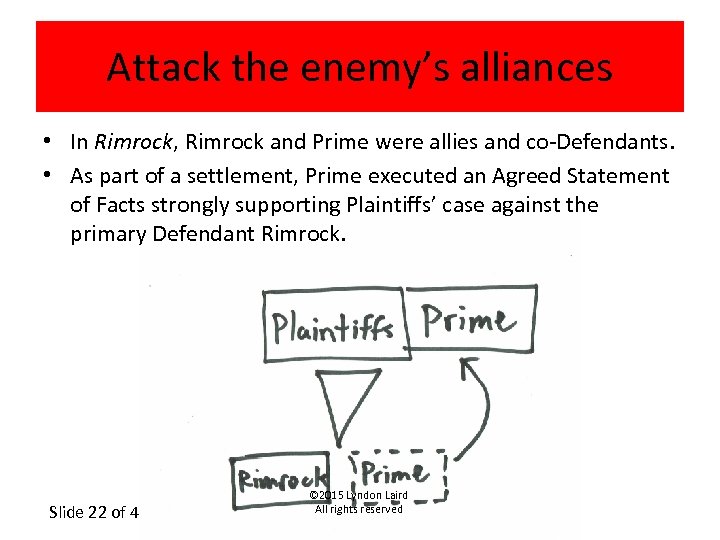 Attack the enemy’s alliances • In Rimrock, Rimrock and Prime were allies and co-Defendants. • As part of a settlement, Prime executed an Agreed Statement of Facts strongly supporting Plaintiffs’ case against the primary Defendant Rimrock. Slide 22 of 42 © 2015 Lyndon Laird All rights reserved
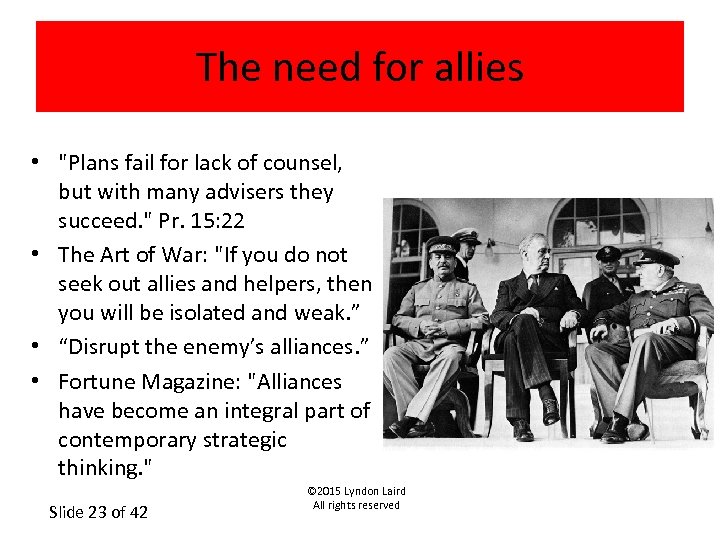 The need for allies • "Plans fail for lack of counsel, but with many advisers they succeed. " Pr. 15: 22 • The Art of War: "If you do not seek out allies and helpers, then you will be isolated and weak. ” • “Disrupt the enemy’s alliances. ” • Fortune Magazine: "Alliances have become an integral part of contemporary strategic thinking. " Slide 23 of 42 © 2015 Lyndon Laird All rights reserved
 Attack the enemy’s army • The litigant’s army is the party, his attorneys, experts, and evidence. • In a recent case, on legal various grounds, we: – Subpoenaed law firm records to show possible unethical collusion by the attorneys. – Filed a Motion to Disqualify an opposing attorney. – Filed a Motion to Bar a party Plaintiff from testifying. – Filed a Motion to Strike Plaintiff’s key evidence. Slide 24 of 42 © 2015 Lyndon Laird All rights reserved
 Attack the enemy’s cities as a last resort • In litigation “cities” are the opponent’s strongest points: examples are clear liability, clear damages, large financial resources, a famous name. • We may attack “cities” in order to (a) diminish their strength, (b) divert attention from our main attack or (c) force the opponent him to expend resources. Slide 25 of 42 © 2015 Lyndon Laird All rights reserved
 Evaluation • The Art of War: "If you know yourself and your enemy you will not be imperiled in a hundred battles. " • Know industry trends and the enemy’s and your own interests, goals, strengths, weaknesses, and plans. • Rothschilds used carrier pigeons to learn of Napoleon’s defeat. • Gordon Gekko: “The most valuable commodity I know of is information. ” • “Loose lips sink ships”-Information is valuable to the extent it is not widely known. • In determining our goals we must match capabilities with objectives. Slide 26 of 42 © 2015 Lyndon Laird All rights reserved
 Decide on the goal • Realistic yet bold. • Few things are "impossible. " – The world does not have perfect information--science constantly changing. – The mere fact that we can conceive of something is some evidence that it may be within our reach; otherwise it would not have occurred to us. – The reasons something seems "impossible" are often precisely why and how it can be achieved. Why because you know there are compensating factors for every difficulty. How because you know exactly what must be overcome. • Clear and specific. • Exclusive because concentration of resources is vital. Slide 27 of 42 © 2015 Lyndon Laird All rights reserved
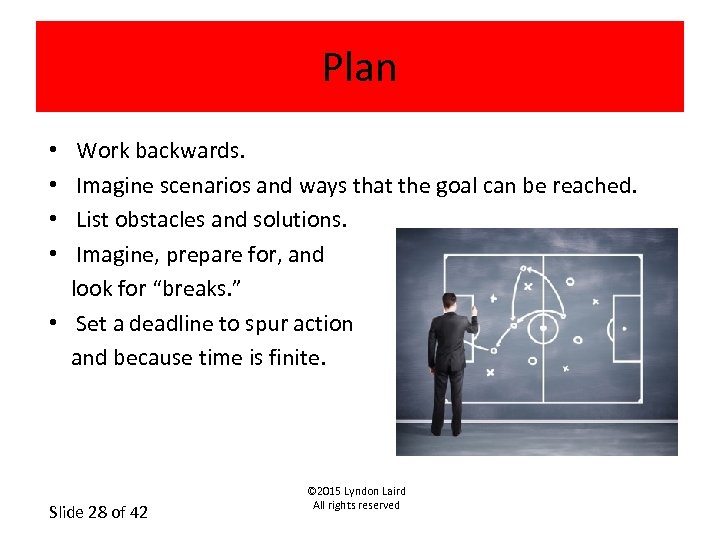 Plan • Work backwards. • Imagine scenarios and ways that the goal can be reached. • List obstacles and solutions. • Imagine, prepare for, and look for “breaks. ” • Set a deadline to spur action and because time is finite. Slide 28 of 42 © 2015 Lyndon Laird All rights reserved
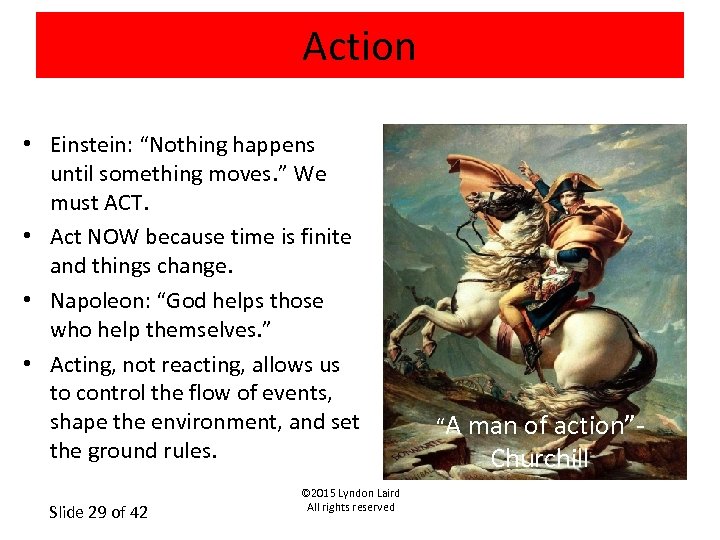 Action • Einstein: “Nothing happens until something moves. ” We must ACT. • Act NOW because time is finite and things change. • Napoleon: “God helps those who help themselves. ” • Acting, not reacting, allows us to control the flow of events, shape the environment, and set the ground rules. Slide 29 of 42 © 2015 Lyndon Laird All rights reserved “A man of action”- Churchill
 Effects of actions • Direct-exercise has direct benefits on health and fitness. • Displacement-exercise displaces non-productive activity like watching the Simpsons. • Affinity-exercise tends to attract similar activities—eating better, getting checkups. • Inertial- exercise make it easier to take same action again. • Synergistic- exercise combines with other actions and circumstances in positive ways. Slide 30 of 42 © 2015 Lyndon Laird All rights reserved
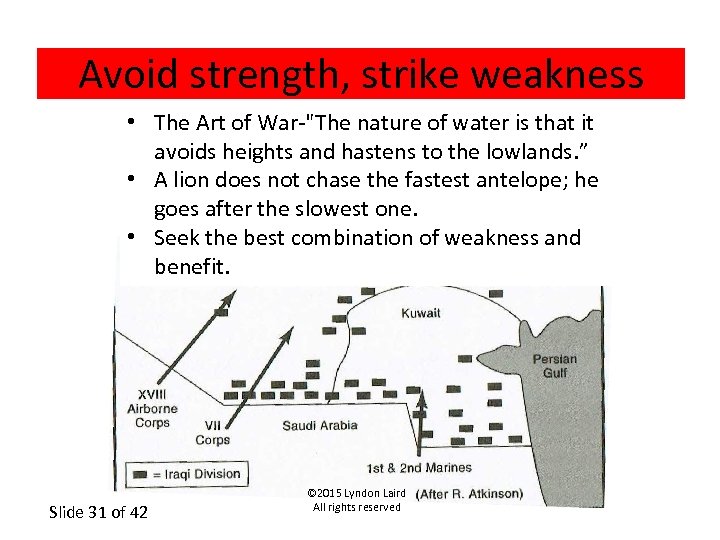 Avoid strength, strike weakness • The Art of War-"The nature of water is that it avoids heights and hastens to the lowlands. ” • A lion does not chase the fastest antelope; he goes after the slowest one. • Seek the best combination of weakness and benefit. Slide 31 of 42 © 2015 Lyndon Laird All rights reserved
 There is always a weakness • Rimrock hired the country’s top expert in Oil & Gas law to testify about lease validity. But he admitted under crossexamination that he: – Never worked as a landman. – Never took an Oil & Gas lease from a landowner. – Never entered into an Oil & Gas lease personally. • Ironically, and typically, the fact that he was the top academic expert was the reason for his weakness in lacking real-world experience. Slide 32 of 42 © 2015 Lyndon Laird All rights reserved
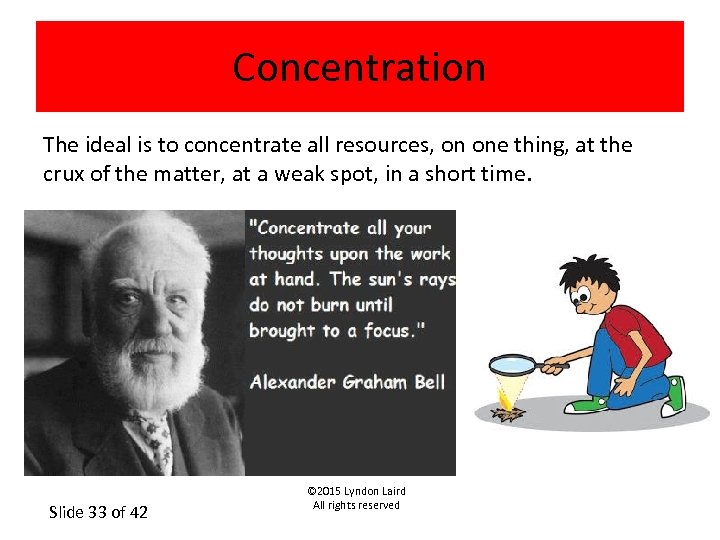 Concentration The ideal is to concentrate all resources, on one thing, at the crux of the matter, at a weak spot, in a short time. Slide 33 of 42 © 2015 Lyndon Laird All rights reserved
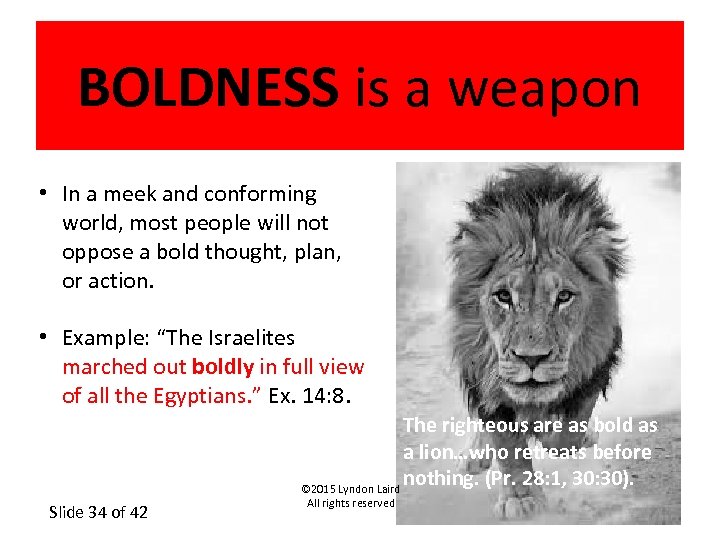 BOLDNESS is a weapon • In a meek and conforming world, most people will not oppose a bold thought, plan, or action. • Example: “The Israelites marched out boldly in full view of all the Egyptians. ” Ex. 14: 8. The righteous are as bold as a lion…who retreats before nothing. (Pr. 28: 1, 30: 30). © 2015 Lyndon Laird Slide 34 of 42 All rights reserved
 Speed slaughters the competition Sun Tzu said, “Speed is the essence of war. ” Time and life are finite. Circumstances change, opportunities are fleeting. If we wait the enemy can prepare against our plans. If we wait our resources and energy are exhausted. Speed concentrates more power in a given time. Speed shocks and surprises the enemy--"Shock and Awe. ” Advance preparation is required for speed in decisionmaking/reacting. (BU’s rule) • “To every thing there is a season, and a time to every purpose under the heaven. ” Ecc 3: 3 • • Slide 35 of 42 © 2015 Lyndon Laird All rights reserved
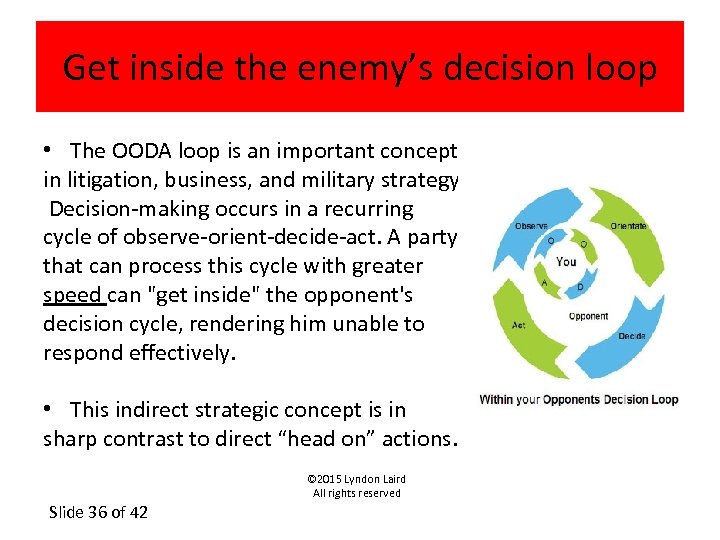 Get inside the enemy’s decision loop • The OODA loop is an important concept in litigation, business, and military strategy. Decision-making occurs in a recurring cycle of observe-orient-decide-act. A party that can process this cycle with greater speed can "get inside" the opponent's decision cycle, rendering him unable to respond effectively. • This indirect strategic concept is in sharp contrast to direct “head on” actions. © 2015 Lyndon Laird All rights reserved Slide 36 of 42
 Balance and compensation • Newton’s third law-for every action, there is an equal and opposite reaction. • For every action, there is a void (opportunity) created by actions not taken. • For every benefit, there is a cost. • For every strength, a weakness. • For every adversity, a potential benefit. • Churchill: “A pessimist sees the difficulty in every opportunity; an optimist sees the opportunity in every difficulty. ” • In the Rimrock lawsuit the strength inherent in our dozens of clients became a weakness when the other side filed dozens of simultaneous motions for summary judgment. • Gov. Greg Abbott Slide 37 of 42 © 2015 Lyndon Laird All rights reserved
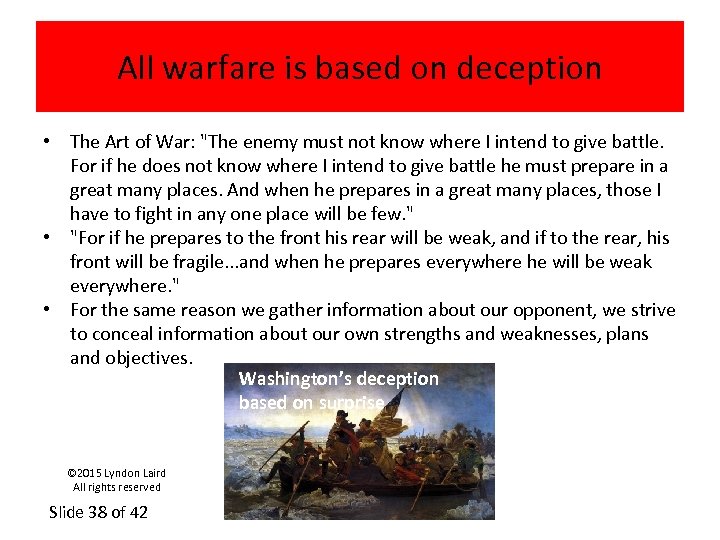 All warfare is based on deception • The Art of War: "The enemy must not know where I intend to give battle. For if he does not know where I intend to give battle he must prepare in a great many places. And when he prepares in a great many places, those I have to fight in any one place will be few. " • "For if he prepares to the front his rear will be weak, and if to the rear, his front will be fragile. . . and when he prepares everywhere he will be weak everywhere. " • For the same reason we gather information about our opponent, we strive to conceal information about our own strengths and weaknesses, plans and objectives. Washington’s deception based on surprise © 2015 Lyndon Laird All rights reserved Slide 38 of 42
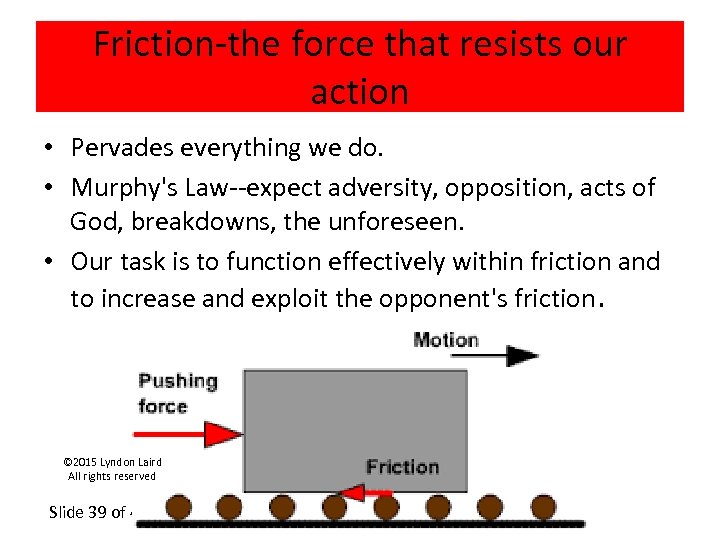 Friction-the force that resists our action • Pervades everything we do. • Murphy's Law--expect adversity, opposition, acts of God, breakdowns, the unforeseen. • Our task is to function effectively within friction and to increase and exploit the opponent's friction. © 2015 Lyndon Laird All rights reserved Slide 39 of 42
 Uncertainty • A type of friction • Our task is to function effectively amid uncertainty and to increase and exploit the opponent's uncertainty. • In a recent case we filed 5 potentially decisive motions shortly before trial and advised the client that, "The time to settle the case is before our 5 motions are heard and ruled on. " • For the same reason, we often conduct mediations while a Motion for Summary Judgment is pending. Slide 40 of 42 © 2015 Lyndon Laird All rights reserved
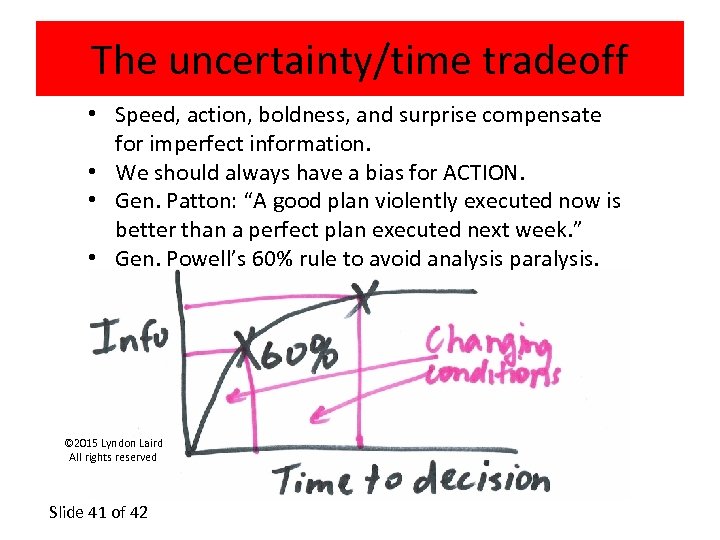 The uncertainty/time tradeoff • Speed, action, boldness, and surprise compensate for imperfect information. • We should always have a bias for ACTION. • Gen. Patton: “A good plan violently executed now is better than a perfect plan executed next week. ” • Gen. Powell’s 60% rule to avoid analysis paralysis. © 2015 Lyndon Laird All rights reserved Slide 41 of 42