


 Скачать презентацию Pursuing Household Electric Savings In-field Short Course
dd8826739961058f84eb46473d549afb.ppt
- Количество слайдов: 40
 Pursuing Household Electric Savings In-field Short Course Monday, April 7, 8 am -12 pm Pittsburgh, Pennsylvania Rana Belshe Conservation Connection Consulting Fairchild, Wisconsin 715 -334 -2707 A. Tamasin Sterner Pure Energy Lancaster, Pennsylvania 717 -293 -8990
 In This Session We Will § Interview occupant and explore baseload use in home § Ponder the intersection of residential electricity use and carbon emissions § Point to potential collaborators and resources § Discuss how to take advantage of rising energy prices and environmental awareness
 …and We Care Because… • • • Change is upon us. Price signals & mainstream environmental awareness of Global Warming is happening. Efficiency gains are netting zero in some places due to population growth, increased size of houses and connected loads. Electric intensity per capita has more than tripled in the US since 1960 as consumers binge on electronic technologies-- communication, home entertainment, information, etc. Cutting greenhouse gas emissions requires using less electricity if earth is to remain a good place to live. Successfully diagnosing and remediating high baseload use and educating and influencing people takes time. How do we charge for this time?
 Making a Difference… • What have we learned from our successes • • • and mistakes? What are we going to do now? What resources do we need to move forward in Wisconsin? How does this translate to income after taxes?
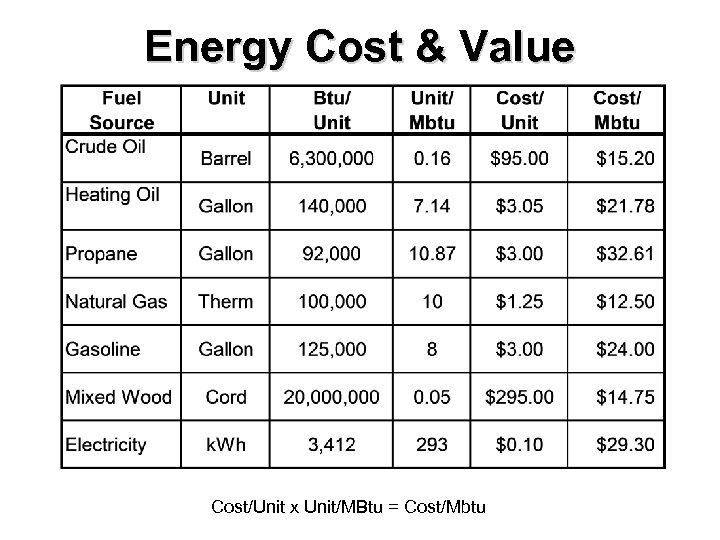 Energy Cost & Value Cost/Unit x Unit/MBtu = Cost/Mbtu
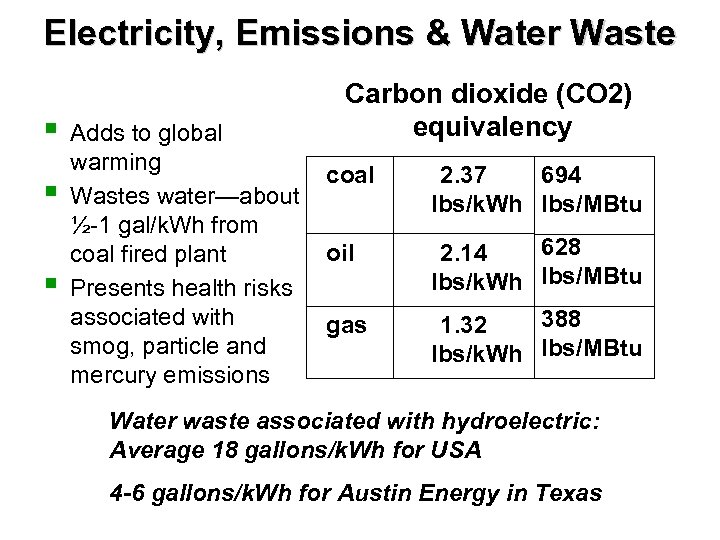 Electricity, Emissions & Water Waste § § § Carbon dioxide (CO 2) equivalency Adds to global warming coal Wastes water—about ½-1 gal/k. Wh from oil coal fired plant Presents health risks associated with gas smog, particle and mercury emissions 2. 37 694 lbs/k. Wh lbs/MBtu 628 2. 14 lbs/k. Wh lbs/MBtu 388 1. 32 lbs/k. Wh lbs/MBtu Water waste associated with hydroelectric: Average 18 gallons/k. Wh for USA 4 -6 gallons/k. Wh for Austin Energy in Texas
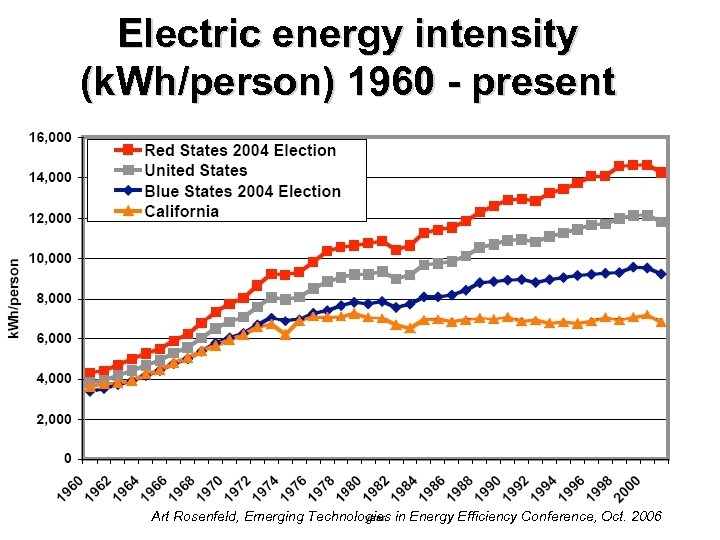 Electric energy intensity (k. Wh/person) 1960 - present Art Rosenfeld, Emerging Technologies in Energy Efficiency Conference, Oct. 2006
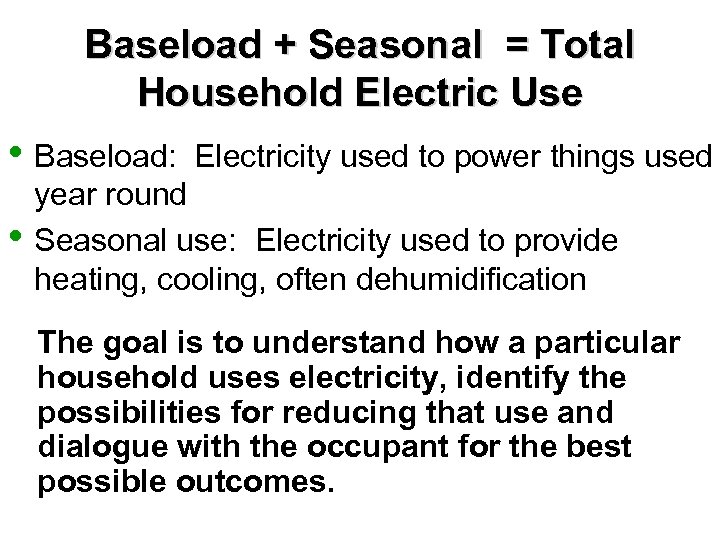 Baseload + Seasonal = Total Household Electric Use • Baseload: Electricity used to power things used • year round Seasonal use: Electricity used to provide heating, cooling, often dehumidification The goal is to understand how a particular household uses electricity, identify the possibilities for reducing that use and dialogue with the occupant for the best possible outcomes.
 Establishing Baseload Use • Obtain (a printout of) the client’s electricity use for at least one year, prior to the site visit. • Separate the baseload use from the total use by adding together the three lowest months, (not weird numbers) dividing the sum by 3 to get an average baseload month’s use, and then multiplying that number by 12 months. • • This can easily be done visually from a bar chart. There are lots of ways to do this. They all work.
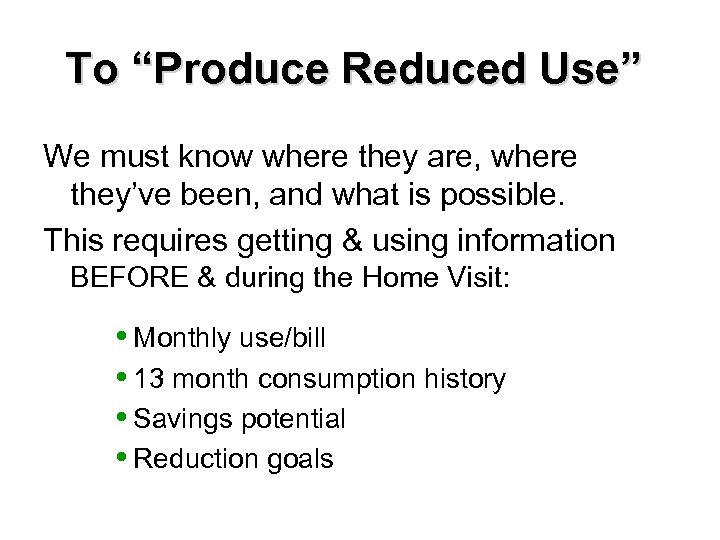 To “Produce Reduced Use” We must know where they are, where they’ve been, and what is possible. This requires getting & using information BEFORE & during the Home Visit: • Monthly use/bill • 13 month consumption history • Savings potential • Reduction goals
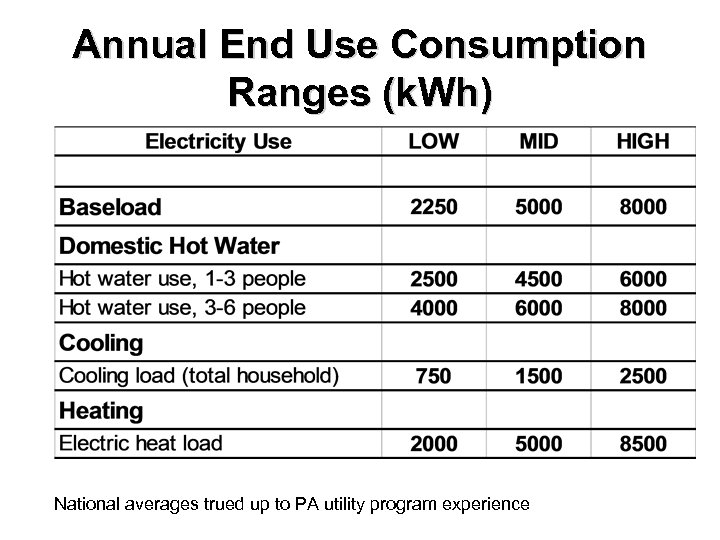 Annual End Use Consumption Ranges (k. Wh) National averages trued up to PA utility program experience
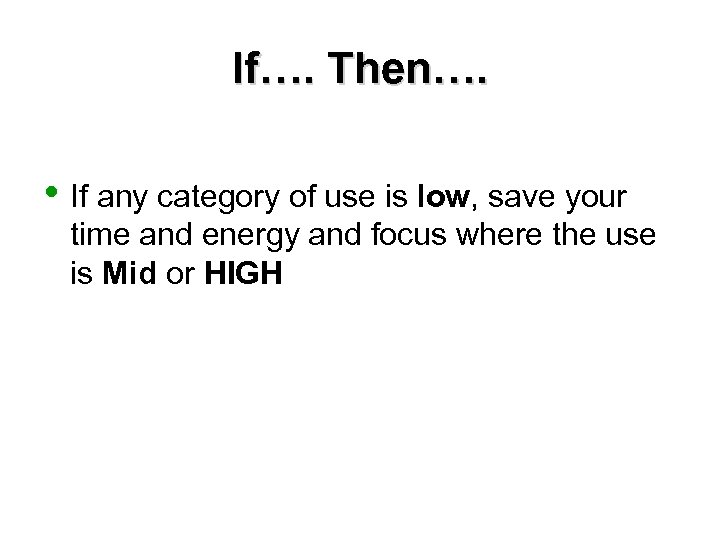 If…. Then…. • If any category of use is low, save your time and energy and focus where the use is Mid or HIGH
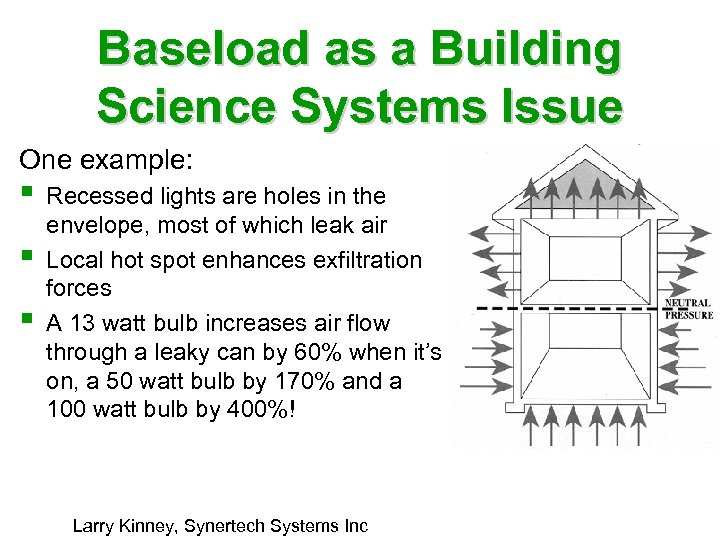 Baseload as a Building Science Systems Issue One example: § § § Recessed lights are holes in the envelope, most of which leak air Local hot spot enhances exfiltration forces A 13 watt bulb increases air flow through a leaky can by 60% when it’s on, a 50 watt bulb by 170% and a 100 watt bulb by 400%! Larry Kinney, Synertech Systems Inc
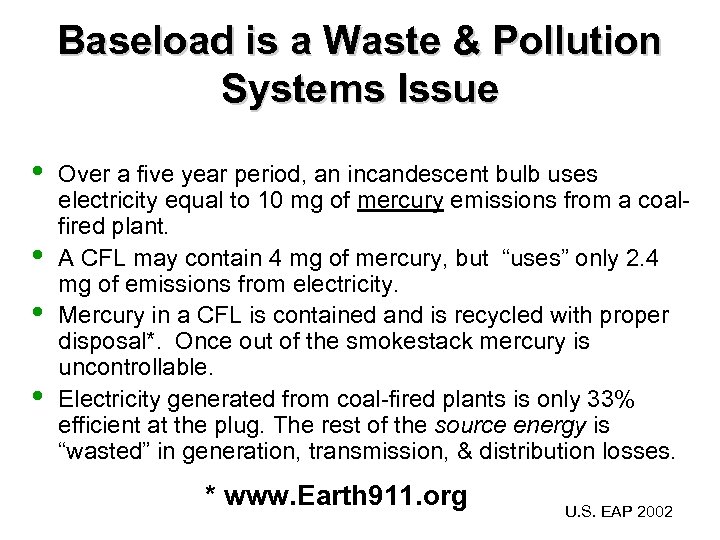 Baseload is a Waste & Pollution Systems Issue • • Over a five year period, an incandescent bulb uses electricity equal to 10 mg of mercury emissions from a coalfired plant. A CFL may contain 4 mg of mercury, but “uses” only 2. 4 mg of emissions from electricity. Mercury in a CFL is contained and is recycled with proper disposal*. Once out of the smokestack mercury is uncontrollable. Electricity generated from coal-fired plants is only 33% efficient at the plug. The rest of the source energy is “wasted” in generation, transmission, & distribution losses. * www. Earth 911. org U. S. EAP 2002
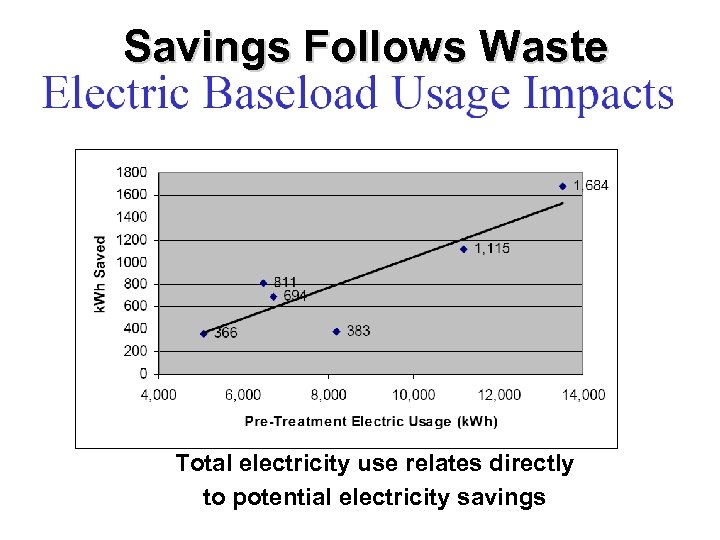 Savings Follows Waste Total electricity use relates directly to potential electricity savings
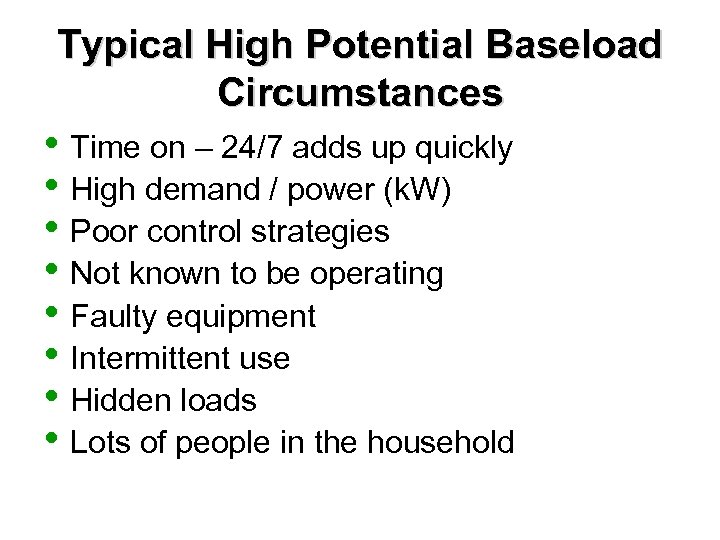 Typical High Potential Baseload Circumstances • Time on – 24/7 adds up quickly • High demand / power (k. W) • Poor control strategies • Not known to be operating • Faulty equipment • Intermittent use • Hidden loads • Lots of people in the household
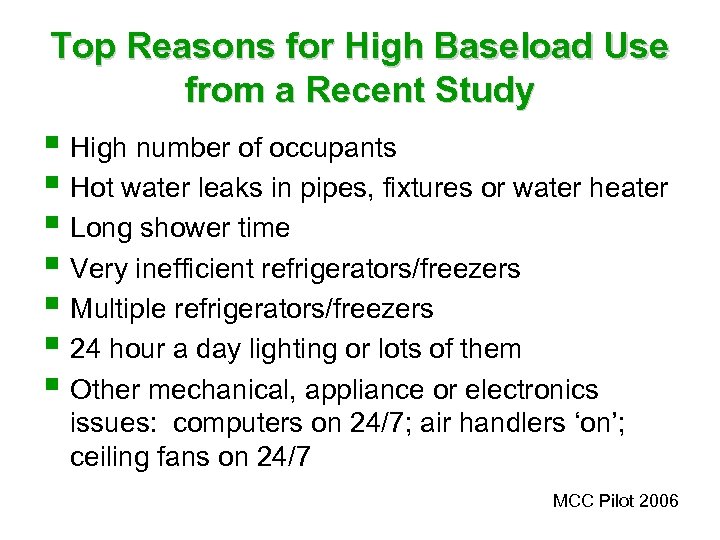 Top Reasons for High Baseload Use from a Recent Study § High number of occupants § Hot water leaks in pipes, fixtures or water heater § Long shower time § Very inefficient refrigerators/freezers § Multiple refrigerators/freezers § 24 hour a day lighting or lots of them § Other mechanical, appliance or electronics issues: computers on 24/7; air handlers ‘on’; ceiling fans on 24/7 MCC Pilot 2006
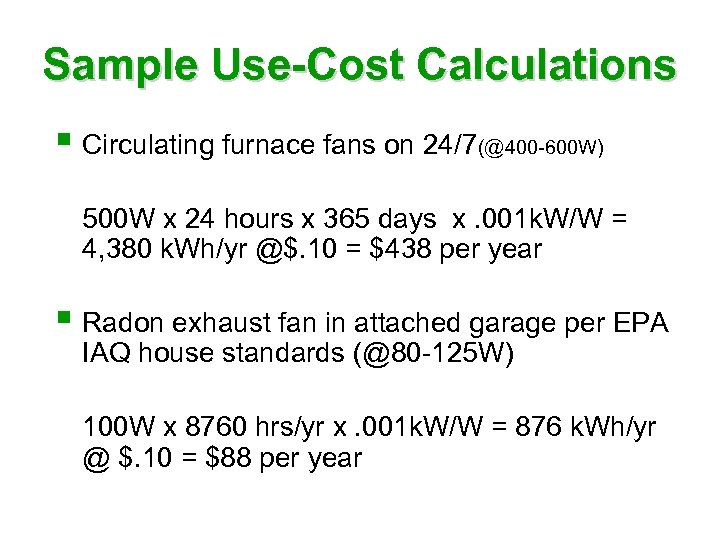 Sample Use-Cost Calculations § Circulating furnace fans on 24/7(@400 -600 W) 500 W x 24 hours x 365 days x. 001 k. W/W = 4, 380 k. Wh/yr @$. 10 = $438 per year § Radon exhaust fan in attached garage per EPA IAQ house standards (@80 -125 W) 100 W x 8760 hrs/yr x. 001 k. W/W = 876 k. Wh/yr @ $. 10 = $88 per year
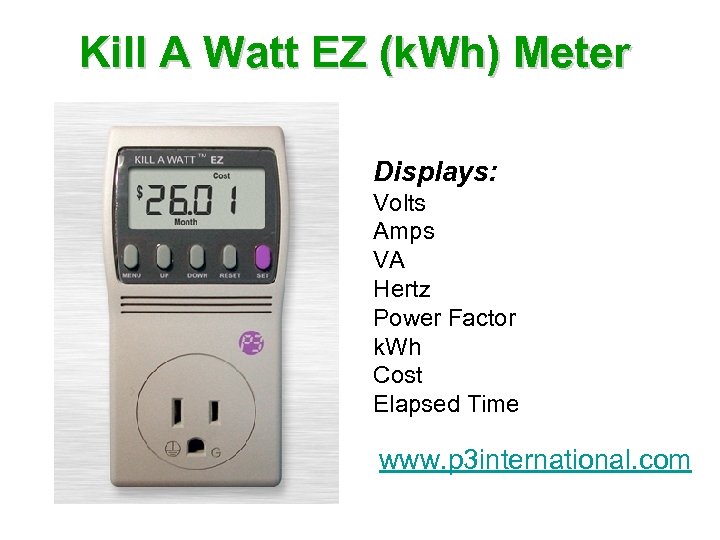 Kill A Watt EZ (k. Wh) Meter Displays: Volts Amps VA Hertz Power Factor k. Wh Cost Elapsed Time www. p 3 international. com
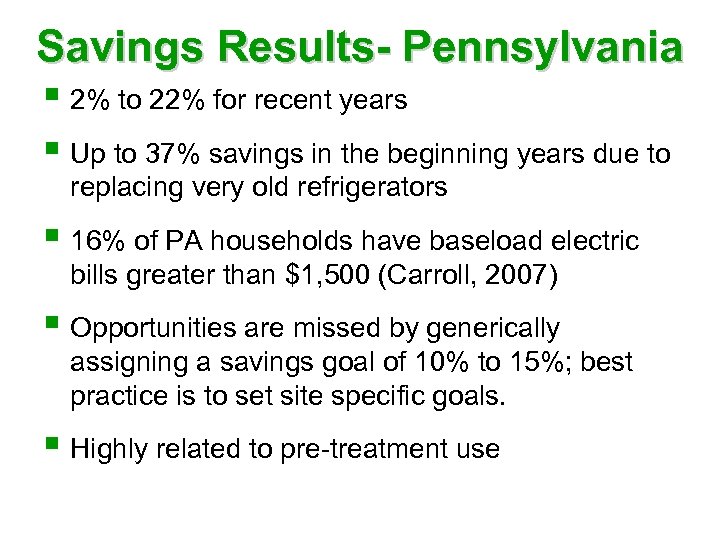 Savings Results- Pennsylvania § 2% to 22% for recent years § Up to 37% savings in the beginning years due to replacing very old refrigerators § 16% of PA households have baseload electric bills greater than $1, 500 (Carroll, 2007) § Opportunities are missed by generically assigning a savings goal of 10% to 15%; best practice is to set site specific goals. § Highly related to pre-treatment use
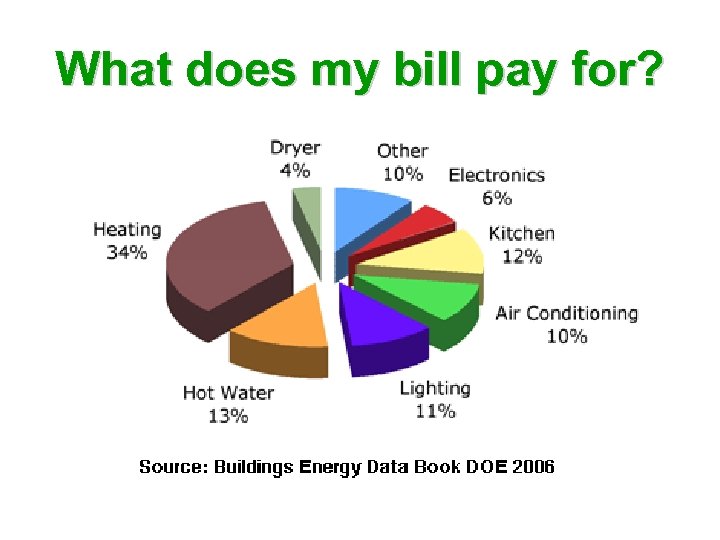 What does my bill pay for?
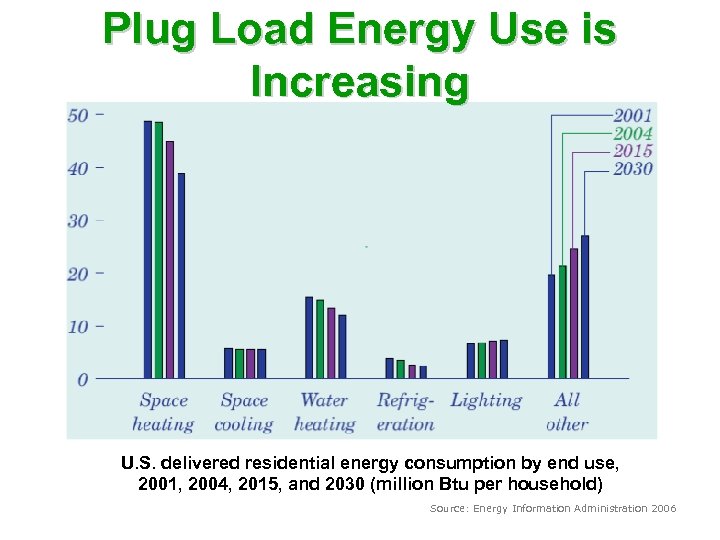 Plug Load Energy Use is Increasing U. S. delivered residential energy consumption by end use, 2001, 2004, 2015, and 2030 (million Btu per household) Source: Energy Information Administration 2006
 The Vexing Challenges of Lifestyle & Behavior § The number of occupants impacts use. § Occupant choices can make a 10 to 1 difference in total use. § Changing operating behaviors, such as control settings, fewer hours of use, more efficient appliances, can make a big difference. § Thoughtless or emergency purchasing decisions — multiple units, features, size– can have unintended consequences and use.
 Power Supplies: A Growing Plug Load Component • • • Function: convert wall voltage ac to low voltage dc needed to operate today’s digital chips, LED indicators, displays, etc. 6% to 10% of U. S. electricity flows through the nation’s 3. 6 billion power supplies Roughly 1 to 2% of U. S. electricity could be saved by improving power supply efficiency – $2. 1 to 4. 2 billion saved by consumers on their electricity bills – Prevent release of 40 to 80 million tons of CO 2 into the atmosphere – Equivalent of taking 2. 3 to 4. 6 million cars off the road – Equivalent of building roughly 4. 5 to 9 average sized power plants
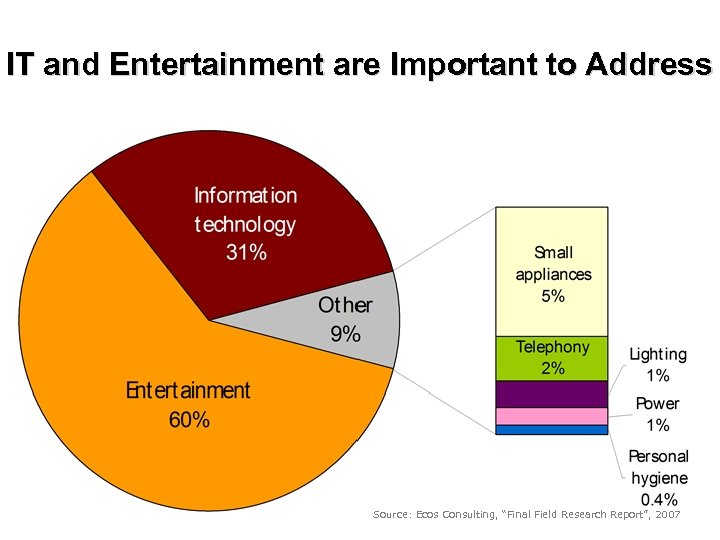 IT and Entertainment are Important to Address Source: Ecos Consulting, “Final Field Research Report”, 2007
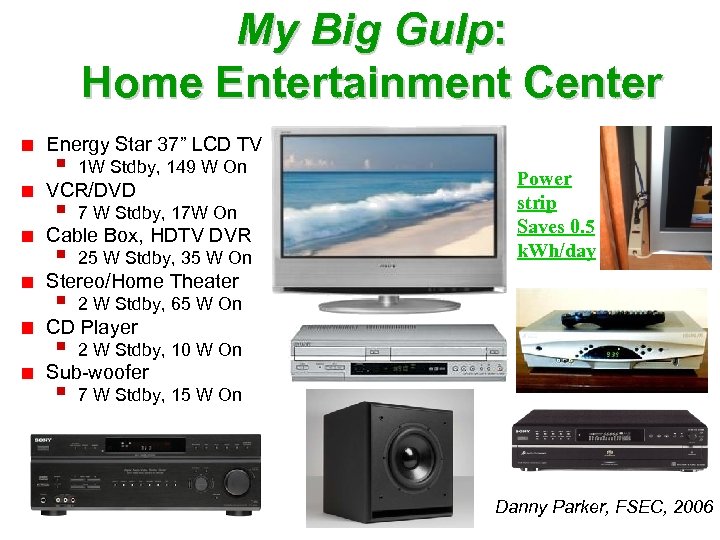 My Big Gulp: Home Entertainment Center Energy Star 37” LCD TV § 1 W Stdby, 149 W On § 7 W Stdby, 17 W On § 25 W Stdby, 35 W On § 2 W Stdby, 65 W On § 2 W Stdby, 10 W On § 7 W Stdby, 15 W On VCR/DVD Cable Box, HDTV DVR Power strip Saves 0. 5 k. Wh/day Stereo/Home Theater CD Player Sub-woofer Danny Parker, FSEC, 2006
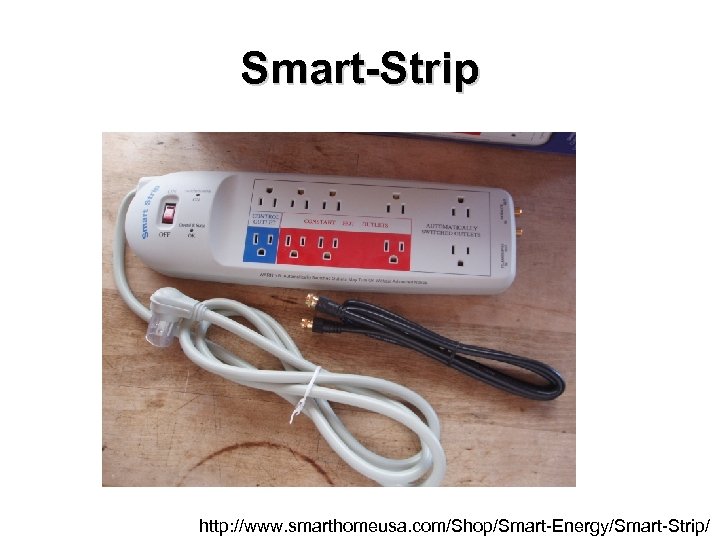 Smart-Strip http: //www. smarthomeusa. com/Shop/Smart-Energy/Smart-Strip/
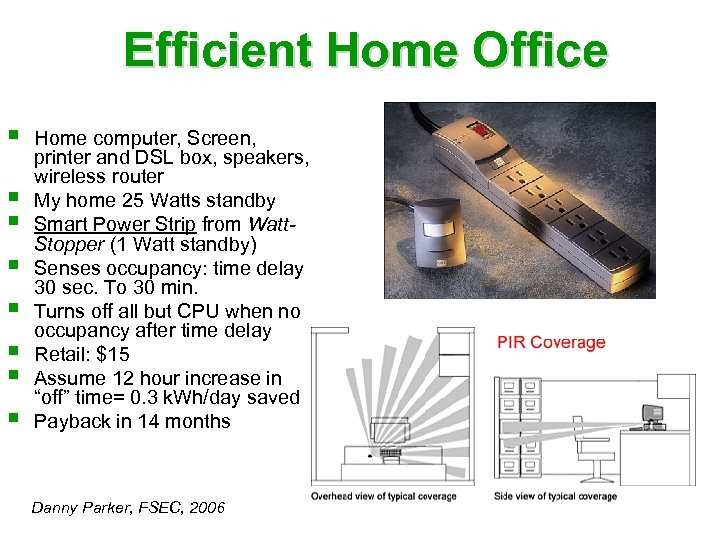 Efficient Home Office § § § § Home computer, Screen, printer and DSL box, speakers, wireless router My home 25 Watts standby Smart Power Strip from Watt. Stopper (1 Watt standby) Senses occupancy: time delay 30 sec. To 30 min. Turns off all but CPU when no occupancy after time delay Retail: $15 Assume 12 hour increase in “off” time= 0. 3 k. Wh/day saved Payback in 14 months Danny Parker, FSEC, 2006
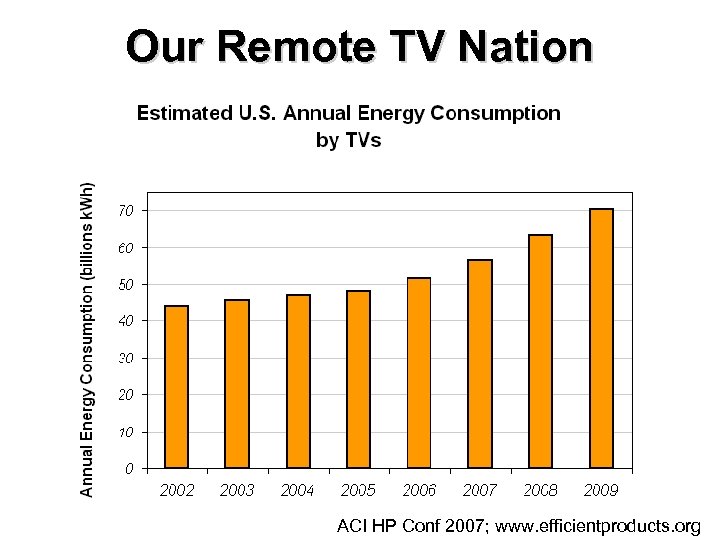 Our Remote TV Nation ACI HP Conf 2007; www. efficientproducts. org
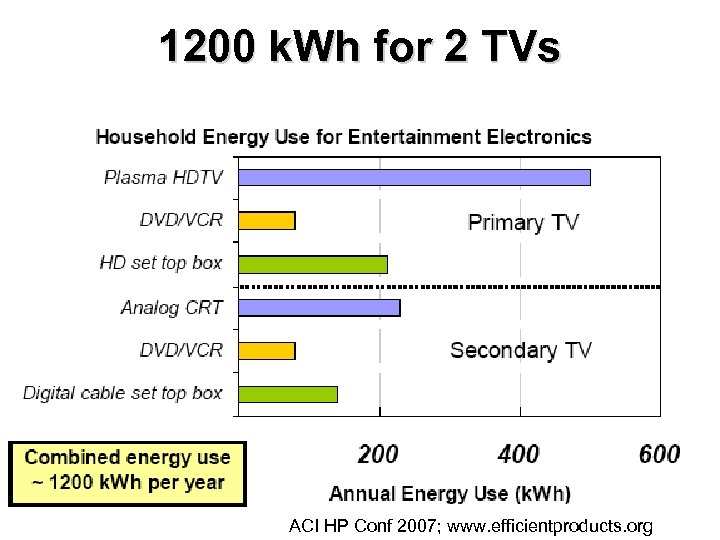 1200 k. Wh for 2 TVs ACI HP Conf 2007; www. efficientproducts. org
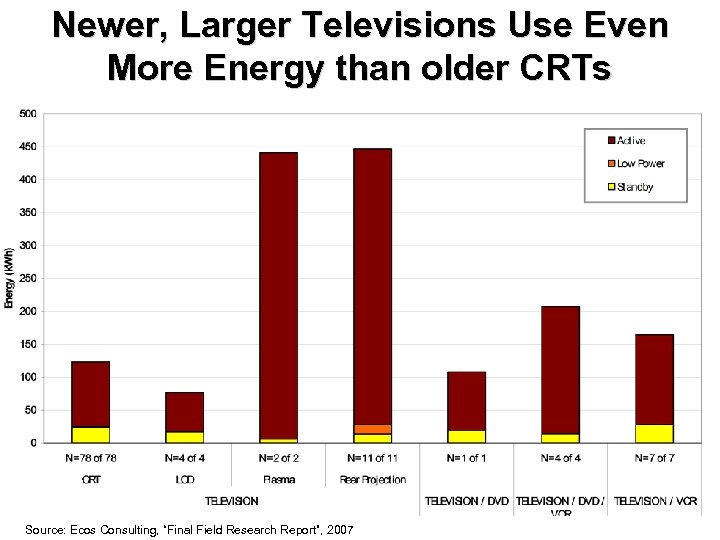 Newer, Larger Televisions Use Even More Energy than older CRTs Source: Ecos Consulting, “Final Field Research Report”, 2007
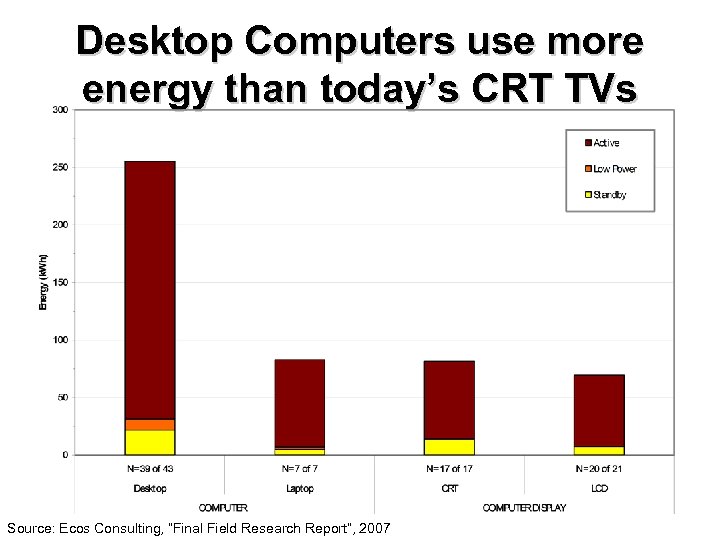 Desktop Computers use more energy than today’s CRT TVs Source: Ecos Consulting, “Final Field Research Report”, 2007
 Computer Use • • • Monitor accounts for about ½ the use 17” color monitor uses about 35% more energy than a 14” color monitor Laser printers draw about 1/3 of print power when on standby– 100 W or so Screen savers don’t save energy Laptops use a small fraction of the energy that desktops use Activate the Power Management Functions Turn off monitor if not using > 20 min. and both CPU and monitor if not using for > 1 hour Check DOE & www. energystar. gov for great stuff on this.
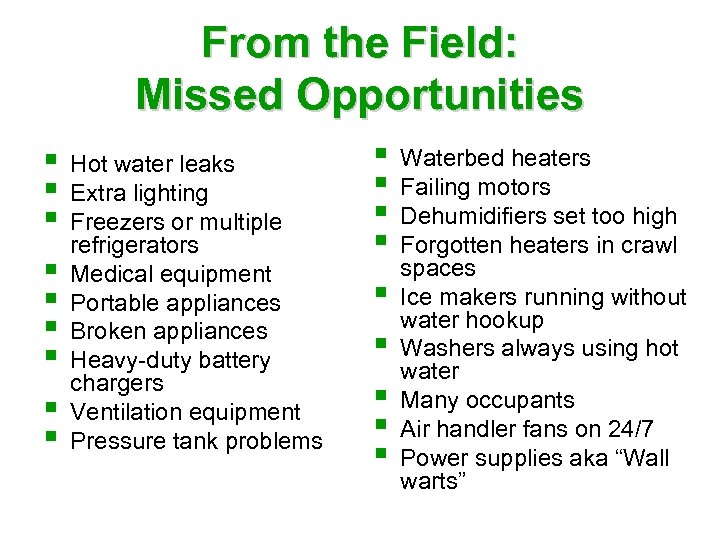 From the Field: Missed Opportunities § § § § § Hot water leaks Extra lighting Freezers or multiple refrigerators Medical equipment Portable appliances Broken appliances Heavy-duty battery chargers Ventilation equipment Pressure tank problems § § § § § Waterbed heaters Failing motors Dehumidifiers set too high Forgotten heaters in crawl spaces Ice makers running without water hookup Washers always using hot water Many occupants Air handler fans on 24/7 Power supplies aka “Wall warts”
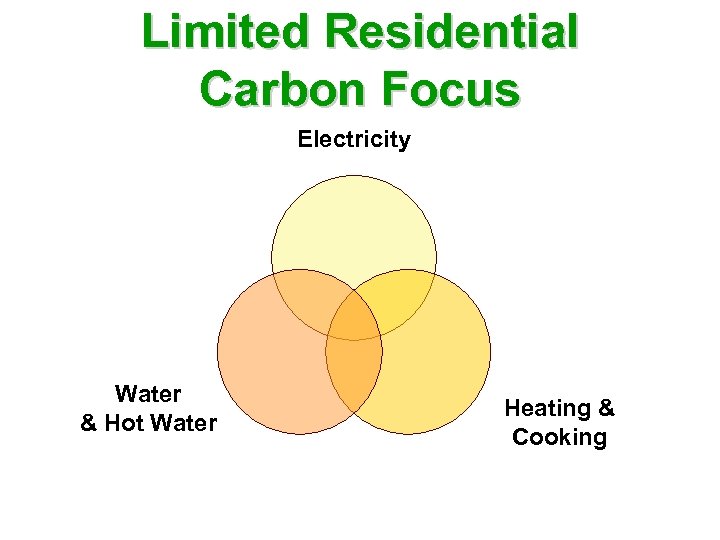 Limited Residential Carbon Focus Electricity Water & Hot Water Heating & Cooking
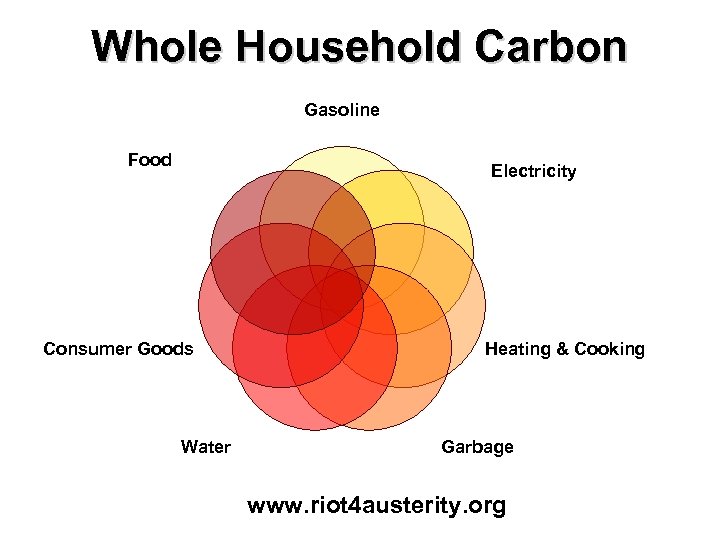 Whole Household Carbon Gasoline Food Electricity Consumer Goods Water Heating & Cooking Garbage www. riot 4 austerity. org
 Carbon Footprint A carbon footprint is a "measure of the impact human activities have on the environment in terms of the amount of green house gases (GHG) produced, measured in units of equivalent carbon dioxide (CO 2 e). ” See also: Ecological Footprint Adjusted wikipedia
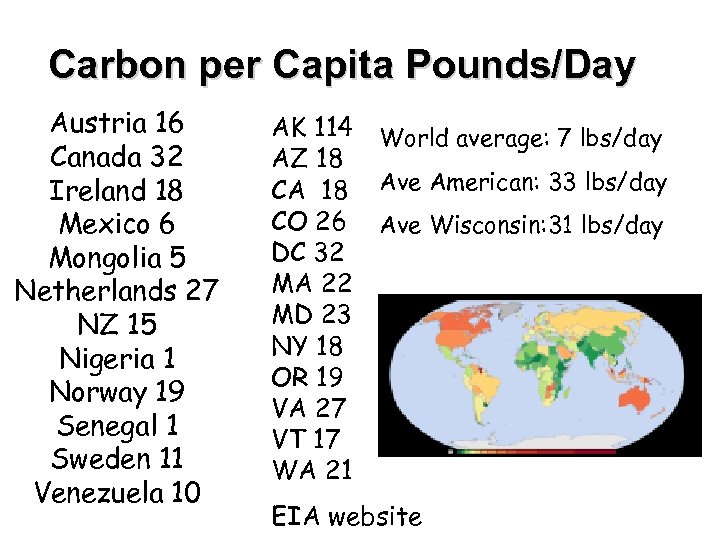 Carbon per Capita Pounds/Day Austria 16 Canada 32 Ireland 18 Mexico 6 Mongolia 5 Netherlands 27 NZ 15 Nigeria 1 Norway 19 Senegal 1 Sweden 11 Venezuela 10 AK 114 AZ 18 CA 18 CO 26 DC 32 MA 22 MD 23 NY 18 OR 19 VA 27 VT 17 WA 21 World average: 7 lbs/day Ave American: 33 lbs/day Ave Wisconsin: 31 lbs/day EIA website
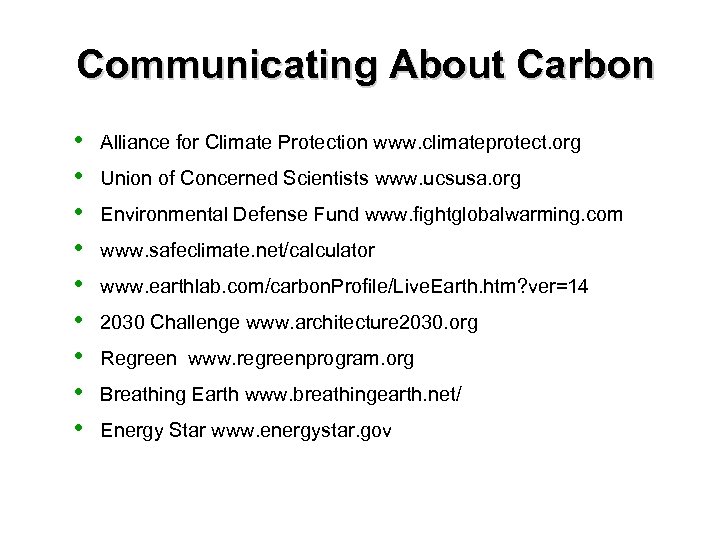 Communicating About Carbon • • • Alliance for Climate Protection www. climateprotect. org Union of Concerned Scientists www. ucsusa. org Environmental Defense Fund www. fightglobalwarming. com www. safeclimate. net/calculator www. earthlab. com/carbon. Profile/Live. Earth. htm? ver=14 2030 Challenge www. architecture 2030. org Regreen www. regreenprogram. org Breathing Earth www. breathingearth. net/ Energy Star www. energystar. gov
 Feedback Welcome! A. Tamasin Sterner 717 -293 -8990 tsterner@pureenergyaudits. com Rana Belshe 715 -334 -2707 ranabelshe@centurytel. net