


 Скачать презентацию PURPOSE What is the print advertisement attempting to
09ba70f76bf454bc78300b3416d04e0d.ppt
- Количество слайдов: 35
 PURPOSE: What is the print advertisement attempting to sell?
 AUDIENCE: What is the target group that the advertiser is attempting to reach?
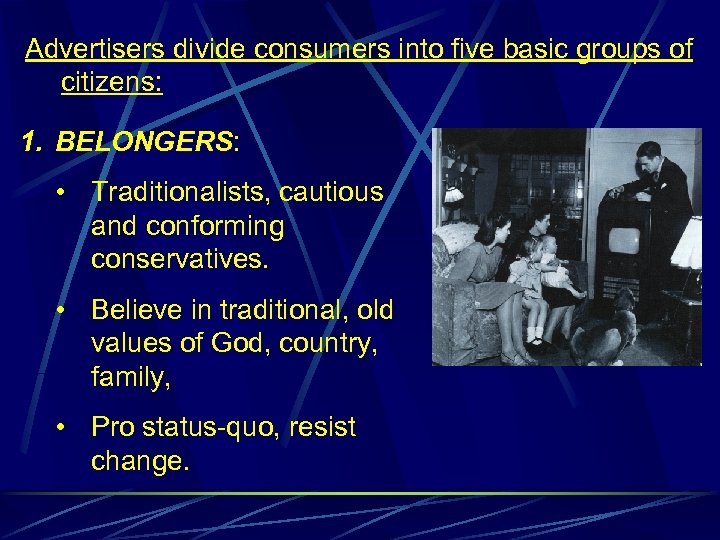 Advertisers divide consumers into five basic groups of citizens: 1. BELONGERS: • Traditionalists, cautious and conforming conservatives. • Believe in traditional, old values of God, country, family, • Pro status-quo, resist change.
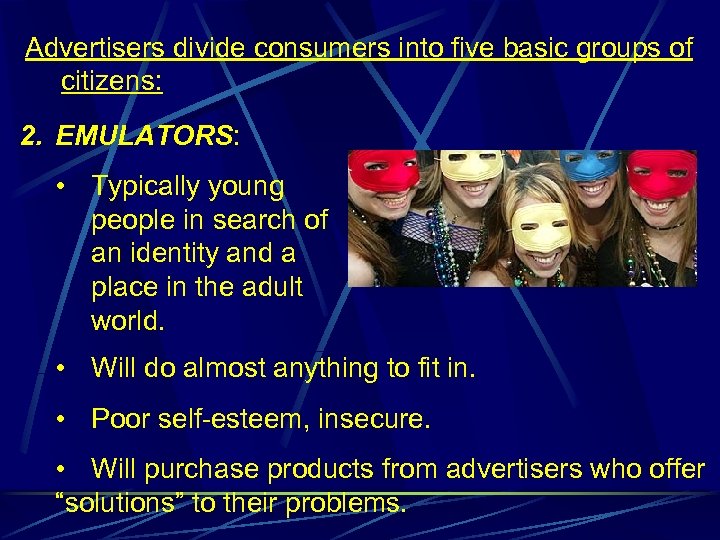 Advertisers divide consumers into five basic groups of citizens: 2. EMULATORS: • Typically young people in search of an identity and a place in the adult world. • Will do almost anything to fit in. • Poor self-esteem, insecure. • Will purchase products from advertisers who offer “solutions” to their problems.
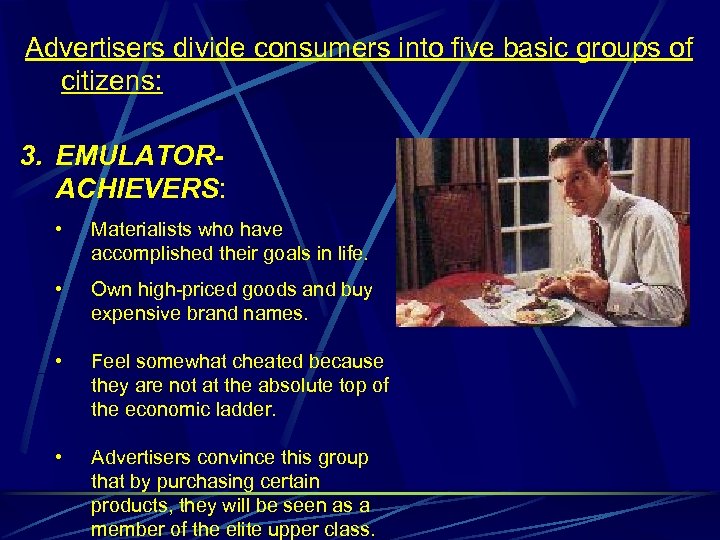 Advertisers divide consumers into five basic groups of citizens: 3. EMULATORACHIEVERS: • Materialists who have accomplished their goals in life. • Own high-priced goods and buy expensive brand names. • Feel somewhat cheated because they are not at the absolute top of the economic ladder. • Advertisers convince this group that by purchasing certain products, they will be seen as a member of the elite upper class.
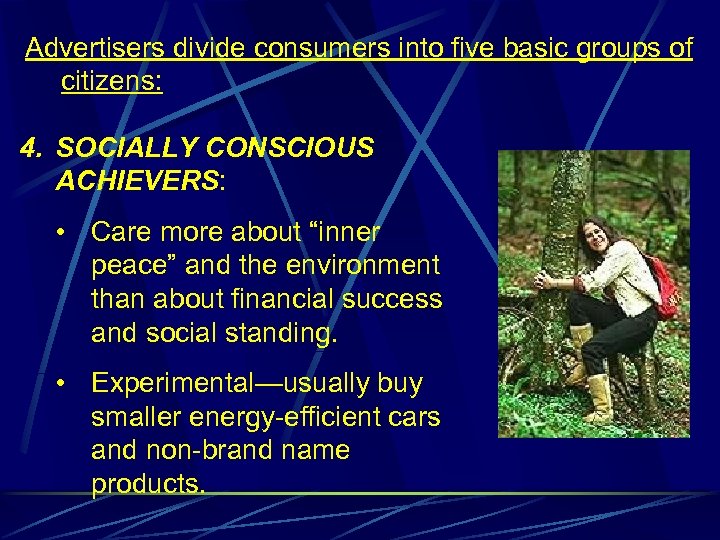 Advertisers divide consumers into five basic groups of citizens: 4. SOCIALLY CONSCIOUS ACHIEVERS: • Care more about “inner peace” and the environment than about financial success and social standing. • Experimental—usually buy smaller energy-efficient cars and non-brand name products.
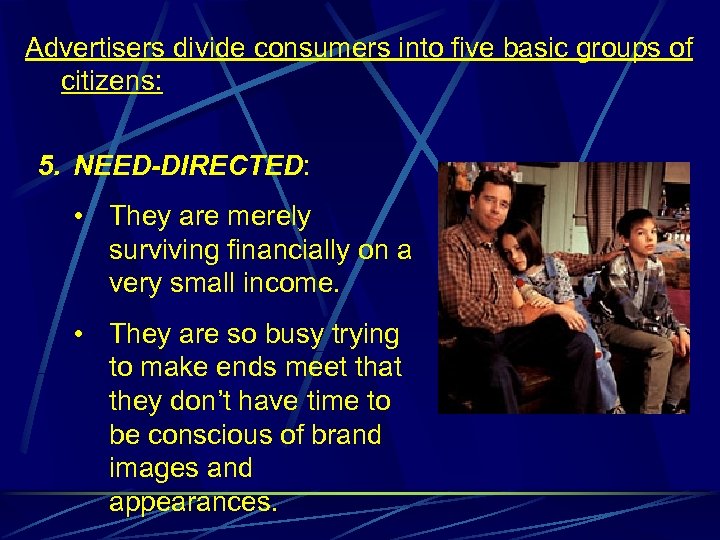 Advertisers divide consumers into five basic groups of citizens: 5. NEED-DIRECTED: • They are merely surviving financially on a very small income. • They are so busy trying to make ends meet that they don’t have time to be conscious of brand images and appearances.
 When advertisers “target” their audience, they will use characteristics of these five groups to create a media message perfectly suited to whatever group they are trying to appeal to. Advertisers carefully build each ad to create a specific emotional appeal. Through research and experience, advertisers can accurately predict how large groups of people will respond to a campaign.
 ADVERTISING STRATEGIES: Discuss the main advertising strategies employed in the advertisement.
 • • • Image • Scale • Put downs • Excitement • Sounds good • Social issues • Celebrity • endorsement Borrowed symbols • • Expert opinions Personal testimonial • Status Bandwagon Humour Sexual Imagery Self image/esteem Shock response Product quality Product placement Infomercials Weasel words Omission Facts and figures
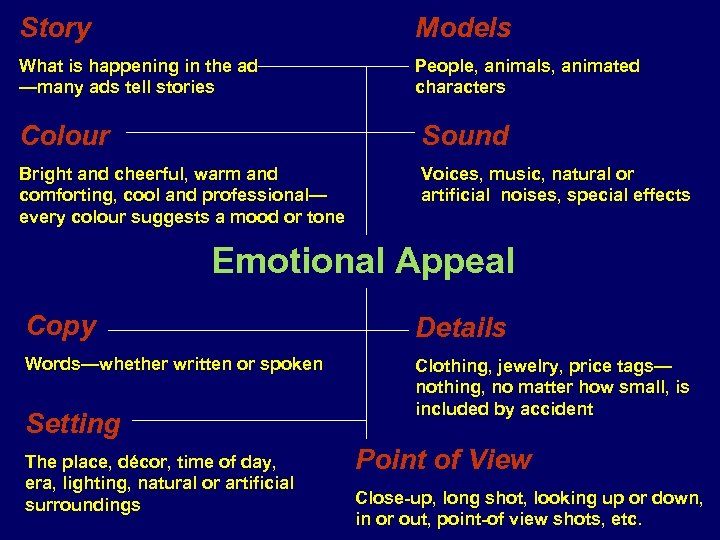 Story Models What is happening in the ad —many ads tell stories People, animals, animated characters Colour Sound Bright and cheerful, warm and comforting, cool and professional— every colour suggests a mood or tone Voices, music, natural or artificial noises, special effects Emotional Appeal Copy Details Words—whether written or spoken Clothing, jewelry, price tags— nothing, no matter how small, is included by accident Setting The place, décor, time of day, era, lighting, natural or artificial surroundings Point of View Close-up, long shot, looking up or down, in or out, point-of view shots, etc.
 COLOUR Advertisers use COLOUR to communicate meaning. Through surveys and studies, they have determined how we (in our culture) “read” colour: LIGHT COLOURS: Impart feelings of airiness, rest, relaxation and comfort. Calming, gentle, reassuring. Bright colours attract your attention first. DARK COLOURS: Somber—suggest heaviness, pessimism. Dark colours recede into the background while bright colours leap out at us.
 BLACK and WHITE: Technically, are not colours. WHITE has a pristine, clean pure reputation. BLACK is the colour of death, mourning, darkness, negativity. GREY is a neutral colour. Suggest bleakness, dullness, coolness. EARTH TONES (brown, terra cotta, beige) are soft, rich and natural. They suggest a subtle, comforting warmth.
 RED: A strong, aggressive colour. It leaps forward to attract attention. It is also the colour of passion, emotion, love and hate. YELLOW implies the life-giving sun. Suggests happiness, cheerfulness, warmth. BLUE: A bright blue is dominating and strong. It also suggests coldness. Soft blue evokes calm and tranquility. ORANGE is comfortable, welcoming, cheerful, reassuring.
 GREEN: Cool and calming; peaceful. The colour of nature/the environment. PURPLE: Dark purple suggests royalty and power. Light purple suggests tranquility and happiness. PINK: Suggests romance, love, femininity. GOLD/SILVER: Suggests prestige, wealth, power, but also coldness (especially silver).
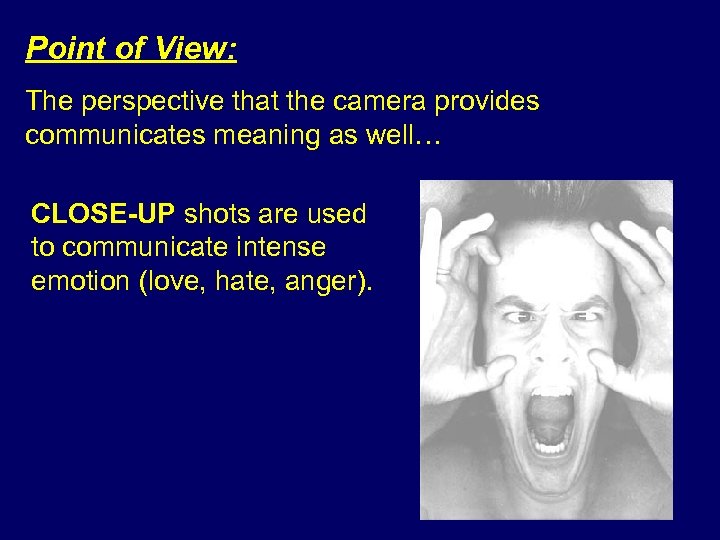 Point of View: The perspective that the camera provides communicates meaning as well… CLOSE-UP shots are used to communicate intense emotion (love, hate, anger).
 EXTREME CLOSE-UPS are used to communicate detail or extreme concentration.
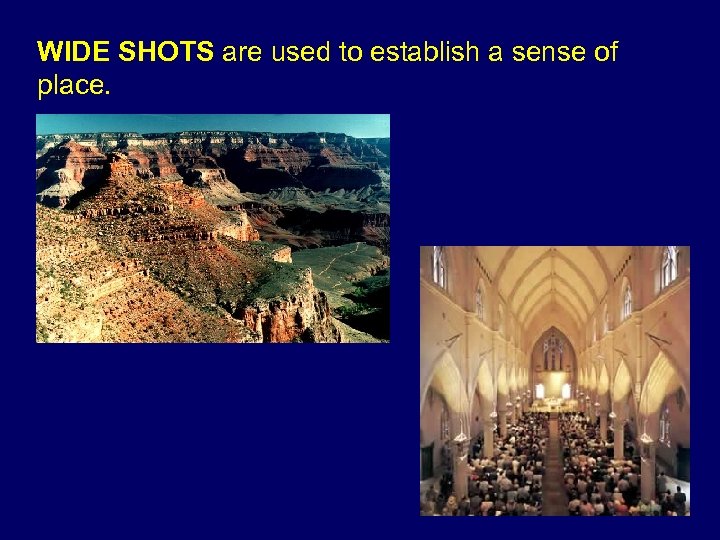 WIDE SHOTS are used to establish a sense of place.
 LOW CAMERA ANGLE SHOTS (looking up at the subject) make the subject appear powerful, dominating, intimidating.
 HIGH CAMERA ANGLE SHOTS (looking down at the subject) make the subject appear weak, dominated, intimidated.
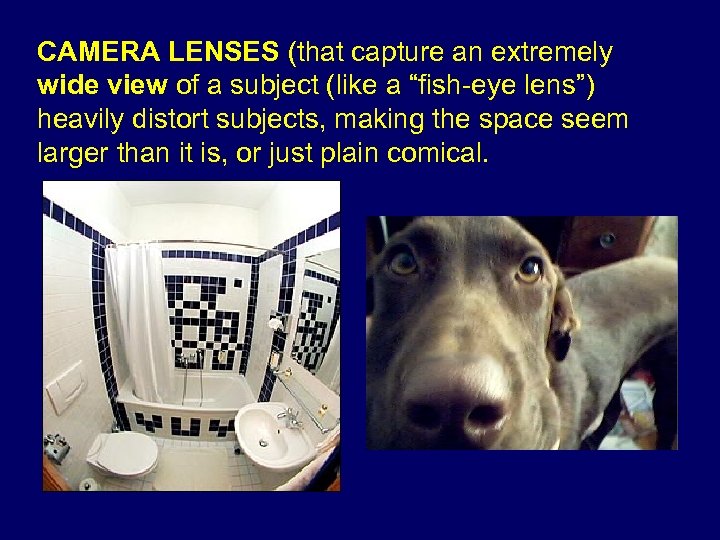 CAMERA LENSES (that capture an extremely wide view of a subject (like a “fish-eye lens”) heavily distort subjects, making the space seem larger than it is, or just plain comical.
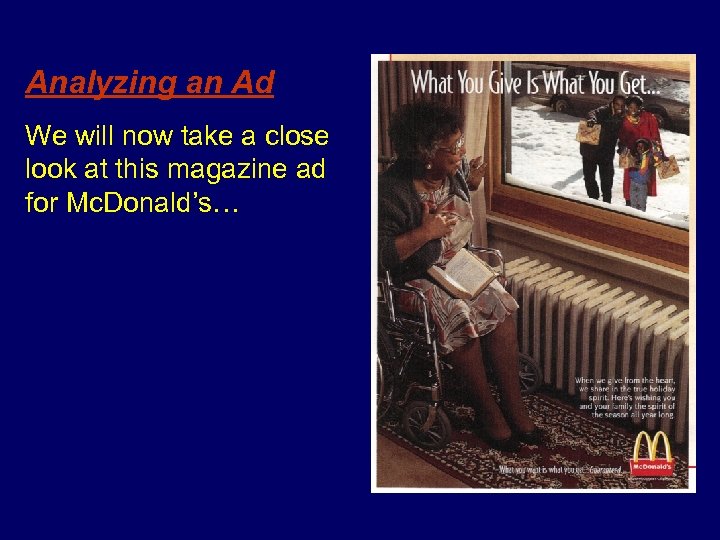 Analyzing an Ad We will now take a close look at this magazine ad for Mc. Donald’s…

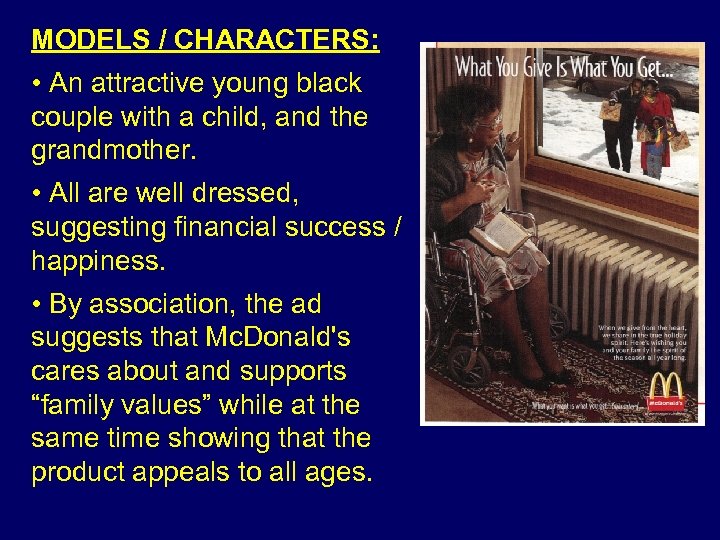 MODELS / CHARACTERS: • An attractive young black couple with a child, and the grandmother. • All are well dressed, suggesting financial success / happiness. • By association, the ad suggests that Mc. Donald's cares about and supports “family values” while at the same time showing that the product appeals to all ages.
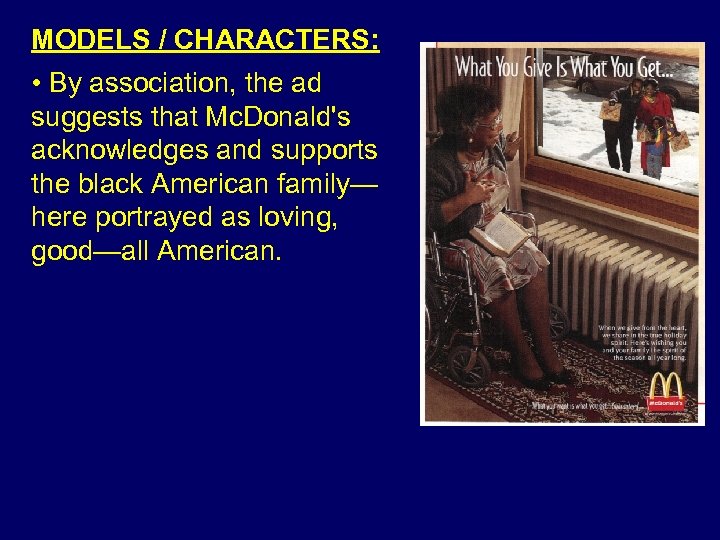 MODELS / CHARACTERS: • By association, the ad suggests that Mc. Donald's acknowledges and supports the black American family— here portrayed as loving, good—all American.
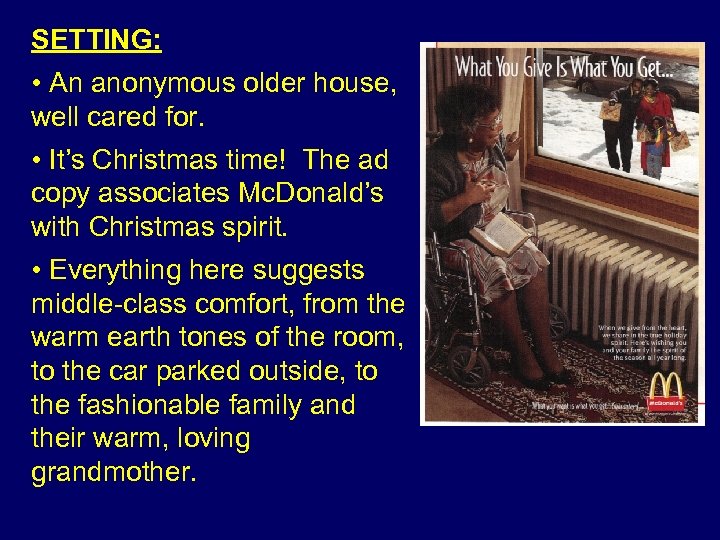 SETTING: • An anonymous older house, well cared for. • It’s Christmas time! The ad copy associates Mc. Donald’s with Christmas spirit. • Everything here suggests middle-class comfort, from the warm earth tones of the room, to the car parked outside, to the fashionable family and their warm, loving grandmother.
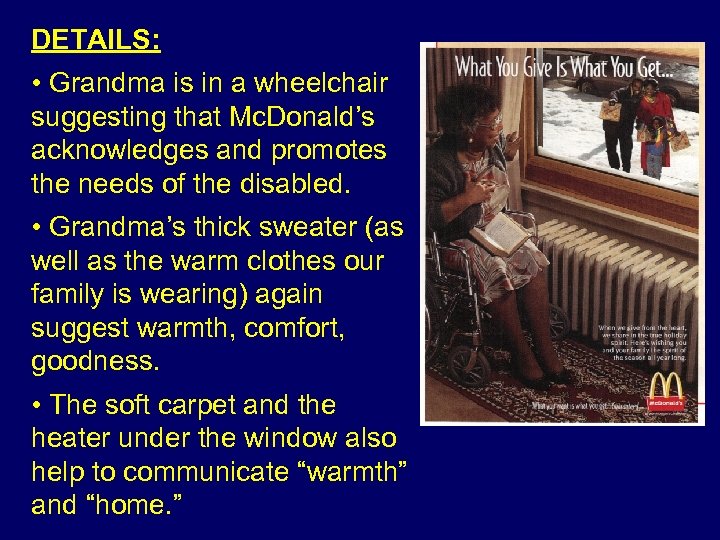 DETAILS: • Grandma is in a wheelchair suggesting that Mc. Donald’s acknowledges and promotes the needs of the disabled. • Grandma’s thick sweater (as well as the warm clothes our family is wearing) again suggest warmth, comfort, goodness. • The soft carpet and the heater under the window also help to communicate “warmth” and “home. ”
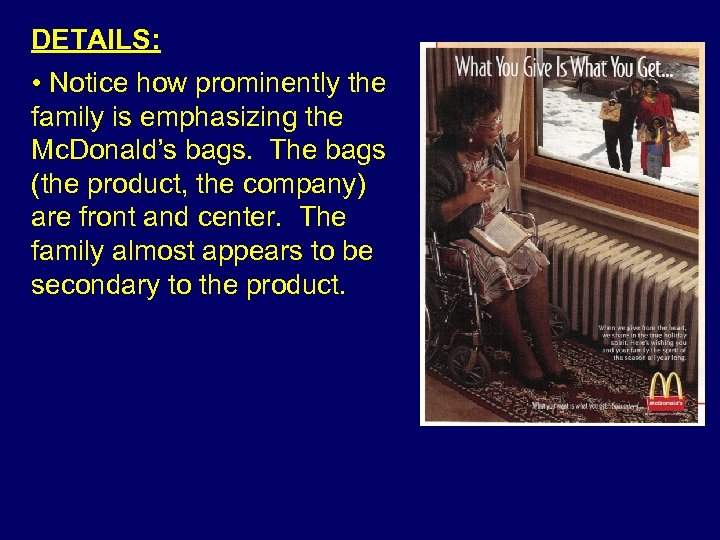 DETAILS: • Notice how prominently the family is emphasizing the Mc. Donald’s bags. The bags (the product, the company) are front and center. The family almost appears to be secondary to the product.
 STORY: • Our ad is a narrative. It tells the story with one picture--a surprise visit to Grandma’s house. Her loving family is bringing her a yummy dinner from Mc. Donald’s, and boy is Grandma jazzed about that! • Once again, we associate Grandma’s good feelings at seeing her family come for a visit (with a raunchy $1. 99 burger in tow) with Mc. Donald’s itself.
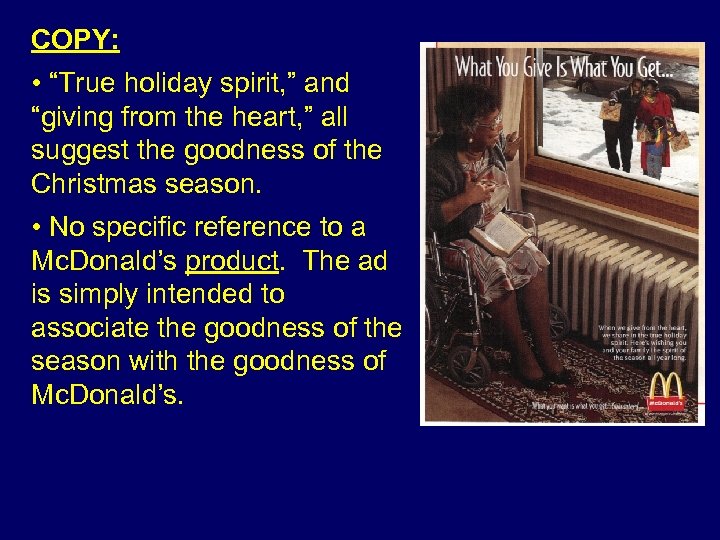 COPY: • “True holiday spirit, ” and “giving from the heart, ” all suggest the goodness of the Christmas season. • No specific reference to a Mc. Donald’s product. The ad is simply intended to associate the goodness of the season with the goodness of Mc. Donald’s.
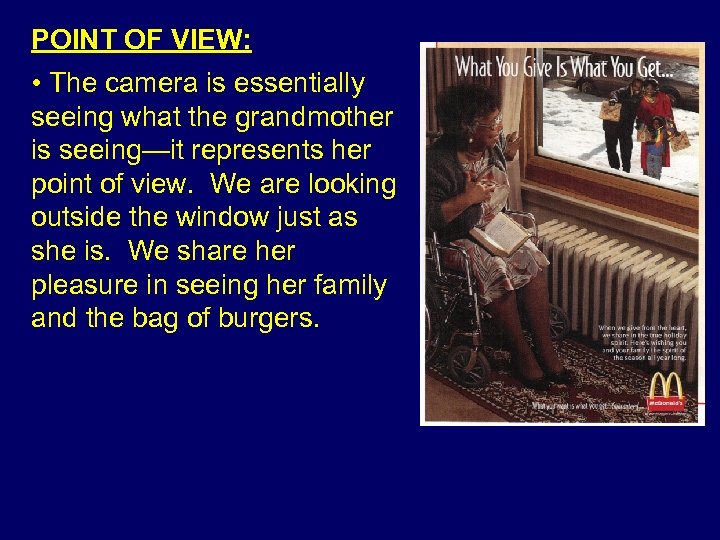 POINT OF VIEW: • The camera is essentially seeing what the grandmother is seeing—it represents her point of view. We are looking outside the window just as she is. We share her pleasure in seeing her family and the bag of burgers.
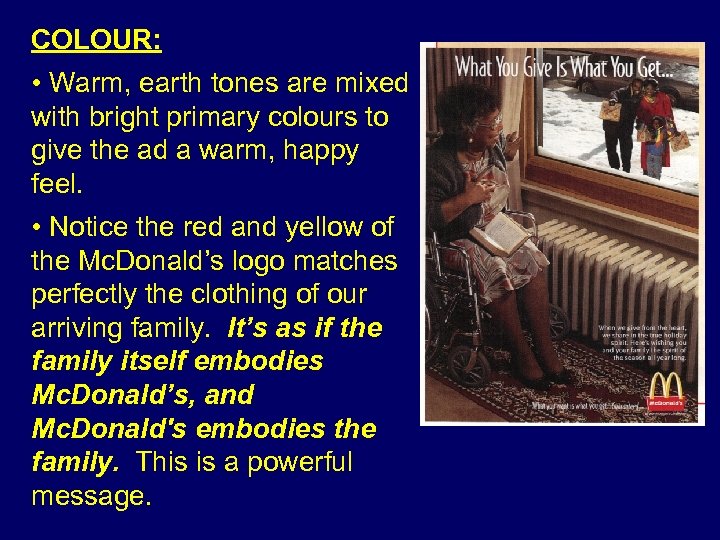 COLOUR: • Warm, earth tones are mixed with bright primary colours to give the ad a warm, happy feel. • Notice the red and yellow of the Mc. Donald’s logo matches perfectly the clothing of our arriving family. It’s as if the family itself embodies Mc. Donald’s, and Mc. Donald's embodies the family. This is a powerful message.
 MESSAGES AND CONSEQUENCES: Identify the messages that the advertisement promotes either intentionally or unintentionally. Discuss the consequences of these messages.
 What are the effects of advertising and commercialism? • Commercialism places a strong emphasis on appearance rather than content. • Constant exposure to ads may encourage materialism and selfishness. This may make people less inclined to help and care for others. • Heavy promotion of shopping and buying (and consuming) may distract us from other more meaningful activities like reading, thinking, playing and human interaction. • Our commercialized culture encourages people to spend money they may not have.
 What are the effects of advertising and commercialism? • Advertising implies that there’s a simple solution to everything—buy our product! • Commercialism does not just promote specific products. It promotes consumption as a way of life. • The messages and values promoted in the advertisements may shape the way we think and see reality.