


 Скачать презентацию Punishment and Norm Compliance Daniel Houser Professor of
e002061a7be6840be0ba3027080528c6.ppt
- Количество слайдов: 38
 Punishment and Norm Compliance Daniel Houser Professor of Economics Director, Interdisciplinary Center for Economics Science George Mason University, Fairfax, VA
 motivation l Sanctions are widely used to enforce cooperation and solve asymmetric information problems. l Evidence shows that people do not always act to avoid punishment. Two primary reasons: Incentive effects and Intention effects.
 related studies l Detrimental Incentive Effects: Extrinsic incentive tends to reduce intrinsic motivation Frey and Oberholzer-Gee, 1997 Deci, et al, 1999 Gneezy and Rustichini, 2000 l Intention Effects: Imposing sanctions can be seen as a signal of distrust. Fehr and Falk, 2002 Intentions play an important role in shaping decisions. Rabin, 1993 Mc. Cabe, Rigdon and Smith, 2003
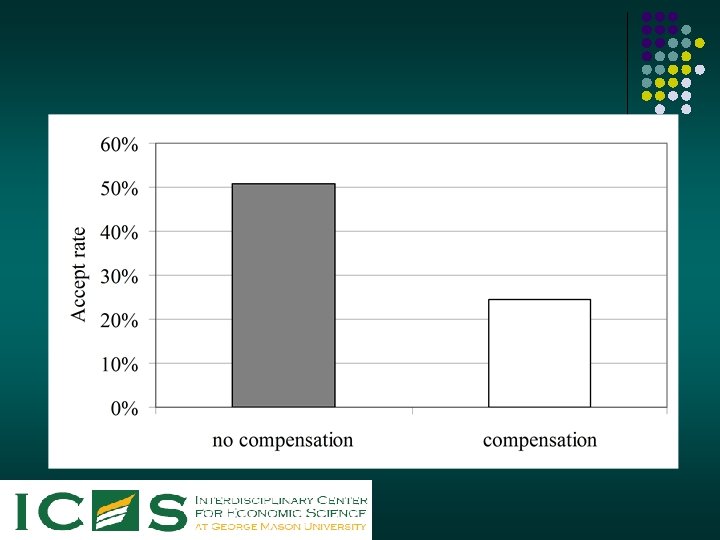
 incentive effects Frey and Oberholzer-Gee (1997) l Survey l Swiss government intends to build two repositories to store nuclear waste. Two adjacent communities have been designated as potential sites. l In 1993, 305 interviews. l Ask respondents if they were willing to permit the construction of a nuclear waste repository of short-lived, low- and midlevel radioactive waste on the grounds of their community. l Either no compensation, or compensation of $2, 175 to $4, 350 for all residents in community.
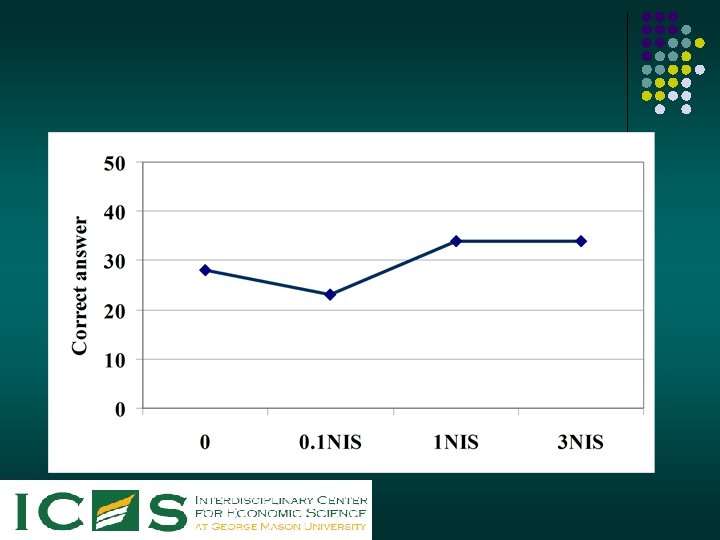
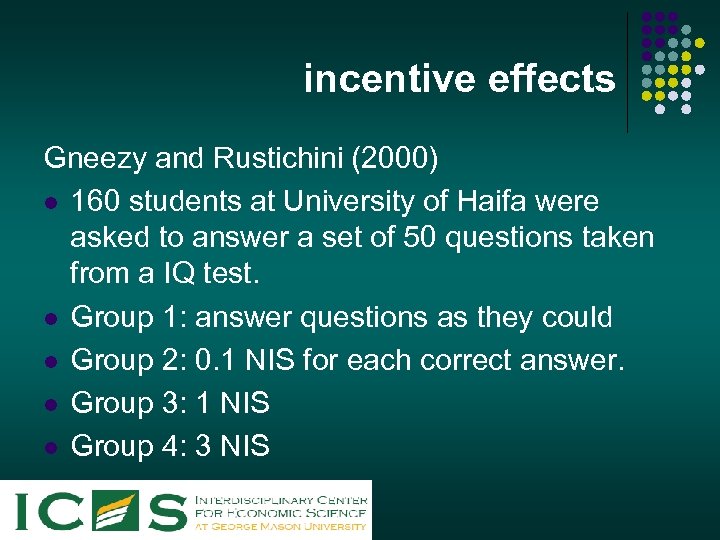 incentive effects Gneezy and Rustichini (2000) l 160 students at University of Haifa were asked to answer a set of 50 questions taken from a IQ test. l Group 1: answer questions as they could l Group 2: 0. 1 NIS for each correct answer. l Group 3: 1 NIS l Group 4: 3 NIS
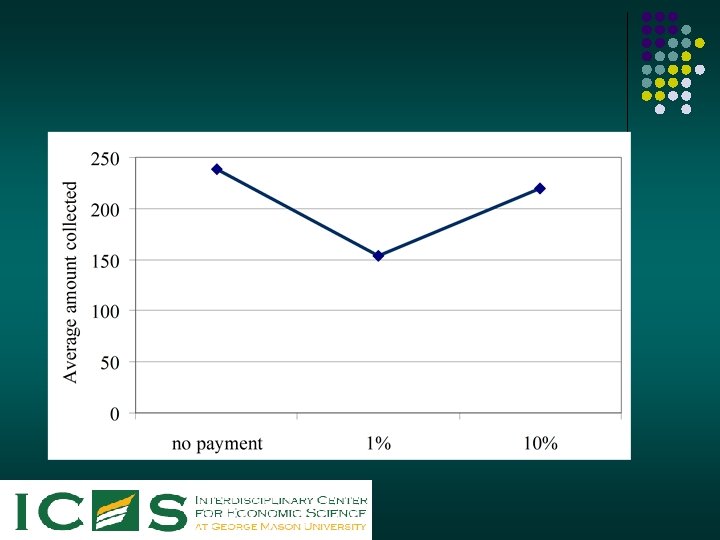
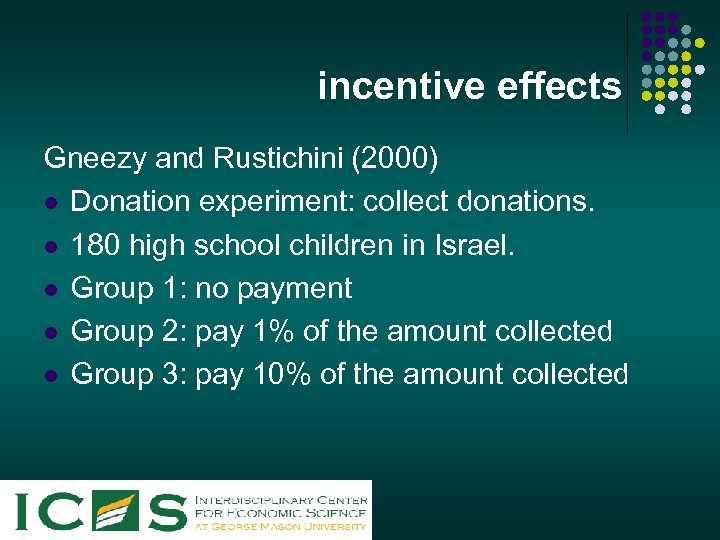 incentive effects Gneezy and Rustichini (2000) l Donation experiment: collect donations. l 180 high school children in Israel. l Group 1: no payment l Group 2: pay 1% of the amount collected l Group 3: pay 10% of the amount collected
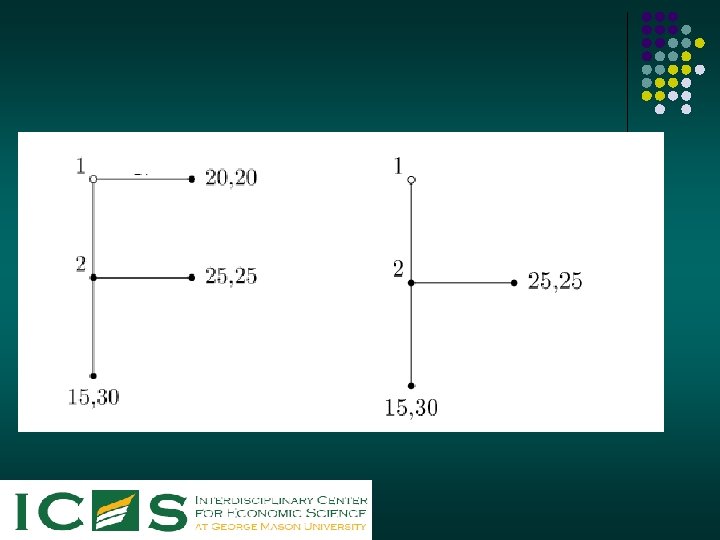
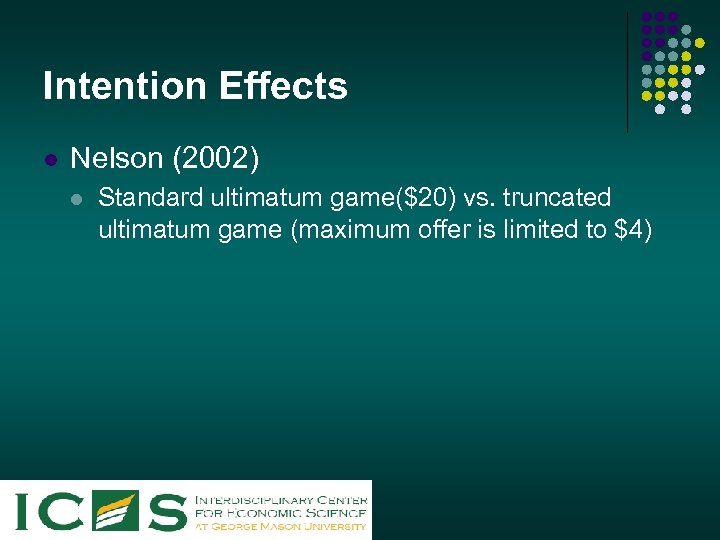
 intention effects l Mc. Cabe, Rigdon and Smith (2003): l l Outcome-based model: inequality aversion. Intention-based model: players reading each other’s motivation. l Depending on the available alternatives, identical outcomes may be interpreted differentially. (not the case in outcome-based model)
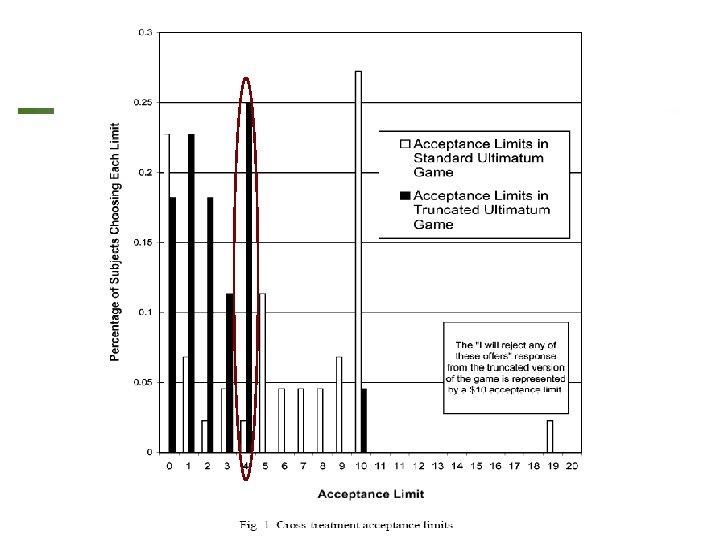
 Intention Effects l Nelson (2002) l Standard ultimatum game($20) vs. truncated ultimatum game (maximum offer is limited to $4)
 Houser, Xiao, Mc. Cabe and Smith (2008) Goal: Assess the importance of incentives and intentions in cases where punishment does not promote norm compliance.
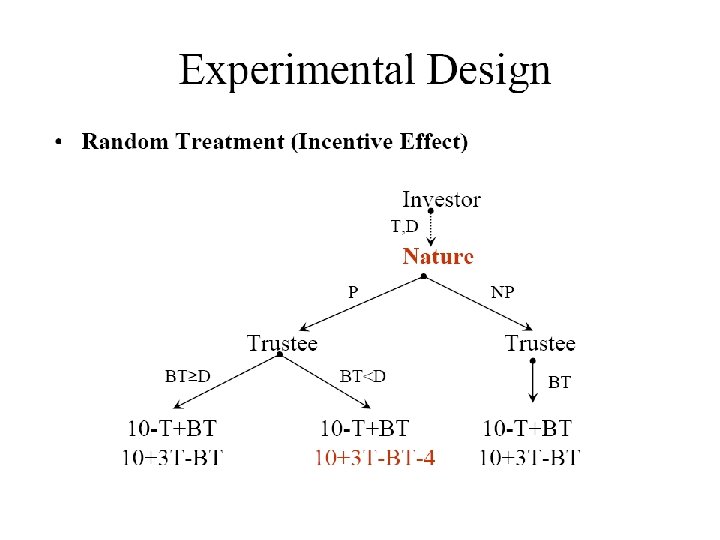
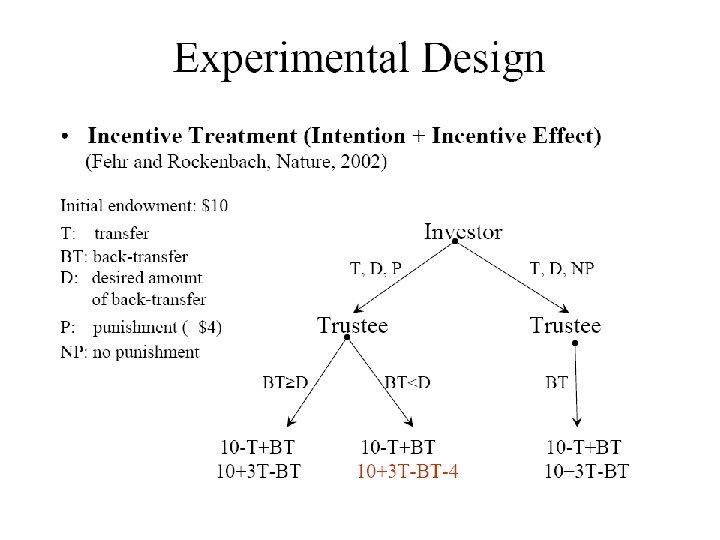
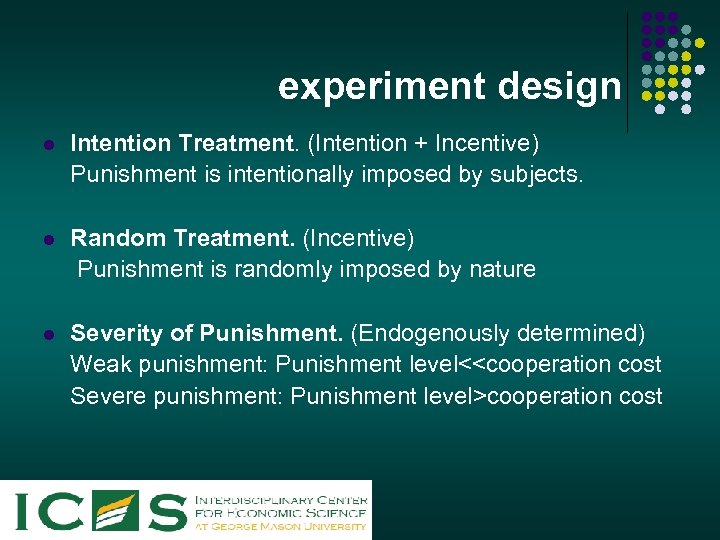 experiment design l Intention Treatment. (Intention + Incentive) Punishment is intentionally imposed by subjects. l Random Treatment. (Incentive) Punishment is randomly imposed by nature l Severity of Punishment. (Endogenously determined) Weak punishment: Punishment level<
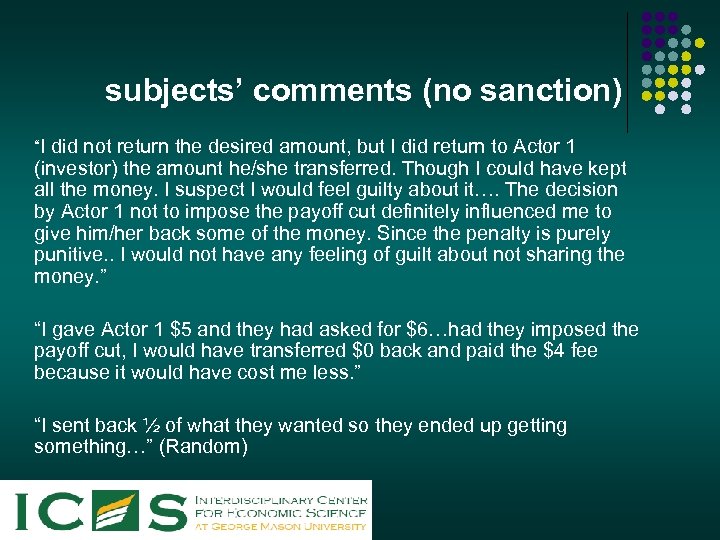 subjects’ comments (no sanction) “I did not return the desired amount, but I did return to Actor 1 (investor) the amount he/she transferred. Though I could have kept all the money. I suspect I would feel guilty about it…. The decision by Actor 1 not to impose the payoff cut definitely influenced me to give him/her back some of the money. Since the penalty is purely punitive. . I would not have any feeling of guilt about not sharing the money. ” “I gave Actor 1 $5 and they had asked for $6…had they imposed the payoff cut, I would have transferred $0 back and paid the $4 fee because it would have cost me less. ” “I sent back ½ of what they wanted so they ended up getting something…” (Random)
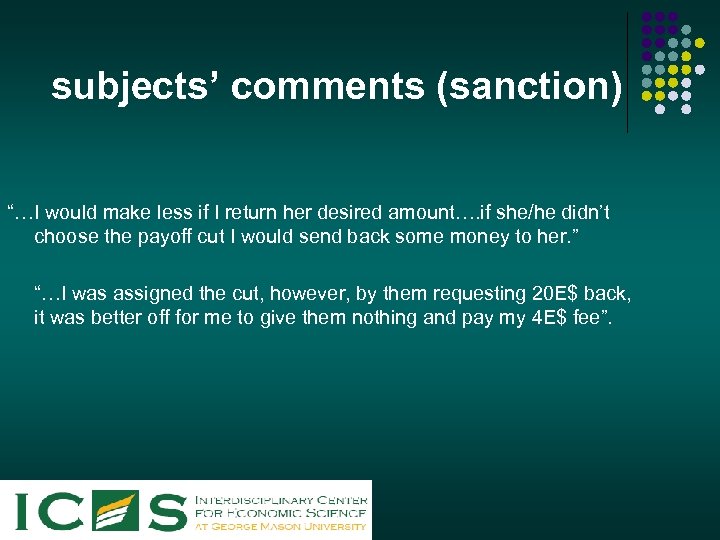 subjects’ comments (sanction) “…I would make less if I return her desired amount…. if she/he didn’t choose the payoff cut I would send back some money to her. ” “…I was assigned the cut, however, by them requesting 20 E$ back, it was better off for me to give them nothing and pay my 4 E$ fee”.
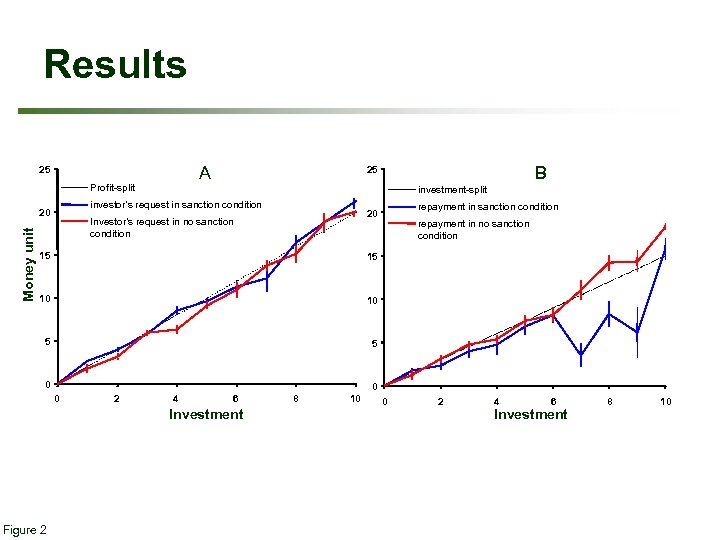
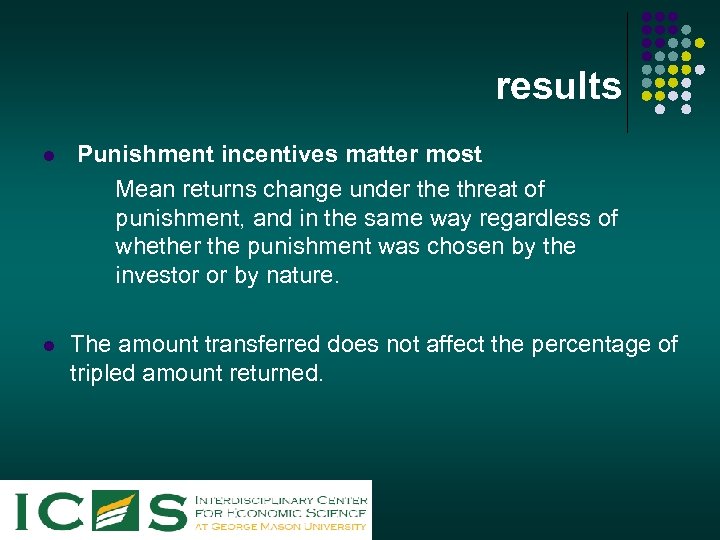 results l l Punishment incentives matter most Mean returns change under the threat of punishment, and in the same way regardless of whether the punishment was chosen by the investor or by nature. The amount transferred does not affect the percentage of tripled amount returned.
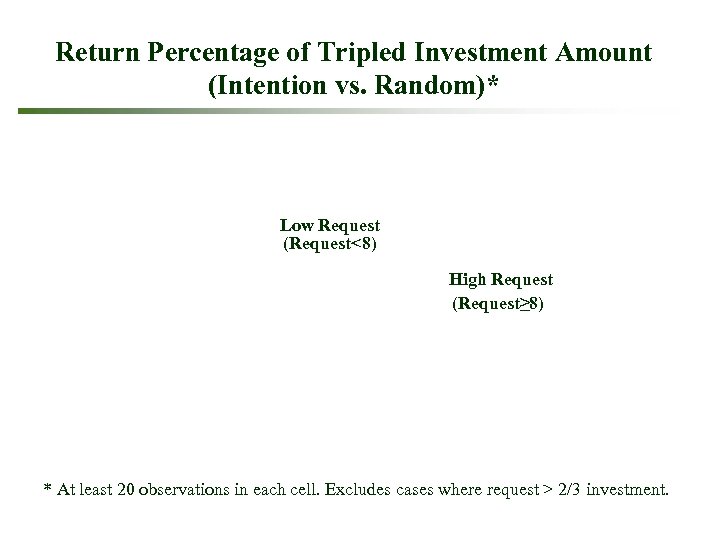 Return Percentage of Tripled Investment Amount (Intention vs. Random)* Low Request (Request<8) High Request (Request≥ 8) * At least 20 observations in each cell. Excludes cases where request > 2/3 investment.
 results l Punishment: get what you want or nothing at all When not threatened with punishment, the most common decision is to return something but not everything requested. This behavior is least common under threats of punishment.
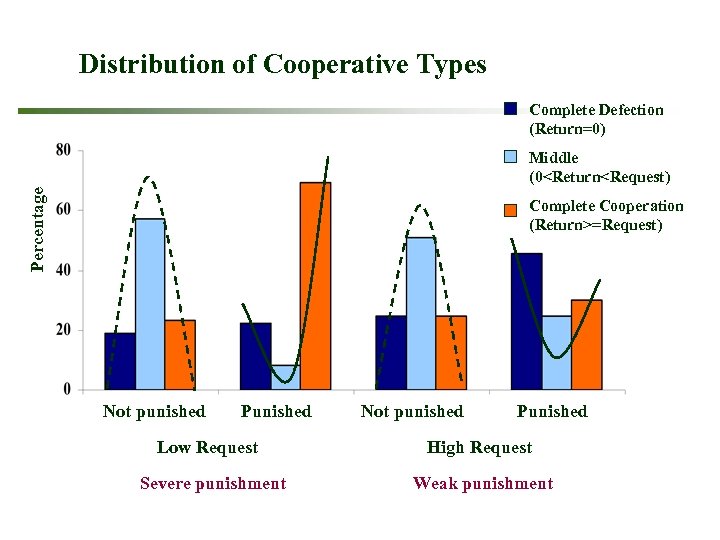 Distribution of Cooperative Types Complete Defection (Return=0) Percentage Middle (0
 discussion l Cooperation is more likely under threats of severe punishment. But severe punishment can be difficult to enforce, and consequently not credible, outside of the laboratory. l Weak punishment is credible but risky: it can have detrimental effects on human cooperation. l Why does punishment fail to promote cooperation? l l Our results suggest incentives can crowd-out norm based social motivations. Imaging study could shed important light on this issue
 Li, Xiao, Houser and Montague (2008) l Neuroeconomic investigation of why punishment fails to promote cooperation in a particular trust and reciprocity context. l Provide evidence on the “perception shift” (framing/crowding out) explanation for the failure of weak sanctions to promote cooperation. l Adding sanction threats to a social environment creates a business environment that promotes selfinterested decision making.
 neuroeconomics evidence l l l Sanfey et al (2003) de Quervain et al (2004) Knoch et al (2006) l l All involve neural activity associated with the punishment decision Spitzer et al (2007) l Neurocorrelates of punishment threats that promote norm compliance.
 hypothesis l l When sanctions are not imposed, (social) reward system will be active in making decisions l VMPFC (Mc. Cabe, et al 2001) l LOFC (Montague and Lohrenz, 2007; Spitzer et al, 2007) l Amygdala l PCC (Mc. Clure et al, 2004) When sanctions are imposed, social reward system will be relatively less active, and parietal areas will be relatively more active (Platt and Glimcher, 1999)
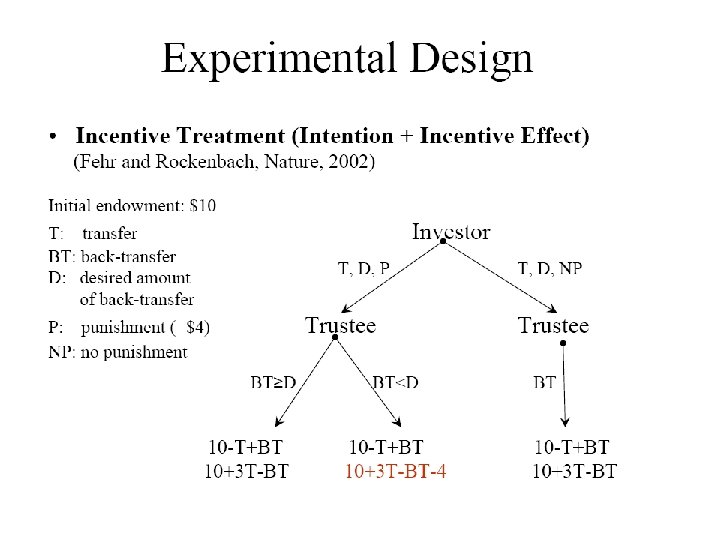
 f. MRI design l l Use Fehr and Rockenbach design Two subjects anonymously matched, one as investor and one as trustee Play game 10 times Only trustee is scanned
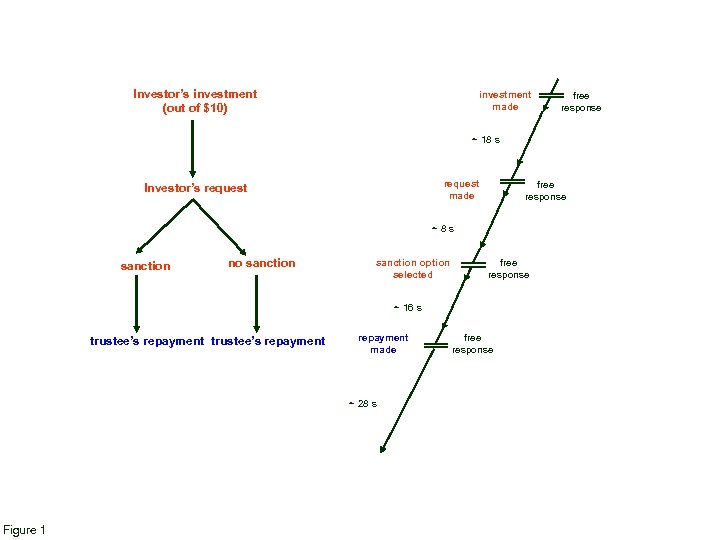 Investor’s investment (out of $10) investment made free response ~ 18 s request made Investor’s request free response ~8 s sanction no sanction option selected free response ~ 16 s trustee’s repayment made ~ 28 s Figure 1 free response
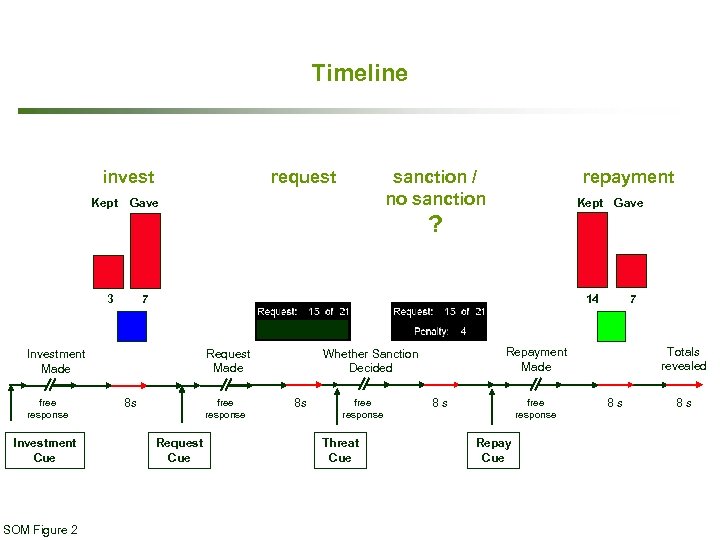 Timeline invest Kept request repayment sanction / no sanction Gave Kept Gave ? 3 14 7 Request Made Investment Made free response Investment Cue SOM Figure 2 8 s free response Request Cue free response Threat Cue Totals revealed Repayment Made Whether Sanction Decided 8 s 7 8 s free response Repay Cue 8 s 8 s
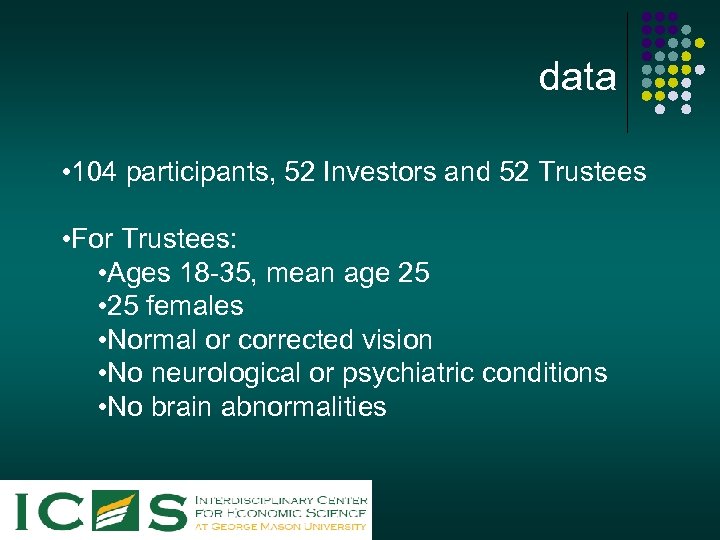 data • 104 participants, 52 Investors and 52 Trustees • For Trustees: • Ages 18 -35, mean age 25 • 25 females • Normal or corrected vision • No neurological or psychiatric conditions • No brain abnormalities
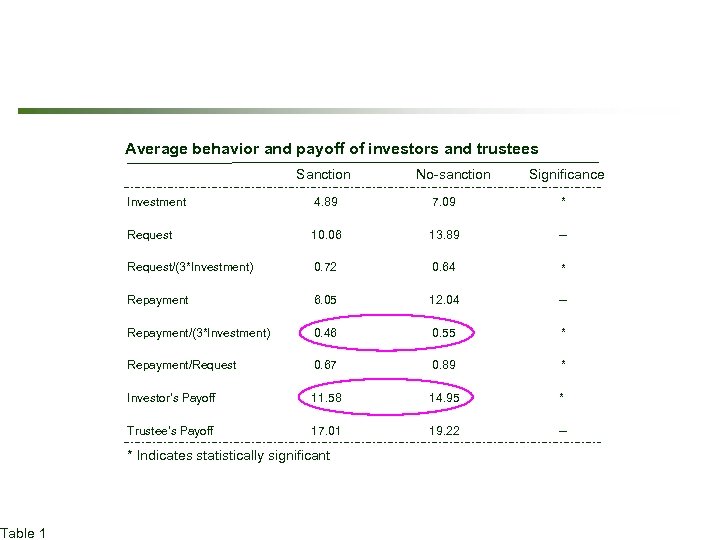 Table 1 Average behavior and payoff of investors and trustees Sanction No-sanction Significance Investment 4. 89 7. 09 * Request 10. 06 13. 89 -- Request/(3*Investment) 0. 72 0. 64 * Repayment 6. 05 12. 04 -- Repayment/(3*Investment) 0. 46 0. 55 * Repayment/Request 0. 67 0. 89 * Investor’s Payoff 11. 58 14. 95 * Trustee’s Payoff 17. 01 19. 22 -- * Indicates statistically significant
 Results A 25 Profit-split Money unit investment-split investor’s request in sanction condition 20 B 25 repayment in sanction condition 20 Investor’s request in no sanction condition 15 15 10 10 5 repayment in no sanction condition 5 0 0 0 2 4 6 Investment Figure 2 8 10 0 2 4 6 Investment 8 10
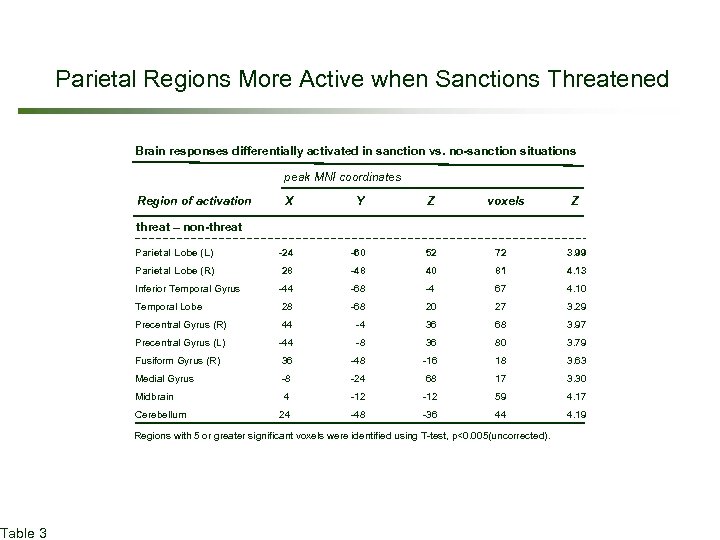 Table 3 Parietal Regions More Active when Sanctions Threatened Brain responses differentially activated in sanction vs. no-sanction situations peak MNI coordinates Region of activation X Y Z voxels Z Parietal Lobe (L) -24 -60 52 72 3. 99 Parietal Lobe (R) 28 -48 40 81 4. 13 Inferior Temporal Gyrus -44 -68 -4 67 4. 10 Temporal Lobe 28 -68 20 27 3. 29 Precentral Gyrus (R) 44 -4 36 68 3. 97 Precentral Gyrus (L) -44 -8 36 80 3. 79 Fusiform Gyrus (R) 36 -48 -16 18 3. 63 Medial Gyrus -8 -24 68 17 3. 30 Midbrain 4 -12 59 4. 17 24 -48 -36 44 4. 19 threat – non-threat Cerebellum Regions with 5 or greater significant voxels were identified using T-test, p<0. 005(uncorrected).
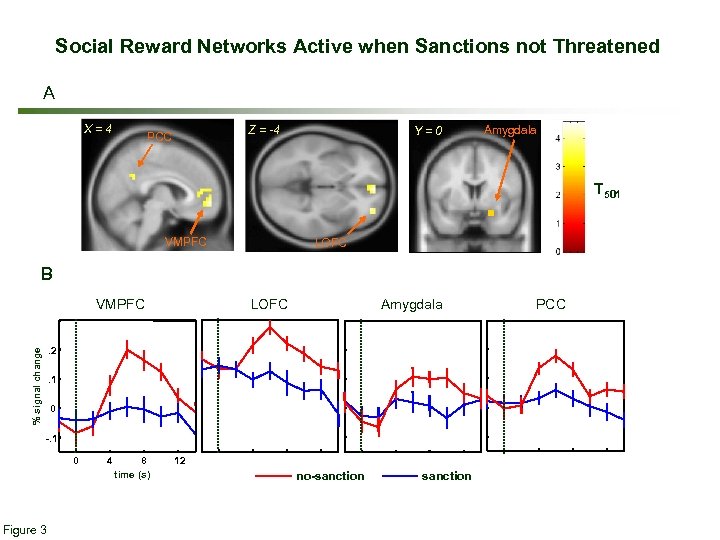 Social Reward Networks Active when Sanctions not Threatened A X=4 Z = -4 PCC Y=0 Amygdala T 501 VMPFC LOFC B VMPFC LOFC Amygdala % signal change . 2. 1 0 -. 1 0 Figure 3 4 8 time (s) 12 no-sanction PCC
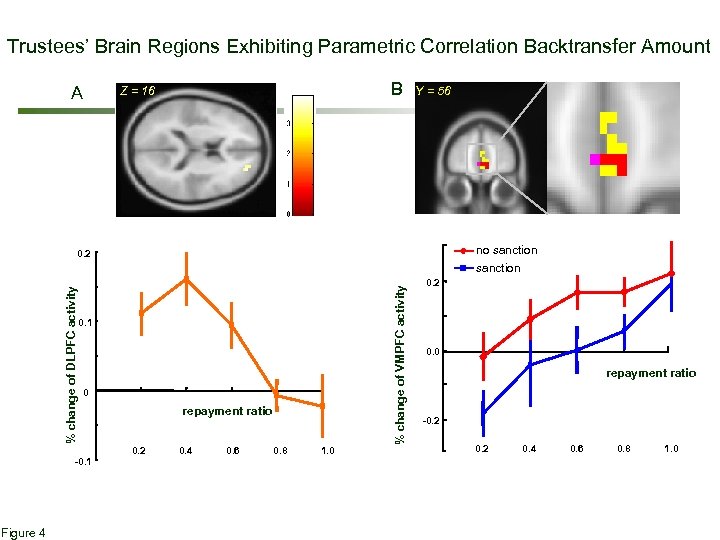 Trustees’ Brain Regions Exhibiting Parametric Correlation Backtransfer Amount A B Z = 16 Y = 56 no sanction 0. 1 0 -0. 1 Figure 4 repayment ratio 0. 2 0. 4 0. 6 0. 8 1. 0 % change of VMPFC activity % change of DLPFC activity 0. 2 0. 0 repayment ratio -0. 2 0. 4 0. 6 0. 8 1. 0
 conclusions l Credible threats of sanctions perhaps generate a “cognitive shift” that diminish social motivations and promote selfish behaviors l Absent sanctions, our data show a consistent activation pattern in areas previously been linked to social reward processing: LOFC, VMPFC, Amygdala. l Imposing sanctions suppresses the social network and parietal areas play a greater role in decision making. l Regardless of sanctions, activation in VMPFC correlates positively with trustee altruism. The sanction/no-sanction signal modulates baseline activity of VMPFC, but does not affect the correlation.