Скачать презентацию PUNCTUATION The full stop This is
241dad80ac361e277d19f2ccf9248b51.ppt
- Количество слайдов: 20
 PUNCTUATION
 The full stop · This is used: § To mark the end of the assertive and imperative sentence e. g. He has succeeded in his venture. § After an abbreviation. e. g. H. G Wells. § Full stops are not used with : Acronyms e. g. FIFA, NATO § Full stops are not essential for: abbreviations consisting entirely for capitals, e. g. BBC, AD, BC, PLC.
 APOSTROPHE ’ This is used: • to indicate possession: with a singular noun : e. g. a boy’s book • with a plural already ending with - s e. g. a girls’ school two weeks’ newspapers To indicate the union of two words in question tag. e. g. He wasn’t there, was he?
 with a plural not already ending with –s: e. g. the children’s books women’s literature with a singular name: e. g. Bill’s book Nicholas’ ( or Nicholas’s) coat with a name ending in –es that is pronounced /IZ/: e. g. Bridges’ poems in phrases using sake; e. g. for God’s sake for goodness’ sake but it is often omitted in a business name: e. g. Barclays Bank
 to mark an omission of one or more letters or numbers: e. g. he’s ( he is) we’ll o’ clock ( of the clock) the summer of ’ 68 (1968)
![BRACKETS ( ) [ ] Round brackets , also called parenthesis, are used](https://present5.com/presentation/241dad80ac361e277d19f2ccf9248b51/image-7.jpg "BRACKETS ( ) [ ] Round brackets , also called parenthesis, are used") BRACKETS ( ) [ ] Round brackets , also called parenthesis, are used mainly to enclose: explanations and extra information or comment, e. g. Congo ( formerly Zaire ) This is done using integrated circuits(see page 38). Square brackets are used to enclose: words added by someone other than the original writer or speaker, e. g. Then the man said, ‘He [the police officer ] can’t prove I did it. various special types of information, such as stage directions, e. g. Hedley: Goodbye! [Exit]
BRACKETS ( ) [ ] Round brackets , also called parenthesis, are used mainly to enclose: explanations and extra information or comment, e. g. Congo ( formerly Zaire ) This is done using integrated circuits(see page 38). Square brackets are used to enclose: words added by someone other than the original writer or speaker, e. g. Then the man said, ‘He [the police officer ] can’t prove I did it. various special types of information, such as stage directions, e. g. Hedley: Goodbye! [Exit]
 COLON: This is used: between two main clauses of which the second explains, enlarges on, or follows from the first, e. g. It was not easy: to begin with I had to find the right house. to introduce a list of items (a dash should not be added), and after expressions such as namely, for example, to resume, to sum up, and the following, e. g. You will need: a tent, a sleeping bag, cooking equipment, and a rucksack. before a quotation, e. g. The poem begins: ‘Earth has not anything to show more fair’.
 COMMA , The comma marks a slight break between words, phrases, etc. In particular, it is used: üto separate items in a list, e. g. We bought some shoes, socks, gloves, and handkerchiefs. to separate adjectives that describe something in the same way, e. g. It is a hot, dry, dusty place. but not if they describe it in different ways, e. g. a distinguished foreign author or if one adjective adds to or alters the meaning of another, e. g. a bright red tie.
 To separate a series of words of the same class in the sentence: Ram, Gopal and Hari are here. Put a comma after ‘yes’, ‘no’, or ‘well’ when these words start a sentence: Yes, he is. No, he isn’t.
 DASH — This is used: to mark the beginning and end of an interruption in the structure of a sentence: My son — where has he gone? — would like to meet you. to show faltering speech in conversation: Yes — well —I would —only you see — it’s not easy. to show other kinds of break in a sentence, often where a comma, semicolon, or colon would traditionally be used. e. g. Come tomorrow — if you can.
 EXCLAMATION MARK! v. This is used instead of a full stop at the end of a sentence to show that the speaker or writer is very angry, enthusiastic, insistent, disappointed, hurt, surprised, etc. , e. g. I am not pleased at all! I wish I could have gone! Ow! Go away! I just love sweets! He didn’t even say goodbye!
 The Inverted Commas or Quotation Marks (‘ ’“ ”) The inverted commas are used to indicate the exact words of the speaker. He said, “God made the country and man made the town”. Round the title of a book, song, poem, magazine article, television program. e. g. ‘Hard Times’ by Charles Dickens
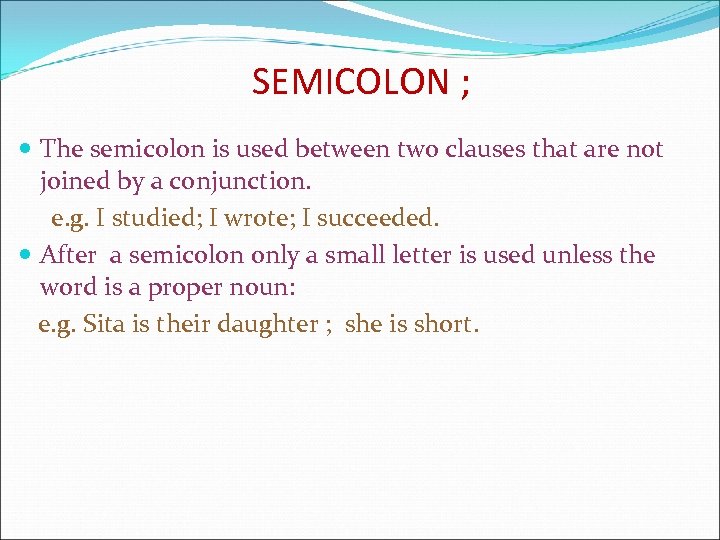 SEMICOLON ; The semicolon is used between two clauses that are not joined by a conjunction. e. g. I studied; I wrote; I succeeded. After a semicolon only a small letter is used unless the word is a proper noun: e. g. Sita is their daughter ; she is short.
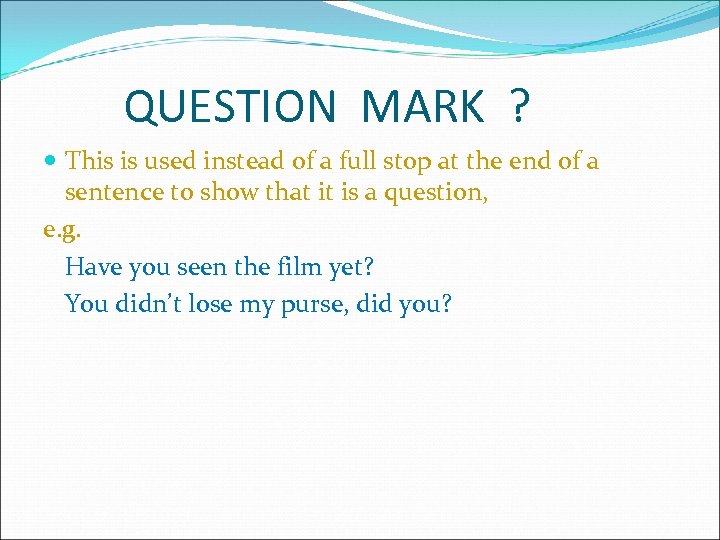 QUESTION MARK ? This is used instead of a full stop at the end of a sentence to show that it is a question, e. g. Have you seen the film yet? You didn’t lose my purse, did you?
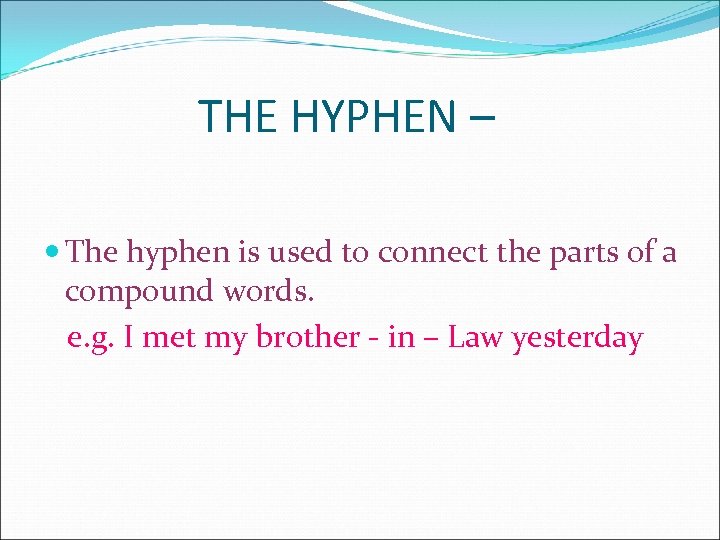 THE HYPHEN – The hyphen is used to connect the parts of a compound words. e. g. I met my brother - in – Law yesterday
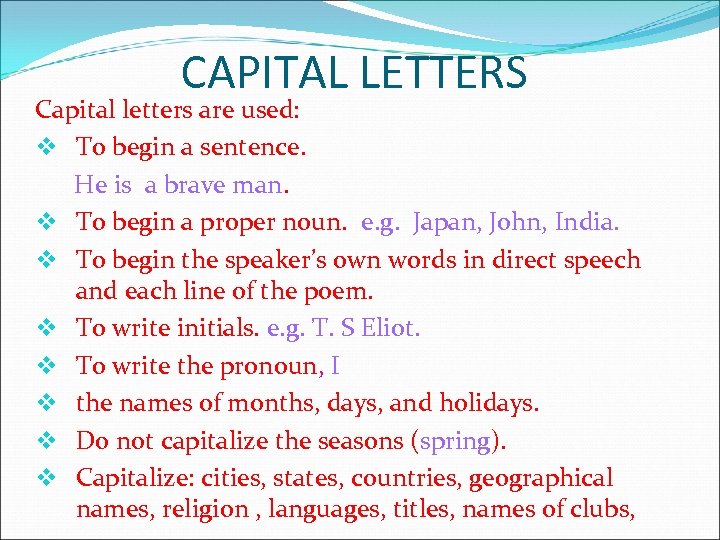 CAPITAL LETTERS Capital letters are used: v To begin a sentence. He is a brave man. v To begin a proper noun. e. g. Japan, John, India. v To begin the speaker’s own words in direct speech and each line of the poem. v To write initials. e. g. T. S Eliot. v To write the pronoun, I v the names of months, days, and holidays. v Do not capitalize the seasons (spring). v Capitalize: cities, states, countries, geographical names, religion , languages, titles, names of clubs,
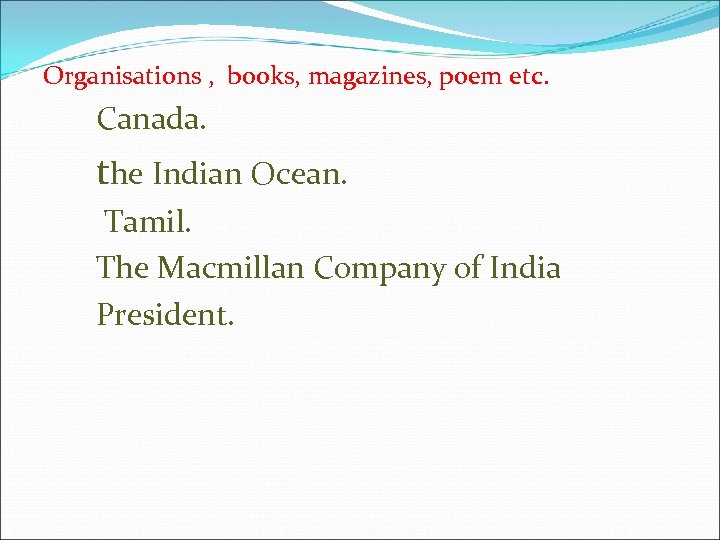 Organisations , books, magazines, poem etc. Canada. the Indian Ocean. Tamil. The Macmillan Company of India President.
![Ellipsis [ … ] It consists of three evenly spaced dots. with spaces between](https://present5.com/presentation/241dad80ac361e277d19f2ccf9248b51/image-19.jpg "Ellipsis [ … ] It consists of three evenly spaced dots. with spaces between") Ellipsis [ … ] It consists of three evenly spaced dots. with spaces between the ellipsis. It is used to quote material and to omit some words. If the omission comes after the end of a sentence, the ellipsis will be placed after the period, making a total of four dots. … e. g. The ceremony honoured twelve brilliant athletes … visiting the U. S. The MLA Handbook recommends using square brackets on either side of the ellipsis. e. g. "Bohr […] used the analogy of parallel stairways […]" (Smith 55).
Ellipsis [ … ] It consists of three evenly spaced dots. with spaces between the ellipsis. It is used to quote material and to omit some words. If the omission comes after the end of a sentence, the ellipsis will be placed after the period, making a total of four dots. … e. g. The ceremony honoured twelve brilliant athletes … visiting the U. S. The MLA Handbook recommends using square brackets on either side of the ellipsis. e. g. "Bohr […] used the analogy of parallel stairways […]" (Smith 55).