



 Punctuation
 Full stop (=full point) Fill in the gaps. Use at the end of the sentence.
 Point I need 4. 5 litres of water. Use to say numbers
 Dots j, i Use dots in these letters
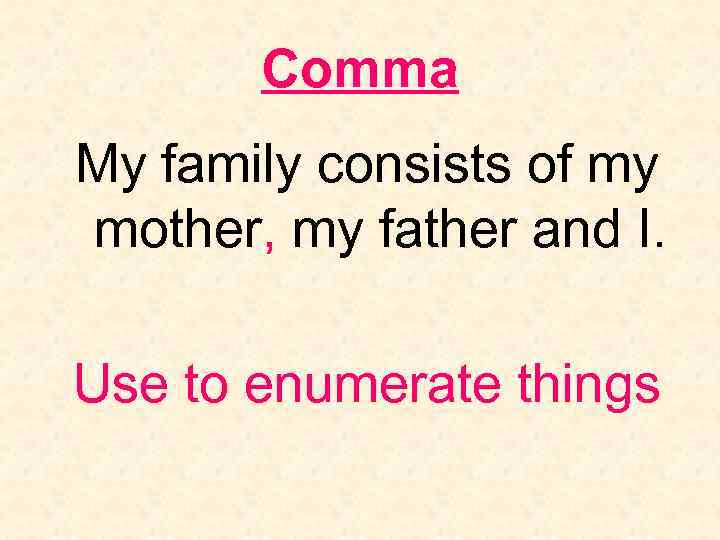 Comma My family consists of my mother, my father and I. Use to enumerate things
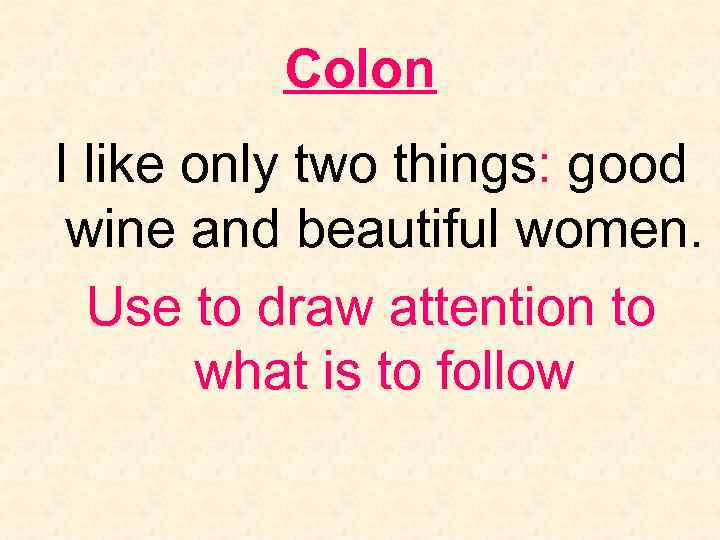 Colon I like only two things: good wine and beautiful women. Use to draw attention to what is to follow
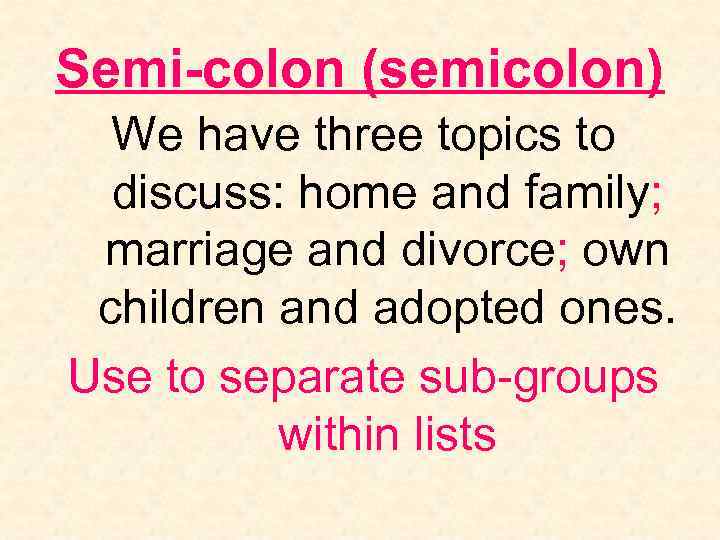 Semi-colon (semicolon) We have three topics to discuss: home and family; marriage and divorce; own children and adopted ones. Use to separate sub-groups within lists
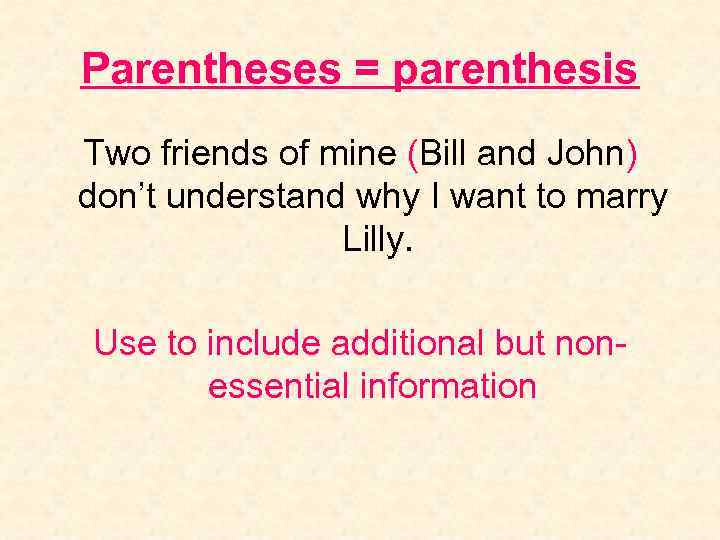 Parentheses = parenthesis Two friends of mine (Bill and John) don’t understand why I want to marry Lilly. Use to include additional but nonessential information
![[Square] brackets Ask not what your country can do for you but [ask] what](https://present5.com/presentation/3/12808191_437533549.pdf-img/12808191_437533549.pdf-9.jpg "[Square] brackets Ask not what your country can do for you but [ask] what") [Square] brackets Ask not what your country can do for you but [ask] what you can do for your country Use to include additional but nonessential information and to give some explanation
[Square] brackets Ask not what your country can do for you but [ask] what you can do for your country Use to include additional but nonessential information and to give some explanation
 Apostrophe It’s my mother’s car. Use to show possession or contraction
 Dash Dogs – common four-legged animals kept by humans as companions. NB: The dash is longer than hyphen!!! Use in definitions instead of linking verbs
 Hyphen The word ‘copy-book’ can be hyphenated. Use in compound nouns
 Ellipsis The president made the following statement: ‘ Dear friends…’ Use to omit some information
 Question mark Are you free tonight? Use to indicate a sentence is interrogative
 Quotation mark (=point) The president made the following statement: ‘ Dear friends…’ Use for quotes and titles
 Exclamation mark (=point) I’m so happy!!!!! Hurray! Use to emphasize, but avoid its use in a formal writing
 Test yourself
 Use at the end of the sentence.
 Use to enumerate things
 Use to separate subgroups within lists
 Use to draw attention to what is to follow
 Use to write titles
 Use to show contraction
 Don’t use it in a formal writing
 Use to omit some information
 Use to include additional nonessential information
 Essential Punctuation rules
 AND & COMMA A comma usually comes before “and” when it links more than two nouns. Commas also appear before “and” when it introduces an independent clause. Be sure not to use a comma before “and” when it links compound verbs or compound subjects, adjectives, predicates, and so on.
 Place the correct punctuation mark if necessary 1) The man and the woman looked longingly to sea. 2) The woman looked at the duck and the man stood on the shore. 3) The man the woman and the boy looked at the pond the duck standing on the shore and the large red and shiny umbrella.
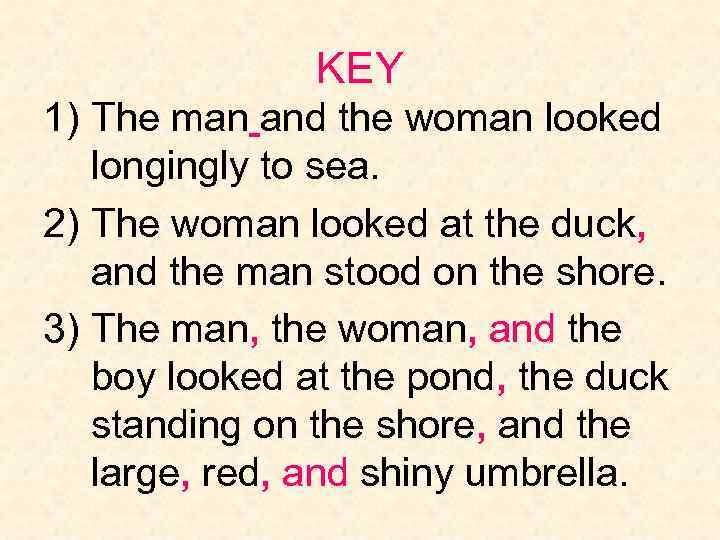 KEY 1) The man and the woman looked longingly to sea. 2) The woman looked at the duck, and the man stood on the shore. 3) The man, the woman, and the boy looked at the pond, the duck standing on the shore, and the large, red, and shiny umbrella.
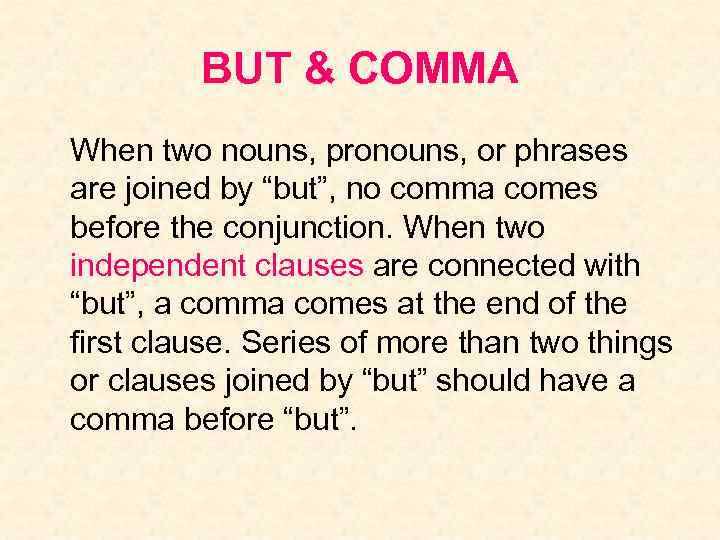 BUT & COMMA When two nouns, pronouns, or phrases are joined by “but”, no comma comes before the conjunction. When two independent clauses are connected with “but”, a comma comes at the end of the first clause. Series of more than two things or clauses joined by “but” should have a comma before “but”.
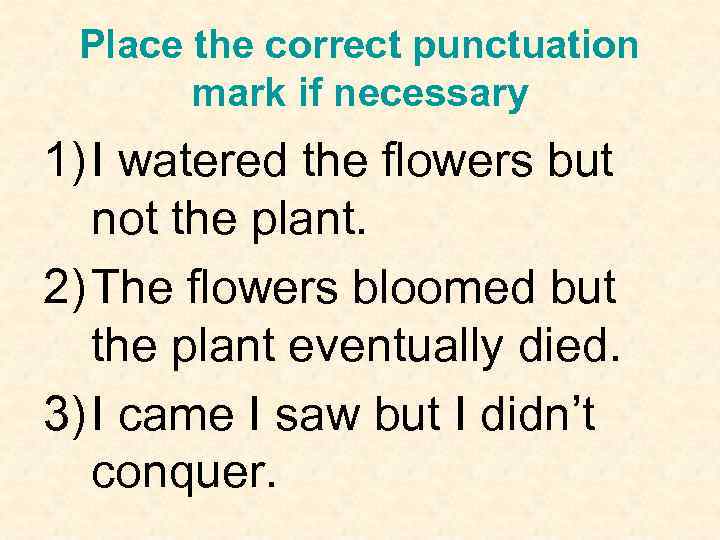 Place the correct punctuation mark if necessary 1) I watered the flowers but not the plant. 2) The flowers bloomed but the plant eventually died. 3) I came I saw but I didn’t conquer.
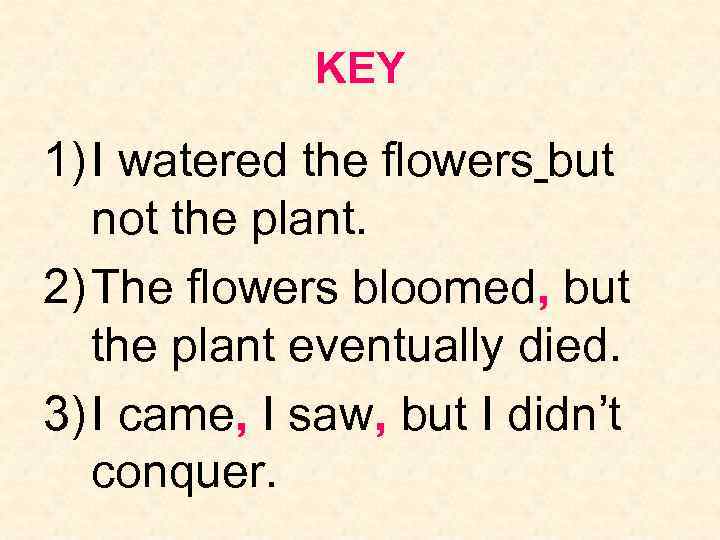 KEY 1) I watered the flowers but not the plant. 2) The flowers bloomed, but the plant eventually died. 3) I came, I saw, but I didn’t conquer.
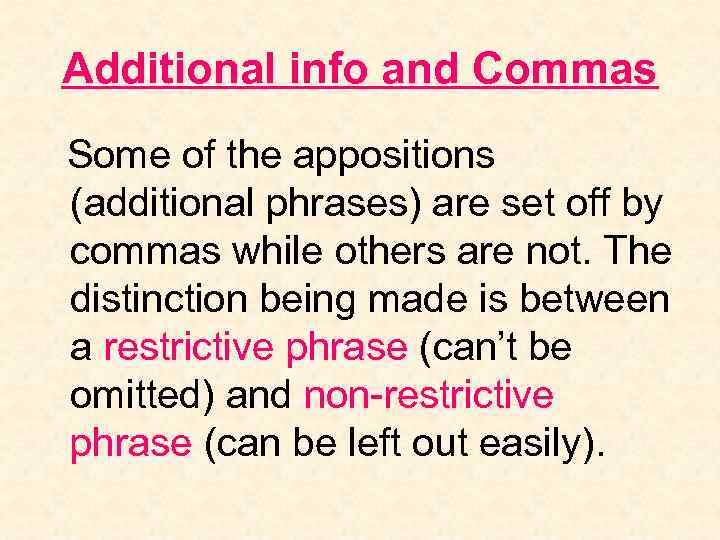 Additional info and Commas Some of the appositions (additional phrases) are set off by commas while others are not. The distinction being made is between a restrictive phrase (can’t be omitted) and non-restrictive phrase (can be left out easily).
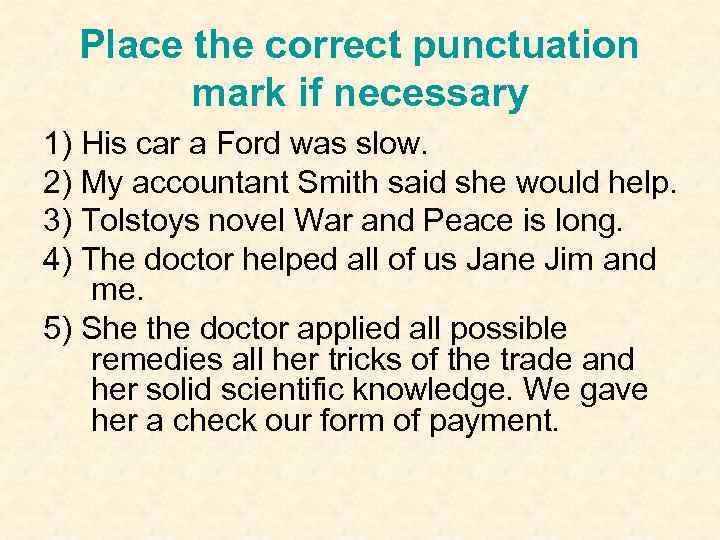 Place the correct punctuation mark if necessary 1) His car a Ford was slow. 2) My accountant Smith said she would help. 3) Tolstoys novel War and Peace is long. 4) The doctor helped all of us Jane Jim and me. 5) She the doctor applied all possible remedies all her tricks of the trade and her solid scientific knowledge. We gave her a check our form of payment.
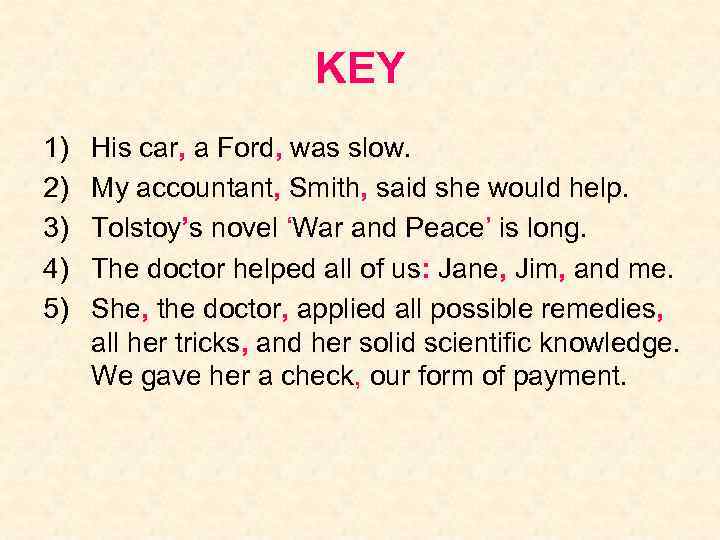 KEY 1) 2) 3) 4) 5) His car, a Ford, was slow. My accountant, Smith, said she would help. Tolstoy’s novel ‘War and Peace’ is long. The doctor helped all of us: Jane, Jim, and me. She, the doctor, applied all possible remedies, all her tricks, and her solid scientific knowledge. We gave her a check, our form of payment.
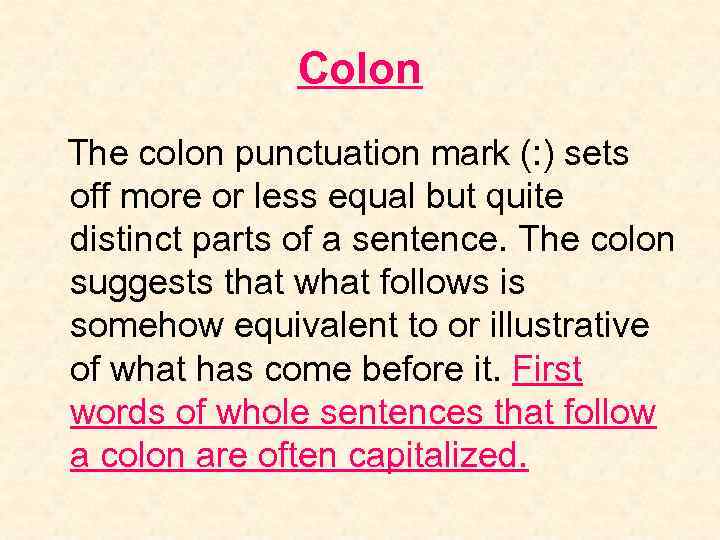 Colon The colon punctuation mark (: ) sets off more or less equal but quite distinct parts of a sentence. The colon suggests that what follows is somehow equivalent to or illustrative of what has come before it. First words of whole sentences that follow a colon are often capitalized.
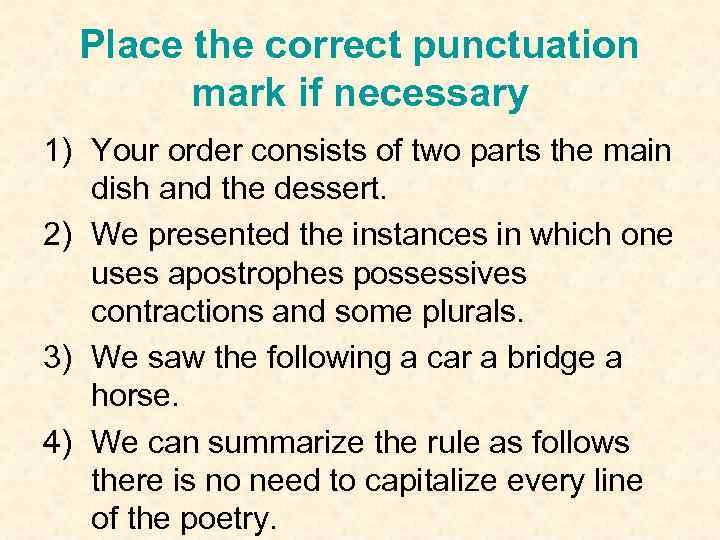 Place the correct punctuation mark if necessary 1) Your order consists of two parts the main dish and the dessert. 2) We presented the instances in which one uses apostrophes possessives contractions and some plurals. 3) We saw the following a car a bridge a horse. 4) We can summarize the rule as follows there is no need to capitalize every line of the poetry.
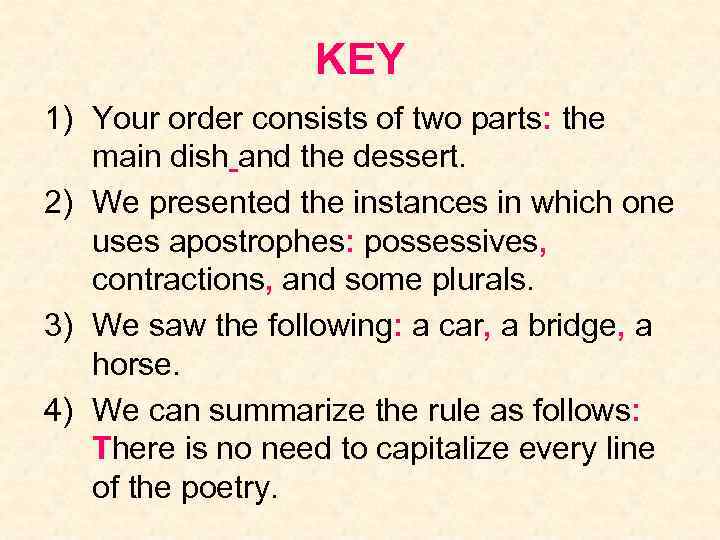 KEY 1) Your order consists of two parts: the main dish and the dessert. 2) We presented the instances in which one uses apostrophes: possessives, contractions, and some plurals. 3) We saw the following: a car, a bridge, a horse. 4) We can summarize the rule as follows: There is no need to capitalize every line of the poetry.
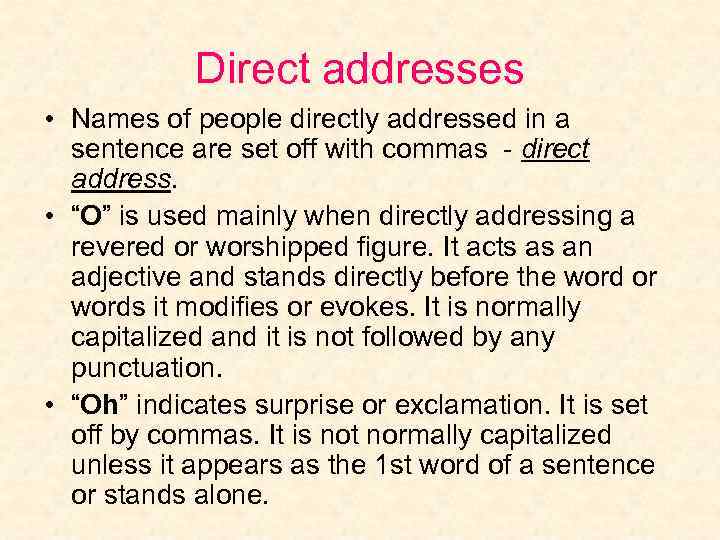 Direct addresses • Names of people directly addressed in a sentence are set off with commas - direct address. • “O” is used mainly when directly addressing a revered or worshipped figure. It acts as an adjective and stands directly before the word or words it modifies or evokes. It is normally capitalized and it is not followed by any punctuation. • “Oh” indicates surprise or exclamation. It is set off by commas. It is not normally capitalized unless it appears as the 1 st word of a sentence or stands alone.
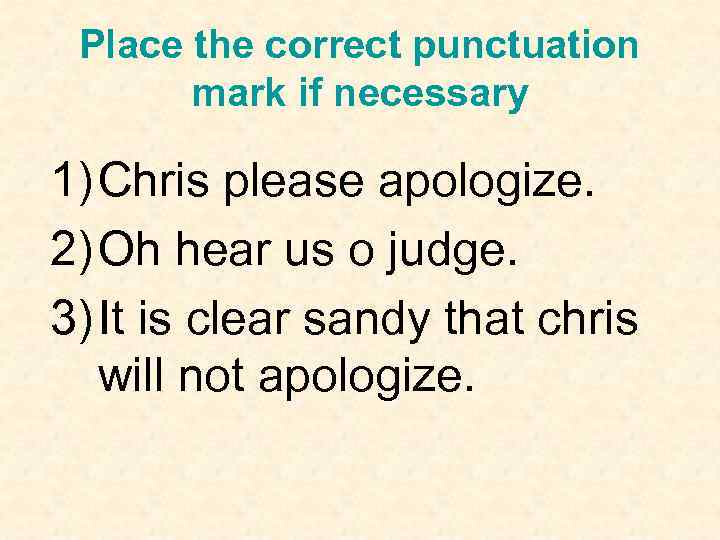 Place the correct punctuation mark if necessary 1) Chris please apologize. 2) Oh hear us o judge. 3) It is clear sandy that chris will not apologize.
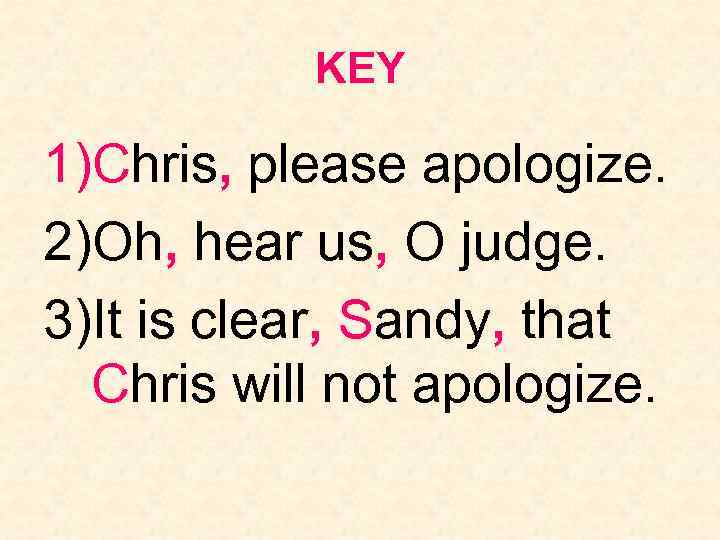 KEY 1)Chris, please apologize. 2)Oh, hear us, O judge. 3)It is clear, Sandy, that Chris will not apologize.
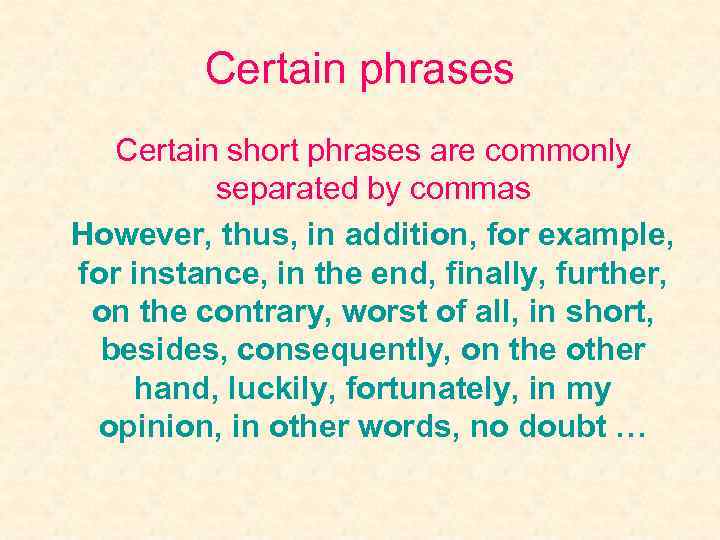 Certain phrases Certain short phrases are commonly separated by commas However, thus, in addition, for example, for instance, in the end, finally, further, on the contrary, worst of all, in short, besides, consequently, on the other hand, luckily, fortunately, in my opinion, in other words, no doubt …
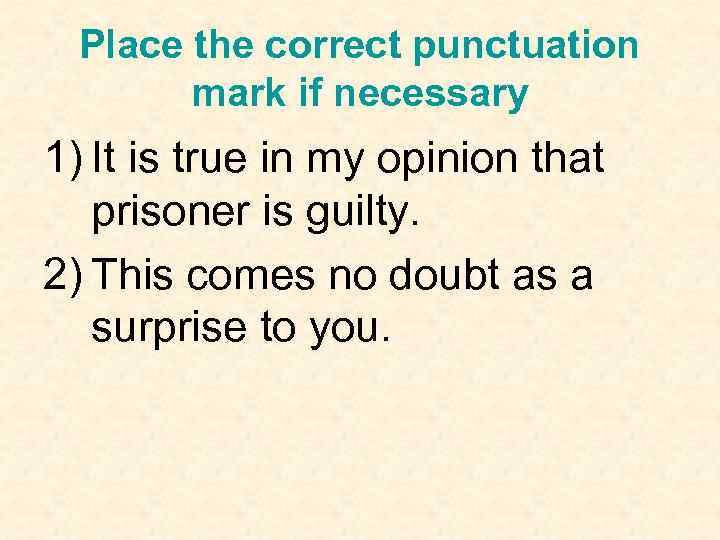 Place the correct punctuation mark if necessary 1) It is true in my opinion that prisoner is guilty. 2) This comes no doubt as a surprise to you.
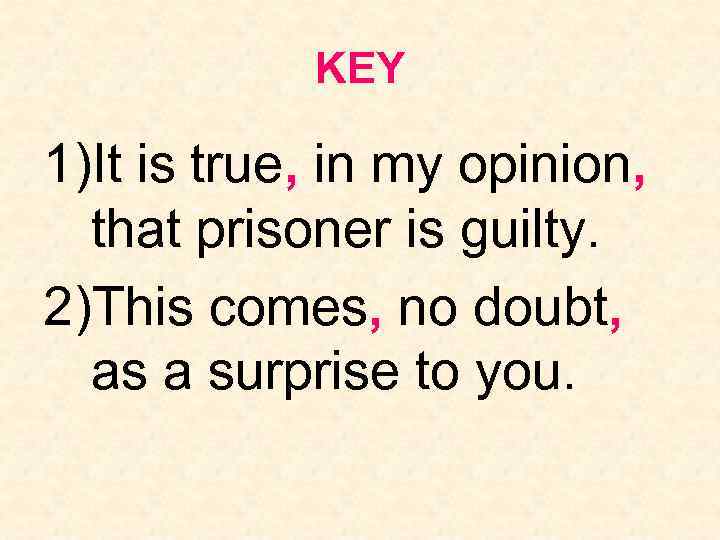 KEY 1)It is true, in my opinion, that prisoner is guilty. 2)This comes, no doubt, as a surprise to you.
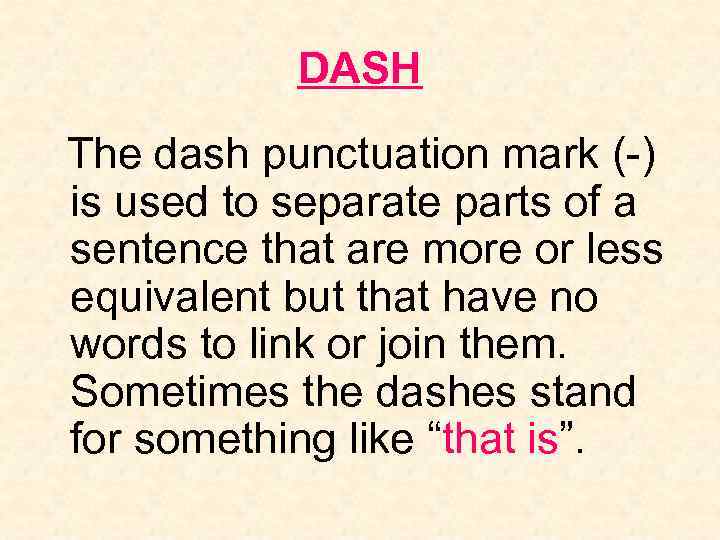 DASH The dash punctuation mark (-) is used to separate parts of a sentence that are more or less equivalent but that have no words to link or join them. Sometimes the dashes stand for something like “that is”.
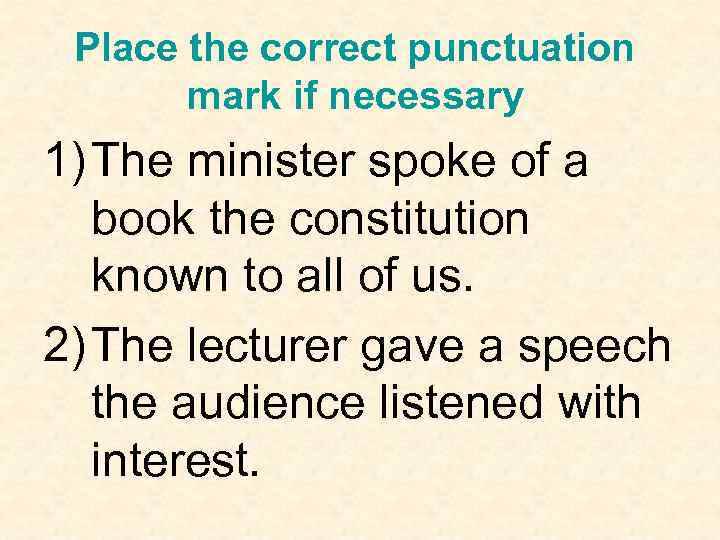 Place the correct punctuation mark if necessary 1) The minister spoke of a book the constitution known to all of us. 2) The lecturer gave a speech the audience listened with interest.
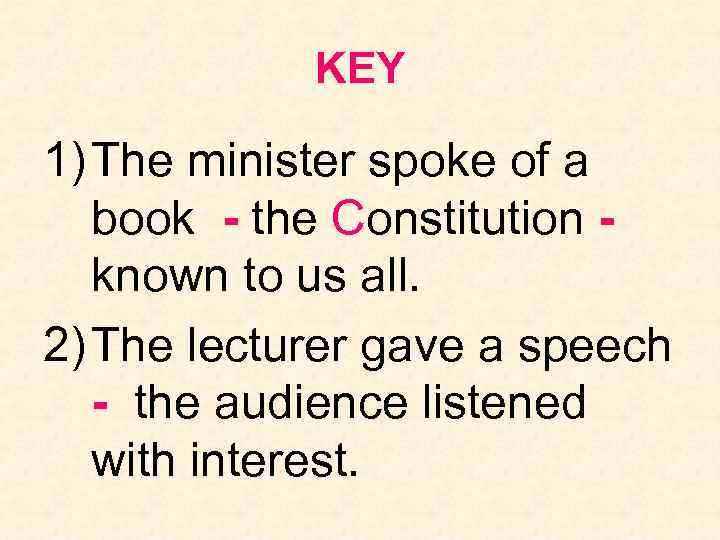 KEY 1) The minister spoke of a book - the Constitution known to us all. 2) The lecturer gave a speech - the audience listened with interest.
 It is enough for today!