 Скачать презентацию Pulmonary Shadow on Prenatal Sonogram 1 Haitham Al-Wahab
c4a4442a8e10f863b483a983f80f31d5.ppt
- Количество слайдов: 1



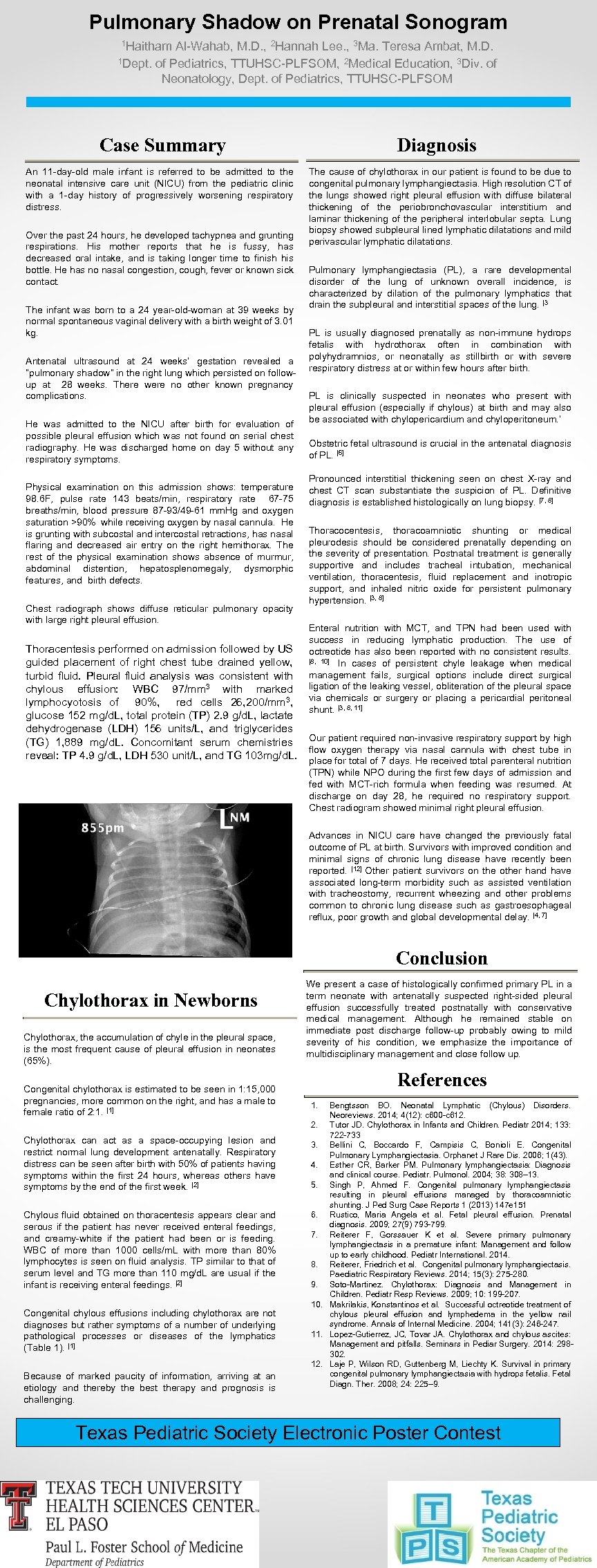
Pulmonary Shadow on Prenatal Sonogram 1 Haitham Al-Wahab, M. D. , 2 Hannah Lee. , 3 Ma. Teresa Ambat, M. D. 1 Dept. of Pediatrics, TTUHSC-PLFSOM, 2 Medical Education, 3 Div. of Neonatology, Dept. of Pediatrics, TTUHSC-PLFSOM Case Summary An 11 -day-old male infant is referred to be admitted to the neonatal intensive care unit (NICU) from the pediatric clinic with a 1 -day history of progressively worsening respiratory distress. Over the past 24 hours, he developed tachypnea and grunting respirations. His mother reports that he is fussy, has decreased oral intake, and is taking longer time to finish his bottle. He has no nasal congestion, cough, fever or known sick contact. The infant was born to a 24 year-old-woman at 39 weeks by normal spontaneous vaginal delivery with a birth weight of 3. 01 kg. Antenatal ultrasound at 24 weeks’ gestation revealed a “pulmonary shadow” in the right lung which persisted on followup at 28 weeks. There were no other known pregnancy complications. He was admitted to the NICU after birth for evaluation of possible pleural effusion which was not found on serial chest radiography. He was discharged home on day 5 without any respiratory symptoms. Physical examination on this admission shows: temperature 98. 6 F, pulse rate 143 beats/min, respiratory rate 67 -75 breaths/min, blood pressure 87 -93/49 -61 mm. Hg and oxygen saturation >90% while receiving oxygen by nasal cannula. He is grunting with subcostal and intercostal retractions, has nasal flaring and decreased air entry on the right hemithorax. The rest of the physical examination shows absence of murmur, abdominal distention, hepatosplenomegaly, dysmorphic features, and birth defects. Chest radiograph shows diffuse reticular pulmonary opacity with large right pleural effusion. Thoracentesis performed on admission followed by US guided placement of right chest tube drained yellow, turbid fluid. Pleural fluid analysis was consistent with chylous effusion: WBC 97/mm 3 with marked lymphocyotosis of 90%, red cells 26, 200/mm 3, glucose 152 mg/d. L, total protein (TP) 2. 9 g/d. L, lactate dehydrogenase (LDH) 156 units/L, and triglycerides (TG) 1, 889 mg/d. L. Concomitant serum chemistries reveal: TP 4. 9 g/d. L, LDH 530 unit/L, and TG 103 mg/d. L. Diagnosis The cause of chylothorax in our patient is found to be due to congenital pulmonary lymphangiectasia. High resolution CT of the lungs showed right pleural effusion with diffuse bilateral thickening of the periobronchovascular interstitium and laminar thickening of the peripheral interlobular septa. Lung biopsy showed subpleural lined lymphatic dilatations and mild perivascular lymphatic dilatations. Pulmonary lymphangiectasia (PL), a rare developmental disorder of the lung of unknown overall incidence, is characterized by dilation of the pulmonary lymphatics that drain the subpleural and interstitial spaces of the lung. [3 PL is usually diagnosed prenatally as non-immune hydrops fetalis with hydrothorax often in combination with polyhydramnios, or neonatally as stillbirth or with severe respiratory distress at or within few hours after birth. PL is clinically suspected in neonates who present with pleural effusion (especially if chylous) at birth and may also be associated with chylopericardium and chyloperitoneum. ‘ Obstetric fetal ultrasound is crucial in the antenatal diagnosis of PL. [6] Pronounced interstitial thickening seen on chest X-ray and chest CT scan substantiate the suspicion of PL. Definitive diagnosis is established histologically on lung biopsy. [7, 8] Thoracocentesis, thoracoamniotic shunting or medical pleurodesis should be considered prenatally depending on the severity of presentation. Postnatal treatment is generally supportive and includes tracheal intubation, mechanical ventilation, thoracentesis, fluid replacement and inotropic support, and inhaled nitric oxide for persistent pulmonary hypertension. [3, 8] Enteral nutrition with MCT, and TPN had been used with success in reducing lymphatic production. The use of octreotide has also been reported with no consistent results. [8, 10] In cases of persistent chyle leakage when medical management fails, surgical options include direct surgical ligation of the leaking vessel, obliteration of the pleural space via chemicals or surgery or placing a pericardial peritoneal shunt. [3, 8, 11] Our patient required non-invasive respiratory support by high flow oxygen therapy via nasal cannula with chest tube in place for total of 7 days. He received total parenteral nutrition (TPN) while NPO during the first few days of admission and fed with MCT-rich formula when feeding was resumed. At discharge on day 28, he required no respiratory support. Chest radiogram showed minimal right pleural effusion. Advances in NICU care have changed the previously fatal outcome of PL at birth. Survivors with improved condition and minimal signs of chronic lung disease have recently been reported. [12] Other patient survivors on the other hand have associated long-term morbidity such as assisted ventilation with tracheostomy, recurrent wheezing and other problems common to chronic lung disease such as gastroesophageal reflux, poor growth and global developmental delay. [4, 7] Conclusion Chylothorax in Newborns Chylothorax, the accumulation of chyle in the pleural space, is the most frequent cause of pleural effusion in neonates (65%). Congenital chylothorax is estimated to be seen in 1: 15, 000 pregnancies, more common on the right, and has a male to female ratio of 2: 1. [1] Chylothorax can act as a space-occupying lesion and restrict normal lung development antenatally. Respiratory distress can be seen after birth with 50% of patients having symptoms within the first 24 hours, whereas others have symptoms by the end of the first week. [2] Chylous fluid obtained on thoracentesis appears clear and serous if the patient has never received enteral feedings, and creamy-white if the patient had been or is feeding. WBC of more than 1000 cells/m. L with more than 80% lymphocytes is seen on fluid analysis. TP similar to that of serum level and TG more than 110 mg/d. L are usual if the infant is receiving enteral feedings. [2] Congenital chylous effusions including chylothorax are not diagnoses but rather symptoms of a number of underlying pathological processes or diseases of the lymphatics (Table 1). [1] Because of marked paucity of information, arriving at an etiology and thereby the best therapy and prognosis is challenging. We present a case of histologically confirmed primary PL in a term neonate with antenatally suspected right-sided pleural effusion successfully treated postnatally with conservative medical management. Although he remained stable on immediate post discharge follow-up probably owing to mild severity of his condition, we emphasize the importance of multidisciplinary management and close follow up. References 1. Bengtsson BO. Neonatal Lymphatic (Chylous) Disorders. Neoreviews. 2014; 4(12): c 600 -c 612. 2. Tutor JD. Chylothorax in Infants and Children. Pediatr 2014; 133: 722 -733 3. Bellini C, Boccardo F, Campisis C, Bonioli E. Congenital Pulmonary Lymphangiectasia. Orphanet J Rare Dis. 2006; 1(43). 4. Esther CR, Barker PM. Pulmonary lymphangiectasia: Diagnosis and clinical course. Pediatr. Pulmonol. 2004; 38: 308– 13. 5. Singh P, Ahmed F. Congenital pulmonary lymphangiectasis resulting in pleural effusions managed by thoracoamniotic shunting. J Ped Surg Case Reports 1 (2013) 147 e 151 6. Rustico, Maria Angela et al. Fetal pleural effusion. Prenatal diagnosis. 2009; 27(9) 793 -799. 7. Reiterer F, Gorssauer K et al. Severe primary pulmonary lymphangiectasis in a premature infant: Management and follow up to early childhood. Pediatr International. 2014. 8. Reiterer, Friedrich et al. Congenital pulmonary lymphangiectasis. Paediatric Respiratory Reviews. 2014; 15(3): 275 -280. 9. Soto-Martinez. Chylothorax: Diagnosis and Management in Children. Pediatr Resp Reviews. 2009; 10: 199 -207. 10. Makrilakis, Konstantinos et al. Successful octreotide treatment of chylous pleural effusion and lymphedema in the yellow nail syndrome. Annals of Internal Medicine. 2004; 141(3): 246 -247. 11. Lopez-Gutierrez, JC, Tovar JA. Chylothorax and chylous ascites: Management and pitfalls. Seminars in Pediar Surgery. 2014: 298302. 12. Laje P, Wilson RD, Guttenberg M, Liechty K. Survival in primary congenital pulmonary lymphangiectasia with hydrops fetalis. Fetal Diagn. Ther. 2008; 24: 225– 9. Texas Pediatric Society Electronic Poster Contest Insert Program or Hospital Logo
Скачать презентацию Pulmonary Shadow on Prenatal Sonogram 1 Haitham Al-Wahab
c4a4442a8e10f863b483a983f80f31d5.ppt