 Скачать презентацию Publishing Academic Articles a way through the maze
0f32818e3d6812e9c7b47cd2eb2c74a6.ppt
- Количество слайдов: 27



Publishing Academic Articles: a way through the maze Ian White, Routledge and Professor Ian Mc. Nay University of Greenwich July 2 nd, 2014
session overview We will cover: the mechanics of getting published in journals how to choose the right journal working with other people; gaining and using their feedback identifying the differences between writing for journals and other forms of writing with which you may be more familiar 2
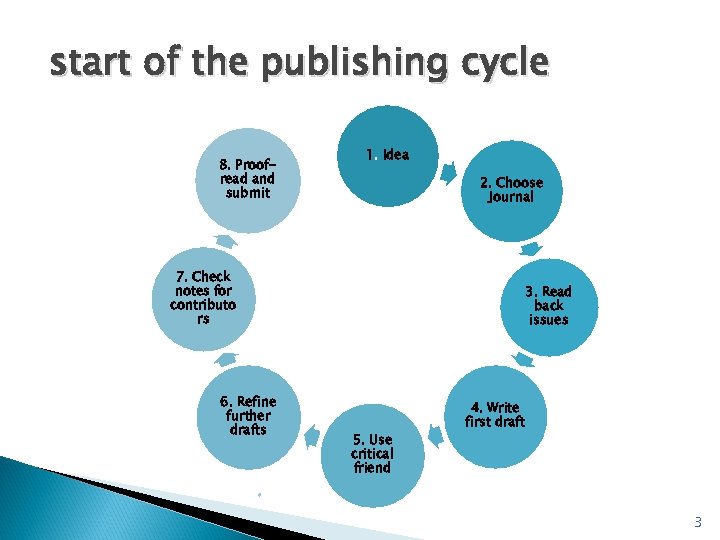
start of the publishing cycle 8. Proofread and submit 1. Idea 2. Choose Journal 7. Check notes for contributo rs 6. Refine further drafts 3. Read back issues 5. Use critical friend 4. Write first draft 3
what is the basis for a good journal article? An interesting topic (to you and others) Originality ◦ Not been researched before in that way (different methods and methodology; different context) ◦ Develops previous work A thesis chapter, dissertation or conference paper that has received good feedback from others What are your ideas? How are they original? 4
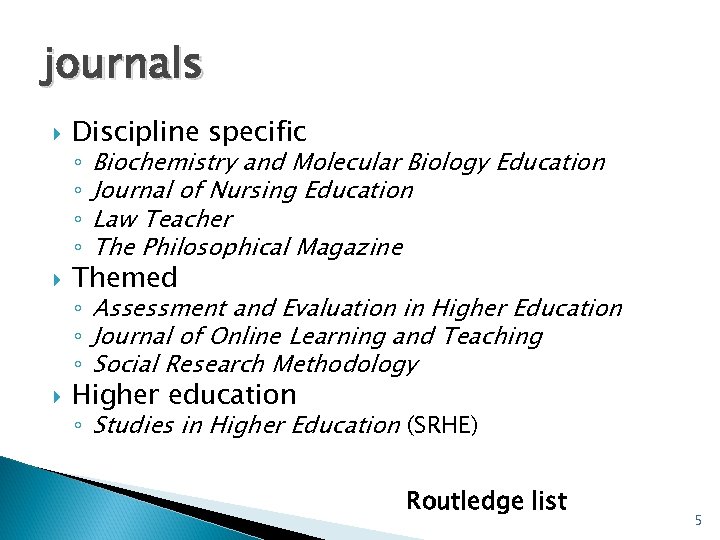
journals Discipline specific ◦ ◦ Biochemistry and Molecular Biology Education Journal of Nursing Education Law Teacher The Philosophical Magazine Themed Higher education ◦ Assessment and Evaluation in Higher Education ◦ Journal of Online Learning and Teaching ◦ Social Research Methodology ◦ Studies in Higher Education (SRHE) Routledge list 5
choosing the right journal Which journals are you familiar with? In what ways are they distinctive? 6
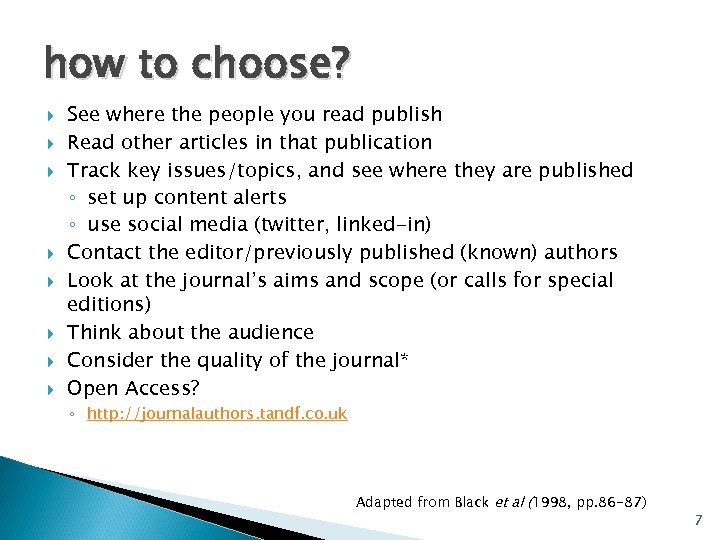
how to choose? See where the people you read publish Read other articles in that publication Track key issues/topics, and see where they are published ◦ set up content alerts ◦ use social media (twitter, linked-in) Contact the editor/previously published (known) authors Look at the journal’s aims and scope (or calls for special editions) Think about the audience Consider the quality of the journal* Open Access? ◦ http: //journalauthors. tandf. co. uk Adapted from Black et al (1998, pp. 86 -87) 7
thinking about different journals and the kinds of articles they carry In pairs, look at different journals. Consider the following questions: ◦ How do the journals’ aims differ? ◦ Do the journals have the same article types (empirical papers, theoretical papers, think pieces, reviews)? ◦ Are there any patterns in the types of articles that are published (quantitative, qualitative, policy-focused? ) ◦ Is there a house style for the different journals? Are there common article structures? ◦ How do these compare to the forms of writing you are more familiar with (research in other disciplines, essays, chapters)? 8
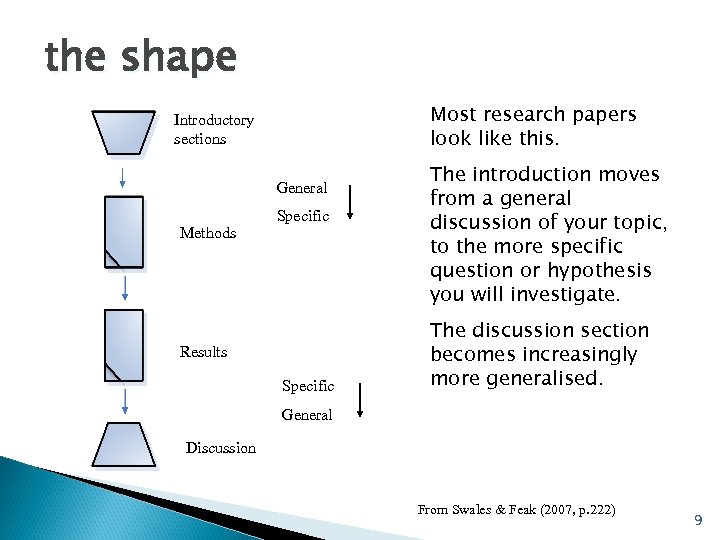
the shape Most research papers look like this. Introductory sections General Methods Specific Results Specific The introduction moves from a general discussion of your topic, to the more specific question or hypothesis you will investigate. The discussion section becomes increasingly more generalised. General Discussion From Swales & Feak (2007, p. 222) 9
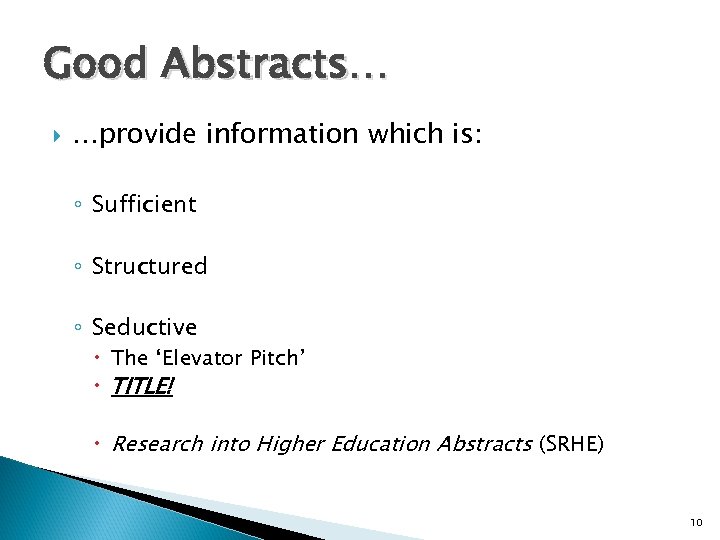
Good Abstracts… …provide information which is: ◦ Sufficient ◦ Structured ◦ Seductive The ‘Elevator Pitch’ TITLE! Research into Higher Education Abstracts (SRHE) 10
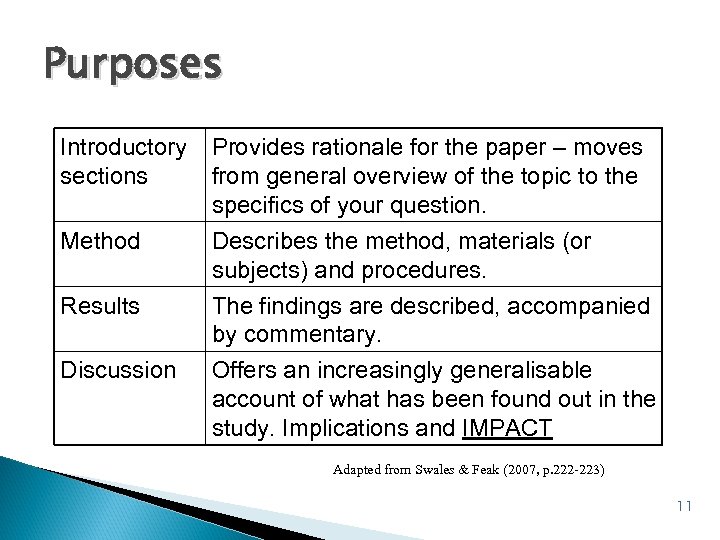
Purposes Introductory sections Method Provides rationale for the paper – moves from general overview of the topic to the specifics of your question. Describes the method, materials (or subjects) and procedures. Results The findings are described, accompanied by commentary. Discussion Offers an increasingly generalisable account of what has been found out in the study. Implications and IMPACT Adapted from Swales & Feak (2007, p. 222 -223) 11
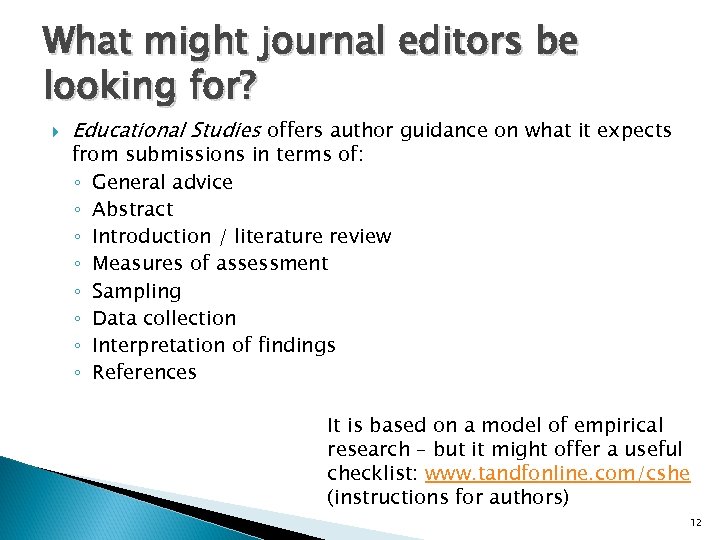
What might journal editors be looking for? Educational Studies offers author guidance on what it expects from submissions in terms of: ◦ General advice ◦ Abstract ◦ Introduction / literature review ◦ Measures of assessment ◦ Sampling ◦ Data collection ◦ Interpretation of findings ◦ References It is based on a model of empirical research – but it might offer a useful checklist: www. tandfonline. com/cshe (instructions for authors) 12
Journal article compared to other piece(s) of writing Focussed background/ literature review stating a claim for the need for the study Concise overview of method/s Findings ◦ Discussion of findings in relation to existing knowledge / research Clear structure to argument Accurately referenced Bound by (often) tight word count 13
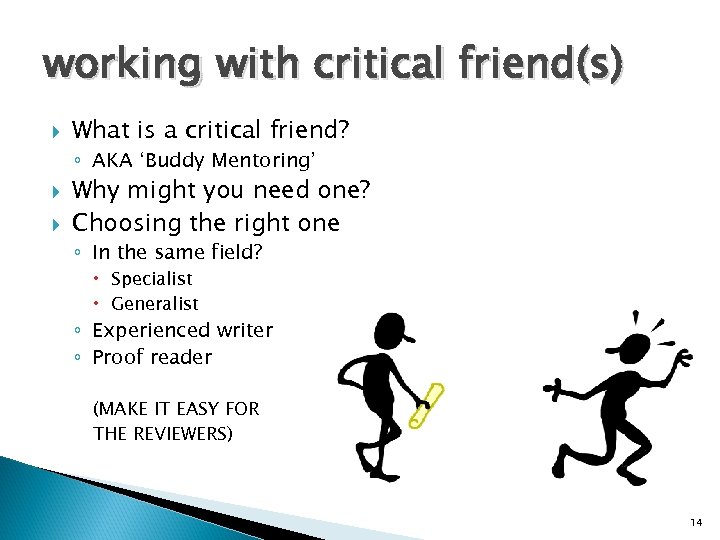
working with critical friend(s) What is a critical friend? ◦ AKA ‘Buddy Mentoring’ Why might you need one? Choosing the right one ◦ In the same field? Specialist Generalist ◦ Experienced writer ◦ Proof reader (MAKE IT EASY FOR THE REVIEWERS) 14
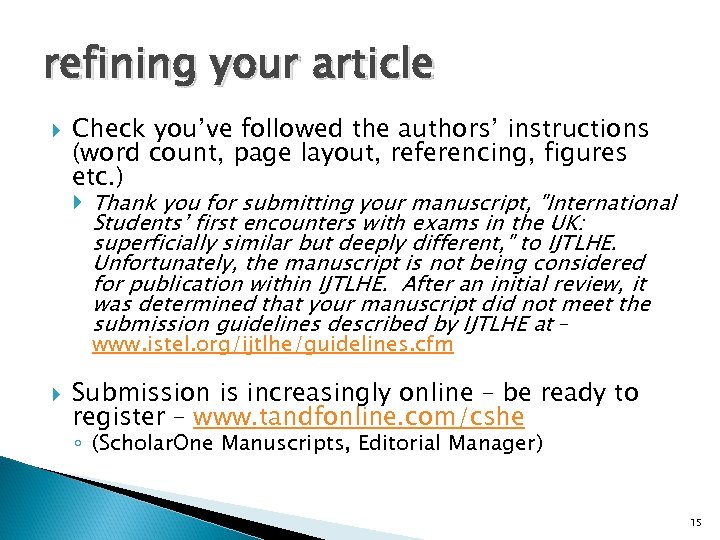
refining your article Check you’ve followed the authors’ instructions (word count, page layout, referencing, figures etc. ) Thank you for submitting your manuscript, "International Students’ first encounters with exams in the UK: superficially similar but deeply different, " to IJTLHE. Unfortunately, the manuscript is not being considered for publication within IJTLHE. After an initial review, it was determined that your manuscript did not meet the submission guidelines described by IJTLHE at – www. istel. org/ijtlhe/guidelines. cfm Submission is increasingly online – be ready to register – www. tandfonline. com/cshe ◦ (Scholar. One Manuscripts, Editorial Manager) 15
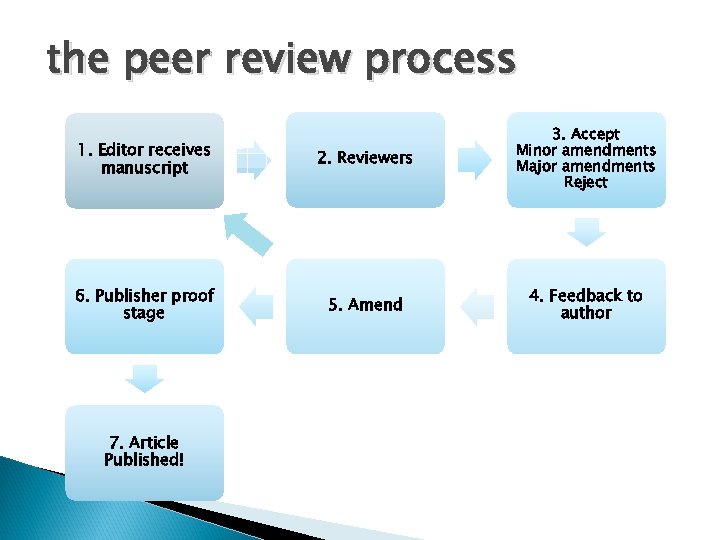
the peer review process 1. Editor receives manuscript 2. Reviewers 3. Accept Minor amendments Major amendments Reject 6. Publisher proof stage 5. Amend 4. Feedback to author 7. Article Published! 16
feedback. . . what to expect Acceptance ◦ 98% not immediately accepted/2% accepted on receipt ◦ Acceptance/Rejection Rates (SSH vs STM) Rejection ◦ Reasons for Revision ◦ Reviewer’s mediated response(s) detail ◦ Major, minor amendments 17
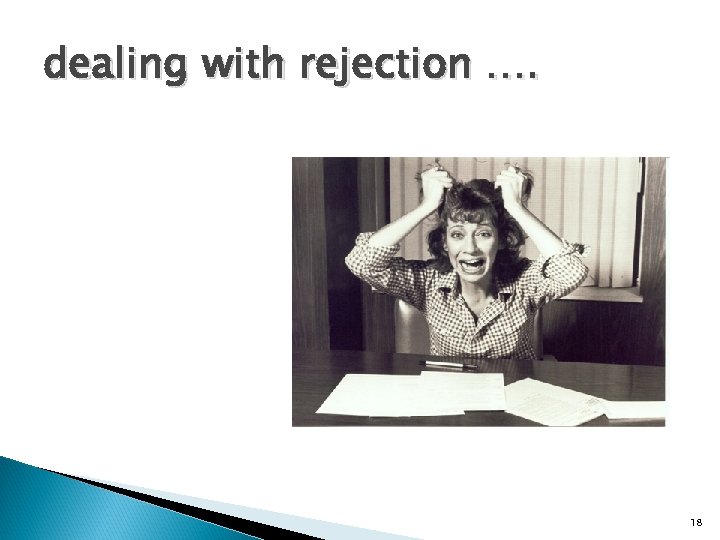
dealing with rejection …. 18
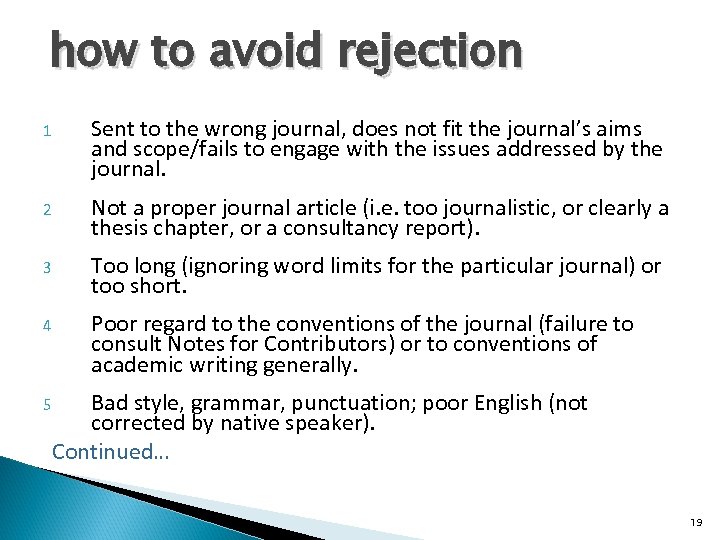
how to avoid rejection 1 Sent to the wrong journal, does not fit the journal’s aims and scope/fails to engage with the issues addressed by the journal. 2 Not a proper journal article (i. e. too journalistic, or clearly a thesis chapter, or a consultancy report). 3 Too long (ignoring word limits for the particular journal) or too short. 4 Poor regard to the conventions of the journal (failure to consult Notes for Contributors) or to conventions of academic writing generally. 5 Bad style, grammar, punctuation; poor English (not corrected by native speaker). Continued… 19
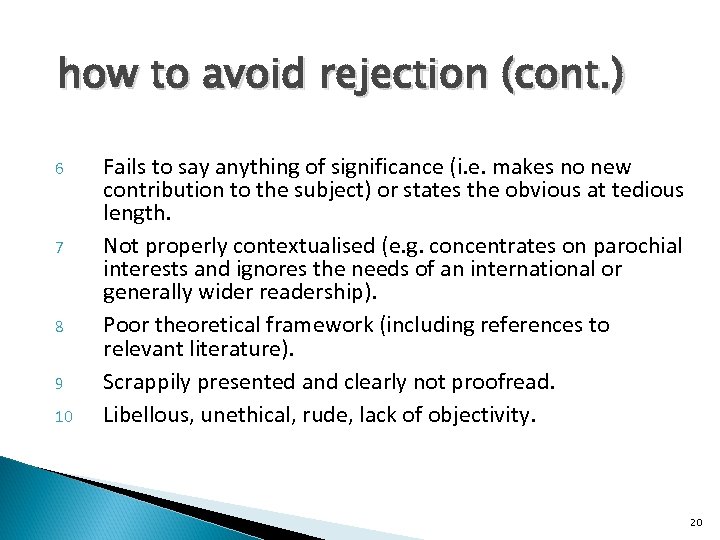
how to avoid rejection (cont. ) 6 7 8 9 10 Fails to say anything of significance (i. e. makes no new contribution to the subject) or states the obvious at tedious length. Not properly contextualised (e. g. concentrates on parochial interests and ignores the needs of an international or generally wider readership). Poor theoretical framework (including references to relevant literature). Scrappily presented and clearly not proofread. Libellous, unethical, rude, lack of objectivity. 20
referees’ comments Accept feedback with good grace Revise as requested If you can’t – admit it, and explain why Turn the paper round on time Thank the referees for their time Adapted from Black et al (1998, pp. 98 -99) 21
preparing your response Be specific Exemplify e. g. author’s response to Reviewers’ comments Defend your position ◦ (be assertive and persuasive, not defensive, aggressive) Re-submit within the given timeframe n. b. version control 22
post-acceptance Article Proofs Fast turn-round Publication ◦ Online ◦ (within weeks of acceptance) ◦ Print ◦ Licensing/Author Rights ◦ retention, transfer? ◦ Creative Commons (Open Access) Promotion ◦ Publisher “E-prints” ◦ What can you do? 23
self-promotion Acknowledge/Thank those who have helped Reading lists Departmental web pages or personal website Social and academic networking ◦ Twitter, facebook, Linkedin, My. Net. Research, Academici, Cite. ULike, Conferences Discussion lists Blogs Library recommendations E-Prints Email signature 24
help for prospective authors We have an Author Services website http: //journalauthors. tandf. co. uk/ The site contains audio interviews with academic editors providing advice on how to get published and how to write a research paper. Guidance is also available on: writing an article, editing or language polishing, translating, checking references, artwork, providing supplementary data, how to choose a journal; systems and interfaces (Scholar. One Manuscripts, CATS, Rightslink); the review process and what to expect; the production process and checking proofs; post-publication, errata, reprints, optimising citations; Licensing article versions and institutional repositories: what authors can and can’t do with their articles. Our Authors’ Newsletter is freely available online. 25
where will you go from here? 26
references Black, D. ; Brown, S. ; Day, A. ; & Race, P. (1998) 500 Tips for Getting Published, London: Kogan Page Swales, J. M & Feak, C. B. (2007) Academic Writing for Graduate Students, Michigan: The University of Michigan Press Why do academics blog? An analysis of audiences, purposes and challenges, Studies in Higher Education, 2013, DOI: 10. 1080. 03075079. 2013. 835624 27
Скачать презентацию Publishing Academic Articles a way through the maze
0f32818e3d6812e9c7b47cd2eb2c74a6.ppt