 Скачать презентацию Publishers Future Speculations and Counterspeculations Profit Nonprofit Learned Society University Commercial
ff9178c514fe8baa18ebba916a16e2cb.ppt
- Количество слайдов: 28



Publishers Future: Speculations and Counterspeculations Profit/Nonprofit Learned Society/University/Commercial
Learned Society Functions (“Good Works”) • • Meetings Scholarships Lobbying Publications
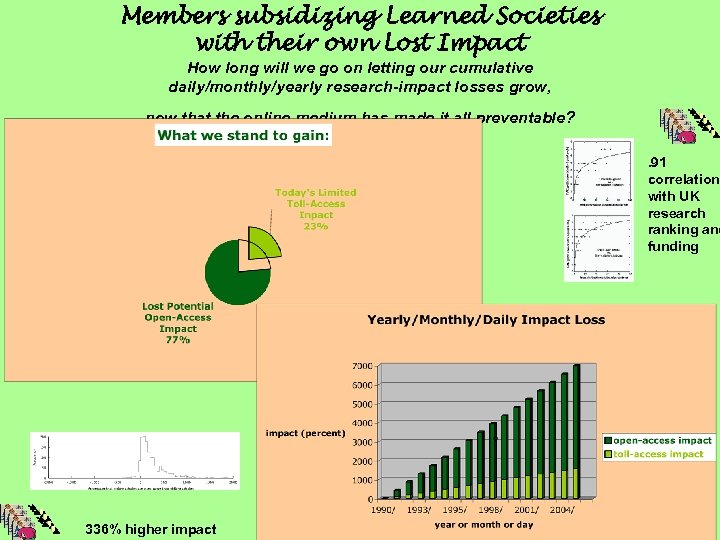
Members subsidizing Learned Societies with their own Lost Impact How long will we go on letting our cumulative daily/monthly/yearly research-impact losses grow, now that the online medium has made it all preventable? . 91 correlation with UK research ranking and funding 336% higher impact
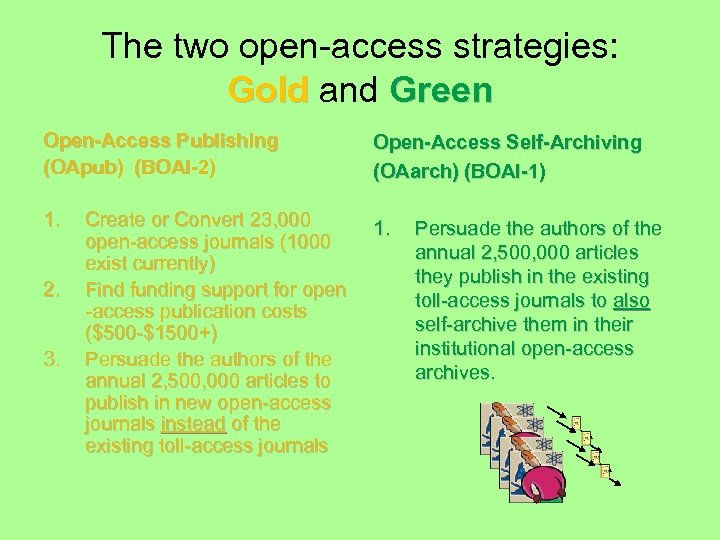
The two open-access strategies: Gold and Green Open-Access Publishing (OApub) (BOAI-2) Open-Access Self-Archiving (OAarch) (BOAI-1) 1. 2. 3. Create or Convert 23, 000 open-access journals (1000 exist currently) Find funding support for open -access publication costs ($500 -$1500+) Persuade the authors of the annual 2, 500, 000 articles to publish in new open-access journals instead of the existing toll-access journals Persuade the authors of the annual 2, 500, 000 articles they publish in the existing toll-access journals to also self-archive them in their institutional open-access archives.
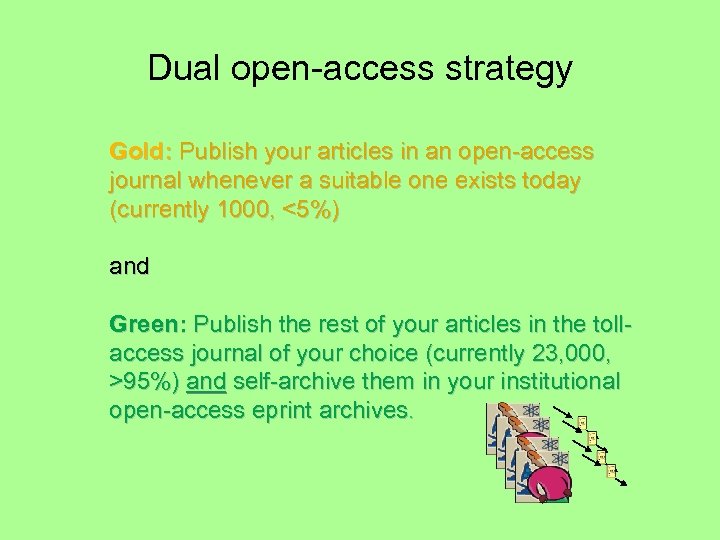
Dual open-access strategy Gold: Publish your articles in an open-access journal whenever a suitable one exists today (currently 1000, <5%) and Green: Publish the rest of your articles in the tollaccess journal of your choice (currently 23, 000, >95%) and self-archive them in your institutional open-access eprint archives.
Universal Access Through Affordable Licensing? Open access through author/institution self-archiving is a parallel self-help measure for researchers, to prevent further impact-loss now. Open access is a supplement to toll-access, but not necessarily a substitute for it. One possible outcome is that the toll access and open access versions will peacefully co-exist in perpetuity, with all researchers using the toll-access versions of the research their own institutions can afford and the openaccess versions of the rest. The more affordable the toll-access licenses, the less researchers will need to use the open-access versions. Even if the growth of the open-access versions is destined eventually to reduce the demand for the toll-access versions, that is a long way off, because selfarchiving proceeds gradually and anarchically, and journals cannot be cancelled while only random parts of their contents are openly accessible. If and when open accessibility does reduce the demand for the toll-access versions, this will at the same time be creating windfall savings for institutions on their periodical budgets -- savings which will then be available to institutions to pay for peer-review service provision up-front to those journals that are ready to convert to becoming open-access journals.
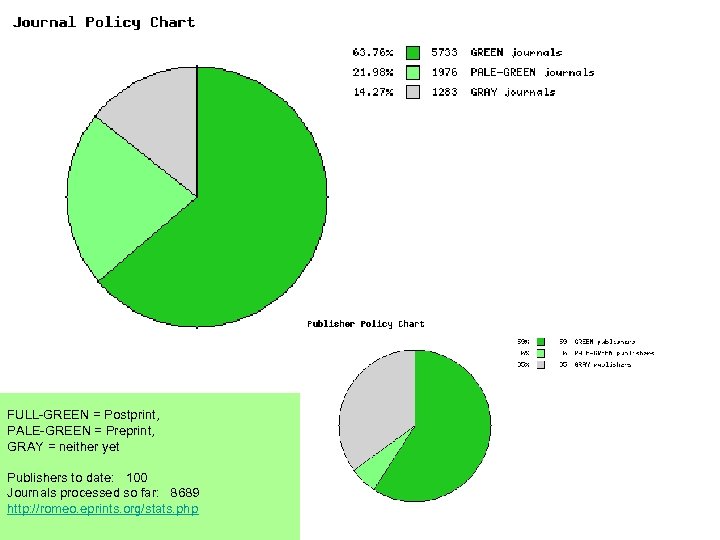
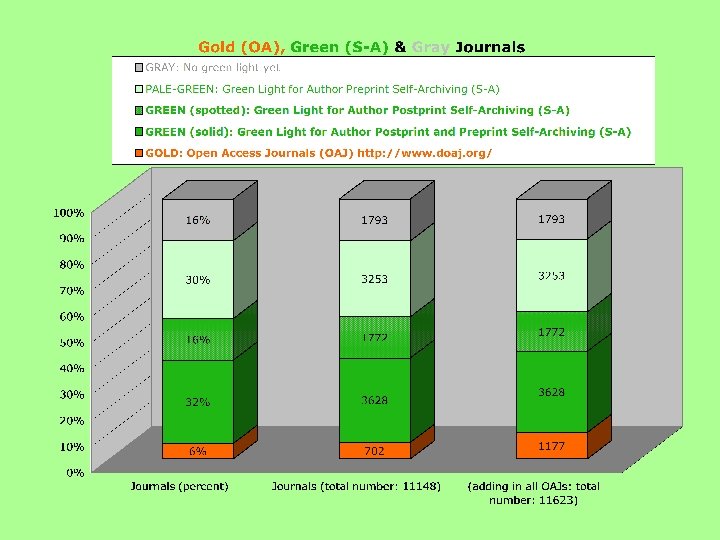
Current Journal Tally: 86% Green! FULL-GREEN = Postprint, PALE-GREEN = Preprint, GRAY = neither yet Publishers to date: 100 Journals processed so far: 8689 http: //romeo. eprints. org/stats. php
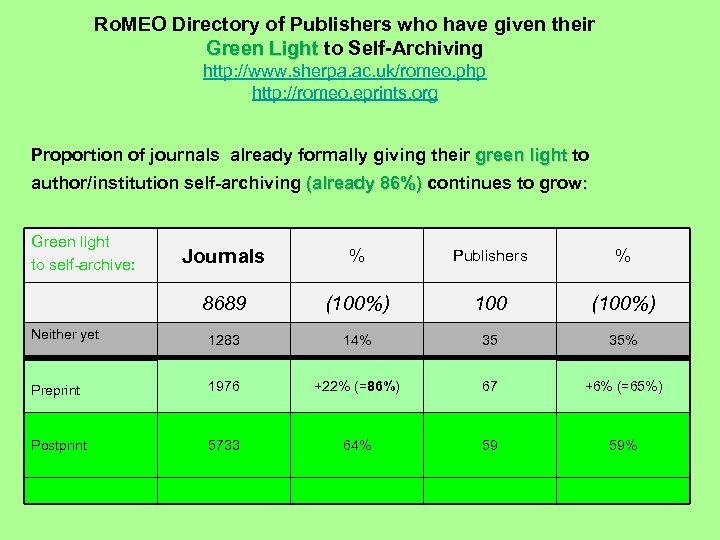
Ro. MEO Directory of Publishers who have given their Green Light to Self-Archiving http: //www. sherpa. ac. uk/romeo. php http: //romeo. eprints. org Proportion of journals already formally giving their green light to author/institution self-archiving (already 86%) continues to grow: Green light to self-archive: Journals % Publishers % 8689 (100%) 100 (100%) Neither yet 1283 14% 35 35% Preprint 1976 +22% (=86%) 67 +6% (=65%) Postprint 5733 64% 59 59%
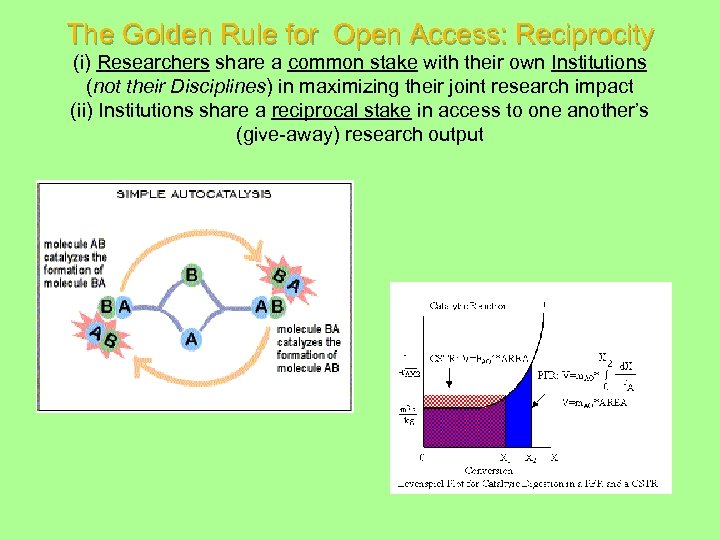
The Golden Rule for Open Access: Reciprocity (i) Researchers share a common stake with their own Institutions (not their Disciplines) in maximizing their joint research impact (ii) Institutions share a reciprocal stake in access to one another’s (give-away) research output

“Self-archive unto others as ye would have them self-archive unto you. ” http: //www. ecs. soton. ac. uk/~harnad/Temp/unto-others. doc http: //www. ecs. soton. ac. uk/~harnad/Temp/self-archiving. ppt
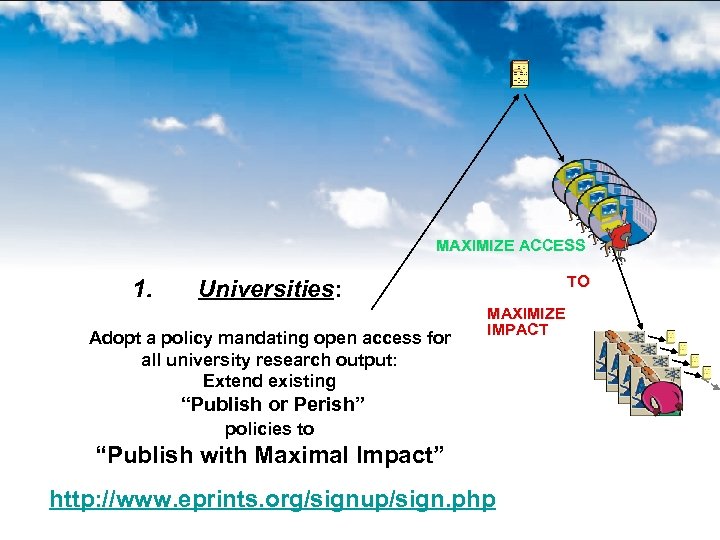
MAXIMIZE ACCESS 1. TO Universities: Adopt a policy mandating open access for all university research output: Extend existing MAXIMIZE IMPACT “Publish or Perish” policies to “Publish with Maximal Impact” http: //www. eprints. org/signup/sign. php
2. Departments: Adopt a departmental policy mandating Open Access for All Research Output Create (and Fill): OAI-compliant Eprint Archives http: //software. eprints. org/handbook/departments. php
3. University Libraries: Provide digital library support for university research self-archiving and archive-maintenance (and if/when university toll-cancellation savings begin to grow, prepare to redirect 1/3 of annual windfall savings to cover open-access journal peer-review service-costs for university research output) http: //www. eprints. org/self-faq/#libraries-do
4. Universities and Research Institutions: Mandate open access for all research output. http: //www. eprints. org/signup/sign. php Adopt a standardized online-CV with harvestable performance indicators and links to open-access full-texts (template and demo below) http: //paracite. eprints. org/cgi-bin/rae_front. cgi
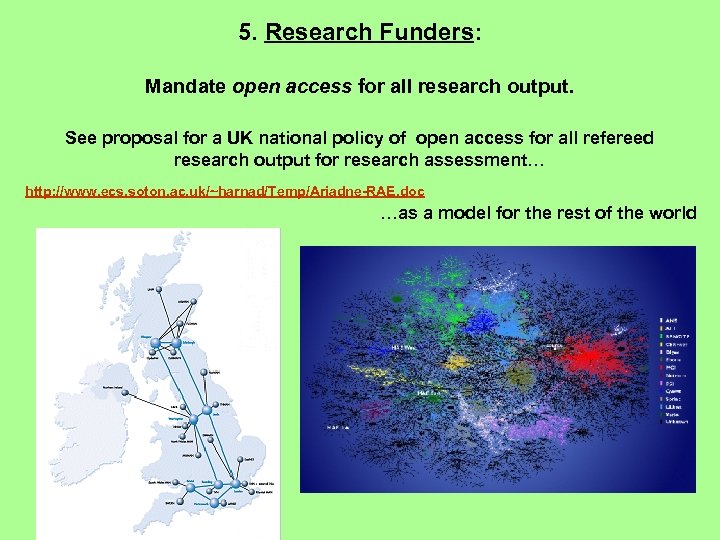
5. Research Funders: Mandate open access for all research output. See proposal for a UK national policy of open access for all refereed research output for research assessment… http: //www. ecs. soton. ac. uk/~harnad/Temp/Ariadne-RAE. doc …as a model for the rest of the world
What is needed for open access now: 1. Universities: Adopt a university-wide policy of making all university 2. Departments: Create and fill departmental OAI-compliant open-access 3. University Libraries: Provide digital library support for research self- 4. Promotion Committees: Require a standardized online CV from all 5. Research Funders: Mandate open access for all funded research (via 6. Publishers: Become either gold or green research output open access (via either the gold or green strategy) archives archiving and open-access archive-maintenance. Redirect 1/3 of any eventual toll-savings to cover open-access journal peer-review service charges candidates, with refereed publications all linked to their full-texts in the open -access journal archives and/or departmental open-access archives either the gold or green strategy). Fund (fixed, fair) open-access journal peer -review service charges. Assess research and researcher impact online (from the online CVs).
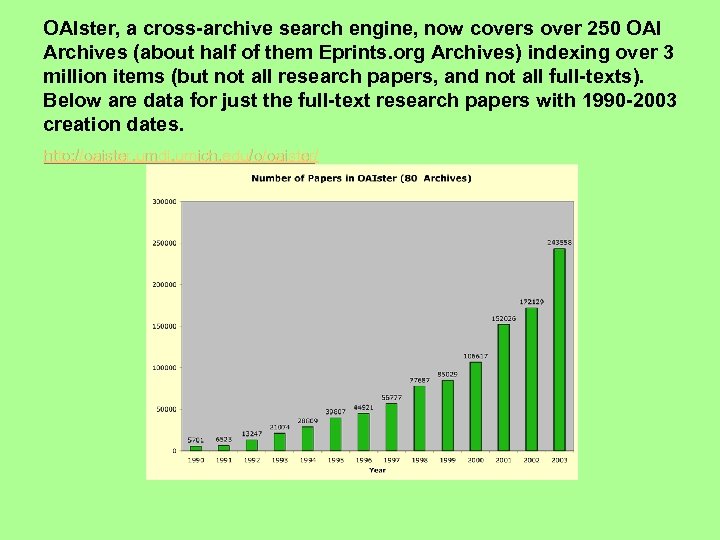
OAIster, a cross-archive search engine, now covers over 250 OAI Archives (about half of them Eprints. org Archives) indexing over 3 million items (but not all research papers, and not all full-texts). Below are data for just the full-text research papers with 1990 -2003 creation dates. http: //oaister. umdl. umich. edu/o/oaister/ http: //oaister. umdl. umich. edu/o/oaister
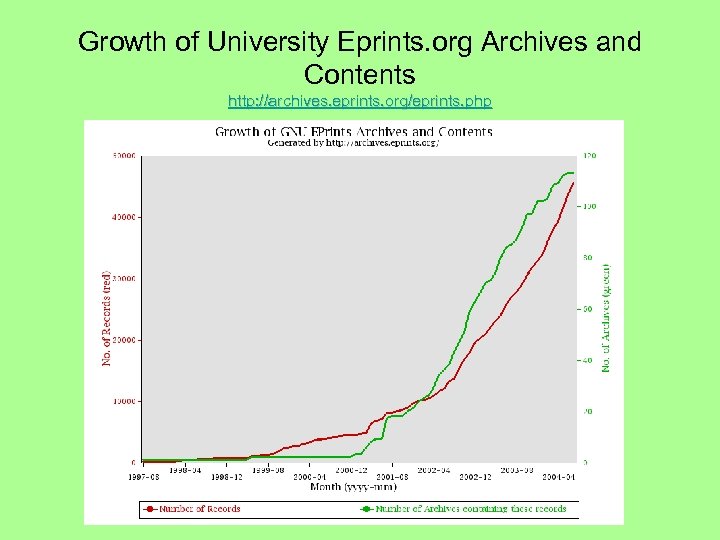
Growth of University Eprints. org Archives and Contents http: //archives. eprints. org/eprints. php
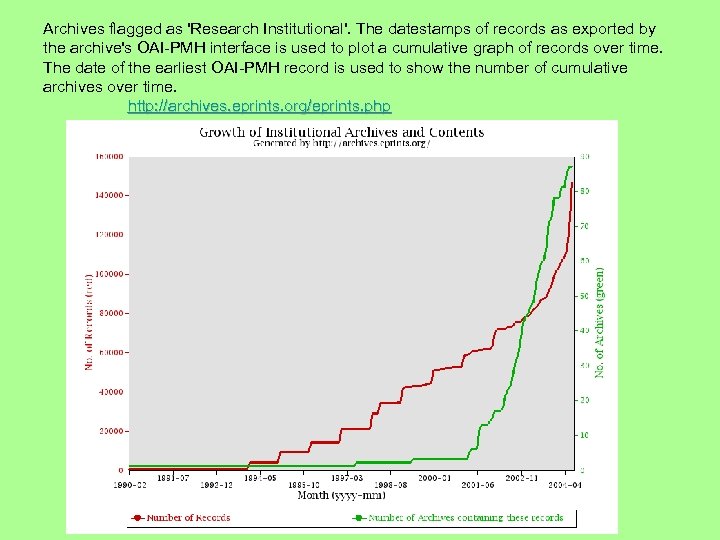
Archives flagged as 'Research Institutional'. The datestamps of records as exported by the archive's OAI-PMH interface is used to plot a cumulative graph of records over time. The date of the earliest OAI-PMH record is used to show the number of cumulative archives over time. http: //archives. eprints. org/eprints. php
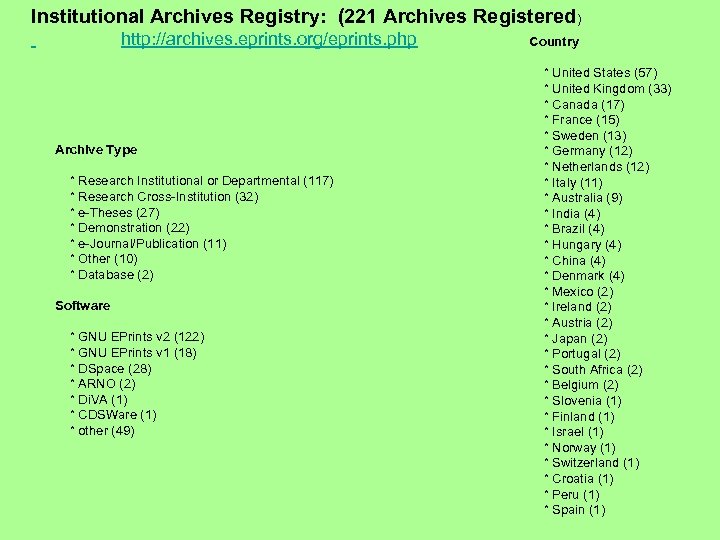
Institutional Archives Registry: (221 Archives Registered) http: //archives. eprints. org/eprints. php Archive Type * Research Institutional or Departmental (117) * Research Cross-Institution (32) * e-Theses (27) * Demonstration (22) * e-Journal/Publication (11) * Other (10) * Database (2) Software * GNU EPrints v 2 (122) * GNU EPrints v 1 (18) * DSpace (28) * ARNO (2) * Di. VA (1) * CDSWare (1) * other (49) Country * United States (57) * United Kingdom (33) * Canada (17) * France (15) * Sweden (13) * Germany (12) * Netherlands (12) * Italy (11) * Australia (9) * India (4) * Brazil (4) * Hungary (4) * China (4) * Denmark (4) * Mexico (2) * Ireland (2) * Austria (2) * Japan (2) * Portugal (2) * South Africa (2) * Belgium (2) * Slovenia (1) * Finland (1) * Israel (1) * Norway (1) * Switzerland (1) * Croatia (1) * Peru (1) * Spain (1)
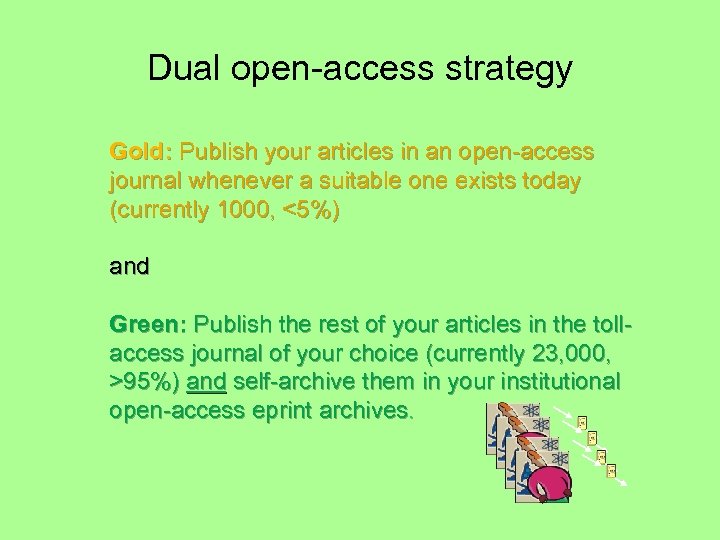
Dual open-access strategy Gold: Publish your articles in an open-access journal whenever a suitable one exists today (currently 1000, <5%) and Green: Publish the rest of your articles in the tollaccess journal of your choice (currently 23, 000, >95%) and self-archive them in your institutional open-access eprint archives.
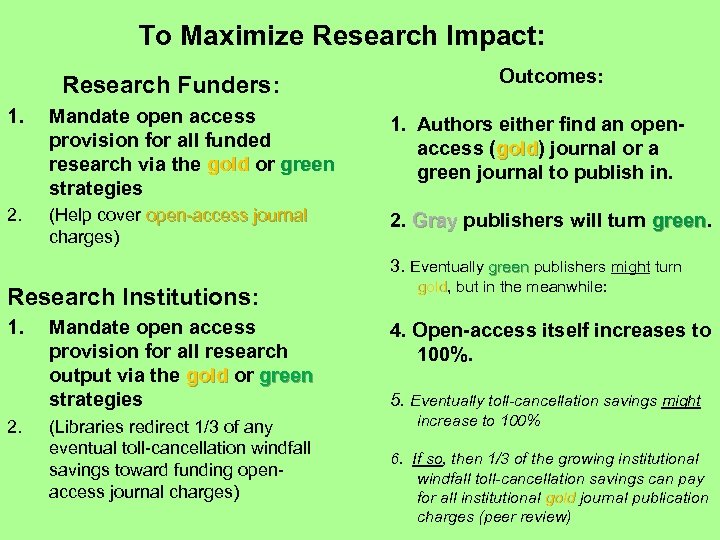
To Maximize Research Impact: Research Funders: Outcomes: 1. Mandate open access provision for all funded research via the gold or green strategies 1. Authors either find an openaccess (gold) journal or a gold green journal to publish in. 2. (Help cover open-access journal charges) 2. Gray publishers will turn green 3. Eventually green publishers might turn Research Institutions: 1. 2. Mandate open access provision for all research output via the gold or green strategies (Libraries redirect 1/3 of any eventual toll-cancellation windfall savings toward funding openaccess journal charges) gold, but in the meanwhile: gold 4. Open-access itself increases to 100%. 5. Eventually toll-cancellation savings might increase to 100% 6. If so, then 1/3 of the growing institutional windfall toll-cancellation savings can pay for all institutional gold journal publication charges (peer review)
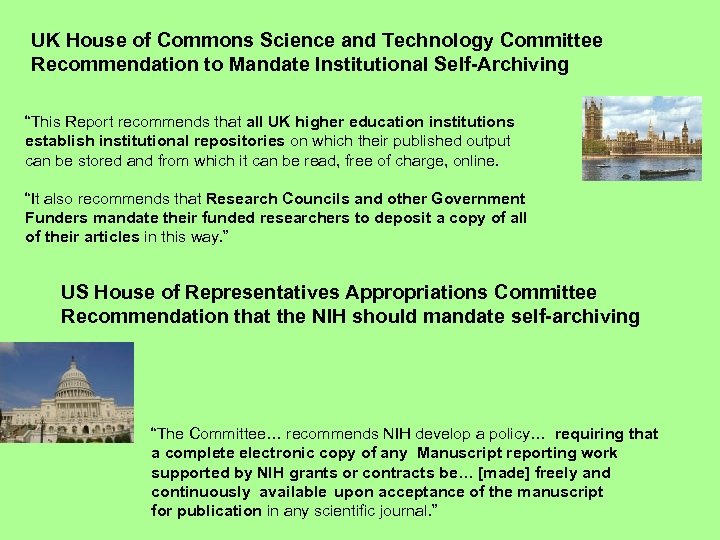
UK House of Commons Science and Technology Committee Recommendation to Mandate Institutional Self-Archiving “This Report recommends that all UK higher education institutions establish institutional repositories on which their published output can be stored and from which it can be read, free of charge, online. “It also recommends that Research Councils and other Government Funders mandate their funded researchers to deposit a copy of all of their articles in this way. ” US House of Representatives Appropriations Committee Recommendation that the NIH should mandate self-archiving “The Committee… recommends NIH develop a policy… requiring that a complete electronic copy of any Manuscript reporting work supported by NIH grants or contracts be… [made] freely and continuously available upon acceptance of the manuscript for publication in any scientific journal. ”
Declaration of Institutional Commitment to implementing the Berlin Declaration on open-access provision Our institution hereby commits itself to adopting and implementing an official institutional policy of providing open access to our own peer-reviewed research output -- i. e. , toll-free, full-text online access, for all would-be users webwide -- in accordance with the Budapest Open Access Initiative and the Berlin Declaration UNIFIED OPEN-ACCESS PROVISION POLICY: (OAJ) Researchers publish their research in an open-access journal if a suitable one exists otherwise (OAA) Researchers publish their research in a suitable toll-access journal and also self-archive it in their own research institution's open-access researchive. To sign: http: //www. eprints. org/signup/sign. php A JISC survey (Swan & Brown 2004) "asked authors to say how they would feel if their employer or funding body required them to deposit copies of their published articles in one or more… repositories. The vast majority. . . said they would do so willingly. ” http: //www. jisc. ac. uk/uploaded_documents/JISCOAreport 1. pdf
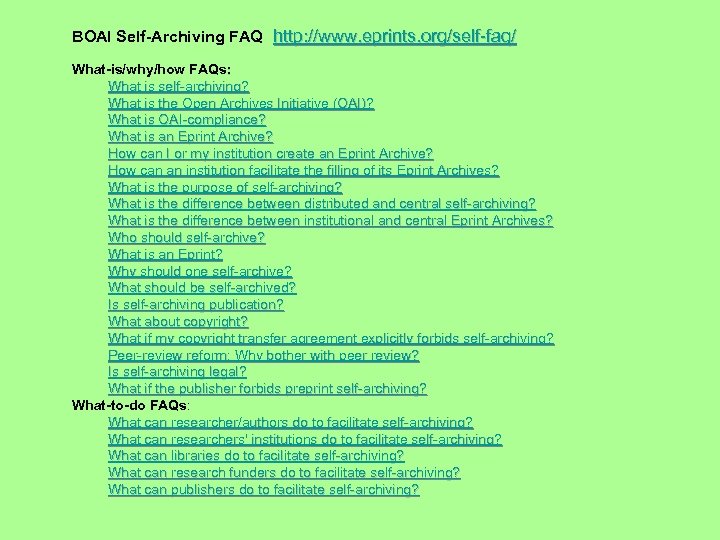
BOAI Self-Archiving FAQ http: //www. eprints. org/self-faq/ What-is/why/how FAQs: What is self-archiving? What is the Open Archives Initiative (OAI)? What is OAI-compliance? What is an Eprint Archive? How can I or my institution create an Eprint Archive? How can an institution facilitate the filling of its Eprint Archives? What is the purpose of self-archiving? What is the difference between distributed and central self-archiving? What is the difference between institutional and central Eprint Archives? Who should self-archive? What is an Eprint? Why should one self-archive? What should be self-archived? Is self-archiving publication? What about copyright? What if my copyright transfer agreement explicitly forbids self-archiving? Peer-review reform: Why bother with peer review? Is self-archiving legal? What if the publisher forbids preprint self-archiving? What-to-do FAQs: What can researcher/authors do to facilitate self-archiving? What can researchers' institutions do to facilitate self-archiving? What can libraries do to facilitate self-archiving? What can research funders do to facilitate self-archiving? What can publishers do to facilitate self-archiving?
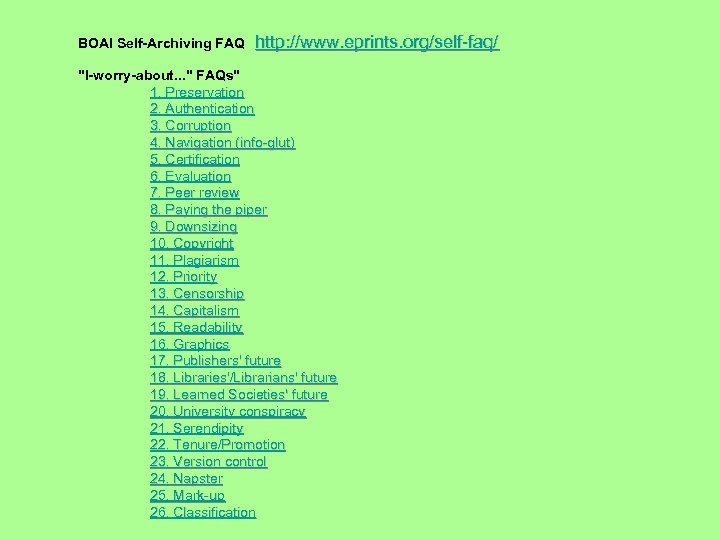
BOAI Self-Archiving FAQ http: //www. eprints. org/self-faq/ "I-worry-about. . . " FAQs" 1. Preservation 2. Authentication 3. Corruption 4. Navigation (info-glut) 5. Certification 6. Evaluation 7. Peer review 8. Paying the piper 9. Downsizing 10. Copyright 11. Plagiarism 12. Priority 13. Censorship 14. Capitalism 15. Readability 16. Graphics 17. Publishers' future 18. Libraries'/Librarians' future 19. Learned Societies' future 20. University conspiracy 21. Serendipity 22. Tenure/Promotion 23. Version control 24. Napster 25. Mark-up 26. Classification
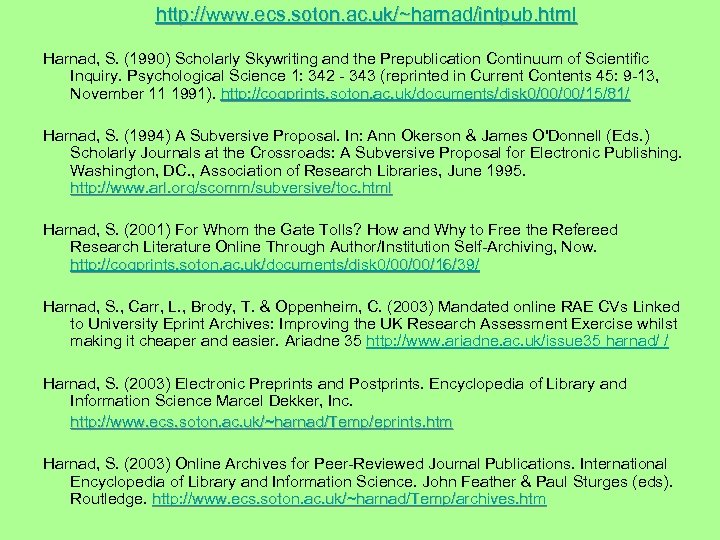
http: //www. ecs. soton. ac. uk/~harnad/intpub. html Harnad, S. (1990) Scholarly Skywriting and the Prepublication Continuum of Scientific Inquiry. Psychological Science 1: 342 - 343 (reprinted in Current Contents 45: 9 -13, November 11 1991). http: //cogprints. soton. ac. uk/documents/disk 0/00/00/15/81/ Harnad, S. (1994) A Subversive Proposal. In: Ann Okerson & James O'Donnell (Eds. ) Scholarly Journals at the Crossroads: A Subversive Proposal for Electronic Publishing. Washington, DC. , Association of Research Libraries, June 1995. http: //www. arl. org/scomm/subversive/toc. html Harnad, S. (2001) For Whom the Gate Tolls? How and Why to Free the Refereed Research Literature Online Through Author/Institution Self-Archiving, Now. http: //cogprints. soton. ac. uk/documents/disk 0/00/00/16/39/ Harnad, S. , Carr, L. , Brody, T. & Oppenheim, C. (2003) Mandated online RAE CVs Linked to University Eprint Archives: Improving the UK Research Assessment Exercise whilst making it cheaper and easier. Ariadne 35 http: //www. ariadne. ac. uk/issue 35 harnad/ / Harnad, S. (2003) Electronic Preprints and Postprints. Encyclopedia of Library and Information Science Marcel Dekker, Inc. http: //www. ecs. soton. ac. uk/~harnad/Temp/eprints. htm Harnad, S. (2003) Online Archives for Peer-Reviewed Journal Publications. International Encyclopedia of Library and Information Science. John Feather & Paul Sturges (eds). Routledge. http: //www. ecs. soton. ac. uk/~harnad/Temp/archives. htm
Скачать презентацию Publishers Future Speculations and Counterspeculations Profit Nonprofit Learned Society University Commercial
ff9178c514fe8baa18ebba916a16e2cb.ppt