 Скачать презентацию Public Symposium on Air Quality Management Policy in
6ef091fde339997a0af228bc3f88ff36.ppt
- Количество слайдов: 32



Public Symposium on Air Quality Management Policy in Metropolitan Areas Seoul, Korea - December 20, 2004 California Air Resources Board Sacramento California

Thank you for inviting me to the symposium.
Topics to Discuss F About ARB F Regulatory development disputes F LEV/ZEV program F Reducing in-use gasoline vehicle emissions F Reducing diesel vehicle emissions F Impacts of regulations
Topics to Discuss F About F F F ARB Regulatory development disputes LEV/ZEV program Reducing in-use gasoline vehicle emissions Reducing diesel vehicle emissions Impacts of regulations
About ARB Air Quality Agency Relationships F F F U. S. EPA (Federal) – Sets deadlines for clean air, e. g. Clean Air Act – Oversight of state programs – Control mobile sources nationally ARB (State) – Lead air agency in California – Control emissions from mobile sources, fuels, and consumer products Air Districts (County) – Control industrial sources – Implement programs at local level
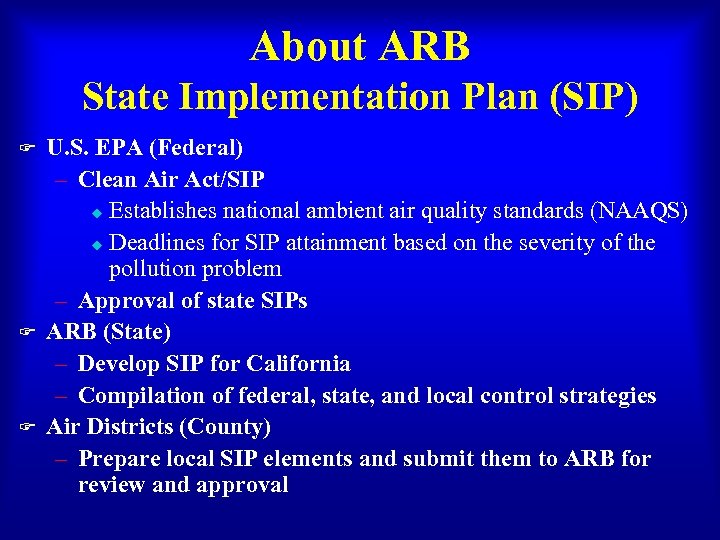
About ARB State Implementation Plan (SIP) F F F U. S. EPA (Federal) – Clean Air Act/SIP u Establishes national ambient air quality standards (NAAQS) u Deadlines for SIP attainment based on the severity of the pollution problem – Approval of state SIPs ARB (State) – Develop SIP for California – Compilation of federal, state, and local control strategies Air Districts (County) – Prepare local SIP elements and submit them to ARB for review and approval
About ARB Primary Legal Mandates F Ensure continuous progress toward attaining health-based air quality standards F Reduce public exposure to toxic air contaminants
Topics to Discuss About ARB F Regulatory development disputes F LEV/ZEV program F Reducing in-use gasoline vehicle emissions F Reducing diesel vehicle emissions F Impacts of regulations F
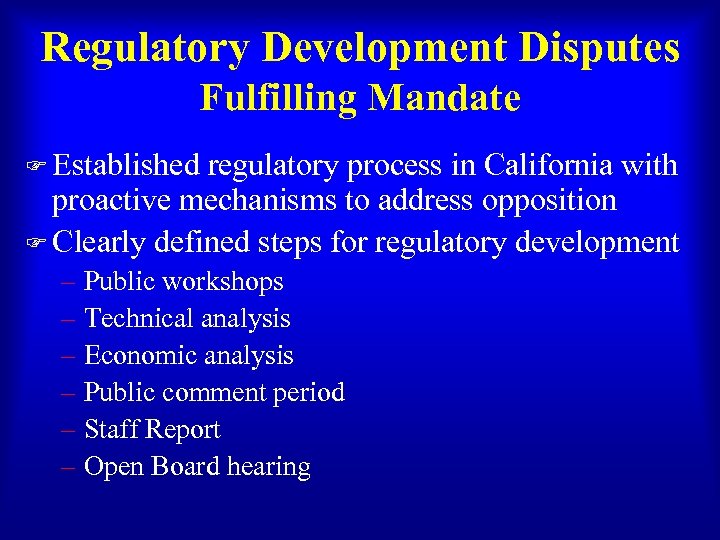
Regulatory Development Disputes Fulfilling Mandate F Established regulatory process in California with proactive mechanisms to address opposition F Clearly defined steps for regulatory development – Public workshops – Technical analysis – Economic analysis – Public comment period – Staff Report – Open Board hearing
Regulatory Development Disputes Stakeholder Involvement F Identification and involvement of affected parties at the earliest possible point in the regulatory process F Understanding of industry operations F Environmental groups and other regulatory agencies included F Special consideration to small businesses F Seek buy-in of all parties
Regulatory Development Disputes Scientific Understanding F Problems identified through research, monitoring, surveys, and modeling F Solutions – Available and emerging technologies – Economically and technologically feasible F Consequences of no action – Costs increase with inaction – Impact on living standard – Drastic measures may become necessary
Topics to Discuss About ARB F Regulatory development disputes F LEV/ZEV program F Reducing in-use gasoline vehicle emissions F Reducing diesel vehicle emissions F Impacts of regulations F
LEV/ZEV Program Goals F Goal is near-zero and zero emissions F LEV/ZEV provides a mix of technologies – Very clean ULEV 2 – Near-zero emission PZEVs – Advanced technology PZEVs (e. g. hybrids) – ZEVs (e. g. fuel cells) F Lifetime emissions PZEV = 4 kg – Cars with no controls = 2000 kg
LEV/ZEV Program Status F First PZEVs sold in 2003 – 200, 000 sales this year (2004) – Regulation: ~40% of sales by next decade F Advanced technology PZEVs – Many AT-PZEV models being introduced – Regulation: ~10% of sales by 2015 F ZEVs – Small number of fuel cells required u Pre-commercialization through 2012 – Infrastructure e. g. H 2 Highway; Fuel Cell Partnership
Topics to Discuss About ARB F Regulatory development disputes F LEV/ZEV program F Reducing in-use gasoline vehicle emissions F Reducing diesel vehicle emissions F Impacts of regulations F
Reducing Gasoline In-use Vehicle Emissions: Smog Check F Inspections every 2 years F Dynamometer test (for NOx) F Evaporative system check (pressure) F Newer cars exempt (4 years and newer) F Inspection ~$45; Repair averages $145 F Strong enforcement needed to reduce fraud – Inspections done in private garages F Large, cost effective emission reductions
Reducing Gasoline In-use Vehicle Emissions: Scrap F Voluntary F Limited scale so far – Scrapped 55, 000 vehicles since 2000 – Replacement cars average 8 years newer F Pay $500 -1000 per vehicle – No reuse of engine or emission parts F Cost effective
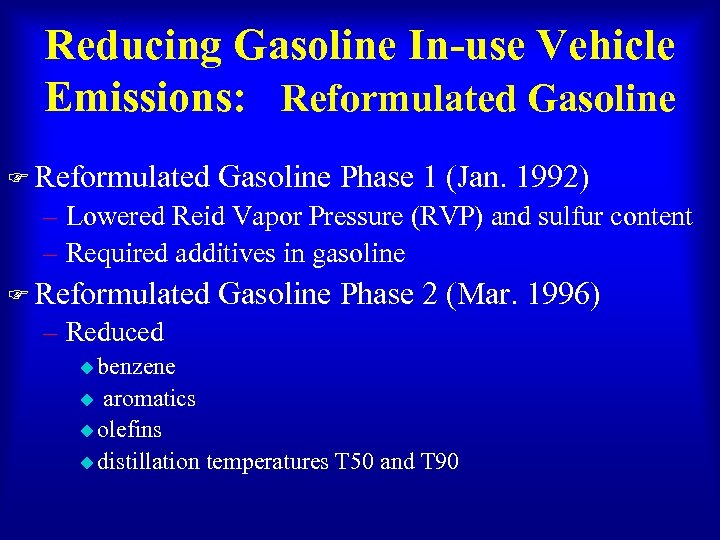
Reducing Gasoline In-use Vehicle Emissions: Reformulated Gasoline F Reformulated Gasoline Phase 1 (Jan. 1992) – Lowered Reid Vapor Pressure (RVP) and sulfur content – Required additives in gasoline F Reformulated Gasoline Phase 2 (Mar. 1996) – Reduced u benzene aromatics u olefins u distillation temperatures T 50 and T 90 u
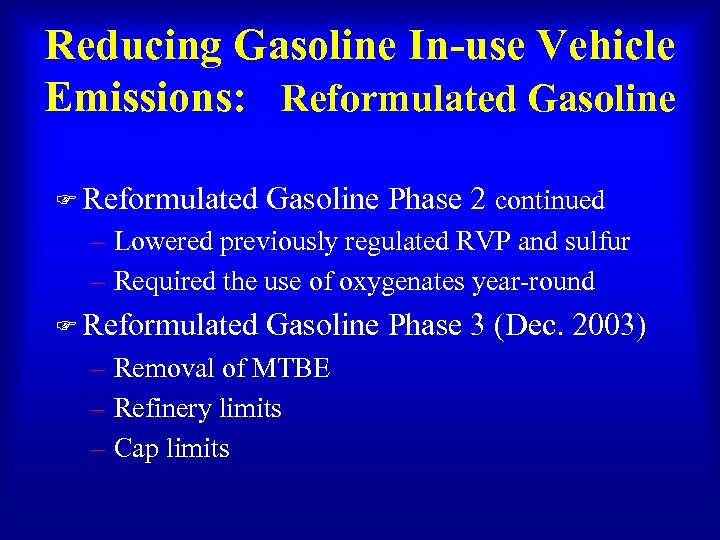
Reducing Gasoline In-use Vehicle Emissions: Reformulated Gasoline F Reformulated Gasoline Phase 2 continued – Lowered previously regulated RVP and sulfur – Required the use of oxygenates year-round F Reformulated Gasoline Phase 3 (Dec. 2003) – Removal of MTBE – Refinery limits – Cap limits
Topics to Discuss About ARB F Regulatory development disputes F LEV/ZEV program F Reducing in-use gasoline vehicle emissions F Reducing diesel vehicle emissions F Impacts of regulations F
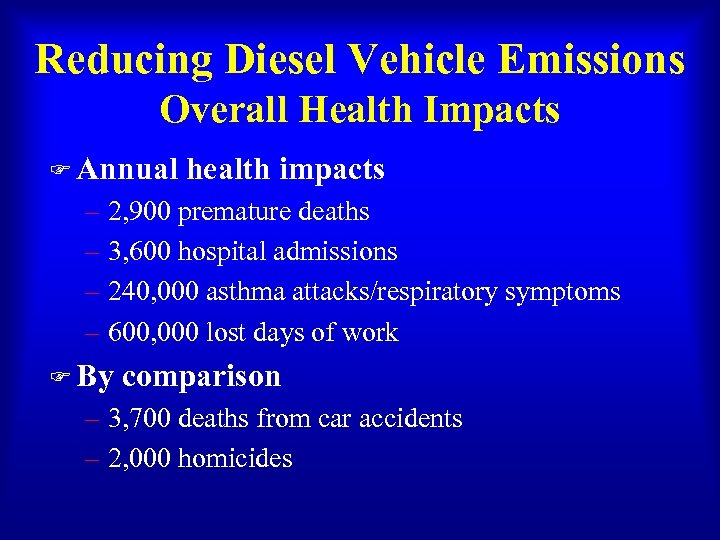
Reducing Diesel Vehicle Emissions Overall Health Impacts F Annual health impacts – 2, 900 premature deaths – 3, 600 hospital admissions – 240, 000 asthma attacks/respiratory symptoms – 600, 000 lost days of work F By comparison – 3, 700 deaths from car accidents – 2, 000 homicides
Reducing Diesel Vehicle Emissions General Approach F Technology-forcing exhaust after-treatment for new engines: NOx and PM F Clean up current diesels – Regulatory – Incentives F Ultra-low sulfur fuel (<15 ppm S) – Enables use of after-treatment
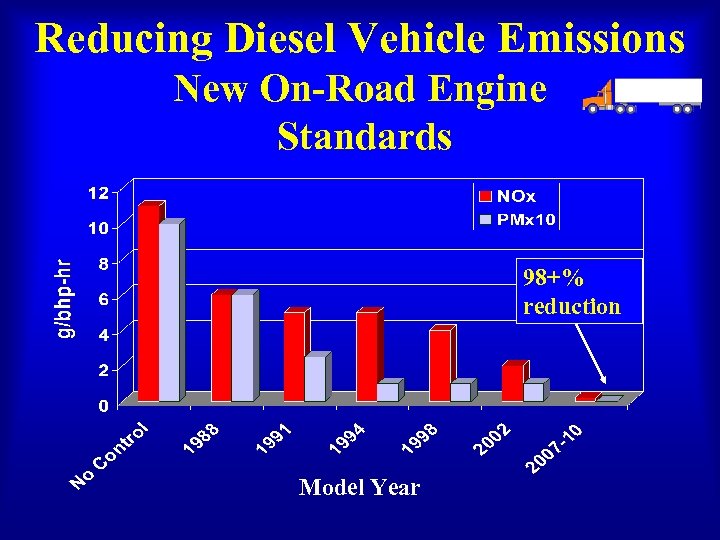
Reducing Diesel Vehicle Emissions New On-Road Engine Standards 98+% reduction Model Year
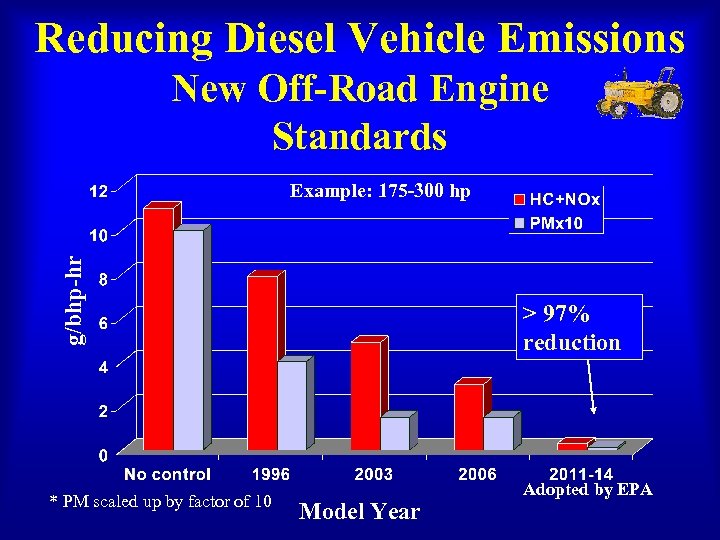
Reducing Diesel Vehicle Emissions New Off-Road Engine Standards g/bhp-hr Example: 175 -300 hp * PM scaled up by factor of 10 > 97% reduction Model Year Adopted by EPA
Reducing Diesel Vehicle Emissions Schedule for Additional In-use Regulations F 2004 – Public fleets – Idling restrictions School busses effective July 2003 u Commercial Motor Vehicles approved July 22, 2004 u F 2005+ – Private on-road fleets – Private off-road fleets – Harbor craft
Topics to Discuss About ARB F Regulatory development disputes F LEV/ZEV program F Reducing diesel vehicle emissions F Reducing in-use gasoline vehicle emissions F Impact of regulations F
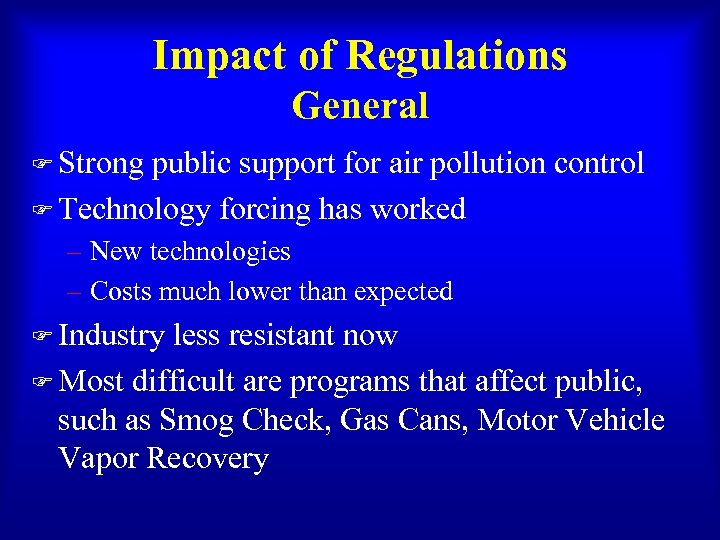
Impact of Regulations General F Strong public support for air pollution control F Technology forcing has worked – New technologies – Costs much lower than expected F Industry less resistant now F Most difficult are programs that affect public, such as Smog Check, Gas Cans, Motor Vehicle Vapor Recovery
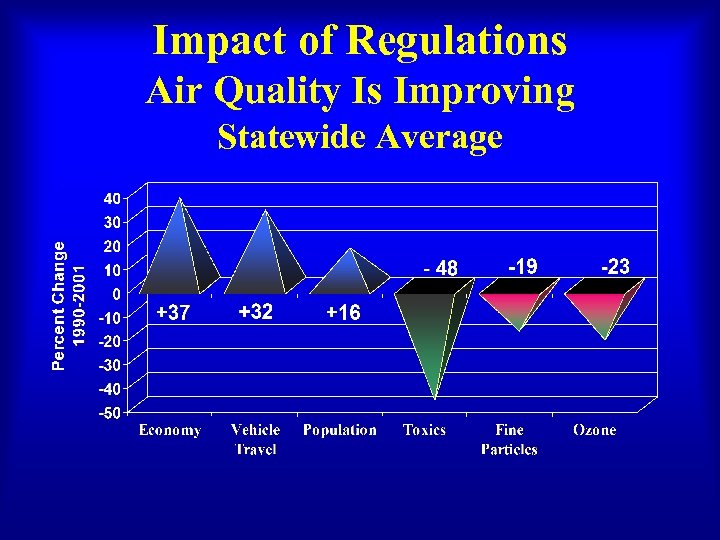
Impact of Regulations Air Quality Is Improving Statewide Average
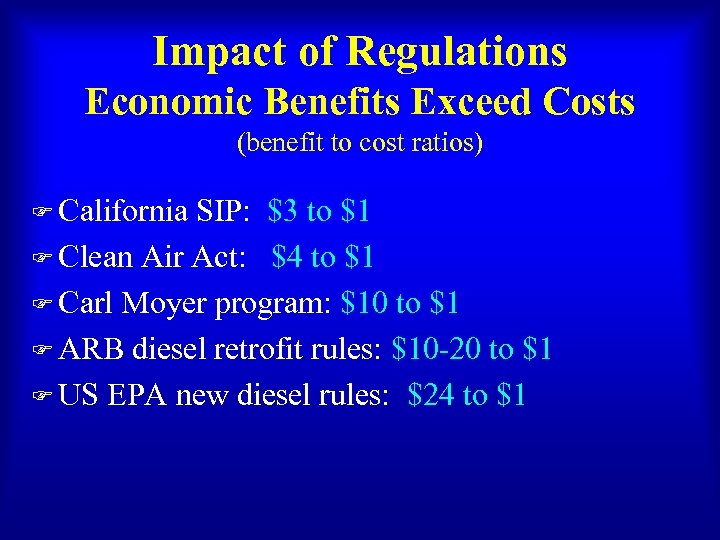
Impact of Regulations Economic Benefits Exceed Costs (benefit to cost ratios) F California SIP: $3 to $1 F Clean Air Act: $4 to $1 F Carl Moyer program: $10 to $1 F ARB diesel retrofit rules: $10 -20 to $1 F US EPA new diesel rules: $24 to $1
Impact of Regulations The Future F Near-zero emission technologies – Assures clean air – Consistent with growth, sound economy F Reduce greenhouse gas emissions F Clean, stable, sustainable, economical transportation fuel
Summary F The ARB functions at the State level to protect the public health by improving air quality F Disputes arising in regulatory development are addressed through a well established process F The LEV/ZEV program will reduce vehicular transportation emissions to zero or near-zero F Smog Check and Scrap are cost effective for reducing in-use gasoline vehicle emissions F There are significant health benefits from reducing diesel vehicle emissions

Manjit Ahuja P. O. Box 2815 Sacramento, CA 95812 email: mahuja@arb. ca. gov for more information see: http: //www. arb. ca. gov/homepage. htm
Скачать презентацию Public Symposium on Air Quality Management Policy in
6ef091fde339997a0af228bc3f88ff36.ppt