 Скачать презентацию Public Relations Strategies and Tactics 11 th Edition
ad56236b19fe334643b034feaa977dc5.ppt
- Количество слайдов: 17



Public Relations: Strategies and Tactics 11 th Edition Dennis L. Wilcox Glen T. Cameron Bryan H. Reber This multimedia product and its contents are protected under copyright law. The following are prohibited by law: • any public performance or display, including transmission of any image over a network; • preparation of any derivative work, including the extraction, in whole or in part, of any images; • any rental, lease, or lending of the program. Copyright © 2015, 2012, 2009 Pearson Education, Inc. All Rights Reserved.
Chapter 5 Research Copyright © 2015, 2012, 2009 Pearson Education, Inc. All Rights Reserved.
Chapter 5 Objectives n Understand the importance of research in public relations planning n Conduct online and database research n Organize a focus group n Design a scientific survey n Write a survey questionnaire n Determine the best method of reaching respondents n Conduct basic Web and social media analytics Copyright © 2015, 2012, 2009 Pearson Education, Inc. All Rights Reserved.
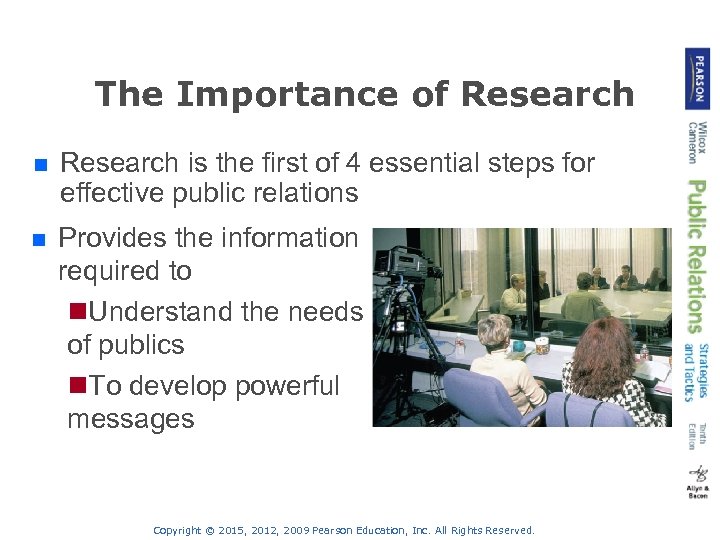
The Importance of Research n Research is the first of 4 essential steps for effective public relations n Provides the information required to n. Understand the needs of publics n. To develop powerful messages Copyright © 2015, 2012, 2009 Pearson Education, Inc. All Rights Reserved.
Determining the Research Role and Scope n n n n What is the problem? What kind of information is needed? How will the results of the research be used? What specific public (or publics) should be researched? Should the organization do the research in-house or hire an outside consultant? How will the research data be analyzed, reported, or applied? How soon will the results be needed? How much will the research cost? Copyright © 2015, 2012, 2009 Pearson Education, Inc. All Rights Reserved.
Using Research n n n n n To achieve credibility with management To define audiences and segment publics To formulate strategy To test messages To help management keep in touch To prevent crises To monitor the competition To sway public opinion To generate publicity To measure success Copyright © 2015, 2012, 2009 Pearson Education, Inc. All Rights Reserved.
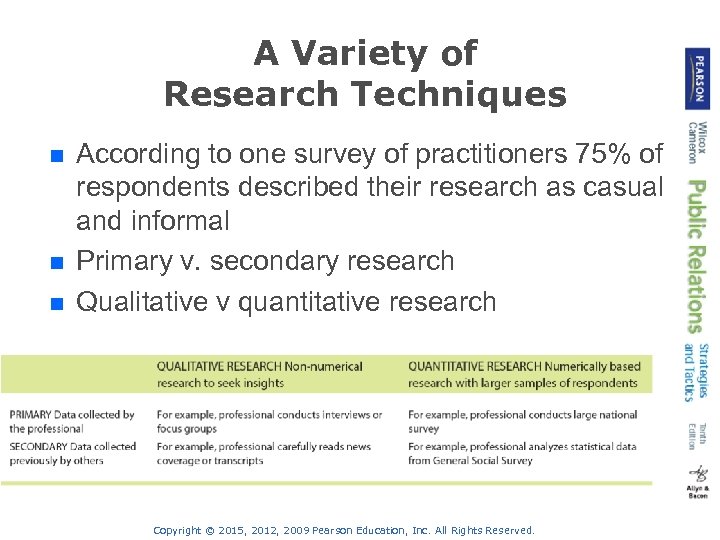
A Variety of Research Techniques n n n According to one survey of practitioners 75% of respondents described their research as casual and informal Primary v. secondary research Qualitative v quantitative research Copyright © 2015, 2012, 2009 Pearson Education, Inc. All Rights Reserved.
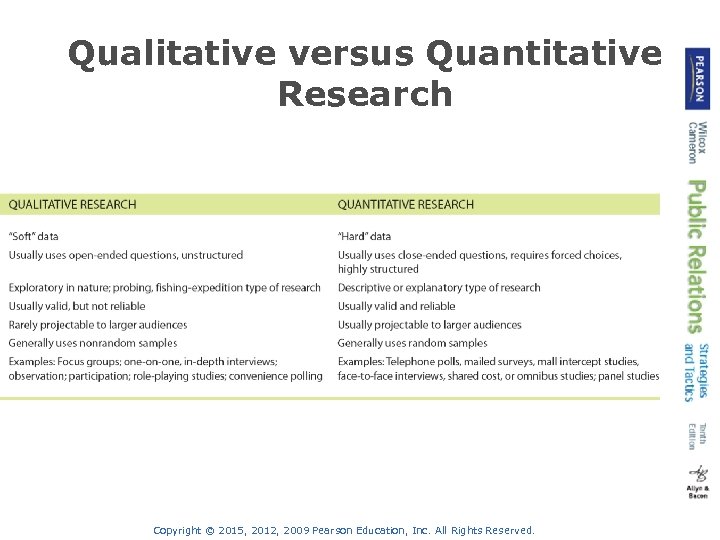
Qualitative versus Quantitative Research Copyright © 2015, 2012, 2009 Pearson Education, Inc. All Rights Reserved.
Secondary Research n n When public relations professionals analyze data collected by someone else Common sources n Online databases n The World Wide Web Copyright © 2015, 2012, 2009 Pearson Education, Inc. All Rights Reserved.
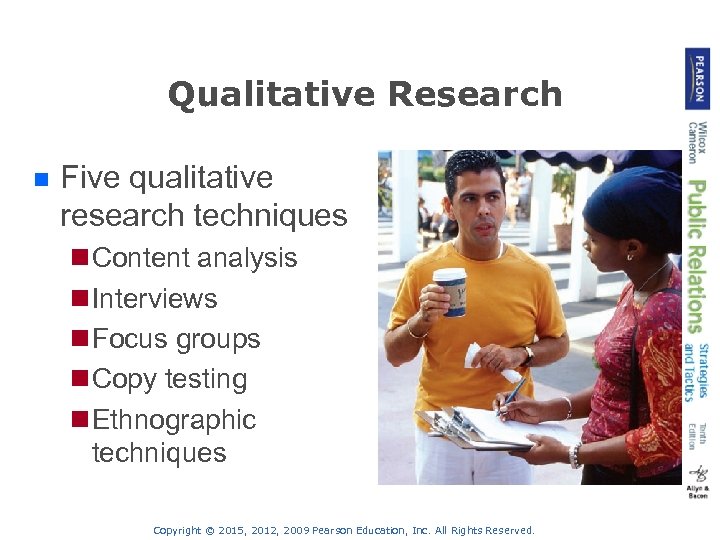
Qualitative Research n Five qualitative research techniques n Content analysis n Interviews n Focus groups n Copy testing n Ethnographic techniques Copyright © 2015, 2012, 2009 Pearson Education, Inc. All Rights Reserved.
Quantitative Research n n Often takes the form of polls and surveys conducted using precise, scientific sampling methods Based on 2 major factors n Random sampling n Sample size Copyright © 2015, 2012, 2009 Pearson Education, Inc. All Rights Reserved.
Questionnaire Construction n n n Carefully consider wording Avoid loaded questions Consider timing and context Avoid the politically correct answer Give a range of possible answers Use scaled answers Copyright © 2015, 2012, 2009 Pearson Education, Inc. All Rights Reserved.
How to Reach Respondents n n n Mailed questionnaires Telephone surveys Personal interviews Omnibus or piggyback surveys Web and e-mail surveys Copyright © 2015, 2012, 2009 Pearson Education, Inc. All Rights Reserved.
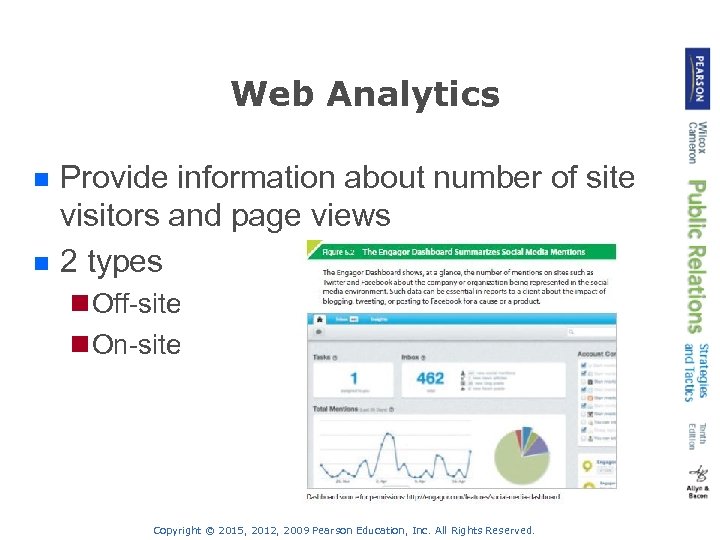
Web Analytics n n Provide information about number of site visitors and page views 2 types n Off-site n On-site Copyright © 2015, 2012, 2009 Pearson Education, Inc. All Rights Reserved.
Social Media Monitoring Tools n Typical objectives n Increasing revenues n Tracking and managing issues n Developing content that tracks trends in thinking and fashion (called memes) n Increasing awareness of the organization’s mission n Improving public opinion of a particular cause or organization Copyright © 2015, 2012, 2009 Pearson Education, Inc. All Rights Reserved.
Social Media Participatory Research n Form of participant observation that may include n Tweeting and following influential tweeters n Pinning and viewing pins on Pinterest n Watching and posting You. Tube or Vimeo videos n Reading blogs n Reviewing user comments on news stories and opinion pieces relevant to the client’s business n Tracking what people consider important or good current reading on Reddit n Monitoring activity in Facebook groups that impact one’s business Copyright © 2015, 2012, 2009 Pearson Education, Inc. All Rights Reserved.
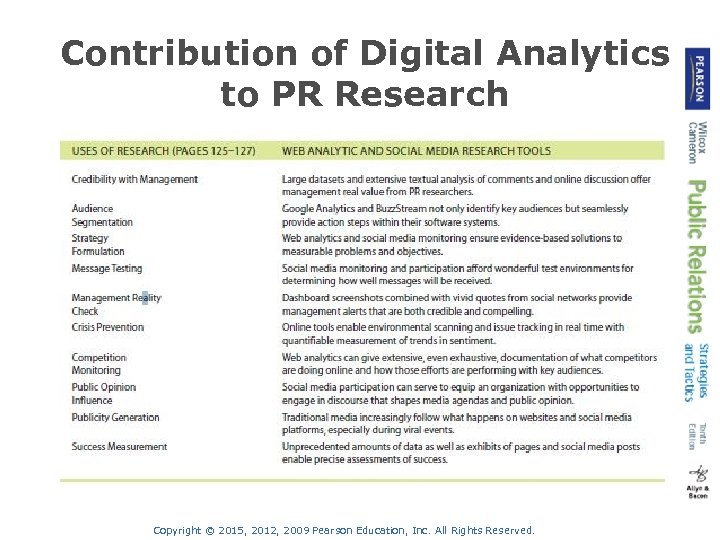
Contribution of Digital Analytics to PR Research Copyright © 2015, 2012, 2009 Pearson Education, Inc. All Rights Reserved.
Скачать презентацию Public Relations Strategies and Tactics 11 th Edition
ad56236b19fe334643b034feaa977dc5.ppt