 Скачать презентацию Public Relations and Globalization School of Journalism
427a255dfc6a89786dde058179d8da08.ppt
- Количество слайдов: 169



Public Relations and Globalization School of Journalism & Communications Chinese University of Hong Kong Presenter: BC Lo B. C. Lo 1
Definition of Public Relations Society of America – PRSA Public relations helps an organization and its public to adapt mutually to each other. International Public Relations: Negotiating Culture, Identity & Power by Patricia A Curtin & T. Kenn Gaither B. C. Lo 2
Chartered Institute of Public Relations l l The discipline which looks after reputation, with the aim of earning understanding and support and influencing opinion and behaviour. It is a planned and sustained effort to establish and maintain goodwill and understanding between an organization and its public. B. C. Lo 3
Scholars Management of communications between an organization and its public, best accomplished by using two-way symmetric communication. B. C. Lo 4
Commonly Used Definition A form of strategic communication directed primarily towards gaining public understanding and acceptance and the process of creating a good relationship between an organization and the public, especially with regard to reputation and communication of information. B. C. Lo 5
Old School – One Way Street l l Always labelled as propaganda & persuasion Associated with dictatorship & authoritarian Different viewpoint/different side of the coin “Democratic countries” always pushing to create a “level playing field” for economic reasons B. C. Lo 6
Globalization Dissolves Boundaries l l l Government shifting to democracy Nation building Multinational Corporation (MNC) expansion NGOs boost and monitor development Economic reasons - promotion of trade & tourism B. C. Lo 7
Nation Building l l Concentrate government effort to achieve its domestic and international goals Domestic – national unity & consensus International – show of power Soft power – economic power (investment, trade & tourism) B. C. Lo 8
Global PR Driven by Business l l l Technology growth Trading agreements MNCs need to: 1. Understand local culture 2. Balance short-term gain with long-term relations 3. Work through local & national, legal & cultural issues 4. Integrate Corporate Social Responsibility (CSR) & sustainability B. C. Lo 9
Investment – Culture’s 5 Moments of Circuit l l l Regulation – controls & considering factors Production – creation of cultural products, planning & execution of a campaign Representation – conveying the meaning, method of distribution Identities – set up and maintenance of an identity Consumption – audience decoding messages, receptive to the investment B. C. Lo 10
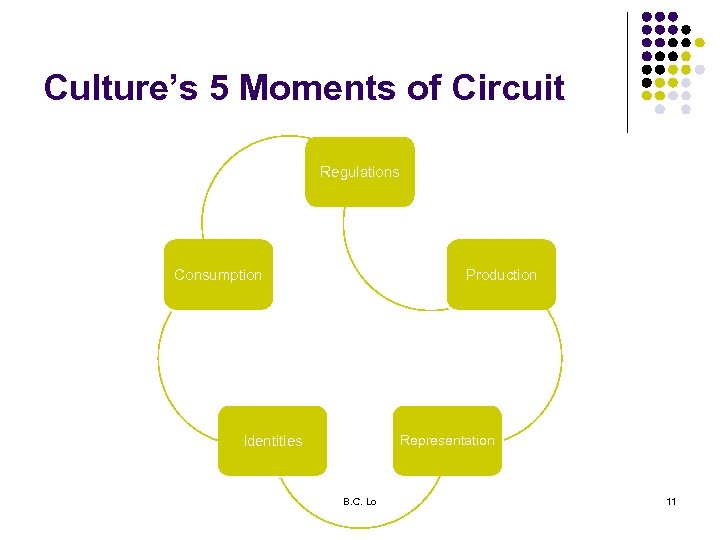
Culture’s 5 Moments of Circuit Regulations Consumption Production Identities Representation B. C. Lo 11
Globalisation & PR Covers l l l Marketing PR – approach, strategies & tools Corporate reputation – image, models, tools & crisis management MNC’s internal communications Event sponsorships – case studies in sports, arts, culture, charity & ambush Creativity in PR B. C. Lo 12
Global PR Cornerstone – Ethics l Advocacy Expertise Fairness Honesty Independence l Loyalty l l B. C. Lo 13
Know Your Public – Push, Pull and Pass Approaches B. C. Lo 14
3 Ways to Know Your Audience Approach l Push l Pull l Pass Messages B. C. Lo Channels/Tools 15
Push Approach List all stakeholders between you and your ultimate consumers/users l. Who helps/ harms l. Combine with SWOT analysis l. Useful tools to find out what goes wrong l. Messages formulation l. Channel/message matching/Mapping l. Resources allocation B. C. Lo 16
Pull Approach Analysis of your ultimate users/consumers l Who are they – categories, age, sex, etc. l What factors appeal l Positioning & priorities l Which channels l How to capture & keep – trial & loyalty l How to create behaviour changes l Tools/channels/timing – resources allocation B. C. Lo 17
Pass Approach What are the obstacles & ways to overcome l Company, products & services l Who are the gatekeepers? l How to PASS l Third party help l Divert attention l Business changes B. C. Lo 18
Customer Experience Management Approach Customer decision journey: l Touch points, entry points & obstacles (pain points) l What makes them come/return – needs, choice l How to keep them – loyalty program l What makes consumers use more – extend usage, occasions, etc. B. C. Lo 19
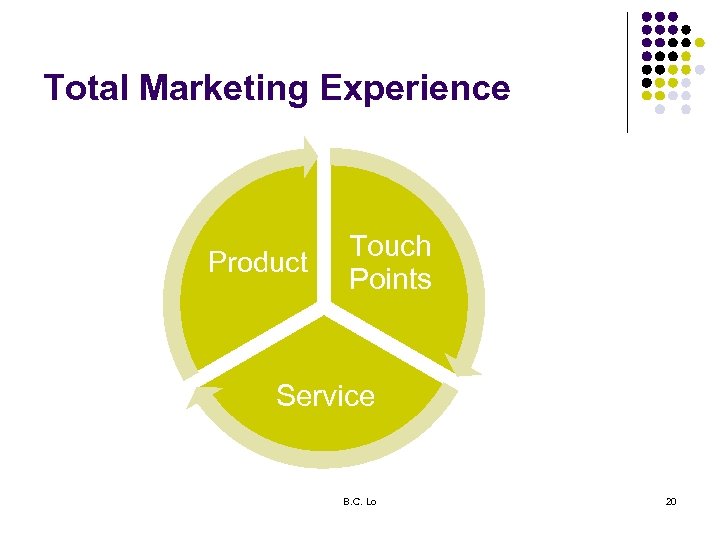
Total Marketing Experience Product Touch Points Service B. C. Lo 20
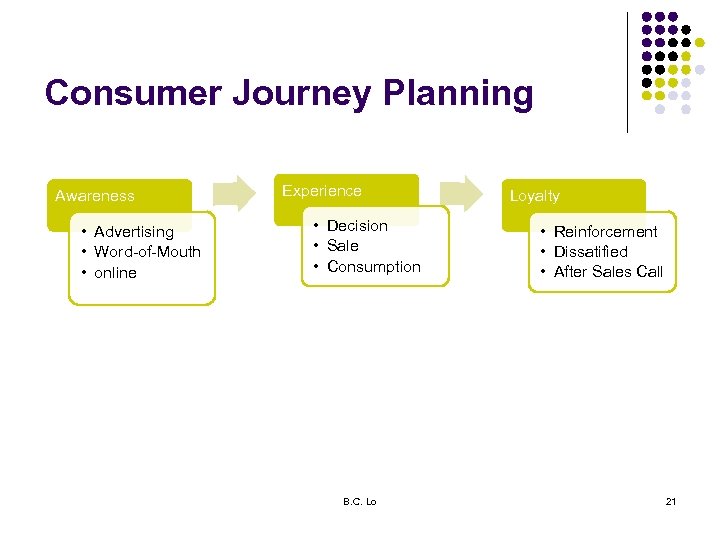
Consumer Journey Planning Awareness • Advertising • Word-of-Mouth • online Experience • Decision • Sale • Consumption B. C. Lo Loyalty • Reinforcement • Dissatified • After Sales Call 21
Chadstone Digital Journey B. C. Lo 22
In-class Exercise Apply the 3 approaches (Push, Pull, Pass) to work out a consumer experience management journey to analyze the marketing PR activities of an international company/organization/product in HK & China markets. B. C. Lo 23
Marketing PR: A Marketer’s Approach to Public Relations & Social Media by Gaetan T. Giannini, Jr. The Marketer’s Guide to Public Relations by Thomas Harris B. C. Lo 24
Definition of MPR Marketing public relations is the process of planning, executing and evaluating programs that encourage purchase and consumer satisfaction through credible communication of information and impression that identify companies and their products with needs, wants, concerns and interests of consumers. The Marketer’s Guide to Public Relations by Thomas Harris B. C. Lo 25
Marketing PR (MPR) What does MPR do? 1. 2. 3. 4. 5. 6. 7. Builds organization/product identity Increases visibility Establishes as an expert Educates stakeholders on issues Shapes public opinion Maintains image Stimulates trial & repeat usage B. C. Lo 26
Basic Rules of MPR l l l l l Highest cost effectiveness & creditability Newsworthy – public attention Share news – share of voice & share of mind Proper packaging – appeal Get to the right people – public Be available – close to your public Be engaged – two-way communication Realize its global reach – not a local story Ethics is key – facts & figures B. C. Lo 27
MPR Planning Need to consider a company’s l Vision & Mission l Business environment l Measurable goals l Implementation – the devil is in the details l Monitoring & timely adjustment – plan for the worst l Review & evaluation B. C. Lo 28
MPR Planning & Tools B. C. Lo 29
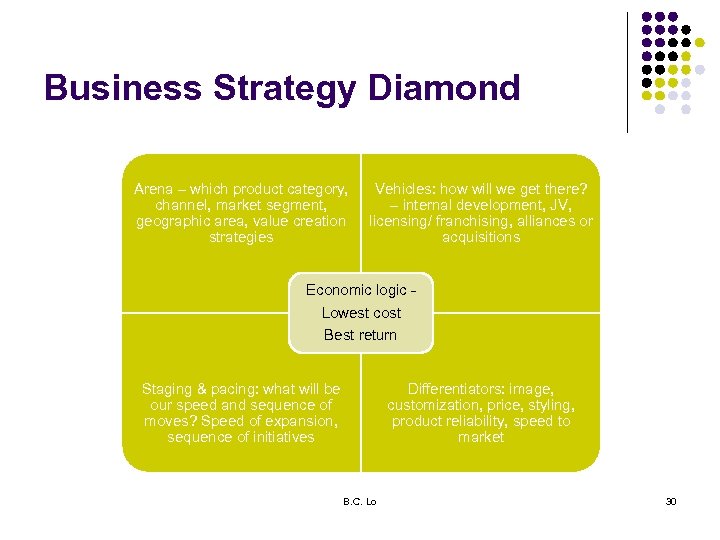
Business Strategy Diamond Arena – which product category, channel, market segment, geographic area, value creation strategies Vehicles: how will we get there? – internal development, JV, licensing/ franchising, alliances or acquisitions Economic logic Lowest cost Best return Staging & pacing: what will be our speed and sequence of moves? Speed of expansion, sequence of initiatives Differentiators: image, customization, price, styling, product reliability, speed to market B. C. Lo 30
Business Strategy Diamond l l l Economic Logic – how to realize Return On Investment (ROI) – which market/price/customer base Arena – decisions & strategies – what product/channel (place) Vehicles – means to conduct business – JV or wholly-owned, franchise, acquire, OEM Differentiators – competitive advantages Staging – speed & sequence to implement plan B. C. Lo 31
How MPR Serves an Organization l l l HR – employer of choice Investor relations Vendors/suppliers relations Customer relationship management Government relations B. C. Lo 32
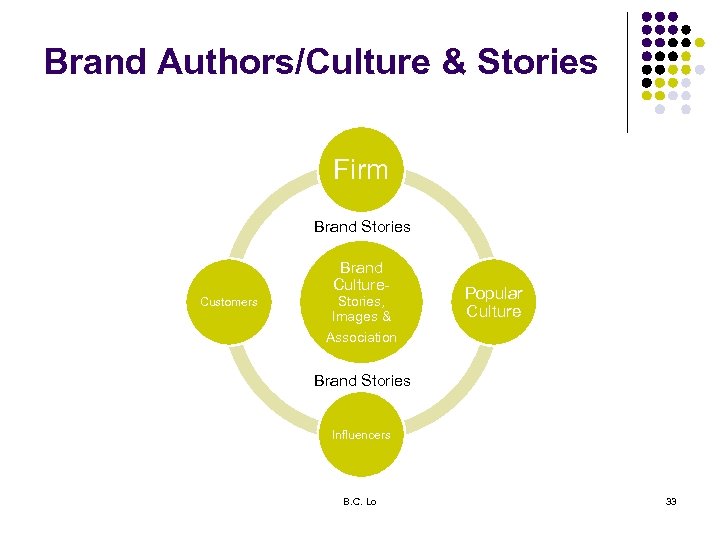
Brand Authors/Culture & Stories Firm Brand Stories Brand Culture- Customers Stories, Images & Popular Culture Association Brand Stories Influencers B. C. Lo 33
Brand Value l l Reputation value – customer confidence Relations value – long-term trust, e. g. hospitals Experiential value – shortcut to allow customers making effective choices – experience & word-ofmouth Symbolic value – status, lifestyle, politics & other social aspirations B. C. Lo 34
SMART Goal Setting 1. 2. 3. 4. 5. Specific Measurable Attainable Realistic Tangible B. C. Lo 35
Elements of the MRP Planning Process l l l Objectives Segmentation & target markets Type of connectors – channels & tools Messages Measurement B. C. Lo 36
10 Commonly Used Brand Building Tools B. C. Lo 37
1. No Advertising Support l l l Information for media Celebrity endorsement Contests – selection of spokesperson Special events Wars – cola, TV, beer, shopping malls, etc. Case studies: Walkman, i. Pod/i. Phone, Awards ceremonies B. C. Lo 38
2. Making News Before Launch l l Create suspense, last minute changes First ever – technical breakthrough Positioning and re-positioning Celebrities – leaks and gossips Note: Plan for the worst – what may backfire B. C. Lo 39
3. Enhance Advertising Effect l l l l Awards, endorsements & testimonials Create controversy, short supply Tie in with charity/community events Bundle with film/DVD/concert releases Multi-destinations publicity – create discussion Multi-media – electronic, print, outdoor & web Strategic alliance – tie in/bundle with others B. C. Lo 40
4. Winning Consumer Loyalty l l l Giving back – discounts, points & upgrade Loyalty programs – different classes Suggested usages, serving tips, pairing VIP events – wine tasting, investment talks Special interest, special tours, trials Case studies: Benz, BMW, Martell, credit cards, mileage programs, Campbell’s Soup B. C. Lo 41
5. New Product Launch l l l l Create news/stories prior launch New news – breakthrough The “making of “– stories behind Educate consumers – usage, effect Comparison & tests – tortoise jelly Road shows & demos – multi-city/market Product placement Encourage product trial – sampling B. C. Lo 42
6. News for Old Products l l l Promoting new benefits/usage – aspirin Re-positioning – oatmeal New packages – PET soft dinks New ways to use – whisky & green tea Endorsement & awards Contests – user generated content Case studies: SKII for men, whisky & green tea B. C. Lo 43
7. Use of Charity l l Cause related marketing – sports equipment Self-generated content – “Mama Bloggers” Compassion – disaster relief Advertising for public cause – water conservation Case studies: Project Hope, Project Smile, Project Pink Chalk B. C. Lo 44
8. Using Special Occasions l l Stories about founder, records, milestones Birthdays & anniversaries Special day, week, month Special offer for certain groups – Mother’s Day, Teacher’s Day Case studies: Olympic Day Run, National Day, Beer Festival B. C. Lo 45
9. Lobbying l l l l Legislation Use of experts & authorities Word-of-mouth & viral word-of-mouth Reference groups & fan clubs Official or third party endorsement Professional & trade associations support University research B. C. Lo 46
10. Use of Mascots & Figures l l l Create mascots – Michelin, Olympic Games, Asia Games Figures & trademarks – Pepsi man Color – orange, pink, red, green Collectors’ items – memorabilia Trends, wars and “rumors” Case studies : Coca-Collectors’ Club B. C. Lo 47
Useful List of MPR Tactics & Tools l l l l l Awards Books Contests Demonstrations Exhibits Fan clubs Festivals Grand opening Hotlines l l l l l B. C. Lo Interviews Luncheons Meetings Museums/pavilions Newsletters Official endorsement Product placement Public service announcements Questionnaires 48
Useful list of MPR Tactics & Tools (cont’d) l l l Radio trade for mentions Road shows Sampling Symbols Tours “Thons” – marathons, bikeathons, walkathons, telethons l l l l B. C. Lo Underwriting Vehicles Video news release Special day/occasion Expert columns Youth program Use of color 49
Group Exercise Case studies: Select a product/service from a MNC or an international organization in HK or China. Analyze how they apply some of the 10 commonly used brand tactics. Or: Apply brand building tactics to any existing product or service in HK or China. Give details about planning, implementation & measurement of effectiveness. B. C. Lo 50
Public Opinion & Its Impact on Brands B. C. Lo 51
Why Borders l l l Consumer boycott Government actions – new law/policy/off the shelf/ penalty Pressure groups actions – increase cost Financial pressure - share price drop, shareholder activism Reputation damage spreading to other markets B. C. Lo 52
What We Should Focus On l l l Causes of the problem How it will develop How will it affect us – worst case scenario How can we resolve/mitigate/use it? Price to pay – can we afford it? Creating a good growth environment B. C. Lo 53
True to Ourselves l l l Public Opinion is neither “Public” nor “Opinion” Public is only true for “Public Opinion Leaders” Opinion is often a “decided” set agenda - get buy-in only B. C. Lo 54
Public Opinion in the West l l Kingdom – power from Heaven – Christianity French thinker Rousseau’s “Public Agreement” in 1762 – “Public Opinion” Voting to delegate our power to someone to manage the state – the public servant Watchdogs – check & balance – constitutions, media, public opinion B. C. Lo 55
Public Opinion in China l l l l Sons of heaven – Federalism Public opinion – folk & children’s songs, dynasty changes Beliefs – Confucianism, Buddhism, Taoism Chairman Mao’s “Single Party” system Post Cultural Revolution – correct past wrongs Open policy – watchdog & public pressure Changes – mass media & internet B. C. Lo 56
Public Opinion Polls l l l Test the water/fly kites – to adjust policies Know what appeals to voters – how to win Participation – call for action – vote & resources Seek out people sharing same values – gatherings, mass media & internet Agenda setting B. C. Lo 57
Nationalism – Case Studies l China Vs. USA Anti-spiritual pollution, Belgium Coke boycott, Starbucks in Forbidden City l China vs. Japan Prado & Badao, Nippon Paint, Japanese cars l China Vs. France Olympic Torch relay, Carrefour stores B. C. Lo 58
HK vs. Mainland China l l l D & G incident “Invasion” of pregnant women mainlanders Anti-mainlander trends in HK & impact on local tourism B. C. Lo 59
Mainland China Case Studies l l l Super girls/ Voice of China South China Tigers & tourism Milk powder rush around the world Red Cross China & impact on NGOs Bear bile juice & company public listing Human search engines – mistresses, cigarettes, watches, false qualifications, moon cakes B. C. Lo 60
Citizen Marketers – 4 Fs l l Filters – human wire services, bloggers Fanatics – sports fanatics – analyze & call for action, advocates & drivers Facilitators – mayors of online towns – bring fans together Firecrackers – “one-hit-wonders” that attract lots of attention for one song, incident – tend to die out quickly, can be highly damaging B. C. Lo 61
Action for a Good Cause l l l l Fur boycott Ban shark fin Animal welfare/no animal testing Water conservation Compassion – disaster relief/ earthquake, flooding, poverty elimination Anti-corruption, anti-child labor Education for the underprivileged B. C. Lo 62
In-class Exercise Case study Use a case study in either China or Hong Kong to illustrate how public opinion affects a product, a service or an organization. B. C. Lo 63

Corporate Reputation & Its Global Development B. C. Lo 64
Corporate Reputation Management Corporate Reputation: Managing Opportunities & Threats, edited by Ronald J. Burke, Graeme Martin, Cary L. Cooper B. C. Lo 65
Corporate Reputation l l Corporate reputation is a function of the perceptions & attitudes towards it held by individual members of a particular group of stakeholders Corporate identity – how people outside an organisation assess those within B. C. Lo 66
Opinion Research Corporation Input from 4, 000 Executives l l l Customer focus – quality of product/service, value for $, responsiveness Competitive effectiveness – quality of management, investment strategies, financial soundness Market leadership – vision, differentiators Corporate culture – social image, recruit & retain talent Communications B. C. Lo 67
Favourable Corporate Reputation l l Employer of choice – recruit & retain talents Customers/consumers become advocates – affects purchase decision B. C. Lo 68
Good Features l l l Distinctiveness – only this company can do it Focus – experts in the field, specialized Consistency – communications, policies & practices Identity – perceived as genuine & listening Transparency – corporate governance B. C. Lo 69
6 Elements that Build Good Corporate Reputation l l l Social responsibility – support worthy causes Communication – transparency, full disclosure & open dialogue High quality products & services Talent – rewards and attracts talent Financial measures – high investment value Leadership – CEO, best in class, sets example Reference: Weber Shandwick & Reputation Institute B. C. Lo 70
Preliminaries – First Steps l l l Formulate a corporate reputation strategy & business sustainability Integrate communication & social responsibilities into the strategy Develop a good crisis management strategy Good communication of the corporate story to both internal and external stakeholders Good corporate culture that attracts & retains talent B. C. Lo 71
Building Blocks l l l Emotional appeal Vision & leadership Social responsibility Workplace environment Financial performance Quality of products and services B. C. Lo 72
Measurement of Corporate Reputation l l l Recognition Trust Stock price Financial performance Employment recruitment & retention B. C. Lo 73
Building a Corporate Reputation for New Firms l l l Founder’s track record Quality of partners Certificates achieved Board of Directors members Logos, stories & success of the brand Compare with others – benchmarking B. C. Lo 74
Corporate Rebranding Even successful brands need rebranding. Steps: 1. Develop a brand essence – differ from others 2. Create a guiding framework – balance old & new, what to keep & what to do more 3. Market needs old & new, or a bigger share 4. Communication training & internal marketing 5. Integrated communications & marketing strategies 6. Promote new brand to all stakeholders B. C. Lo 75
Damages To Corporate Reputation l l l Product recalls Scandals Spillovers Issues & crisis Legal battles Key: Issue and crisis management readiness B. C. Lo 76
Audits & Measurement l l Cognitive – Fortune magazine’s annual America’s Most Admired Companies; FT Global MBA Ranking – salary after graduation Measurement of opinions & experiences of respondents in different stakeholder groups Benchmarking What to keep (strength) & what to improve B. C. Lo 77
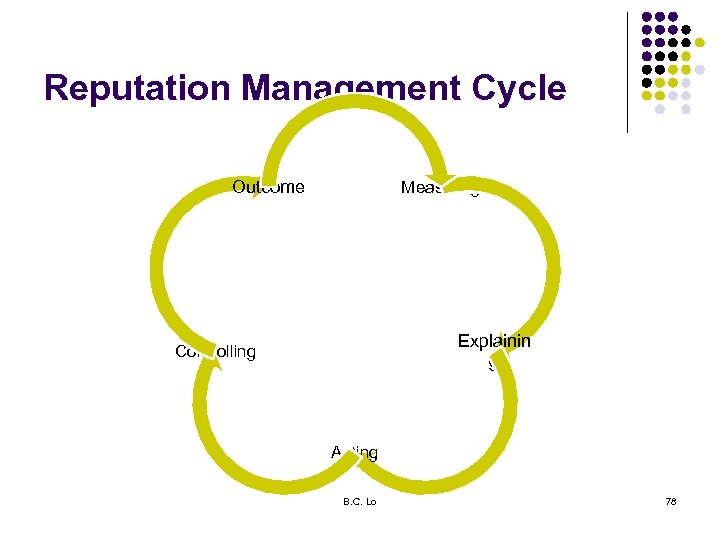
Reputation Management Cycle Outcome Measuring Explainin g Controlling Acting B. C. Lo 78
Global Reputation Management Approach l l Employer brand Social responsibilities Corporate citizenship – what matters most Issue & crisis management B. C. Lo 79
Using CSR to Drive Reputation 1. 2. 3. 4. 5. 6. 7. 8. Identify key stakeholders Understand what they want Identify company VMV Identify communication gaps & create support Take strategic actions to close gaps Consistent communication to stakeholders & public Measure activity effectiveness in increasing support Analyze & improve B. C. Lo 80
Know Your CSR Drivers l l l Conservationism & environmental issues Compassionate – corporate gifting, emergency relief, food bank Creativity Volunteerism Donation matching Recognition & endorsement from third party – awards & executives on key committees B. C. Lo 81
Employer Branding l l l l Employer of choice External and internal communications Impact on psychological contract link - job applicants, recruitment & retention - psychological fulfillment or breach Career development Empowerment & perception Social factors Importance of staff communications B. C. Lo 82
Employer Brand Building Tools l l l l l Newsletters in various formats – old & new media Employee portal/website(s) Corporate website/apps Town Hall Employee day/night Career development/enhancement – job rotations Volunteerism Creativity Staff family & friends engagement B. C. Lo 83
Group Discussion Apply what you have learned from the Corporate Reputation Management section to analyze a local branch of an international company. Prepare a plan to enhance its corporate reputation. B. C. Lo 84
Defending a Product at Risk – Issues and Crisis Management B. C. Lo 85
Old Days Are Gone l l l Government could gag media Local story could be contained Monetary solutions Cooperate with media to attack competition What happened inside to stay inside B. C. Lo 86
Incidents and Crisis An emergency situation that needs immediate action to avoid serious damage to business, people or brand or, that could result in serious adverse publicity. Reference: International Public Relations Association B. C. Lo 87
Common Crisis Elements l l l One or a series of negative incidents/events Serious damage to image, brand property & people Business disruption B. C. Lo 88
Issue and Crisis Management Your success is determined by how well you can manage the “coverage” – both traditional & new media. B. C. Lo 89
Crisis Management Approach PRP l Prevent if possible l Reduce negative impact l Protect company future Key = Good planning in advance B. C. Lo 90
General Principles – 4 Cs l l Control – agreed process Contain – prevent escalation, localize, isolate Concern – show concern for public Caution – facts first, avoid hasty reactions, speculation & over disclosure B. C. Lo 91
Step 1: Identify All Possible Threats l l l l Plant related Transportation related Employee related Product or package related Customer related Supply related National disaster Terrorism & violence B. C. Lo 92
Step 2: Physical Check 1. 2. 3. 4. 5. 6. 7. Do you have an early alert system? What notification system in place? What is the emergency response plan? What internal issues can cause damages if exposed in public? Spokesperson in Crisis How much information we share with public? How to reach management & employee? B. C. Lo 93
Step 2: Physical Check (cont’d) 8. How does this happen in other organizations? - How many times has it taken place? - What lawsuits or investigation faced? - What can we learn from this? - What will we do if it happens on us ? - What can we change to prepare to face a similar situation? B. C. Lo 94
Early Warning System 1. 2. 2/3 begins with negative news Negative news worksheet - fact finding - assessment - reaction analysis - Recommendations to management B. C. Lo 95
Q 1: Do We Have an Early Warning System? 1. 2. 3. Timely daily clipping report – print, electronic & new media Do we have the right contacts in media, government and other key stakeholder groups? Time needed to reach management during odd hours B. C. Lo 96
Q 2: Do We Have an Updated Emergency Response Plan? 1. 2. 3. 4. 5. When was it last updated/tested? Is it tied in with plans from others sites/countries/head office? When was last approval? Who are the team leaders and members? How soon can they get ready? B. C. Lo 97
Q 3: Any Internal Issue that Can Damage Us if Goes Public? 1. 2. 3. 4. What are they? How does it impact us & stakeholders? - lawsuit - government investigation - share price fluctuation Will it affect head office, other markets? How can we minimize/mitigate/resolve? B. C. Lo 98
Q 4: Spokesperson in a Crisis 1. 2. 3. 4. Who is he/she? Any alternative? Does he/she has all the needed information? Disclosed information approval steps & time Who has the final say – important legal role B. C. Lo 99
Q 5: Communications with Management 1. 2. 3. 4. Who makes the calls at different levels? Any impact to employees/customers/suppliers/ shareholders/government? Who calls the shots? Recommendations to management B. C. Lo 100
Q 6: Early Warning System 1. 2. 3. When was the first indicator? Who alerted you? Why? Any similar incidents recently? Any insight & source? - What questions asked? Reporter’s attitude & background - What is our response? - What will likely be the coverage - tone & size B. C. Lo 101
Communications in Crisis l l l Find out what is known and unknown Weigh disclosure options & develop a plan Get support from senior management Brief the media – document after each interview – protect and improve Anticipate the aftershocks Document & share learning B. C. Lo 102
Dealing with Media in a Crisis l l l Be honest – don’t lie, best truth Facts – double check everything Get management support Third party support – industry association, academia, authorities Remember: you are not working for the media. They can be your friends, not partner B. C. Lo 103
Dealing with Media in a Crisis – Keep at Local Level l l Isolated incident Use local public opinion leaders, business leaders, academia or other third party Remember not so say: - Anything without approval, avoid “no comment”, internal conflict, personal matters - Do not comment on competitor(s) B. C. Lo 104
Staying in Control in Crisis l l l The first hour – find out what is known and what is unknown - cut through the chaos, check all available information/data Weight disclosure options, build a disclosure plan – minimize impact quickly, anticipate questions & possible development, focus on known facts Get management support/clearance before meeting media – build confidence, don’t push B. C. Lo 105
Staying in Control – Before You Speak l l l Take time to get used to surroundings Look clam & confident – get notes in order Be brief – focus on confirmed facts & messages Don’t be pressured into responding – friendly, polite but firm Check and confirm with authorities – be consistent B. C. Lo 106
Staying in Control – Anticipate the Aftershock l l Time to resolve the crisis – can be a long time Additional resources to sustain effort Possible legal/government/labor/insurance & other issues Document everything to defend yourself and for the review to improve, compare notes B. C. Lo 107
Shall We Be Proactive? l l No, unless absolutely in need – give the right facts Unless in a recall or pressure from consumers/ suppliers/employees No management on camera unless needed On-camera – if someone important to say/clarify B. C. Lo 108
Shall We Recall Products? l l l Health & safety issues Advised by government or authorities Recall is costly, damaging reputation & business May impact other markets & head office – decision made after consultation Make sure proper authority is given in advance, recovery system in place B. C. Lo 109
Build Relations in Advance How? l Product news/marketing events l Journalists, public opinion leaders, bloggers, l Media gatherings, public occasions l Find/Seek them out – internet, direct message B. C. Lo 110
Case Studies & Syndicated Exercise l l l Coca-Cola Belgium boycott Product recall The Pellet lesson B. C. Lo 111
How to Write a CM Plan l l l Start with what needs to be protected Create a crisis management team Create guidelines/procedure – flow chart Establish a crisis center/war room Prepare alert system & material in advance Aftermath management – documentation & learning B. C. Lo 112

Media Relations in Global PR B. C. Lo 113
Basic Understanding of News Media l l l Electronic – radio, TV Print – newspapers, magazines, trade New media – websites & bloggers Beat – special field, business, geographical News agencies – local, regional & international, government, business Correspondents, chambers of commerce, embassies B. C. Lo 114
Media Opportunities l l l l Editorials – co-ops, trade development Expert articles – columnists, talk shows Cases – successful cases, landmarks Events – media events Interviews – exclusive, group, live, on-camera Blogs & websites Media convergence – eroded borders – news websites B. C. Lo 115
Create Viral Word-of-Mouth l l l Capture the imagination by being fun Easy to use and highly visible product Target well – interest and engage audience Associate with credible sources Combine delivery technology – text, video B. C. Lo 116
Key Opinion Leaders (KOL) l l l Know where to find them Make sure they have appeal/draw Citizen marketers (4 Fs) – filters, fanatics, facilitators, firecrackers Blogs & bloggers Offline word-of-mouth, face-to-face, telephone B. C. Lo 117
What is News? Story Told First Time l l l l Famous & successful people, heroes New facts, discovery, first of its kind Human interest, love, hero, role model Locally related, nationalism Disasters, conflicts, fights Gossip, money, sex, power Underdog Trends B. C. Lo 118
The Press Release l l l l The 5 Ws 1 H – what, who, where, which, why, How Inverted primary writing – must have first Backgrounder Fact sheet Frequently Asked Questions (FAQs) Supporting material (certificates, pictures) Press kit – paper Vs. electronic Video news release B. C. Lo 119
Selling a Story l l l l Newsworthiness Credibility Relationships Beliefs & values Interests Communications Exclusive Fitting into editorial calendar B. C. Lo 120
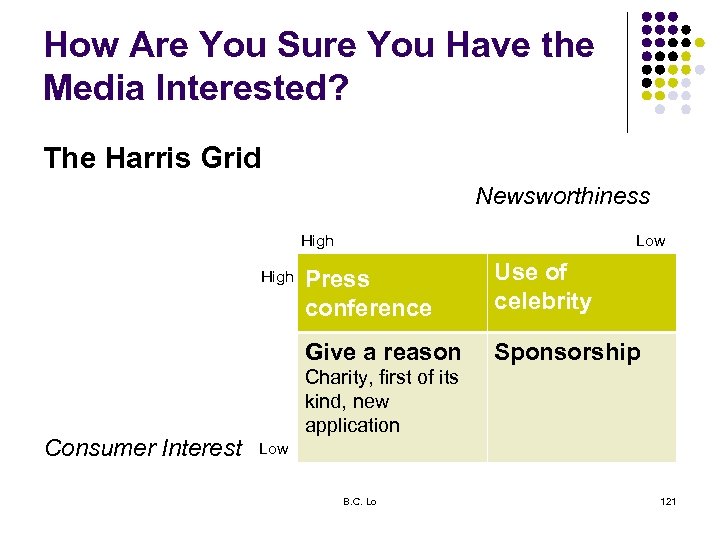
How Are You Sure You Have the Media Interested? The Harris Grid Newsworthiness High Low Consumer Interest Press conference Use of celebrity Give a reason High Sponsorship Charity, first of its kind, new application Low B. C. Lo 121
Use of Pictures or Video “A good picture is worth a thousand words. ” l l l Availability of good photographer/briefing Proper caption Hard copy Vs. soft copy Nature of news media & preference of editors Picture Vs. footage B. C. Lo 122
Proactive or Reactive l l l Proactive – when you want publicity Reactive – when you want to clarify On-camera or off-camera – preparedness Are you prepared: l Background, statement, key messages, Q&A l Media training – rehearsals, latest facts B. C. Lo 123
In-class Assignment Apply Harris Grid to design a media event you are going to stage in the near future for a product or service of a MNC operating in HK or China. You must pick a product or service first. Then use one of the 10 brand building tactics to define what you are going to do for an event. List out how to generate the news angle with different tools you are going to use. B. C. Lo 124

Understanding Government Relations in Asia B. C. Lo 125
Code of Ethics/Foreign Anti-corruption Acts l l Most MNCs have it – protection of company, brands, property & management Protect shareholders by preventing a market dragging the whole system down B. C. Lo 126
Basic Questions l l l Why and how did it happen? What is the core problem – governance or government? Our objectives Key decision maker(s) What is the price? Can we afford it? Can competitors, trade, supplier involvement B. C. Lo 127
Clear Objective for Our Actions l l l Fact finding or seeking help Approval Protect our reputation to prevent government intervention Lobbying Put competitor on the defense Create a barrier for entry B. C. Lo 128
Legal Conditions l l Foreign Anti-Corruption Act/Foreign Practices Act/ICAC State Department (government) requirements Corporate governance Local restrictions/protection B. C. Lo 129
Class Exercise – Are We Prepared? l l List all organizations that you/your company need to reach out for government relations activities. Do you have the latest information of the key contacts? If not, how are we going to develop the network? When was the last time we update the lists? B. C. Lo 130
Event Sponsorship − Use of Sports, Art, Cultural Exhibitions & Events as Tools Event Sponsorship by Bruce E. Skinner & Vladimir Rukavina B. C. Lo 131
History of Event Sponsorship l l l Since Roman Empire – Michelangelo, Leonardo de Vinci Advertising − 1600 s, e. g. classified ad in French newspaper in 1631 Pioneers – 1920 s to 70 s, e. g. Goodyear Blimp, Philip Morris Festival of Stars at the Kentucky Derby Era of development – 1984 onward, e. g. LA Olympics & Peter Ueberroth Added Value of 1990 s – measured by sales, B 2 B, ROI Technological era – cybercast of Elton John concert B. C. Lo 132
Key to a Successful Event: Media l l l Present the dominant event in community, industry, region or international appeal Media exposure – coverage, coverage… Grab hearts and minds of majority Do something others cannot/have not Develop a high regard event – “value” what people talk about – only “they” can do it Make it something sponsors cannot stay away from B. C. Lo 133
Sponsorship – Why Supporters l l l Must invite sufficient media coverage Must attract existing and potential users – the warm and fussy feeling Meaningful link between product & event, engage users, customers and key stakeholders Link needs to be evident, not intrusive Can support promotion, ad and marketing campaign Results can be evaluated – Return On Investment B. C. Lo 134
Event Planner’s Marketing plan l l l What you have to sell – internal/external coverage Start by selling to media – coverage Which categories of company should you approach – reasons that motivate them Any existing supporters of similar events – right fit How they do it in similar countries/markets Look at account payable to decide what you need to get B. C. Lo 135
Key for Event Sponsorship l l News creator(s) – the draw of officiating guests Participants, invited guests of event – relations building – atmosphere Media exposure – national, regional and international coverage Marketing opportunities – reach new customers and enhance relations with existing ones B. C. Lo 136

Music, Sex and Sports Overcome Cultural Boundaries B. C. Lo 137
Revenue for Sports Events l l l Broadcast rights – 1/3 to 40% (coverage = advertising slots) Merchandising and licensing – 1/3 (How can a sponsor make use of this? ) Tickets and on site – less than 1/3 (sponsor’s right – hospitality) B. C. Lo 138
Sports Sponsorship in Mainland China l l l Success in the 1984 LA Olympics China reform policy 2 rest days a week provides leisure time Public fund cuts, alternate resources Health consciousness Business opportunities B. C. Lo 139
Sports Sponsorship Goals l l l Promote sales – identify the link Enhance awareness Increase acceptance Grow loyalty – award loyal customers Customer relationship l l B. C. Lo Government relations – effective market entry Corporate image & reputation Product trial Employment relations 140
Entitlement l l l Use of name Use of mascots Promotion Venue publicity/media exposure Endorsement Tickets & hospitality opportunities l l l B. C. Lo Olympics World Cup Asian Games National Games Premier Leagues NBA 141
Naming Rights l l l Associate a venue with your company/brand Difficult to capture Return On Investment Continued media coverage is limited Case study: Kodak & Oscar venue B. C. Lo 142
Using Sports Celebrities l l Official brand/product spokesperson Media exposure for events and activities Charity/community projects Use of products Alternative planning - Scandals and negative associations, e. g. Tiger Woods - Ambush marketing B. C. Lo 143
Return on Investment l l l Sponsorship – may be just permission to use logo, mascots, publicity material and limited tickets, e. g. Olympics, World Cup May need the same or double investment to capitalize on what you have paid Need to set aside funding to prevent ambush B. C. Lo 144
Sports Celebrities: Plus and Minus l l Hope for the best and plan for the worst Paparazzi – scandals, the dark side Short shelf life of celebrities Cultural conflicts Case studies: Tiger Woods, NBA Superstars, English Premier League B. C. Lo 145
Arts, Music and Cultural Sponsorship B. C. Lo 146
Use of Celebrities, Successful Leaders, Heroes l l l Common tool for Fast Moving Consumer Goods (FMCG) Quick awareness and acceptability Celebrities seeking partnership with FMCG due to the high advertising investment Need alternative plan in place on Day 1 Celebrity acceptability can change overnight – scandals, nude pictures, drugs, alcoholism B. C. Lo 147
Charity Event Sponsorship Commonly used platforms: l Education – Project Hope, Pink Chalk l Environmental protection – water conservation l Family relations – mother/father & kids, developmental skills, EQ/IQ l Health – oral hygiene, Operation Smile l Compassion – flood/earthquake relief B. C. Lo 148
Supporting Charity Events l l l Is your consumer interested, likely to or will take part? Is it a creditable event? Is the partner reliable? Will this give your consumer a reason to buy? Will our publicity backfire? How can I prevent competitors to ambush? How to draw a line to prevent backfire? B. C. Lo 149
Commonly Used Tools l l l 1 per purchase/item Lump sum Matching – internal & external Key – contingency B. C. Lo 150
Keys to Successful Event Management Coverage – appeal of the event, celebrities to take part, any local community and CSR element 3 Keys 1. VIPs – news generators, photo opportunity 2. Audience – hospitality, how can sponsor get most out of it 3. Media – publicity pre-event, during the event and post event B. C. Lo 151
Case Studies l l l l Tennis – Opens and Masters Standard Chartered Marathon SPCA Dog Walkathon Olympics, World Cup, NBA, CBA Premier League, Super League Pink Chalk Project Health Train, Obis B. C. Lo 152
Group Assignment Apply what was discussed in class to develop an event management plan. It can be a sports, cultural or charity event. Remember to start with getting media coverage. State clearly your objectives, event logistics and publicity details and how you define success and ROI. B. C. Lo 153

Ambush PR – Guerilla or Parasite Marketing B. C. Lo 154
Ambush PR l l l Started in sports sponsorship, spread to other marketing/business activities Creates confusion for major sponsorships, e. g. no need to pay for sponsorship fees – more resources to put into markets Create distraction to affect competitor’s marketing effectiveness B. C. Lo 155
International Olympic Committee l l Ambush marketing will destroy the funding of the Olympics. We must handle seriously. Funding – The Olympic Programs (TOP) provide money for organizing committee B. C. Lo 156
Case Studies l l l Fuji Vs. Kodak 1984: Kodak TV spend Seagram 1998: athlete’s family to Seoul Adidas Vs. Nike 1992: Nike’s Dream Team, Amex room key in official hotel Puma 1996: champion holding shoes Annett Vs. Qantas 2000: Annett (Track and Field) B. C. Lo 157
IOC Weigh In l l l IOC – Ambush marketing will destroy our funding. Introduction of strict guidelines to combat ambush marketing 2000 onward Clean City Act in Sydney Olympics 2004 Athens Olympics 2008 Beijing Olympics 2012 London Olympics B. C. Lo 158
Ambush Marketing l l Use of creativity Morals & ethics Hard to use repeatedly Price and consequences B. C. Lo 159
Group Discussion Describe a successful ambush PR event in China or Hong Kong B. C. Lo 160
Creativity in Public Relations CREATIVITY IN PR, 4 TH EDITION, ANDY GREEN, KOGAN PAGE, CIPR B. C. Lo 161
Definition of Creativity “A creative act consists of not only originating but also evaluating the added value it contributes. ” “It is not novelty of its own sake, but it must produce some form of value that can be recognized by a third party. ” Andy Green, Creativity in PR B. C. Lo 162
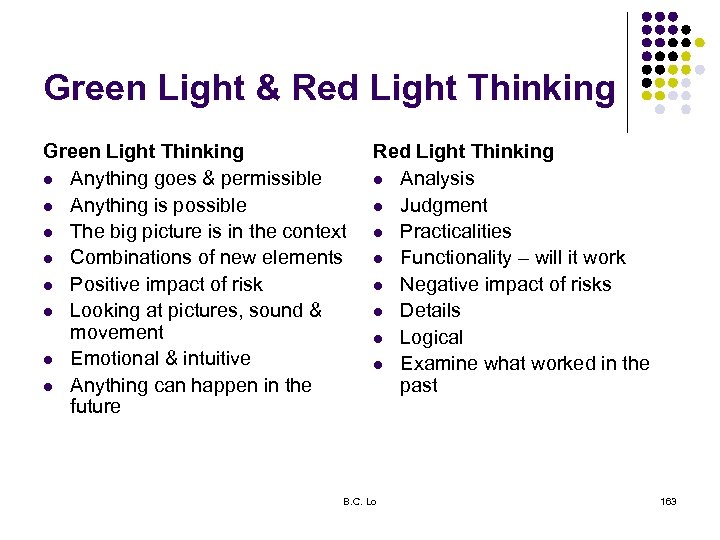
Green Light & Red Light Thinking Green Light Thinking l Anything goes & permissible l Anything is possible l The big picture is in the context l Combinations of new elements l Positive impact of risk l Looking at pictures, sound & movement l Emotional & intuitive l Anything can happen in the future Red Light Thinking l Analysis l Judgment l Practicalities l Functionality – will it work l Negative impact of risks l Details l Logical l Examine what worked in the past B. C. Lo 163
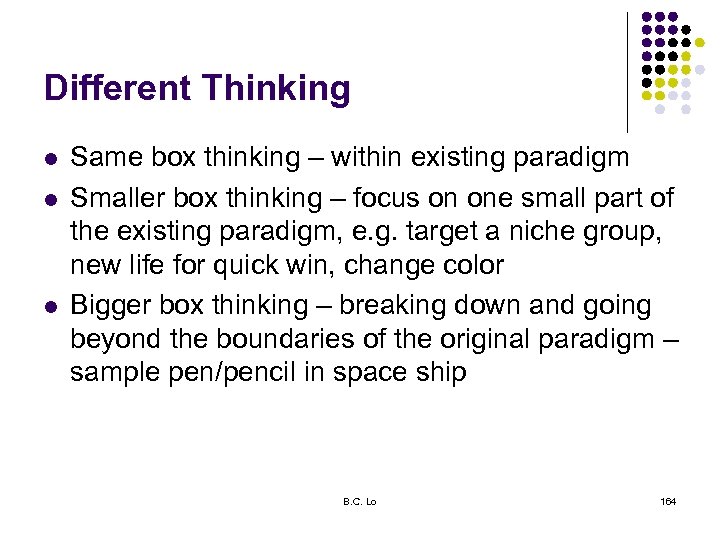
Different Thinking l l l Same box thinking – within existing paradigm Smaller box thinking – focus on one small part of the existing paradigm, e. g. target a niche group, new life for quick win, change color Bigger box thinking – breaking down and going beyond the boundaries of the original paradigm – sample pen/pencil in space ship B. C. Lo 164
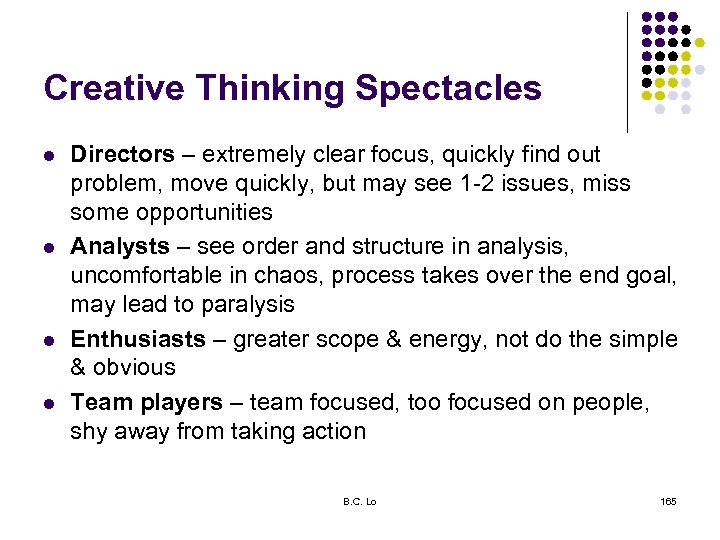
Creative Thinking Spectacles l l Directors – extremely clear focus, quickly find out problem, move quickly, but may see 1 -2 issues, miss some opportunities Analysts – see order and structure in analysis, uncomfortable in chaos, process takes over the end goal, may lead to paralysis Enthusiasts – greater scope & energy, not do the simple & obvious Team players – team focused, too focused on people, shy away from taking action B. C. Lo 165
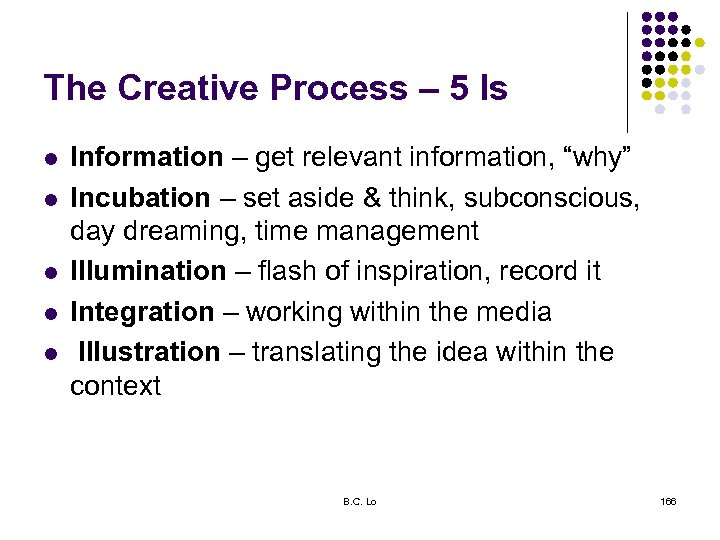
The Creative Process – 5 Is l l l Information – get relevant information, “why” Incubation – set aside & think, subconscious, day dreaming, time management Illumination – flash of inspiration, record it Integration – working within the media Illustration – translating the idea within the context B. C. Lo 166
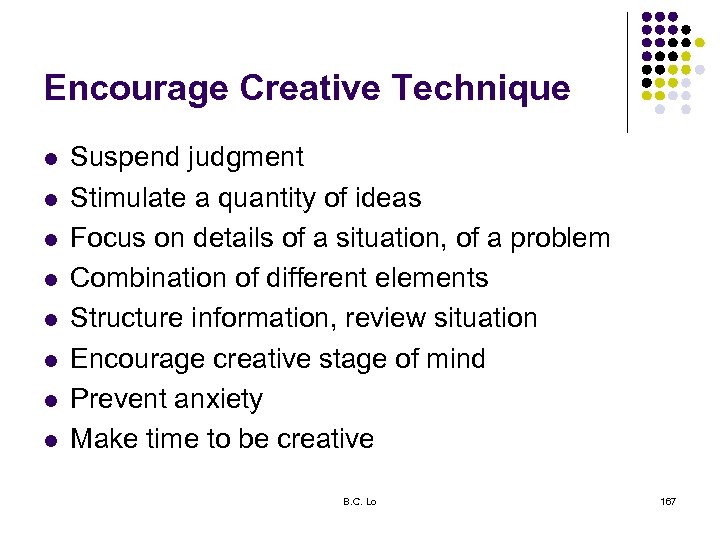
Encourage Creative Technique l l l l Suspend judgment Stimulate a quantity of ideas Focus on details of a situation, of a problem Combination of different elements Structure information, review situation Encourage creative stage of mind Prevent anxiety Make time to be creative B. C. Lo 167
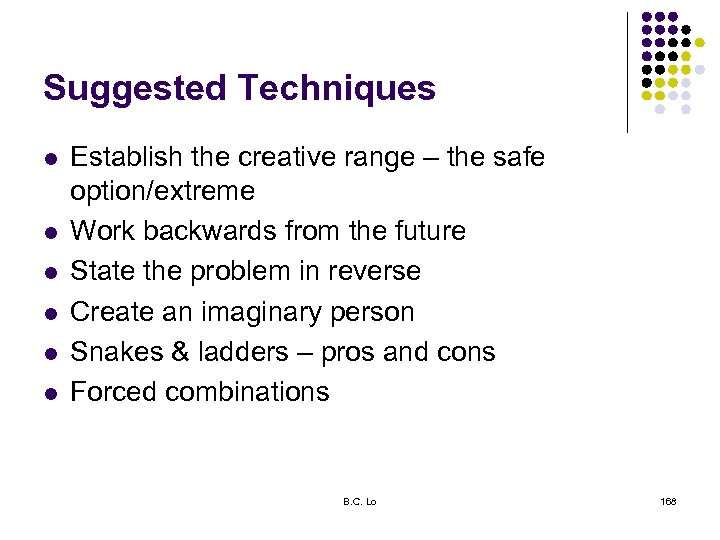
Suggested Techniques l l l Establish the creative range – the safe option/extreme Work backwards from the future State the problem in reverse Create an imaginary person Snakes & ladders – pros and cons Forced combinations B. C. Lo 168
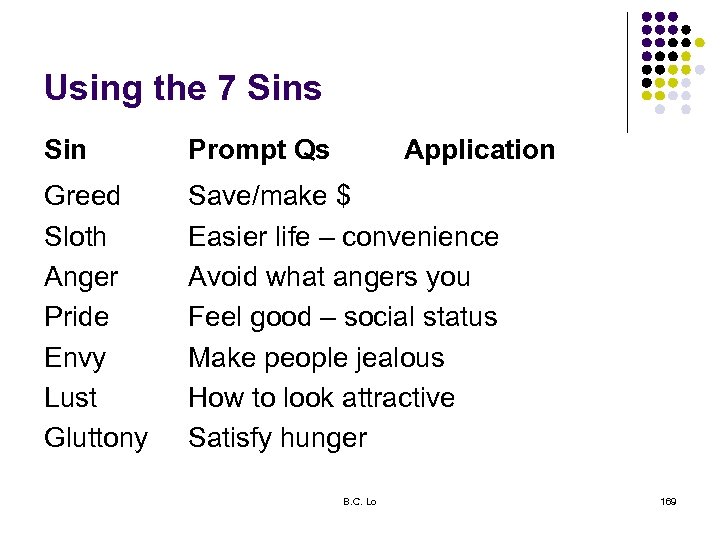
Using the 7 Sins Sin Prompt Qs Application Greed Sloth Anger Pride Envy Lust Gluttony Save/make $ Easier life – convenience Avoid what angers you Feel good – social status Make people jealous How to look attractive Satisfy hunger B. C. Lo 169
Скачать презентацию Public Relations and Globalization School of Journalism
427a255dfc6a89786dde058179d8da08.ppt