 Скачать презентацию Public Property Asset Management Models 22 August 2007
f3ca63d233c1bce8bf535a42c2b661e5.ppt
- Количество слайдов: 31



Public Property Asset Management Models 22 August 2007 N. Mandindi
Background Intersite started as a property division of the SA Rail Commuter Corporation Limited in 1991; and, in 1992 established as a separate corporate entity to manage and develop the property portfolio of the SARCC.
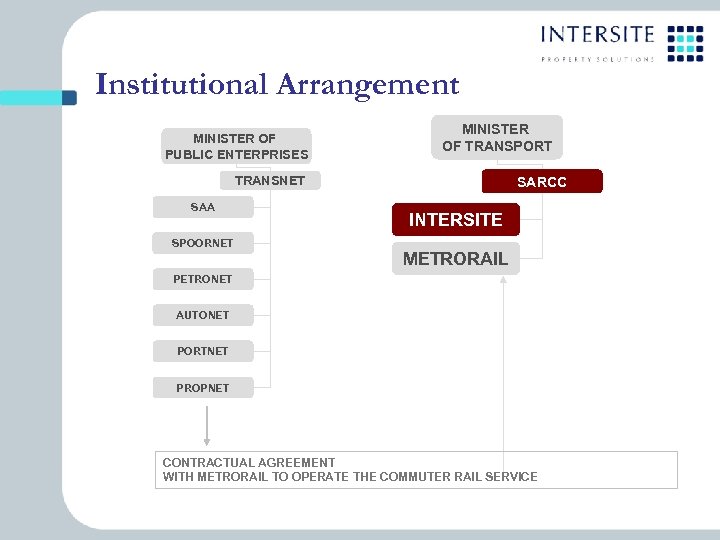
Institutional Arrangement MINISTER OF PUBLIC ENTERPRISES MINISTER OF TRANSPORT TRANSNET SAA SPOORNET SARCC INTERSITE METRORAIL PETRONET AUTONET PORTNET PROPNET CONTRACTUAL AGREEMENT WITH METRORAIL TO OPERATE THE COMMUTER RAIL SERVICE
PUBLIC PROPERTY PURPOSE The critical success factor of Public Property is its ability to support service delivery through the provision of “fit for purpose” facilities
FUNDAMENTAL DECISIONS PRINCIPLES TO DEAL WITH 1) OWNERSHIP 2) MANAGEMENT
STATE PROPERTY OWNERSHIP ØEstablishment of Property Agencies (SPV) ØGovernment holds 100% equity ØAssets transferred to entities ØAsset controlled by financial instruments ØGovernment provide policies & guidelines ØCreation of value a requirement ØReturn expected
STATE PROPERTY MANAGEMENT ØOwner/Manager separation – international trend Ø Ownership/Management duties transferred to and vest in specialists Ø Government representation – Agency Boards Ø Reporting requirements – Annual Statements Ø Specific Performance Parameters Ø Structuring of entities – Private Sector principals
International Models • Finland • Norway • Sweden • Queensland - Australia
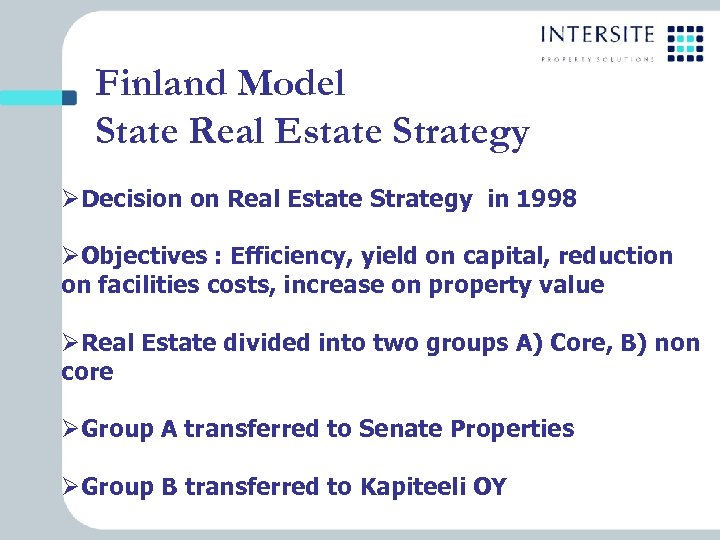
Finland Model State Real Estate Strategy ØDecision on Real Estate Strategy in 1998 ØObjectives : Efficiency, yield on capital, reduction on facilities costs, increase on property value ØReal Estate divided into two groups A) Core, B) non core ØGroup A transferred to Senate Properties ØGroup B transferred to Kapiteeli OY
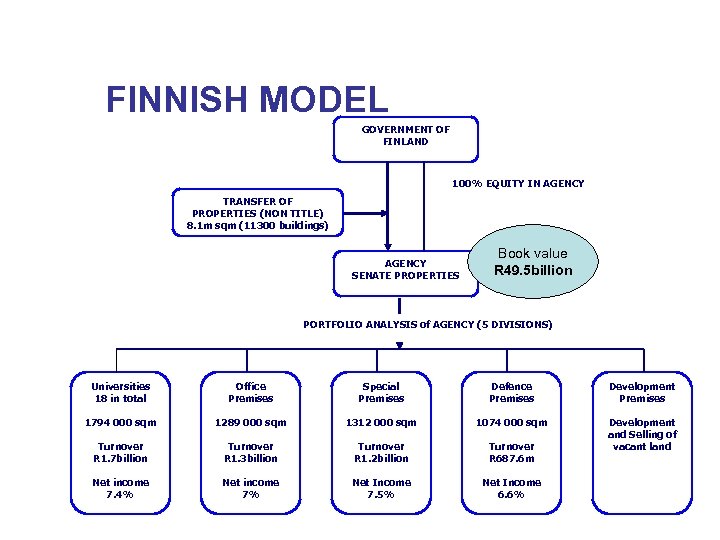
FINNISH MODEL GOVERNMENT OF FINLAND 100% EQUITY IN AGENCY TRANSFER OF PROPERTIES (NON TITLE) 8. 1 m sqm (11300 buildings) AGENCY SENATE PROPERTIES Book value R 49. 5 billion PORTFOLIO ANALYSIS of AGENCY (5 DIVISIONS) Universities 18 in total Office Premises Special Premises Defence Premises Development Premises 1794 000 sqm 1289 000 sqm 1312 000 sqm 1074 000 sqm Turnover R 1. 7 billion Turnover R 1. 3 billion Turnover R 1. 2 billion Turnover R 687. 6 m Development and Selling of vacant land Net income 7. 4% Net income 7% Net Income 7. 5% Net Income 6. 6%
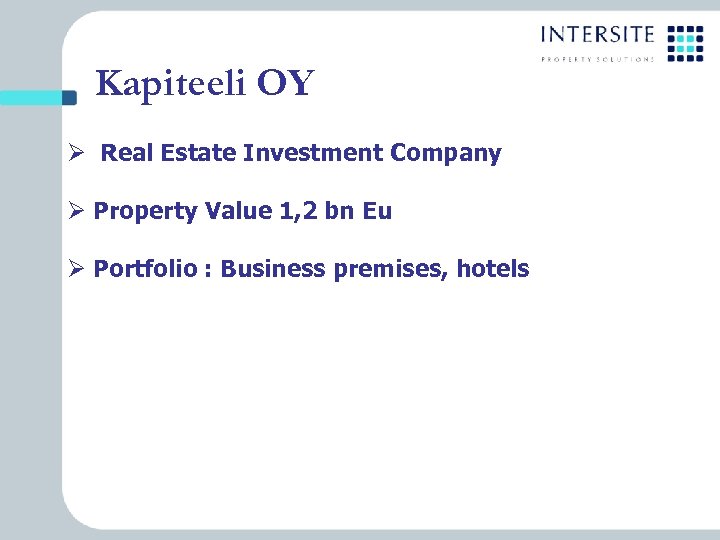
Kapiteeli OY Ø Real Estate Investment Company Ø Property Value 1, 2 bn Eu Ø Portfolio : Business premises, hotels
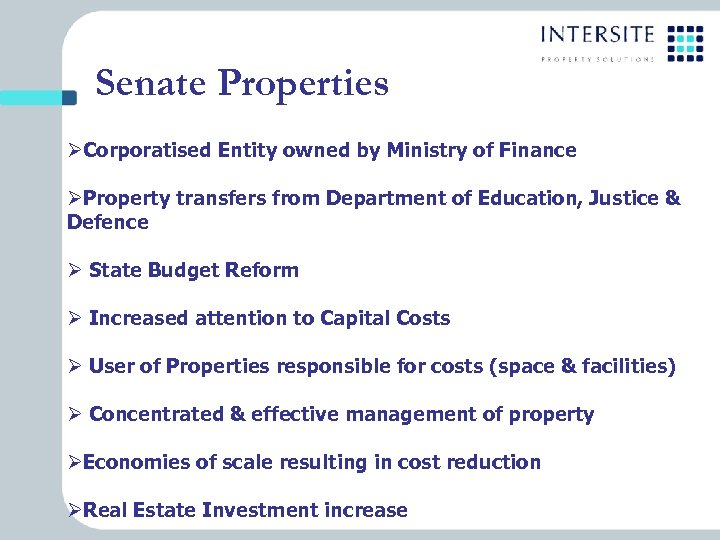
Senate Properties ØCorporatised Entity owned by Ministry of Finance ØProperty transfers from Department of Education, Justice & Defence Ø State Budget Reform Ø Increased attention to Capital Costs Ø User of Properties responsible for costs (space & facilities) Ø Concentrated & effective management of property ØEconomies of scale resulting in cost reduction ØReal Estate Investment increase
Senate Properties Portfolio Ø University Premises Ø Office Premises Ø Special Premises Ø Defence Premises Ø Developments
Norway 1960 - Directorate of Public Construction and Property was established 1992 - Reorganisation of the directorate – introduction of rent (lease) payment 2000 – Commercial property was separated from Statsbygg The remaining properties of Statsbygg consists of ”purpose” buildings (infrastucture)
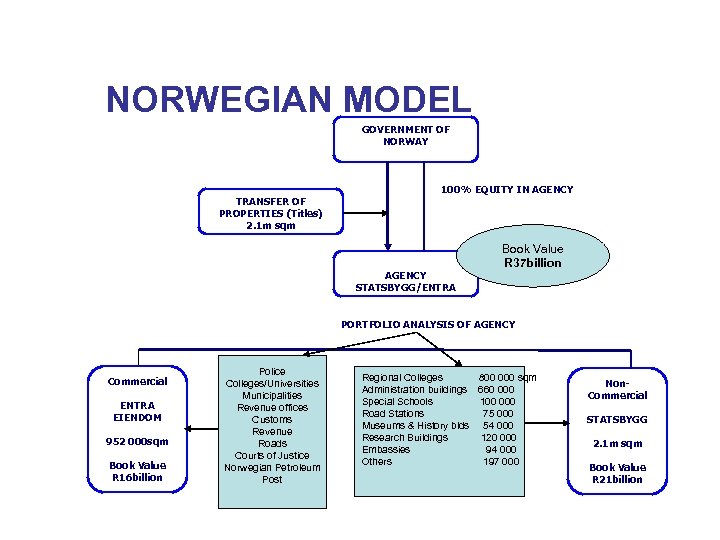
NORWEGIAN MODEL GOVERNMENT OF NORWAY TRANSFER OF PROPERTIES (Titles) 2. 1 m sqm 100% EQUITY IN AGENCY STATSBYGG/ENTRA Book Value R 37 billion PORTFOLIO ANALYSIS OF AGENCY Commercial ENTRA EIENDOM 952 000 sqm Book Value R 16 billion Police Colleges/Universities Municipalities Revenue offices Customs Revenue Roads Courts of Justice Norwegian Petroleum Post Regional Colleges 800 000 sqm Administration buildings 660 000 Special Schools 100 000 Road Stations 75 000 Museums & History blds 54 000 Research Buildings 120 000 Embassies 94 000 Others 197 000 Non. Commercial STATSBYGG 2. 1 m sqm Book Value R 21 billion
Norway - Statsbygg ØStatsbygg is an administrative body, responsible to the Ministry of Modernisation ØBuilding projects are financed by reinvestment of rent income or by government subsidy ØProperty management and maintenance is financed by rent income.
Norway - Statsbygg ØStatsbygg acts on behalf of the government as consultant and manager in construction and property affairs. ØStatsbygg construct buildings for own administration, but also universities, prisons and other ”not-rented” buildings ØStatsbygg offers governmental organisations advice suited to their needs, in either new or existing buildings.
Norway – Statsbygg Political directions in the budget ØIn the Chapter for Statsbygg ØPolitical objectives in the areas of architecture, the environment, cultural heritage and universal design ØInitiate and participate in R&D projects inter alia by using its own building projects as pilot projects to assist in gradually introducing and using digital building models in the construction and property industry throughout a building’s entire lifecycle
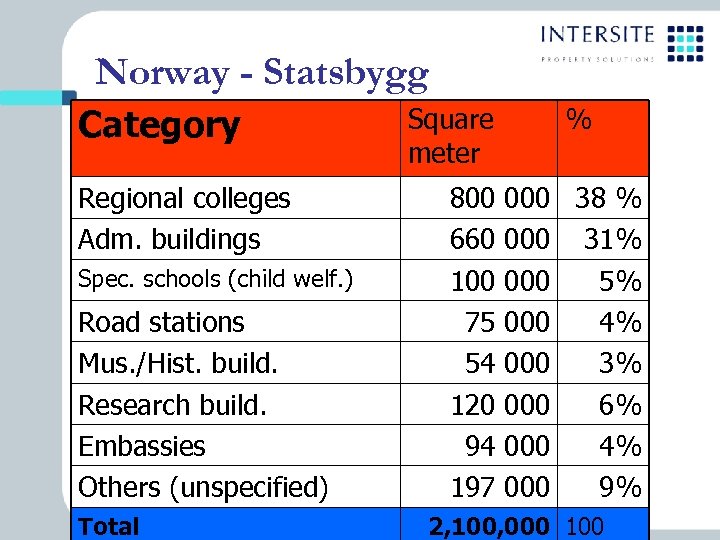
Norway - Statsbygg Category Regional colleges Adm. buildings Spec. schools (child welf. ) Road stations Mus. /Hist. build. Research build. Embassies Others (unspecified) Total Square meter 800 660 100 75 54 120 94 197 % 000 38 % 000 31% 000 5% 000 4% 000 3% 000 6% 000 4% 000 9% 2, 100, 000 100
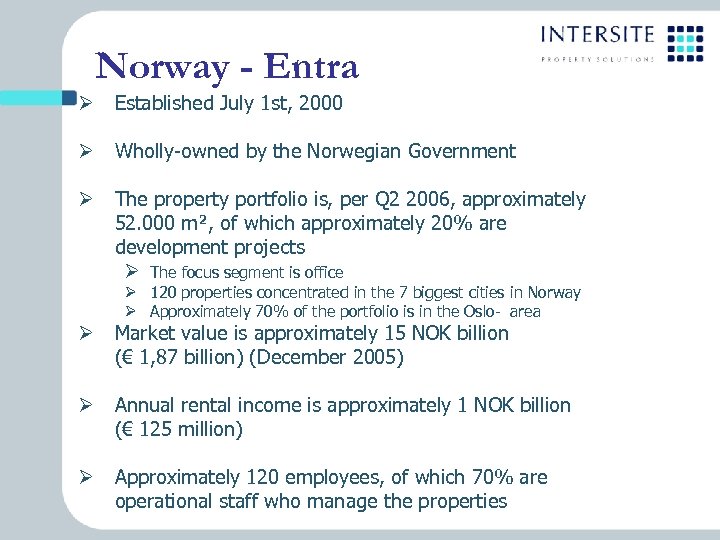
Norway - Entra Ø Established July 1 st, 2000 Ø Wholly-owned by the Norwegian Government Ø The property portfolio is, per Q 2 2006, approximately 52. 000 m², of which approximately 20% are development projects Ø The focus segment is office Ø 120 properties concentrated in the 7 biggest cities in Norway Ø Approximately 70% of the portfolio is in the Oslo- area Ø Market value is approximately 15 NOK billion (€ 1, 87 billion) (December 2005) Ø Annual rental income is approximately 1 NOK billion (€ 125 million) Ø Approximately 120 employees, of which 70% are operational staff who manage the properties
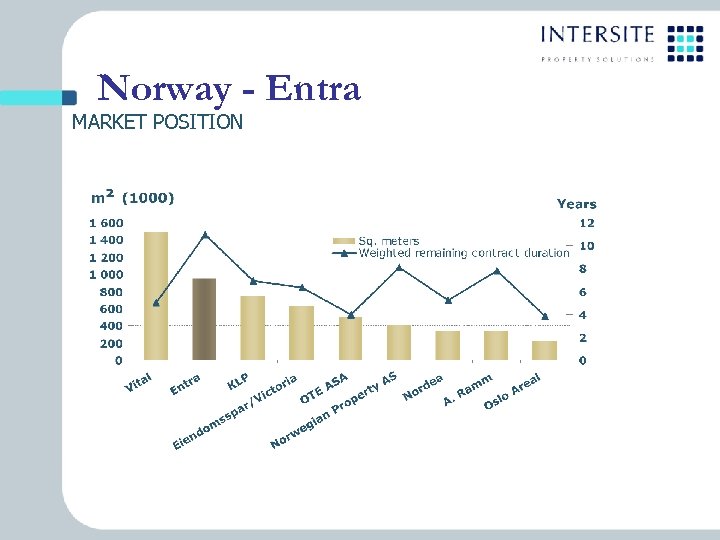
Norway - Entra MARKET POSITION
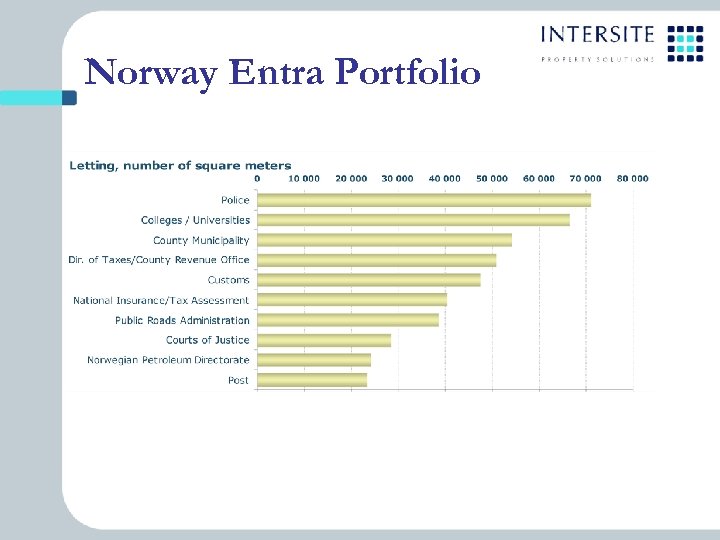
Norway Entra Portfolio • To maximise the long term recurring income and investment on the portfolio.
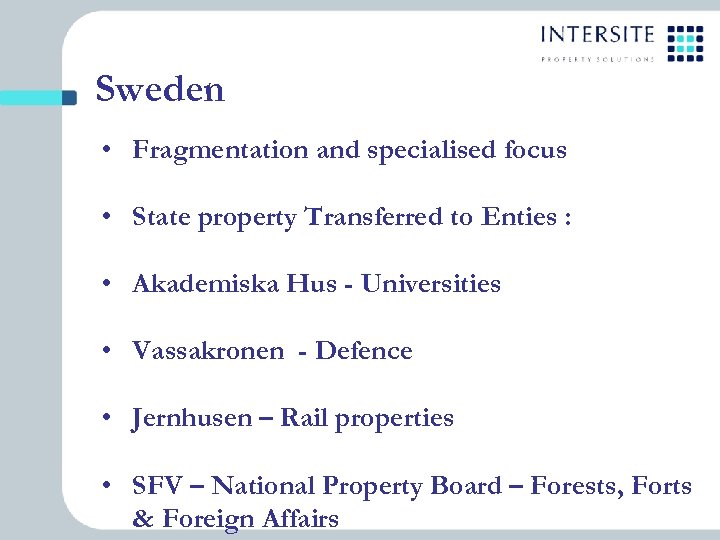
Sweden • Fragmentation and specialised focus • State property Transferred to Enties : • Akademiska Hus - Universities • Vassakronen - Defence • Jernhusen – Rail properties • SFV – National Property Board – Forests, Forts & Foreign Affairs
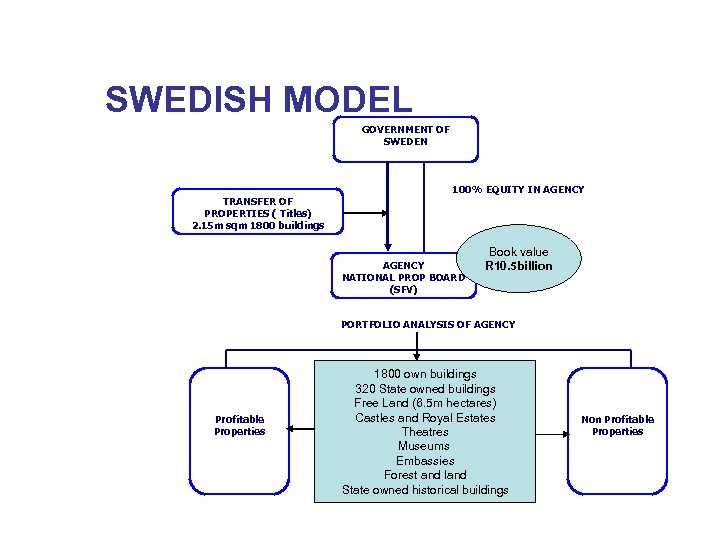
SWEDISH MODEL GOVERNMENT OF SWEDEN TRANSFER OF PROPERTIES ( Titles) 2. 15 m sqm 1800 buildings 100% EQUITY IN AGENCY NATIONAL PROP BOARD (SFV) Book value R 10. 5 billion PORTFOLIO ANALYSIS OF AGENCY Profitable Properties 1800 own buildings 320 State owned buildings Free Land (6. 5 m hectares) Castles and Royal Estates Theatres Museums Embassies Forest and land State owned historical buildings Non Profitable Properties
National Property Board ØSFV owns 1, 800 properties in Sweden, totalling 2 million m². ØSFV manages 6. 5 million hectares (around 16 million acres) of land – one seventh of Sweden’s surface area. ØSFV administers state-owned property and land at 73 locations in 69 countries around the world. In 44 of these countries we manage a Swedish Embassy. ØSFV manages four items on the UNESCO list: Drottningholm Palace and parts of the Naval Port of Karlskrona; the agricultural landscape in southern Öland; and World Heritage Laponia.
Queensland - Australia Whole of Government approach Q Build Q Fleet User Pay model Strong emphasis on efficiency and high level of maintenance and facilities management
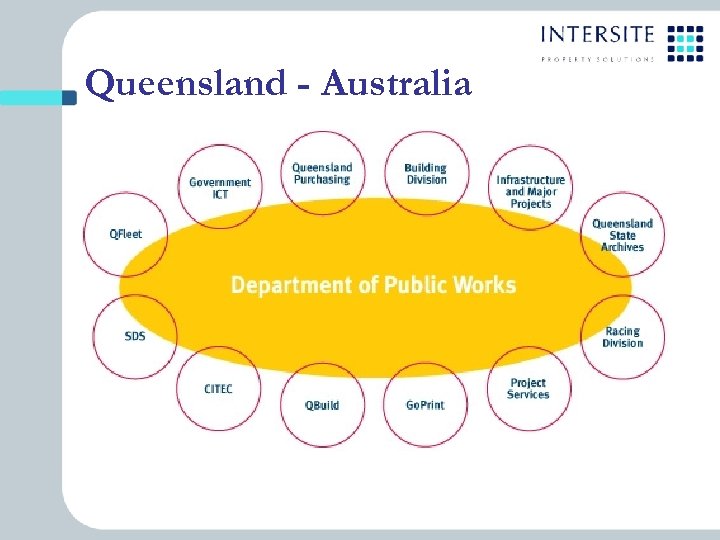
Queensland - Australia
Property Agency - Rationale ØEfficiencies ØAccountability ØFocus on delivery ØBusiness/private sector principles ØIntroduction of User Pay principle Market related or Controlled system
BENCHMARKING The Nordic Countries vs South Africa Property Agency Concept Implemented more than a decade ago in Norway, Sweden, Finland ØPublic Works model with overarching mandate over state property
QUESTIONS Capacity building thro institutions of higher learning Design philosophy Role of Public works within Government User pay system ? ? Budgeting for Capital works implementations Property Agencies Provincial piloting Develop a critique – Relevance to South Africa – analysis of SA public property including capacity building mechanisms

THANK YOU
Скачать презентацию Public Property Asset Management Models 22 August 2007
f3ca63d233c1bce8bf535a42c2b661e5.ppt