 Скачать презентацию Public-Private Partnerships UNITED NATIONS Special Unit South-South Cooperation September
2336d46e7b0d168c5c5f2160ab929236.ppt
- Количество слайдов: 33



Public-Private Partnerships UNITED NATIONS Special Unit/South-South Cooperation September 18, 2006 Rick Norment NCPPP Executive Director
Why Use Public-Private Partnerships? § Demands – General Citizenry – Increasing Populations – Business Development – Special Interests § Budgetary Limitations 1 O 102004008 OM
Private Sector and Public Works – The First Step Toward PPPs § Mass Transit Systems § Railroads § Electric Utilities § Telephone and Telegraph § Water/Wastewater Systems 2 O 102004008 OM
PPPs as a Public Policy Tool § Private Sector Can Not Be “Unrestrained” § The Evolution of Law During the 19 th Century in Europe and US – Regulatory controls equally applied – Anti-Trust laws enforced by the courts – Enforced contract laws • Between private and private • Between public and private § But a balance is needed so both private and public Sectors win 3 O 102004008 OM
Public-Private Partnerships Defined A Public-Private Partnership is a contractual agreement between a public agency (federal, state or local) and a private sector entity. Through this agreement, the skills and assets of each sector (public and private) are shared in delivering a service or facility for the use of the general public. In addition to the sharing of resources, each party shares in the risks and rewards potential in the delivery of the service and/or facility. source: www. ncppp. org 4 O 102004008 OM
Some Vocabulary § B = Build § D = Design § F = Finance § L = Lease § M = Maintain § O = Operate § T = Transfer BOT, BBO, DBFOM, LOM, etc. Any Combination = PPP § DBFOM = PFI in Europe § LOM – Concession 5 O 102004008 OM
Private Sector Strengths The Result of Market Competition § Management Efficiency § Newer Technologies § Workplace Efficiencies § Cash Flow Management § Personnel Development § Shared Resources (Financial and other) 6 O 102004008 OM
Public Sector Strengths § Legal Authority § Protection of Procurement Policies (more on this later) § Broad prospective/balance the competing goals to meet public needs § Personnel – dedicated but constrained § Capital resources & underutilized assets 7 O 102004008 OM
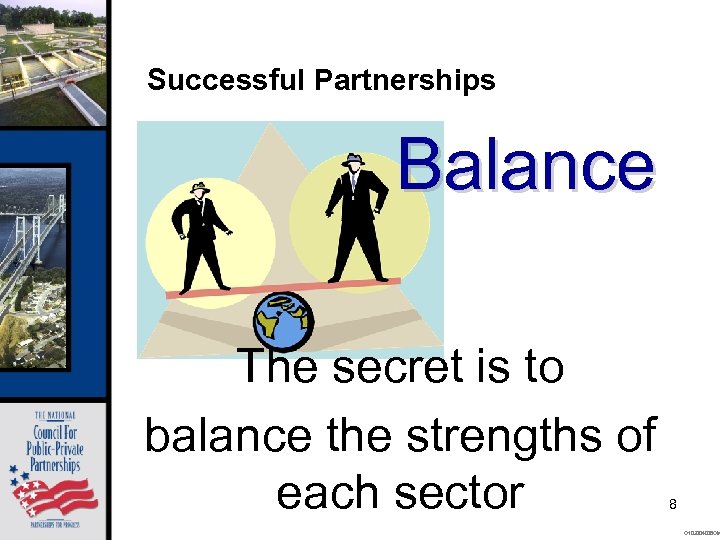
Successful Partnerships Balance The secret is to balance the strengths of each sector 8 O 102004008 OM
Partnerships at Work The Experience of One Sector Helps Another § Transportation § Public Safety § Water/Wastewater § Social Programs § Financial Management § Environmental Programs § Urban Development § Education 9 O 102004008 OM
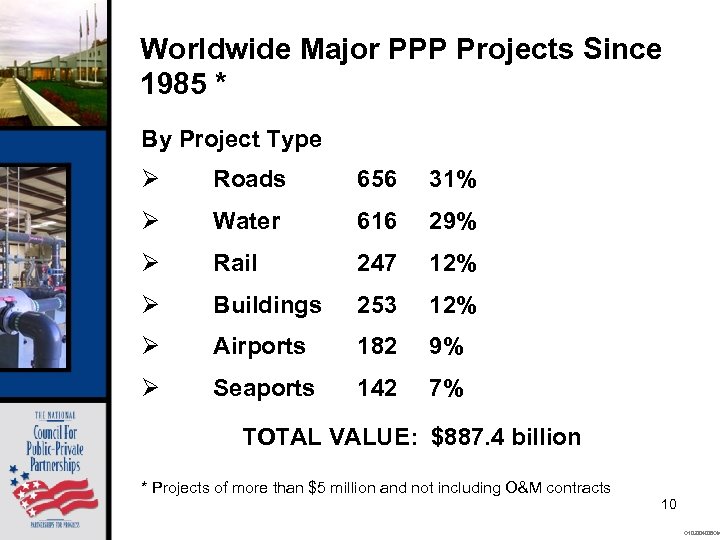
Worldwide Major PPP Projects Since 1985 * By Project Type Ø Roads 656 31% Ø Water 616 29% Ø Rail 247 12% Ø Buildings 253 12% Ø Airports 182 9% Ø Seaports 142 7% TOTAL VALUE: $887. 4 billion * Projects of more than $5 million and not including O&M contracts 10 O 102004008 OM
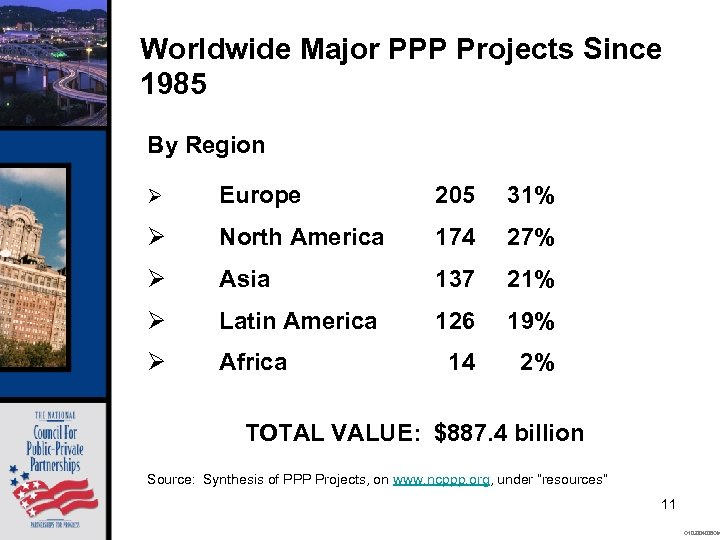
Worldwide Major PPP Projects Since 1985 By Region Ø Europe 205 31% Ø North America 174 27% Ø Asia 137 21% Ø Latin America 126 19% Ø Africa 14 2% TOTAL VALUE: $887. 4 billion Source: Synthesis of PPP Projects, on www. ncppp. org, under “resources” 11 O 102004008 OM
Recruiting the Private Sector § What will bring them to the table? § Remember: – Development cost often over $1 million – Risks are higher than a traditional DBB – Long-term is needed to repay the initial capital investment 12 O 102004008 OM
The Private Sector’s Criteria § Guarantee of property rights § Established and enforceable contract law § Enabling legislation in place § Actual demand – Does the public really want this project? § Reasonable development timeframe § Financially feasible (public, user fees, etc. ) § Manageable, shared risks 13 O 102004008 OM
The Private Sector’s Criteria Continued § Political Climate § Transparent Procurement Process § Market Evaluation § Environmental Evaluation § Solid Partnership Philosophy of Public Sector – Dedicated team for the processes • Concept to RFP • Management of negotiations • Management of the partnership 14 O 102004008 OM
PPPs and Cost Savings = Part of the Puzzle § Quicker delivery vs. inflation § Design-Build can be another cost saver § Economies of scale – Engineering – Materials – Management practices § Savings – 5% up to 40% § Manage currency fluctuations 15 O 102004008 OM
Cost Savings = The Other is Half the Benefits Income Generation GENERAL RULE: TOLLS/USER FEES DO NOT COVER THE TOTAL COST § But can provide enough income to make a project possible § Provide a cash stream for private equity investment - “enough dough to make it go” § There are “cash cows” – share the wealth with less fortunate parts of the system 16 O 102004008 OM
Cost Savings = The Other is Half the Benefits Income Generation Other Income Sources § Dedicated Tax Districts and Tax Increment Financing (TIF) – DC’s New York Avenue Metro Station § Underutilized Assets – Economic Development • Oyster School – Transportation Oriented Development • Union Station 17 O 102004008 OM
Non-Construction Project PPPs § Operations and Maintenance – All types of infrastructure § Competitive Sourcing of Personnel Functions – Social program delivery – Financial management (debt collection, etc. ) 18 O 102004008 OM
Managed Competition for Maintenance § Public and Private compete for the same contract § Can have an even split on the winners § Example: Highway Maintenance – Massachusetts • Saved $15 million per year (Harvard Study) – Virginia • Saved 12% on average – Texas • Expanding program rapidly because of savings experience (again 12 to 15%) 19 O 102004008 OM
Asset Management Contracts § Applies to any capital investment § Energy Savings Performance Contracts § Can be included with construction through a defined life cycle – Build better = lower maintenance § Florida – Saved over 15% in maintenance costs 20 O 102004008 OM
Six Keys to Successful PPPs § Statutory and Political Environment § Organized Structure § Detailed Business Plan § Guaranteed Revenue Stream § Stakeholder Support § Pick Your Partner Carefully 21 O 102004008 OM
Managing for Success – Six Keys Component One: The Environment § Statutory authority and regulations § Political leadership must be in place – Leading Political Figure – Top Administrative Officials – “The Will to Change the System” – A Strong Policy Statement 22 O 102004008 OM
Managing for Success – Six Keys Component Two: Organizational Structure § Dedicated group (tied to the purpose of the partnership) § Dedicated and TRAINED personnel to monitor implementation § Examples: – – – TXDOT VDOT PPP Centrum Partnerships UK Irish Government’s Central PPP Unit § Need for Good Governance – To assure an open and fair procurement process – Consolidate staff = easier to monitor – Independent authority (domestic/internal or international) 23 O 102004008 OM
Managing for Success – Six Keys Component Three: Detailed Business Plan a. k. a. Enforceable Contract § Performance goal oriented - Allow for innovative plans § Best Value vs. Lowest Price § Plan/Contract should include: – Specific milestones and goals – Reporting of metrics and frequency § Risk Allocation – Shift to the private sector can raise costs – Identify best prices to retain, which to shift § Dispute Resolution Methodology § Workforce Development? – Develop in-country resources/small businesses 24 O 102004008 OM
Managing for Success – Six Keys Component Four: Guaranteed Revenue Stream § Funds to Cover the Long-Term Financing – Tolls/Fees (real or shadow) – TIF or other form of a Tax District – Long-Term Maintenance Contracts – Underutilized Assets – Creative Approaches 25 O 102004008 OM
Managing for Success – Six Keys Component Five: Stakeholder Support § Public Sector Employees § Private Sector § Labor Unions § End Users § Competing Interests § Requires: – Open and frank discussion between sectors – Knowing the FACTS (no myths) – Translating each other’s language 26 O 102004008 OM
Managing for Success – Six Keys Component Six: Pick Your Partner Carefully § This is a long-term relationship § Verify experience (technical capability) § Verify financial capability § Best Value vs. Lowest Price § Remember each sector’s motivation – Timely and effective execution – Reasonable return on investment 27 O 102004008 OM
Managing for Success The Most Critical is Component One: Strong LEADERSHIP makes all the other factors come together 28 O 102004008 OM
A Case Study: Dakar, Senegal – Water system 29 O 102004008 OM
A Case Study Dakar, Senegal – Water system § Originally, less than 56% had access to potable water § Government created an asset holding company -- Société Nationale des Eaux du Sénégal (SONES) ü Component One: ü Component Two: Political environment Organizational Structure § Developed a contract with a private consortium, with clearly defined goals and penalties – Maintenance specifications – Upgrading of equipment – Meet WHO standards for water quality ü Component Three: Enforceable Contract 30 O 102004008 OM
A Case Study Dakar, Senegal – Water system § Financial agreement included partial funding from the World Bank, and a gradual increase in the water rates with a “social block” ü Component Four: Guaranteed Revenue Stream § Extensive contact with local officials for evaluating the program before and during implementation ü Component Five: Stakeholder Communications § Award was made through an open competitoin, with the advance and counsel of a Dutch consultant (not part of the private consortium) ü Component Six: Pick Your Partners Carefully 31 O 102004008 OM
Six Keys to Successful PPPs § Statutory and Political Environment § Organized Structure § Detailed Business Plan § Guaranteed Revenue Stream § Stakeholder Support § Pick Your Partner Carefully 32 O 102004008 OM
Скачать презентацию Public-Private Partnerships UNITED NATIONS Special Unit South-South Cooperation September
2336d46e7b0d168c5c5f2160ab929236.ppt