 Скачать презентацию Public Private Partnerships Introduction to PPPs Frederick J
671d5f356c790288cdcdf130ec116118.ppt
- Количество слайдов: 22



Public Private Partnerships Introduction to PPPs Frederick J. Werner FHWA Resource Center Innovative Finance Team Federal Highway Administration-National Resource Center
Presentation Outline § What are PPPs? § Working definition § PPPs for existing, new and improved facilities § PPPs: Pros and Cons § Myths and facts about PPPs § The evolving US federal role § SAFETEA-LU innovative finance tools § Summary 2 Federal Highway Administration-National Resource Center
What are PPPs? § Would anyone like to venture a guess? § Public component § Private component § Partnership component 3 Federal Highway Administration-National Resource Center
Working Definition § PPPs are a legally-enforceable contractual agreement § Between a public sector and a private sector entity § Designed to develop and deliver a surface transportation project § Specific terms/provisions of contractual agreement can and do vary widely 4 Federal Highway Administration-National Resource Center
Public Partner § Most commonly, the public partner is a state or provincial DOT § However, public partners can also include: § Local governments; highway and toll authorities § Port or bridge authorities; transit districts § Bi-state, multi-state or bi-national districts 5 Federal Highway Administration-National Resource Center
Private Partner § Most commonly, large engineering or investment companies § However, private partners can also include: • Combinations of firms (joint ventures or consortia) • Individuals; groups of individuals • Quasi-public corporations 6 Federal Highway Administration-National Resource Center
Partnership Arrangement § Can be structured as a simple contract; concession agreement; letter of intent; memorandum of understanding; hand-shake agreement (uncommon; for small value transactions) § Can address one-time events such as donation of land for ROW § Can address very long-term agreements whereby the private sector builds and/or operates a transportation facility 7 Federal Highway Administration-National Resource Center
Partnership Arrangement § Arrangement may specify a minimum of private sector involvement, such as donation of land, a guaranty of public sector debt, or a willingness to self-assess to finance an improvement. § Arrangement may specify significant private sector involvement, whereby private sector invests its equity capital – cash on hand or borrowed funds – and agrees to design, build, finance, operate and maintain a given facility. § Many variations on private involvement for existing and new (“greenfield”) facilities, as well as significant improvements to existing facilities. 8 Federal Highway Administration-National Resource Center
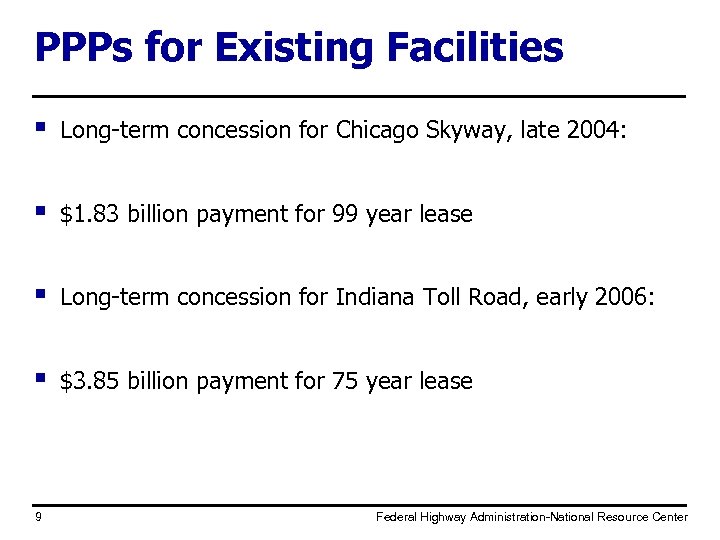
PPPs for Existing Facilities § Long-term concession for Chicago Skyway, late 2004: § $1. 83 billion payment for 99 year lease § Long-term concession for Indiana Toll Road, early 2006: § $3. 85 billion payment for 75 year lease 9 Federal Highway Administration-National Resource Center
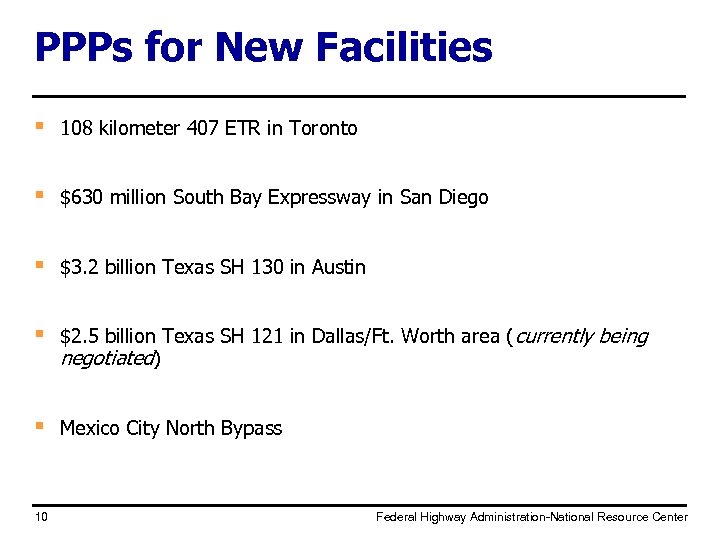
PPPs for New Facilities § 108 kilometer 407 ETR in Toronto § $630 million South Bay Expressway in San Diego § $3. 2 billion Texas SH 130 in Austin § $2. 5 billion Texas SH 121 in Dallas/Ft. Worth area ( currently being negotiated) § Mexico City North Bypass 10 Federal Highway Administration-National Resource Center
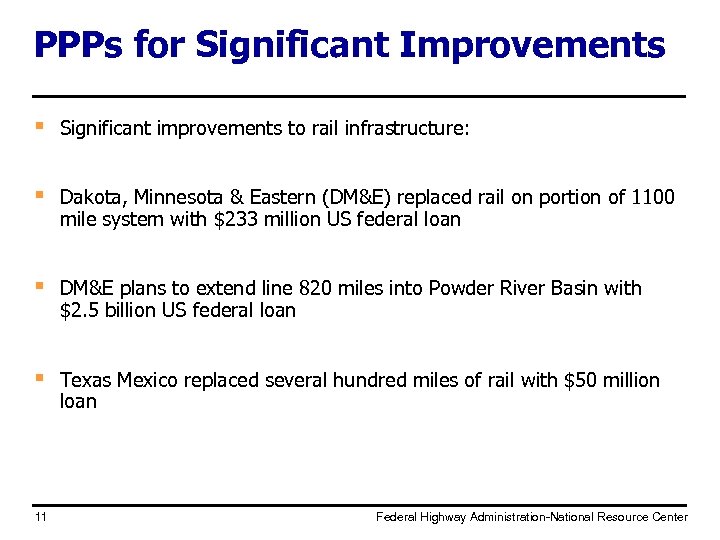
PPPs for Significant Improvements § Significant improvements to rail infrastructure: § Dakota, Minnesota & Eastern (DM&E) replaced rail on portion of 1100 mile system with $233 million US federal loan § DM&E plans to extend line 820 miles into Powder River Basin with $2. 5 billion US federal loan § Texas Mexico replaced several hundred miles of rail with $50 million loan 11 Federal Highway Administration-National Resource Center
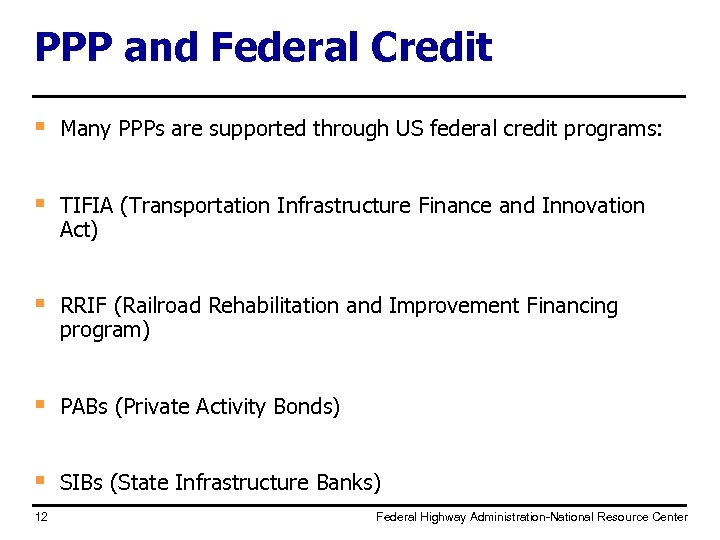
PPP and Federal Credit § Many PPPs are supported through US federal credit programs: § TIFIA (Transportation Infrastructure Finance and Innovation Act) § RRIF (Railroad Rehabilitation and Improvement Financing program) § PABs (Private Activity Bonds) § SIBs (State Infrastructure Banks) 12 Federal Highway Administration-National Resource Center
PPPs: Pros and Cons § Deep pools of investment capital looking to invest in assets for a very long period; funds looking for long-term income to match long-term liabilities (Tim Romer, Goldman Sachs). § Injection of equity capital to invest in other assets and access to funding outside municipal bond market (Trent Vichie, Macquarie Securities). § Transfer of project risk to private sector (Trent Vichie, Macquarie Securities). 13 Federal Highway Administration-National Resource Center
PPPs: Pros and Cons § Public perception that critical “public” assets are controlled by private sector, often for very long periods, with related public safety and asset performance concerns. § Need to charge user fees in environments and/or markets unaccustomed to such charges (Caltrans). § Concern that PPP projects - especially those involving railroads and dedicated truck lanes - properly protect the environment. “The real obstacle to many PPP projects is not the politics, but environmental clearance” (Southern California Association of Governments). § Need to fit PPP projects into coherent long-term state plans (Caltrans). 14 Federal Highway Administration-National Resource Center
Myths About PPPs § PPPs can solve all the nation’s infrastructure problems § Every project is a potential PPP § All PPPs will generate big financial rewards § The US is losing control of critical transportation assets § PPPs will replace the traditional federal-aid grant program 15 Federal Highway Administration-National Resource Center
Facts About PPPs § State/local governments face challenges: • • Growing need for new infrastructure • § Fiscal stress and budget deficits Need to rehabilitate decaying existing infrastructure Public and private sector can share benefits: • § 16 Project delivery vs. concession income Public and private sector can share (environmental, financing, construction) project risks Federal Highway Administration-National Resource Center
The Evolving Federal Role § Traditionally, the US federal government has financed highways through 80% grant programs § § Pay-as-you-go approach § Goal is to leverage limited federal resources from: • Co-investment • Revenue expansion 17 However, ISTEA, TEA-21 and SAFETEALU have provided alternative or “innovative” forms of non-grant assistance to advance projects Federal Highway Administration-National Resource Center
SAFETEA-LU Facilitates PPPs § Innovative Finance initiatives: • Enhanced TIFIA credit program – Available for refinancings – Available for projects costing $50 million or more • Continued RRIF credit program • $15 billion in Private Activity Bond authority • Expanded SIB authority • Broader tolling authority on Interstates • Expanded use of design-build provisions 18 Federal Highway Administration-National Resource Center
FHWA Initiatives § Secretary Mineta’s National Congestion Strategy • “Unleashing private-sector investment resources” § Use of SEP 15 waiving most federal-aid requirements on a trial basis § Use of SEP 15 coupled with a streamlined TIFIA credit application process 19 Federal Highway Administration-National Resource Center
Revolutionary Change in PPPs § § PPPs have been successful for wide variety of projects § Electronic toll technology is facilitating public’s acceptance of user fees § GASB 34 (asset management) is changing traditional view of highway construction from an “expense” to an “investment” § PPPs are another important tool in our toolbox - if the right conditions are met! 20 Increases in equity market capacity and competition; domestic equity investors are joining international investors in PPP market Federal Highway Administration-National Resource Center
In Summary ……… § § Take advantage of changing US federal regulatory landscape § Contact Information: Prabhat Diksit 720 -963 -3202; Frederick Werner 404 -562 -3680 § Additional Information Leverage expertise of FHWA National Resource Center, Innovative Finance Team • Subject matter experts and solution providers • Expansive view – across FHWA and other modal programs • Broad view of needs – states, regions, nation, bi-national projects • www. fhwa. dot. gov/innovative • www. fhwa. dot. gov/ppp 21 Federal Highway Administration-National Resource Center
Conclusion 22 Federal Highway Administration-National Resource Center
Скачать презентацию Public Private Partnerships Introduction to PPPs Frederick J
671d5f356c790288cdcdf130ec116118.ppt