 Скачать презентацию Public-Private Partnership Does It Work The case
d8b82ca09d4e265f1c140b08335c4d7b.ppt
- Количество слайдов: 66



Public-Private Partnership – Does It Work? The case of banana R&D in the Philippines Dr. Agustin B. Molina Regional Coordinator – Asia Pacific Commodities for Livelihoods Bioversity International* *With effect from 1 December 2006, IPGRI and INIBAP operate under the name "Bioversity International", Bioversity for short. This new name echoes our new strategy, which focuses on improving people’s lives through biodiversity research.
Banana is the most important food in terms of production value after rice, wheat and maize About 100 million tons of bananas produced every year: § § § in 120 countries 13% is exported 87% is consumed where they are produced
In the Philippines, banana is: : • the most widely grown fruit crop, source of livelihoods of many small scale farmers • top foreign exchange earner among horticultural crops • most available fruit all year round
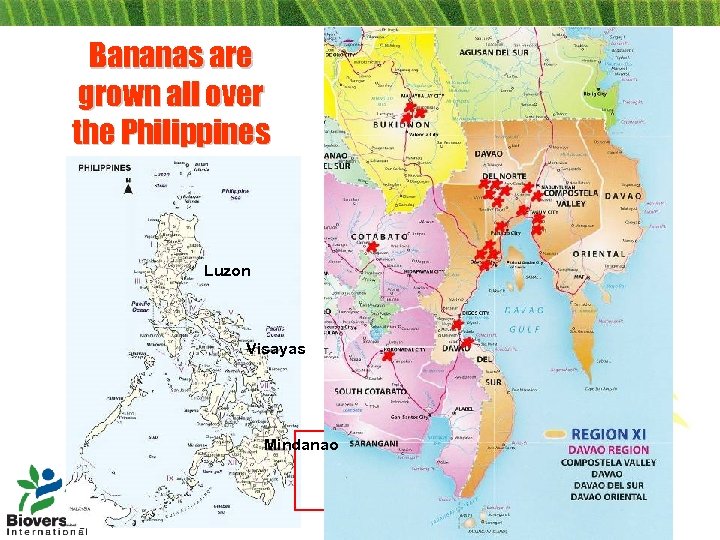
Bananas are grown all over the Philippines Luzon Visayas Mindanao
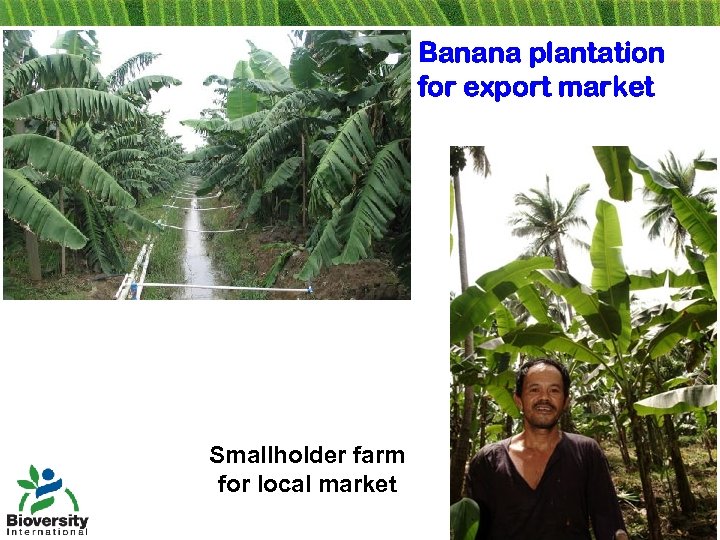
Banana plantation for export market Smallholder farm for local market
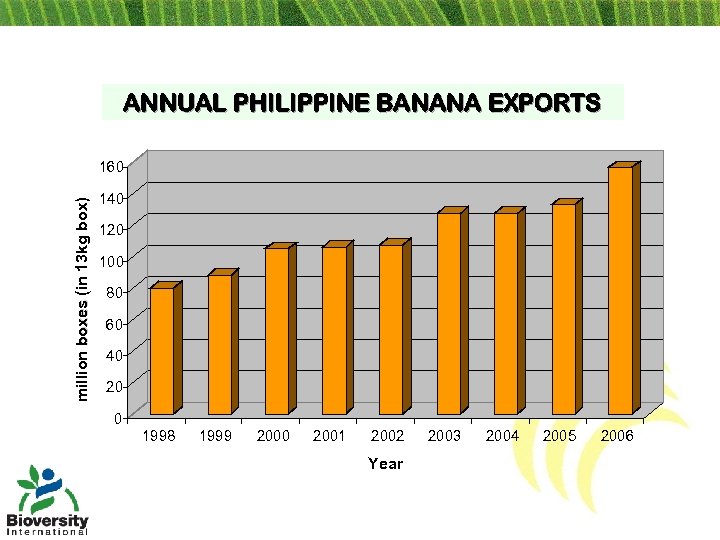
ANNUAL PHILIPPINE BANANA EXPORTS million boxes (in 13 kg box) 160 140 120 100 80 60 40 20 0 1998 1999 2000 2001 2002 Year 2003 2004 2005 2006
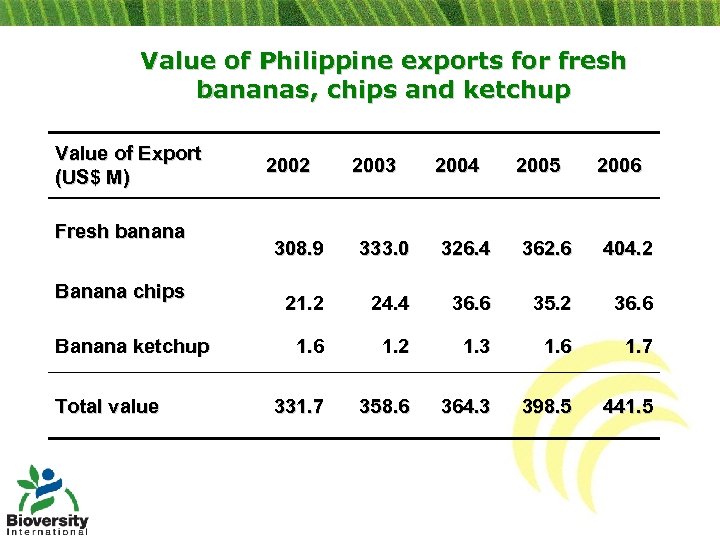
Value of Philippine exports for fresh bananas, chips and ketchup Value of Export (US$ M) Fresh banana Banana chips Banana ketchup Total value 2002 2003 2004 2005 2006 308. 9 333. 0 326. 4 362. 6 404. 2 21. 2 24. 4 36. 6 35. 2 36. 6 1. 2 1. 3 1. 6 1. 7 331. 7 358. 6 364. 3 398. 5 441. 5
Two banana diseases of major concern: • Fusarium wilt – a serious threat to the export industry • Banana Bunchy Top Virus– destroyed the livelihood of many small-scale Lakatan growers
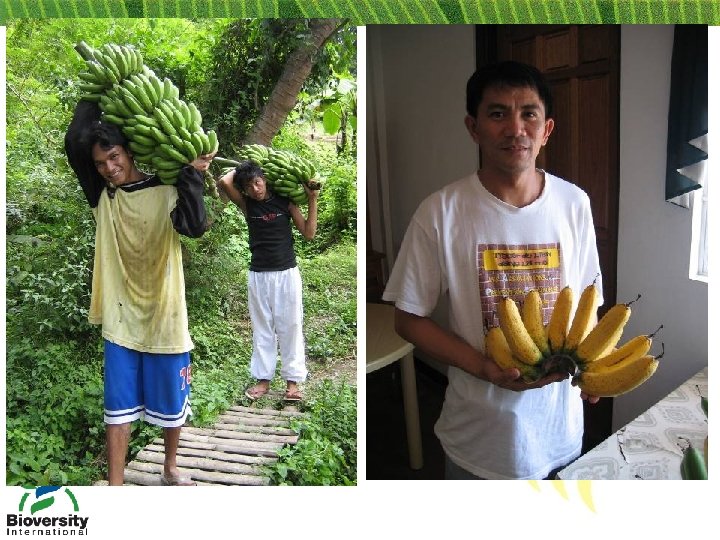
The Lakatan Industry • Lakatan is the most popular table banana in the Philippines • Huge local market • Traditionally produced by small-scale growers • Devastated by BBTV since 1990 • Loss of livelihoods of many small-scale growers in Luzon and the Visayas • Current supply produced by big companies
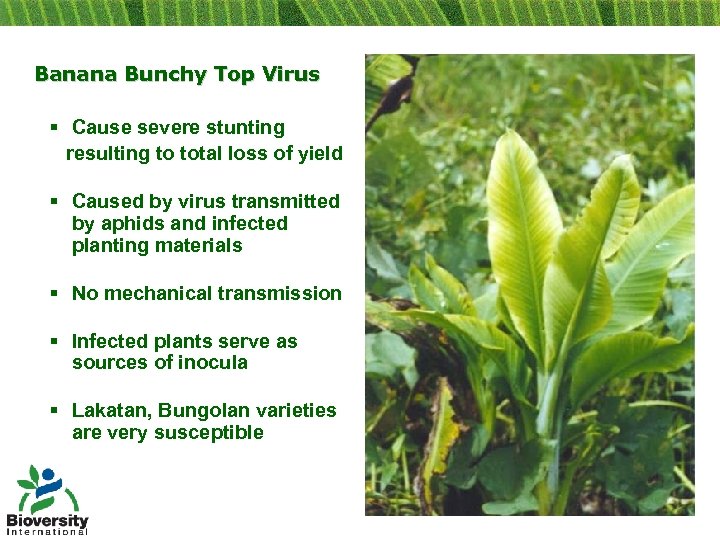
Banana Bunchy Top Virus § Cause severe stunting resulting to total loss of yield § Caused by virus transmitted by aphids and infected planting materials § No mechanical transmission § Infected plants serve as sources of inocula § Lakatan, Bungolan varieties are very susceptible
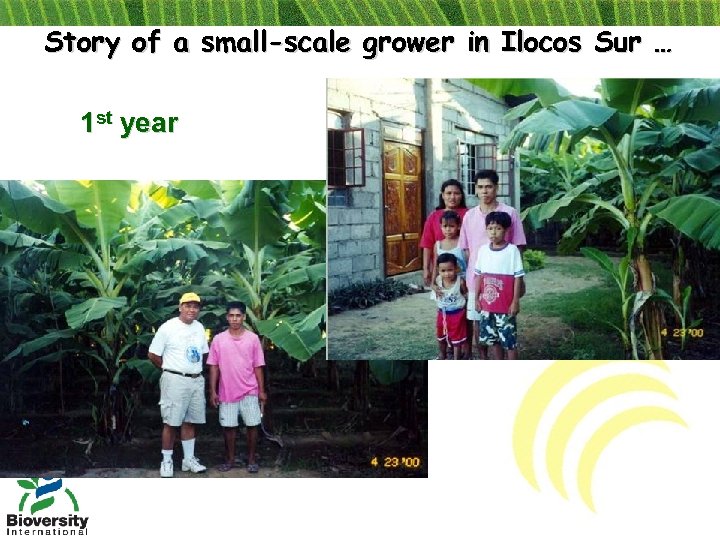
Story of a small-scale grower in Ilocos Sur … 1 st year
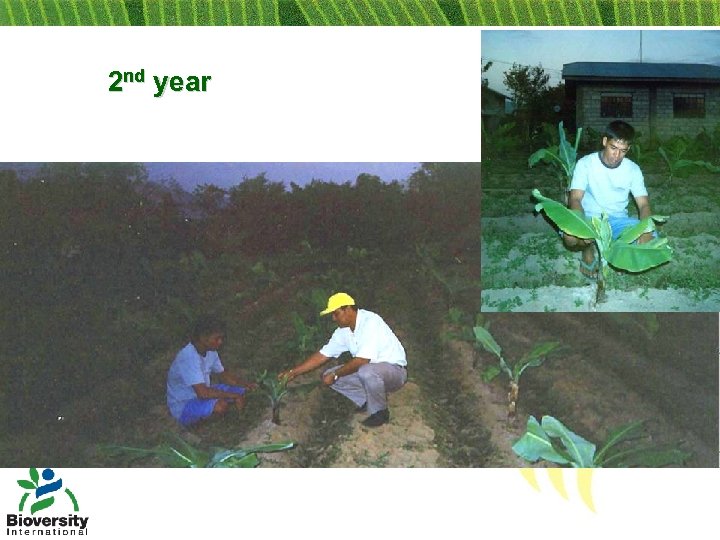
2 nd year
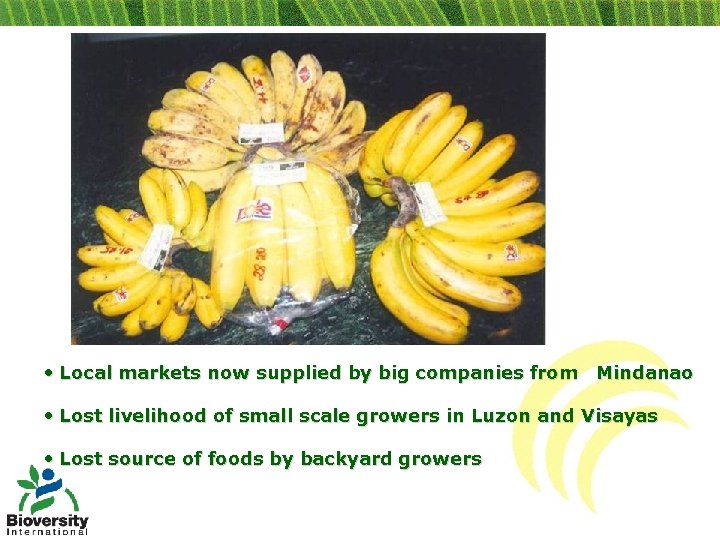
• Local markets now supplied by big companies from Mindanao • Lost livelihood of small scale growers in Luzon and Visayas • Lost source of foods by backyard growers
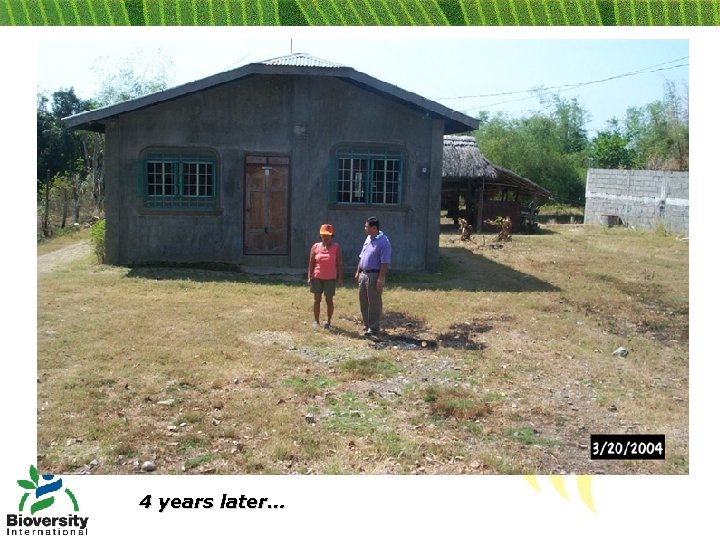
4 years later…
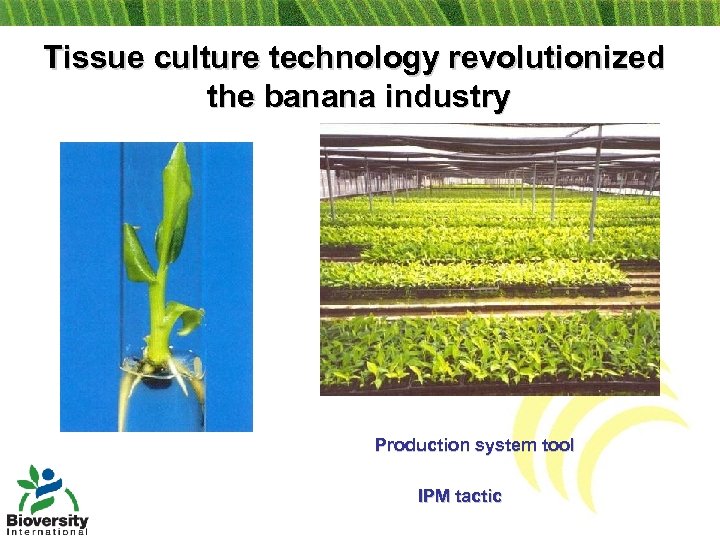
Tissue culture technology revolutionized the banana industry Production system tool IPM tactic
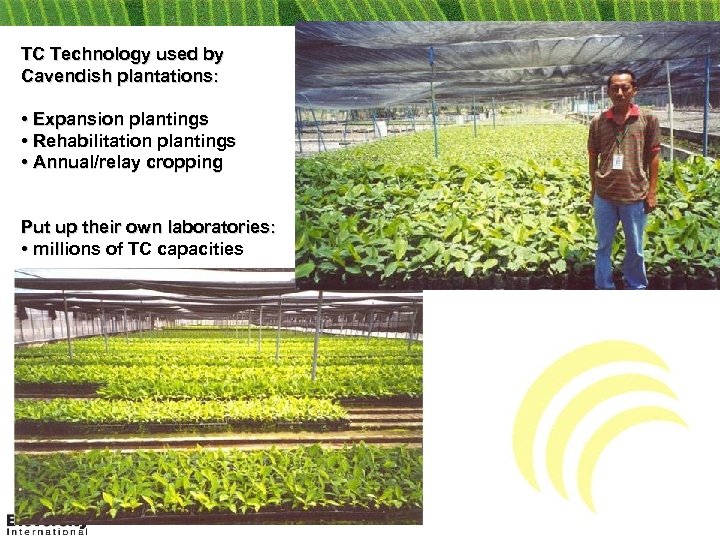
TC Technology used by Cavendish plantations: • Expansion plantings • Rehabilitation plantings • Annual/relay cropping Put up their own laboratories: • millions of TC capacities
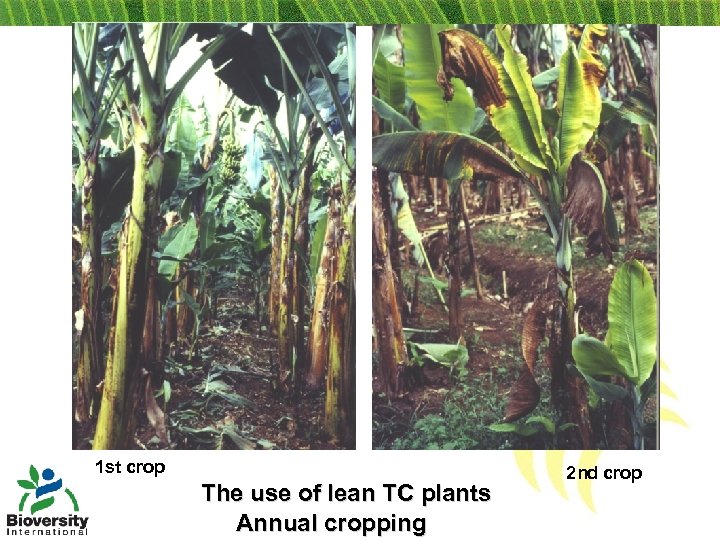
1 st crop The use of lean TC plants Annual cropping 2 nd crop
The need to develop a sustainable delivery system of clean TC plants for small-scale growers Previous strategy: Assisted/funded tissue culture laboratories through universities and other government institutes Failed: no sustainable supply, expensive Government laboratories are not cost-effective Private labs make money because of efficiency and economies of scale
Need to develop profitable production system for TC plants • TC plants have cost • TC plants need appropriate production technique • Small-scale farmers need training to make TC banana production profitable • Need to develop a safe cost-effective and sustainable TC delivery system
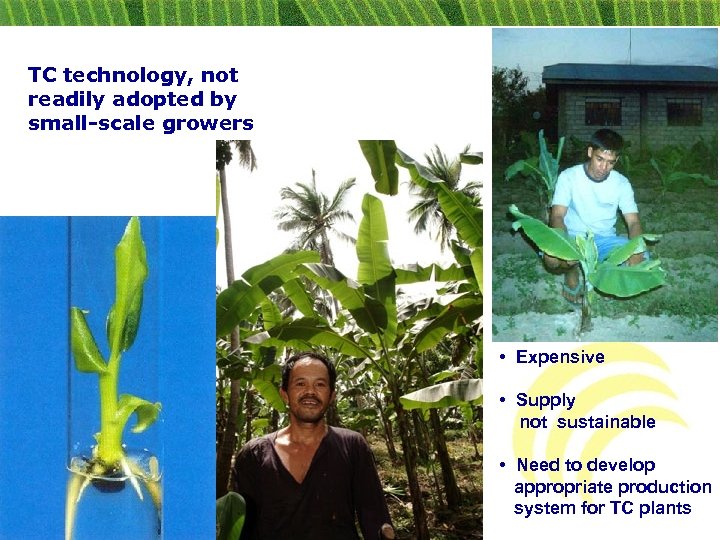
TC technology, not readily adopted by small-scale growers • Expensive • Supply not sustainable • Need to develop appropriate production system for TC plants
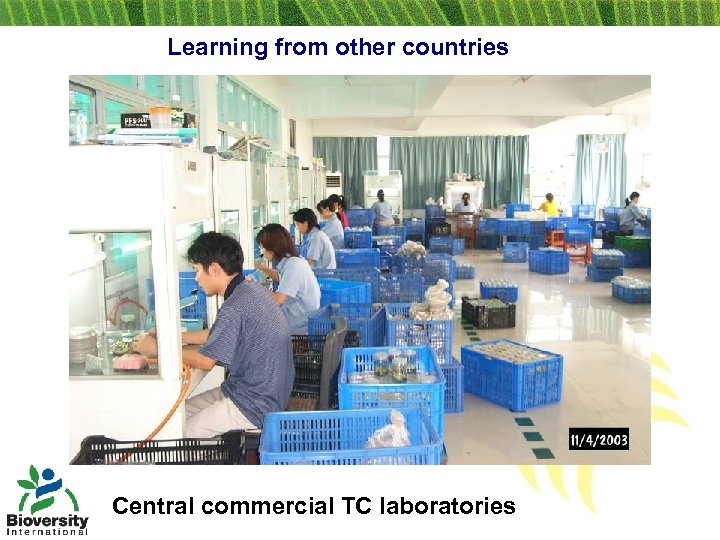
Learning from other countries Central commercial TC laboratories
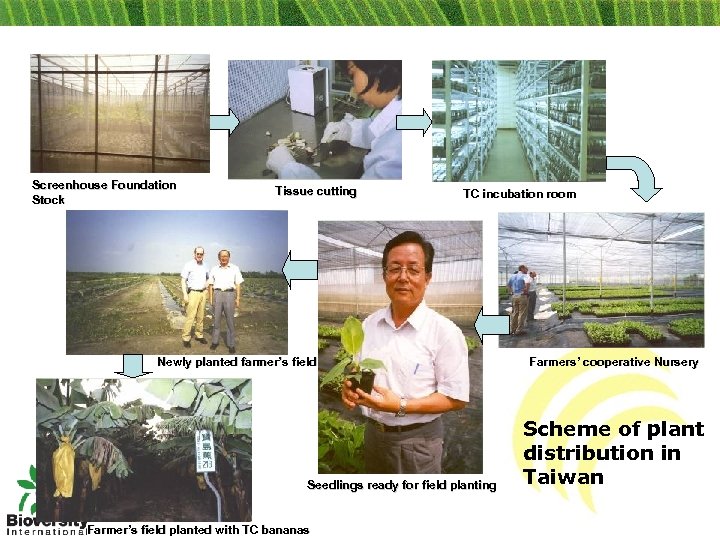
Screenhouse Foundation Stock Tissue cutting TC incubation room Newly planted farmer’s field Seedlings ready for field planting Farmer’s field planted with TC bananas Farmers’ cooperative Nursery Scheme of plant distribution in Taiwan
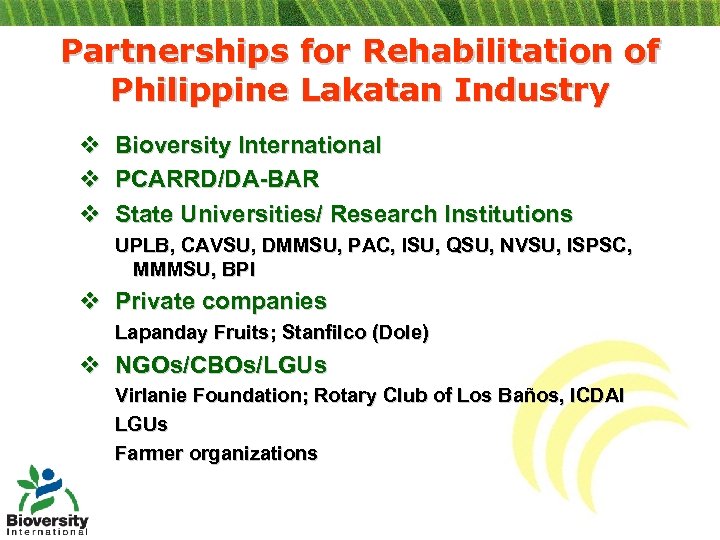
Partnerships for Rehabilitation of Philippine Lakatan Industry v v v Bioversity International PCARRD/DA-BAR State Universities/ Research Institutions UPLB, CAVSU, DMMSU, PAC, ISU, QSU, NVSU, ISPSC, MMMSU, BPI v Private companies Lapanday Fruits; Stanfilco (Dole) v NGOs/CBOs/LGUs Virlanie Foundation; Rotary Club of Los Baños, ICDAI LGUs Farmer organizations
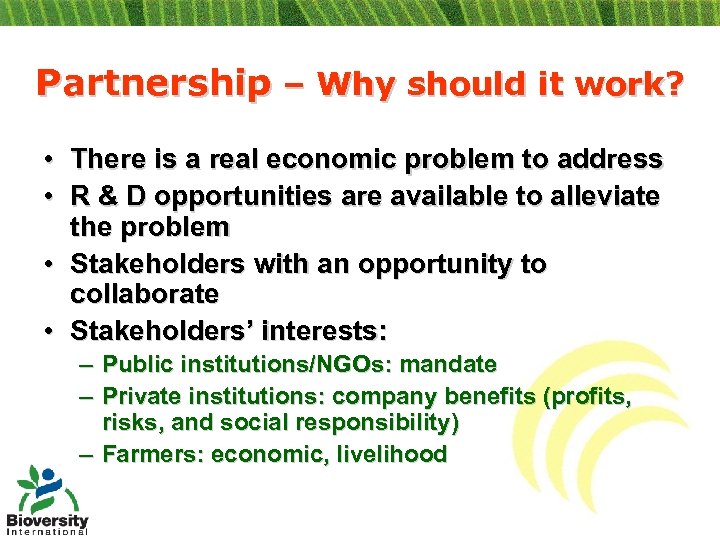
Partnership – Why should it work? • There is a real economic problem to address • R & D opportunities are available to alleviate the problem • Stakeholders with an opportunity to collaborate • Stakeholders’ interests: – Public institutions/NGOs: mandate – Private institutions: company benefits (profits, risks, and social responsibility) – Farmers: economic, livelihood
Roles of partners • Bioversity International – Networking/Technical coordination • PCARRD/DA-BAR – National coordination/funding/monitoring and evaluation • State Universities/ Research Institutions – R&D, technical support and technology packaging and validation, and promotion • Private companies/ NGOs/LGUs/FO – Farm validation, promotion and upscaling
R & D activities by SCUs • Epidemiology of BBTV – source of inocula, transmission and spread • Role of disease free-planting materials – TC vs. suckers, virus indexing • Production systems – annual vs. perennial • Appropriate cultural management – fertilization, population density, pruning, etc • Varietal resistance
BBTV Management • Quarantine – prevent spread • Sanitation/Eradication • Use of disease-free planting materials • Resistant varieties
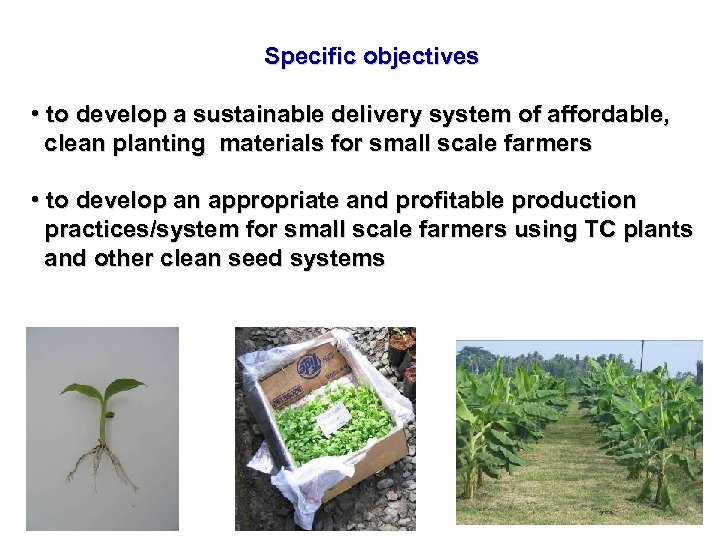
Specific objectives • to develop a sustainable delivery system of affordable, clean planting materials for small scale farmers • to develop an appropriate and profitable production practices/system for small scale farmers using TC plants and other clean seed systems
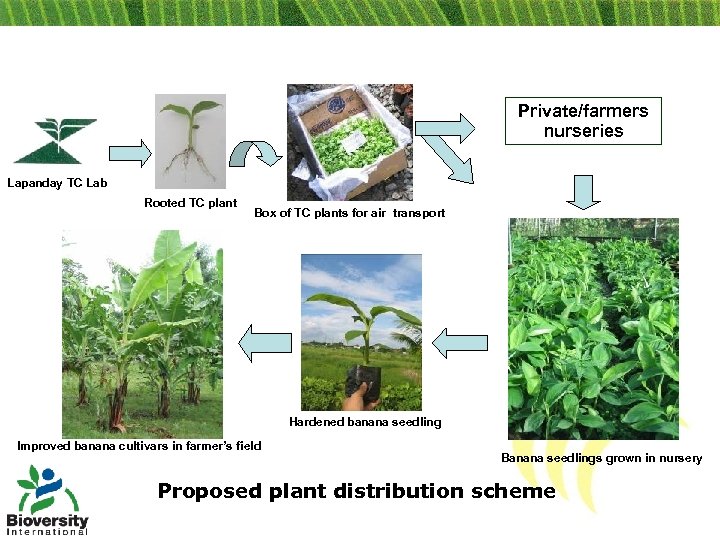
Private/farmers nurseries Lapanday TC Lab Rooted TC plant Box of TC plants for air transport Hardened banana seedling Improved banana cultivars in farmer’s field Banana seedlings grown in nursery Proposed plant distribution scheme
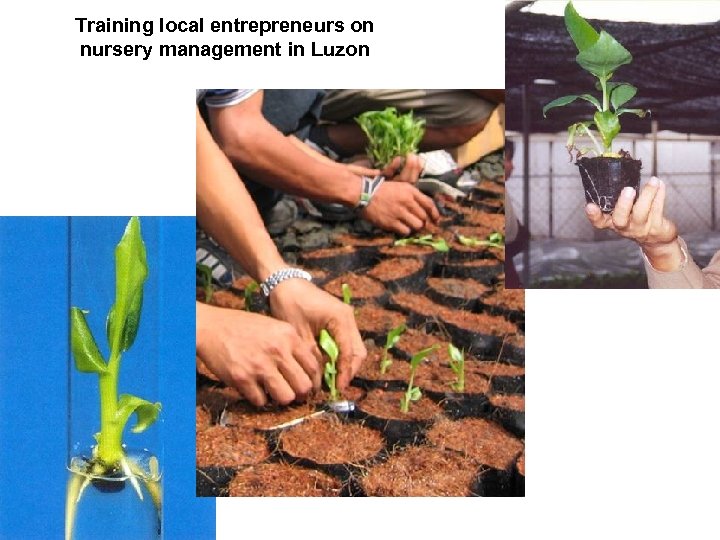
Training local entrepreneurs on nursery management in Luzon
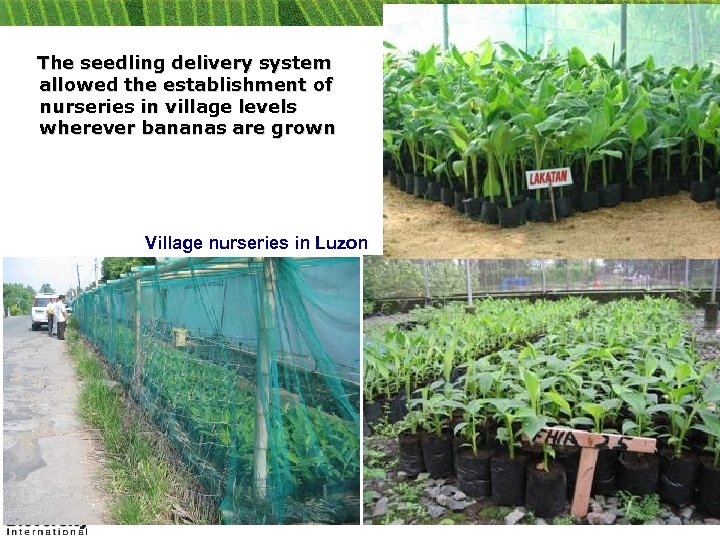
The seedling delivery system allowed the establishment of nurseries in village levels wherever bananas are grown Village nurseries in Luzon
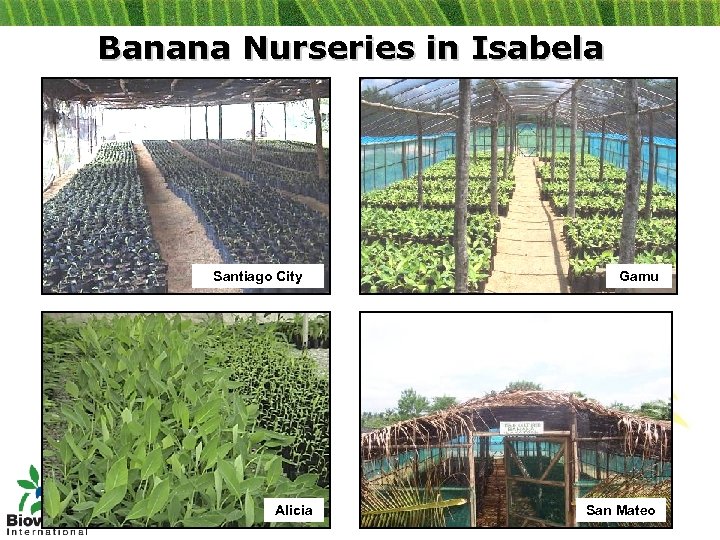
Banana Nurseries in Isabela Santiago City Alicia Gamu San Mateo
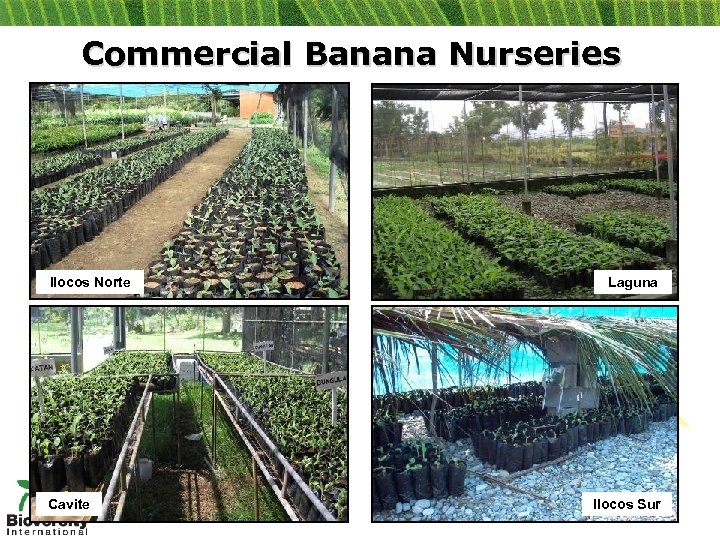
Commercial Banana Nurseries Ilocos Norte Cavite Laguna Ilocos Sur
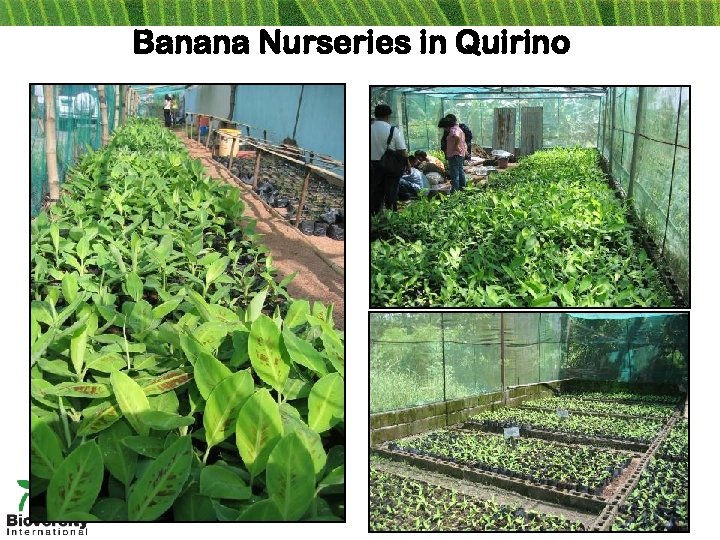
Banana Nurseries in Quirino
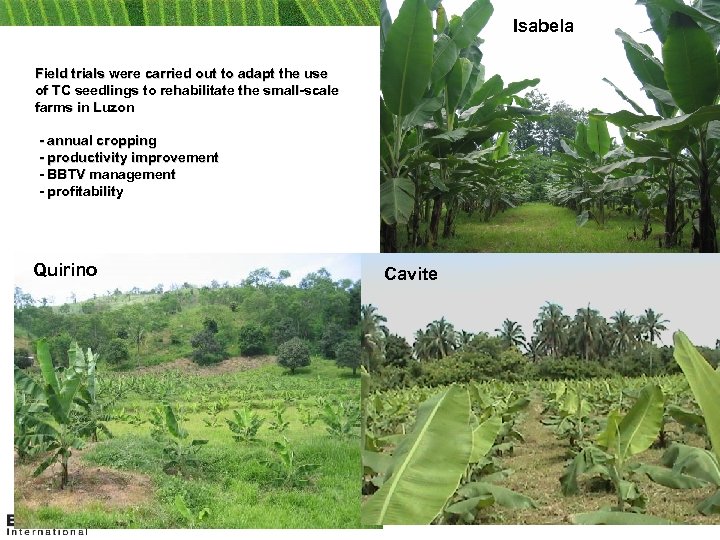
Isabela Field trials were carried out to adapt the use of TC seedlings to rehabilitate the small-scale farms in Luzon - annual cropping - productivity improvement - BBTV management - profitability Quirino Cavite
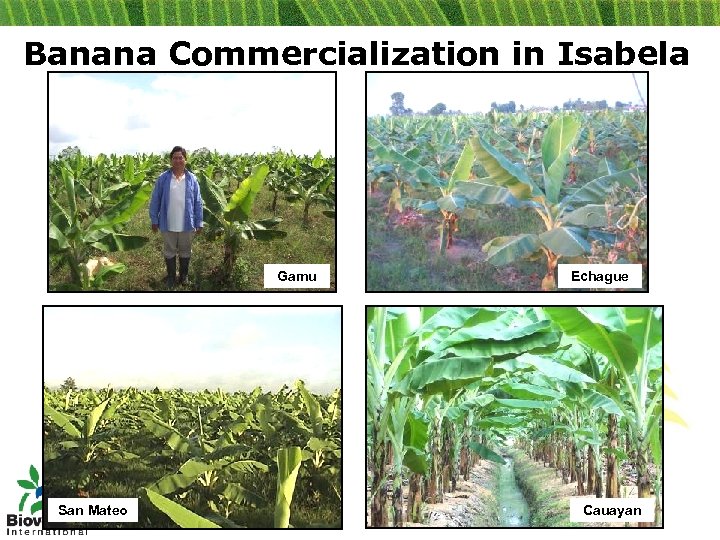
Banana Commercialization in Isabela Gamu San Mateo Echague Cauayan
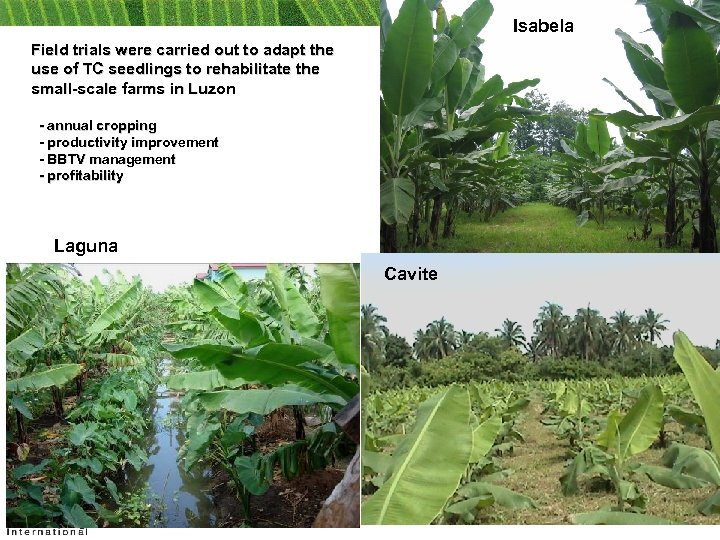
Isabela Field trials were carried out to adapt the use of TC seedlings to rehabilitate the small-scale farms in Luzon - annual cropping - productivity improvement - BBTV management - profitability Laguna Quirino Cavite
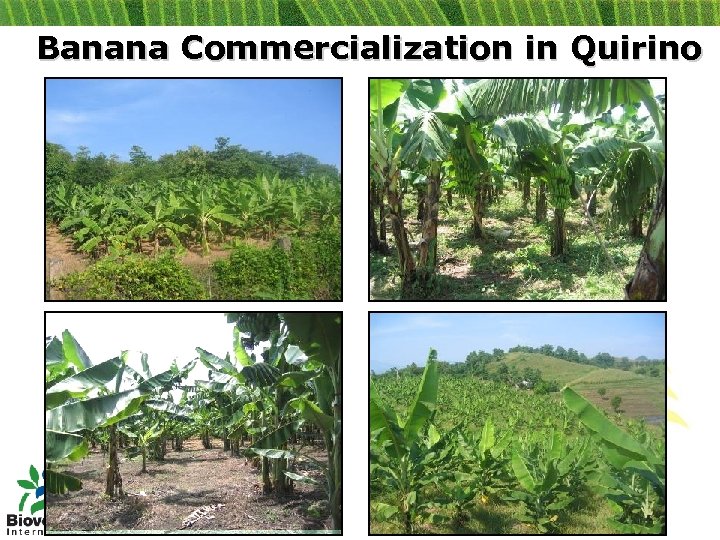
Banana Commercialization in Quirino
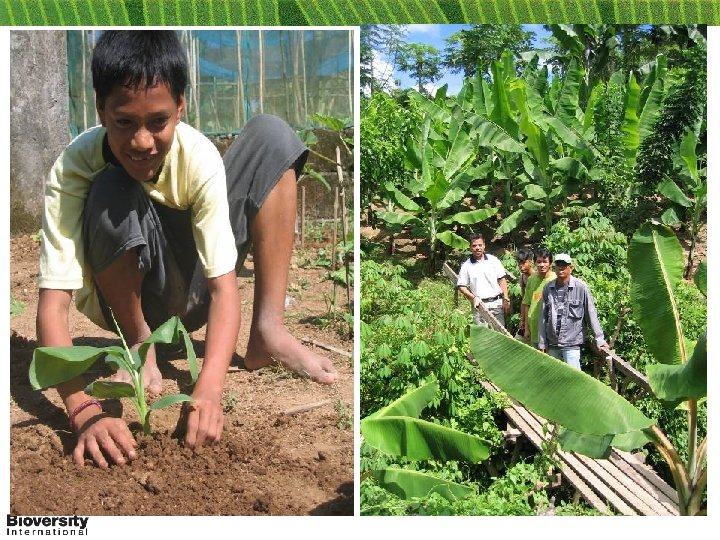
Virlanie Foundation, Inc. non-government organization A French non-government organization that offers shelter, food and education to over 300 former street children The foundation has 11 homes in Manila, and a farm for more than 15 boys in Batangas province Bioversity assisted Virlanie in the training of former street children in the basics of banana production and sustainable farming Bioversity helped enable the Virlanie farm to be more food secure by producing their own bananas; supply other Virlanie homes in Manila and generate income through the sale of excess produce
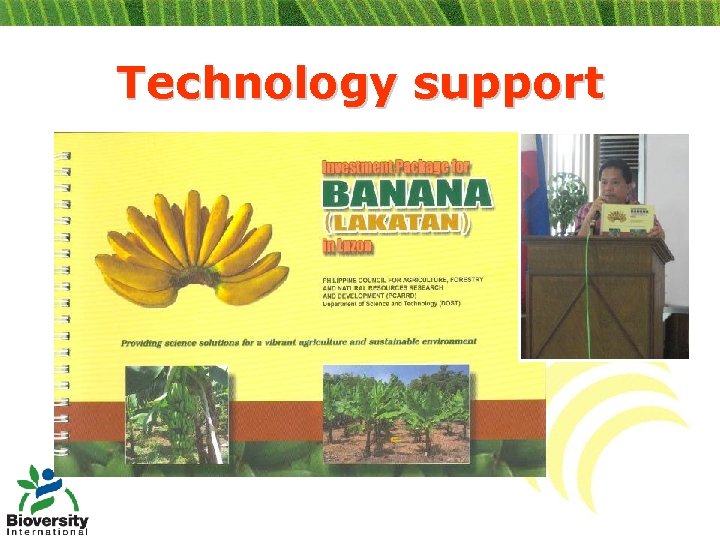
Technology support
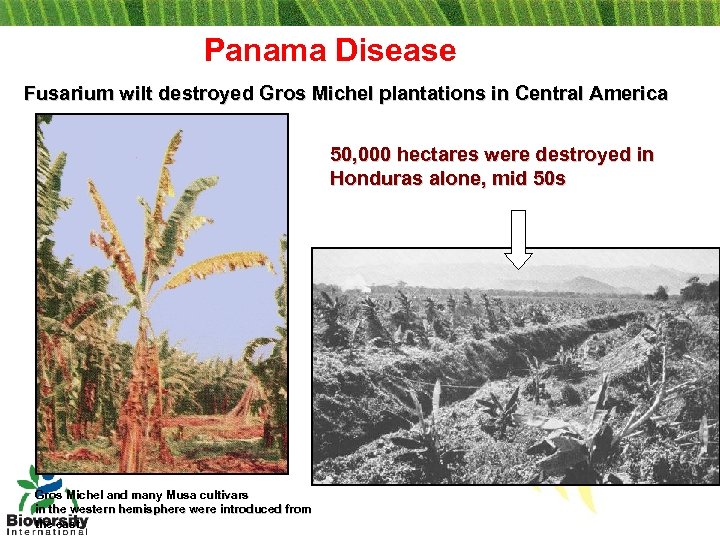
Panama Disease Fusarium wilt destroyed Gros Michel plantations in Central America 50, 000 hectares were destroyed in Honduras alone, mid 50 s Gros Michel and many Musa cultivars in the western hemisphere were introduced from the east
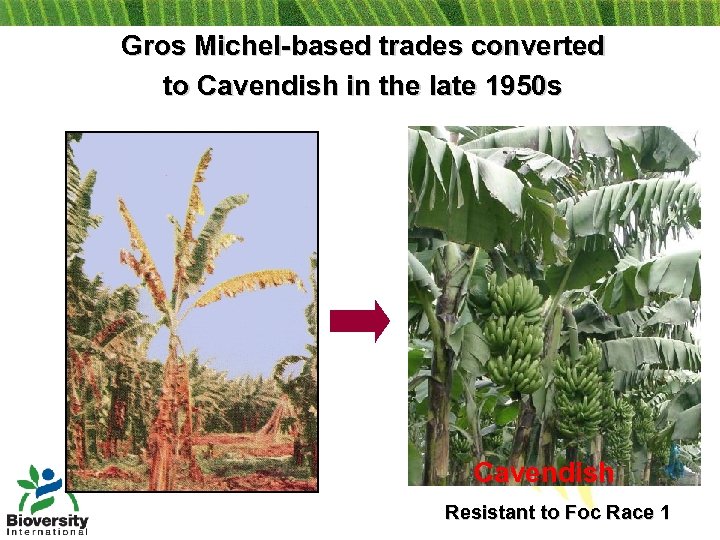
Gros Michel-based trades converted to Cavendish in the late 1950 s Cavendish Resistant to Foc Race 1
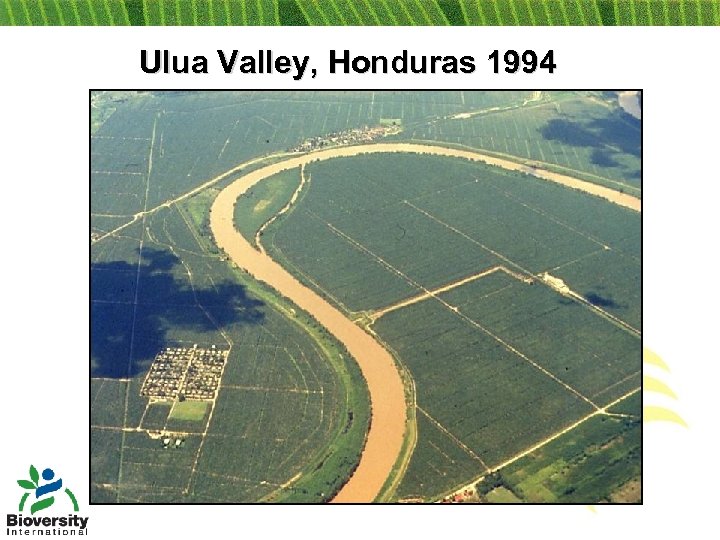
Ulua Valley, Honduras 1994
Our problem is solved!
The problem is over? . . NOT QUITE! The appearance of a Race of Foc in Asia, Tropical Race 4 (TR 4), that can attack Cavendish has renewed the nightmare brought about by the Foc epidemic during the Gros Michel era
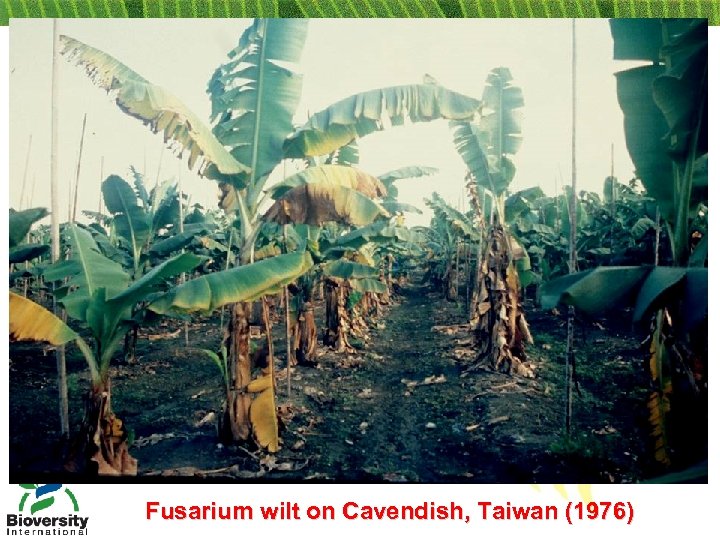
Fusarium wilt on Cavendish, Taiwan (1976)
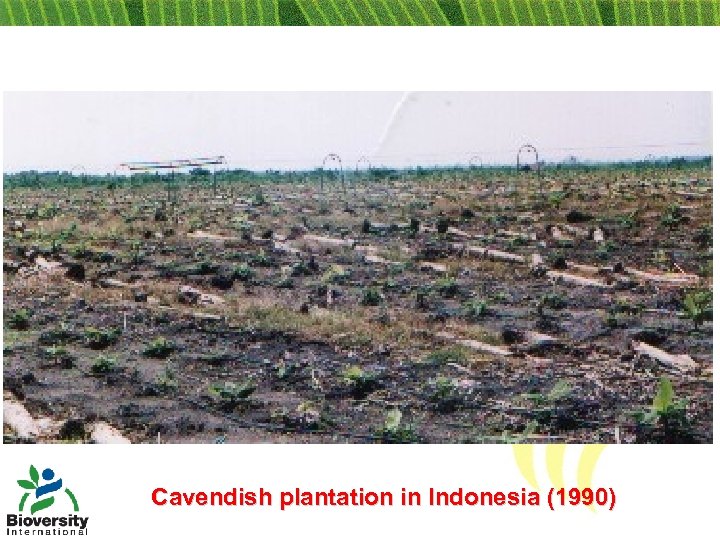
Cavendish plantation in Indonesia (1990)
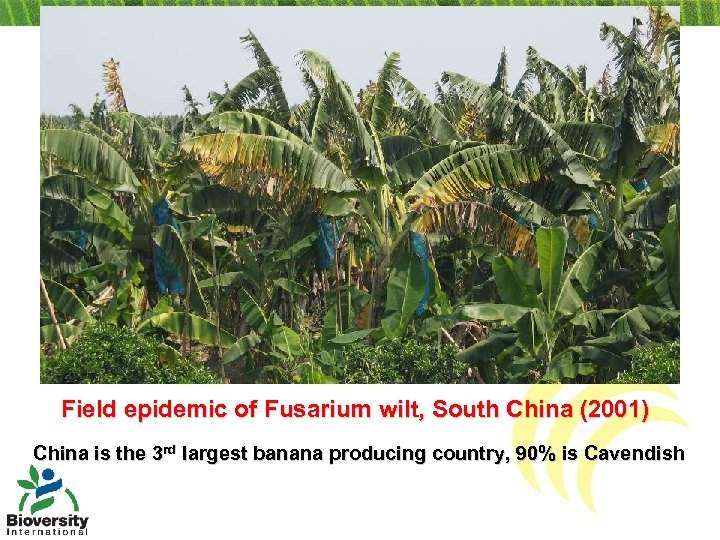
Field epidemic of Fusarium wilt, South China (2001) China is the 3 rd largest banana producing country, 90% is Cavendish
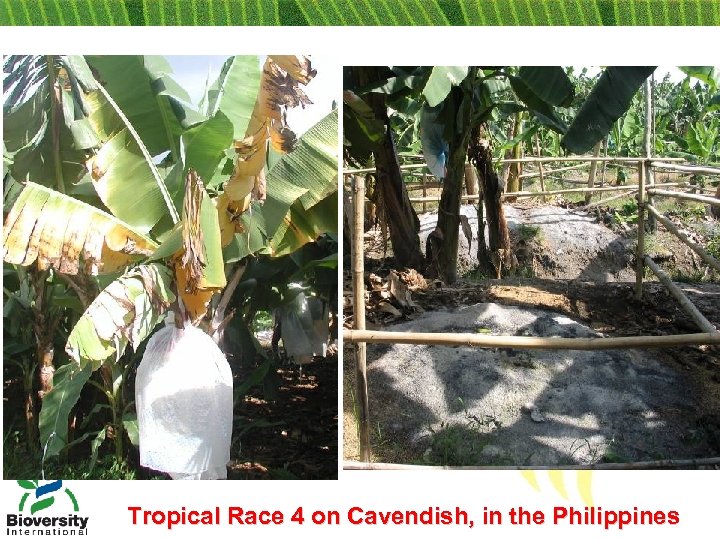
Tropical Race 4 on Cavendish, in the Philippines
“A virulent Fusarium wilt pathogen that can attack the popular Cavendish export varieties will have a significant impact on the Cavendish banana industry in the Philippines”
Public-private partnerships in addressing Foc TR 4 in the Philippines • Traditionally companies are secretive and individualistic in their operations and R & D • Public research institutions traditionally leave the industry to address their own R & D needs • Recognizing that Fusarium wilt TR 4 problem is an industry-wide issue (including small-scale farmers), Bioversity facilitated a collaboration of companies, Department of Agriculture, PCARRD, advance research centers to work together
Developing an IPM approach: • A knowledge-based quarantine strategy to contain and prevent spread: Survey and characterization of Foc pathogens both in commercial plantations and small scale farms – funded by PBGEA, PCARRD, DA-BAR, Bioversity - implemented by Bioversity International, UPLB, BPI, Companies, LGUs, FABI (South Africa) • Development and validation of disease management tactics: cultural management, varietal resistance, biological control • Information exchange and training
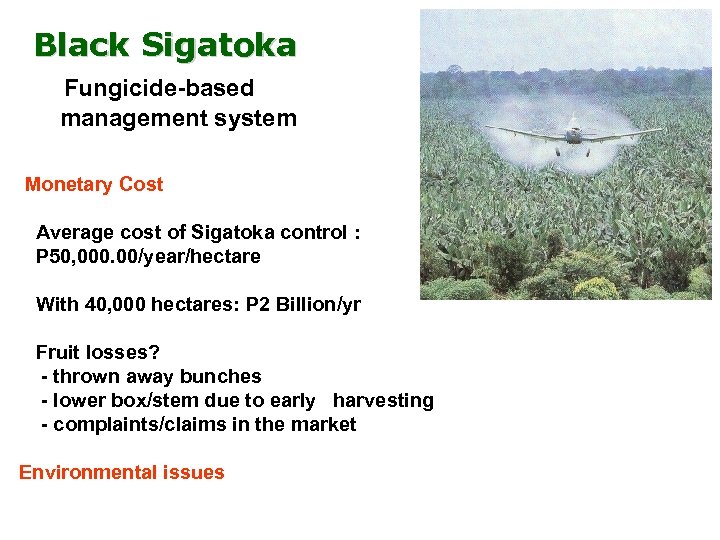
Black Sigatoka Fungicide-based management system Monetary Cost Average cost of Sigatoka control : P 50, 000. 00/year/hectare With 40, 000 hectares: P 2 Billion/yr Fruit losses? - thrown away bunches - lower box/stem due to early harvesting - complaints/claims in the market Environmental issues
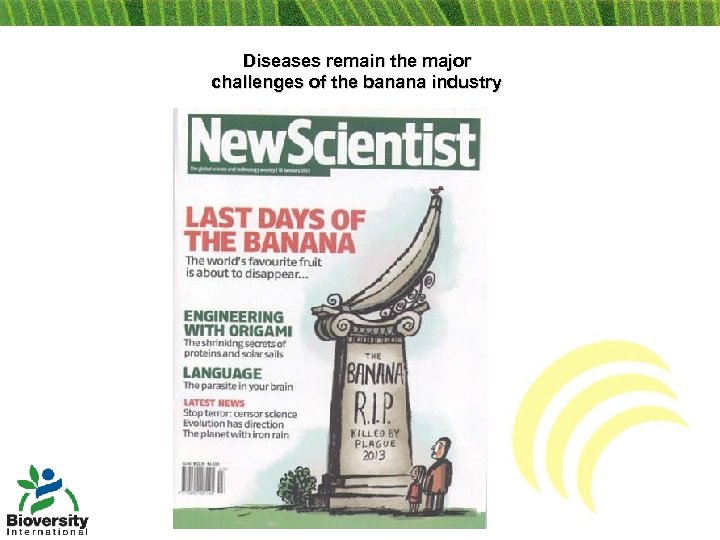
Diseases remain the major challenges of the banana industry

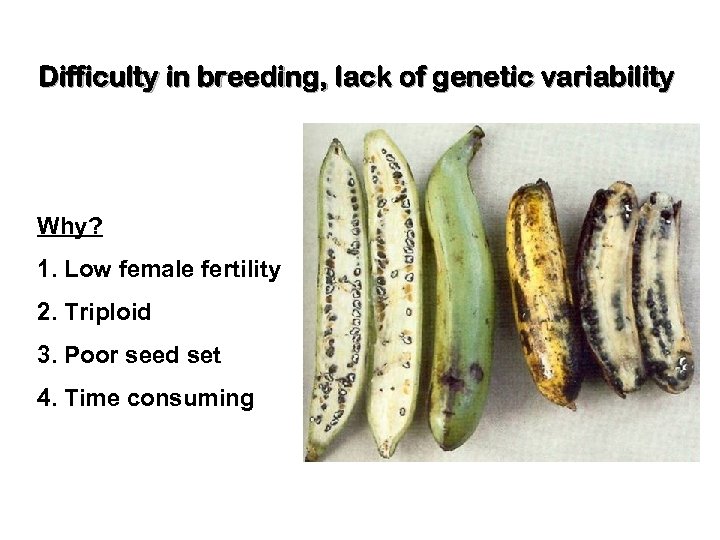
Difficulty in breeding, lack of genetic variability Why? 1. Low female fertility 2. Triploid 3. Poor seed set 4. Time consuming
Banana Breeding: • Polyploidy presents difficulty • Very few breeding programs in the whole world • Genetic engineering – market acceptability, especially for the export market, difficulty in genes for disease resistance
The Need for Global Partnership in Banana Breeding: • Bioversity International – Genomics consortium mainly public institution • Need for more participation by the private industry (multinationals) - short vs long term goals - industry in the red? - excess production
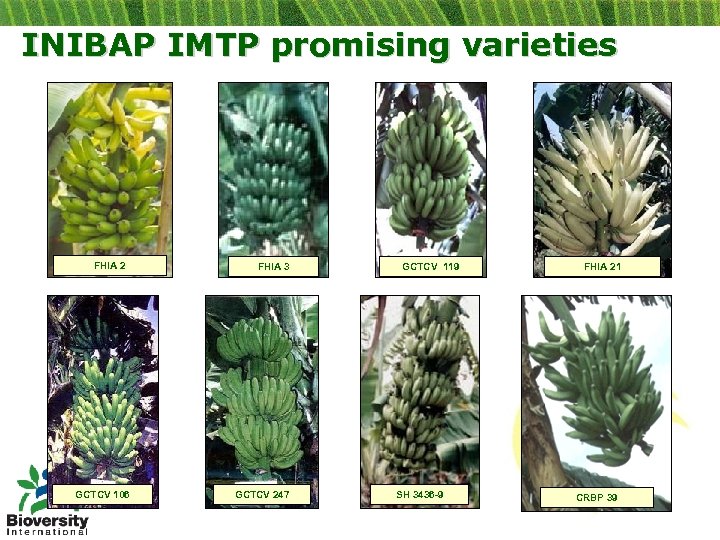
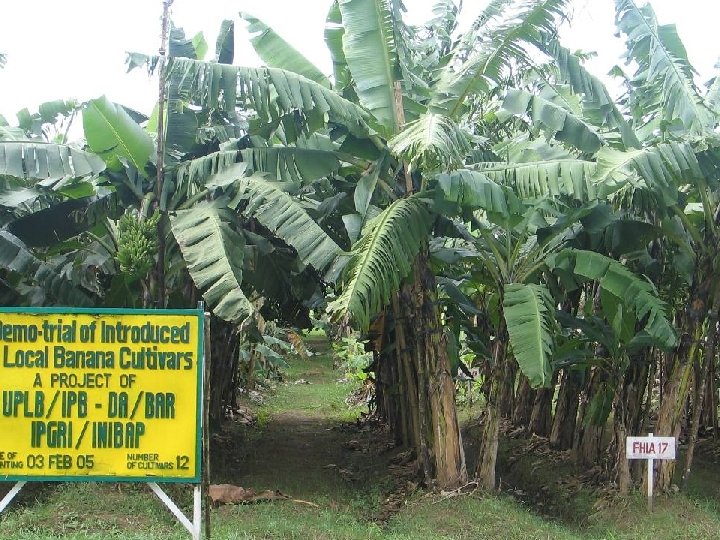
INIBAP IMTP promising varieties FHIA 2 GCTCV 106 FHIA 3 GCTCV 247 GCTCV 119 SH 3436 -9 FHIA 21 CRBP 39
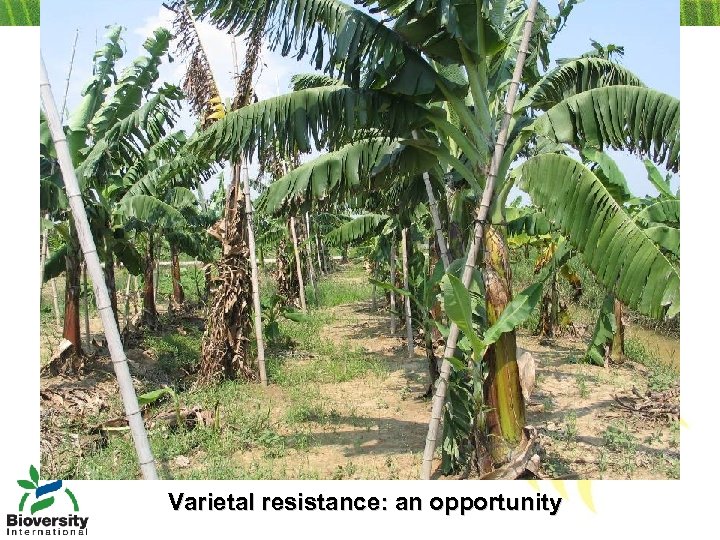
Varietal resistance: an opportunity
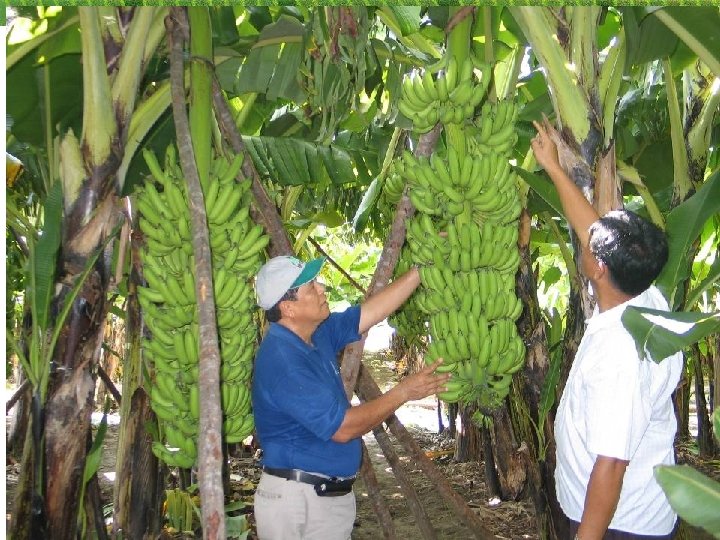
Market acceptability is of great importance: • taste • appearance • post harvest • other uses This makes new varieties, however good their agronomic traits are, difficult to introduce in the market Demand can also be inelastic - substitutability
Thank You!
Скачать презентацию Public-Private Partnership Does It Work The case
d8b82ca09d4e265f1c140b08335c4d7b.ppt