 Скачать презентацию Public Private linkages in UK wheat breeding
314729659df9ea1e22bf5ff8e41d1c90.ppt
- Количество слайдов: 15



Public – Private linkages in UK wheat breeding: Successes, Failures and Opportunities Peter Jack, RAGT, Cambridge 3 rd UK Cereal Genetics and Genomics Workshop, John Innes Centre, Norwich, 6– 7 April 2006
Background • Application of DNA markers in Breeding – 1 site – 3 owners! – PBI-Cambridge (1987 -1997) • Privatised part of PBI (sold to Unilever) • PBI crops, plantation crops, vegetable crops – Monsanto Cambridge (1997 - 2004) • European Wheat & Barley breeding & biotech centre – RAGT Seeds Cambridge (2004 -present) • European Wheat breeding centre • Number 2 European wheat breeder (after Limagrain/Nickerson-Advanta) • Very different organisations, crops, view of technology. – But consistent use of DNA markers by breeders throughout. – Strongly assisted by sharing site > facilitating technology transfer. – Communication is SO important!
Marker-Assisted Wheat Breeding in RAGT • Applications – Introgression novel alleles from non-adapted wheats or related species • Some characters would not have been introgressed without markers – Parental characterisation • Identifying optimal combinations of crosses – Early generation selection • Eliminating negative & enriching positive alleles – Mid & late generation selection • Fixing positive allele combinations. • Traits under marker selection – Disease resistance, Quality, Yield, Adaptation – BUT gene interactions e. g. yield penalty of disease, quality penalty of yield – need to understand why. – Sustainability traits too complex to tackle alone. • Source of Markers & Trait Marker Linkages – 50% discovered/validated in house – 50% sourced from public work (but most from outside UK!)
Scope of Talk • Focus specifically on Wheat given its importance in UK agriculture – Apologies to barley and other communities but similar principles apply? • Personal perspective – But also an attempt to synthesise many discussions within UK wheat breeding industry. • Distinction between Fundamental Plant Science & Crop Science – Fundamental science is curiosity driven and criteria of success is discovery per se - as judged by literature & not by applications. – Crop Science is “Applied” research i. e. there has to be clear benefit to Agriculture to justify “Crop” Science. – My comments relate to Crop Science & not fundamental Plant Science.
This subject has received much attention recently! • Recent discussion meetings – BCPC meeting at RRS 16/2/06. – WGIN management meeting at NIAB 7/2/06. – HGCA LINK project review at NIAB 6/3/06. • Reflects – genuine desire for more effective PP linkages (by some at least) – encouraged by broader analyses such as BBSRC Crop Science Review April ‘ 04. • Will consider outcomes later – First some successes – what can we learn from them & how do we achieve them more consistently.
Successes part 1 - LINK • LINK projects e. g. practical benefits from: – Orange blossom midge; Septoria tritici; Lodging; Soil borne mosaic virus; Fusarium head blight (not an exclusive list just some examples) • Others in progress: Wheat functionality; HFN; Ergot. • Others in development: Drought tolerance & WUE; Second wheat. • Why is LINK successful? – Close relationship between Industry & Public scientists – e. g. hands on breeder involvement • at a practical level (in-kind); project set up & ownership; project management. • Not just suppliers of letters of support (at last minute with no opportunity to be involved!) – Rarely has this occurred in BBSRC projects or initiatives. • Limitations of LINK – In kind limits have now been reached – very difficult to take on new projects – should this be a limitation? Is there a way around? – DEFRA review of role in relation to supporting genetic research (outcome end ‘ 06) – Increasingly policy driven – how will important projects with lesser “sustainability” status be supported in future?
Successes part 2 - Communication • WGIN as a Communications Vehicle – Management meetings consistently well attended by Industry & Public sector. – CIMMYT visit Dec ’ 04 – Industry & Public sector both involved. – These Cereal Genetics & Genomics Meetings! – Much debate over priorities & applications. – Need to ensure such ideas acted upon! – Need to ensure this or similar communications vehicle continues. • Wheat apprentice at JI. – Secondment in Industry to gain practical experience & commercial realities.
Successes part 3 – Identification of Industry Needs • Wheat breeding community becoming more coordinated. – Especially pre-competitive research. • An example - Priority Traits List. – Aim is to identify important traits for which there is inadequate current public research. – Strong emphasis on work direct in wheat (or with clear route to wheat exploitation). – Many have strong sustainability aspects!
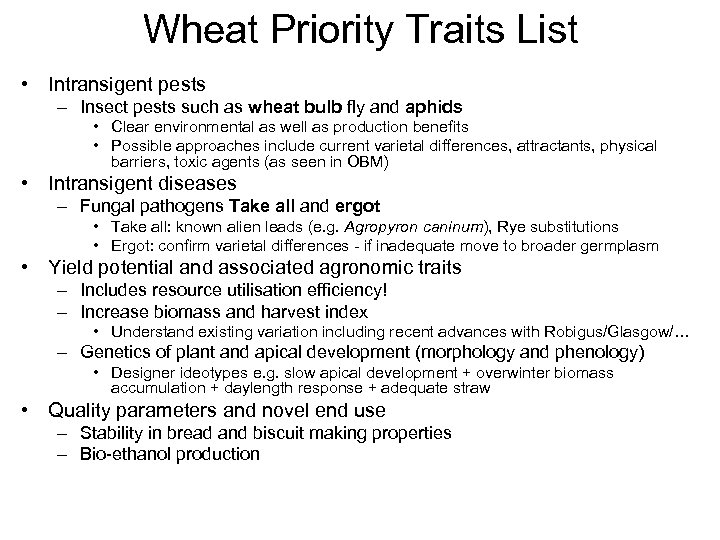
Wheat Priority Traits List • Intransigent pests – Insect pests such as wheat bulb fly and aphids • Clear environmental as well as production benefits • Possible approaches include current varietal differences, attractants, physical barriers, toxic agents (as seen in OBM) • Intransigent diseases – Fungal pathogens Take all and ergot • Take all: known alien leads (e. g. Agropyron caninum), Rye substitutions • Ergot: confirm varietal differences - if inadequate move to broader germplasm • Yield potential and associated agronomic traits – Includes resource utilisation efficiency! – Increase biomass and harvest index • Understand existing variation including recent advances with Robigus/Glasgow/… – Genetics of plant and apical development (morphology and phenology) • Designer ideotypes e. g. slow apical development + overwinter biomass accumulation + daylength response + adequate straw • Quality parameters and novel end use – Stability in bread and biscuit making properties – Bio-ethanol production
Priority Traits List - Outcomes • Take-all workshop, Cambridge 24/2/06 – Remarkable attendance list in terms of take-all research. – No easy solutions but can molecular genetics & genomics help? – Proposals required. • Grain quality workshop being planned. • But many opportunities remain! – e. g. Bioethanol; Insect resistance.
External Successes • What can we learn from others? – US Wheat National Marker Assisted Selection Program (MASwheat). – Web site contains much information that can be used directly e. g. marker protocols. • http: //maswheat. ucdavis. edu/ • Model that others could take note of. – Appears to be very strong link between researcher & breeder – targets & translation. • US Scab (FHB) Initiative. – Coordinated programme to attack key pathogen from multiple approaches. – Model for key UK targets e. g. Bioethanol, insect pests?
Failures part 1 – BBSRC Overview • BBSRC Crop Science Review identified many problems in UK Crop Science – No coherent strategy for crop research – Investment in plant science not yet impacting on strategic & applied crop science. – Fragmentation of funding within and between funders weakening the scientific strategy. – Shortage of suitably trained personnel. • Identified clear targets & technology priorities as basis for “BBSRC Crop Science Strategy”. – Quality through whole food chain including health & consumer benefits – Drought tolerance & water use – Durable & environmentally sustainable strategies for control of pests, pathogens & weeds; efficiency resource use & minimising waste. – Broadening crop range including novel crops & products for bioenergy… • Note the close fit with wheat breeders priority areas!
Failures part 2 –Specific examples • Many marker-trait associations in UK use were developed outside UK e. g. markers to: – – – GAI alleles Rht 1/2 Puroindoline grain hardness. Waxy. Glutenin & gliadin storage proteins. Bdv 2 Many disease resistance genes (FHB, Septoria, Rusts etc). • Importantly, much of the fundamental work behind these was conducted in UK. – the failure was to exploit these discoveries. • Public datasets often difficult to access or even know about. – More open dissemination should be encouraged. • WGIN core projects. – Targets were not agreed with those who would benefit from them e. g. breeders, end users. Sadly much of the work will not be taken up. – Many small projects – what about a focus on 1 or 2 key targets • e. g. bioethanol or insect resistance or take-all or exploiting diversity in synthetics? – BUT WGIN has played a valuable role in stimulating debate • engaging breeders in identifying common targets
Opportunities (& issues to be aware of) • BBSRC Crop Science Initiative. – Strong emphasis on translation of benefit. – Will this happen? Will there be a working relationship between public and industry scientists? • BBSRC LINK. – BBSRC would like to encourage LINK projects but will in kind limits restrict this? – Private sector much smaller than public so by definition can only match a small portion! – If this issue can be resolved then many opportunities open up. • Need for coordinated actions on key areas, especially where strong sustainability argument. – e. g. Bioethanol, insect pests. • NIAB - developing role in pre-breeding. – Supported by industry in area of pre-competitive breeding – important not to duplicate competencies. • MONOGRAM – Opportunity to not only align Institute activities but also to link with Industry – will this happen? Not forgetting Universities.
Conclusion • UK fundamental plant science is outstanding. – And much expenditure in “Crop” Science per se. – But small fraction projects translate into practical wheat benefits. • Especially in comparison with International outputs. • Recent LINK schemes are the exception – many successes. – Genuine collaboration & interaction between public and private sector. – But in kind requirements restrict options – this needs urgent attention. • BBSRC Initiatives such as CSI may help. – But better translational mechanisms are required. – Unclear how BBSRC response mode committees will respond to crops. • Communication vehicles such as WGIN are critical. • Emerging coordination between breeders in relation to precompetitive research. – Make the most of this! – TALK to them! And LISTEN to them! – And INVOLVE them THROUGHOUT!
Скачать презентацию Public Private linkages in UK wheat breeding
314729659df9ea1e22bf5ff8e41d1c90.ppt