 Скачать презентацию Public Preferences for Sustainable Tourism Management A Choice
1191b8b99870dd5de145c04c635a0c0e.ppt
- Количество слайдов: 53



Public Preferences for Sustainable Tourism Management: A Choice Modeling Approach (환 경-자원경제학적 분석을 통한 지속가능한 관 광자원관리 ) Chi-Ok Oh, Ph. D. Department of CARRS, Michigan State University
Research Interests Recreation and tourism economics Economic impact and valuation of recreation & tourism resources Tied with recreation, leisure and tourism theories Decision-making, Public preferences for resource policies Human dimensions of natural resources – Water Resource Management

Research Presentation I – Multi-group Preferences for New Tourism Products Using Recreation Specialization Kim, H. , & Oh, C. (2013). Applying theory of recreation specialization to better understand tourist preferences for product development, Leisure Sciences, forthcoming.
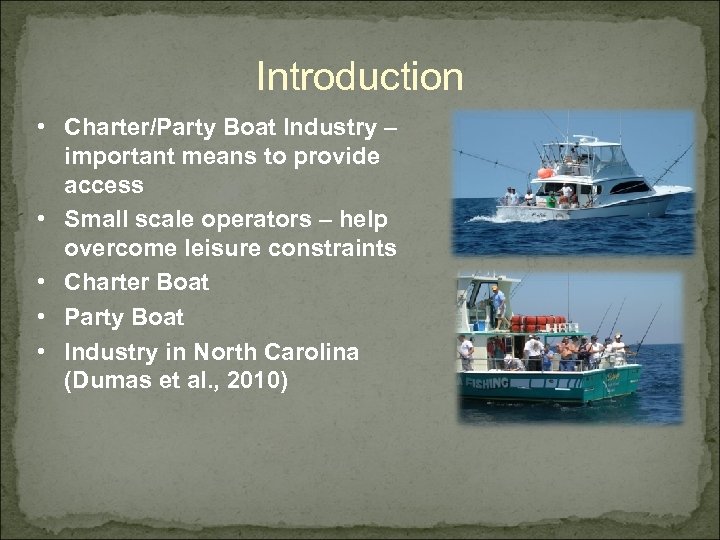
Introduction • Charter/Party Boat Industry – important means to provide access • Small scale operators – help overcome leisure constraints • Charter Boat • Party Boat • Industry in North Carolina (Dumas et al. , 2010)
Introduction – Cont’d Fish stocks depleted – overfishing & by-catches practices Industry – private but fishing – utilize public goods Shortened offshore season Enforced limits of the number and size of fish caught Recreational fishing opportunities – negatively impacted Need to adapt to changing status A constructive avenue – understand anglers’ preferences and provide better fishing trip experiences
Introduction – Cont’d Homogenous preferences by average anglers A means of segmentation necessary to investigate group differences Advantage – 1) enhance understanding so that improve services 2) differentiate recreation/tourism products with clientele-modified characteristics. Recreation specialization
Recreation specialization Ditton, Loomis & Choi (1992) – redefined the concept and summarized eight theoretical propositions 1. 2. 3. Personas participating in a given recreation activity are more likely to become more specialized in that activity over time. As level of specialization in a given recreation activity increases, the importance of activity-specific elements of the experience will decrease relative to non-activityspecific elements of the experience. As level of specialization in a given recreation activity increases, acceptance and support for the rules, norms, and procedures associated with the activity will likely increase. Focus shift from activity specific to activity general motivations More emphasis on conservation and resource setting shifted from resource consumption High specialization anglers – great appreciation and support for management practices
Study Objectives • Seek to provide boat operators with better • • information related to “fishing trip products”continue to provide anglers with offshore access Comprehensive information - what type s of fishing trips anglers prefer and importance and tradeoffs of trip elements Heterogeneity Segmentation: Recreation Specialization Required to understand different preferences for the provision of new fishing tourism products
Introduction III Methods Opinion Measurement (Separate Evaluation) - individuals to reveal their preferences for each item of rule making and concern, one at a time Stated Preference Choice Method (Joint Evaluation)
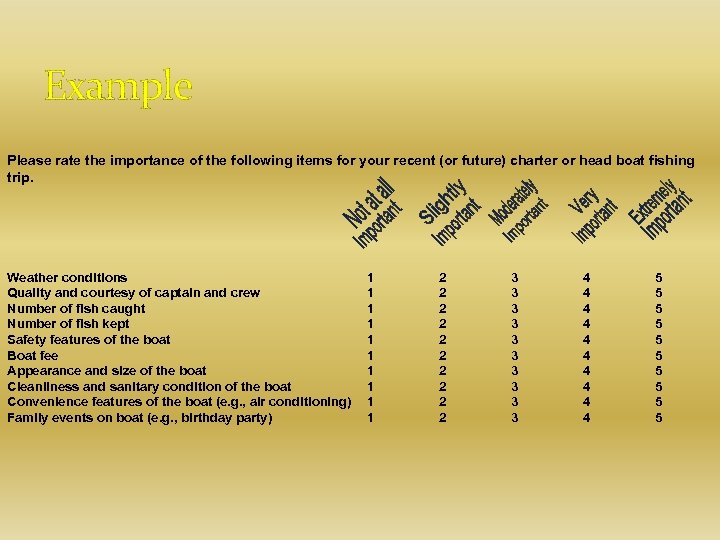
Example Please rate the importance of the following items for your recent (or future) charter or head boat fishing trip. Weather conditions Quality and courtesy of captain and crew Number of fish caught Number of fish kept Safety features of the boat Boat fee Appearance and size of the boat Cleanliness and sanitary condition of the boat Convenience features of the boat (e. g. , air conditioning) Family events on boat (e. g. , birthday party) 1 1 1 1 1 2 2 2 2 2 3 3 3 3 3 4 4 4 4 4 5 5 5 5 5
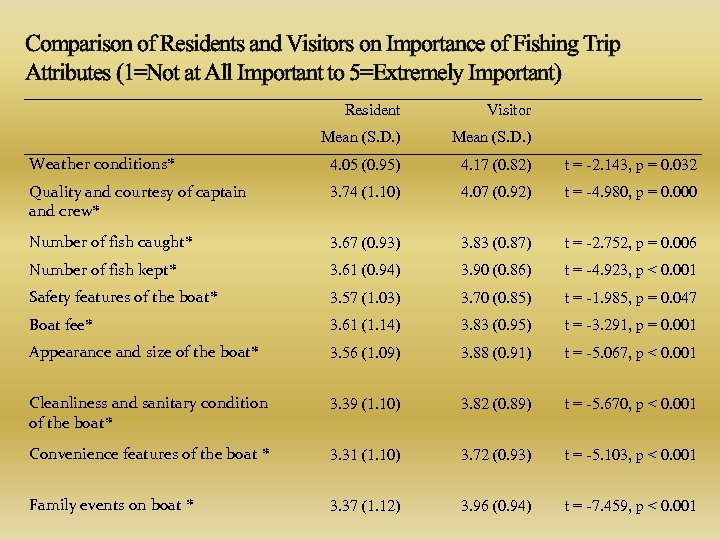
Comparison of Residents and Visitors on Importance of Fishing Trip Attributes (1=Not at All Important to 5=Extremely Important) Resident Visitor Mean (S. D. ) Weather conditions* 4. 05 (0. 95) 4. 17 (0. 82) t = -2. 143, p = 0. 032 Quality and courtesy of captain and crew* 3. 74 (1. 10) 4. 07 (0. 92) t = -4. 980, p = 0. 000 Number of fish caught* 3. 67 (0. 93) 3. 83 (0. 87) t = -2. 752, p = 0. 006 Number of fish kept* 3. 61 (0. 94) 3. 90 (0. 86) t = -4. 923, p < 0. 001 Safety features of the boat* 3. 57 (1. 03) 3. 70 (0. 85) t = -1. 985, p = 0. 047 Boat fee* 3. 61 (1. 14) 3. 83 (0. 95) t = -3. 291, p = 0. 001 Appearance and size of the boat* 3. 56 (1. 09) 3. 88 (0. 91) t = -5. 067, p < 0. 001 Cleanliness and sanitary condition of the boat* 3. 39 (1. 10) 3. 82 (0. 89) t = -5. 670, p < 0. 001 Convenience features of the boat * 3. 31 (1. 10) 3. 72 (0. 93) t = -5. 103, p < 0. 001 Family events on boat * 3. 37 (1. 12) 3. 96 (0. 94) t = -7. 459, p < 0. 001
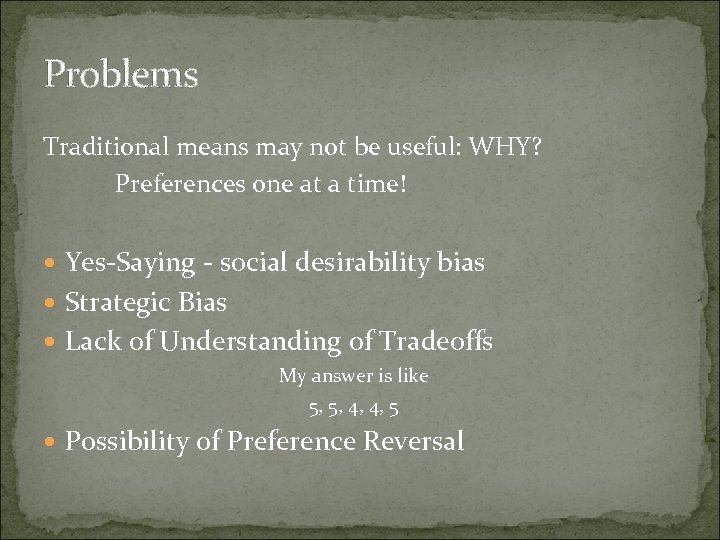
Problems Traditional means may not be useful: WHY? Preferences one at a time! Yes-Saying - social desirability bias Strategic Bias Lack of Understanding of Tradeoffs My answer is like 5, 5, 4, 4, 5 Possibility of Preference Reversal
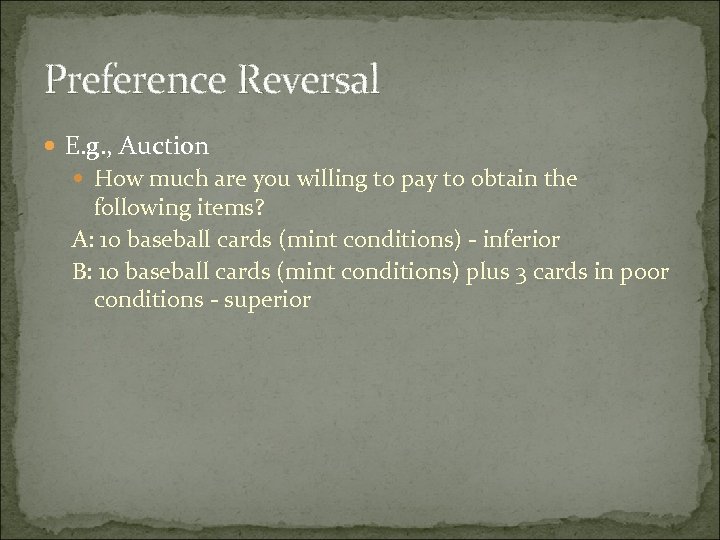
Preference Reversal E. g. , Auction How much are you willing to pay to obtain the following items? A: 10 baseball cards (mint conditions) - inferior B: 10 baseball cards (mint conditions) plus 3 cards in poor conditions - superior
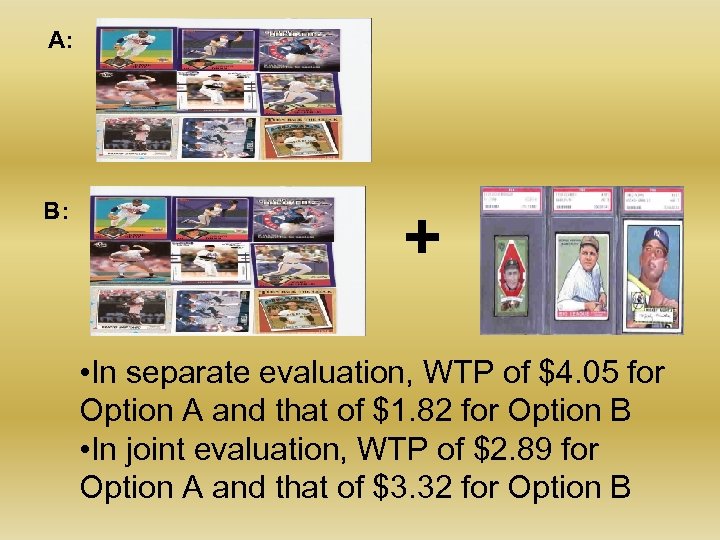
A: B: + • In separate evaluation, WTP of $4. 05 for Option A and that of $1. 82 for Option B • In joint evaluation, WTP of $2. 89 for Option A and that of $3. 32 for Option B
Alternative Choice Modeling (or Stated Preference Choice method) Package Avoid response difficulties
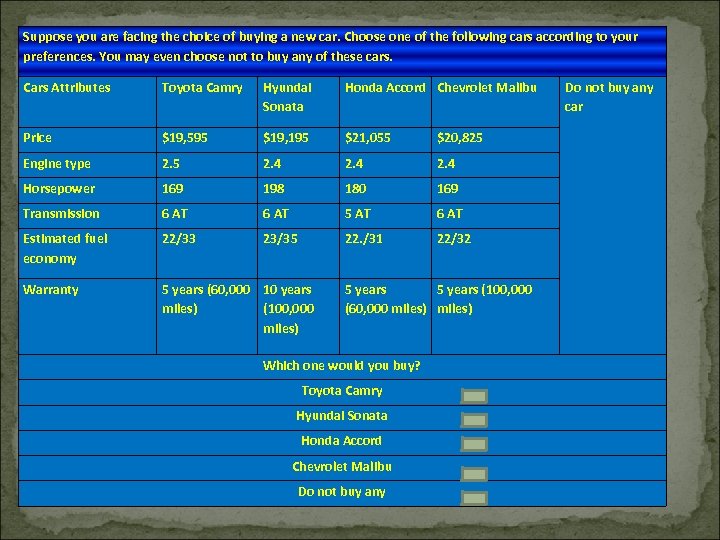
Suppose you are facing the choice of buying a new car. Choose one of the following cars according to your preferences. You may even choose not to buy any of these cars. Cars Attributes Toyota Camry Hyundai Sonata Honda Accord Chevrolet Malibu Price $19, 595 $19, 195 $21, 055 $20, 825 Engine type 2. 5 2. 4 Horsepower 169 198 180 169 Transmission 6 AT 5 AT 6 AT Estimated fuel economy 22/33 23/35 22. /31 22/32 Warranty 5 years (60, 000 10 years miles) (100, 000 miles) 5 years (100, 000 (60, 000 miles) Which one would you buy? Toyota Camry Hyundai Sonata Honda Accord Chevrolet Malibu Do not buy any car
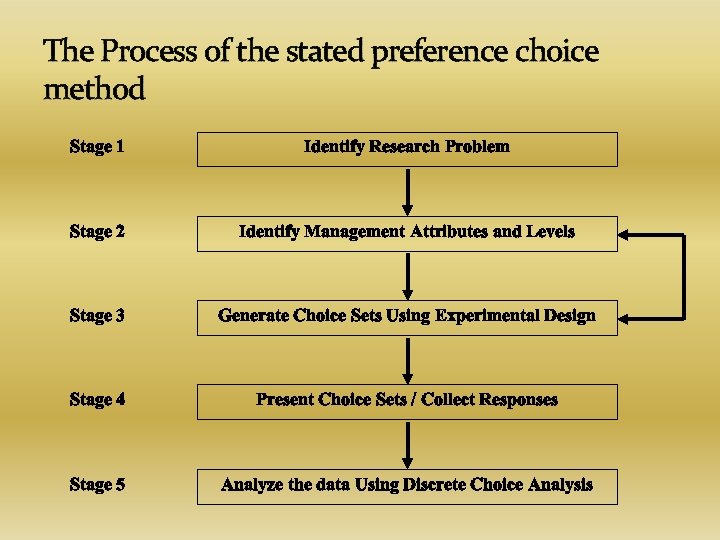
The Process of the stated preference choice method Stage 1 Identify Research Problem Stage 2 Identify Management Attributes and Levels Stage 3 Generate Choice Sets Using Experimental Design Stage 4 Present Choice Sets / Collect Responses Stage 5 Analyze the data Using Discrete Choice Analysis
Step 2 – Identify Management Attributes and Levels
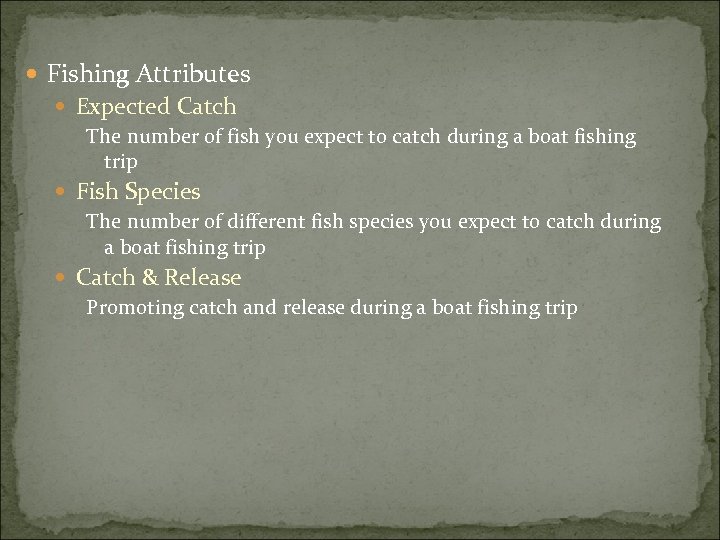
Fishing Attributes Expected Catch The number of fish you expect to catch during a boat fishing trip Fish Species The number of different fish species you expect to catch during a boat fishing trip Catch & Release Promoting catch and release during a boat fishing trip
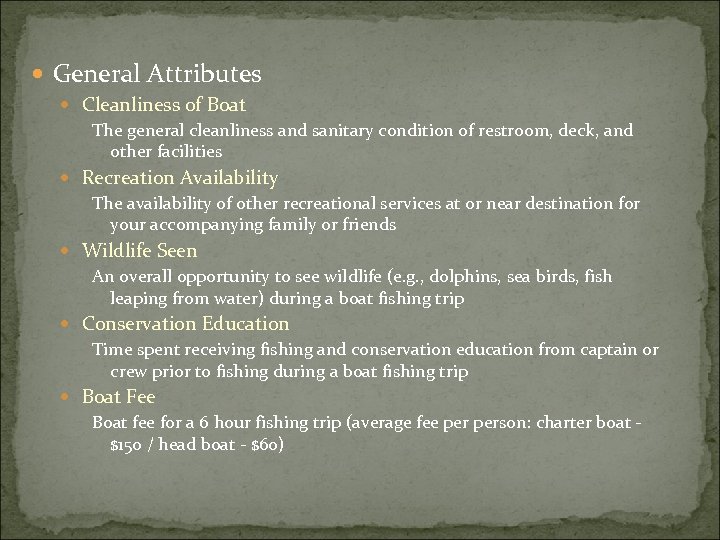
General Attributes Cleanliness of Boat The general cleanliness and sanitary condition of restroom, deck, and other facilities Recreation Availability The availability of other recreational services at or near destination for your accompanying family or friends Wildlife Seen An overall opportunity to see wildlife (e. g. , dolphins, sea birds, fish leaping from water) during a boat fishing trip Conservation Education Time spent receiving fishing and conservation education from captain or crew prior to fishing during a boat fishing trip Boat Fee Boat fee for a 6 hour fishing trip (average fee person: charter boat $150 / head boat - $60)
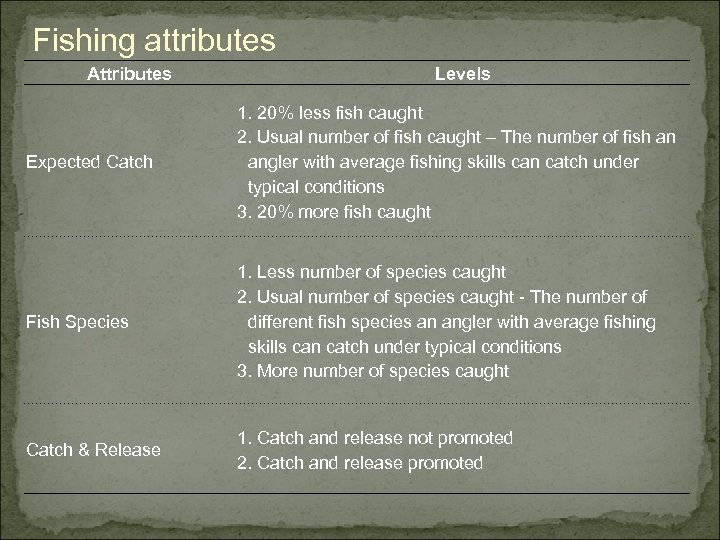
Fishing attributes Attributes Levels Expected Catch 1. 20% less fish caught 2. Usual number of fish caught – The number of fish an angler with average fishing skills can catch under typical conditions 3. 20% more fish caught Fish Species 1. Less number of species caught 2. Usual number of species caught - The number of different fish species an angler with average fishing skills can catch under typical conditions 3. More number of species caught Catch & Release 1. Catch and release not promoted 2. Catch and release promoted
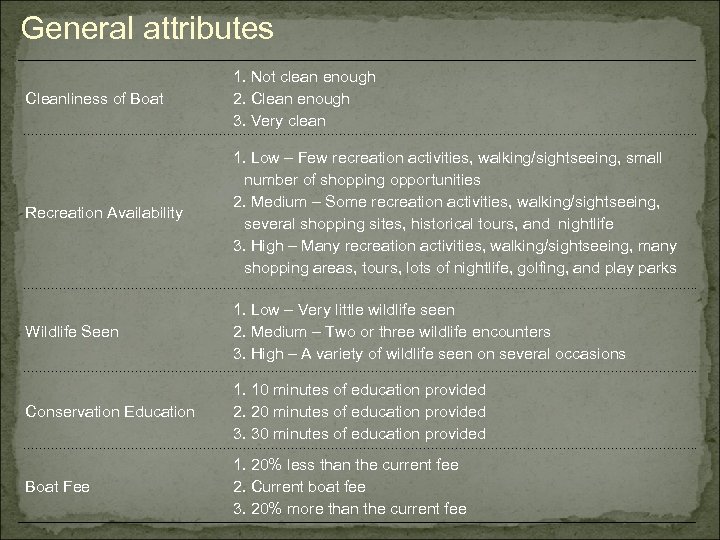
General attributes Cleanliness of Boat 1. Not clean enough 2. Clean enough 3. Very clean Recreation Availability 1. Low – Few recreation activities, walking/sightseeing, small number of shopping opportunities 2. Medium – Some recreation activities, walking/sightseeing, several shopping sites, historical tours, and nightlife 3. High – Many recreation activities, walking/sightseeing, many shopping areas, tours, lots of nightlife, golfing, and play parks Wildlife Seen 1. Low – Very little wildlife seen 2. Medium – Two or three wildlife encounters 3. High – A variety of wildlife seen on several occasions Conservation Education 1. 10 minutes of education provided 2. 20 minutes of education provided 3. 30 minutes of education provided Boat Fee 1. 20% less than the current fee 2. Current boat fee 3. 20% more than the current fee
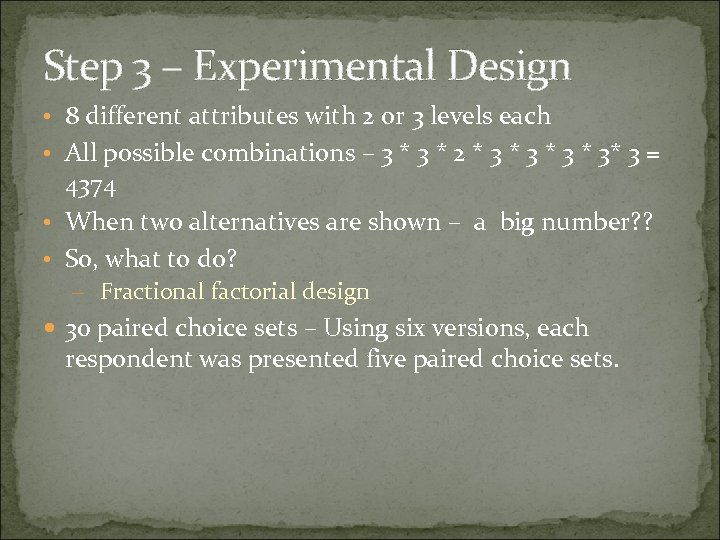
Step 3 – Experimental Design • 8 different attributes with 2 or 3 levels each • All possible combinations – 3 * 2 * 3 * 3* 3 = 4374 • When two alternatives are shown – a big number? ? • So, what to do? – Fractional factorial design 30 paired choice sets – Using six versions, each respondent was presented five paired choice sets.
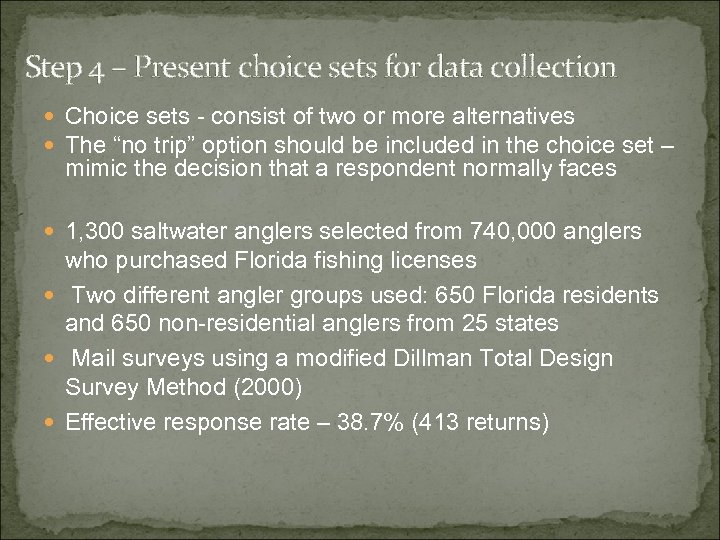
Step 4 – Present choice sets for data collection Choice sets - consist of two or more alternatives The “no trip” option should be included in the choice set – mimic the decision that a respondent normally faces 1, 300 saltwater anglers selected from 740, 000 anglers who purchased Florida fishing licenses Two different angler groups used: 650 Florida residents and 650 non-residential anglers from 25 states Mail surveys using a modified Dillman Total Design Survey Method (2000) Effective response rate – 38. 7% (413 returns)
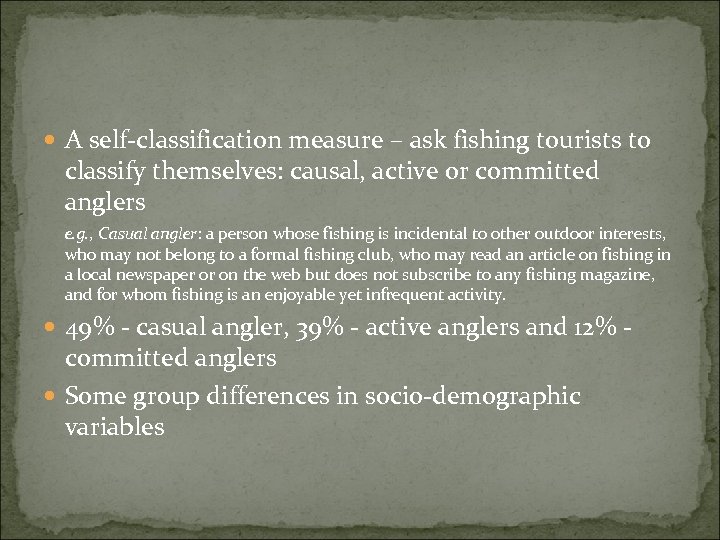
A self-classification measure – ask fishing tourists to classify themselves: causal, active or committed anglers e. g. , Casual angler: a person whose fishing is incidental to other outdoor interests, who may not belong to a formal fishing club, who may read an article on fishing in a local newspaper or on the web but does not subscribe to any fishing magazine, and for whom fishing is an enjoyable yet infrequent activity. 49% - casual angler, 39% - active anglers and 12% - committed anglers Some group differences in socio-demographic variables
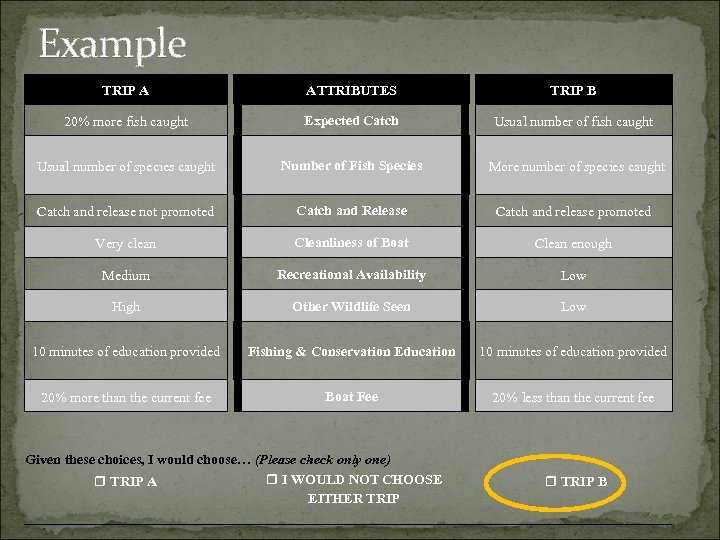
Example TRIP A ATTRIBUTES TRIP B 20% more fish caught Expected Catch Usual number of fish caught Usual number of species caught Number of Fish Species More number of species caught Catch and release not promoted Catch and Release Catch and release promoted Very clean Cleanliness of Boat Clean enough Medium Recreational Availability Low High Other Wildlife Seen Low 10 minutes of education provided Fishing & Conservation Education 10 minutes of education provided 20% more than the current fee Boat Fee 20% less than the current fee Given these choices, I would choose… (Please check only one) I WOULD NOT CHOOSE TRIP A EITHER TRIP B
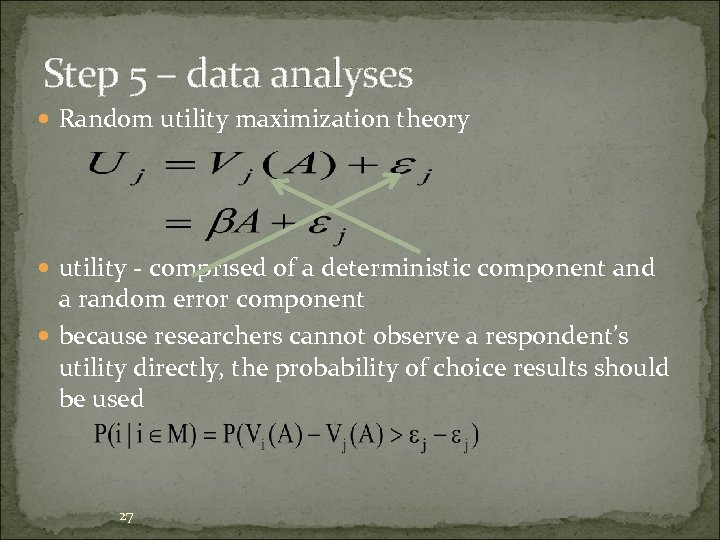
Step 5 – data analyses Random utility maximization theory utility - comprised of a deterministic component and a random error component because researchers cannot observe a respondent’s utility directly, the probability of choice results should be used 27
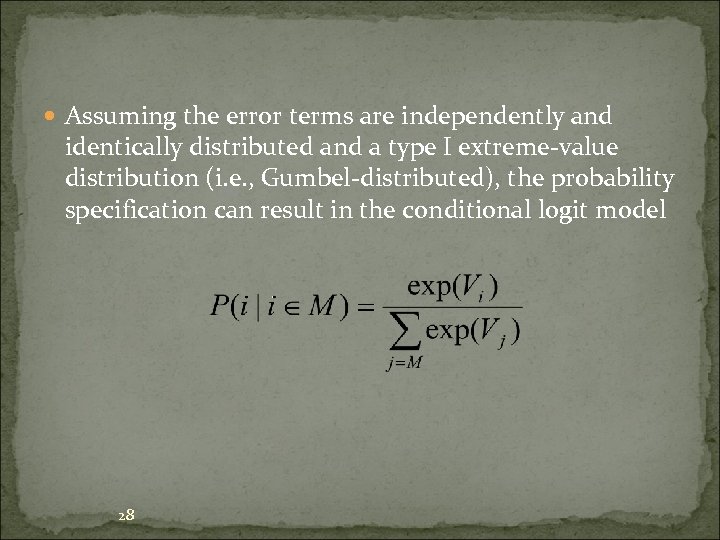
Assuming the error terms are independently and identically distributed and a type I extreme-value distribution (i. e. , Gumbel-distributed), the probability specification can result in the conditional logit model 28
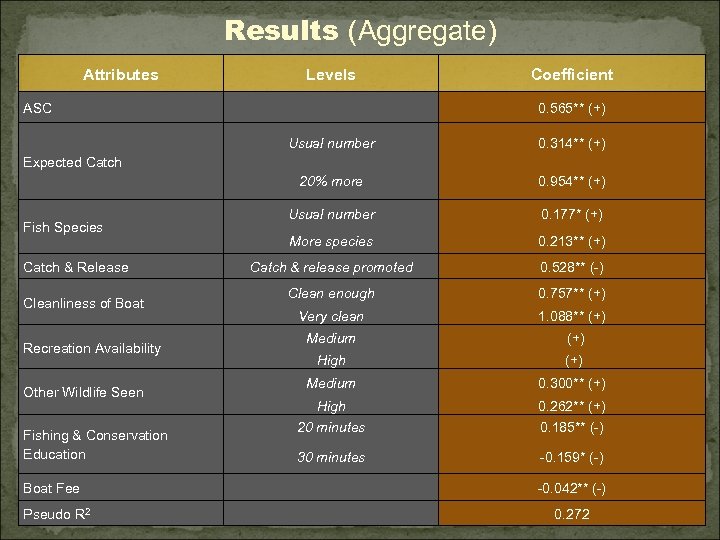
Results (Aggregate) Attributes Levels ASC Coefficient 0. 565** (+) Usual number 0. 314** (+) 20% more 0. 954** (+) Usual number 0. 177* (+) More species 0. 213** (+) Catch & release promoted 0. 528** (-) Clean enough 0. 757** (+) Very clean 1. 088** (+) Medium (+) High (+) Medium 0. 300** (+) High 0. 262** (+) 20 minutes 0. 185** (-) 30 minutes -0. 159* (-) Expected Catch Fish Species Catch & Release Cleanliness of Boat Recreation Availability Other Wildlife Seen Fishing & Conservation Education Boat Fee Pseudo R 2 -0. 042** (-) 0. 272
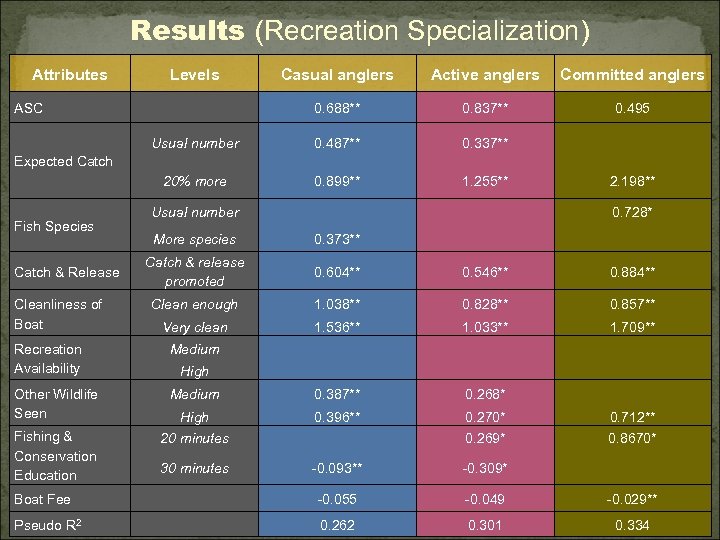
Results (Recreation Specialization) Attributes Levels Casual anglers Active anglers Committed anglers 0. 688** 0. 837** 0. 495 Usual number 0. 487** 0. 337** 20% more 0. 899** 1. 255** ASC Expected Catch Fish Species Catch & Release Cleanliness of Boat Usual number 2. 198** 0. 728* More species 0. 373** Catch & release promoted 0. 604** 0. 546** 0. 884** Clean enough 1. 038** 0. 828** 0. 857** Very clean 1. 536** 1. 033** 1. 709** Recreation Availability Medium Other Wildlife Seen Medium 0. 387** 0. 268* High 0. 396** 0. 270* 0. 712** Fishing & Conservation Education 20 minutes 0. 269* 0. 8670* High 30 minutes -0. 093** -0. 309* Boat Fee -0. 055 -0. 049 -0. 029** Pseudo R 2 0. 262 0. 301 0. 334
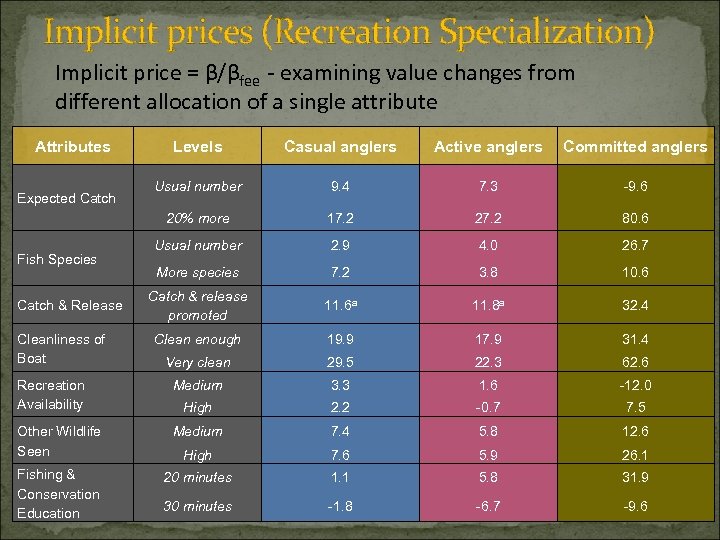
Implicit prices (Recreation Specialization) Implicit price = β/βfee - examining value changes from different allocation of a single attribute Attributes Levels Casual anglers Active anglers Committed anglers Usual number 9. 4 7. 3 -9. 6 20% more 17. 2 27. 2 80. 6 Usual number 2. 9 4. 0 26. 7 More species 7. 2 3. 8 10. 6 Catch & release promoted 11. 6 a 11. 8 a 32. 4 Clean enough 19. 9 17. 9 31. 4 Very clean 29. 5 22. 3 62. 6 Recreation Availability Medium 3. 3 1. 6 -12. 0 High 2. 2 -0. 7 7. 5 Other Wildlife Seen Medium 7. 4 5. 8 12. 6 High 7. 6 5. 9 26. 1 Fishing & Conservation Education 20 minutes 1. 1 5. 8 31. 9 30 minutes -1. 8 -6. 7 -9. 6 Expected Catch Fish Species Catch & Release Cleanliness of Boat
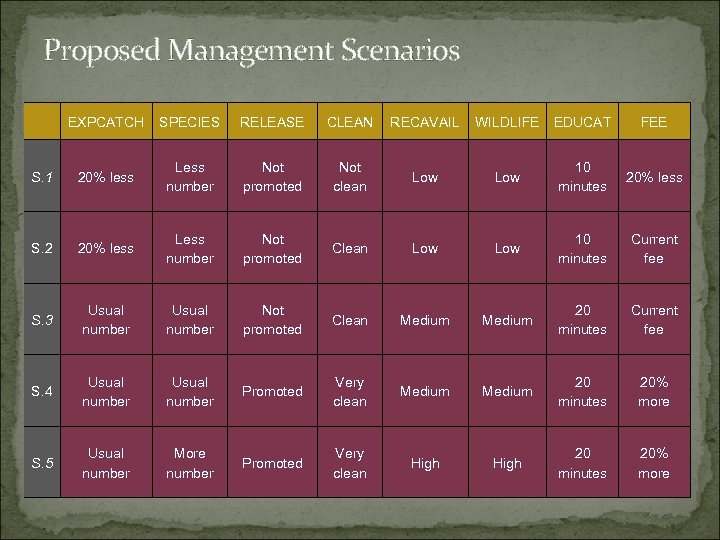
Proposed Management Scenarios EXPCATCH SPECIES RELEASE CLEAN RECAVAIL WILDLIFE EDUCAT FEE S. 1 20% less Less number Not promoted Not clean Low 10 minutes 20% less S. 2 20% less Less number Not promoted Clean Low 10 minutes Current fee S. 3 Usual number Not promoted Clean Medium 20 minutes Current fee S. 4 Usual number Promoted Very clean Medium 20 minutes 20% more S. 5 Usual number More number Promoted Very clean High 20 minutes 20% more
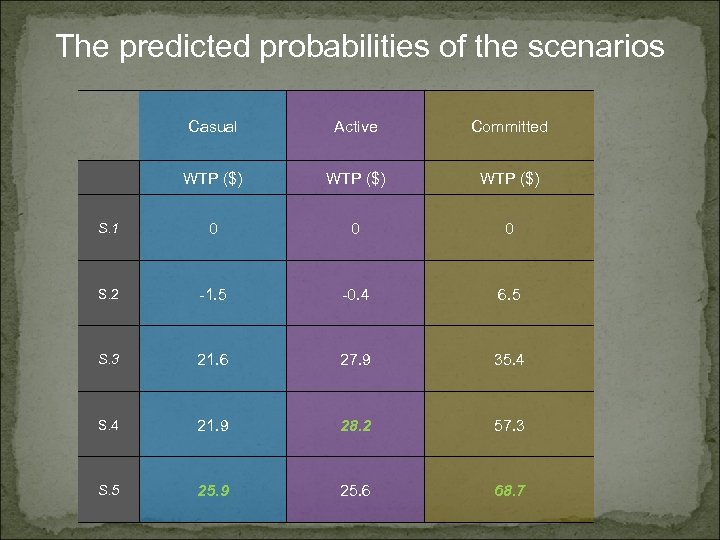
The predicted probabilities of the scenarios Casual Active Committed WTP ($) S. 1 0 0 0 S. 2 -1. 5 -0. 4 6. 5 S. 3 21. 6 27. 9 35. 4 S. 4 21. 9 28. 2 57. 3 S. 5 25. 9 25. 6 68. 7
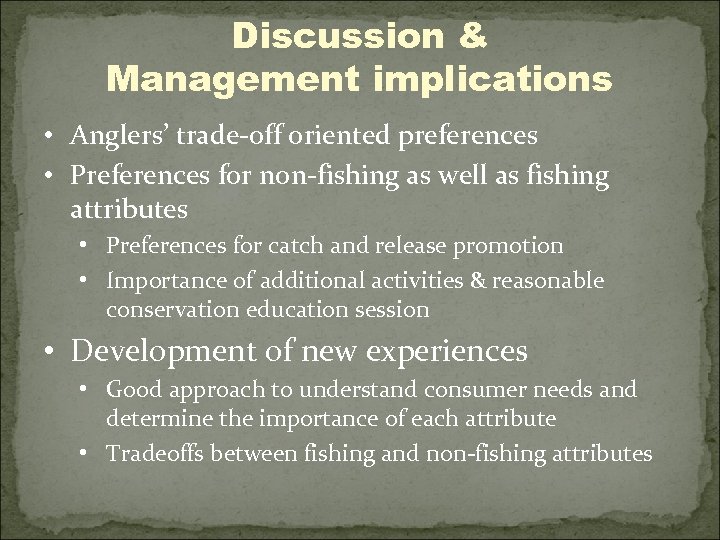
Discussion & Management implications • Anglers’ trade-off oriented preferences • Preferences for non-fishing as well as fishing attributes • Preferences for catch and release promotion • Importance of additional activities & reasonable conservation education session • Development of new experiences • Good approach to understand consumer needs and determine the importance of each attribute • Tradeoffs between fishing and non-fishing attributes
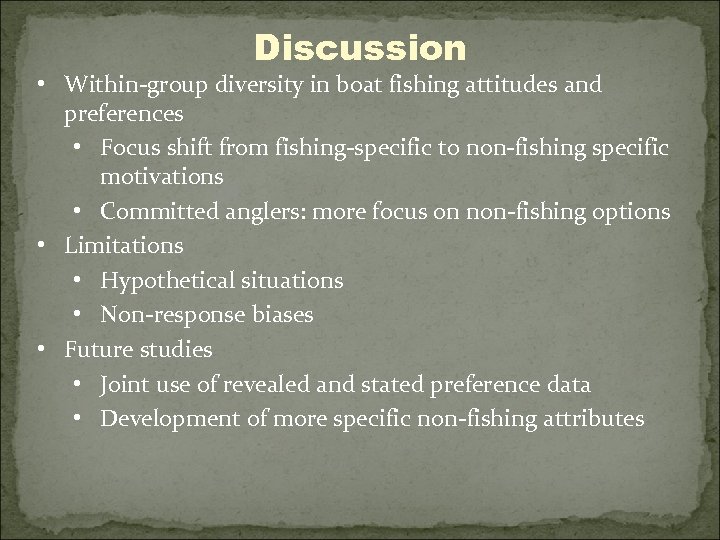
Discussion • Within-group diversity in boat fishing attitudes and preferences • Focus shift from fishing-specific to non-fishing specific motivations • Committed anglers: more focus on non-fishing options • Limitations • Hypothetical situations • Non-response biases • Future studies • Joint use of revealed and stated preference data • Development of more specific non-fishing attributes
Research Presentation II - Use of Simplified Decision Rules on Modeling Recreationist Preferences § Break!!! Oh, C. (2013). Incorporating Simplified Decision Rules into Tourist Decision Making Processes: A Case of Fishing Trips, Ocean & Coastal Management, 71, 79 -87.
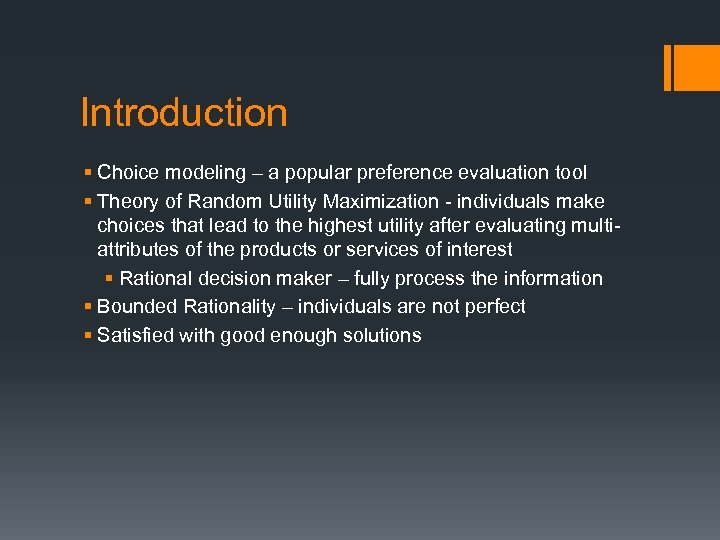
Introduction § Choice modeling – a popular preference evaluation tool § Theory of Random Utility Maximization - individuals make choices that lead to the highest utility after evaluating multiattributes of the products or services of interest § Rational decision maker – fully process the information § Bounded Rationality – individuals are not perfect § Satisfied with good enough solutions
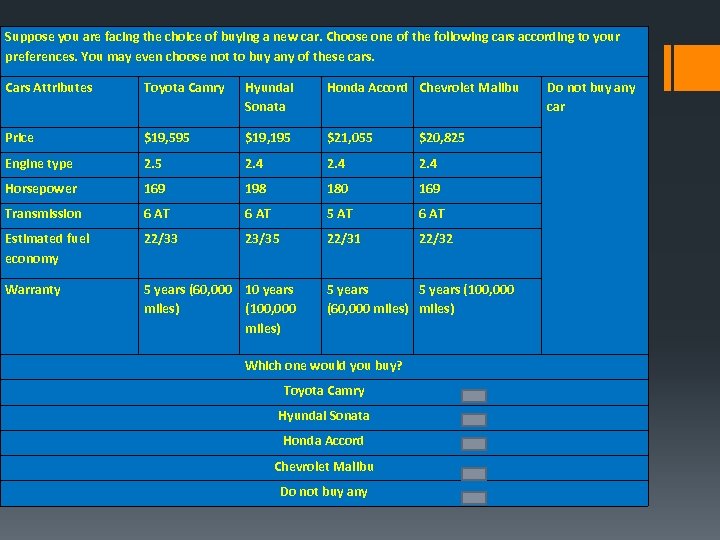
Suppose you are facing the choice of buying a new car. Choose one of the following cars according to your preferences. You may even choose not to buy any of these cars. Cars Attributes Toyota Camry Hyundai Sonata Honda Accord Chevrolet Malibu Price $19, 595 $19, 195 $21, 055 $20, 825 Engine type 2. 5 2. 4 Horsepower 169 198 180 169 Transmission 6 AT 5 AT 6 AT Estimated fuel economy 22/33 23/35 22/31 22/32 Warranty 5 years (60, 000 10 years miles) (100, 000 miles) 5 years (100, 000 (60, 000 miles) Which one would you buy? Toyota Camry Hyundai Sonata Honda Accord Chevrolet Malibu Do not buy any car
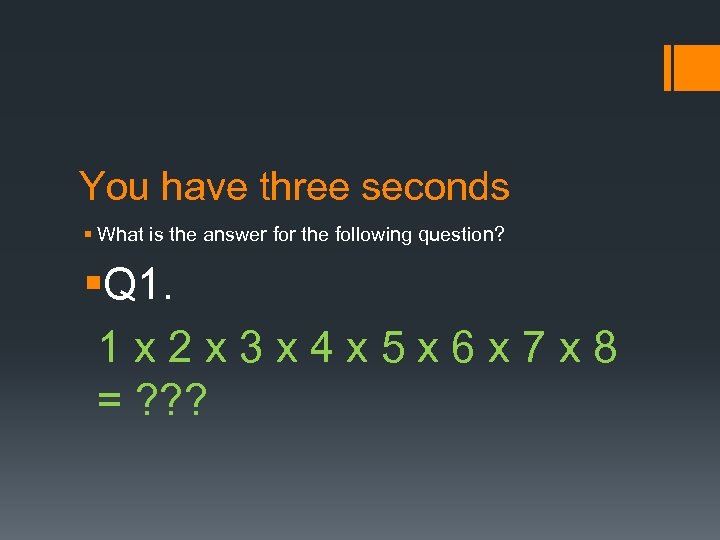
You have three seconds § What is the answer for the following question? §Q 1. 1 x 2 x 3 x 4 x 5 x 6 x 7 x 8 = ? ? ?
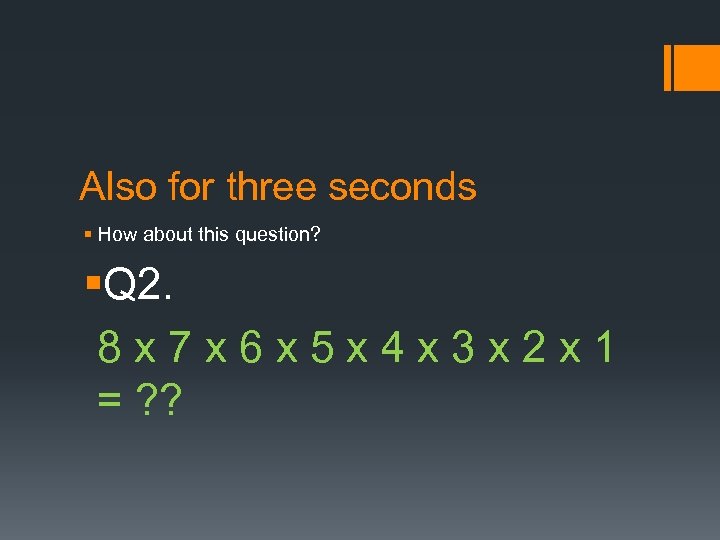
Also for three seconds § How about this question? §Q 2. 8 x 7 x 6 x 5 x 4 x 3 x 2 x 1 = ? ?
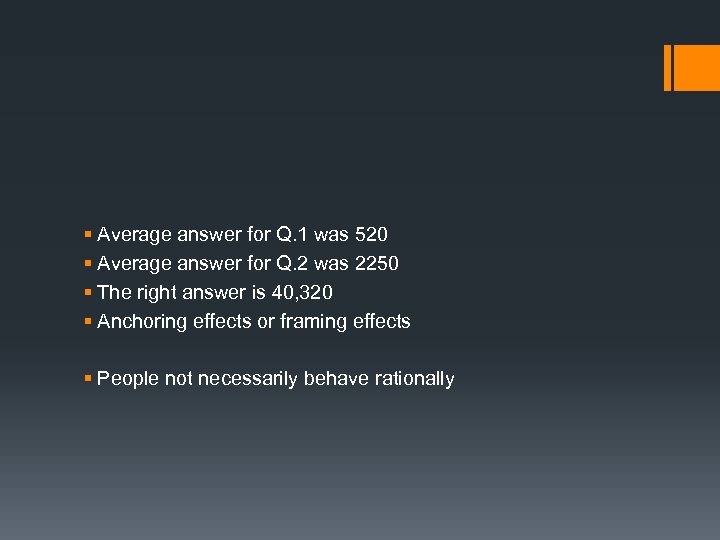
§ Average answer for Q. 1 was 520 § Average answer for Q. 2 was 2250 § The right answer is 40, 320 § Anchoring effects or framing effects § People not necessarily behave rationally
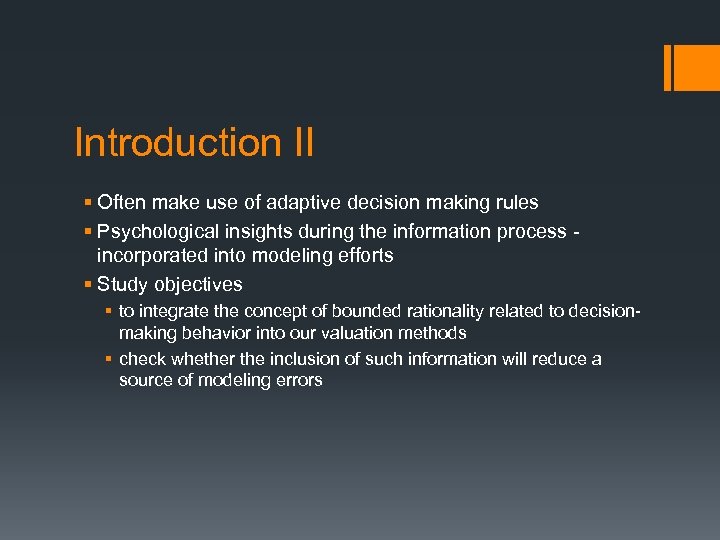
Introduction II § Often make use of adaptive decision making rules § Psychological insights during the information process incorporated into modeling efforts § Study objectives § to integrate the concept of bounded rationality related to decisionmaking behavior into our valuation methods § check whether the inclusion of such information will reduce a source of modeling errors
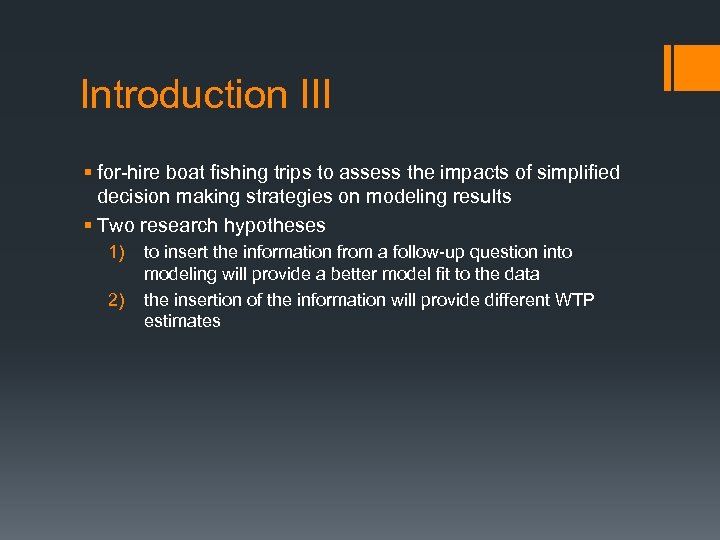
Introduction III § for-hire boat fishing trips to assess the impacts of simplified decision making strategies on modeling results § Two research hypotheses 1) 2) to insert the information from a follow-up question into modeling will provide a better model fit to the data the insertion of the information will provide different WTP estimates
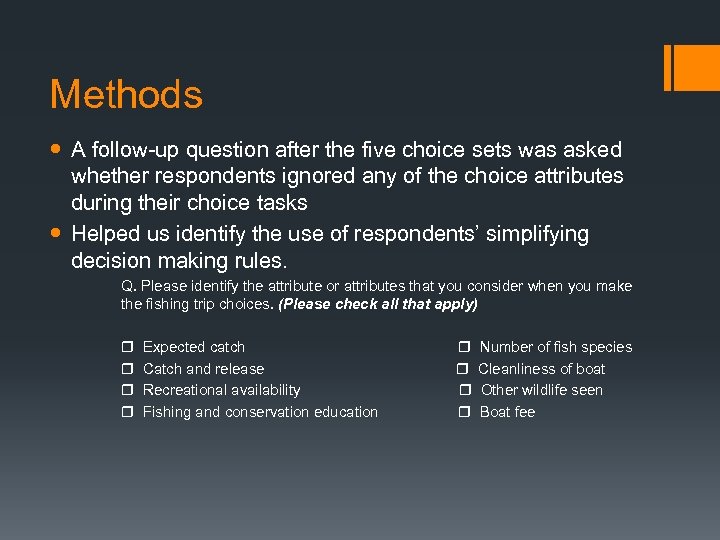
Methods A follow-up question after the five choice sets was asked whether respondents ignored any of the choice attributes during their choice tasks Helped us identify the use of respondents’ simplifying decision making rules. Q. Please identify the attribute or attributes that you consider when you make the fishing trip choices. (Please check all that apply) Expected catch Number of fish species Catch and release Cleanliness of boat Recreational availability Other wildlife seen Fishing and conservation education Boat fee
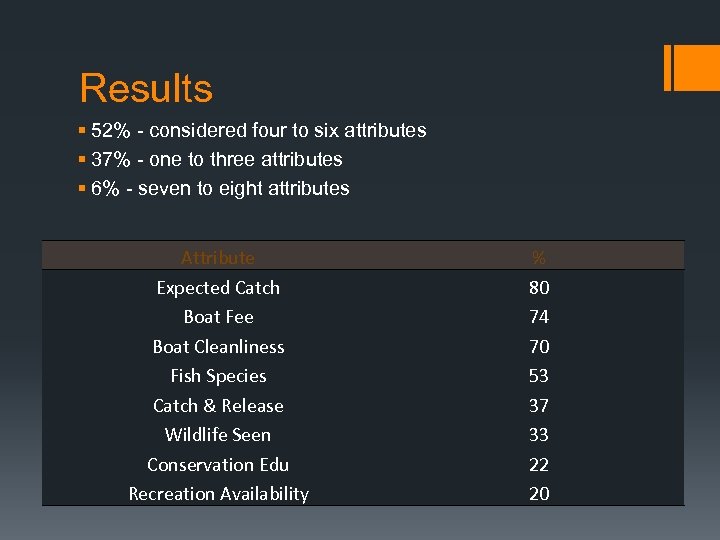
Results § 52% - considered four to six attributes § 37% - one to three attributes § 6% - seven to eight attributes Attribute Expected Catch Boat Fee Boat Cleanliness Fish Species Catch & Release Wildlife Seen Conservation Edu Recreation Availability % 80 74 70 53 37 33 22 20
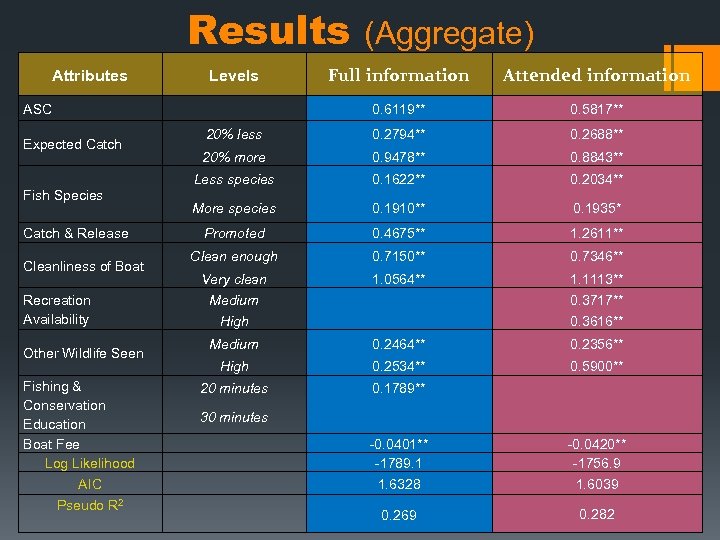
Results (Aggregate) Full information Attended information 0. 6119** 0. 5817** 20% less 0. 2794** 0. 2688** 20% more 0. 9478** 0. 8843** Less species Attributes 0. 1622** 0. 2034** More species 0. 1910** 0. 1935* Promoted 0. 4675** 1. 2611** Clean enough 0. 7150** 0. 7346** Very clean 1. 0564** 1. 1113** Levels ASC Expected Catch Fish Species Catch & Release Cleanliness of Boat Recreation Availability Other Wildlife Seen Fishing & Conservation Education Boat Fee Log Likelihood AIC Pseudo R 2 Medium 0. 3717** High 0. 3616** Medium 0. 2464** 0. 2356** High 0. 2534** 0. 5900** 20 minutes 0. 1789** 30 minutes -0. 0401** -1789. 1 1. 6328 -0. 0420** -1756. 9 1. 6039 0. 269 0. 282
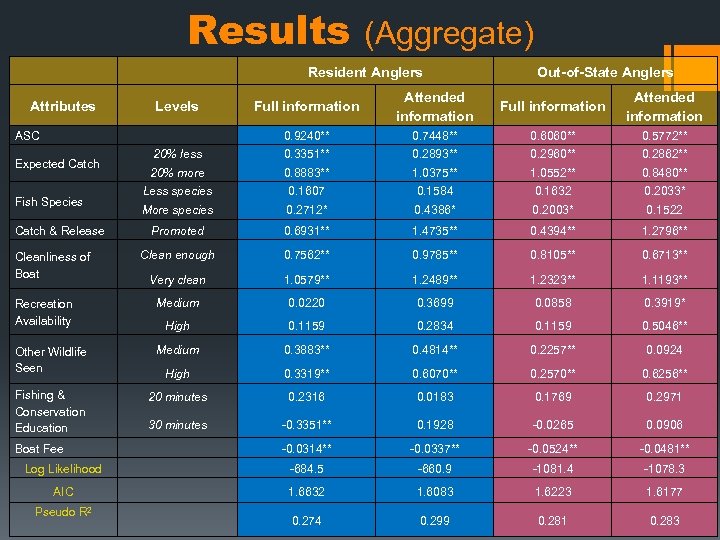
Results (Aggregate) Resident Anglers Out-of-State Anglers Levels Full information Attended information 20% less 0. 9240** 0. 3351** 0. 7448** 0. 2893** 0. 6060** 0. 2960** 0. 5772** 0. 2862** 20% more 0. 8883** 1. 0375** 1. 0552** 0. 8480** Less species 0. 1607 0. 1584 0. 1632 0. 2033* More species 0. 2712* 0. 4386* 0. 2003* 0. 1522 Promoted 0. 6931** 1. 4735** 0. 4394** 1. 2796** Clean enough 0. 7562** 0. 9785** 0. 8105** 0. 6713** Very clean 1. 0579** 1. 2489** 1. 2323** 1. 1193** Recreation Availability Medium 0. 0220 0. 3699 0. 0858 0. 3919* High 0. 1159 0. 2834 0. 1159 0. 5046** Other Wildlife Seen Medium 0. 3883** 0. 4814** 0. 2257** 0. 0924 High 0. 3319** 0. 6070** 0. 2570** 0. 6256** Fishing & Conservation Education 20 minutes 0. 2316 0. 0183 0. 1769 0. 2971 30 minutes -0. 3351** 0. 1928 -0. 0265 0. 0906 -0. 0314** -0. 0337** -0. 0524** -0. 0481** Log Likelihood -684. 5 -660. 9 -1081. 4 -1078. 3 AIC 1. 6632 1. 6083 1. 6223 1. 6177 0. 274 0. 299 0. 281 0. 283 Attributes ASC Expected Catch Fish Species Catch & Release Cleanliness of Boat Fee Pseudo R 2
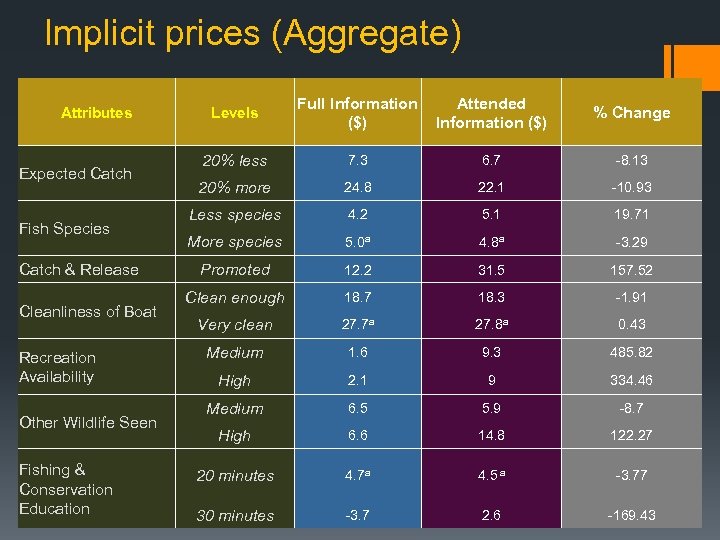
Implicit prices (Aggregate) Attributes Expected Catch Fish Species Catch & Release Cleanliness of Boat Recreation Availability Other Wildlife Seen Fishing & Conservation Education Levels Full Information Attended ($) Information ($) % Change 20% less 7. 3 6. 7 -8. 13 20% more 24. 8 22. 1 -10. 93 Less species 4. 2 5. 1 19. 71 More species 5. 0 a 4. 8 a -3. 29 Promoted 12. 2 31. 5 157. 52 Clean enough 18. 7 18. 3 -1. 91 Very clean 27. 7 a 27. 8 a 0. 43 Medium 1. 6 9. 3 485. 82 High 2. 1 9 334. 46 Medium 6. 5 5. 9 -8. 7 High 6. 6 14. 8 122. 27 20 minutes 4. 7 a 4. 5 a -3. 77 30 minutes -3. 7 2. 6 -169. 43
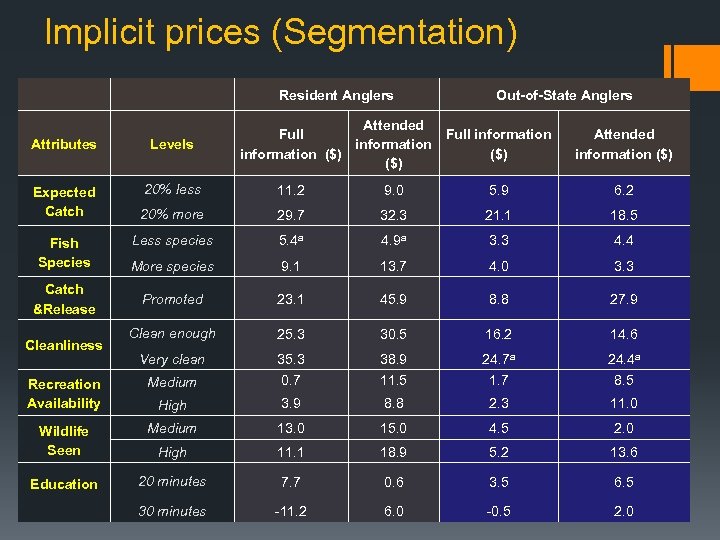
Implicit prices (Segmentation) Resident Anglers Out-of-State Anglers Attended Full information ($) ($) Attended information ($) Attributes Levels Expected Catch 20% less 11. 2 9. 0 5. 9 6. 2 20% more 29. 7 32. 3 21. 1 18. 5 Less species 5. 4 a 4. 9 a 3. 3 4. 4 More species 9. 1 13. 7 4. 0 3. 3 Promoted 23. 1 45. 9 8. 8 27. 9 Clean enough 25. 3 30. 5 16. 2 14. 6 Very clean 35. 3 38. 9 24. 7 a 24. 4 a Recreation Availability Medium 0. 7 11. 5 1. 7 8. 5 High 3. 9 8. 8 2. 3 11. 0 Wildlife Seen Medium 13. 0 15. 0 4. 5 2. 0 High 11. 1 18. 9 5. 2 13. 6 Education 20 minutes 7. 7 0. 6 3. 5 6. 5 30 minutes -11. 2 6. 0 -0. 5 2. 0 Fish Species Catch &Release Cleanliness
Discussion § The model with a simplified strategy consistently showed a better fit to the data § Most willingness to pay values of each choice attribute generated from the two different models - statistically different. § Good rationale for incorporating this attended information § Our computation model – rough approximations to the reality § The results of rational choice – shifted to the process of choice
Future Issues & Limitation § Hypothetical § Non-respondent bias § Different follow-up questions § Different decision strategies § Site specific (Florida? )
Future Research Public preference studies for resource policies – hypothetical, decision-making, benefit transfer Economic impact and valuation of recreation & tourism resources Tied with tourism and recreation theories – recreation specialization, substitution, constraints, conflict Human dimensions of natural resources – Water resource issues
Thank you. Questions? Contact: Dr. Chi-Ok Oh at ohc@msu. edu or 1 -517 -432 -0294 More information available at https: //sites. google. com/site/chiokoh/
Скачать презентацию Public Preferences for Sustainable Tourism Management A Choice
1191b8b99870dd5de145c04c635a0c0e.ppt