 Скачать презентацию PUBLIC PENSIONS IN PENNSYLVANIA A Looming Crisis DUQUESNE
a2f8c7a80d8847d16e1b19ac29cb71f8.ppt
- Количество слайдов: 23



PUBLIC PENSIONS IN PENNSYLVANIA: A Looming Crisis? DUQUESNE UNIVERSITY
HISTORY OF PENSIONS Prior to 1950 s few people had pensions Most worked until they died Initial issue: company specific or industrywide? Labor wanted industry-wide (but lost) G. M. first offered company pensions in 1950 ▪ Set the trend DUQUESNE UNIVERSITY
TYPES OF PENSIONS Defined Benefit Formerly the most common Defined Contribution Now the most common DUQUESNE UNIVERSITY
PA Provides Two Major DB Pensions: State Employee Retiree System (SERS) Most Commonwealth Employees Funded by the Commonwealth, Employee Contributions, and Investment Income Public School Employees’ Retirement System (PSERS) All Public School Teachers Funded by the Commonwealth, School Districts, Employee Contributions , and Investment Income DUQUESNE UNIVERSITY
PA Defined Benefit Plans Guarantee a fixed monthly income upon retirement, usually for life Minimum number of years to be vested Amount determined by formula ▪ Years of service ▪ Average salary at retirement ▪ A “multiplier” DUQUESNE UNIVERSITY
Defined Benefit Plans Employer has life-long obligation The Social Security system provides a form of a defined benefit retirement plan DUQUESNE UNIVERSITY
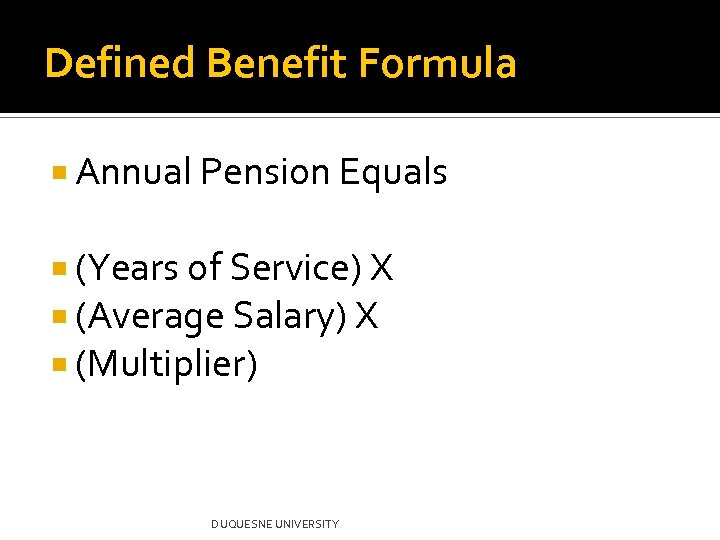
Defined Benefit Formula Annual Pension Equals (Years of Service) X (Average Salary) X (Multiplier) DUQUESNE UNIVERSITY
Defined Benefit Plans Years of Service Often allow credit for other employment or military service Allow participants to buy service years DUQUESNE UNIVERSITY
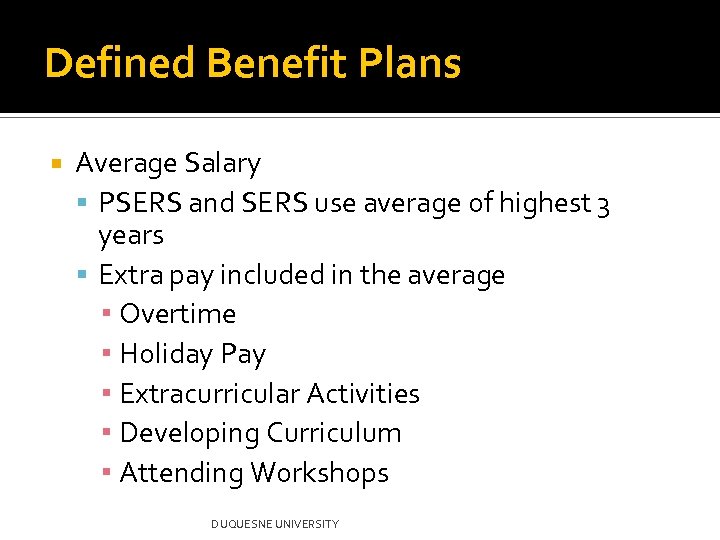
Defined Benefit Plans Average Salary PSERS and SERS use average of highest 3 years Extra pay included in the average ▪ Overtime ▪ Holiday Pay ▪ Extracurricular Activities ▪ Developing Curriculum ▪ Attending Workshops DUQUESNE UNIVERSITY
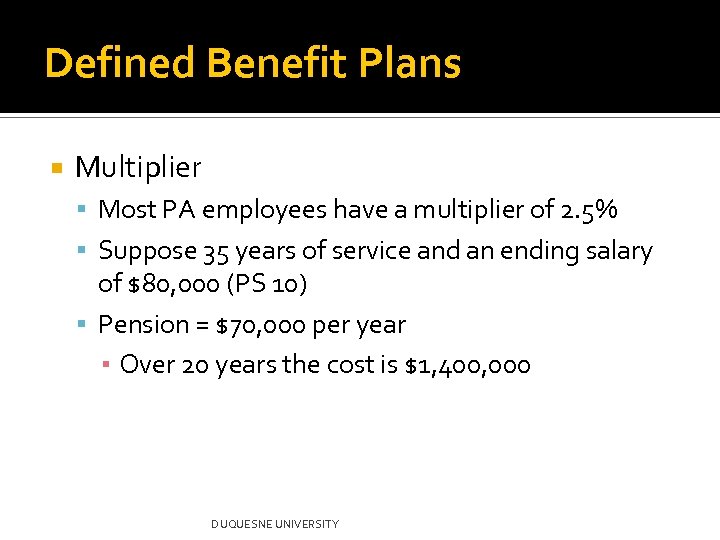
Defined Benefit Plans Multiplier Most PA employees have a multiplier of 2. 5% Suppose 35 years of service and an ending salary of $80, 000 (PS 10) Pension = $70, 000 per year ▪ Over 20 years the cost is $1, 400, 000 DUQUESNE UNIVERSITY
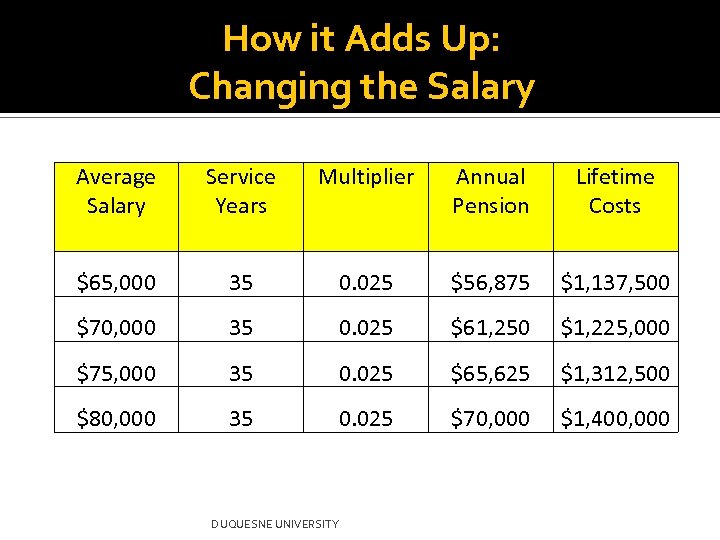
How it Adds Up: Changing the Salary Average Salary Service Years Multiplier Annual Pension Lifetime Costs $65, 000 35 0. 025 $56, 875 $1, 137, 500 $70, 000 35 0. 025 $61, 250 $1, 225, 000 $75, 000 35 0. 025 $65, 625 $1, 312, 500 $80, 000 35 0. 025 $70, 000 $1, 400, 000 DUQUESNE UNIVERSITY
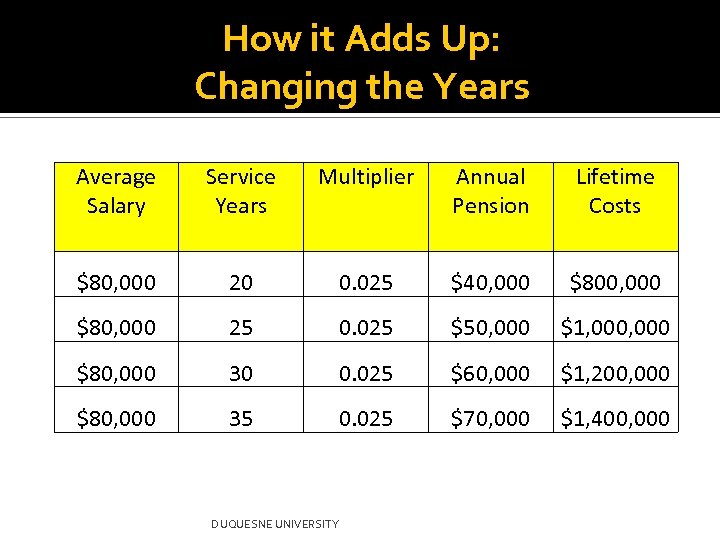
How it Adds Up: Changing the Years Average Salary Service Years Multiplier Annual Pension Lifetime Costs $80, 000 20 0. 025 $40, 000 $80, 000 25 0. 025 $50, 000 $1, 000 $80, 000 30 0. 025 $60, 000 $1, 200, 000 $80, 000 35 0. 025 $70, 000 $1, 400, 000 DUQUESNE UNIVERSITY
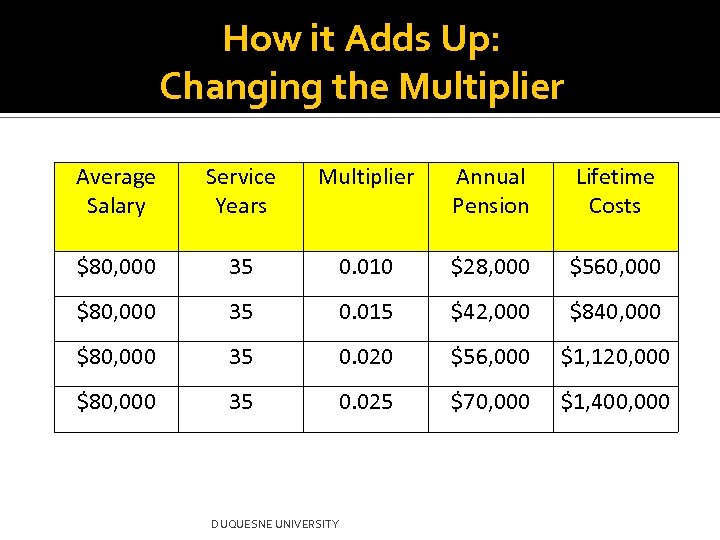
How it Adds Up: Changing the Multiplier Average Salary Service Years Multiplier Annual Pension Lifetime Costs $80, 000 35 0. 010 $28, 000 $560, 000 $80, 000 35 0. 015 $42, 000 $840, 000 $80, 000 35 0. 020 $56, 000 $1, 120, 000 $80, 000 35 0. 025 $70, 000 $1, 400, 000 DUQUESNE UNIVERSITY
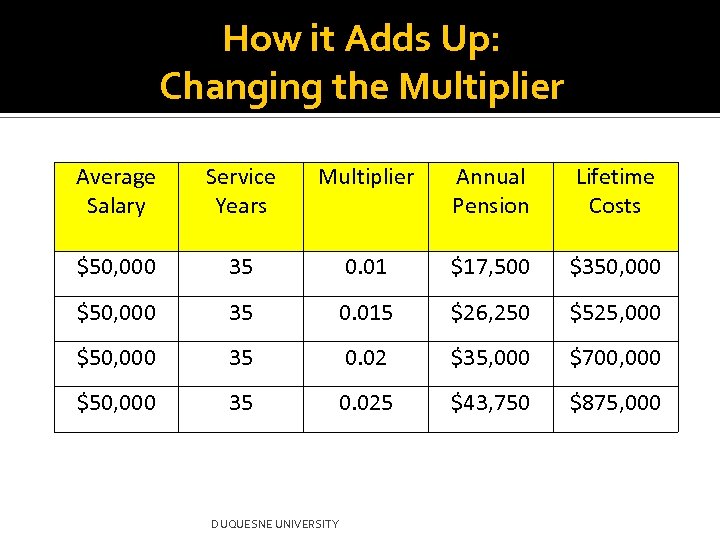
How it Adds Up: Changing the Multiplier Average Salary Service Years Multiplier Annual Pension Lifetime Costs $50, 000 35 0. 01 $17, 500 $350, 000 $50, 000 35 0. 015 $26, 250 $525, 000 $50, 000 35 0. 02 $35, 000 $700, 000 $50, 000 35 0. 025 $43, 750 $875, 000 DUQUESNE UNIVERSITY
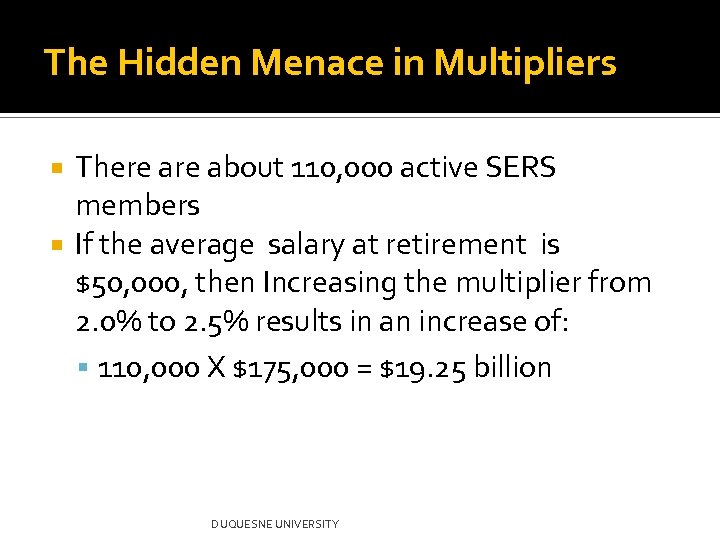
The Hidden Menace in Multipliers There about 110, 000 active SERS members If the average salary at retirement is $50, 000, then Increasing the multiplier from 2. 0% to 2. 5% results in an increase of: 110, 000 X $175, 000 = $19. 25 billion DUQUESNE UNIVERSITY

Pittsburgh’s Going to the Super Bowl!!!
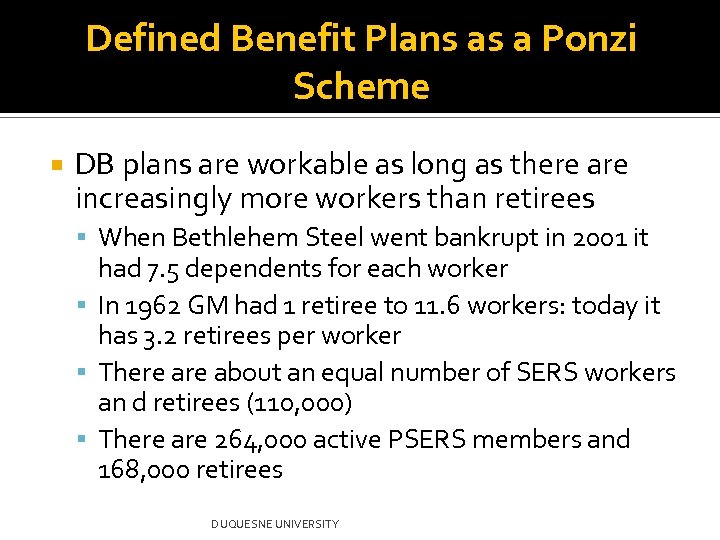
Defined Benefit Plans as a Ponzi Scheme DB plans are workable as long as there are increasingly more workers than retirees When Bethlehem Steel went bankrupt in 2001 it had 7. 5 dependents for each worker In 1962 GM had 1 retiree to 11. 6 workers: today it has 3. 2 retirees per worker There about an equal number of SERS workers an d retirees (110, 000) There are 264, 000 active PSERS members and 168, 000 retirees DUQUESNE UNIVERSITY
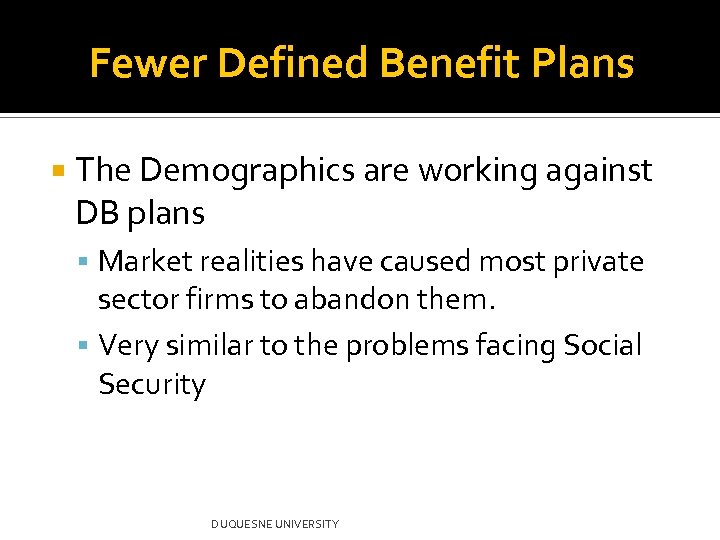
Fewer Defined Benefit Plans The Demographics are working against DB plans Market realities have caused most private sector firms to abandon them. Very similar to the problems facing Social Security DUQUESNE UNIVERSITY
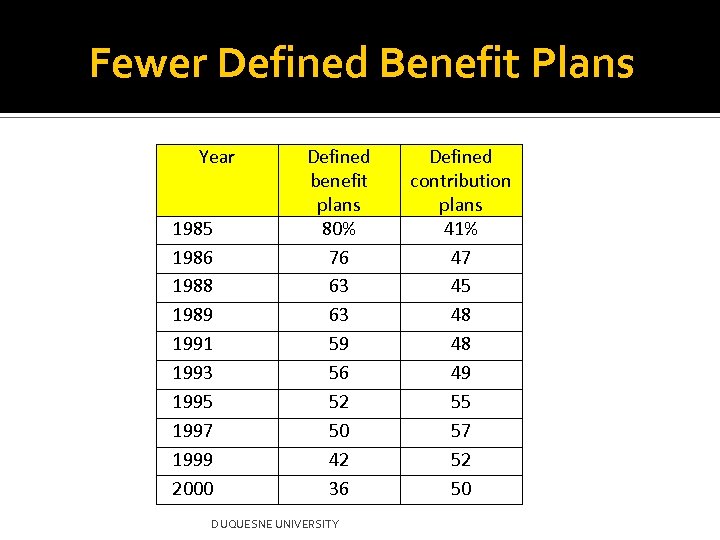
Fewer Defined Benefit Plans Year 1985 1986 1988 1989 1991 1993 1995 1997 1999 2000 Defined benefit plans 80% 76 63 63 59 56 52 50 42 36 DUQUESNE UNIVERSITY Defined contribution plans 41% 47 45 48 48 49 55 57 52 50
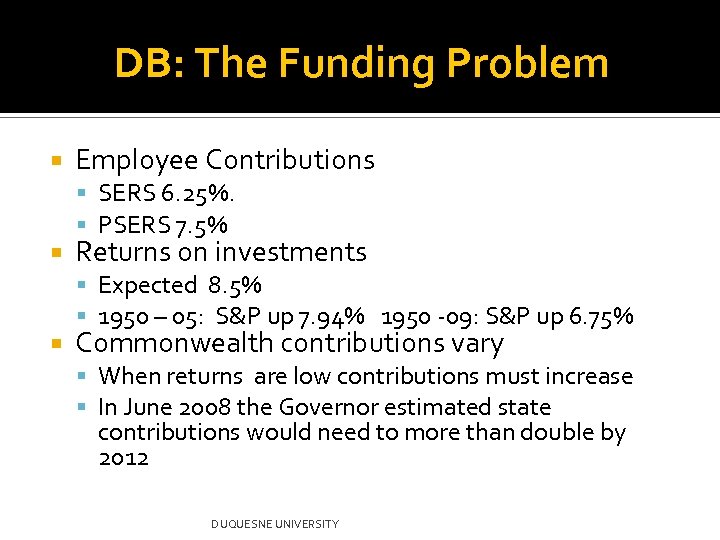
DB: The Funding Problem Employee Contributions SERS 6. 25%. PSERS 7. 5% Returns on investments Expected 8. 5% 1950 – 05: S&P up 7. 94% 1950 -09: S&P up 6. 75% Commonwealth contributions vary When returns are low contributions must increase In June 2008 the Governor estimated state contributions would need to more than double by 2012 DUQUESNE UNIVERSITY
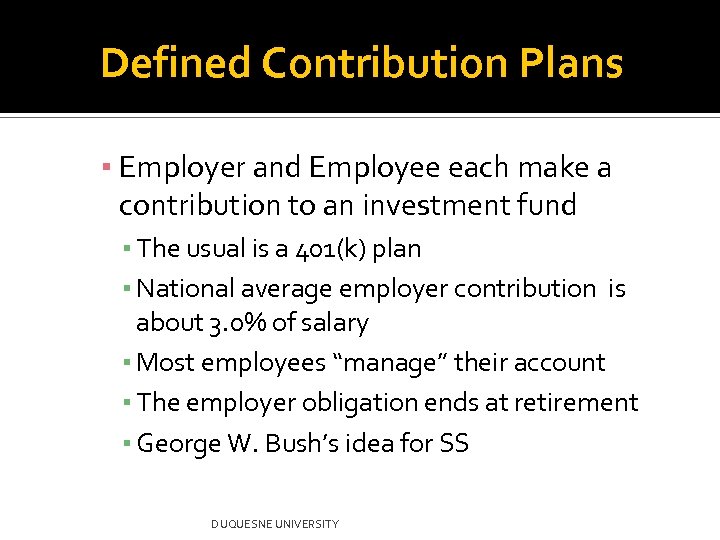
Defined Contribution Plans ▪ Employer and Employee each make a contribution to an investment fund ▪ The usual is a 401(k) plan ▪ National average employer contribution is about 3. 0% of salary ▪ Most employees “manage” their account ▪ The employer obligation ends at retirement ▪ George W. Bush’s idea for SS DUQUESNE UNIVERSITY
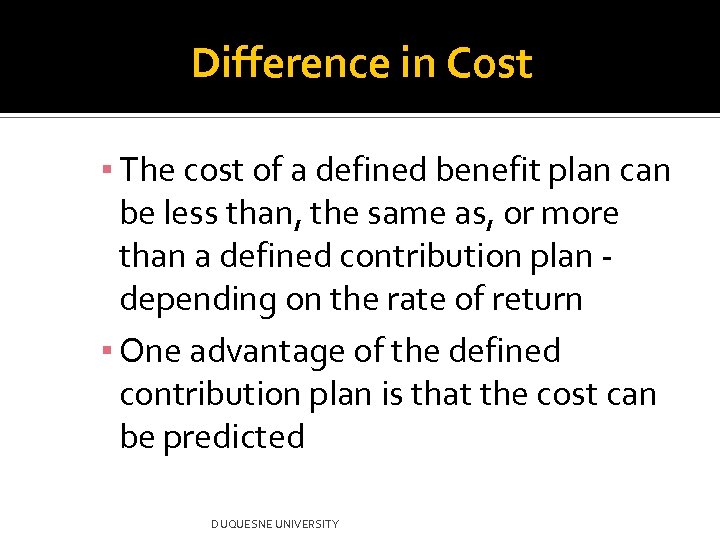
Difference in Cost ▪ The cost of a defined benefit plan can be less than, the same as, or more than a defined contribution plan depending on the rate of return ▪ One advantage of the defined contribution plan is that the cost can be predicted DUQUESNE UNIVERSITY
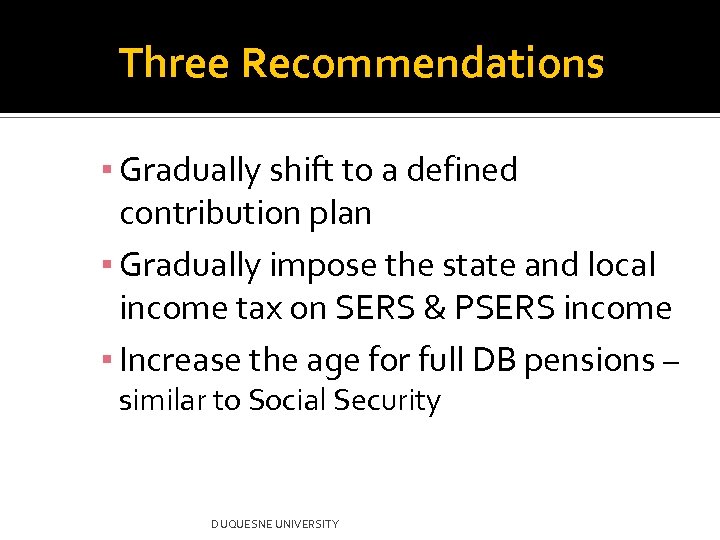
Three Recommendations ▪ Gradually shift to a defined contribution plan ▪ Gradually impose the state and local income tax on SERS & PSERS income ▪ Increase the age for full DB pensions – similar to Social Security DUQUESNE UNIVERSITY
Скачать презентацию PUBLIC PENSIONS IN PENNSYLVANIA A Looming Crisis DUQUESNE
a2f8c7a80d8847d16e1b19ac29cb71f8.ppt