 Скачать презентацию Public Opinion and Political Socialization Chapter 11
political_socialization.pptx
- Количество слайдов: 29



Public Opinion and Political Socialization Chapter 11
Political Socialization • A learning process through which we acquire our ideas, opinions, and beliefs about politics. • It never really ends.
Major Agents of Political Socialization • Family • School • Peers • Mass Media • Events • Social Groups
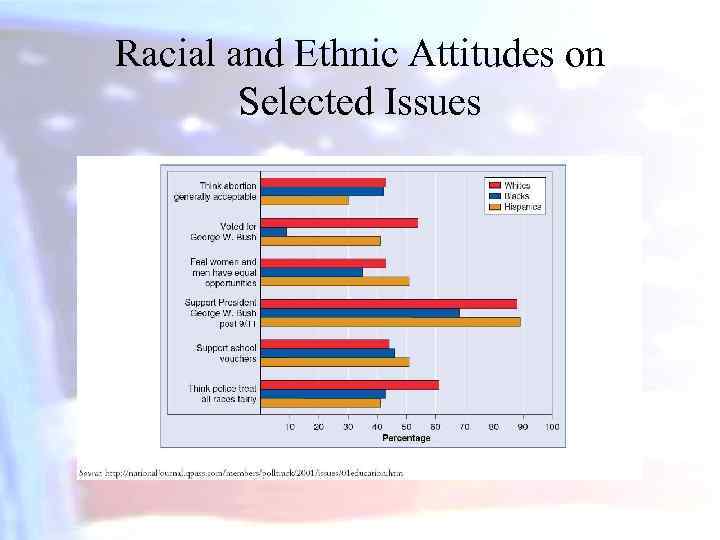
Racial and Ethnic Attitudes on Selected Issues
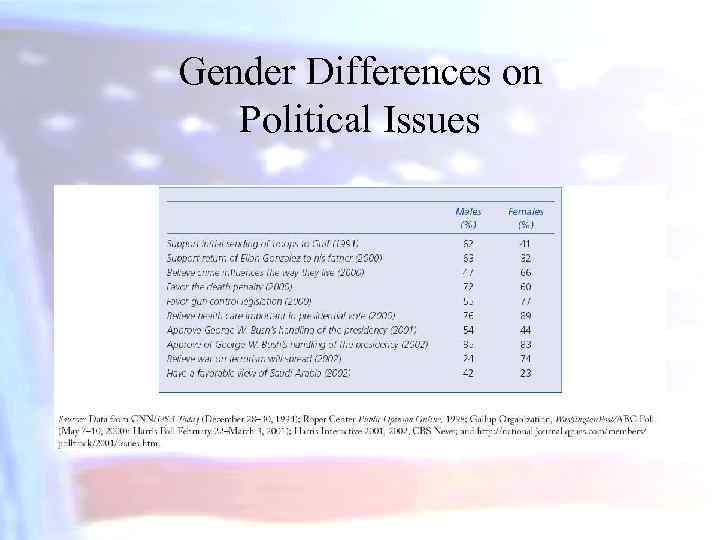
Gender Differences on Political Issues
Through Political Socialization • We eventually form an “Ideology” • This ideology is our set of core beliefs about politics. • It is a foundation from which we judge everything else about politics.
Our core ideology is always the last thing to change. We will usually change lesser opinions first. • I will try to provide an example.
How do we form opinions? • Ideology • Personal Interests • Political Knowledge • Cues from leaders
Political Scientists are somewhat worried by surveys • Which show declining levels of political knowledge. • For example, less than 30% of Americans surveyed in 2004 knew who their Representative was in the U. S. House.
So if you take political knowledge out…what are we left with? Ideology Personal Interests Cues from leaders
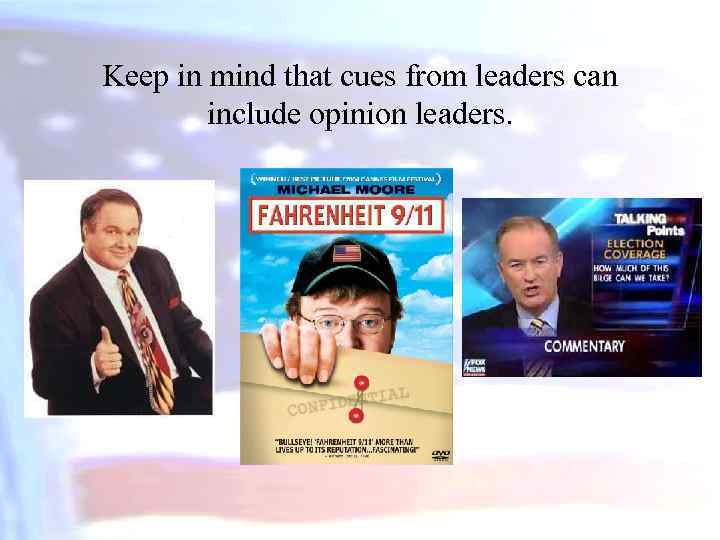
Keep in mind that cues from leaders can include opinion leaders.
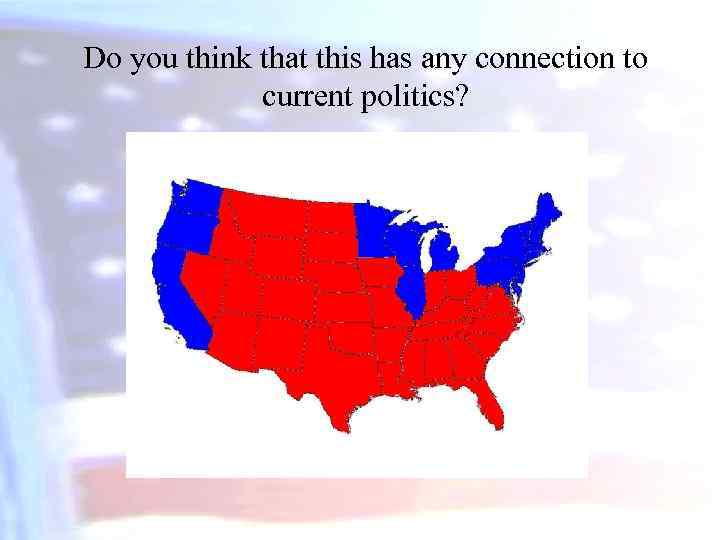
Do you think that this has any connection to current politics?
Is it easier to take a political position by relying on ideology? • What must one do to take a stand relying on the other areas?
What about the level of certainty with an ideology? • Does my level of conviction affect my likeliness to compromise or discuss topics openly?

Would a high level of ideological conviction make me a better teacher?

Would a high level of ideological conviction make you a better student?
Does a high level of ideological conviction make us better citizens in a democracy?
What is Public Opinion? Public opinion is 'what the people think about an issue or set of issues at any given point in time' and opinions are normally measured by opinion polls.
How We Measure Public Opinion In order for a poll to be reliable, it must have a random sample.
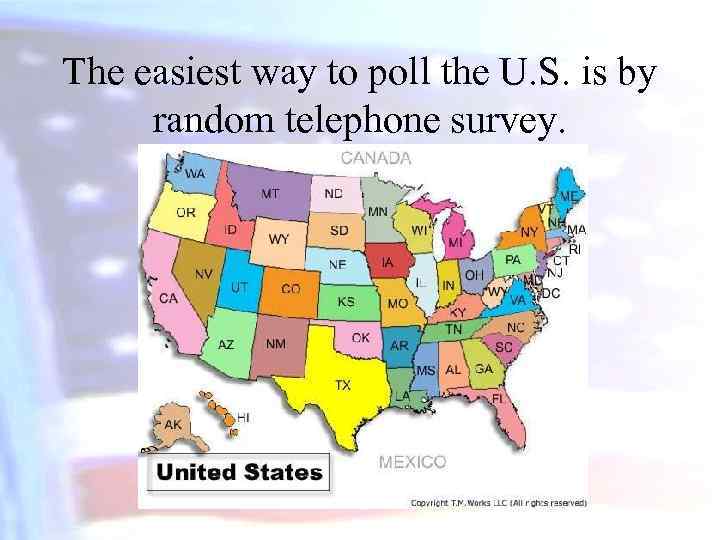
The easiest way to poll the U. S. is by random telephone survey.
Public Opinion Polls are interviews or surveys of a sample of citizens used to estimate how the public feels about an issue or set of issues.
Measuring Public Opinion • In general, do not trust a poll that does not tell you the question wording, the sampling method, and the ways in which respondents were contacted. • Reputable pollsters will also tell you the number of respondents (the 'n') and the error rate (+ or 5%). • Any poll that tells you to call 555 -5554 for yes and 555 -5555 for no is unscientific and unreliable. This is not a random sample at all!
Types of Polls • Tracking polls--continuous surveys that enable a campaign to chart its daily rise and fall in popularity. These may be a decent measure of trends. • Exit polls--polls conducted at polling places on election day.
Some social scientists have experimented with: • Deliberative polls--a new kind of poll first tried in 1996. • A relatively large scientific sample of Americans (600) were selected for intensive briefings, discussions, and presentations about issue clusters including foreign affairs, the family, and the economy.
Who uses polls? • Politicians • Political Parties • Interest Groups
Why? • To help campaign strategy. • To lobby members of government. • Because the results are private. • The poll can be conducted at any time. • The poll can ask specific questions for the candidate or party.
Polls do not do well at: • Measuring intensity of an opinion. • They also have problems with: Providing an optimum range of responses.
Recently, pollsters say it is becoming harder to do phone surveys. • Rise of cell phone use • Do not call list • Public anger over intrusion
Скачать презентацию Public Opinion and Political Socialization Chapter 11
political_socialization.pptx