 Скачать презентацию Public Health Monitoring Summit September 2008 1
d470a8893b20f4265a211fb54de49409.ppt
- Количество слайдов: 42



Public Health Monitoring Summit September 2008 1
Agenda • • • Purpose Definitions and Terms The Life Cycle of a Grant Responsibilities General Monitoring Overview Monitoring “Special” Subrecipients Fiscal Monitoring Reporting Requirements Upcoming Activities Tools and Resources Needs? Public Health Monitoring Summit September 2008 2
Purpose To ensure that all DPH monitors are equipped to be successful monitors by providing the following information: – A review of the monitoring process – An update on monitoring in DPH – Tools and Resources – Opportunity to explore needs and concerns Public Health Monitoring Summit September 2008 3
Definitions and Terms • Grant: An award of financial assistance from a federal agency to a recipient to carry out a public purpose of support or stimulation authorized by a law of the United States or North Carolina law. • Grantor: An entity that makes a grant. For our purposes, either the federal government or state government. • Grantee: A non-state entity that receives State funds (including federal funds that pass through the State) as a grant from a State agency. • Subrecipient: Same as grantee. • Compliance Supplement: An instrument used to assist auditors in performing the required audits per OMB Circular A-133. • Compliance Requirements: Compliance Supplements for each program list which of the 14 Federal requirements with which that program must comply. The State adds a 15 th requirement, Conflict of Interest. • Contract: a binding agreement between two or more persons or parties; especially one legally enforceable. Public Health Monitoring Summit September 2008 4
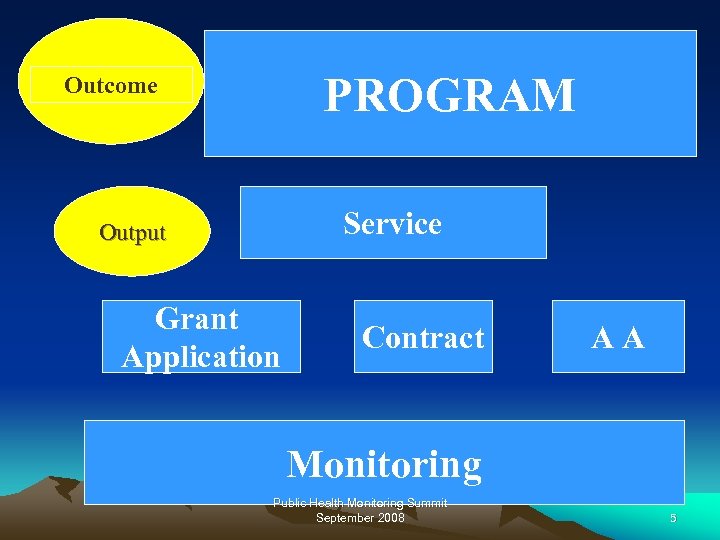
PROGRAM Outcome Service Output Grant Application Contract AA Monitoring Public Health Monitoring Summit September 2008 5
The Life Cycle of a Grant • Refer to Handout # 1 Public Health Monitoring Summit September 2008 6
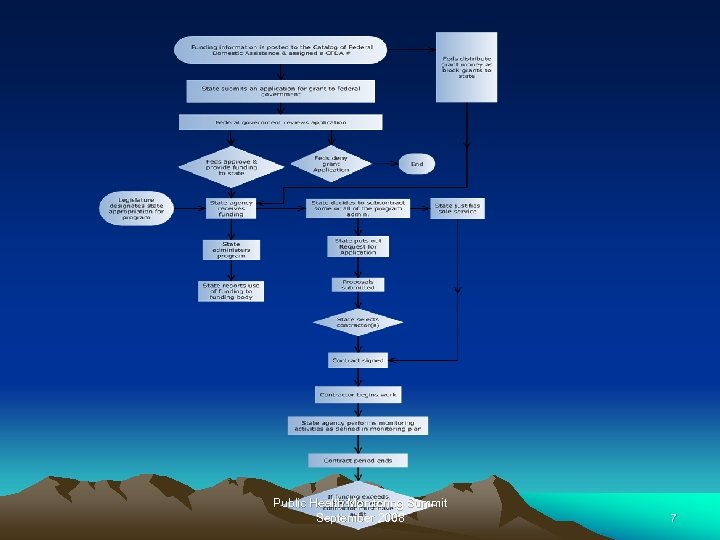
Public Health Monitoring Summit September 2008 7
Federal Agency Responsibilities Federal Agencies Post Funding Opportunities on the Grants. gov website – Review grant proposals from states and other nonfederal entities – Evaluate proposals against established criteria – Award grant money – Advise funded agencies of requirements – Provide technical assistance – Ensure money is spent as designated Public Health Monitoring Summit September 2008 8
State Legislature Responsibilities • Provide State Appropriation to fund specific initiative • Designate responsible agency • Advise how funds are to be used • Establish reporting requirements Public Health Monitoring Summit September 2008 9
State Agency Responsibilities • To accomplish the work. This could be done by: • The state directly • Contractors Public Health Monitoring Summit September 2008 10
State Agency Responsibilities If State Agency decides to contract, they have two options: • Put out for a Competitive Bid • Justify a sole source contract Either way, the State Agency selects a contractor or contractors by evaluating proposals against established criteria. Public Health Monitoring Summit September 2008 11
State Agency and Contractor Responsibilities • In Contract Negotiations, ensure Contract includes: – Terms and Conditions – Scope of Work – Performance Measures – Federal Government Required Certifications – Accountability – Reporting Requirements – Monitoring Information • Contract Execution Public Health Monitoring Summit September 2008 12
Subrecipient’s Responsibilities • • Ensure their staff is trained and competent Do the work Adhere to contract terms Report as required to funding agency and OSA Public Health Monitoring Summit September 2008 13
Everybody’s Responsibility • To meet program objectives. • To spend money appropriately. Public Health Monitoring Summit September 2008 14
What is Monitoring? • Regular observation and recording of activities taking place in a project or program. • Process of routinely gathering information on all aspects of the project – Check on how activities are progressing – Give feedback about progress – Make decisions for improving performance Public Health Monitoring Summit September 2008 15
Why Must We Monitor? • To ensure accountability • To verify that funds are being spent for intended purposes • To meet the requirements of GS 143 C-6 -23 • To confirm continuation of funding • It’s just good business sense Public Health Monitoring Summit September 2008 16
Who Must We Monitor? We are required to monitor all subrecipients, which is any entity with which we have a Financial Assistance arrangement. This includes: • Non-profits • For profits • UNC System • Local health departments • Other units of Local Government Public Health Monitoring Summit September 2008 17
Monitoring When does Monitoring Begin? • Pre-Award – Site visit – Risk Assessment – Research contracts with other programs or agencies (Subrecipient Monitoring System and OSBM Suspension List) Public Health Monitoring Summit September 2008 18
Monitoring Pre-Award Risk Assessment Factors: • Subrecipient’s Stability • Geographic Problems • Amount of award vs. total resources • Susceptibility to fraud – based on minutes and internal controls • New program • Public or legislative scrutiny Public Health Monitoring Summit September 2008 19
How Do We Monitor? Each division must: • Develop an annual monitoring plan for all subrecipients. • Develop program plans that address monitoring needs specific to each program. • Ensure that all internal staff conducting any monitoring activity are trained and that efforts are coordinated internally. • Update the DHHS Subrecipient Monitoring System. Public Health Monitoring Summit September 2008 20
Monitoring Plan Before contract is finalized, determine frequency and types of monitoring activities. Base this on: – Risk – Funding Source Requirements – Compliance Supplements Include monitoring plan in contract and/or provide link to your monitoring plan in Employee Toolkit. Public Health Monitoring Summit September 2008 21
Monitoring Activities • Review of Programmatic Reports • Review of Financial Reports • Review of Contract • Review of Self-Assessment of Internal Control • Review of Historical Findings • Telephone Contact • Follow-up on Prior Year Audit Findings • On Site Visits As long as it’s documented, it counts. Public Health Monitoring Summit September 2008 22
Monitoring by Compliance Supplements • The Compliance Supplement for each program should be reviewed before a monitoring event to see which compliance requirements apply to the program. • See Handout #2 for Compliance Requirement definitions. • Why do we do that? Stay tuned. Public Health Monitoring Summit September 2008 23
Fiscal Monitoring Do not need to be an accountant. Ask simple questions, such as: • How many checkbooks do you have and why? • How do you handle petty cash? • Can you show me your journals and ledgers and walk me through? • Can I review your invoices and compare them to your canceled checks? • How many signatures do you require on a check and does this match what is in your policy and procedures? Public Health Monitoring Summit September 2008 24
Analysis of Monitoring Events Look for Red Flags: • Inability to clear outstanding issues • Letters of complaint • Inaccurate/incomplete/late project submissions or progress reports • Failure to meet agreed-upon schedules • Failure to comply with terms of contract or agreement • Staff turnover/inexperienced staff • Change in leadership; Board turnover Public Health Monitoring Summit September 2008 25
Monitoring “Special” Subrecipients • Universities: • UNC System – Historically low risk • Private Universities and Colleges: – Considered low risk, unless a red flag appears Both can be monitored minimally fiscally (will be added to divisional plan) Public Health Monitoring Summit September 2008 26
Monitoring “Special” Subrecipients Local Health Departments • Only required for Financial Assistance arrangements • LHDs complete a Self Assessment of Internal Controls Annually • Program Monitoring performed by Program monitors • Fiscal Monitoring performed by Administrative Consultants • ACs notify appropriate program if finding • Local Public Health Districts submit Quarterly Fiscal Monitoring Report to the DHHS Office of the Controller Public Health Monitoring Summit September 2008 27
Monitoring “Special” Subrecipients Special Appropriations • They must meet GS 143 C-6 -23 requirements. • Do best you can with what you’ve got. Public Health Monitoring Summit September 2008 28
Monitoring vs. Auditing • Monitoring is done prior to execution of the contract and throughout the life of the contract. • Auditing is done after the end of the contract period. • We should use compliance supplements to monitor since auditors use compliance supplements to audit. Public Health Monitoring Summit September 2008 29
Misuse of Funds • If you become aware of a possible misuse of funding, it is your duty to report this to the Office of the State Auditor. You can do this anonymously. • If it’s a LHD, inform supervisor of program issue immediately. Use chain of command to report. They are to be reported to the Local Government Commission (LGC). Public Health Monitoring Summit September 2008 30
Goals • There will be no findings because we have monitored so well. • The Office of the State Auditor will not be called in to do a audit. • We will not be surprised to be in the N & O. • Work is done correctly, money is spent accordingly, target measures are met. Public Health Monitoring Summit September 2008 31
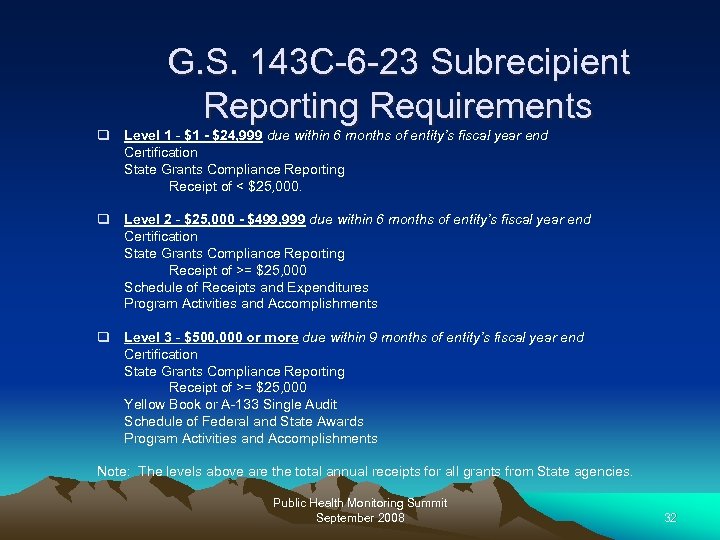
G. S. 143 C-6 -23 Subrecipient Reporting Requirements q Level 1 - $24, 999 due within 6 months of entity’s fiscal year end Certification State Grants Compliance Reporting Receipt of < $25, 000. q Level 2 - $25, 000 - $499, 999 due within 6 months of entity’s fiscal year end Certification State Grants Compliance Reporting Receipt of >= $25, 000 Schedule of Receipts and Expenditures Program Activities and Accomplishments q Level 3 - $500, 000 or more due within 9 months of entity’s fiscal year end Certification State Grants Compliance Reporting Receipt of >= $25, 000 Yellow Book or A-133 Single Audit Schedule of Federal and State Awards Program Activities and Accomplishments Note: The levels above are the total annual receipts for all grants from State agencies. Public Health Monitoring Summit September 2008 32
G. S. 143 C-6 -23 Subrecipient Reporting Requirements Exceptions: • Local government entities – they are not subject to reporting to OSA under GS 143 C-6 -23. They report to the Local Government Commission. • State agencies. Public Health Monitoring Summit September 2008 33
Grants Information Center • Statewide automated system created by OSA that allows grantees to enter aforementioned reports electronically. Also provides a tracking and alert mechanism for grantees. • Forthcoming enhancement will allow grantors to view these reports. • Does not include local governmental entities or other state agencies. Public Health Monitoring Summit September 2008 34
Penalties for Failure to Report • If a subrecipient fails to report or if reports are incorrect or incomplete: • OSA maintains a non-compliance list of reports that are at least 30 days overdue. • After two written requests for late reports, DHHS suspends funds. • The late reporters are put on the OSBM Suspension of Funding list. State agencies are prohibited from disbursing financial assistance to any grantee that has not complied with the reporting requirements. Public Health Monitoring Summit September 2008 35
Upcoming Activities • Entering Actual Monitoring Activities into the Subrecipient Monitoring System - ? ? • Systems Merger – Effective ? ? • Monitoring Plan Update – Due January • Compliance Supplement Updates – Due January • OSA Training Series Public Health Monitoring Summit September 2008 36
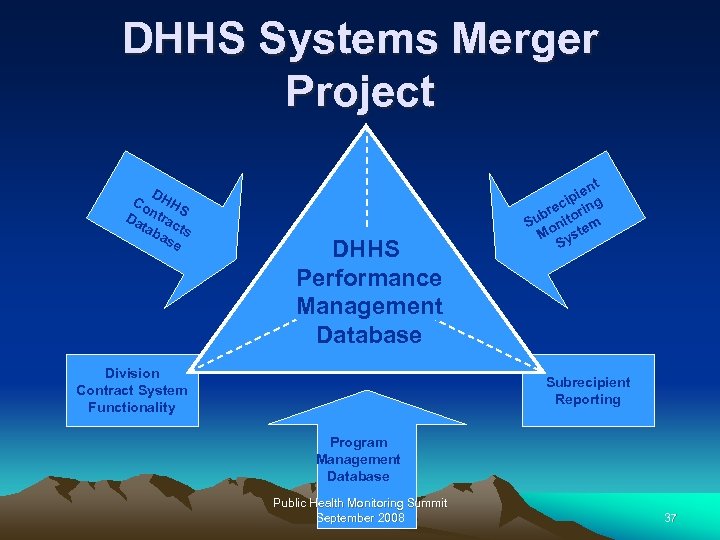
DHHS Systems Merger Project D Co HH S Da ntra tab cts as e DHHS Performance Management Database Division Contract System Functionality nt pie g ci n bre itori Su on em M yst S Subrecipient Reporting Program Management Database Public Health Monitoring Summit September 2008 37
Tools and Resources For Grantors Sources for Risk Assessment: • OSA’s Establishing Effective Grant Monitoring Programs Training - Handout #2 • http: //www. ncauditor. net/Non. Profit. Site/training/2006/Effective. Grant. Monitoring/Establi shing%20 Effective%20 Grants%20 Monitoring%20 Program. ppt • OSA Best Practices Newsletter • http: //www. ncauditor. net/Non. Profit. Site/newsletters/Newsletter-2008 -Fall. pdf • Audit. Net – The Global Resource for Auditors • http: //www. auditnet. org/docs/risk 1. doc Public Health Monitoring Summit September 2008 38
Tools and Resources For Grantors • Subrecipient Monitoring System (to be replaced by Integrated System) • DPH Monitoring Plan • Program Monitoring Plans • DHHS Office of the Controller • DHHS’s and OSBM’s Suspension of Funding Lists • Donna Gregory and Kathy Hardison Public Health Monitoring Summit September 2008 39
Tools and Resources For Grantors and Grantees OSA’s Grants Administration Certification Program • Establishing Effective Grant Monitoring Programs • Creating Effective Policies and Procedures • Basics of Internal Control • Identifying Allowable and Unallowable Costs • Grants Update Training OSA’s quarterly newsletter Public Health Monitoring Summit September 2008 40
Needs? ? • • • Training of Subrecipients? Monitoring Universities? More trainings for monitors? Topics? Other support in specific areas? Quarterly Monitors Meetings? Public Health Monitoring Summit September 2008 41

Thank you! • WE’VE COME A LONG WAY, THANKS TO YOU! Public Health Monitoring Summit September 2008 42
Скачать презентацию Public Health Monitoring Summit September 2008 1
d470a8893b20f4265a211fb54de49409.ppt