 Скачать презентацию Public Health Implications of Water Supply Improvements Did
3f34c5c361d8b2c3b7d335338c121ec7.ppt
- Количество слайдов: 71



Public Health Implications of Water Supply Improvements Did Environmental Engineers save the world? Monroe L. Weber-Shirk School of Civil and Environmental Engineering
Review: Public Health Implications of Water Supply Improvements Ø The life expectancy transition ØThe role of water supply, sanitation, and hygiene ØIn the Global North a century ago ØIn the Global South ØThe U 5 MR connection Ø Exposure Routes: breaking the cycle Ø Pathogens in the loop Ø Implications for successful interventions
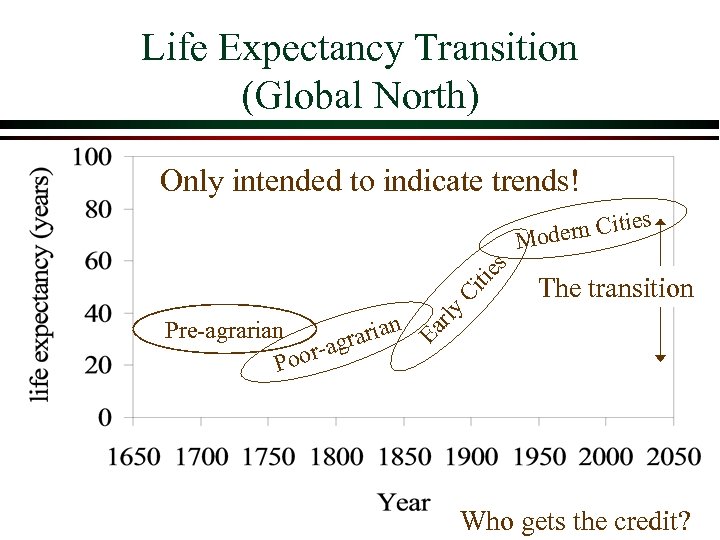
Life Expectancy Transition (Global North) Only intended to indicate trends! s E n Pre-agrarian raria g or-a Po The transition ar ly C iti es tie dern Ci Mo Who gets the credit?
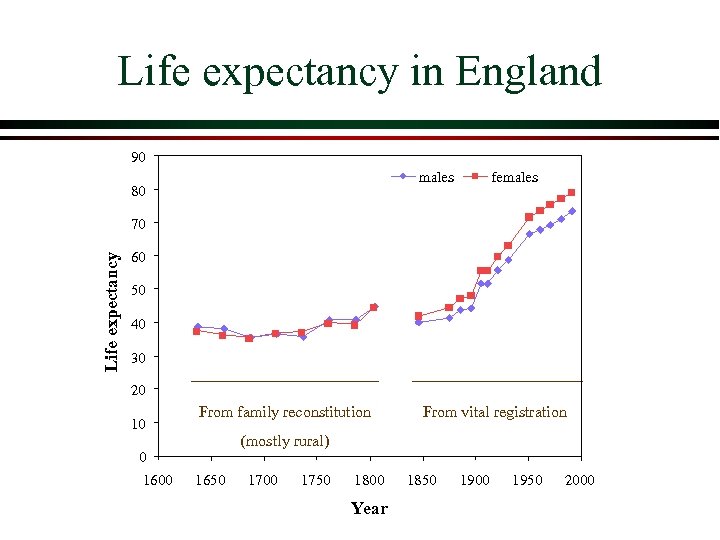
Life expectancy in England 90 males 80 females Life expectancy 70 60 50 40 30 20 10 0 1600 From family reconstitution From vital registration (mostly rural) 1650 1700 1750 1800 Year 1850 1900 1950 2000
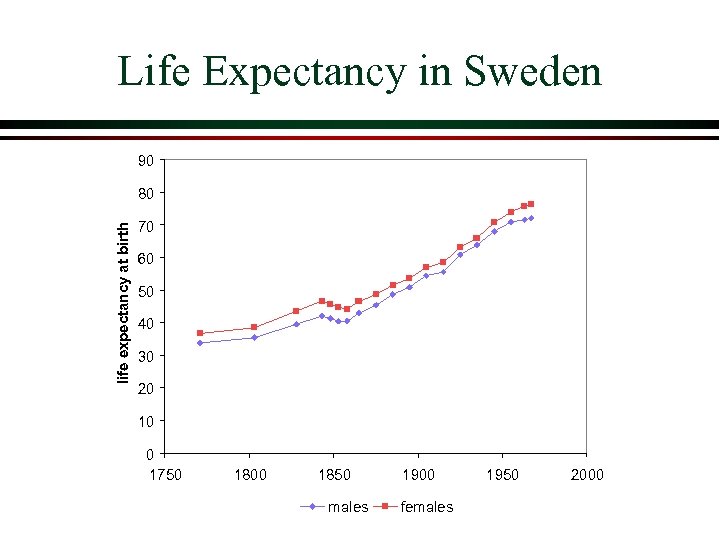
Life Expectancy in Sweden 90 life expectancy at birth 80 70 60 50 40 30 20 10 0 1750 1800 1850 males 1900 females 1950 2000
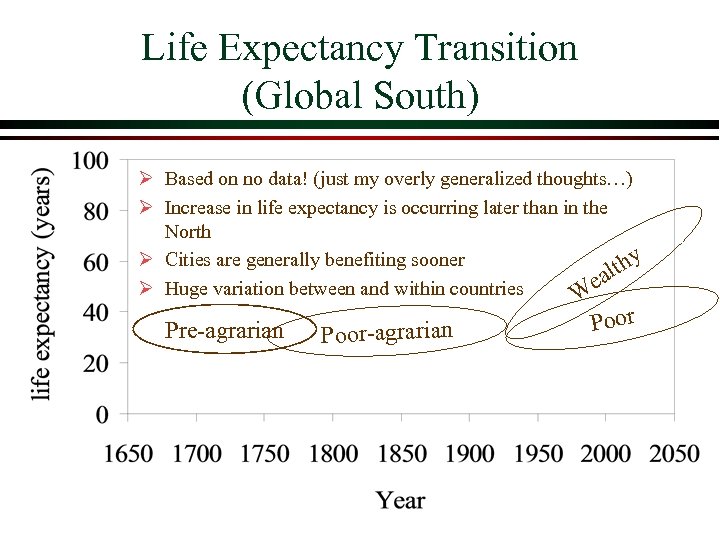
Life Expectancy Transition (Global South) Ø Based on no data! (just my overly generalized thoughts…) Ø Increase in life expectancy is occurring later than in the North y Ø Cities are generally benefiting sooner lth ea Ø Huge variation between and within countries W Pre-agrarian Poor
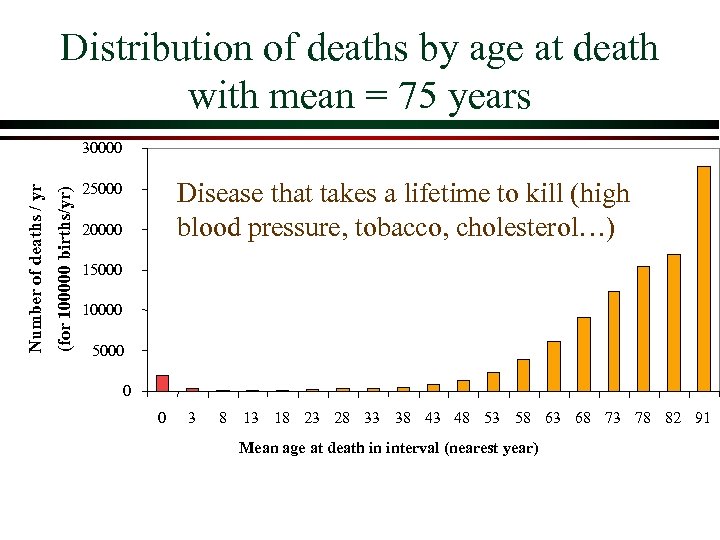
Distribution of deaths by age at death with mean = 75 years (for 100000 births/yr) Number of deaths / yr 30000 Disease that takes a lifetime to kill (high blood pressure, tobacco, cholesterol…) 25000 20000 15000 10000 5000 0 0 3 8 13 18 23 28 33 38 43 48 53 58 63 68 73 78 82 91 Mean age at death in interval (nearest year)
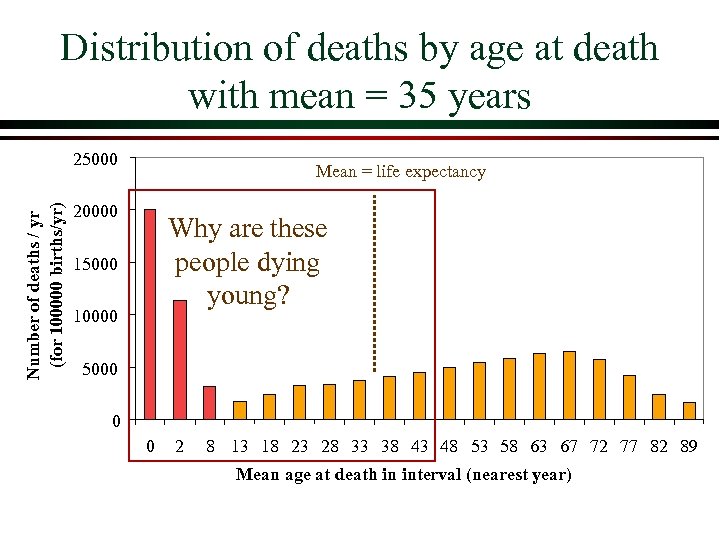
Distribution of deaths by age at death with mean = 35 years Number of deaths / yr (for 100000 births/yr) 25000 Mean = life expectancy 20000 Why are these people dying young? 15000 10000 5000 0 0 2 8 13 18 23 28 33 38 43 48 53 58 63 67 72 77 82 89 Mean age at death in interval (nearest year)
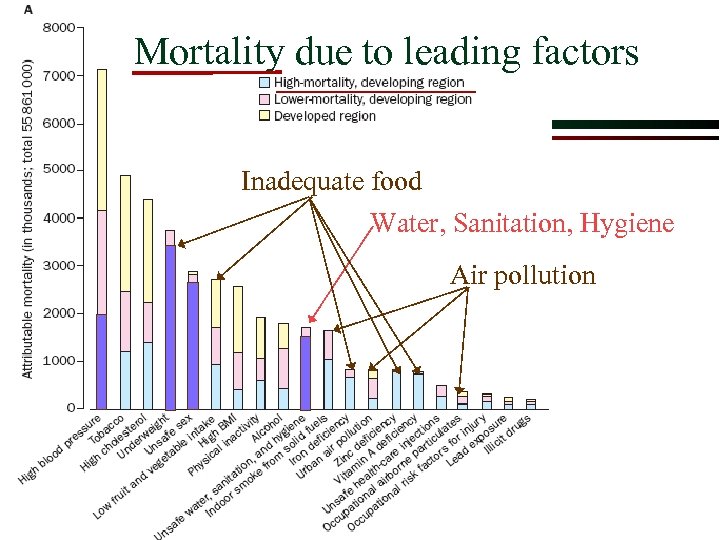
Mortality due to leading factors Inadequate food Water, Sanitation, Hygiene Air pollution
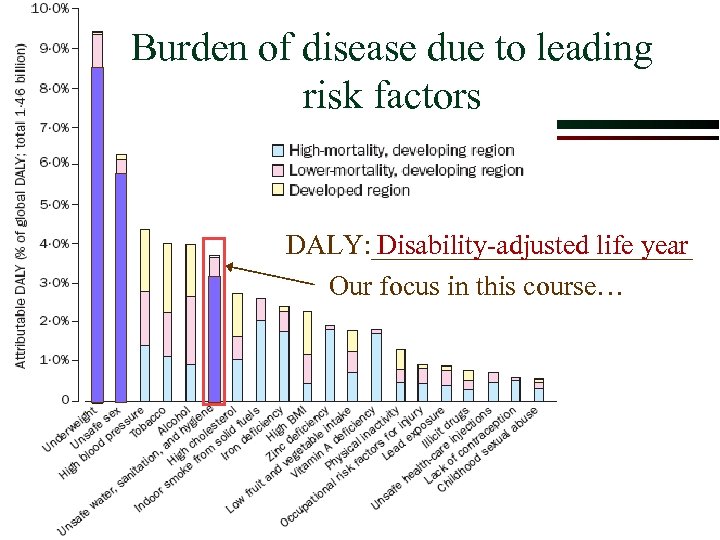
Burden of disease due to leading risk factors Disability-adjusted life year DALY: ____________ Our focus in this course…
The role of Water Supply, Sanitation, and Hygiene Ø Contribute significantly to mortality and morbidity on the global level Ø Have an enormous influence on U 5 MR (under 5 mortality rate) Ø But why are these 3 items grouped together? Ø What is the effect of safe drinking water? Ø Let’s examine the role of safe drinking water in the life expectancy transition
Mills-Reincke Phenomenon ‘…. the purification of polluted public watersupplies reduces the general death-rate much more than it would be reduced by the saving of deaths from the commonly recognized water-borne disease, typhoid fever and Asiatic cholera alone. ’ Sedgwick WT, Mac. Nutt JS. On the Mills-Reincke phenomenon and Hazen's theorem concerning the decrease in mortality from diseases other than typhoid fever following the purification of public water-supplies. J. Infect. Dis. 1910; 7 : 489 -564. This is the “Environmental Engineers Saved the World” Hypothesis.
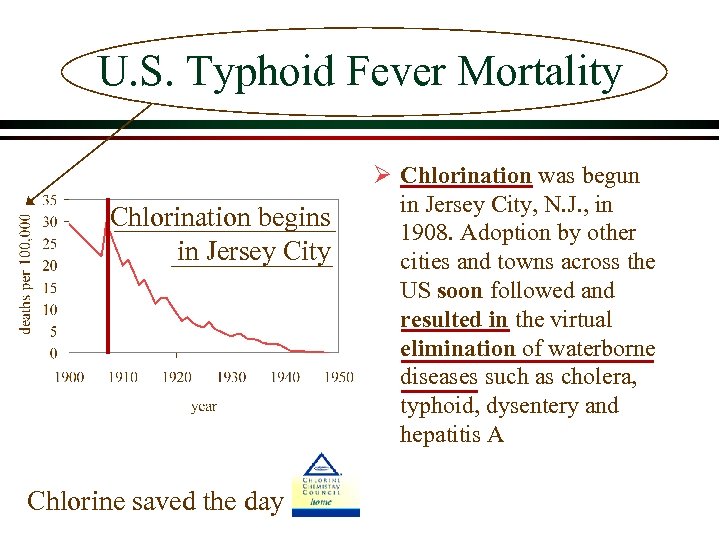
U. S. Typhoid Fever Mortality Chlorination begins in Jersey City Chlorine saved the day Ø Chlorination was begun in Jersey City, N. J. , in 1908. Adoption by other cities and towns across the US soon followed and resulted in the virtual elimination of waterborne diseases such as cholera, typhoid, dysentery and hepatitis A
Chlorine Cause and Effect: What else would you like to know… Ø What was the mortality rate before the introduction of chlorine? Ø When did other cities adopt chlorination? Ø How did the mortality rate change for cities when they began chlorinating? Ø What other changes were occurring during the 1900 s that may have influenced mortality?
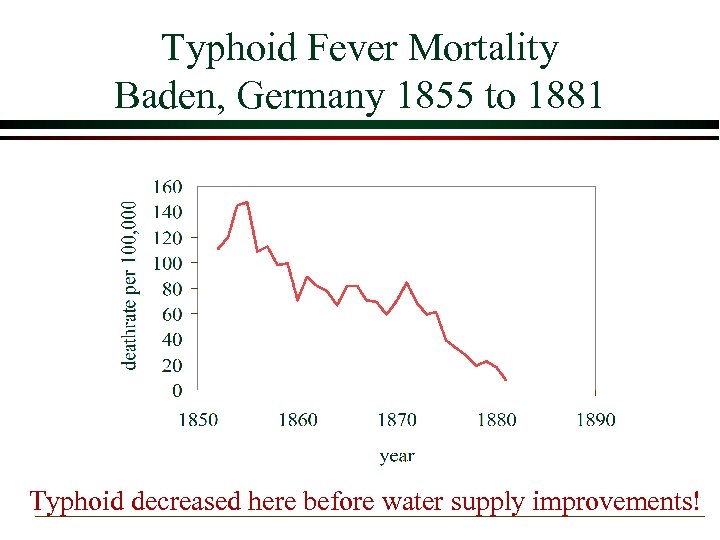
Typhoid Fever Mortality Baden, Germany 1855 to 1881 Typhoid decreased here before water supply improvements!
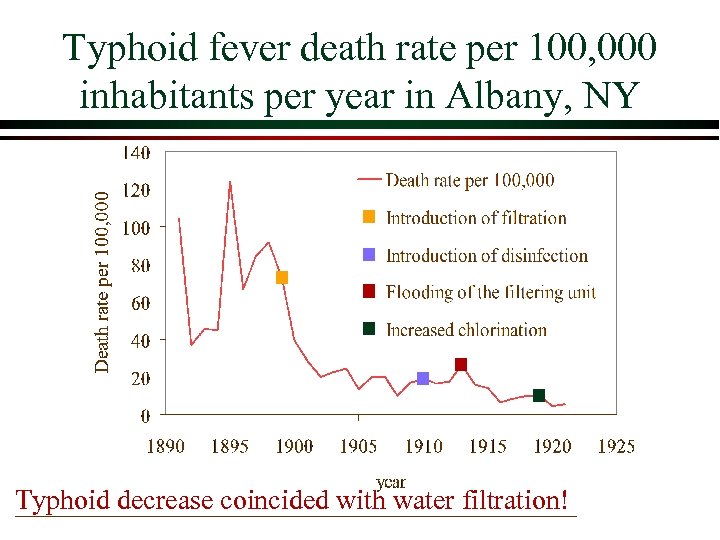
Typhoid fever death rate per 100, 000 inhabitants per year in Albany, NY Typhoid decrease coincided with water filtration!
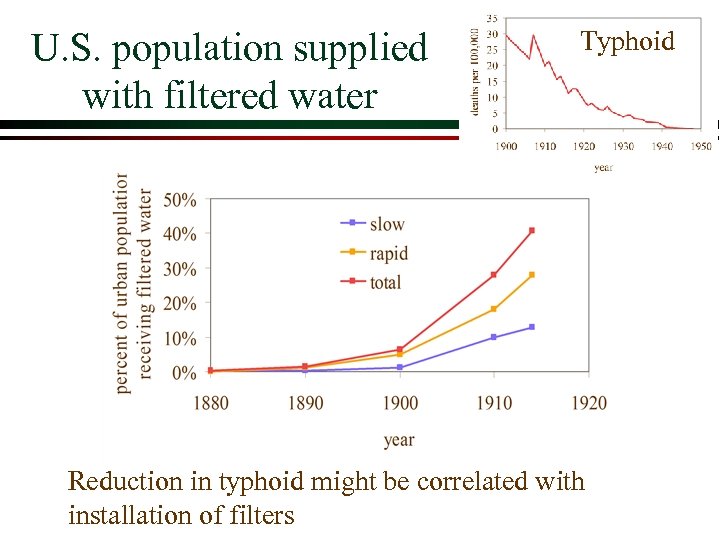
U. S. population supplied with filtered water Typhoid Reduction in typhoid might be correlated with installation of filters
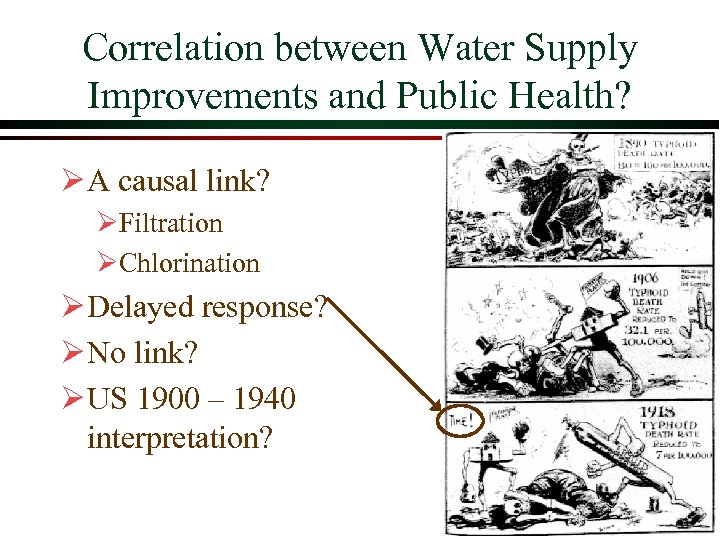
Correlation between Water Supply Improvements and Public Health? Ø A causal link? ØFiltration ØChlorination Ø Delayed response? Ø No link? Ø US 1900 – 1940 interpretation?
Disease rates as measures of efficiency Ø “The final criterion of the efficiency of a purification plant is the absence or prevalence in the community of waterborne diseases. Typhoid fever being the most typical and widespread of such diseases, statistics of its prevalence are of much significance. Prior to the general introduction of purification works, the typhoid death rate was invariably high in many of our large cities drawing their supply from polluted rivers and lakes. Most of these cities are now supplied with satisfactory water, and many records could be given showing the marked effect of water treatment on the typhoid rate. The following data for the cities of New Orleans, Pittsburgh and Cincinnati will suffice. ” Public Water-Supplies by Turneaure, Russell, Mead, Baker. John Wiley & Sons (1924) pages 430 -431.
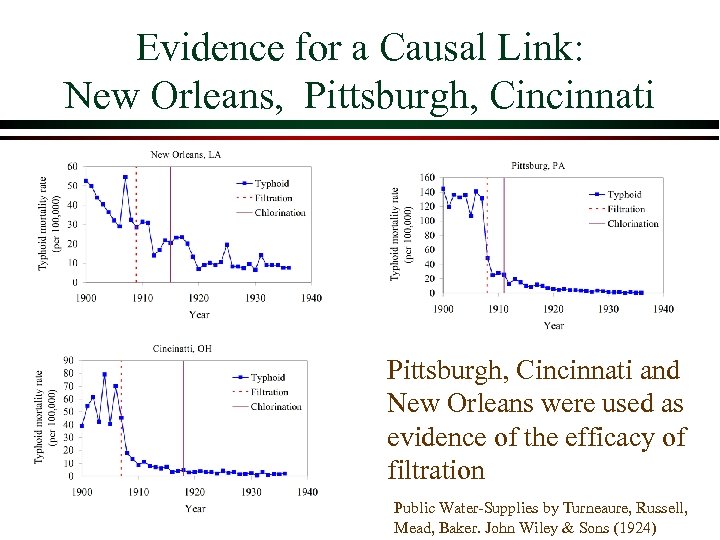
Evidence for a Causal Link: New Orleans, Pittsburgh, Cincinnati and New Orleans were used as evidence of the efficacy of filtration Public Water-Supplies by Turneaure, Russell, Mead, Baker. John Wiley & Sons (1924)
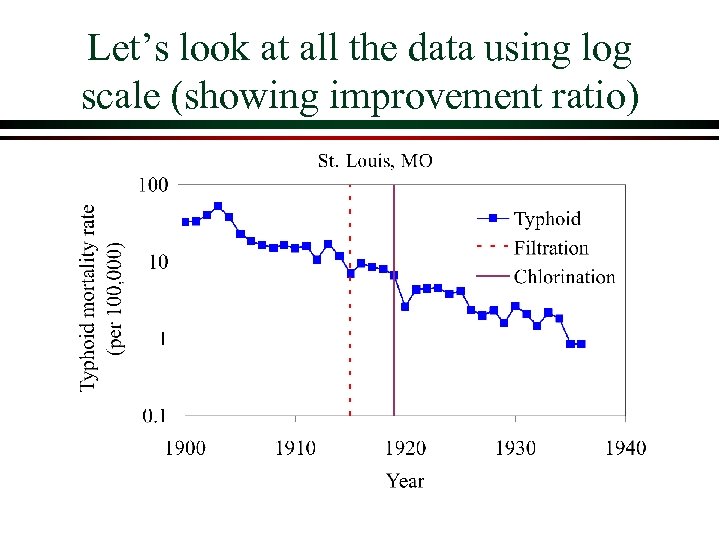
Let’s look at all the data using log scale (showing improvement ratio)
Trying to Understand the Data Ø “The steady reduction… is probably due in part to improved operation and in part to the gradual elimination of the disease from the community and so removing sources of Public Water-Supplies by Turneaure, Russell, contamination. ” Mead, Baker. John Wiley & Sons (1924) Ø What do you think?
What else was happening? …education (one possibility) Ø ‘Infant care’ (US Children’s Bureau) Ø 12, 000 copies Ø Baby care columns in leading newspapers ØCarried by nearly all newspapers by 1912 (though not a few years earlier) Ø ‘Baby weeks’ ØBy 1919: 17, 000 local committees Ø 11, 000 directly involved
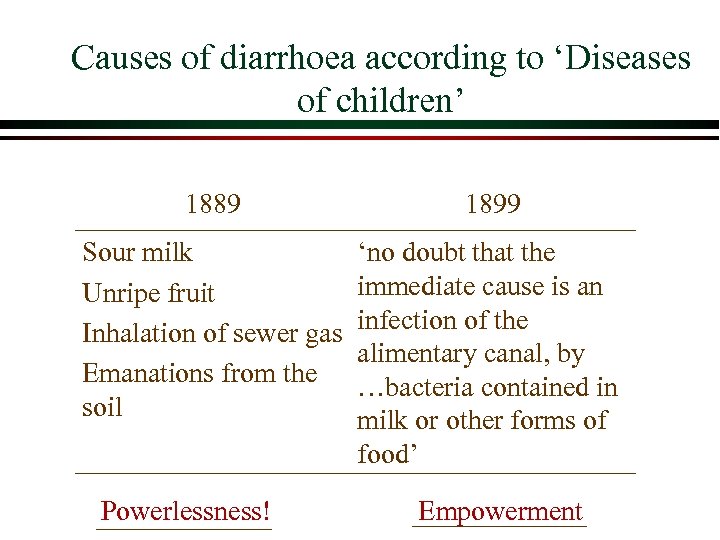
Causes of diarrhoea according to ‘Diseases of children’ 1889 1899 Sour milk Unripe fruit Inhalation of sewer gas Emanations from the soil ‘no doubt that the immediate cause is an infection of the alimentary canal, by …bacteria contained in milk or other forms of food’ Powerlessness! Empowerment
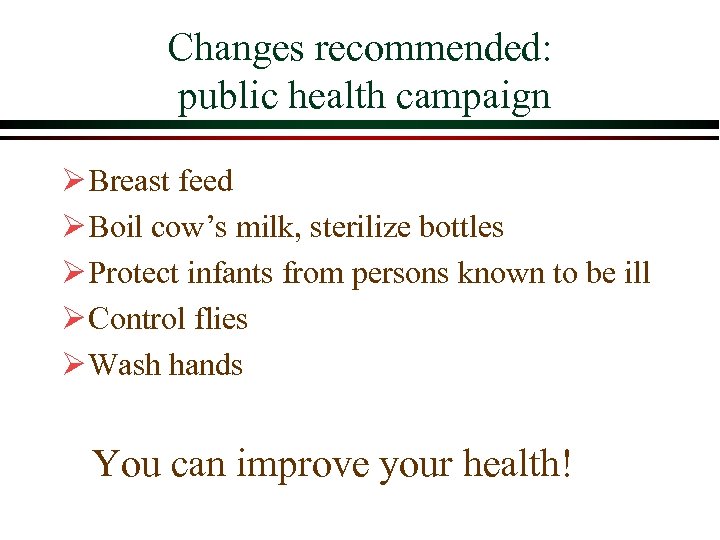
Changes recommended: public health campaign Ø Breast feed Ø Boil cow’s milk, sterilize bottles Ø Protect infants from persons known to be ill Ø Control flies Ø Wash hands You can improve your health!
Education of the Public . . . the discovery of the possibilities of widespread social organization as a means of controlling disease was one which may almost be placed alongside the discovery of the germ theory of disease itself as a factor in the evolution of the modern public health campaign. -Winslow (1929)
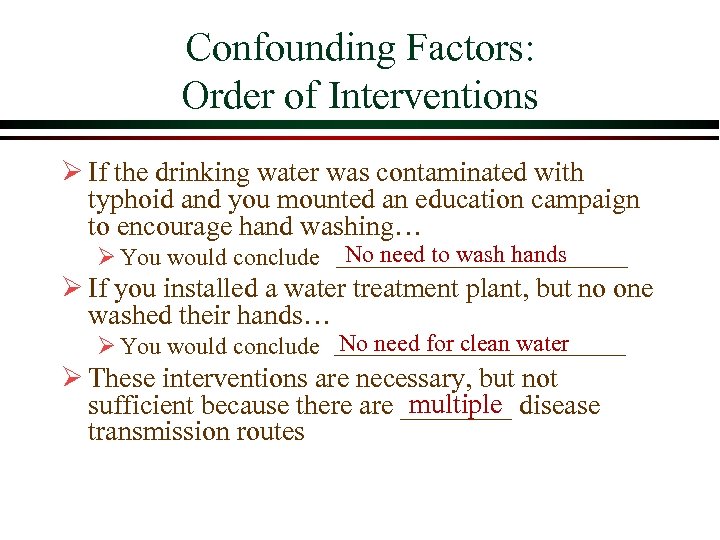
Confounding Factors: Order of Interventions Ø If the drinking water was contaminated with typhoid and you mounted an education campaign to encourage hand washing… Ø You would conclude No need to wash hands Ø If you installed a water treatment plant, but no one washed their hands… Ø You would conclude No need for clean water Ø These interventions are necessary, but not multiple sufficient because there are ____ disease transmission routes
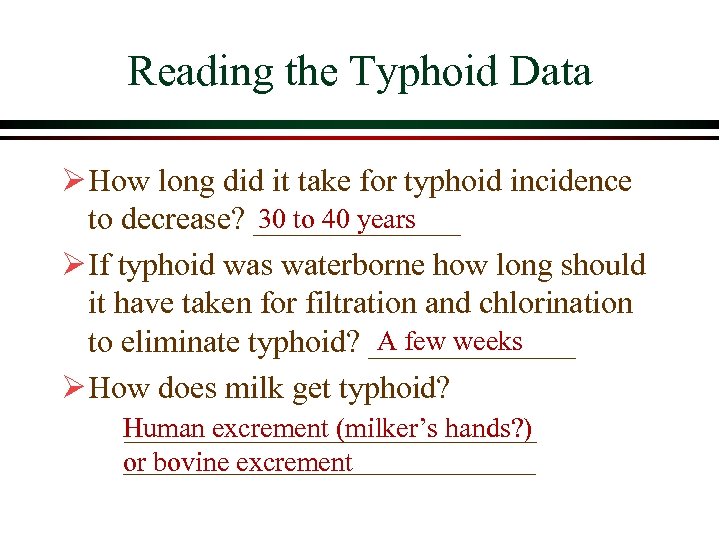
Reading the Typhoid Data Ø How long did it take for typhoid incidence 30 to 40 years to decrease? _______ Ø If typhoid was waterborne how long should it have taken for filtration and chlorination A few weeks to eliminate typhoid? _______ Ø How does milk get typhoid? Human excrement (milker’s hands? ) or bovine excrement
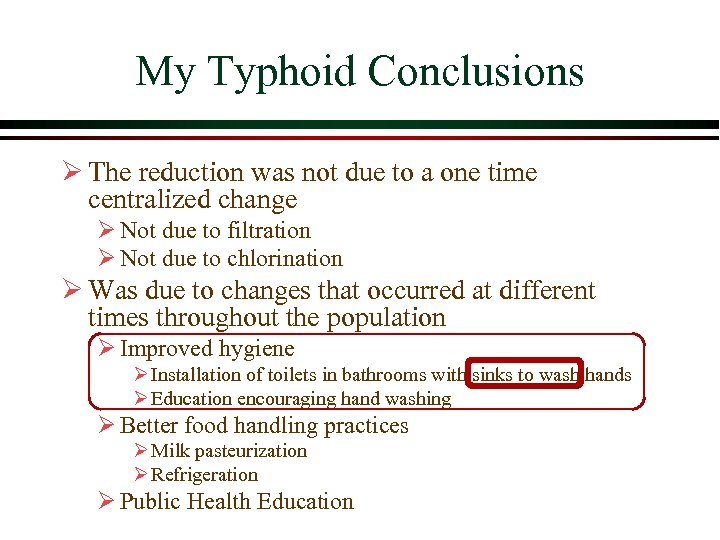
My Typhoid Conclusions Ø The reduction was not due to a one time centralized change Ø Not due to filtration Ø Not due to chlorination Ø Was due to changes that occurred at different times throughout the population Ø Improved hygiene Ø Installation of toilets in bathrooms with sinks to wash hands Ø Education encouraging hand washing Ø Better food handling practices Ø Milk pasteurization Ø Refrigeration Ø Public Health Education
Maybe Env. Eng. saved the world from Cholera Ø Check for evidence that it was waterborne Ø Check for evidence of protection by filtration and/or chlorination
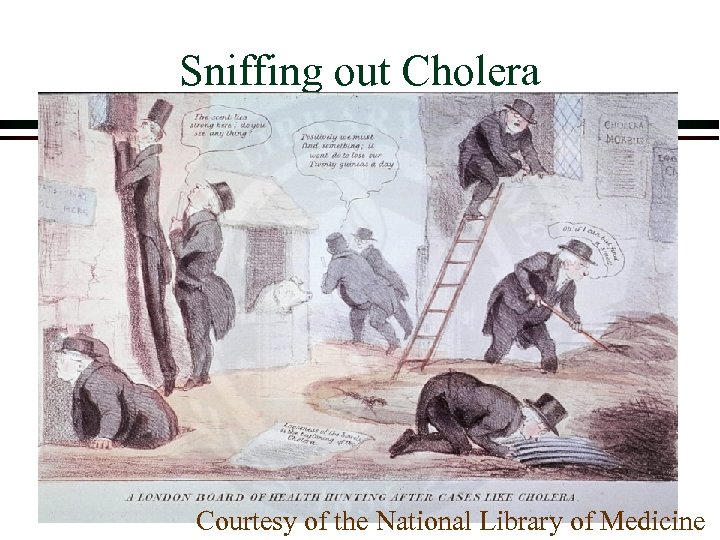
Sniffing out Cholera Courtesy of the National Library of Medicine
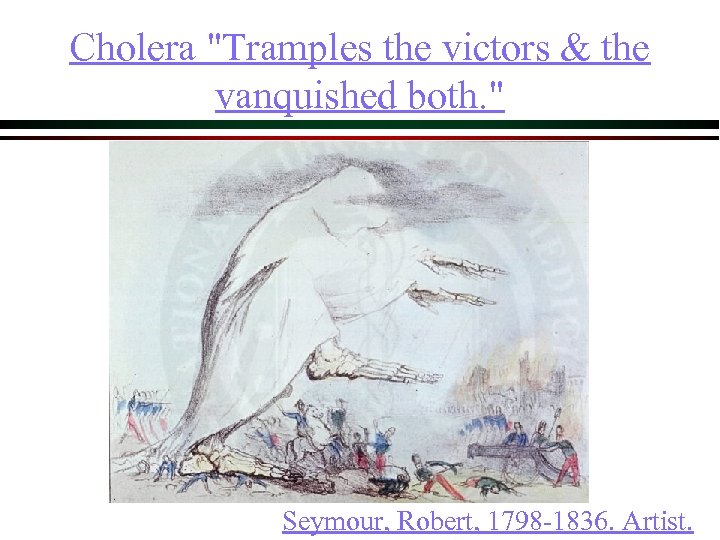
Cholera "Tramples the victors & the vanquished both. " Seymour, Robert, 1798 -1836. Artist.
John Snow: The great experiment Ø Snow's definitive work concerned the spread of cholera through water supplied by the Southwark Company and the Lambeth Company Ø Southwark obtained its water from the Thames at Batttersea, in the middle of London in an area almost certainly polluted with sewage Ø Lambeth Company obtained its water considerably upstream on the Thames, above the major sources of pollution Ø In an area containing about 300, 000 residents the pipes of both companies were laid in the streets, and houses were connected to one or the other sources of supply.
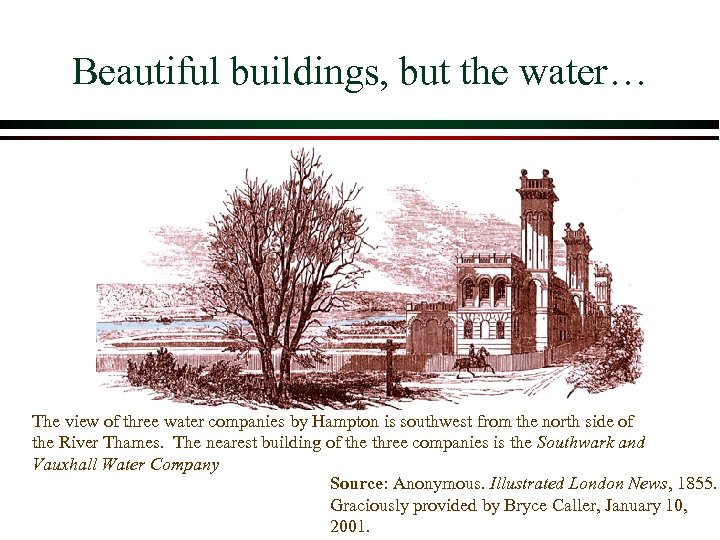
Beautiful buildings, but the water… The view of three water companies by Hampton is southwest from the north side of the River Thames. The nearest building of the three companies is the Southwark and Vauxhall Water Company Source: Anonymous. Illustrated London News, 1855. Graciously provided by Bryce Caller, January 10, 2001.
Southwark and Vauxhall Water Company Ø In 1850, the microbiologist Arthur Hassall wrote of the River Thames water they were using, ". . . a portion of the inhabitants of the metropolis are made to consume, in some form or another, a portion of their own excrement, and moreover, to pay for the privilege. " Ø Next Cartoon presents John Edwards, owner of the Southwark Water Company, posing as Neptune ("Sovereign of the Scented Streams"). He is seen crowned with a chamber-pot, seated on a stool on top of a cesspool which doubles as the water-intake for the Southwark Water Company customers in south London.
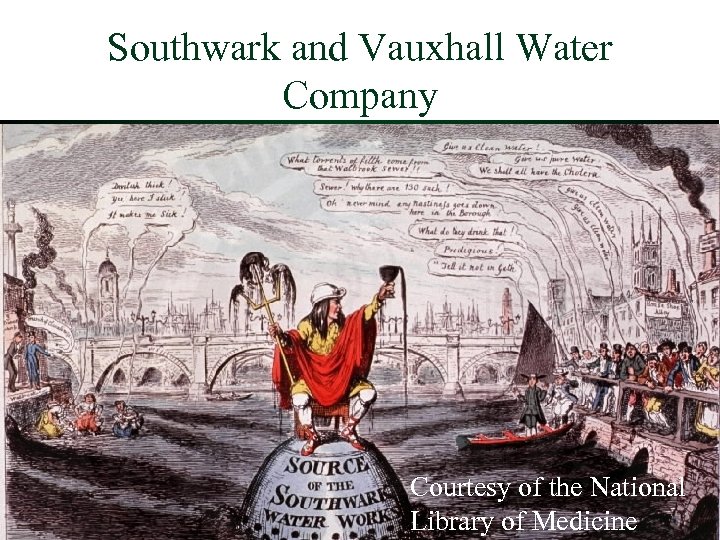
Southwark and Vauxhall Water Company Courtesy of the National Library of Medicine
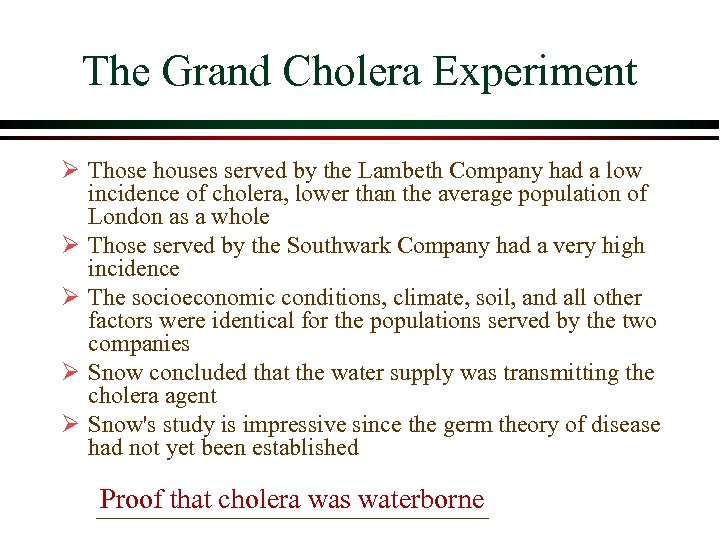
The Grand Cholera Experiment Ø Those houses served by the Lambeth Company had a low incidence of cholera, lower than the average population of London as a whole Ø Those served by the Southwark Company had a very high incidence Ø The socioeconomic conditions, climate, soil, and all other factors were identical for the populations served by the two companies Ø Snow concluded that the water supply was transmitting the cholera agent Ø Snow's study is impressive since the germ theory of disease had not yet been established Proof that cholera was waterborne
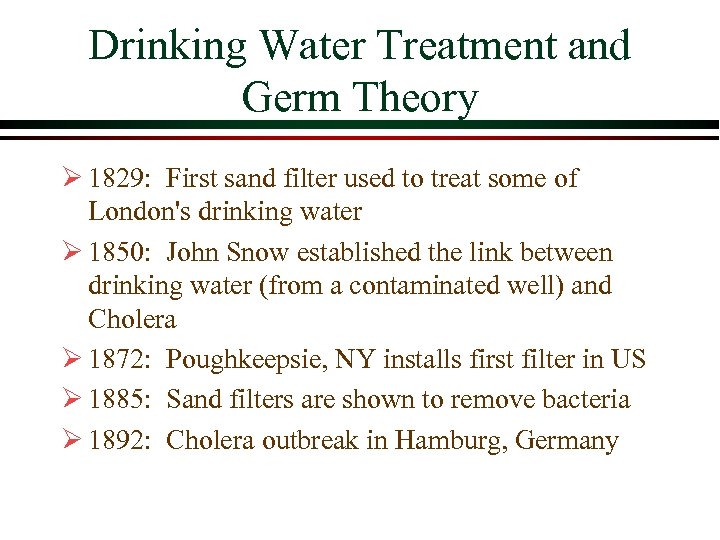
Drinking Water Treatment and Germ Theory Ø 1829: First sand filter used to treat some of London's drinking water Ø 1850: John Snow established the link between drinking water (from a contaminated well) and Cholera Ø 1872: Poughkeepsie, NY installs first filter in US Ø 1885: Sand filters are shown to remove bacteria Ø 1892: Cholera outbreak in Hamburg, Germany
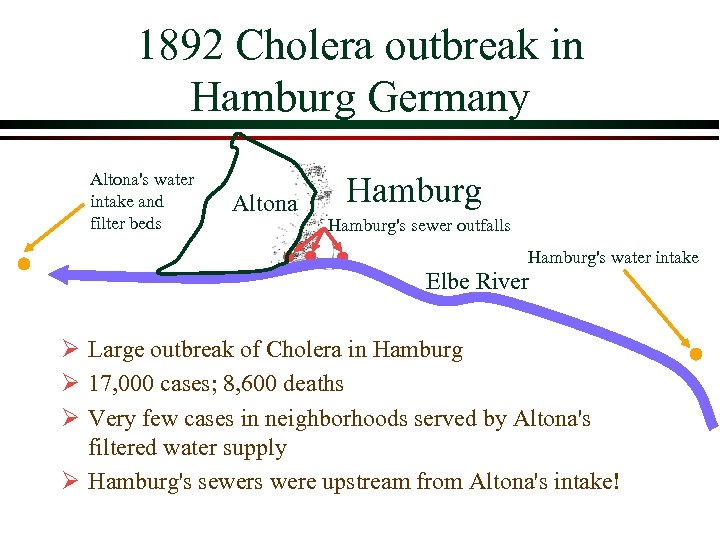
1892 Cholera outbreak in Hamburg Germany Altona's water intake and filter beds Altona Hamburg's sewer outfalls Hamburg's water intake Elbe River Ø Large outbreak of Cholera in Hamburg Ø 17, 000 cases; 8, 600 deaths Ø Very few cases in neighborhoods served by Altona's filtered water supply Ø Hamburg's sewers were upstream from Altona's intake!
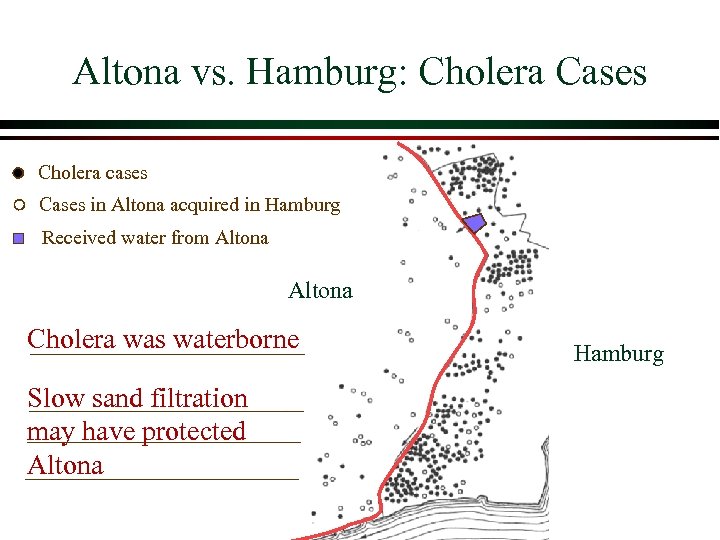
Altona vs. Hamburg: Cholera Cases Cholera cases Cases in Altona acquired in Hamburg Received water from Altona Cholera was waterborne Slow sand filtration may have protected Altona Hamburg
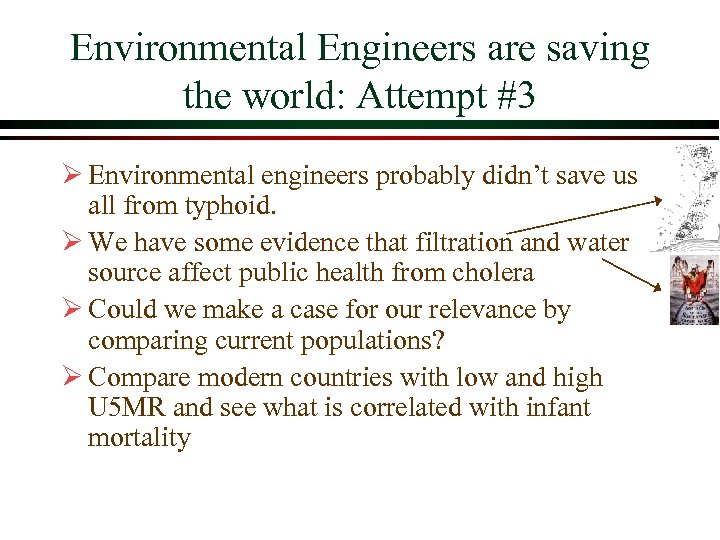
Environmental Engineers are saving the world: Attempt #3 Ø Environmental engineers probably didn’t save us all from typhoid. Ø We have some evidence that filtration and water source affect public health from cholera Ø Could we make a case for our relevance by comparing current populations? Ø Compare modern countries with low and high U 5 MR and see what is correlated with infant mortality
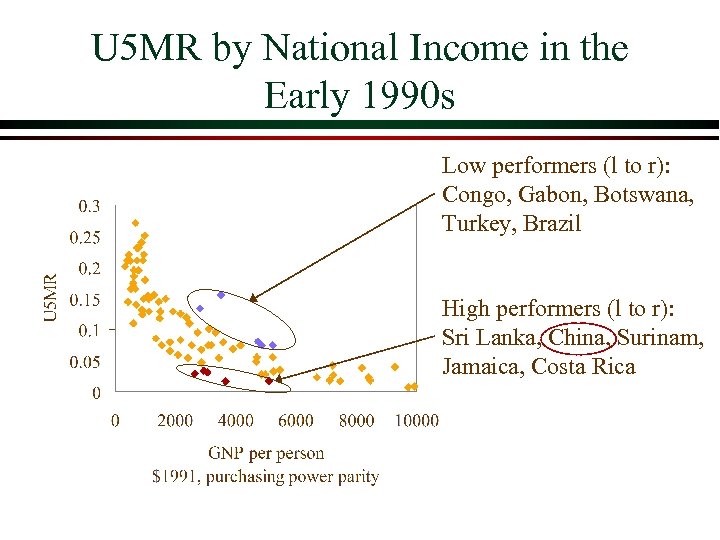
U 5 MR by National Income in the Early 1990 s Low performers (l to r): Congo, Gabon, Botswana, Turkey, Brazil High performers (l to r): Sri Lanka, China, Surinam, Jamaica, Costa Rica
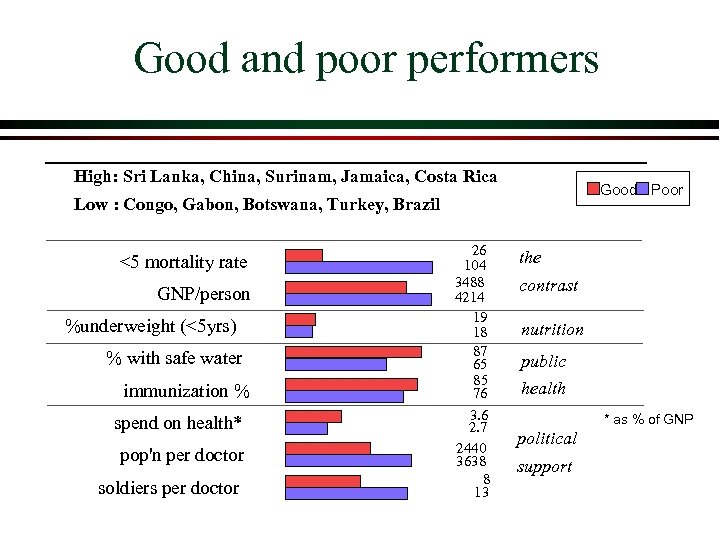
Good and poor performers High: Sri Lanka, China, Surinam, Jamaica, Costa Rica Good Poor Low : Congo, Gabon, Botswana, Turkey, Brazil <5 mortality rate GNP/person %underweight (<5 yrs) % with safe water immunization % spend on health* pop'n per doctor soldiers per doctor 26 104 3488 4214 19 18 87 65 85 76 3. 6 2. 7 2440 3638 8 13 the contrast nutrition public health * as % of GNP political support
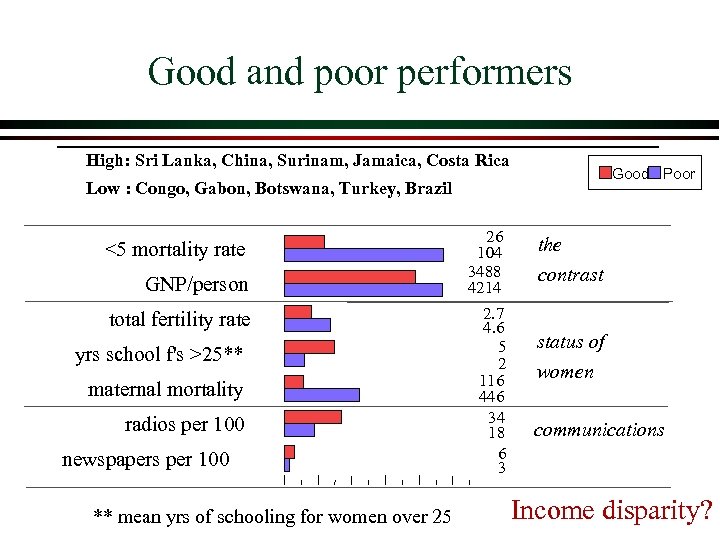
Good and poor performers High: Sri Lanka, China, Surinam, Jamaica, Costa Rica Good Poor Low : Congo, Gabon, Botswana, Turkey, Brazil <5 mortality rate GNP/person total fertility rate yrs school f's >25** maternal mortality radios per 100 newspapers per 100 ** mean yrs of schooling for women over 25 26 104 3488 4214 2. 7 4. 6 5 2 116 446 34 18 6 3 the contrast status of women communications Income disparity?
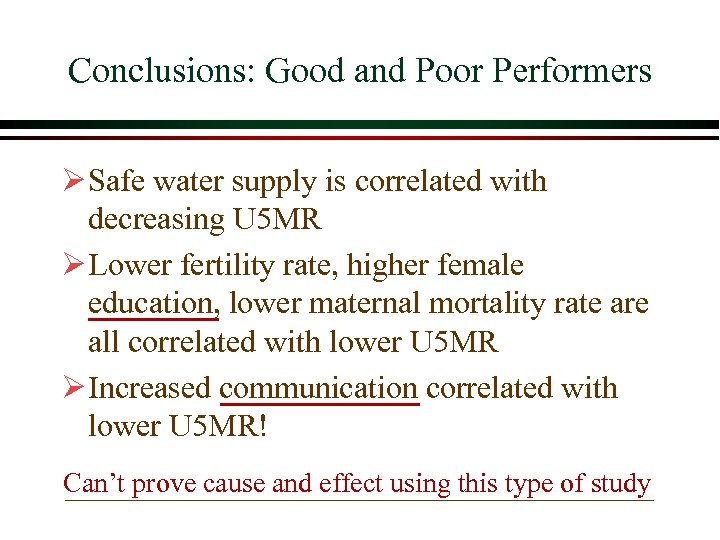
Conclusions: Good and Poor Performers Ø Safe water supply is correlated with decreasing U 5 MR Ø Lower fertility rate, higher female education, lower maternal mortality rate are all correlated with lower U 5 MR Ø Increased communication correlated with lower U 5 MR! Can’t prove cause and effect using this type of study
How might education increase child survival? Ø The whole country runs better as the education level increases Ø Education as an indicator of how well the country responds to the needs of its citizens Ø Education helps the group Ø Individuals make changes in personal habits that Ø improve their own health Ø and the health of those they interact with Ø Education helps the individual
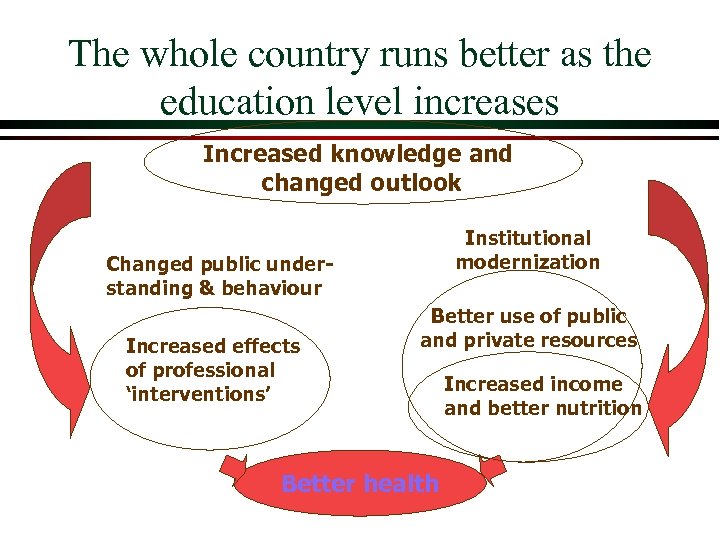
The whole country runs better as the education level increases Increased knowledge and changed outlook Institutional modernization Changed public understanding & behaviour Increased effects of professional ‘interventions’ Better use of public and private resources Better health Increased income and better nutrition
Would a Cornell Education help? Ø If you moved to a poor neighborhood in Tegucigalpa, Honduras and raised a family would your children have a lower risk of dying than your neighbors? Ø Is there anything that you might do that would increase the survival odds for your children? Ø Does education help the individual? Ø Is there specific knowledge that makes a difference?
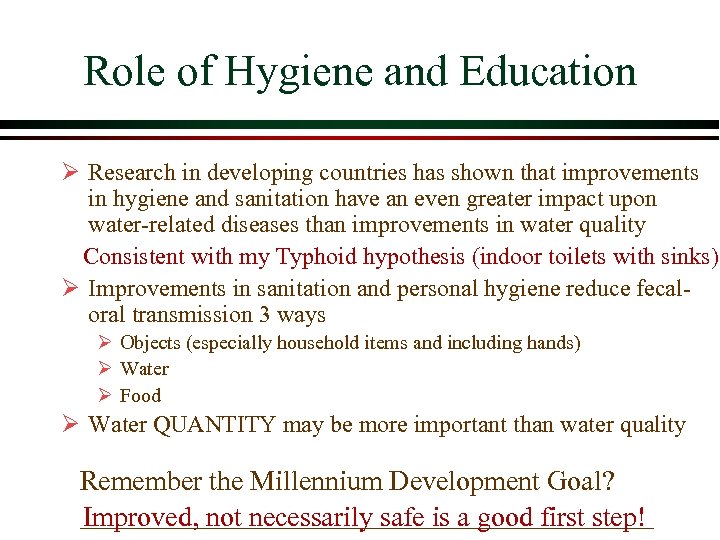
Role of Hygiene and Education Ø Research in developing countries has shown that improvements in hygiene and sanitation have an even greater impact upon water-related diseases than improvements in water quality Consistent with my Typhoid hypothesis (indoor toilets with sinks) Ø Improvements in sanitation and personal hygiene reduce fecaloral transmission 3 ways Ø Objects (especially household items and including hands) Ø Water Ø Food Ø Water QUANTITY may be more important than water quality Remember the Millennium Development Goal? _____________________ Improved, not necessarily safe is a good first step!
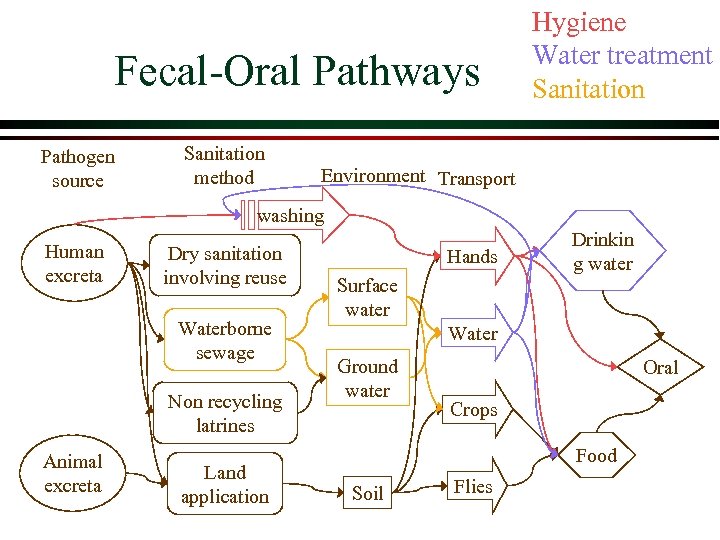
Fecal-Oral Pathways Pathogen source Sanitation method Hygiene Water treatment Sanitation Environment Transport washing Human excreta Dry sanitation involving reuse Waterborne sewage Non recycling latrines Animal excreta Land application Hands Drinkin g water Surface water Water Ground water Oral Crops Food Soil Flies
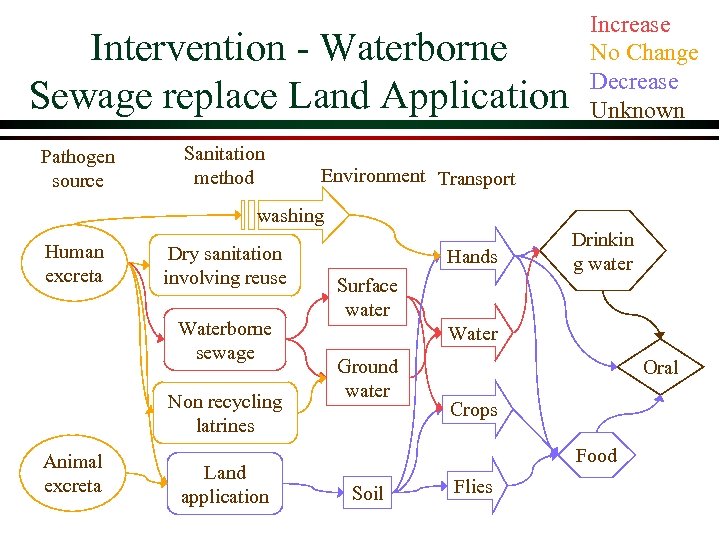
Intervention - Waterborne Sewage replace Land Application Pathogen source Sanitation method Increase No Change Decrease Unknown Environment Transport washing Human excreta Dry sanitation involving reuse Waterborne sewage Non recycling latrines Animal excreta Land application Hands Drinkin g water Surface water Water Ground water Oral Crops Food Soil Flies
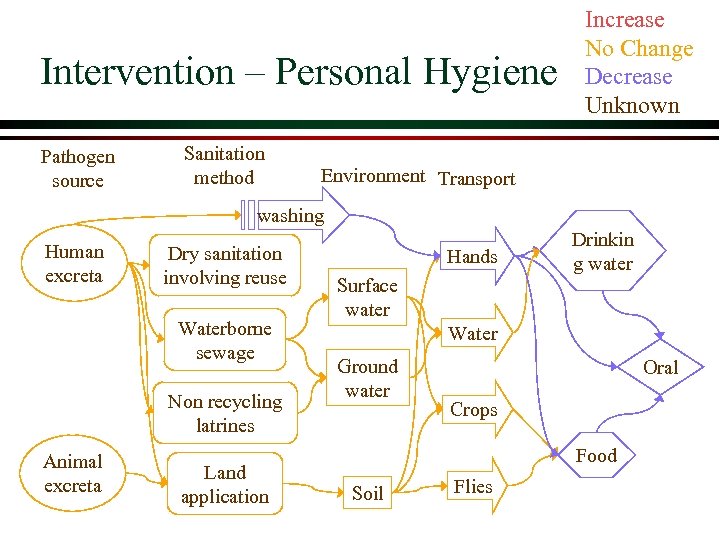
Intervention – Personal Hygiene Pathogen source Sanitation method Increase No Change Decrease Unknown Environment Transport washing Human excreta Dry sanitation involving reuse Waterborne sewage Non recycling latrines Animal excreta Land application Hands Drinkin g water Surface water Water Ground water Oral Crops Food Soil Flies
Hypothetical Intervention Ø What are the public health effects of providing pure drinking water in abundance to a community that practices land application of waste and poor personal hygiene? Continued transmission of pathogens on solid objects (hands, food, dishes) Hygiene education and empowerment could improve health substantially especially given the abundance of water
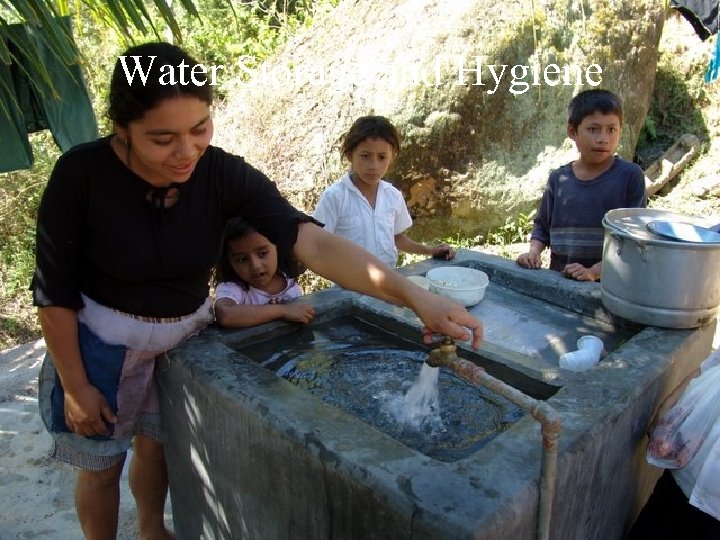
Water Storage and Hygiene
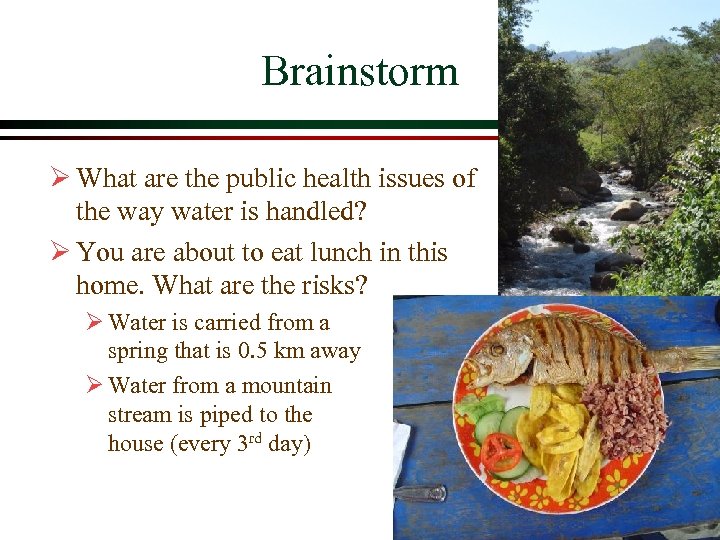
Brainstorm Ø What are the public health issues of the way water is handled? Ø You are about to eat lunch in this home. What are the risks? Ø Water is carried from a spring that is 0. 5 km away Ø Water from a mountain stream is piped to the house (every 3 rd day)
What would it take to reduce Diarrhea (and U 5 MR)? Ø 88% of diarrhoeal disease is attributed to unsafe water supply, inadequate sanitation and hygiene. Ø Improved water supply reduces diarrhea morbidity by 21%. Ø Improved sanitation reduces diarrhea morbidity by 37. 5%. Ø The simple act of washing hands at critical times can reduce the number of diarrhoeal cases by up to 35%. Ø Additional improvement of drinking-water quality, such as point of use disinfection, would lead to a reduction of diarrhea episodes of 45%. 1. 8 million people die every year from diarrhoeal diseases (including cholera); 90% are children under 5, mostly in developing countries. 1. 6 9/11 attacks per day…
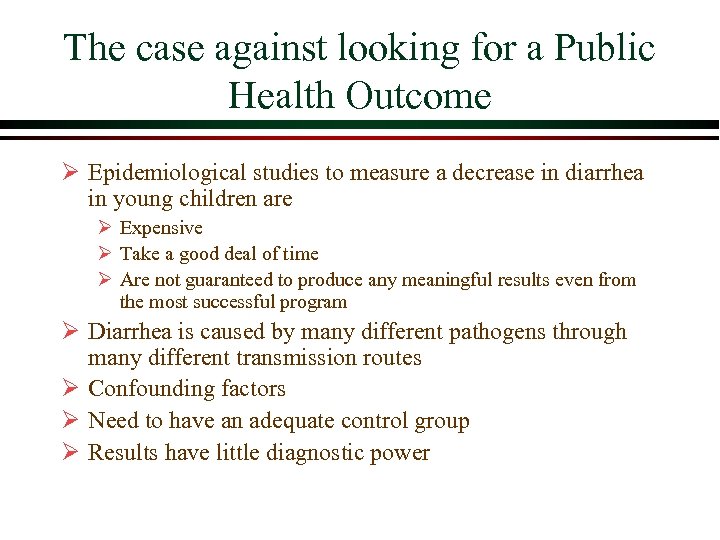
The case against looking for a Public Health Outcome Ø Epidemiological studies to measure a decrease in diarrhea in young children are Ø Expensive Ø Take a good deal of time Ø Are not guaranteed to produce any meaningful results even from the most successful program Ø Diarrhea is caused by many different pathogens through many different transmission routes Ø Confounding factors Ø Need to have an adequate control group Ø Results have little diagnostic power
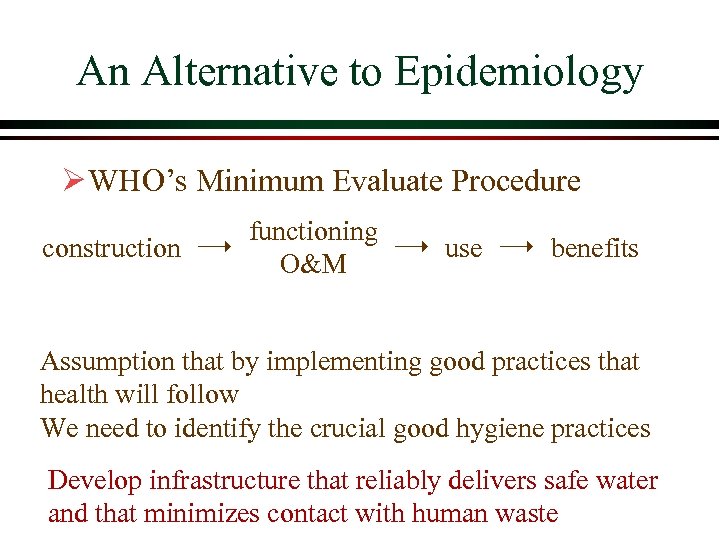
An Alternative to Epidemiology Ø WHO’s Minimum Evaluate Procedure construction functioning O&M use benefits Assumption that by implementing good practices that health will follow We need to identify the crucial good hygiene practices Develop infrastructure that reliably delivers safe water and that minimizes contact with human waste
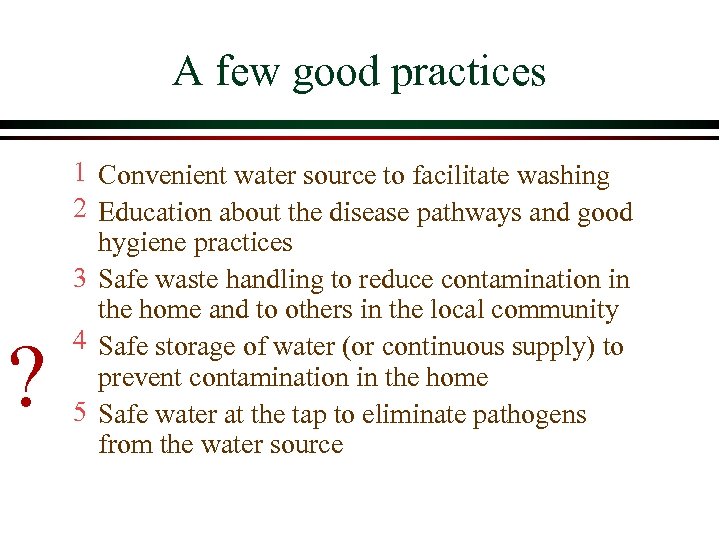
A few good practices ? 1 Convenient water source to facilitate washing 2 Education about the disease pathways and good hygiene practices 3 Safe waste handling to reduce contamination in the home and to others in the local community 4 Safe storage of water (or continuous supply) to prevent contamination in the home 5 Safe water at the tap to eliminate pathogens from the water source
Review: Public Health Implications of Water Supply Improvements Ø The life expectancy transition Ø The role of water supply, sanitation, and hygiene Ø In the Global North a century ago Ø In the Global South Ø The U 5 MR connection Ø Exposure Routes: breaking the cycle Ø Contaminants Ø Implications for successful interventions
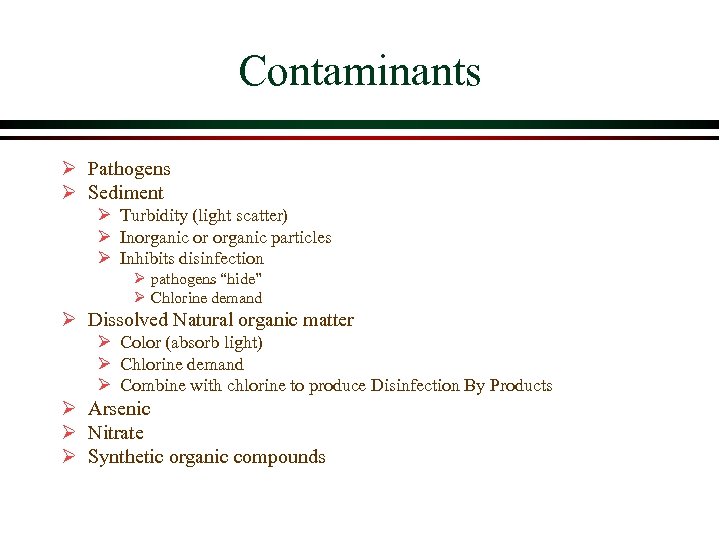
Contaminants Ø Pathogens Ø Sediment Ø Turbidity (light scatter) Ø Inorganic or organic particles Ø Inhibits disinfection Ø pathogens “hide” Ø Chlorine demand Ø Dissolved Natural organic matter Ø Color (absorb light) Ø Chlorine demand Ø Combine with chlorine to produce Disinfection By Products Ø Arsenic Ø Nitrate Ø Synthetic organic compounds
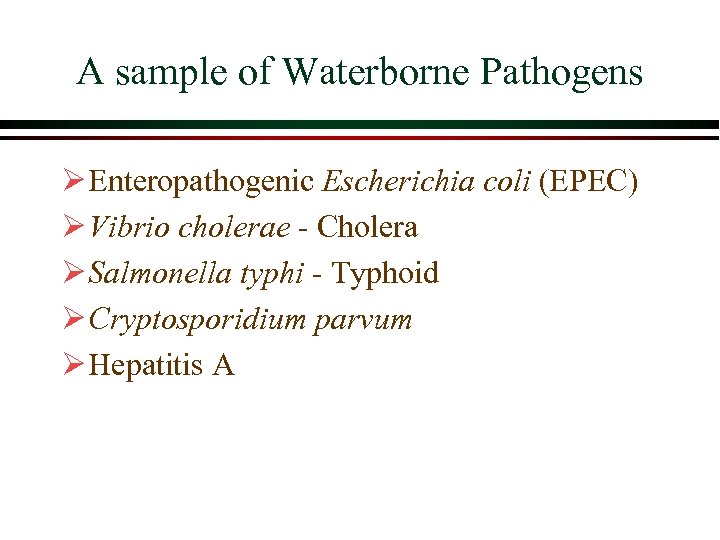
A sample of Waterborne Pathogens Ø Enteropathogenic Escherichia coli (EPEC) Ø Vibrio cholerae - Cholera Ø Salmonella typhi - Typhoid Ø Cryptosporidium parvum Ø Hepatitis A
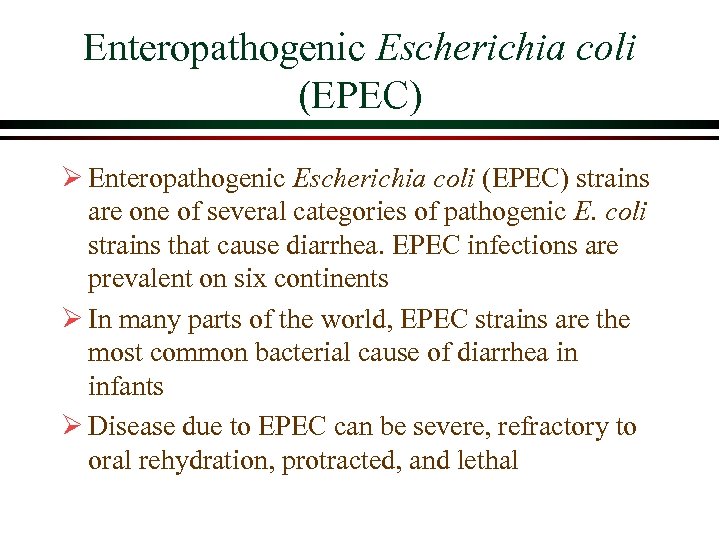
Enteropathogenic Escherichia coli (EPEC) Ø Enteropathogenic Escherichia coli (EPEC) strains are one of several categories of pathogenic E. coli strains that cause diarrhea. EPEC infections are prevalent on six continents Ø In many parts of the world, EPEC strains are the most common bacterial cause of diarrhea in infants Ø Disease due to EPEC can be severe, refractory to oral rehydration, protracted, and lethal
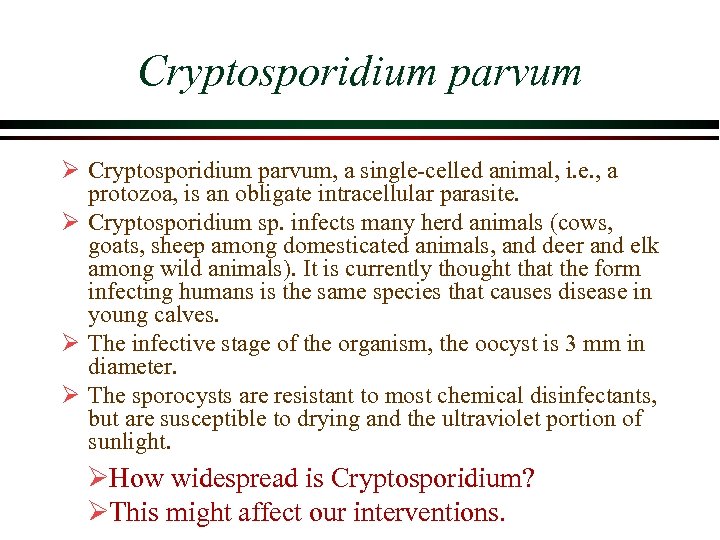
Cryptosporidium parvum Ø Cryptosporidium parvum, a single-celled animal, i. e. , a protozoa, is an obligate intracellular parasite. Ø Cryptosporidium sp. infects many herd animals (cows, goats, sheep among domesticated animals, and deer and elk among wild animals). It is currently thought that the form infecting humans is the same species that causes disease in young calves. Ø The infective stage of the organism, the oocyst is 3 mm in diameter. Ø The sporocysts are resistant to most chemical disinfectants, but are susceptible to drying and the ultraviolet portion of sunlight. ØHow widespread is Cryptosporidium? ØThis might affect our interventions.
Hepatitis A Virus Ø Hepatitis A is usually a mild illness characterized by sudden onset of fever, malaise, nausea, anorexia, and abdominal discomfort, followed in several days by jaundice. The infectious dose is unknown but presumably is 10 -100 virus particles. Ø HAV is excreted in feces of infected people and can produce clinical disease when susceptible individuals consume contaminated water or foods. Ø In developing countries, the incidence of disease in adults is relatively low because of exposure to the virus in childhood. (Immunity!) Ø In the U. S. , the percentage of adults with immunity increases with age (10% for those 18 -19 years of age to 65% for those over 50).
What works to improve health? Ø Residual protection is necessary* Ø Chlorine Ø Locked down POU treatment systems (with faucet) Ø User can’t get their hands into the system Ø But they could still put the water into a cup that isn’t clean Ø SODIS (because you drink out of the container) Ø Product is key for chlorine (technology matters!) Ø Quality assured Ø Technically correct Ø Implementable CDC safe water program results *Is it the chlorine residual or is it that to get a chlorine residual the water has to be clear?
Implications for Successful Interventions Ø Break the major pathogen loops… Ø …for the major pathogens Ø Remove sediment and color for effective disinfection Ø Household Hygiene is important Ø Sanitation (waste disposal) is important Ø We need more information on the efficacy of the various water purification technologies so we can break the waterborne route
Conclusions on Hygiene and Health and Water (1) Ø In order to achieve the primary objective of improving the health status of the community there is a need to improve attitudes, both with respect to hygiene in home and general health education, and implement these in conjunction with community water supply and environmental sanitation programs Ø Most waterborne diseases spread through exposure of food and drinking water to human feces Ø Hence, the rate of infection may be reduced by improving practice for disposal of human waste, as well as improving hygiene in the home and water quality and food hygiene Home hygiene and environmental sanitation: a country situation analysis for India K. J. NATH
Conclusions on Hygiene and Health and Water (2) Ø A supply of safe water would be of little benefit if it became contaminated because of unhygienic practices in the home Ø Correct storage and handling of food and drinking water should be an important component of any program for promoting domestic hygiene Ø On the other hand, improvement in the hygiene behavior of a community cannot be sustained without a concurrent improvement in the quality of environmental sanitation and the supply of safe drinking water Home hygiene and environmental sanitation: a country situation analysis for India K. J. NATH
Conclusions on Hygiene and Health and Water (3) Ø Consistent supply of clean water is important Ø Hand washing Ø Household hygiene (food, dishes, work surfaces) Ø Clean water must be protected from contamination in the home Ø Pilas used for water storage in Central America provide a direct path for contamination within a household Ø Elevated enclosed tanks would be a much better solution (see Mexico!)
What did we forget? Ø What do people want? Ø Easy access to plenty of safe, aesthetically pleasing water looks and taste/smell Ø Judge based on _____________ Ø Will they be willing to pay for and maintain more expensive infrastructure to have aesthetically pleasing water? Ø We are competing with bottled water Ø Can we make tap water as reliable as bottled water?
Скачать презентацию Public Health Implications of Water Supply Improvements Did
3f34c5c361d8b2c3b7d335338c121ec7.ppt