 Скачать презентацию Public Health Control Strategies for Glaucoma What do
e2c4e69800f889864e28966e16adf3f2.ppt
- Количество слайдов: 21



Public Health Control Strategies for Glaucoma: What do we Need to Know? Nathan Congdon, MD, MPH Zhongshan Ophthalmic Center Sun Yat Sen University Guangzhou, China ORBIS International
Financial interest ¨ No financial interest
An explosion of new knowledge about glaucoma and other eye disease
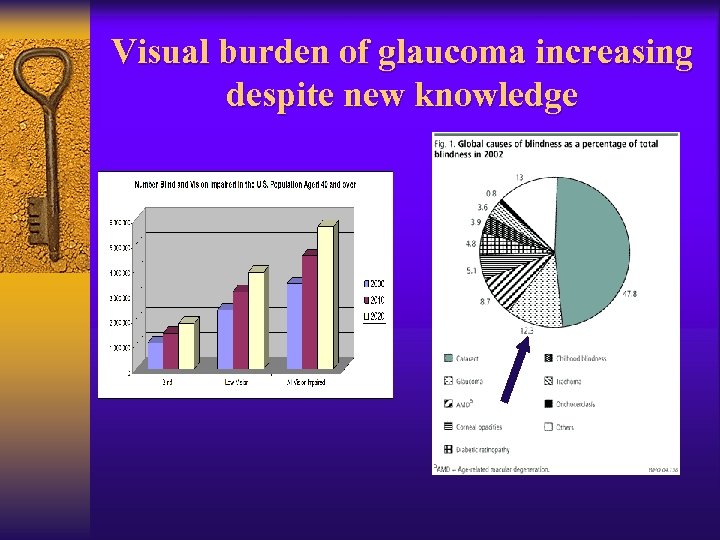
Visual burden of glaucoma increasing despite new knowledge
This talk ¨ Questions to ask: – What model for glaucoma programs in areas of limited resources? – What do we need to know to implement these programs well? ¨ Introduce ideas this session will focus on: – ZAP and EAGLE studies, CREST program, Aravind tube shunt ¨ Emphasis on Asia: – Evidence of significant disease burden – Availability of resources
A strategy for glaucoma in rural Asia: Start in the clinics ¨ Clinic-based case-finding: – Economic models 1 suggest that population-based approach is not cost effective – Uncertainty about morbidity associated with largescale programs of PI for narrow angles ¨ Target is persons aged 40+ years presenting for eye care, and who are at risk for BLINDNESS from glaucoma 1 Burr JM, et al. The clinical effectiveness and cost-effectiveness of screening for open angle glaucoma: a systematic review and economic evaluation. Health Technol Assess 2007; 11(41): iii-iv, ix-x, 1 -190.
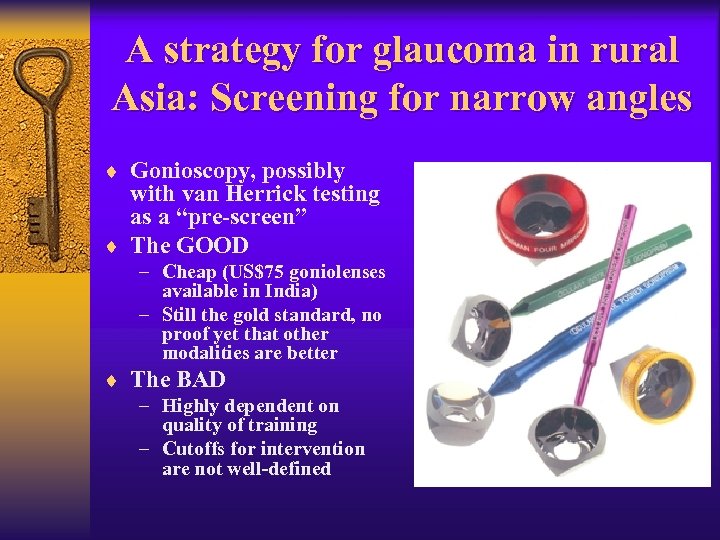
A strategy for glaucoma in rural Asia: Screening for narrow angles ¨ Gonioscopy, possibly with van Herrick testing as a “pre-screen” ¨ The GOOD – Cheap (US$75 goniolenses available in India) – Still the gold standard, no proof yet that other modalities are better ¨ The BAD – Highly dependent on quality of training – Cutoffs for intervention are not well-defined
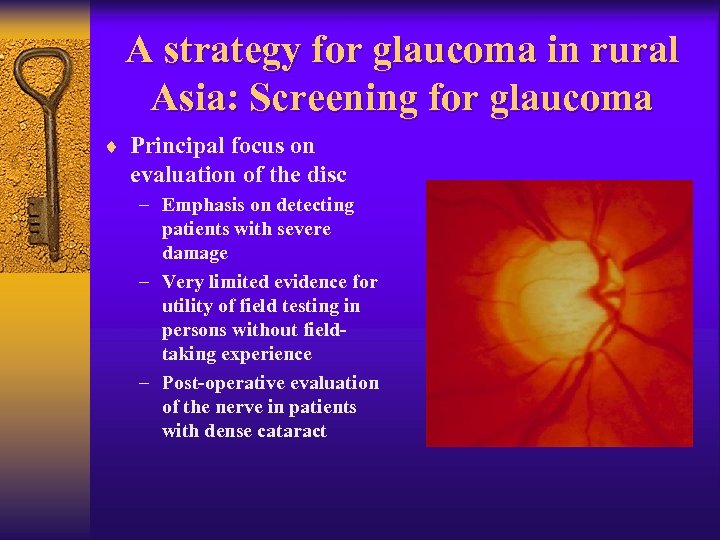
A strategy for glaucoma in rural Asia: Screening for glaucoma ¨ Principal focus on evaluation of the disc – Emphasis on detecting patients with severe damage – Very limited evidence for utility of field testing in persons without fieldtaking experience – Post-operative evaluation of the nerve in patients with dense cataract
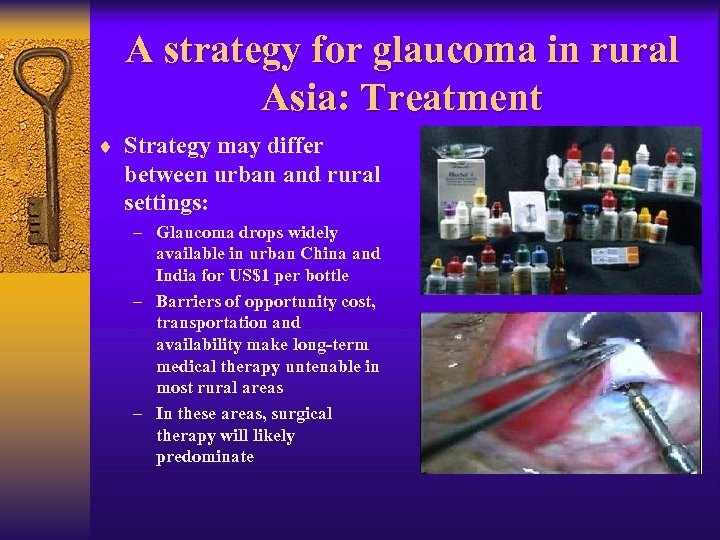
A strategy for glaucoma in rural Asia: Treatment ¨ Strategy may differ between urban and rural settings: – Glaucoma drops widely available in urban China and India for US$1 per bottle – Barriers of opportunity cost, transportation and availability make long-term medical therapy untenable in most rural areas – In these areas, surgical therapy will likely predominate
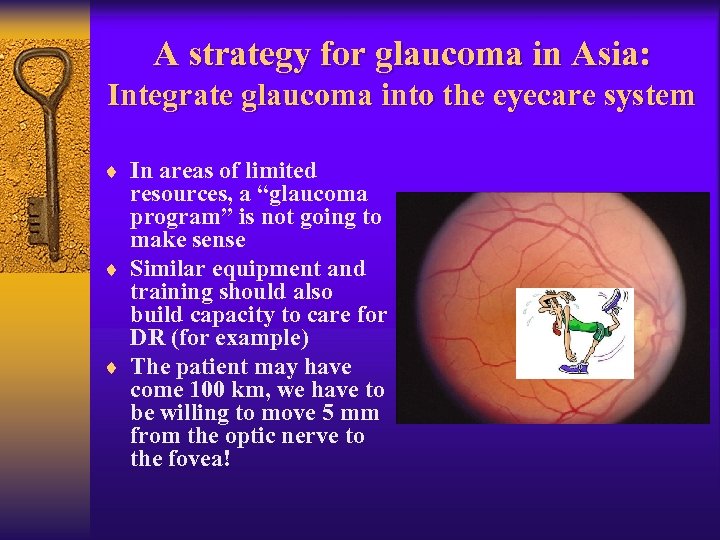
A strategy for glaucoma in Asia: Integrate glaucoma into the eyecare system ¨ In areas of limited resources, a “glaucoma program” is not going to make sense ¨ Similar equipment and training should also build capacity to care for DR (for example) ¨ The patient may have come 100 km, we have to be willing to move 5 mm from the optic nerve to the fovea!
The knowledge gap ¨ What do we need to know in order to scale up glaucoma treatment in Asia?
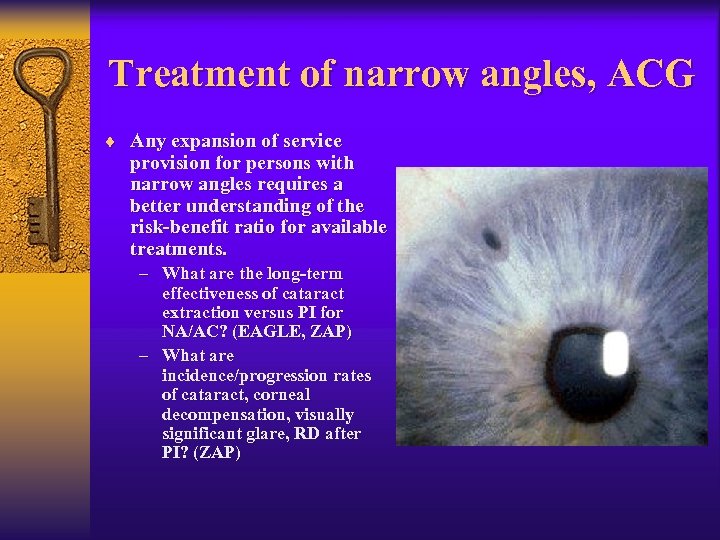
Treatment of narrow angles, ACG ¨ Any expansion of service provision for persons with narrow angles requires a better understanding of the risk-benefit ratio for available treatments. – What are the long-term effectiveness of cataract extraction versus PI for NA/AC? (EAGLE, ZAP) – What are incidence/progression rates of cataract, corneal decompensation, visually significant glare, RD after PI? (ZAP)
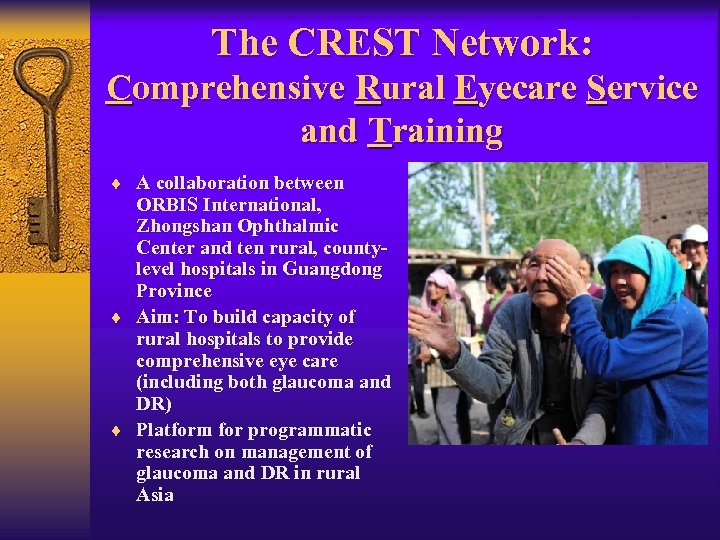
The CREST Network: Comprehensive Rural Eyecare Service and Training ¨ A collaboration between ORBIS International, Zhongshan Ophthalmic Center and ten rural, countylevel hospitals in Guangdong Province ¨ Aim: To build capacity of rural hospitals to provide comprehensive eye care (including both glaucoma and DR) ¨ Platform for programmatic research on management of glaucoma and DR in rural Asia
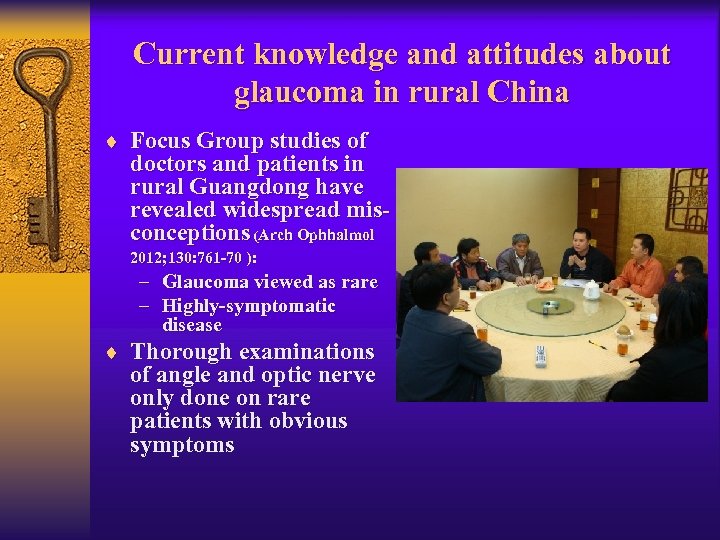
Current knowledge and attitudes about glaucoma in rural China ¨ Focus Group studies of doctors and patients in rural Guangdong have revealed widespread misconceptions (Arch Ophhalmol 2012; 130: 761 -70 ): – Glaucoma viewed as rare – Highly-symptomatic disease ¨ Thorough examinations of angle and optic nerve only done on rare patients with obvious symptoms
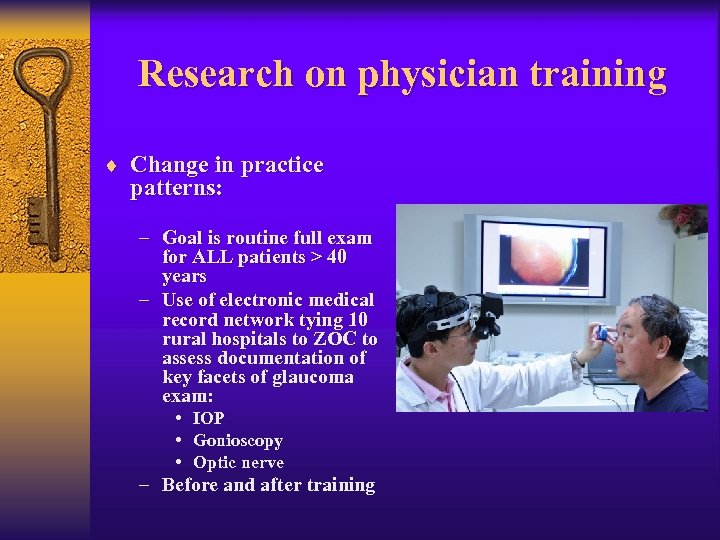
Research on physician training ¨ Change in practice patterns: – Goal is routine full exam for ALL patients > 40 years – Use of electronic medical record network tying 10 rural hospitals to ZOC to assess documentation of key facets of glaucoma exam: • • • IOP Gonioscopy Optic nerve – Before and after training
Research on physician training ¨ A study of rural physicians’ ability to detect glaucoma damage in the optic nerve is also under way ¨ Testing before and after training using the GONE Website: – Jonathan Crowsdon, CERA, Australia – Chinese-language version of website now exists
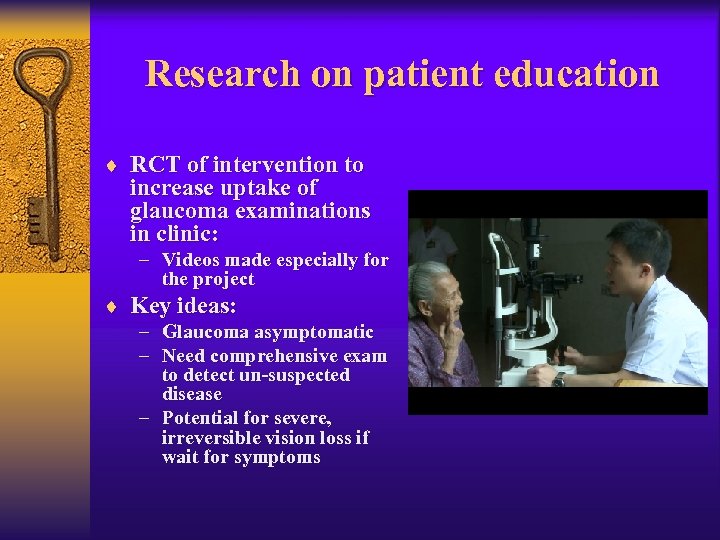
Research on patient education ¨ RCT of intervention to increase uptake of glaucoma examinations in clinic: – Videos made especially for the project ¨ Key ideas: – Glaucoma asymptomatic – Need comprehensive exam to detect un-suspected disease – Potential for severe, irreversible vision loss if wait for symptoms
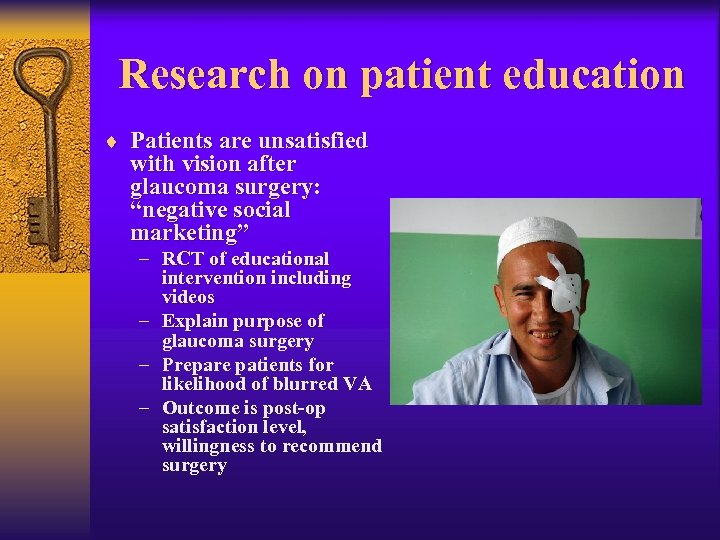
Research on patient education ¨ Patients are unsatisfied with vision after glaucoma surgery: “negative social marketing” – RCT of educational intervention including videos – Explain purpose of glaucoma surgery – Prepare patients for likelihood of blurred VA – Outcome is post-op satisfaction level, willingness to recommend surgery
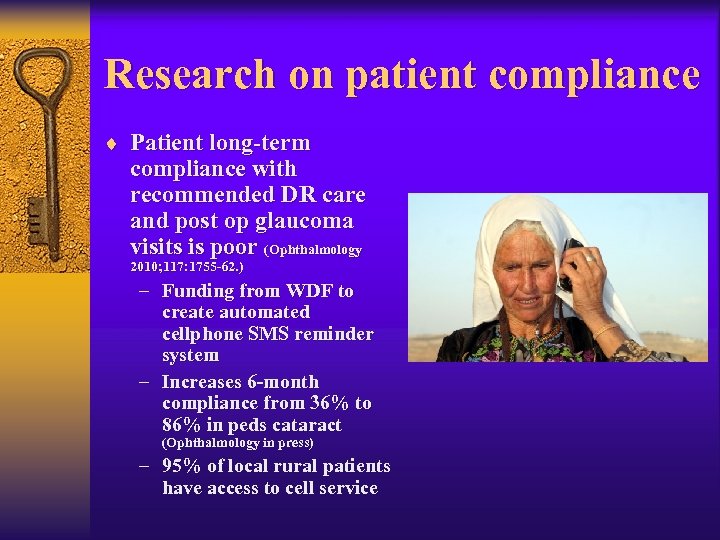
Research on patient compliance ¨ Patient long-term compliance with recommended DR care and post op glaucoma visits is poor (Ophthalmology 2010; 117: 1755 -62. ) – Funding from WDF to create automated cellphone SMS reminder system – Increases 6 -month compliance from 36% to 86% in peds cataract (Ophthalmology in press) – 95% of local rural patients have access to cell service
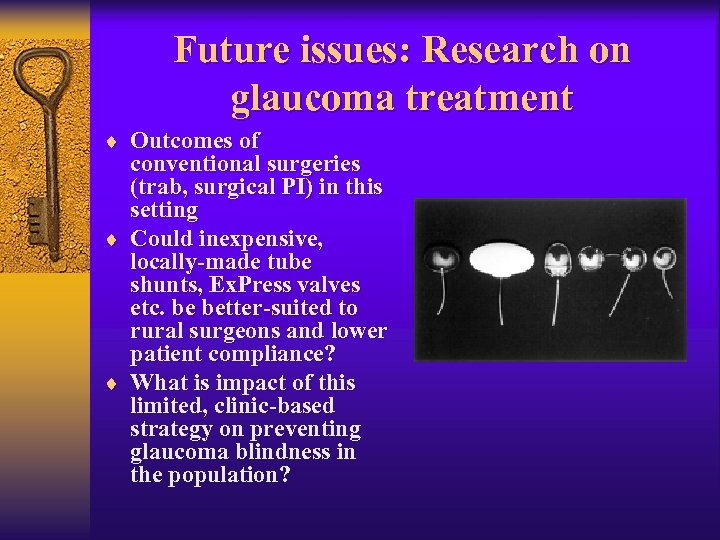
Future issues: Research on glaucoma treatment ¨ Outcomes of conventional surgeries (trab, surgical PI) in this setting ¨ Could inexpensive, locally-made tube shunts, Ex. Press valves etc. be better-suited to rural surgeons and lower patient compliance? ¨ What is impact of this limited, clinic-based strategy on preventing glaucoma blindness in the population?
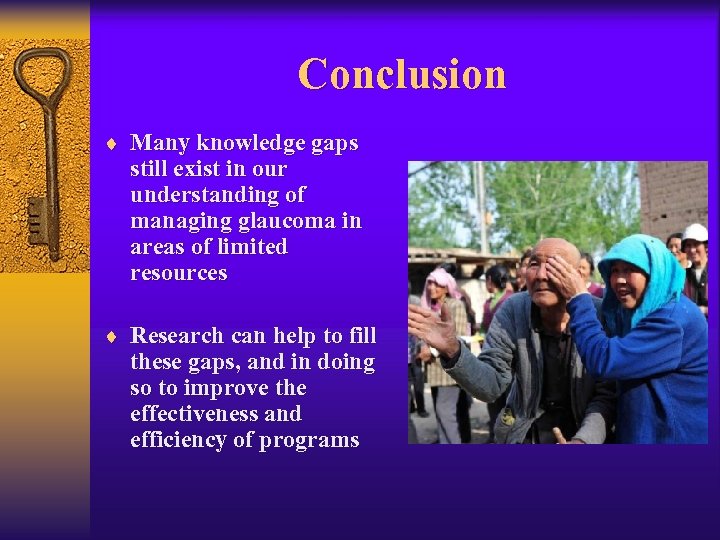
Conclusion ¨ Many knowledge gaps still exist in our understanding of managing glaucoma in areas of limited resources ¨ Research can help to fill these gaps, and in doing so to improve the effectiveness and efficiency of programs
Скачать презентацию Public Health Control Strategies for Glaucoma What do
e2c4e69800f889864e28966e16adf3f2.ppt