 Скачать презентацию Public Financial Management Good Practices The World Bank
3285a8729e810ad1f3310ffa45e9e567.ppt
- Количество слайдов: 21



Public Financial Management: Good Practices The World Bank Bill Dorotinsky Halong Bay, Vietnam October 9, 2003
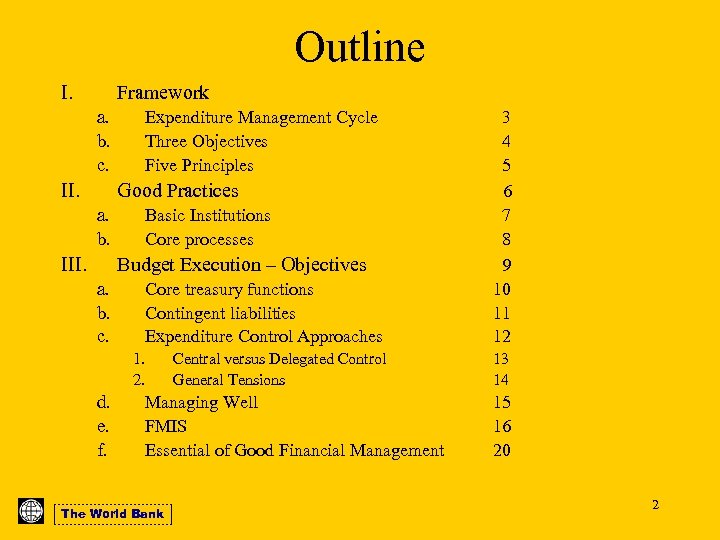
Outline I. Framework a. b. c. II. Expenditure Management Cycle Three Objectives Five Principles Good Practices a. b. III. Basic Institutions Core processes Budget Execution – Objectives a. b. c. Core treasury functions Contingent liabilities Expenditure Control Approaches 1. 2. d. e. f. Central versus Delegated Control General Tensions Managing Well FMIS Essential of Good Financial Management The World Bank 3 4 5 6 7 8 9 10 11 12 13 14 15 16 20 2
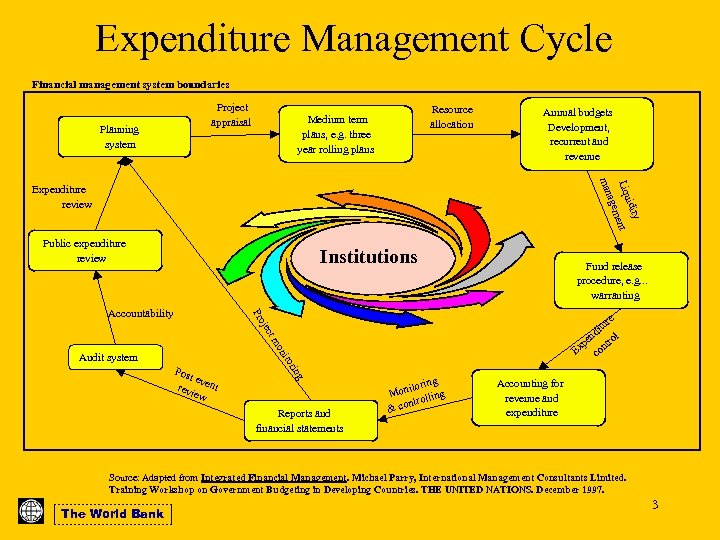
Expenditure Management Cycle Financial management system boundaries Project appraisal Planning system Resource allocation Medium term plans, e. g. three year rolling plans Annual budgets Development, recurrent and revenue idity Liqu ent agem man Expenditure review Public expenditure review Institutions Pro Accountability Fund release procedure, e. g. . . warranting Audit system t ev revi ent ew g Pos n ori it on m t jec re tu di l o en xp ontr E c Reports and financial statements g itorin Mon g rollin cont & Accounting for revenue and expenditure Source: Adapted from Integrated Financial Management. Michael Parry, International Management Consultants Limited. Training Workshop on Government Budgeting in Developing Countries. THE UNITED NATIONS. December 1997. The World Bank 3
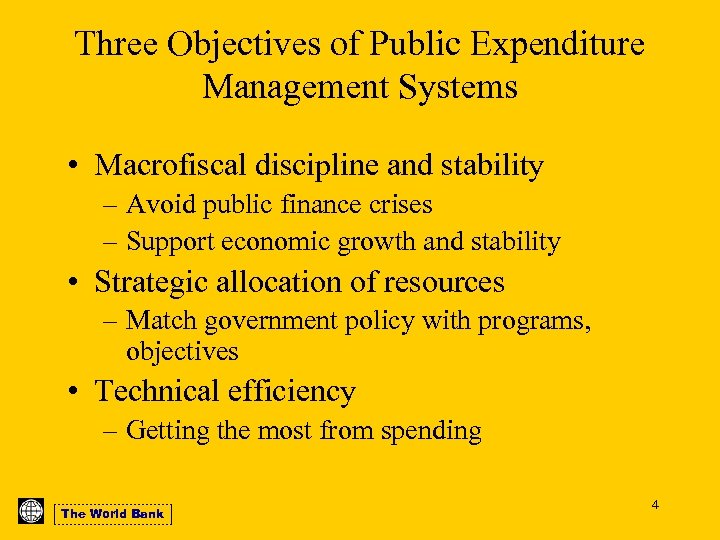
Three Objectives of Public Expenditure Management Systems • Macrofiscal discipline and stability – Avoid public finance crises – Support economic growth and stability • Strategic allocation of resources – Match government policy with programs, objectives • Technical efficiency – Getting the most from spending The World Bank 4
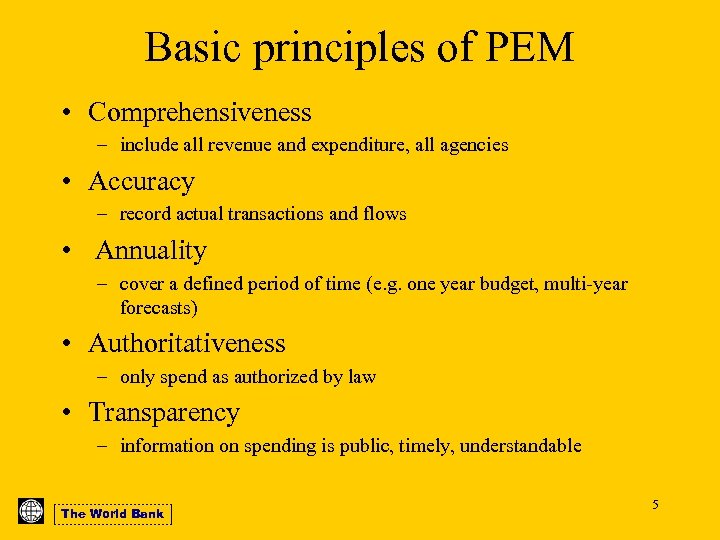
Basic principles of PEM • Comprehensiveness – include all revenue and expenditure, all agencies • Accuracy – record actual transactions and flows • Annuality – cover a defined period of time (e. g. one year budget, multi-year forecasts) • Authoritativeness – only spend as authorized by law • Transparency – information on spending is public, timely, understandable The World Bank 5
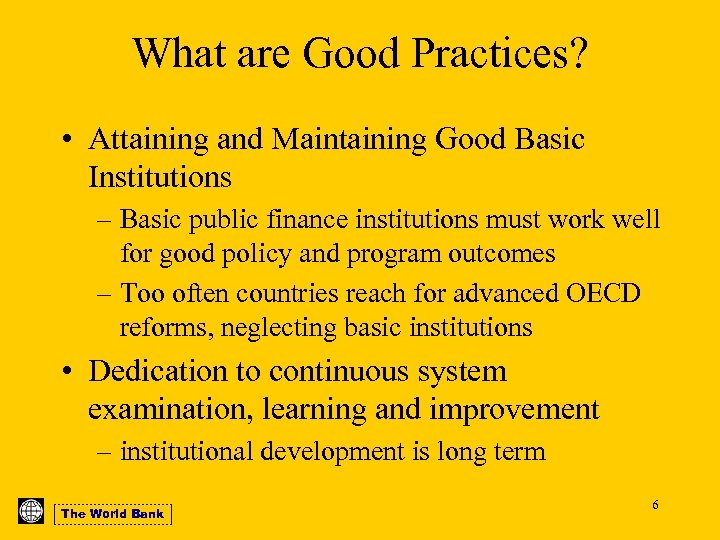
What are Good Practices? • Attaining and Maintaining Good Basic Institutions – Basic public finance institutions must work well for good policy and program outcomes – Too often countries reach for advanced OECD reforms, neglecting basic institutions • Dedication to continuous system examination, learning and improvement – institutional development is long term The World Bank 6
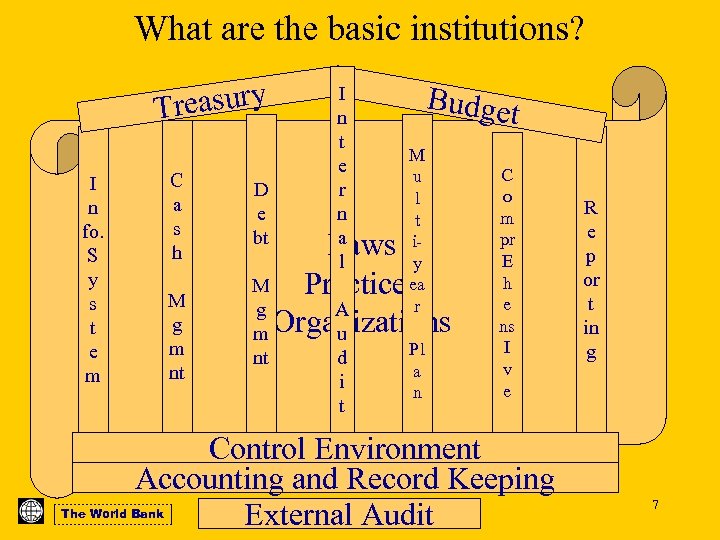
What are the basic institutions? Treasury C a s h M g m nt I n fo. S y s t e m D e bt M g m nt I n t e r n a l A u d i t Budget M u l t iy ea r Laws Practices Organizations Pl a n C o m pr E h e ns I v e Control Environment Accounting and Record Keeping External Audit The World Bank R e p or t in g 7
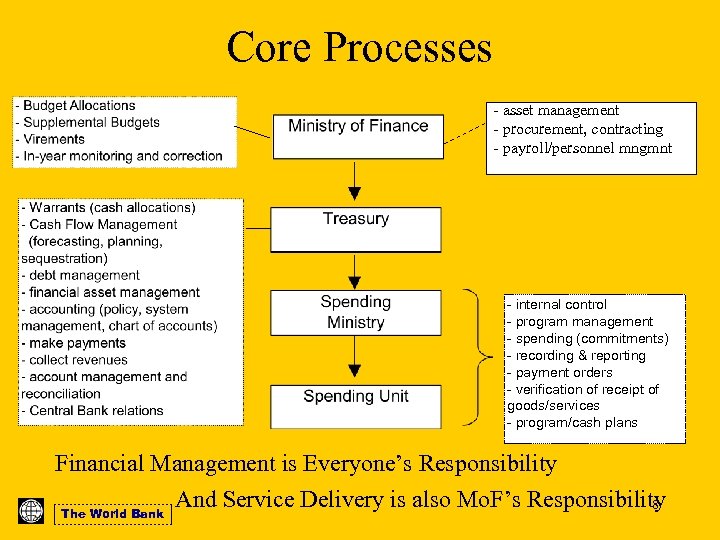
Core Processes - asset management - procurement, contracting - payroll/personnel mngmnt - internal control - program management - spending (commitments) - recording & reporting - payment orders - verification of receipt of goods/services - program/cash plans Financial Management is Everyone’s Responsibility And Service Delivery is also Mo. F’s Responsibility 8 The World Bank
Objectives of budget execution • Manage Spending and Revenues to budget – – support choices of elected officials allow budget to be planning and steering tool promote macrofiscal discipline Reduce opportunities for corruption • Enable program implementation (service delivery) – Assure resources flow to programs – allow budget to be aid to operational efficiency through spending unit advance planning, efficient administration – enable program managers to achieve objective The World Bank 9
Core Treasury Functions • Cash management (flow and stock) • Financial asset management • Debt management, servicing; – Guarantee and contingent liability management • Accounting (policy, chart of accounts, general ledger) and reporting • Revenue collection, forecasting • Account management (payment, collection, reconciliation) • Central Bank relations The World Bank 10
Contingent liabilities • Government acts as a guarantor of debt repayment in the event that the borrower cannot make repayment, or of payment under certain conditions – Loan, pension benefit, bank deposit, agricultural price • Contingent debt must be managed with the same detail as direct debt. • As with direct debt these contingent debts must be inventoried and monitored in a central location • Active identification, monitoring, management of risk important The World Bank 11
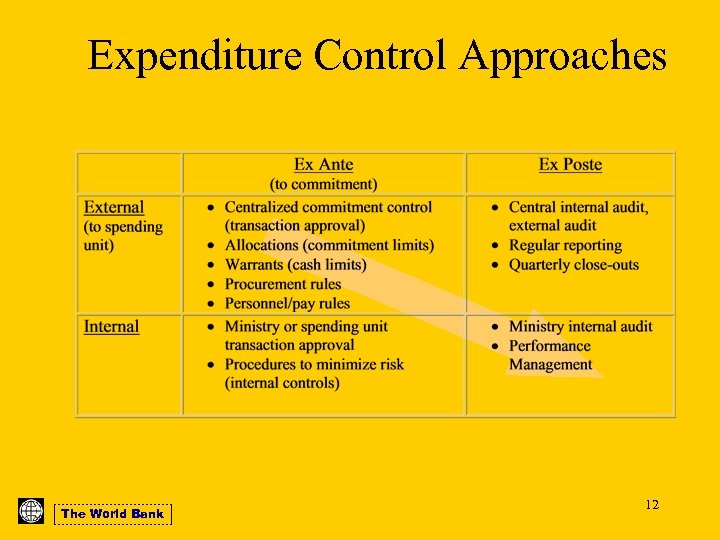
Expenditure Control Approaches The World Bank 12
Central control versus Managerial Flexibility • Tensions between needs of center to – Control cash flow – Control policy • And agency need to manage programs – Larger, less detailed allocations – Longer time horizon – Greater transfer authority/flexible application of resources The World Bank 13
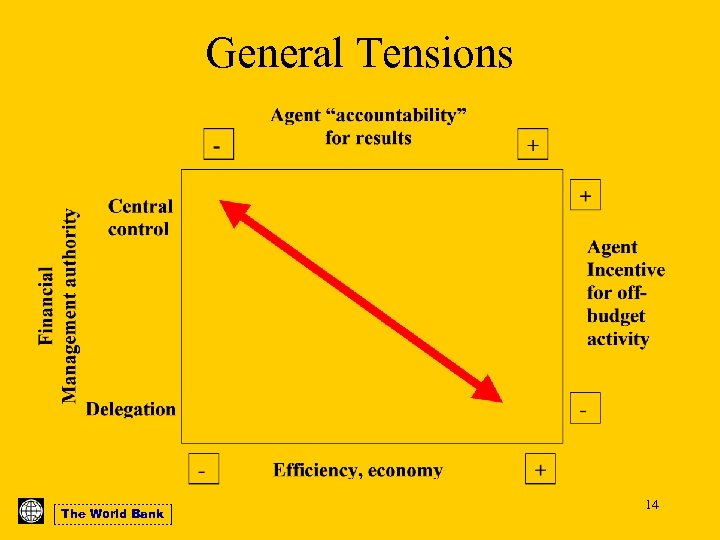
General Tensions The World Bank 14
To manage well requires: • Monitoring/managing – Cash balances – Cash flow • Inflow • outflow – – – Commitments Arrears Contingent liabilities New legislation/mandates Off-budget activity Understanding future impact of current decisions The World Bank 15
Definitions What is an FMIS? • Financial management system: – Information system that tracks financial events and summarizes information – supports adequate management reporting, policy decisions, fiduciary responsibilities, and preparation of auditable financial statements – Should be designed with good relationships between software, hardware, personnel, procedures, controls and data • Generally, FMIS refers to automating financial operations The World Bank 16
Definitions What are core and non-core FMIS systems? • Core systems – General ledger, accounts payable and receivable. May include financial reporting, fund management and cost management. • Non-core systems – HR/payroll, budget formulation, revenue (tax & customs), procurement, inventory, property management, performance, management information The World Bank 17
Definitions What is “integrated” FMIS? • Can refer to core and non-core integration • But, generally, four characteristics* – Standard data classification for recording events – Common processes for similar transactions – Internal controls over data entry, transaction processing, and reporting applied consistently – Design that eliminates unnecessary duplication of transaction entry The World Bank *from Core Financial System Requirement. JFMIP-SR-02 -01. Joint Financial Management Improvement Program. Washington, D. C. , November 2001. 18
What constitutes a good FMIS system? • Ability to* – Collect accurate, timely, complete, reliable, consistent information – Provide adequate management reporting – Support government-wide and agency policy decisions – Support budget preparation and execution – Facilitate financial statement preparation – Provide information for central agency budgeting, analysis and government-wide reporting – Provide complete audit trail to facilitate audits The World Bank *from Core Financial System Requirement. JFMIP-SR-02 -01. Joint Financial Management Improvement Program. Washington, D. C. , November 2001. 19
Essentials of Good Financial Execution • Timely, accurate in-year reporting – Internal controls, audit – External audit • Sufficient detail to identify sources of overspending • Sufficiently regular reporting to allow timely management intervention • Comprehensive system • Accountability framework, control environment The World Bank 20
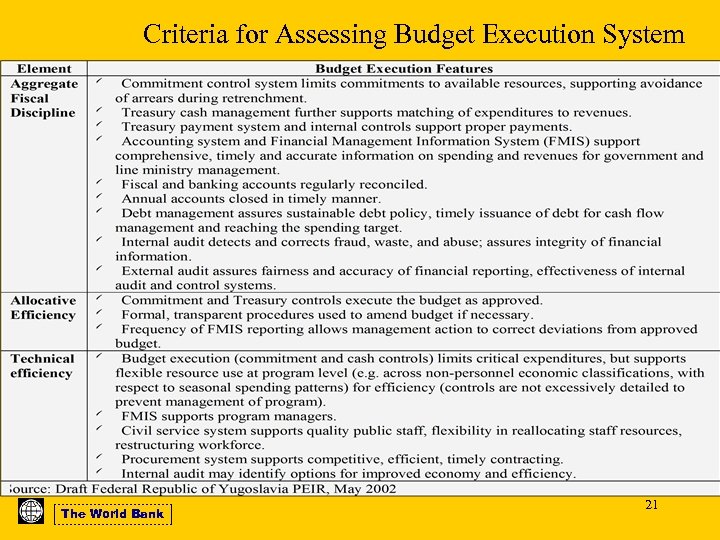
Criteria for Assessing Budget Execution System The World Bank 21
Скачать презентацию Public Financial Management Good Practices The World Bank
3285a8729e810ad1f3310ffa45e9e567.ppt