 Скачать презентацию Public finance Chapter I-2 Public Finance and business
c3adf36750a64c946626befe474fff51.ppt
- Количество слайдов: 68



Public finance Chapter I-2 Public Finance and business cycle 1 PSE – Public Finance – Sandrine Duchêne
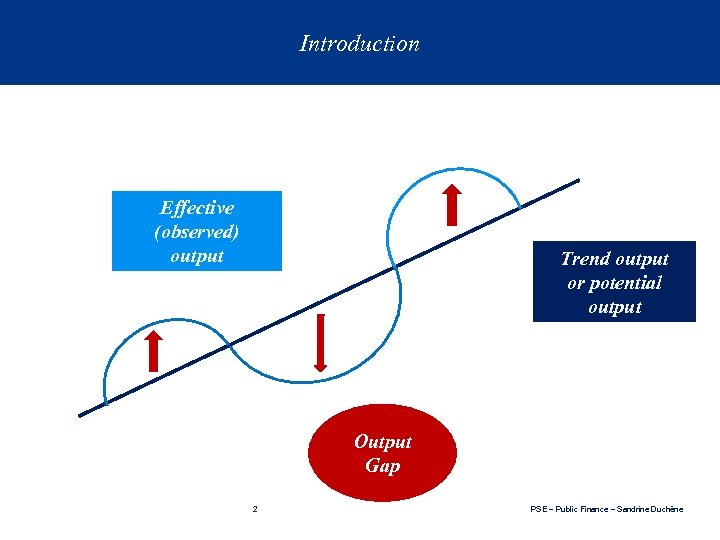
Introduction Effective (observed) output Trend output or potential output Output Gap 2 PSE – Public Finance – Sandrine Duchêne
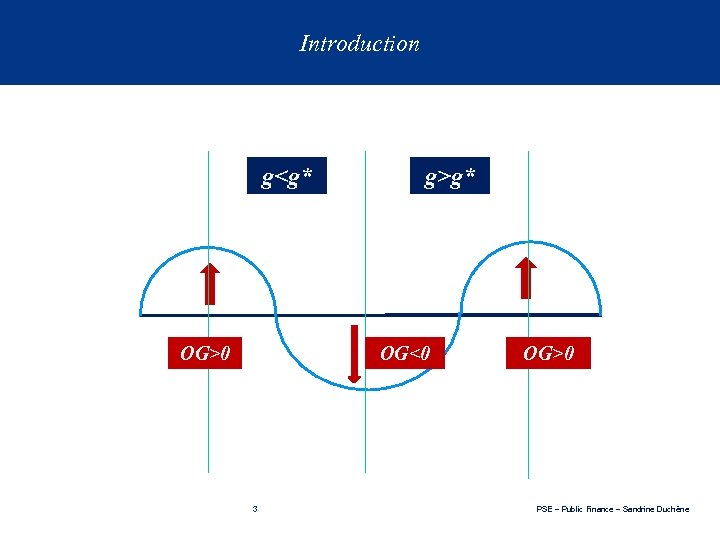
Introduction g<g* OG>0 g>g* OG<0 3 OG>0 PSE – Public Finance – Sandrine Duchêne
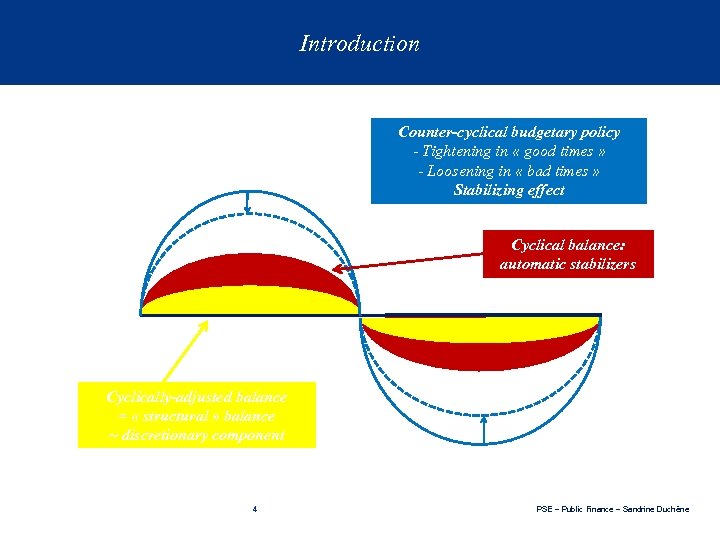
Introduction Counter-cyclical budgetary policy - Tightening in « good times » - Loosening in « bad times » Stabilizing effect Cyclical balance: automatic stabilizers Cyclically-adjusted balance = « structural » balance ~ discretionary component 4 PSE – Public Finance – Sandrine Duchêne
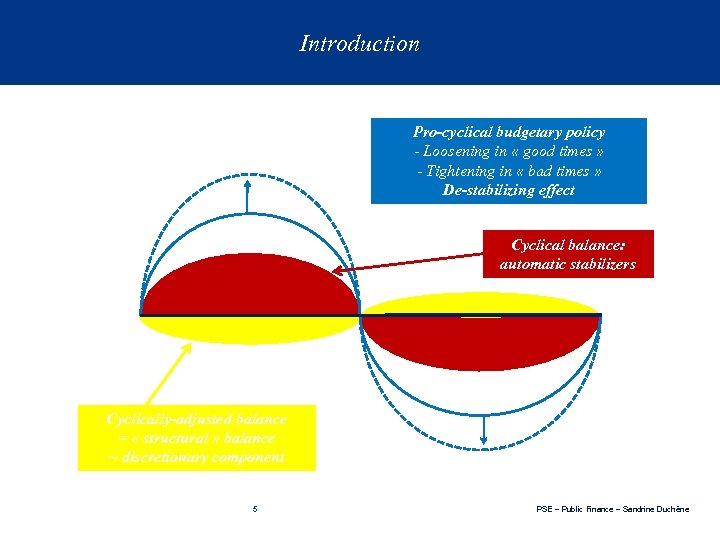
Introduction Pro-cyclical budgetary policy - Loosening in « good times » - Tightening in « bad times » De-stabilizing effect Cyclical balance: automatic stabilizers Cyclically-adjusted balance = « structural » balance ~ discretionary component 5 PSE – Public Finance – Sandrine Duchêne
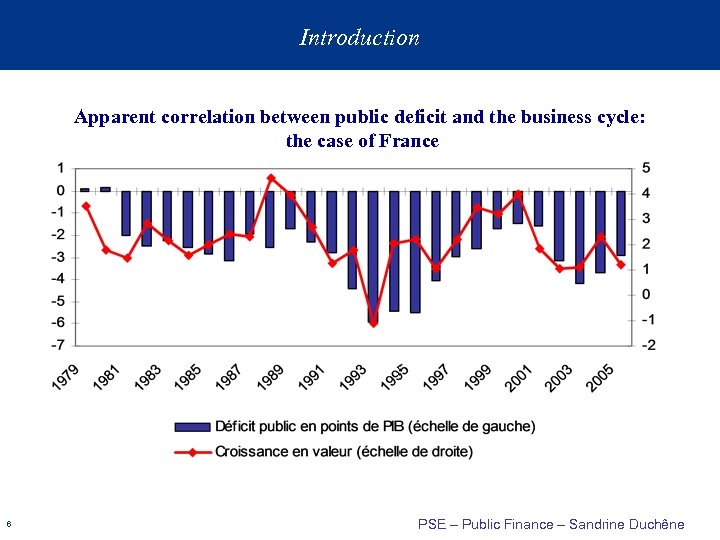
Introduction Apparent correlation between public deficit and the business cycle: the case of France 6 PSE – Public Finance – Sandrine Duchêne
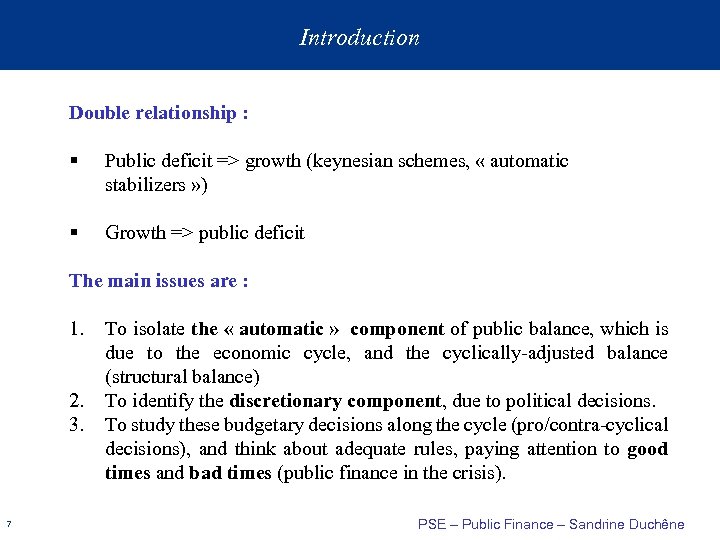
Introduction Double relationship : § Public deficit => growth (keynesian schemes, « automatic stabilizers » ) § Growth => public deficit The main issues are : 1. 2. 3. 7 To isolate the « automatic » component of public balance, which is due to the economic cycle, and the cyclically-adjusted balance (structural balance) To identify the discretionary component, due to political decisions. To study these budgetary decisions along the cycle (pro/contra-cyclical decisions), and think about adequate rules, paying attention to good times and bad times (public finance in the crisis). PSE – Public Finance – Sandrine Duchêne
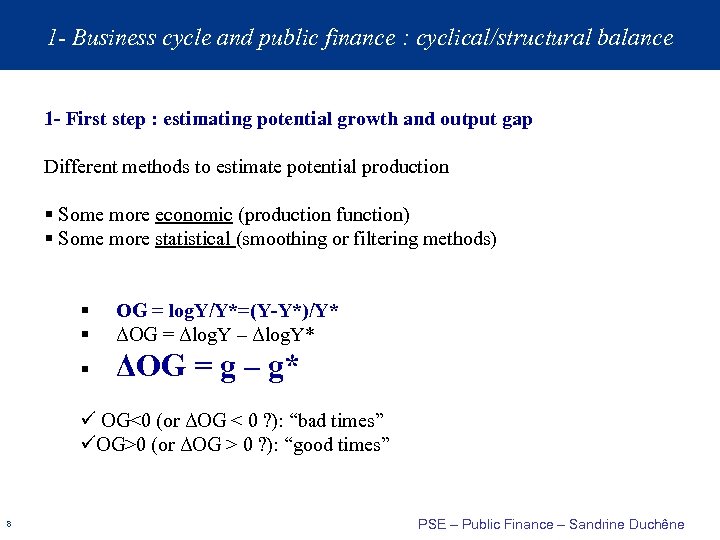
1 - Business cycle and public finance : cyclical/structural balance 1 - First step : estimating potential growth and output gap Different methods to estimate potential production § Some more economic (production function) § Some more statistical (smoothing or filtering methods) § § OG = log. Y/Y*=(Y-Y*)/Y* ΔOG = Δlog. Y – Δlog. Y* § ΔOG = g – g* ü OG<0 (or ΔOG < 0 ? ): “bad times” üOG>0 (or ΔOG > 0 ? ): “good times” 8 PSE – Public Finance – Sandrine Duchêne
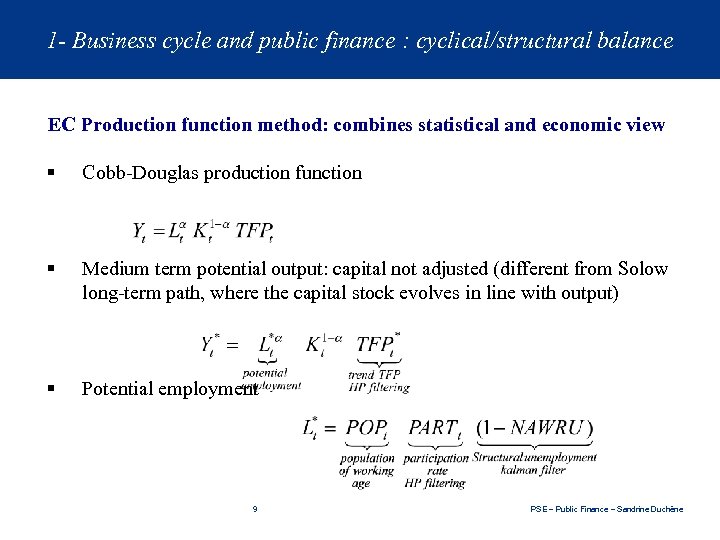
1 - Business cycle and public finance : cyclical/structural balance EC Production function method: combines statistical and economic view § Cobb-Douglas production function § Medium term potential output: capital not adjusted (different from Solow long-term path, where the capital stock evolves in line with output) § Potential employment 9 PSE – Public Finance – Sandrine Duchêne
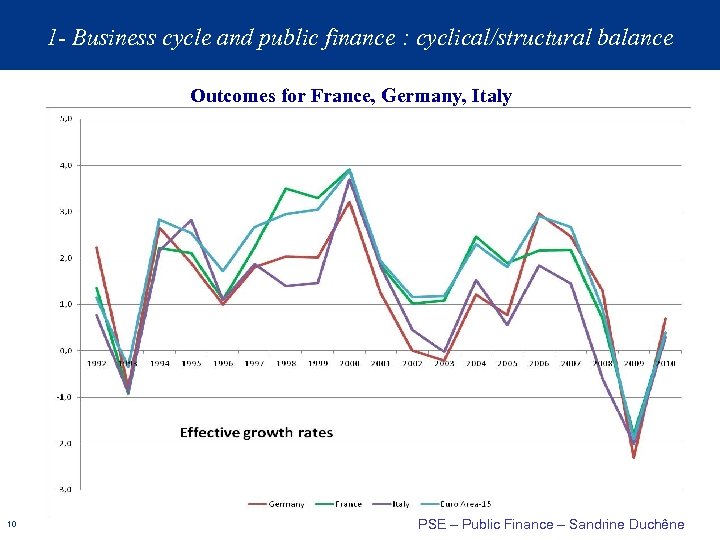
1 - Business cycle and public finance : cyclical/structural balance Outcomes for France, Germany, Italy 10 PSE – Public Finance – Sandrine Duchêne
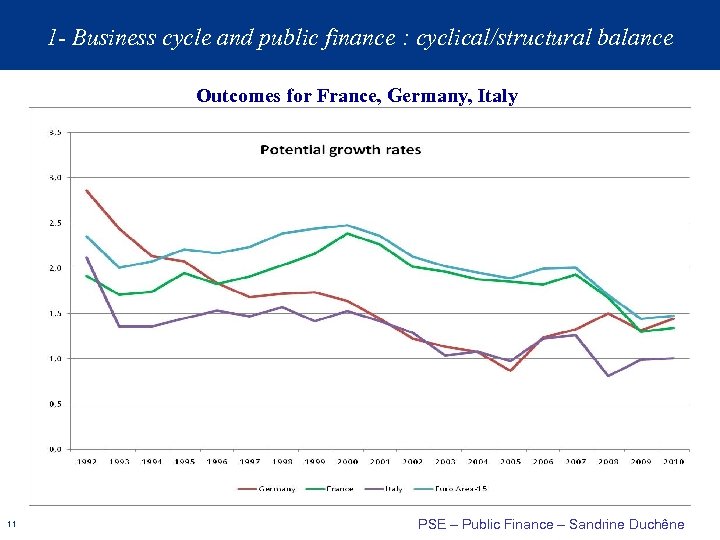
1 - Business cycle and public finance : cyclical/structural balance Outcomes for France, Germany, Italy 11 PSE – Public Finance – Sandrine Duchêne
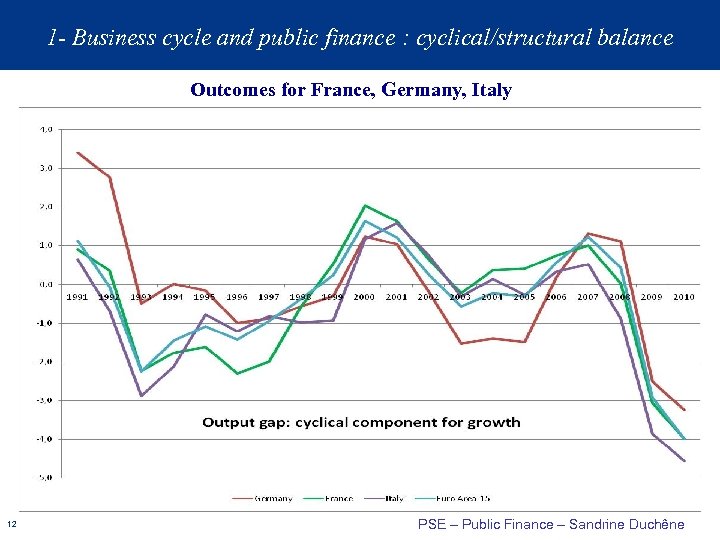
1 - Business cycle and public finance : cyclical/structural balance Outcomes for France, Germany, Italy 12 PSE – Public Finance – Sandrine Duchêne
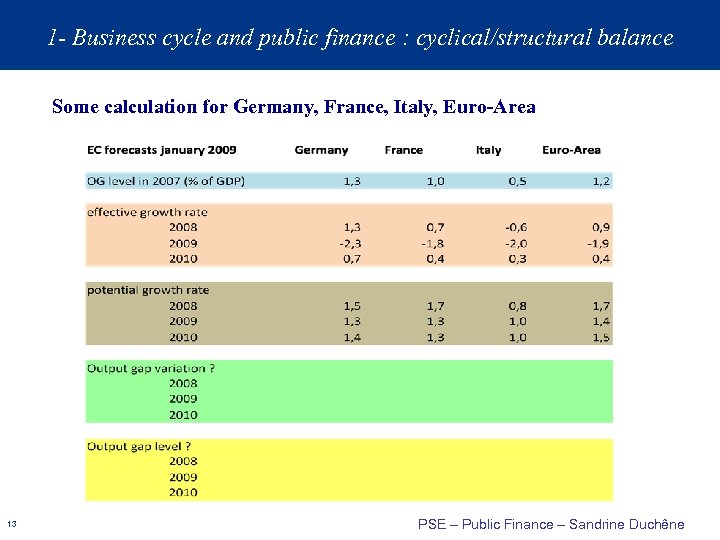
1 - Business cycle and public finance : cyclical/structural balance Some calculation for Germany, France, Italy, Euro-Area 13 PSE – Public Finance – Sandrine Duchêne
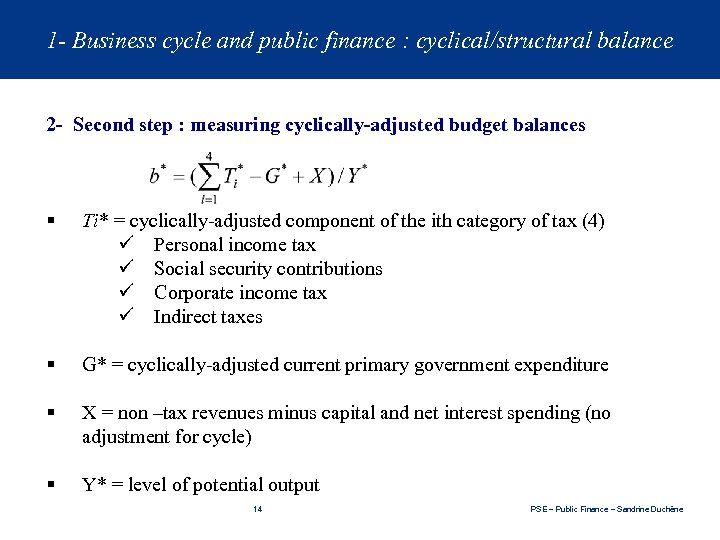
1 - Business cycle and public finance : cyclical/structural balance 2 - Second step : measuring cyclically-adjusted budget balances § Ti* = cyclically-adjusted component of the ith category of tax (4) ü Personal income tax ü Social security contributions ü Corporate income tax ü Indirect taxes § G* = cyclically-adjusted current primary government expenditure § X = non –tax revenues minus capital and net interest spending (no adjustment for cycle) § Y* = level of potential output 14 PSE – Public Finance – Sandrine Duchêne
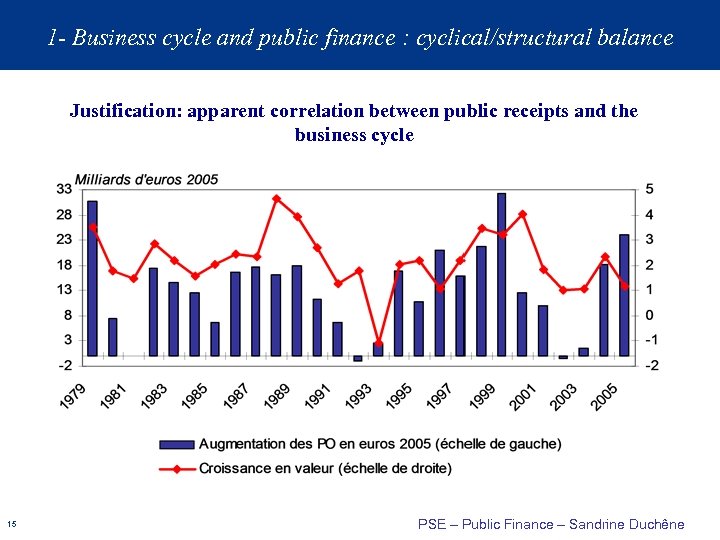
1 - Business cycle and public finance : cyclical/structural balance Justification: apparent correlation between public receipts and the business cycle 15 PSE – Public Finance – Sandrine Duchêne
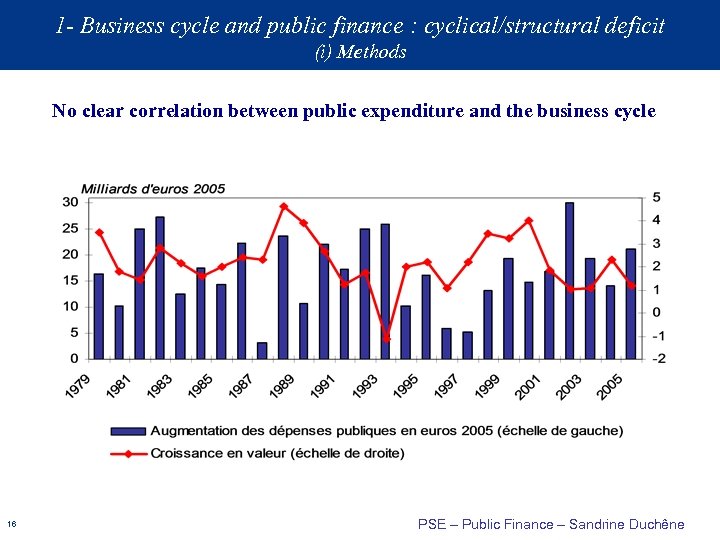
1 - Business cycle and public finance : cyclical/structural deficit (i) Methods No clear correlation between public expenditure and the business cycle 16 PSE – Public Finance – Sandrine Duchêne
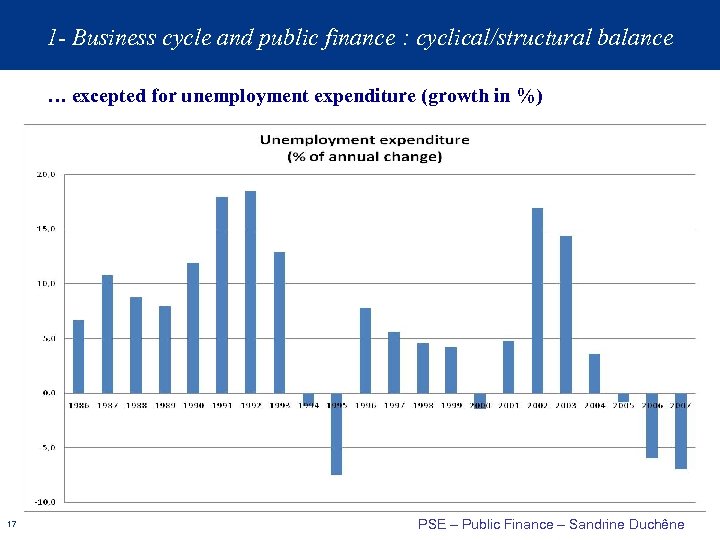
1 - Business cycle and public finance : cyclical/structural balance … excepted for unemployment expenditure (growth in %) 17 PSE – Public Finance – Sandrine Duchêne
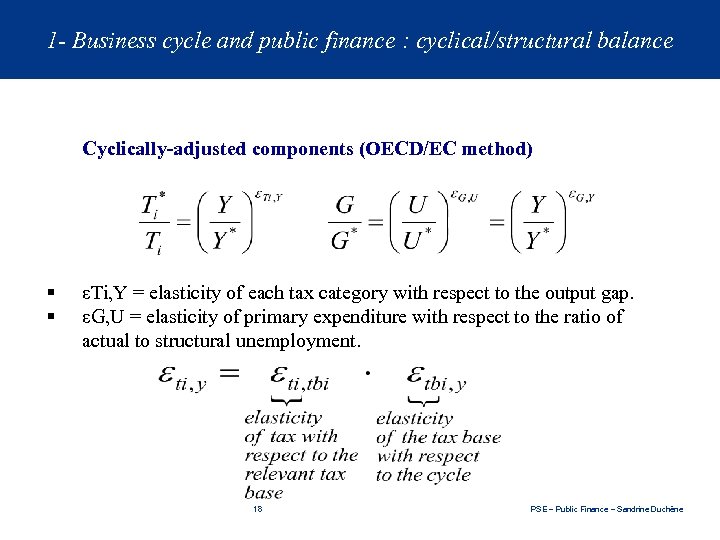
1 - Business cycle and public finance : cyclical/structural balance Cyclically-adjusted components (OECD/EC method) § § εTi, Y = elasticity of each tax category with respect to the output gap. εG, U = elasticity of primary expenditure with respect to the ratio of actual to structural unemployment. 18 PSE – Public Finance – Sandrine Duchêne
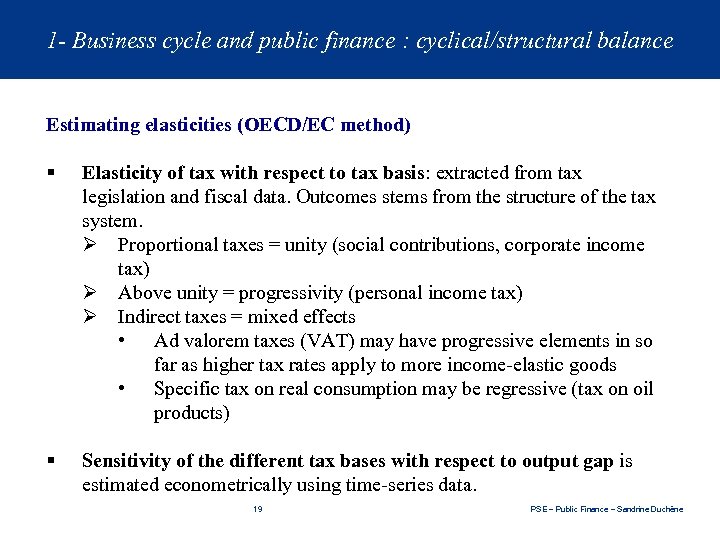
1 - Business cycle and public finance : cyclical/structural balance Estimating elasticities (OECD/EC method) § Elasticity of tax with respect to tax basis: extracted from tax legislation and fiscal data. Outcomes stems from the structure of the tax system. Ø Proportional taxes = unity (social contributions, corporate income tax) Ø Above unity = progressivity (personal income tax) Ø Indirect taxes = mixed effects • Ad valorem taxes (VAT) may have progressive elements in so far as higher tax rates apply to more income-elastic goods • Specific tax on real consumption may be regressive (tax on oil products) § Sensitivity of the different tax bases with respect to output gap is estimated econometrically using time-series data. 19 PSE – Public Finance – Sandrine Duchêne
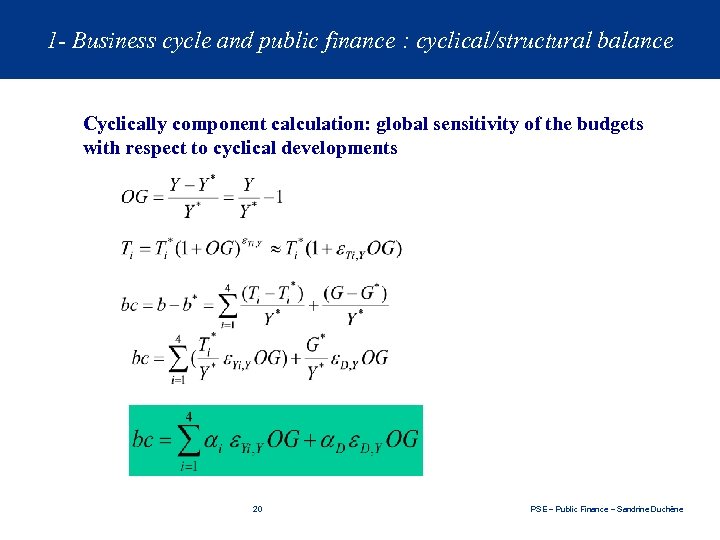
1 - Business cycle and public finance : cyclical/structural balance Cyclically component calculation: global sensitivity of the budgets with respect to cyclical developments 20 PSE – Public Finance – Sandrine Duchêne
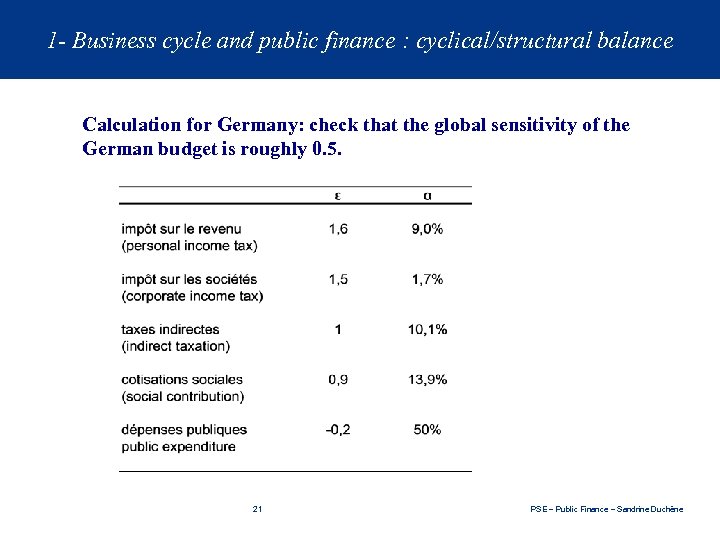
1 - Business cycle and public finance : cyclical/structural balance Calculation for Germany: check that the global sensitivity of the German budget is roughly 0. 5. 21 PSE – Public Finance – Sandrine Duchêne
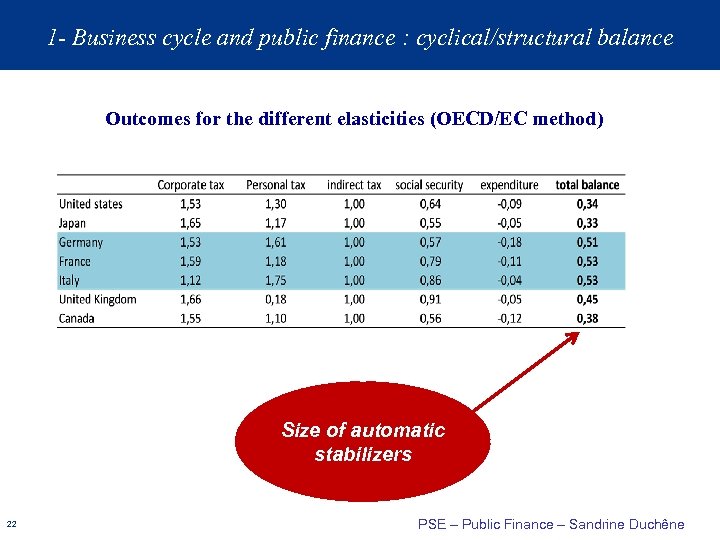
1 - Business cycle and public finance : cyclical/structural balance Outcomes for the different elasticities (OECD/EC method) Size of automatic stabilizers 22 PSE – Public Finance – Sandrine Duchêne
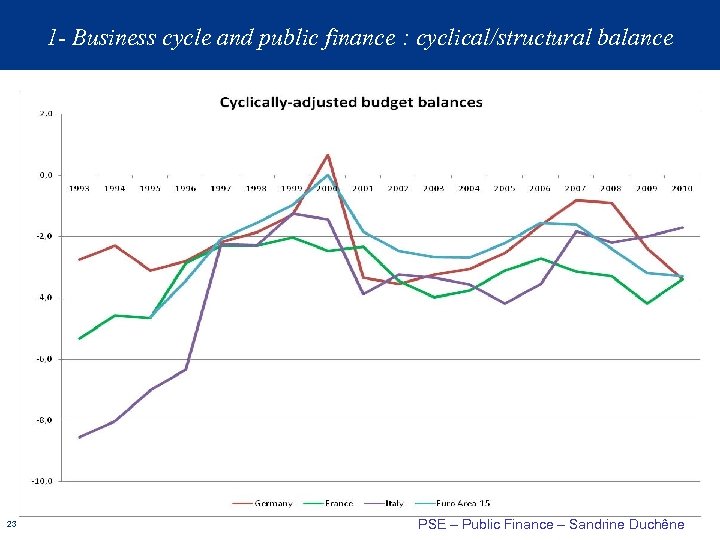
1 - Business cycle and public finance : cyclical/structural balance 23 PSE – Public Finance – Sandrine Duchêne
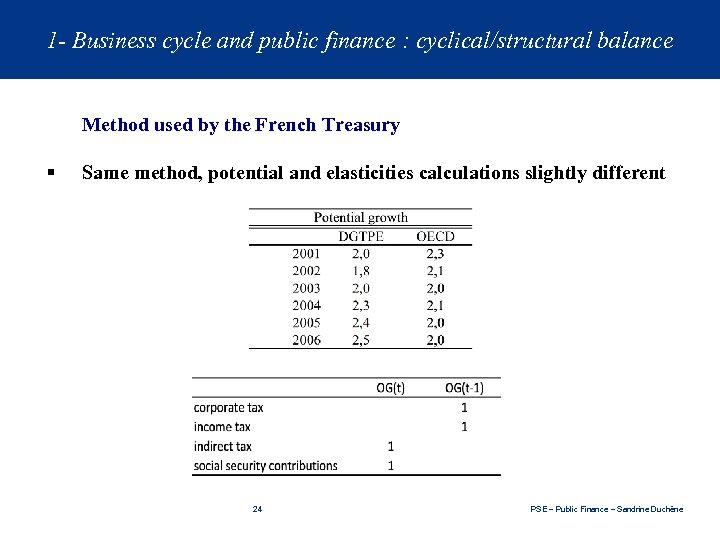
1 - Business cycle and public finance : cyclical/structural balance Method used by the French Treasury § Same method, potential and elasticities calculations slightly different 24 PSE – Public Finance – Sandrine Duchêne
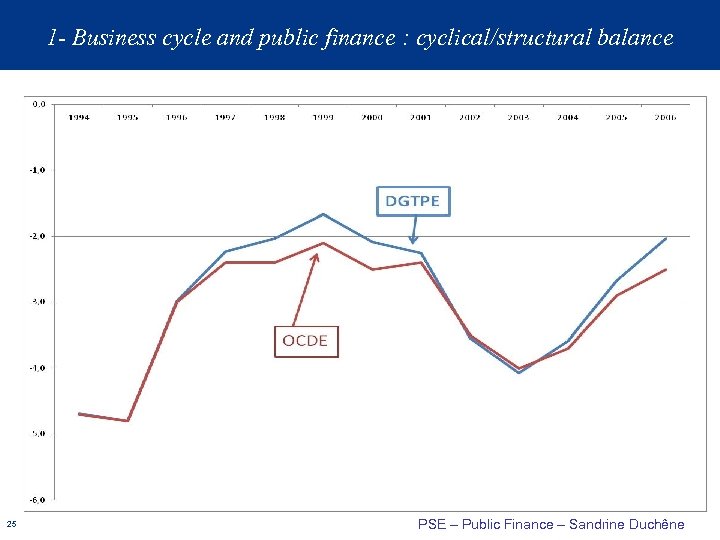
1 - Business cycle and public finance : cyclical/structural balance 25 PSE – Public Finance – Sandrine Duchêne
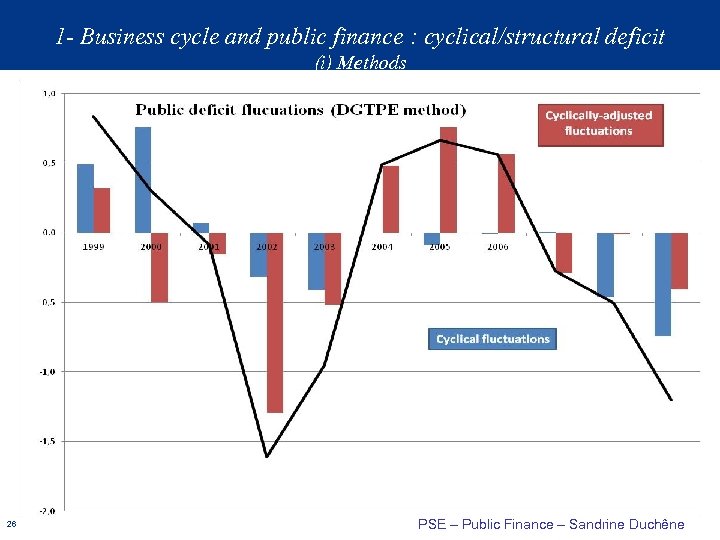
1 - Business cycle and public finance : cyclical/structural deficit (i) Methods 26 PSE – Public Finance – Sandrine Duchêne
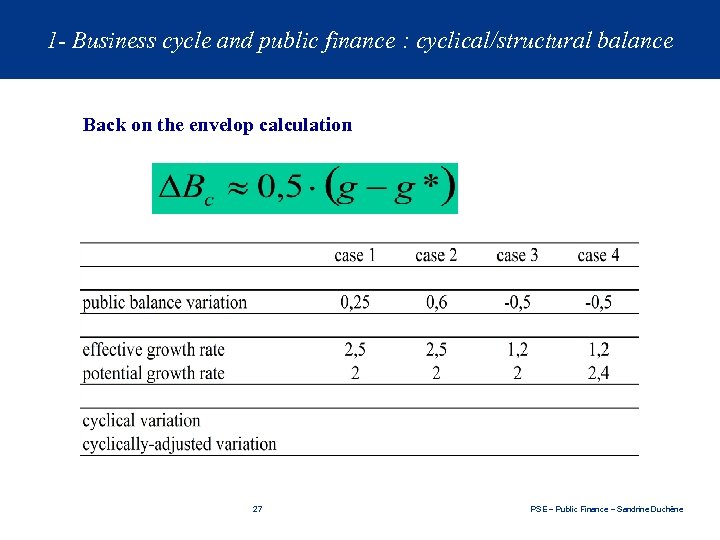
1 - Business cycle and public finance : cyclical/structural balance Back on the envelop calculation 27 PSE – Public Finance – Sandrine Duchêne
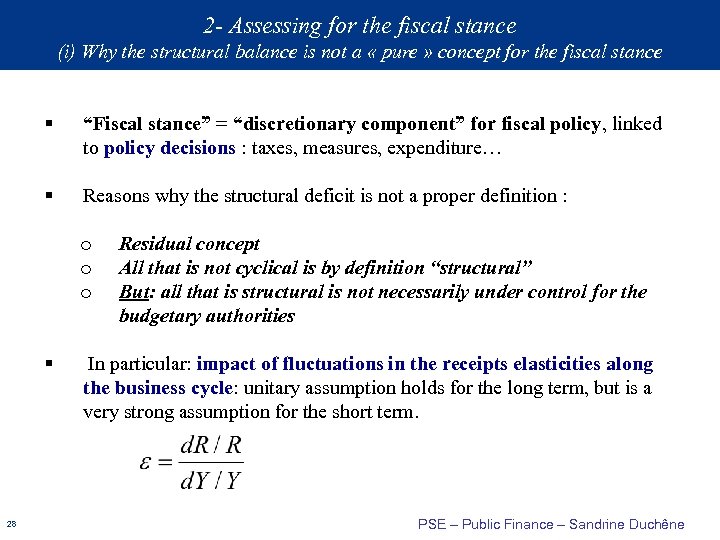
2 - Assessing for the fiscal stance (i) Why the structural balance is not a « pure » concept for the fiscal stance § “Fiscal stance” = “discretionary component” for fiscal policy, linked to policy decisions : taxes, measures, expenditure… § Reasons why the structural deficit is not a proper definition : o o o § 28 Residual concept All that is not cyclical is by definition “structural” But: all that is structural is not necessarily under control for the budgetary authorities In particular: impact of fluctuations in the receipts elasticities along the business cycle: unitary assumption holds for the long term, but is a very strong assumption for the short term. PSE – Public Finance – Sandrine Duchêne
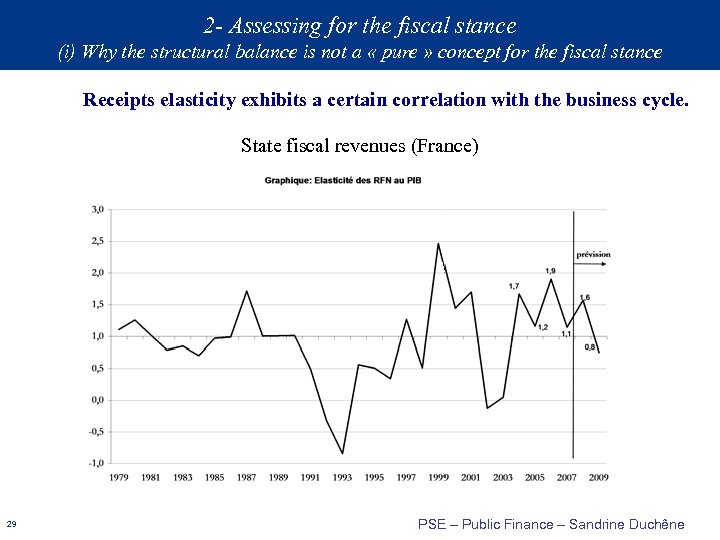
2 - Assessing for the fiscal stance (i) Why the structural balance is not a « pure » concept for the fiscal stance Receipts elasticity exhibits a certain correlation with the business cycle. State fiscal revenues (France) 29 PSE – Public Finance – Sandrine Duchêne
2 - Assessing for the fiscal stance (i) Why the structural balance is not a « pure » concept for the fiscal stance Why the receipts-elasticity is not unit in the short term § § 30 Composition of growth : more or less dependent on internal/external demand o An external shock (from world demand, for example) is propagated to activity via a decline in exports and hence has no direct impact on the public balance. o By contrast, the impact on the public balance of an internal shock on activity of the same magnitude (fall in the household saving ratio, shock to public investment) has an immediate impact on VAT revenue. Proper dynamics of certain tax bases o Productivity cycle : lags between GDP and employment or wages o Profit sharing also impacts the corporate tax. o Sectoral dynamics: housing markets, financial sector PSE – Public Finance – Sandrine Duchêne
2 - Assessing for the fiscal stance (i) Why the structural balance is not a « pure » concept for the fiscal stance Why the receipts-elasticity is not unit in the short term § § 31 “Structure” effects o Progressivity of personal income taxes: the mean evolution of wages is important, but also that of high wages. o VAT: composition effects between the normal tax rate and the reduced tax rate. Time-lags- perception lags o Corporate income tax and personal income tax ares based on the previous year’s revenues. Taken into account (imperfectly) by introducing a time-lag on OG in the calculations. o Particular fiscal dispositions soften the link between the evolution of activity and the tax bases : for example, possibility for the firms to report the current losses into the future. PSE – Public Finance – Sandrine Duchêne
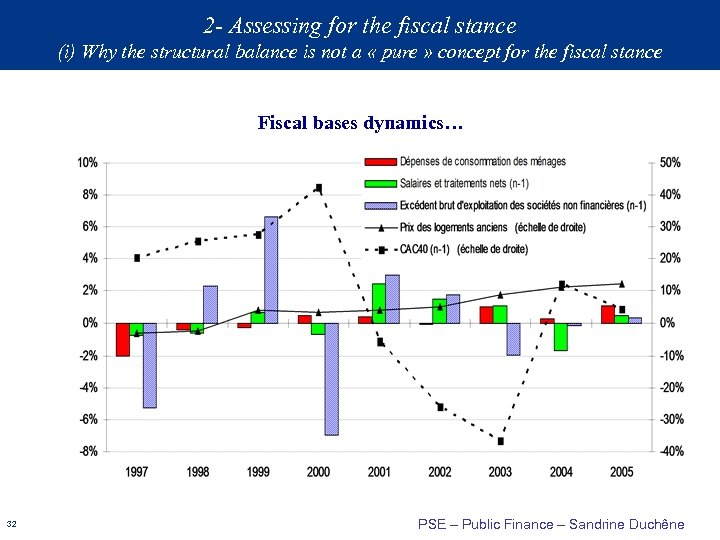
2 - Assessing for the fiscal stance (i) Why the structural balance is not a « pure » concept for the fiscal stance Fiscal bases dynamics… 32 PSE – Public Finance – Sandrine Duchêne
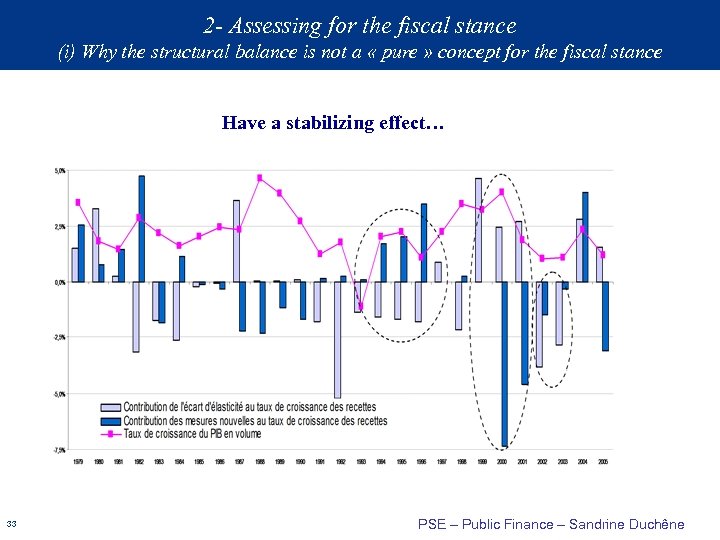
2 - Assessing for the fiscal stance (i) Why the structural balance is not a « pure » concept for the fiscal stance Have a stabilizing effect… 33 PSE – Public Finance – Sandrine Duchêne
2 - Assessing for the fiscal stance (ii) A method to determine the « discretionary component » § “Fiscal stance” = portion of the evolution in the public balance that is attributable to discretionary decisions from the budgetary authorities § Structural or cyclically-adjusted balance is a highly imperfect measure for characterizing the orientation of fiscal policy. § In particular, fluctuations in elasticity of tax revenues blur the interpretation of structural evolutions. From calculation conventions (unit assumption), they are entirely classified as structural variations, although these evolutions are outside of the control of fiscal authorities and cannot be considered as discretionary § “Pure definition” for the fiscal stance ? 34 PSE – Public Finance – Sandrine Duchêne
2 - Assessing for the fiscal stance (ii) A method to determine the « discretionary component » Method: “structural effort” a) Isolate the discretionary component (“structural effort”) of the structural evolutions, composed of 2 parts i. ii. b) Propose a breakdown for the cyclically-adjusted variations into 2 parts i. ii. 35 Expenditure structural margin: gap between the spending growth rate and potential growth rate. When expenditure progression is under potential growth rate, the underlying fiscal position is improving Tax measures: tax raises improves the structural position, tax cuts worsen it The discretionary component The non discretionary component: of which tax-elasticities effects. PSE – Public Finance – Sandrine Duchêne
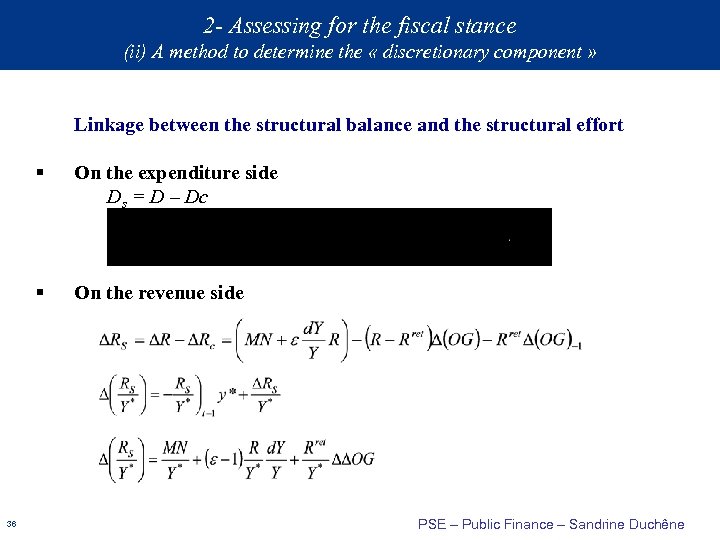
2 - Assessing for the fiscal stance (ii) A method to determine the « discretionary component » Linkage between the structural balance and the structural effort § On the expenditure side Ds = D – Dc § On the revenue side 36 PSE – Public Finance – Sandrine Duchêne
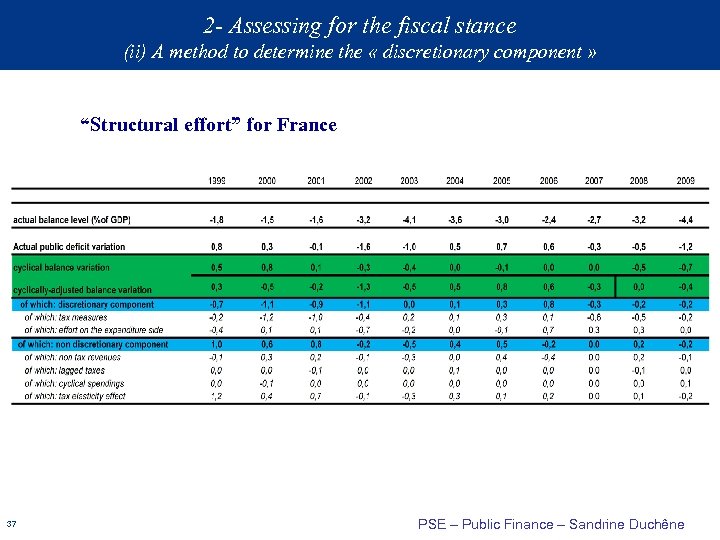
2 - Assessing for the fiscal stance (ii) A method to determine the « discretionary component » “Structural effort” for France 37 PSE – Public Finance – Sandrine Duchêne
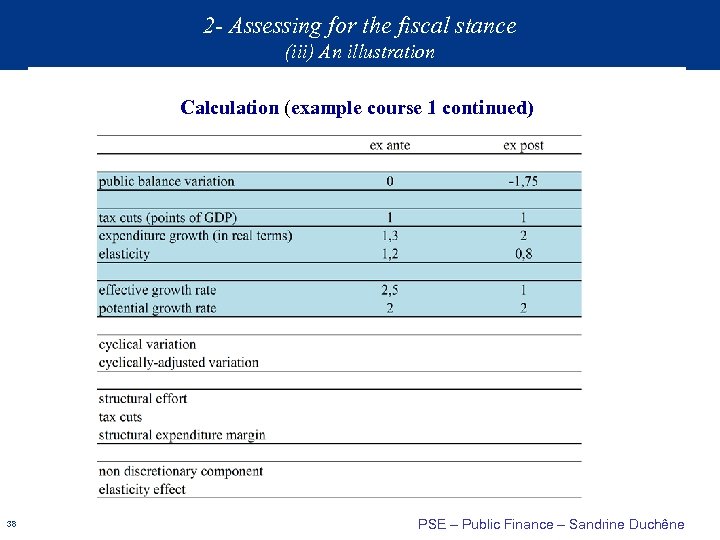
2 - Assessing for the fiscal stance (iii) An illustration Calculation (example course 1 continued) 38 PSE – Public Finance – Sandrine Duchêne
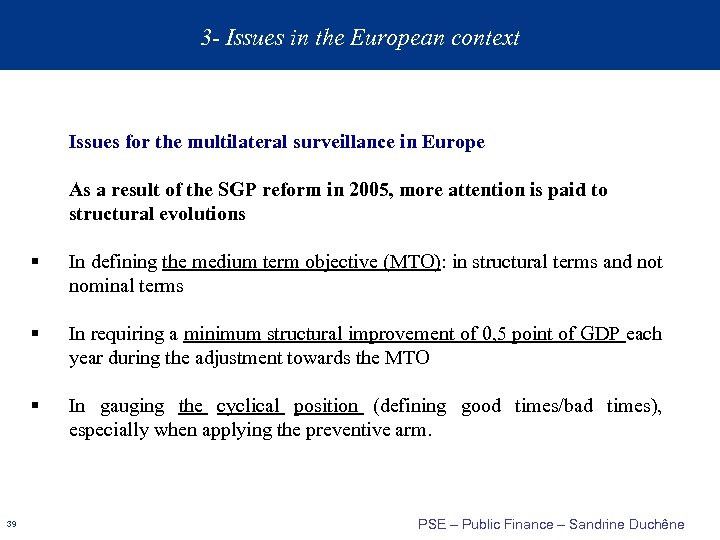
3 - Issues in the European context Issues for the multilateral surveillance in Europe As a result of the SGP reform in 2005, more attention is paid to structural evolutions § § In requiring a minimum structural improvement of 0, 5 point of GDP each year during the adjustment towards the MTO § 39 In defining the medium term objective (MTO): in structural terms and not nominal terms In gauging the cyclical position (defining good times/bad times), especially when applying the preventive arm. PSE – Public Finance – Sandrine Duchêne
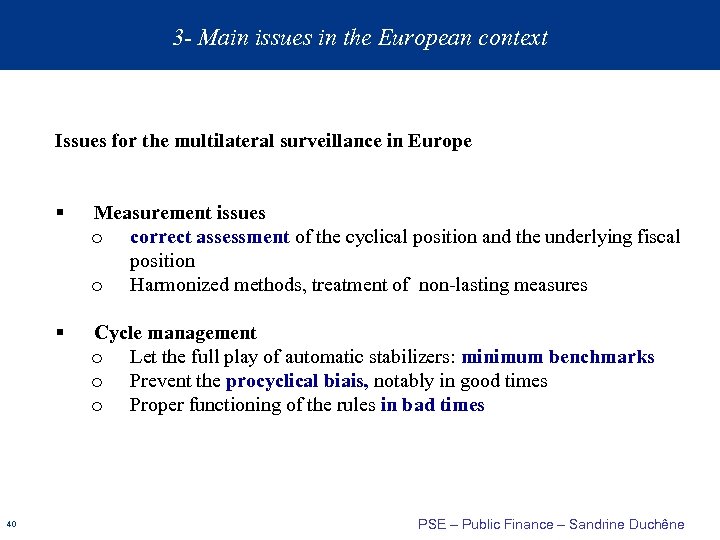
3 - Main issues in the European context Issues for the multilateral surveillance in Europe § § 40 Measurement issues o correct assessment of the cyclical position and the underlying fiscal position o Harmonized methods, treatment of non-lasting measures Cycle management o Let the full play of automatic stabilizers: minimum benchmarks o Prevent the procyclical biais, notably in good times o Proper functioning of the rules in bad times PSE – Public Finance – Sandrine Duchêne
3 - Main issues in the European context (i) Measurement issues Measurement uncertainties may hamper a correct judgement of the cyclical conditions § Real- time output gap estimates of a given year a generally subject to large revisions. § The uncertainty has several sources: ü ü ü 41 Statistical revisions: Data for past years are frequently revised. Forecast uncertainty: The arrival of output data in subsequent years clarifies the position in the cycle . Because of the filtering tools, forecasts are taken into account. Model uncertainty: The arrival of new data in subsequent years may clarify the nature of economic shocks (permanent or temporary). Potential growth is not measured, and is highly dependant on assumptions PSE – Public Finance – Sandrine Duchêne
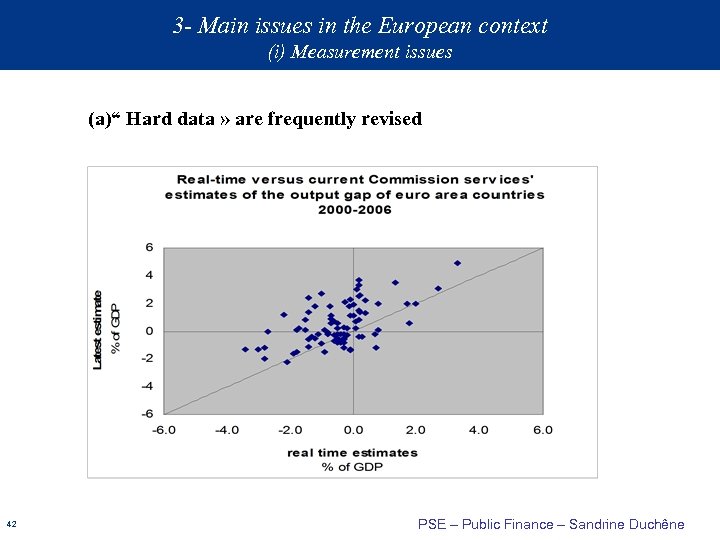
3 - Main issues in the European context (i) Measurement issues (a)“ Hard data » are frequently revised 42 PSE – Public Finance – Sandrine Duchêne
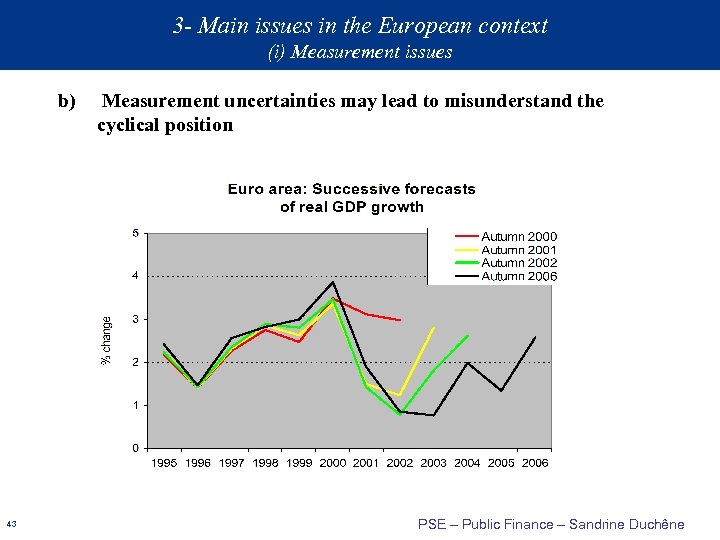
3 - Main issues in the European context (i) Measurement issues b) 43 Measurement uncertainties may lead to misunderstand the cyclical position PSE – Public Finance – Sandrine Duchêne
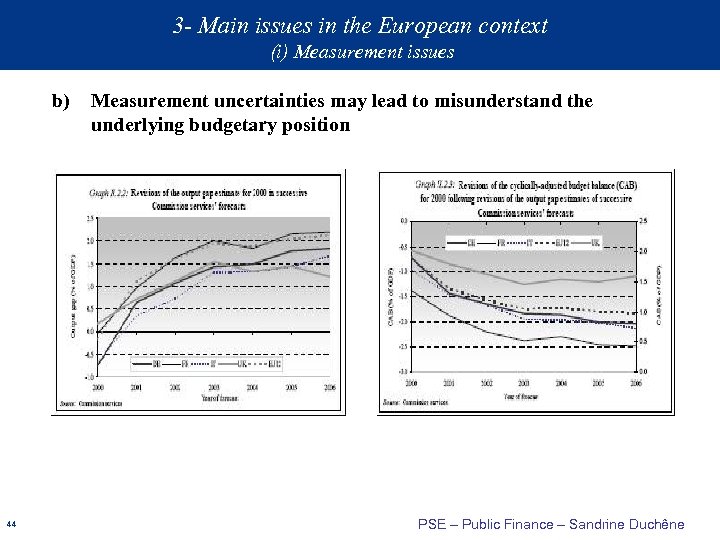
3 - Main issues in the European context (i) Measurement issues b) 44 Measurement uncertainties may lead to misunderstand the underlying budgetary position PSE – Public Finance – Sandrine Duchêne
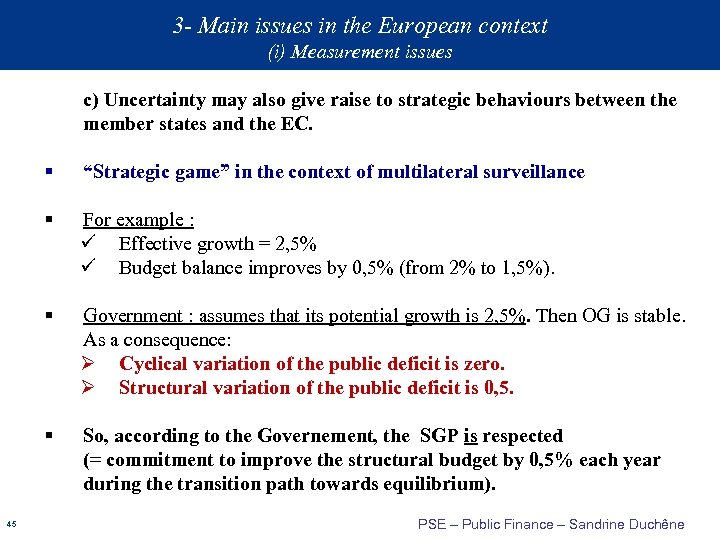
3 - Main issues in the European context (i) Measurement issues c) Uncertainty may also give raise to strategic behaviours between the member states and the EC. § § For example : ü Effective growth = 2, 5% ü Budget balance improves by 0, 5% (from 2% to 1, 5%). § Government : assumes that its potential growth is 2, 5%. Then OG is stable. As a consequence: Ø Cyclical variation of the public deficit is zero. Ø Structural variation of the public deficit is 0, 5. § 45 “Strategic game” in the context of multilateral surveillance So, according to the Governement, the SGP is respected (= commitment to improve the structural budget by 0, 5% each year during the transition path towards equilibrium). PSE – Public Finance – Sandrine Duchêne
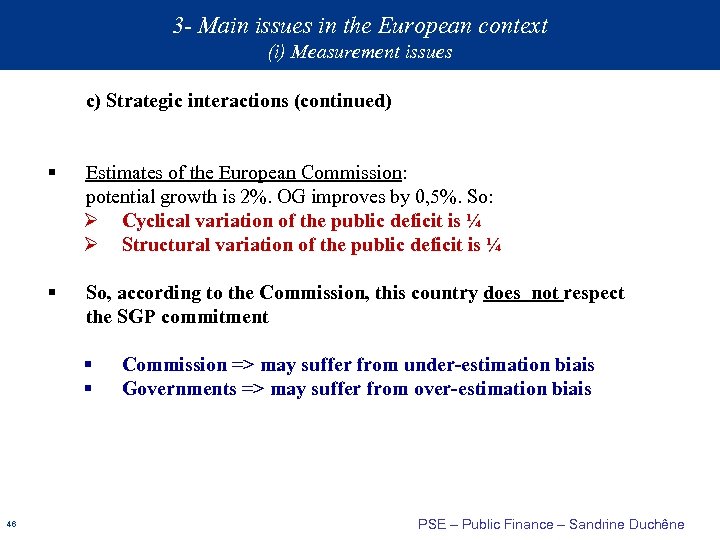
3 - Main issues in the European context (i) Measurement issues c) Strategic interactions (continued) § Estimates of the European Commission: potential growth is 2%. OG improves by 0, 5%. So: Ø Cyclical variation of the public deficit is ¼ Ø Structural variation of the public deficit is ¼ § So, according to the Commission, this country does not respect the SGP commitment § § 46 Commission => may suffer from under-estimation biais Governments => may suffer from over-estimation biais PSE – Public Finance – Sandrine Duchêne
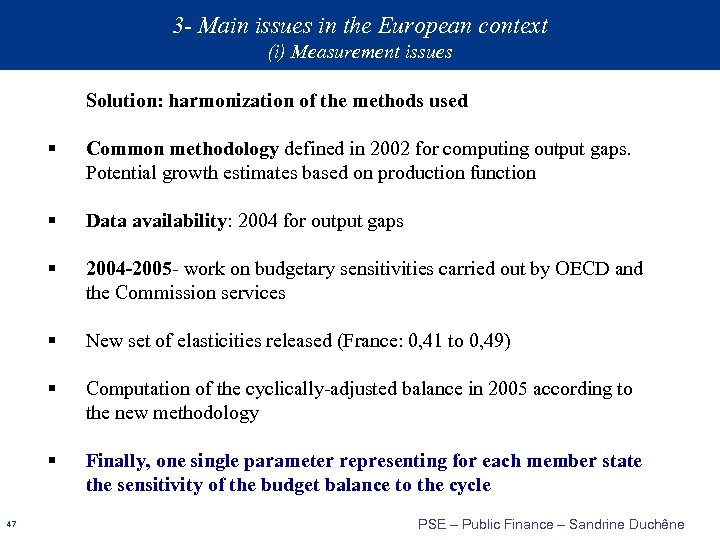
3 - Main issues in the European context (i) Measurement issues Solution: harmonization of the methods used § § Data availability: 2004 for output gaps § 2004 -2005 - work on budgetary sensitivities carried out by OECD and the Commission services § New set of elasticities released (France: 0, 41 to 0, 49) § Computation of the cyclically-adjusted balance in 2005 according to the new methodology § 47 Common methodology defined in 2002 for computing output gaps. Potential growth estimates based on production function Finally, one single parameter representing for each member state the sensitivity of the budget balance to the cycle PSE – Public Finance – Sandrine Duchêne
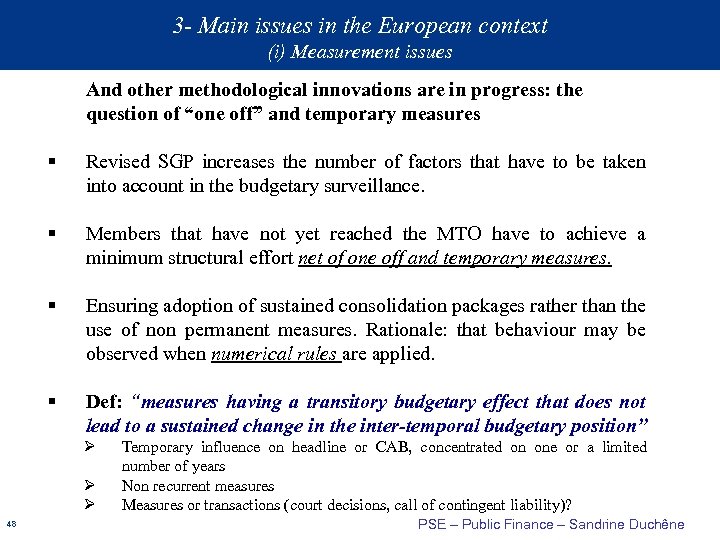
3 - Main issues in the European context (i) Measurement issues And other methodological innovations are in progress: the question of “one off” and temporary measures § Revised SGP increases the number of factors that have to be taken into account in the budgetary surveillance. § Members that have not yet reached the MTO have to achieve a minimum structural effort net of one off and temporary measures. § Ensuring adoption of sustained consolidation packages rather than the use of non permanent measures. Rationale: that behaviour may be observed when numerical rules are applied. § Def: “measures having a transitory budgetary effect that does not lead to a sustained change in the inter-temporal budgetary position” Ø Ø Ø 48 Temporary influence on headline or CAB, concentrated on one or a limited number of years Non recurrent measures Measures or transactions (court decisions, call of contingent liability)? PSE – Public Finance – Sandrine Duchêne
3 - Main issues in the European context (i) Measurement issues An indicative list of “one off” and temporary measures (Note: CAB netted, but not the headline deficit) Deficit reducing measures i. iii. Tax amnesties implying a one-off payment Sales of non financial assets (UMTS licenses in 2000) Temporary legislative changes in the timing of expenditure or collection of revenues: in France, corporate tax collection, social taxes iv. Exceptional revenues linked to transfer of pension obligations: in France, used in 2005 (public corporations in the energy sector), or in 1997 (France telecom) v. Consequences of court or other authorities rulings, in particular the reimbursements of subsidies ordered by the Commission vi. Securitisation operations with impact on deficit vii. Exceptional revenues from state owned companies Deficit increasing measures i. ii. 49 Costs of natural catastrophes or other exceptional events Consequences of court or other authorities rulings. PSE – Public Finance – Sandrine Duchêne
3 - Main issues in the European context (ii) Cycle management/minimum benchmarks Intuition for minimum benchmarks § § The EU framework of 3% reference value has to be respected even under adverse cyclical developments (with possible exception of “severe downturns” enabling to use the exceptional circumstances clause of the Treaty) § Minimum benchmark= safety margin allowing full play of automatic stabilizers, without breaching the 3% ceiling, under “normal” cyclical conditions § 50 Budget balances are affected by cyclical conditions Since 2005, minimum benchamarks enter into the determination of the MTO: the country-specific objective has to be set above a threshold value ensuring the respect of 3% under normal cyclical conditions= MB PSE – Public Finance – Sandrine Duchêne
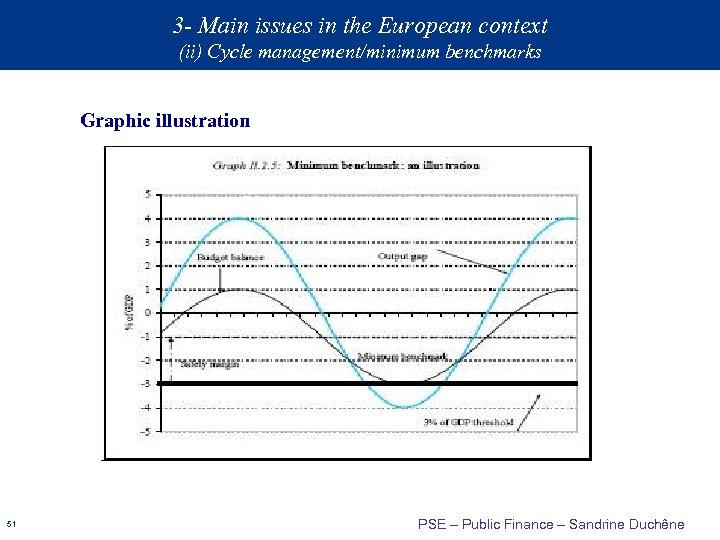
3 - Main issues in the European context (ii) Cycle management/minimum benchmarks Graphic illustration 51 PSE – Public Finance – Sandrine Duchêne
3 - Main issues in the European context (ii) Cycle management/minimum benchmarks Methodology and updates of MB: two steps § § 52 Identifying a “representative OG” for each country Ø The largest negative OG observed in each country Ø The unweighted average of the largest negative OG in each country Ø Two times the country specific standard deviation of the OG (with minus sign) Ø Mixed country-specific SD/overall SD of OG (EC 2006) Applying the estimated budget sensitivities to the cycle to compute the minimum benchmark for each country. PSE – Public Finance – Sandrine Duchêne
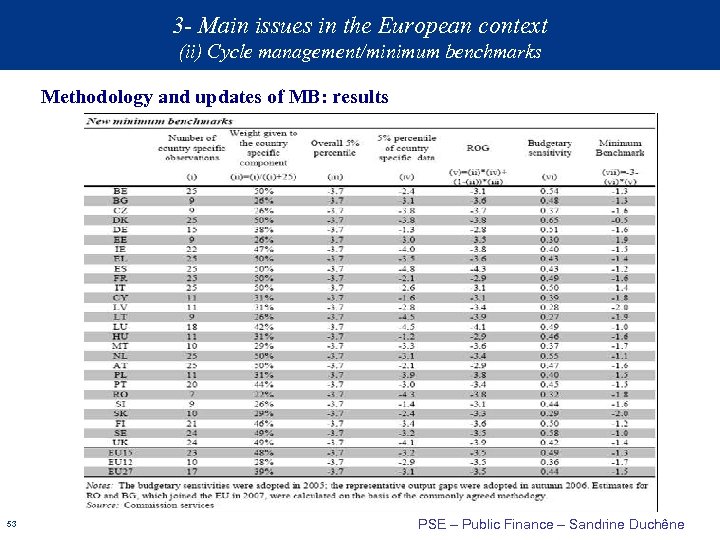
3 - Main issues in the European context (ii) Cycle management/minimum benchmarks Methodology and updates of MB: results 53 PSE – Public Finance – Sandrine Duchêne
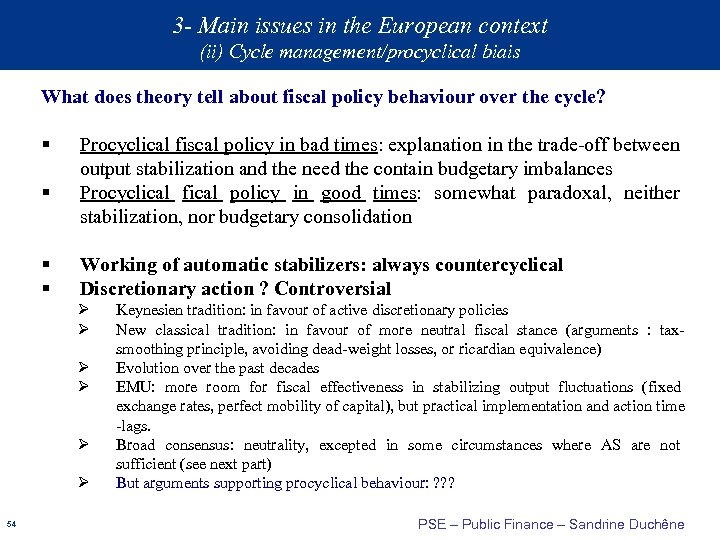
3 - Main issues in the European context (ii) Cycle management/procyclical biais What does theory tell about fiscal policy behaviour over the cycle? § § Procyclical fiscal policy in bad times: explanation in the trade-off between output stabilization and the need the contain budgetary imbalances Procyclical fical policy in good times: somewhat paradoxal, neither stabilization, nor budgetary consolidation Working of automatic stabilizers: always countercyclical Discretionary action ? Controversial Ø Ø Ø 54 Keynesien tradition: in favour of active discretionary policies New classical tradition: in favour of more neutral fiscal stance (arguments : taxsmoothing principle, avoiding dead-weight losses, or ricardian equivalence) Evolution over the past decades EMU: more room for fiscal effectiveness in stabilizing output fluctuations (fixed exchange rates, perfect mobility of capital), but practical implementation and action time -lags. Broad consensus: neutrality, excepted in some circumstances where AS are not sufficient (see next part) But arguments supporting procyclical behaviour: ? ? ? PSE – Public Finance – Sandrine Duchêne
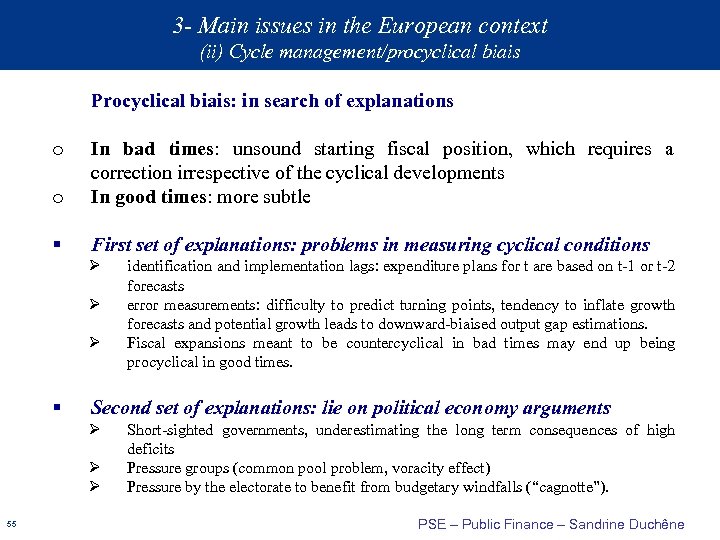
3 - Main issues in the European context (ii) Cycle management/procyclical biais Procyclical biais: in search of explanations o In bad times: unsound starting fiscal position, which requires a correction irrespective of the cyclical developments In good times: more subtle § First set of explanations: problems in measuring cyclical conditions o Ø Ø Ø § Second set of explanations: lie on political economy arguments Ø Ø Ø 55 identification and implementation lags: expenditure plans for t are based on t-1 or t-2 forecasts error measurements: difficulty to predict turning points, tendency to inflate growth forecasts and potential growth leads to downward-biaised output gap estimations. Fiscal expansions meant to be countercyclical in bad times may end up being procyclical in good times. Short-sighted governments, underestimating the long term consequences of high deficits Pressure groups (common pool problem, voracity effect) Pressure by the electorate to benefit from budgetary windfalls (“cagnotte”). PSE – Public Finance – Sandrine Duchêne
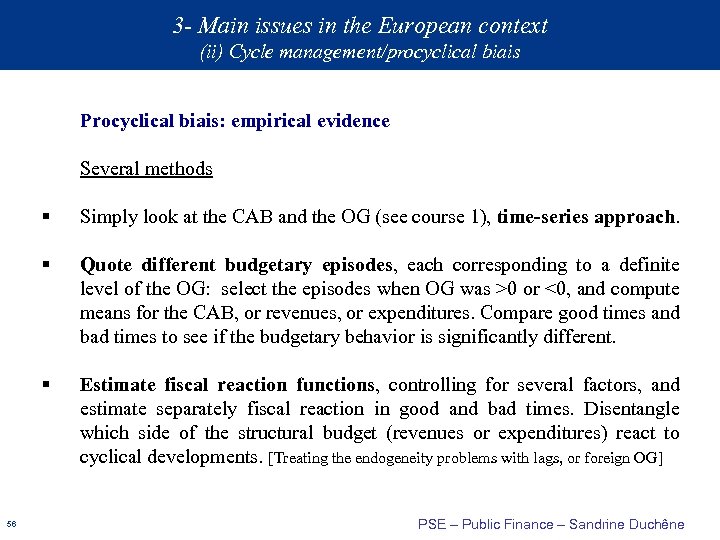
3 - Main issues in the European context (ii) Cycle management/procyclical biais Procyclical biais: empirical evidence Several methods § § Quote different budgetary episodes, each corresponding to a definite level of the OG: select the episodes when OG was >0 or <0, and compute means for the CAB, or revenues, or expenditures. Compare good times and bad times to see if the budgetary behavior is significantly different. § 56 Simply look at the CAB and the OG (see course 1), time-series approach. Estimate fiscal reaction functions, controlling for several factors, and estimate separately fiscal reaction in good and bad times. Disentangle which side of the structural budget (revenues or expenditures) react to cyclical developments. [Treating the endogeneity problems with lags, or foreign OG] PSE – Public Finance – Sandrine Duchêne
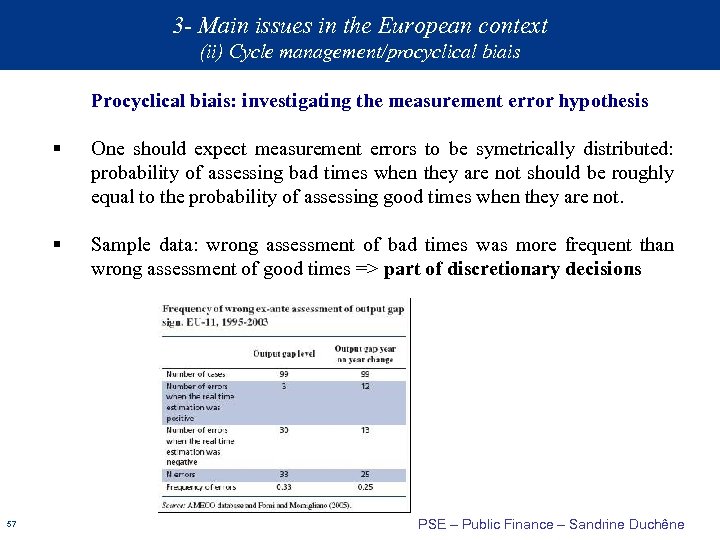
3 - Main issues in the European context (ii) Cycle management/procyclical biais Procyclical biais: investigating the measurement error hypothesis § § 57 One should expect measurement errors to be symetrically distributed: probability of assessing bad times when they are not should be roughly equal to the probability of assessing good times when they are not. Sample data: wrong assessment of bad times was more frequent than wrong assessment of good times => part of discretionary decisions PSE – Public Finance – Sandrine Duchêne
3 - Main issues in the European context (ii) Cycle management/procyclical biais Addressing the procyclical biais If it is of structural nature, needs structural responses: budgetary rules/institutions § Revenue rules o o 58 Caps on the tax burden and minimum ceilings on revenues (Denmark)? Risks of procyclical decisions in good times (caps on tax burden) or in bad times (ceilings) Use of windfall revenues ensuing from better than expected cyclical conditions or from “elasticity surprises” related for instance with asset prices cycles: quite effective (Netherlands, France) Defining ex ante which share of the windfall revenues will be affected to deficit and debt reduction (each year in the budget law in France) o Rainy day funds (Finland) PSE – Public Finance – Sandrine Duchêne
3 - Main issues in the European context (ii) Cycle management/procyclical biais o § o o Rainy day funds (Finland): ü In good times part of extra revenues is used to accumulate financial assets in a fund. Conversely in bad times assets are decumulated. ü Clear stabilization effect on debt, but not on public deficit (can’t be used to improve budgetary figures) ü Interest from a political economy point of view Independent institutions/ fiscal councils (Netherlands Belgium, v. Austria) Role: to supply analytical inputs from fiscal policy making, especially growth forecasts, to assess the impact of fiscal measures May also provide normative indications and express a voice in the policy debate 59 PSE – Public Finance – Sandrine Duchêne
3 - Main issues in the European context (iii) Cycle management/Public finance in the crisis § § 60 Financial crisis began in summer 2007, with the subprimes crisis. Spread over the whole financial sector during 2008. Intensified in automn 2008 with the bank Lehman brothers’ failure. Even if systemic crisis seems to have been avoided (due to massive liquidity injections by central banks together with rescue packages adopted by national authorities), adverse feedback loop between the financial and real sectors – reinforced by specific adverse shocks (oil prices at the beginning of 2008, burst of the housing bubble). o Squeeze on credit, rise of financing costs, fall in house prices and tumbling stock markets are all reinforcing a slump in confidence. o Demand components like consumption and private investment are sharply affected: precautionary savings by the consumers, wait and see attitude by the firms, wealth effects, increasing difficulties of obtaining credit o Downturn is broadbased, with negative spillovers progressively affecting emerging countries. PSE – Public Finance – Sandrine Duchêne
3 - Main issues in the European context (iii) Cycle management/Public finance in the crisis § Economic forecasts for 2009 and 2010 point to a deep, long lasting (? ), and widespread recession (see EC, IMF). § § Downturn is broadbased across all the components of demand (excepted public demand). § 61 In the Euro-Area, real GDP is expected to fall by roughly 2% in 2009. GDP growth is expected to turn moderately positive in 2010 (to around ½%). Unemployment rate will increase by some 3 points, to an annual average rate of 10% in 2010. Some countries will be subject to a more pronounced and protracted downturn, depending on their exposure to the financial crisis or to a substantiel housing-market correction (UK, Spain). PSE – Public Finance – Sandrine Duchêne
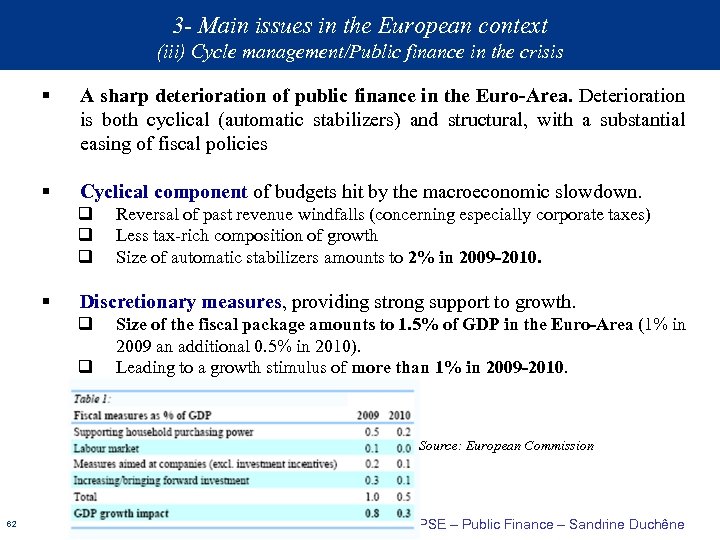
3 - Main issues in the European context (iii) Cycle management/Public finance in the crisis § § A sharp deterioration of public finance in the Euro-Area. Deterioration is both cyclical (automatic stabilizers) and structural, with a substantial easing of fiscal policies Cyclical component of budgets hit by the macroeconomic slowdown. q q q § Reversal of past revenue windfalls (concerning especially corporate taxes) Less tax-rich composition of growth Size of automatic stabilizers amounts to 2% in 2009 -2010. Discretionary measures, providing strong support to growth. q q Size of the fiscal package amounts to 1. 5% of GDP in the Euro-Area (1% in 2009 an additional 0. 5% in 2010). Leading to a growth stimulus of more than 1% in 2009 -2010. Source: European Commission 62 PSE – Public Finance – Sandrine Duchêne
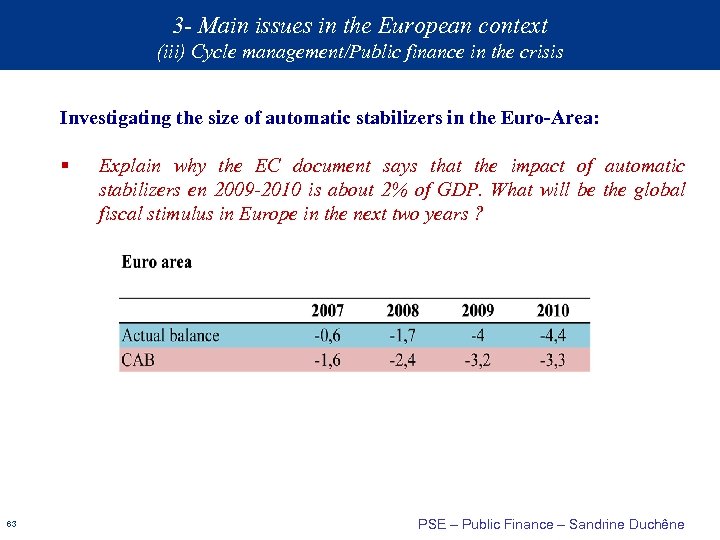
3 - Main issues in the European context (iii) Cycle management/Public finance in the crisis Investigating the size of automatic stabilizers in the Euro-Area: § Explain why the EC document says that the impact of automatic stabilizers en 2009 -2010 is about 2% of GDP. What will be the global fiscal stimulus in Europe in the next two years ? 63 PSE – Public Finance – Sandrine Duchêne
3 - Main issues in the European context (iii) Cycle management/Public finance in the crisis § § 64 Debate on the size/composition of fiscal packages Two papers are noteworthy: Communication of the European Commission in November 2008, Staff note by the IMF in December 2008. Common analysis: q Large fall in aggregate demand, risks that the perverse dynamics of deflation, rising debt and feedback loops to the financial sector materialize with a further demand contraction. q Two macroeconomic tools used traditionally used are less effective in the current situation: export-led recovery strategy (but not an option because crisis is worldwide); financial nature of the current crisis weakens the monetary transmission mechanism, monetary expansion already. q Room for fiscal stimulus=> both institutions call for a sizeable fiscal response at the global level. q But solution to the financial crisis is a precondition for achieving sustained growth (Japan). PSE – Public Finance – Sandrine Duchêne
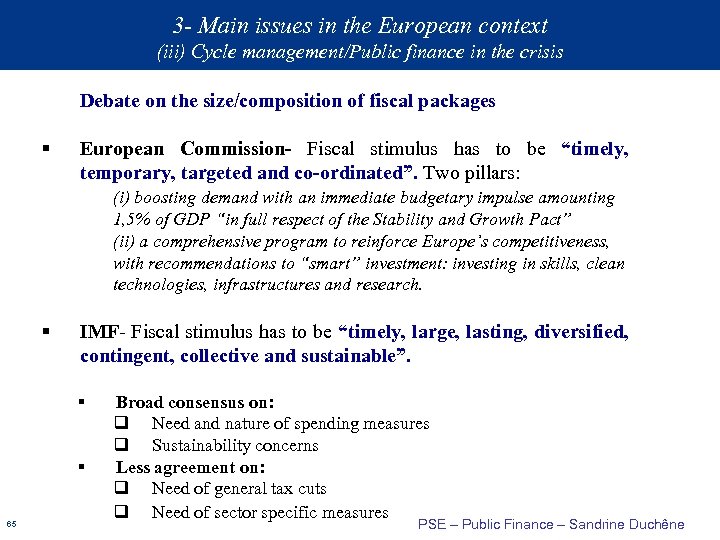
3 - Main issues in the European context (iii) Cycle management/Public finance in the crisis Debate on the size/composition of fiscal packages § European Commission- Fiscal stimulus has to be “timely, temporary, targeted and co-ordinated”. Two pillars: (i) boosting demand with an immediate budgetary impulse amounting 1, 5% of GDP “in full respect of the Stability and Growth Pact” (ii) a comprehensive program to reinforce Europe’s competitiveness, with recommendations to “smart” investment: investing in skills, clean technologies, infrastructures and research. § IMF- Fiscal stimulus has to be “timely, large, lasting, diversified, contingent, collective and sustainable”. § § 65 Broad consensus on: q Need and nature of spending measures q Sustainability concerns Less agreement on: q Need of general tax cuts q Need of sector specific measures PSE – Public Finance – Sandrine Duchêne
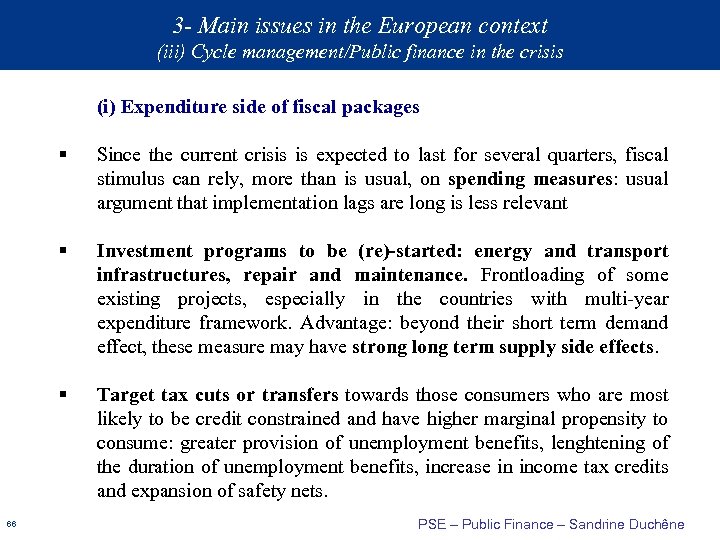
3 - Main issues in the European context (iii) Cycle management/Public finance in the crisis (i) Expenditure side of fiscal packages § Since the current crisis is expected to last for several quarters, fiscal stimulus can rely, more than is usual, on spending measures: usual argument that implementation lags are long is less relevant § § 66 Investment programs to be (re)-started: energy and transport infrastructures, repair and maintenance. Frontloading of some existing projects, especially in the countries with multi-year expenditure framework. Advantage: beyond their short term demand effect, these measure may have strong long term supply side effects. Target tax cuts or transfers towards those consumers who are most likely to be credit constrained and have higher marginal propensity to consume: greater provision of unemployment benefits, lenghtening of the duration of unemployment benefits, increase in income tax credits and expansion of safety nets. PSE – Public Finance – Sandrine Duchêne
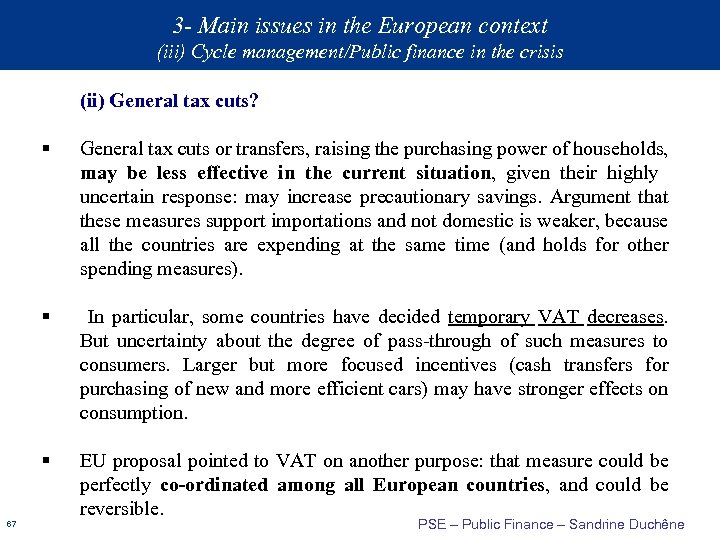
3 - Main issues in the European context (iii) Cycle management/Public finance in the crisis (ii) General tax cuts? § § In particular, some countries have decided temporary VAT decreases. But uncertainty about the degree of pass-through of such measures to consumers. Larger but more focused incentives (cash transfers for purchasing of new and more efficient cars) may have stronger effects on consumption. § 67 General tax cuts or transfers, raising the purchasing power of households, may be less effective in the current situation, given their highly uncertain response: may increase precautionary savings. Argument that these measures support importations and not domestic is weaker, because all the countries are expending at the same time (and holds for other spending measures). EU proposal pointed to VAT on another purpose: that measure could be perfectly co-ordinated among all European countries, and could be reversible. PSE – Public Finance – Sandrine Duchêne
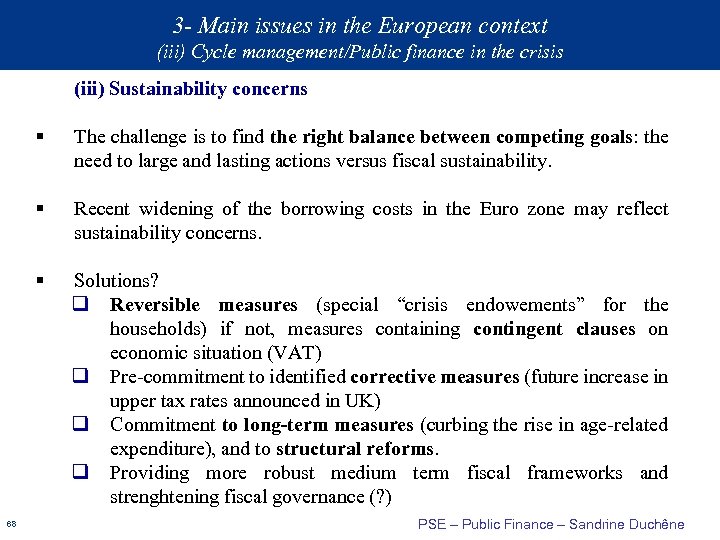
3 - Main issues in the European context (iii) Cycle management/Public finance in the crisis § (iii) Sustainability concerns The challenge is to find the right balance between competing goals: the need to large and lasting actions versus fiscal sustainability. § § 68 Recent widening of the borrowing costs in the Euro zone may reflect sustainability concerns. Solutions? q Reversible measures (special “crisis endowements” for the households) if not, measures containing contingent clauses on economic situation (VAT) q Pre-commitment to identified corrective measures (future increase in upper tax rates announced in UK) q Commitment to long-term measures (curbing the rise in age-related expenditure), and to structural reforms. q Providing more robust medium term fiscal frameworks and strenghtening fiscal governance (? ) PSE – Public Finance – Sandrine Duchêne
Скачать презентацию Public finance Chapter I-2 Public Finance and business
c3adf36750a64c946626befe474fff51.ppt