 Скачать презентацию Public Expenditure Tracking and Service Delivery Surveys Flagship
5efe8e12512f8e1ec29b73eecff5b59e.ppt
- Количество слайдов: 23



Public Expenditure Tracking and Service Delivery Surveys Flagship Course on Governance and Anti-corruption April 21, 2003 Magnus Lindelow Development Research Group The World Bank
The presentation 1. 2. 3. 4. 5. 6. Why new tools for public expenditure analysis? Characteristics of PETS and related approaches The Uganda experience Some conceptual and practical challenges in designing and implementing PETSs Examples of more recent surveys What have we learnt about designing and implementing a PETS?
Why new tools to analyze public spending and service delivery? n n Evidence shows limited impact of public spending on growth and human development indicators Demand for evidence on efficiency of spending and quality in service delivery Lack of reliable data in many developing countries New approaches to aid delivery Move towards budget support (e. g. , PRSC) ð Focus on poverty-focused strategic framework (PRSP) ð Related fiduciary and accountability concerns ð
New challenges… n n Are budget allocations pro-poor? Are budget outturns consistent with established allocations? n n Quantitative measurement of corruption Do expenditures result in intended outputs and outcomes?
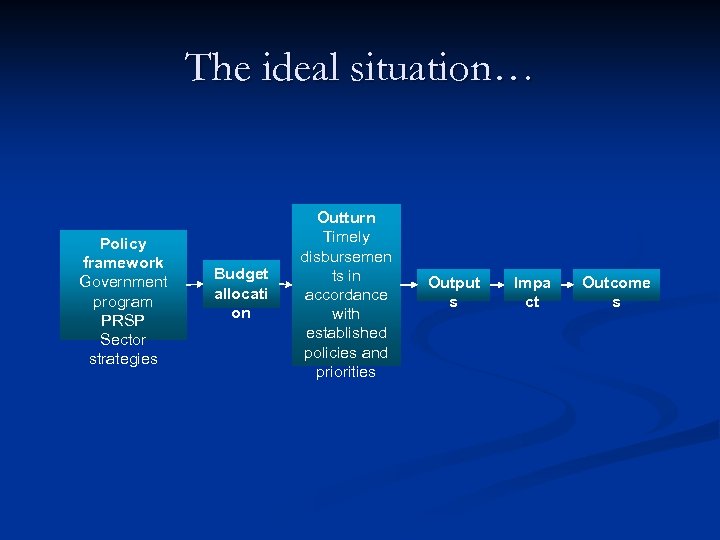
The ideal situation… Policy framework Government program PRSP Sector strategies Budget allocati on Outturn Timely disbursemen ts in accordance with established policies and priorities Output s Impa ct Outcome s
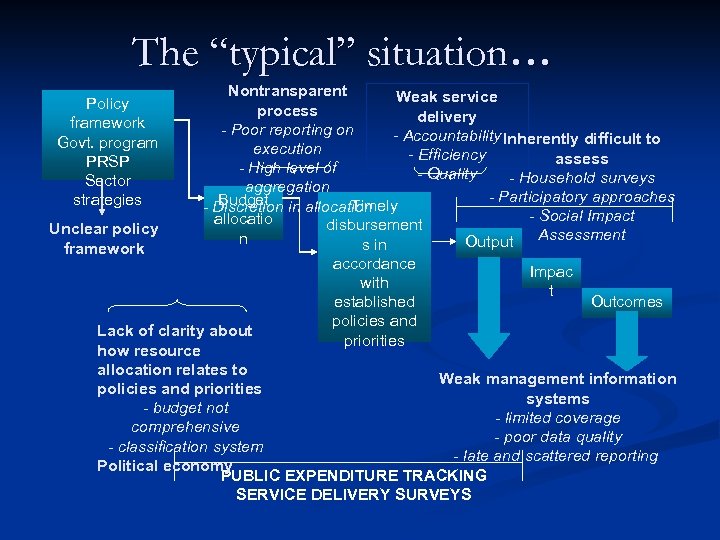
The “typical” situation… Nontransparent Weak service process delivery - Poor reporting on - Accountability Inherently difficult to execution - Efficiency assess - High level of - Quality - Household surveys aggregation - Participatory approaches Budget Timely - Discretion in allocation - Social Impact allocatio disbursement Unclear policy Assessment n Output s in framework s accordance Impac with t Outcomes established policies and Lack of clarity about priorities how resource allocation relates to Weak management information policies and priorities systems - budget not - limited coverage comprehensive - poor data quality - classification system - late and scattered reporting Political economy PUBLIC EXPENDITURE TRACKING SERVICE DELIVERY SURVEYS Policy framework Govt. program PRSP Sector strategies
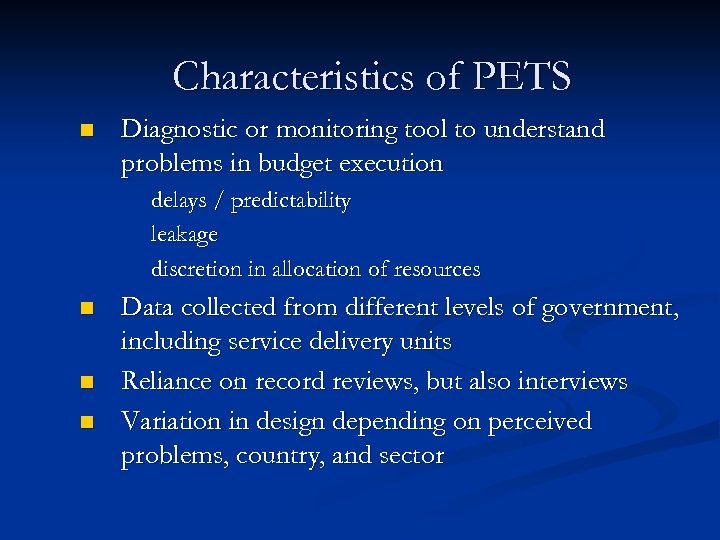
Characteristics of PETS n Diagnostic or monitoring tool to understand problems in budget execution delays / predictability leakage discretion in allocation of resources n n n Data collected from different levels of government, including service delivery units Reliance on record reviews, but also interviews Variation in design depending on perceived problems, country, and sector
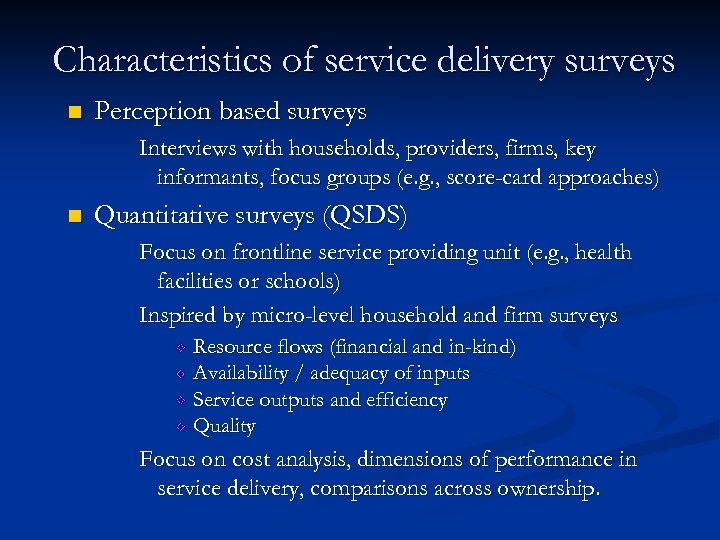
Characteristics of service delivery surveys n Perception based surveys Interviews with households, providers, firms, key informants, focus groups (e. g. , score-card approaches) n Quantitative surveys (QSDS) Focus on frontline service providing unit (e. g. , health facilities or schools) Inspired by micro-level household and firm surveys Resource flows (financial and in-kind) Availability / adequacy of inputs Service outputs and efficiency Quality Focus on cost analysis, dimensions of performance in service delivery, comparisons across ownership.
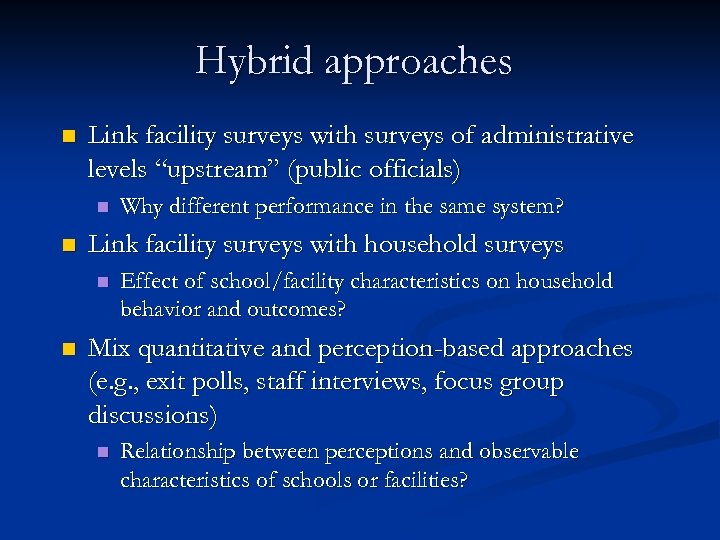
Hybrid approaches n Link facility surveys with surveys of administrative levels “upstream” (public officials) n n Link facility surveys with household surveys n n Why different performance in the same system? Effect of school/facility characteristics on household behavior and outcomes? Mix quantitative and perception-based approaches (e. g. , exit polls, staff interviews, focus group discussions) n Relationship between perceptions and observable characteristics of schools or facilities?
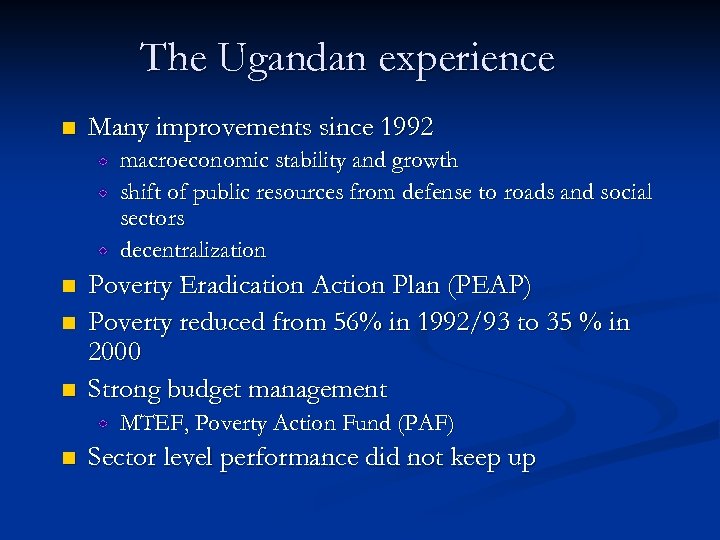
The Ugandan experience n Many improvements since 1992 macroeconomic stability and growth shift of public resources from defense to roads and social sectors decentralization n Poverty Eradication Action Plan (PEAP) Poverty reduced from 56% in 1992/93 to 35 % in 2000 Strong budget management MTEF, Poverty Action Fund (PAF) n Sector level performance did not keep up
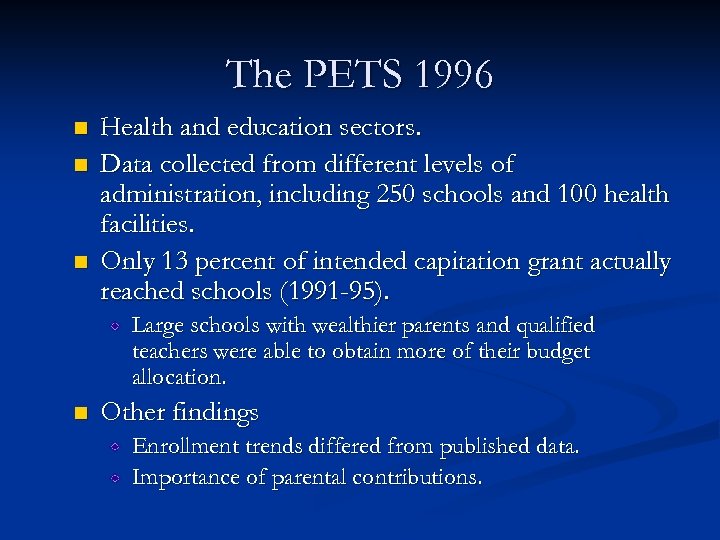
The PETS 1996 n n n Health and education sectors. Data collected from different levels of administration, including 250 schools and 100 health facilities. Only 13 percent of intended capitation grant actually reached schools (1991 -95). Large schools with wealthier parents and qualified teachers were able to obtain more of their budget allocation. n Other findings Enrollment trends differed from published data. Importance of parental contributions.
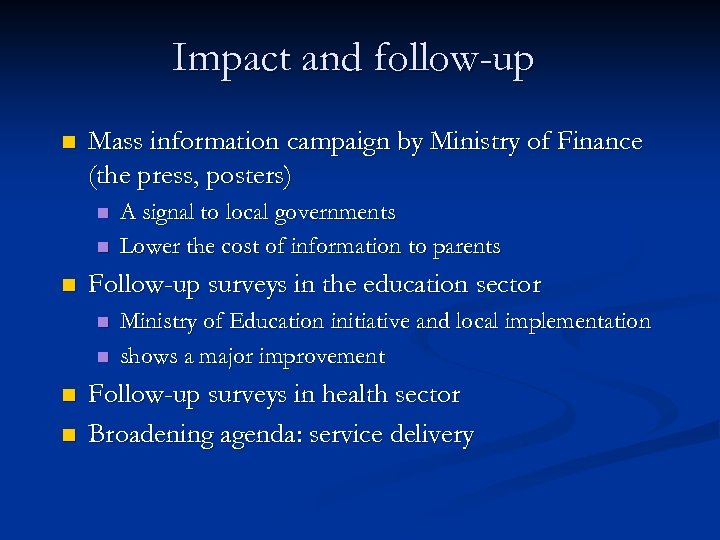
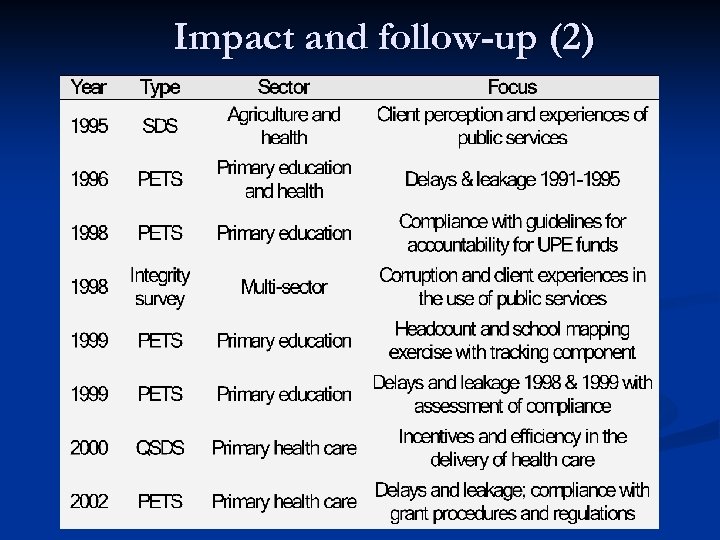
Impact and follow-up n Mass information campaign by Ministry of Finance (the press, posters) n n n Follow-up surveys in the education sector n n A signal to local governments Lower the cost of information to parents Ministry of Education initiative and local implementation shows a major improvement Follow-up surveys in health sector Broadening agenda: service delivery
Impact and follow-up (2)
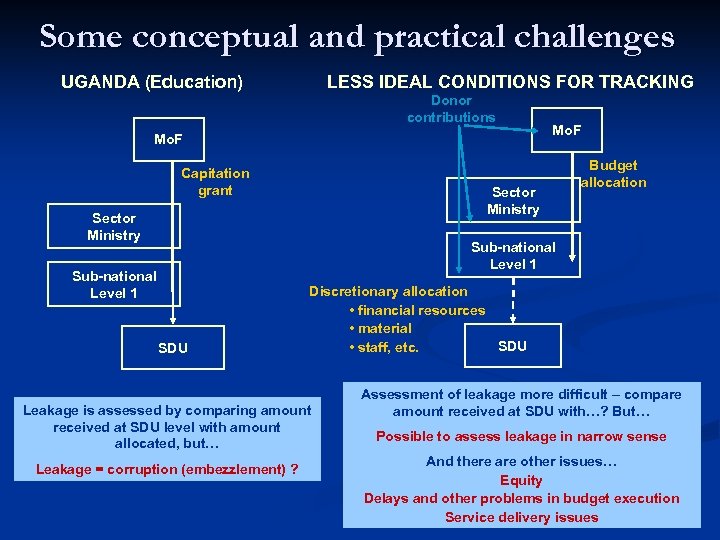
Some conceptual and practical challenges UGANDA (Education) LESS IDEAL CONDITIONS FOR TRACKING Donor contributions Mo. F Capitation grant Mo. F Sector Ministry Budget allocation Sub-national Level 1 SDU Discretionary allocation • financial resources • material SDU • staff, etc. Leakage is assessed by comparing amount received at SDU level with amount allocated, but… Leakage = corruption (embezzlement) ? Assessment of leakage more difficult – compare amount received at SDU with…? But… Possible to assess leakage in narrow sense And there are other issues… Equity Delays and other problems in budget execution Service delivery issues
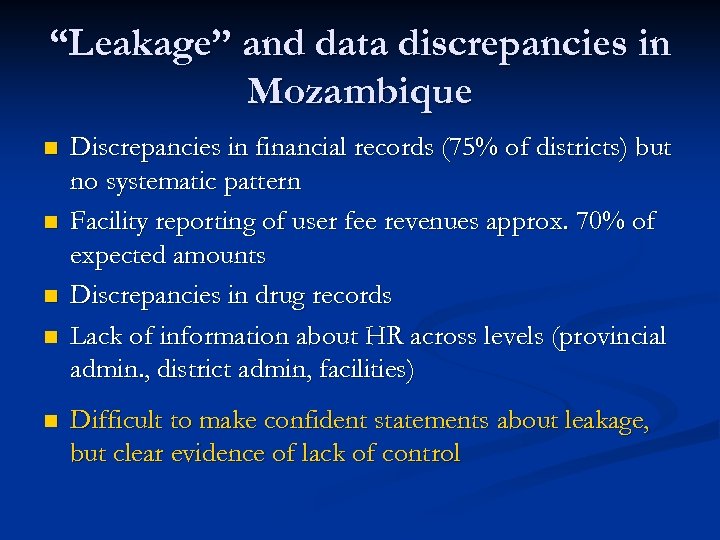
“Leakage” and data discrepancies in Mozambique n n n Discrepancies in financial records (75% of districts) but no systematic pattern Facility reporting of user fee revenues approx. 70% of expected amounts Discrepancies in drug records Lack of information about HR across levels (provincial admin. , district admin, facilities) Difficult to make confident statements about leakage, but clear evidence of lack of control
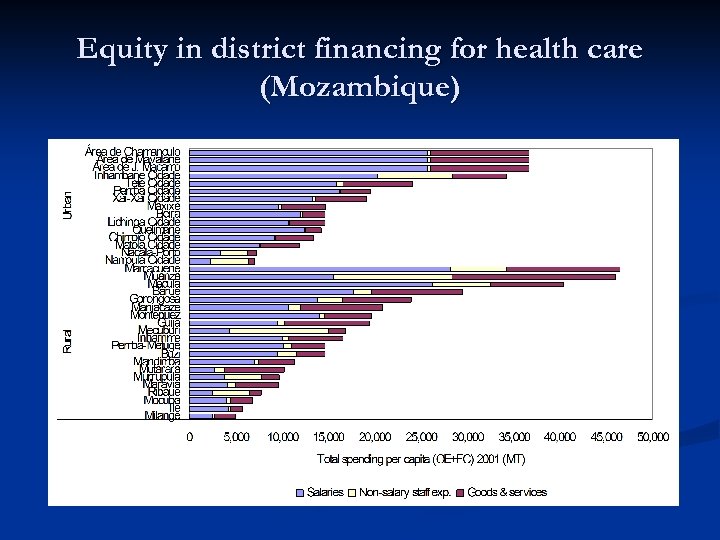
Equity in district financing for health care (Mozambique)
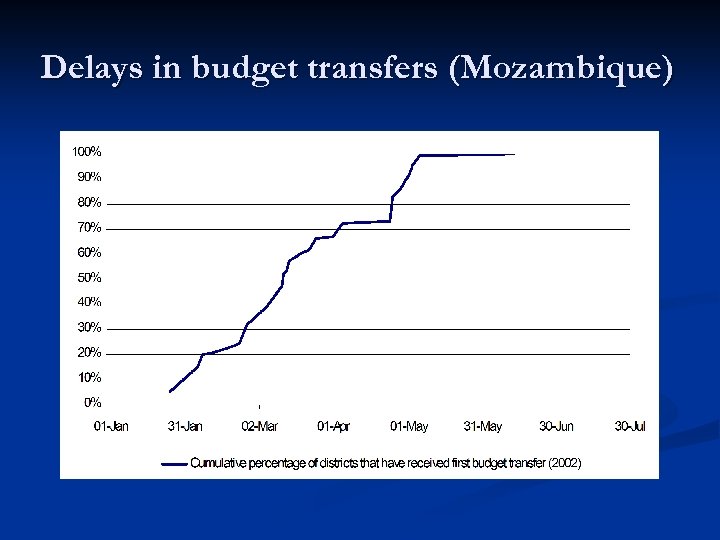
Delays in budget transfers (Mozambique)
PETS in other countries n Tanzania (1999 and 2001) Tracking of pro-poor expenditures in priority sectors at all levels n Ghana (2000) Expenditure tracking based on data collected at facility, district, and central level n Honduras (2000) Survey looking at ghost workers, absenteeism, and “jobmigration” n Other past, ongoing, or future surveys Bolivia, Chad, Georgia, Laos, Madagascar, Mozambique, Nigeria, PNG, Peru, Rwanda, Zambia.
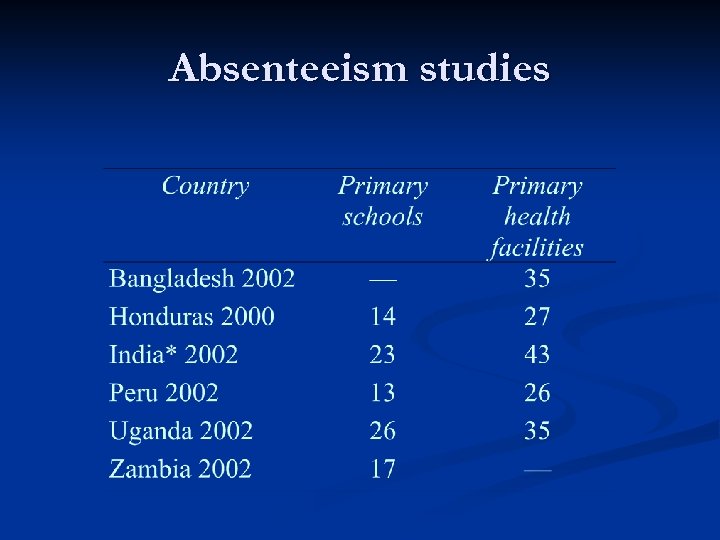
Absenteeism studies
Emerging issues n Many good reasons for doing surveys Diagnosis of problems, such as corruption – shaping the agenda Analysis: guiding reform Monitoring over time / benchmarking Tool for understanding and creating dialogue about PEM and service delivery systems – useful for donors and governments Research n But questions remain Surveys only give part of the answer (what about allocations? Link with outcomes? ) Surveys provide information but is it used?
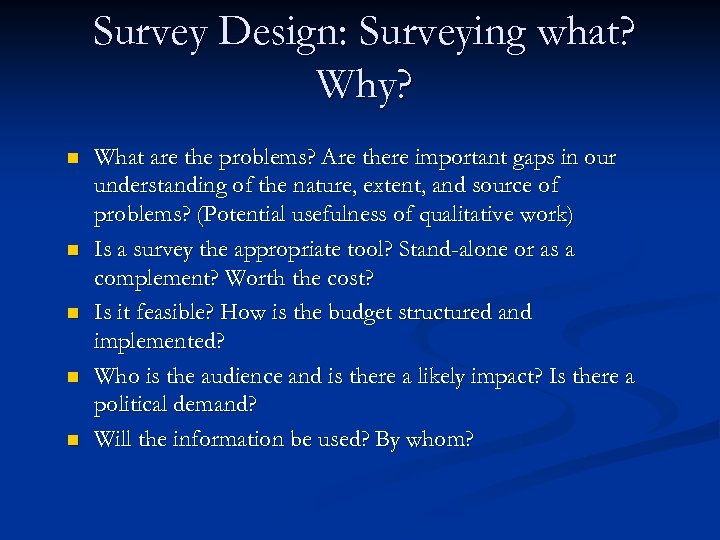
Survey Design: Surveying what? Why? n n n What are the problems? Are there important gaps in our understanding of the nature, extent, and source of problems? (Potential usefulness of qualitative work) Is a survey the appropriate tool? Stand-alone or as a complement? Worth the cost? Is it feasible? How is the budget structured and implemented? Who is the audience and is there a likely impact? Is there a political demand? Will the information be used? By whom?
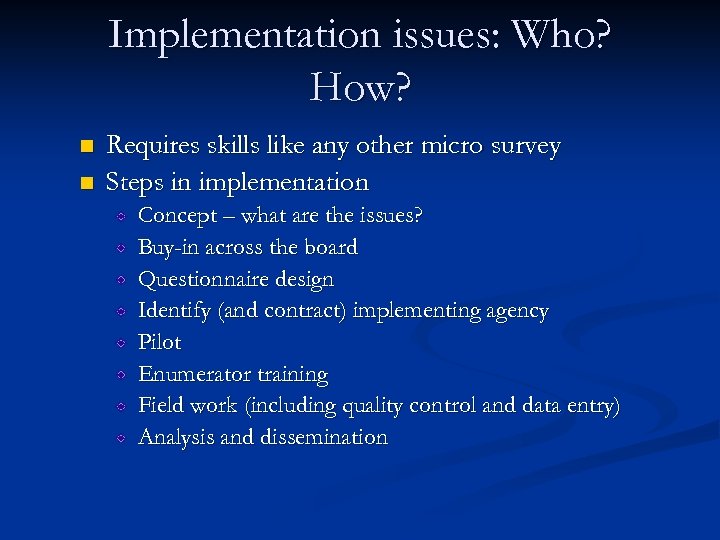
Implementation issues: Who? How? n n Requires skills like any other micro survey Steps in implementation Concept – what are the issues? Buy-in across the board Questionnaire design Identify (and contract) implementing agency Pilot Enumerator training Field work (including quality control and data entry) Analysis and dissemination
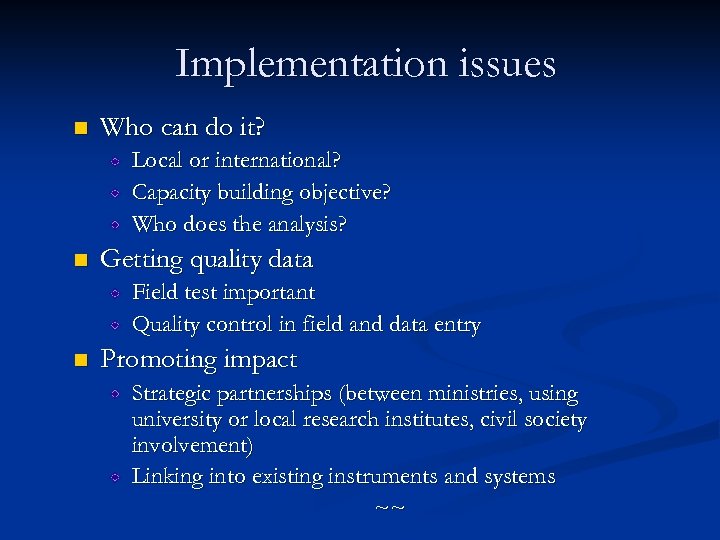
Implementation issues n Who can do it? Local or international? Capacity building objective? Who does the analysis? n Getting quality data Field test important Quality control in field and data entry n Promoting impact Strategic partnerships (between ministries, using university or local research institutes, civil society involvement) Linking into existing instruments and systems ~~
Скачать презентацию Public Expenditure Tracking and Service Delivery Surveys Flagship
5efe8e12512f8e1ec29b73eecff5b59e.ppt