 Скачать презентацию Public e-Procurement in Italy Consip s role and e-Proc
0d091c6fbd2fa106c1b25fb552579ec3.ppt
- Количество слайдов: 36



Public e-Procurement in Italy: Consip’s role and e-Proc System Luca Mastrogregori Head of e-Procurement Strategies Consip Spa Luca. mastrogregori@tesoro. it Amman, July 7, 2010
• Public Procurement and e-Procurement in the EU • General Overview on Consip in the Italian Public Procurement System • E-procurement platform, e-marketplace and new e-proc tools 1
EU Legislation Framework • The legislative package of public procurement Directives, approved in 2004 by the European Parliament and the EU's Council of Ministers and entered into force on 20 April 2004, aims to simplify, harmonies and modernise procurement procedures applied by the EU Member States. • This revision merges the four existing European directives into two legal instruments: – The so-called "traditional" Directive 2004/18/EC for public works contracts, public supply contracts and public service contracts; – Directive 2004/17/EC on the "special sectors" of water, energy, transport and postal services. 2 • Among several innovative provisions the new Directives strongly promote the development of electronic procedures while enforcing general fundamental Principles: – Non-discrimination – Transparency – Fair competition
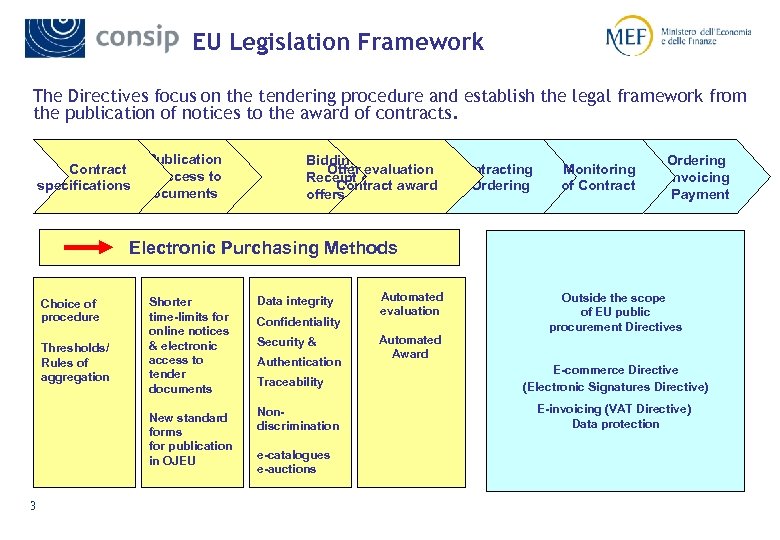
EU Legislation Framework The Directives focus on the tendering procedure and establish the legal framework from the publication of notices to the award of contracts. Contract specifications Publication Access to documents Bidding Offer evaluation Receipt of Contract award offers Contracting Ordering Monitoring of Contract Ordering Invoicing Payment Electronic Purchasing Methods Thresholds/ Rules of aggregation 3 Shorter time-limits for online notices & electronic access to tender documents Data integrity New standard forms for publication in OJEU Choice of procedure Nondiscrimination Confidentiality Security & Authentication Traceability e-catalogues e-auctions Automated evaluation Automated Award Outside the scope of EU public procurement Directives E-commerce Directive (Electronic Signatures Directive) E-invoicing (VAT Directive) Data protection
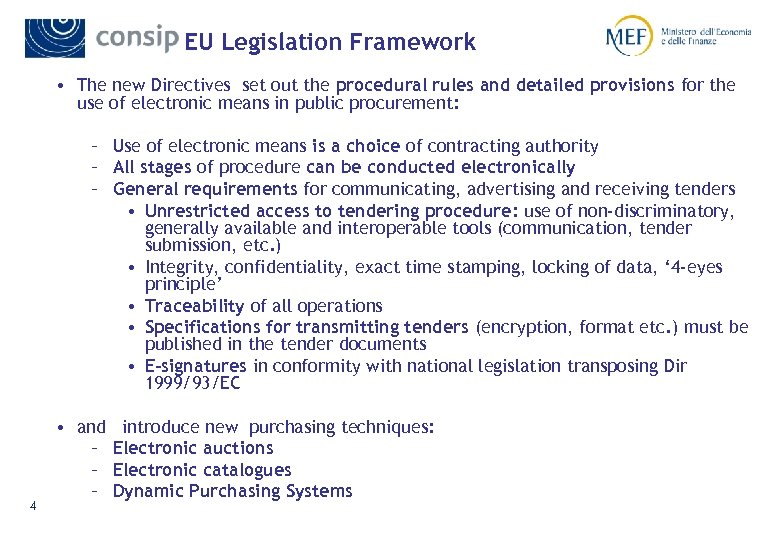
EU Legislation Framework • The new Directives set out the procedural rules and detailed provisions for the use of electronic means in public procurement: – Use of electronic means is a choice of contracting authority – All stages of procedure can be conducted electronically – General requirements for communicating, advertising and receiving tenders • Unrestricted access to tendering procedure: use of non-discriminatory, generally available and interoperable tools (communication, tender submission, etc. ) • Integrity, confidentiality, exact time stamping, locking of data, ‘ 4 -eyes principle’ • Traceability of all operations • Specifications for transmitting tenders (encryption, format etc. ) must be published in the tender documents • E-signatures in conformity with national legislation transposing Dir 1999/93/EC 4 • and – – – introduce new purchasing techniques: Electronic auctions Electronic catalogues Dynamic Purchasing Systems
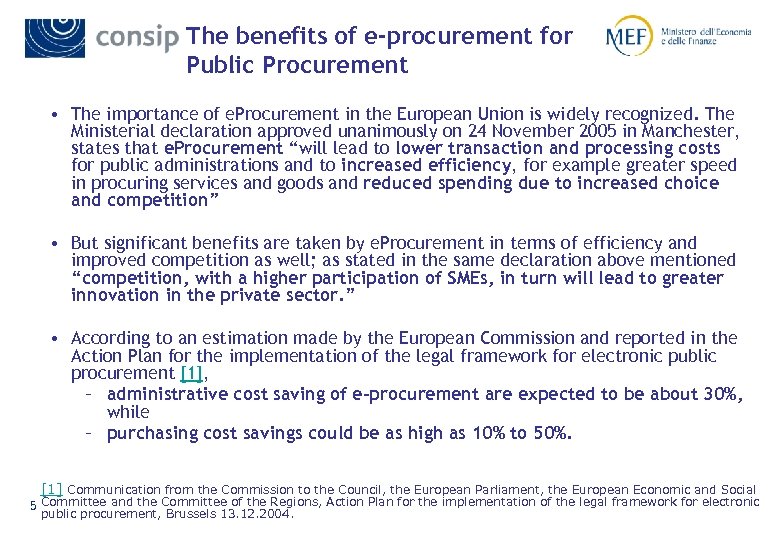
The benefits of e-procurement for Public Procurement • The importance of e. Procurement in the European Union is widely recognized. The Ministerial declaration approved unanimously on 24 November 2005 in Manchester, states that e. Procurement “will lead to lower transaction and processing costs for public administrations and to increased efficiency, for example greater speed in procuring services and goods and reduced spending due to increased choice and competition” • But significant benefits are taken by e. Procurement in terms of efficiency and improved competition as well; as stated in the same declaration above mentioned “competition, with a higher participation of SMEs, in turn will lead to greater innovation in the private sector. ” • According to an estimation made by the European Commission and reported in the Action Plan for the implementation of the legal framework for electronic public procurement [1], – administrative cost saving of e-procurement are expected to be about 30%, while – purchasing cost savings could be as high as 10% to 50%. [1] Communication from the Commission to the Council, the European Parliament, the European Economic and Social 5 Committee and the Committee of the Regions, Action Plan for the implementation of the legal framework for electronic public procurement, Brussels 13. 12. 2004.
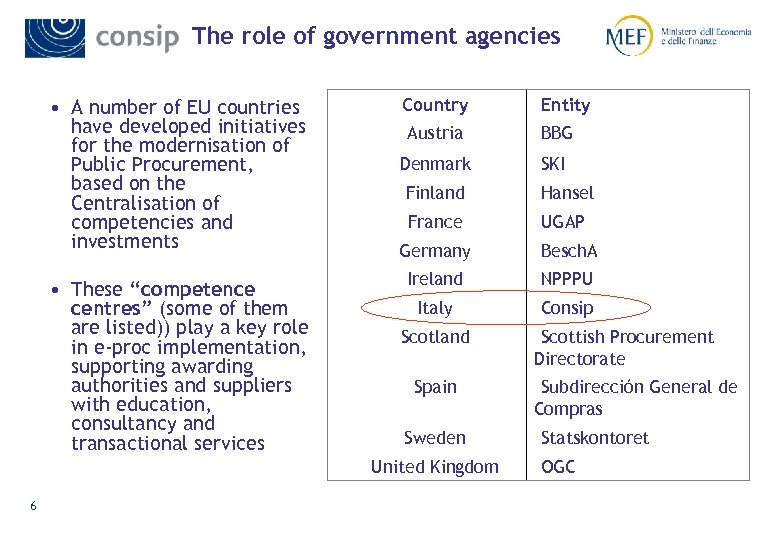
The role of government agencies • A number of EU countries have developed initiatives for the modernisation of Public Procurement, based on the Centralisation of competencies and investments • These “competence centres” (some of them are listed)) play a key role in e-proc implementation, supporting awarding authorities and suppliers with education, consultancy and transactional services Country Entity Austria BBG Denmark SKI Finland Hansel France UGAP Germany Besch. A Ireland NPPPU Italy Consip Scotland Spain Sweden United Kingdom 6 Scottish Procurement Directorate Subdirección General de Compras Statskontoret OGC
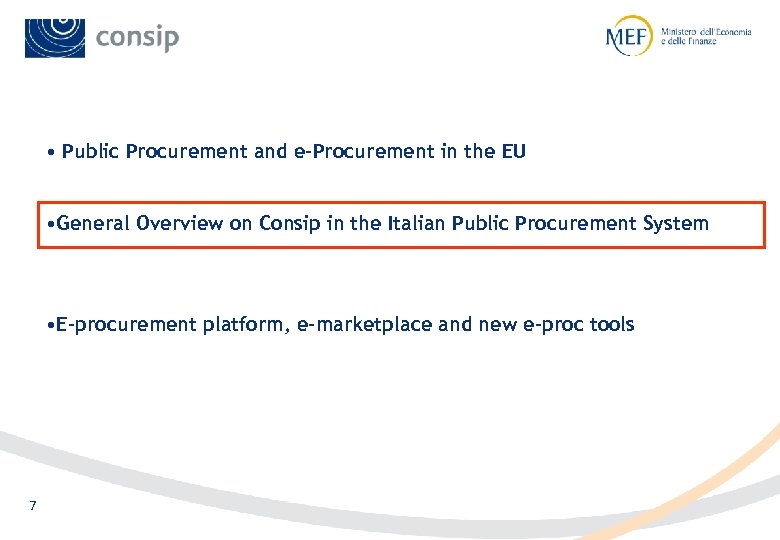
• Public Procurement and e-Procurement in the EU • General Overview on Consip in the Italian Public Procurement System • E-procurement platform, e-marketplace and new e-proc tools 7
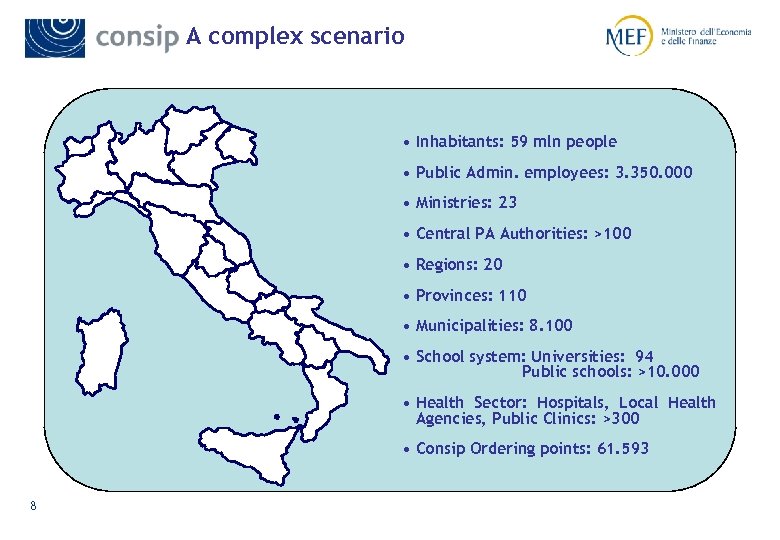
A complex scenario • Inhabitants: 59 mln people • Public Admin. employees: 3. 350. 000 • Ministries: 23 • Central PA Authorities: >100 • Regions: 20 • Provinces: 110 • Municipalities: 8. 100 • School system: Universities: 94 Public schools: >10. 000 • Health Sector: Hospitals, Local Health Agencies, Public Clinics: >300 • Consip Ordering points: 61. 593 8
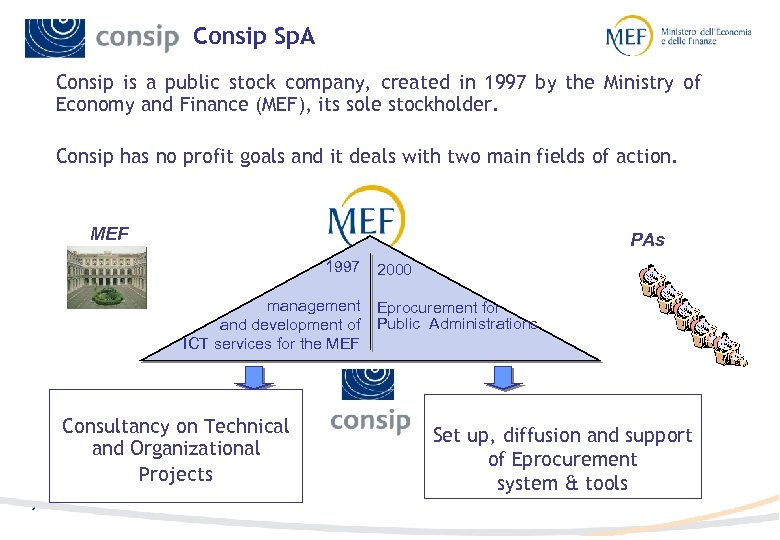
Consip Sp. A Consip is a public stock company, created in 1997 by the Ministry of Economy and Finance (MEF), its sole stockholder. Consip has no profit goals and it deals with two main fields of action. MEF PAs 1997 management and development of ICT services for the MEF Consultancy on Technical and Organizational Projects 9 2000 Eprocurement for Public Administrations Set up, diffusion and support of Eprocurement system & tools
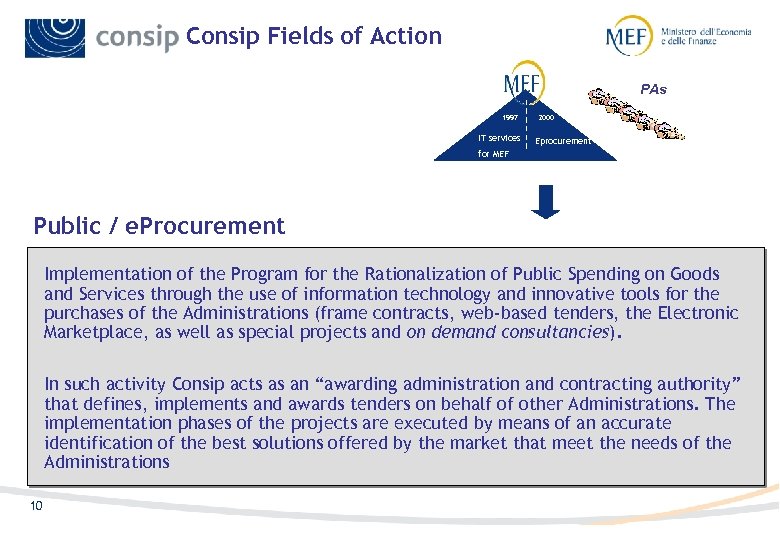
Consip Fields of Action PAs 1997 IT services 2000 Eprocurement for MEF Public / e. Procurement Implementation of the Program for the Rationalization of Public Spending on Goods and Services through the use of information technology and innovative tools for the purchases of the Administrations (frame contracts, web-based tenders, the Electronic Marketplace, as well as special projects and on demand consultancies). In such activity Consip acts as an “awarding administration and contracting authority” that defines, implements and awards tenders on behalf of other Administrations. The implementation phases of the projects are executed by means of an accurate identification of the best solutions offered by the market that meet the needs of the Administrations 10
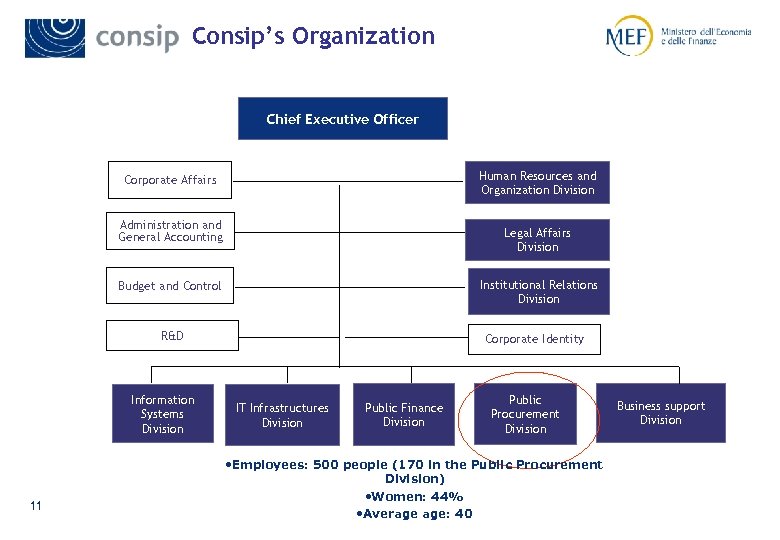
Consip’s Organization Chief Executive Officer Human Resources and Organization Division Corporate Affairs Administration and General Accounting Legal Affairs Division Institutional Relations Division Budget and Control R&D Information Systems Division 11 Corporate Identity IT Infrastructures Division Public Finance Division Public Procurement Division • Employees: 500 people (170 in the Public Procurement Division) • Women: 44% • Average age: 40 Business support Division
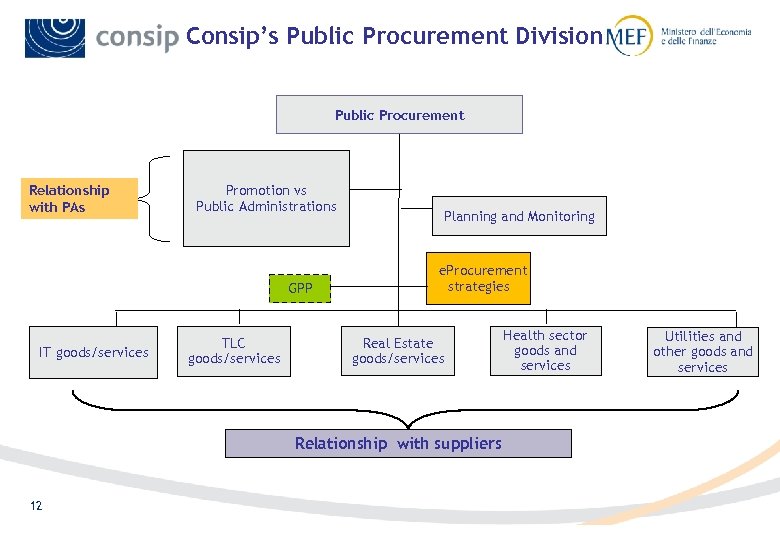
Consip’s Public Procurement Division Public Procurement Relationship with PAs Promotion vs Public Administrations GPP IT goods/services TLC goods/services Planning and Monitoring e. Procurement strategies Real Estate goods/services Relationship with suppliers 12 Health sector goods and services Utilities and other goods and services
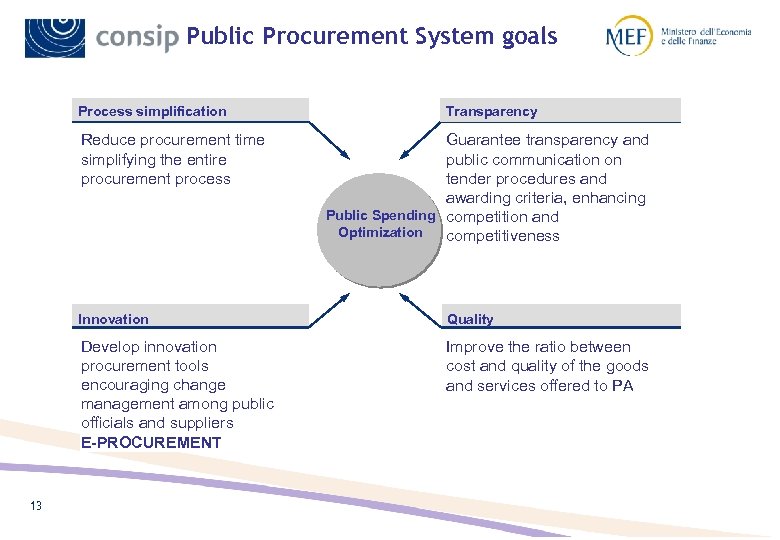
Public Procurement System goals Process simplification Reduce procurement time simplifying the entire procurement process Transparency Guarantee transparency and public communication on tender procedures and awarding criteria, enhancing Public Spending competition and Optimization competitiveness Innovation Develop innovation procurement tools encouraging change management among public officials and suppliers E-PROCUREMENT 13 Quality Improve the ratio between cost and quality of the goods and services offered to PA
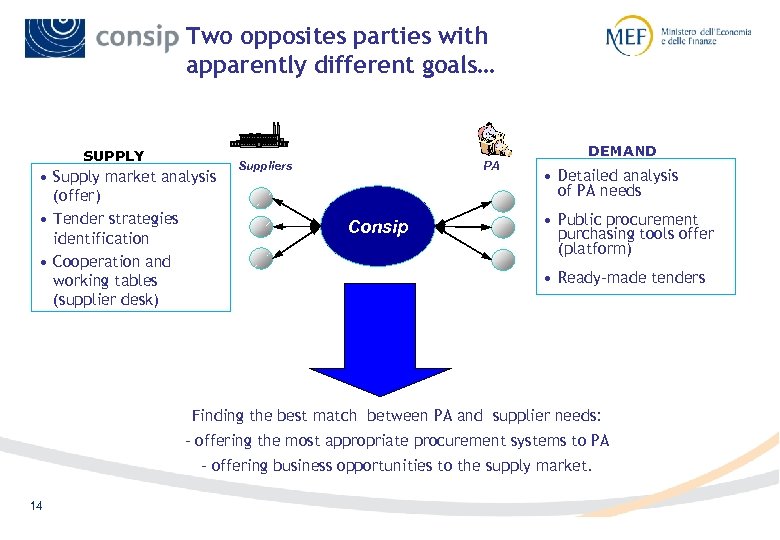
Two opposites parties with apparently different goals… DEMAND SUPPLY • Supply market analysis (offer) • Tender strategies identification • Cooperation and working tables (supplier desk) Suppliers PA Consip • Detailed analysis of PA needs • Public procurement purchasing tools offer (platform) • Ready-made tenders Finding the best match between PA and supplier needs: - offering the most appropriate procurement systems to PA - offering business opportunities to the supply market. 14
• Public Procurement and e-Procurement in the EU • General Overview on Consip in the Italian Public Procurement System • E-procurement platform, e-marketplace and new e-proc tools 15
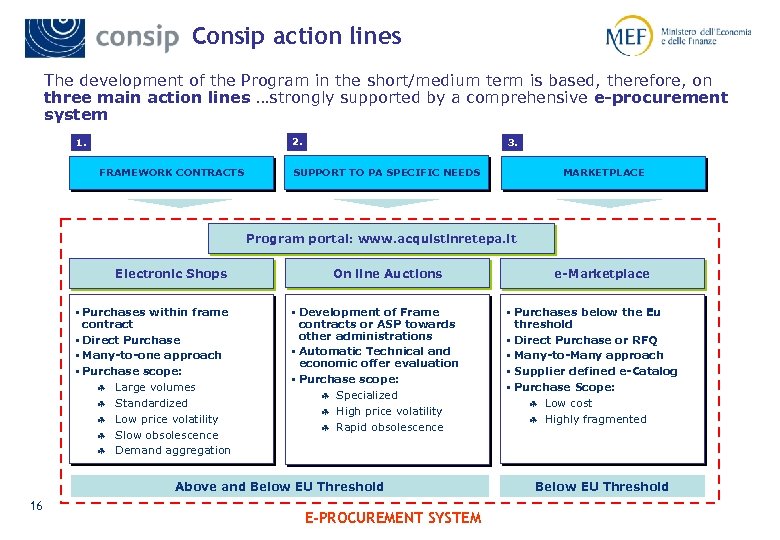
Consip action lines The development of the Program in the short/medium term is based, therefore, on three main action lines …strongly supported by a comprehensive e-procurement system 2. 1. FRAMEWORK CONTRACTS 3. SUPPORT TO PA SPECIFIC NEEDS MARKETPLACE Program portal: www. acquistinretepa. it Electronic Shops § Purchases within frame contract § Direct Purchase § Many-to-one approach § Purchase scope: § Large volumes § Standardized § Low price volatility § Slow obsolescence § Demand aggregation On line Auctions § Development of Frame contracts or ASP towards other administrations § Automatic Technical and economic offer evaluation § Purchase scope: § Specialized § High price volatility § Rapid obsolescence Above and Below EU Threshold 16 E-PROCUREMENT SYSTEM e-Marketplace § Purchases below the Eu threshold § Direct Purchase or RFQ § Many-to-Many approach § Supplier defined e-Catalog § Purchase Scope: § Low cost § Highly fragmented Below EU Threshold
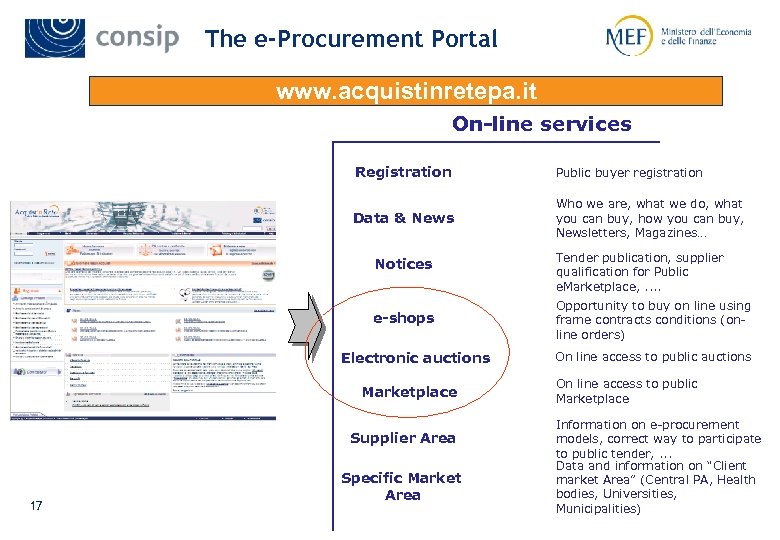
The e-Procurement Portal www. acquistinretepa. it On-line services Registration Public buyer registration Data & News Who we are, what we do, what you can buy, how you can buy, Newsletters, Magazines… Notices e-shops Electronic auctions Marketplace Supplier Area 17 Specific Market Area Tender publication, supplier qualification for Public e. Marketplace, . . Opportunity to buy on line using frame contracts conditions (online orders) On line access to public auctions On line access to public Marketplace Information on e-procurement models, correct way to participate to public tender, . . . Data and information on “Client market Area” (Central PA, Health bodies, Universities, Municipalities)
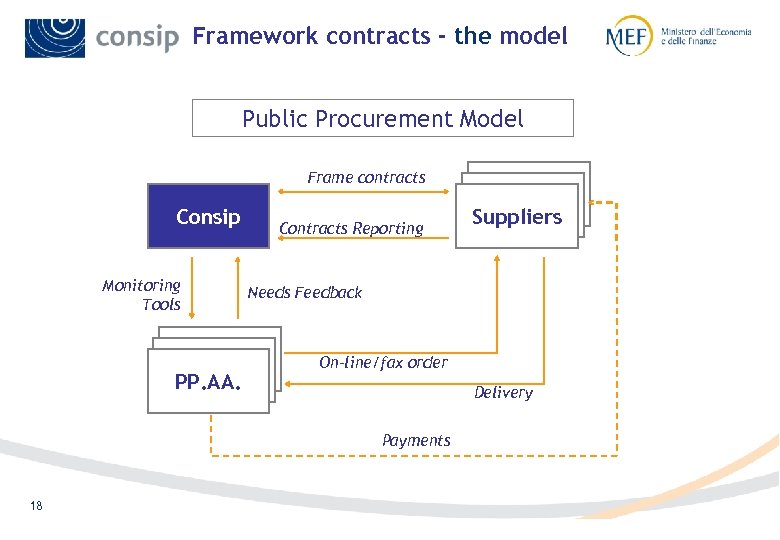
Framework contracts - the model Public Procurement Model Frame contracts Consip Monitoring Tools Contracts Reporting Needs Feedback Fornitori PP. AA. On-line/fax order Delivery Payments 18 Fornitori Suppliers
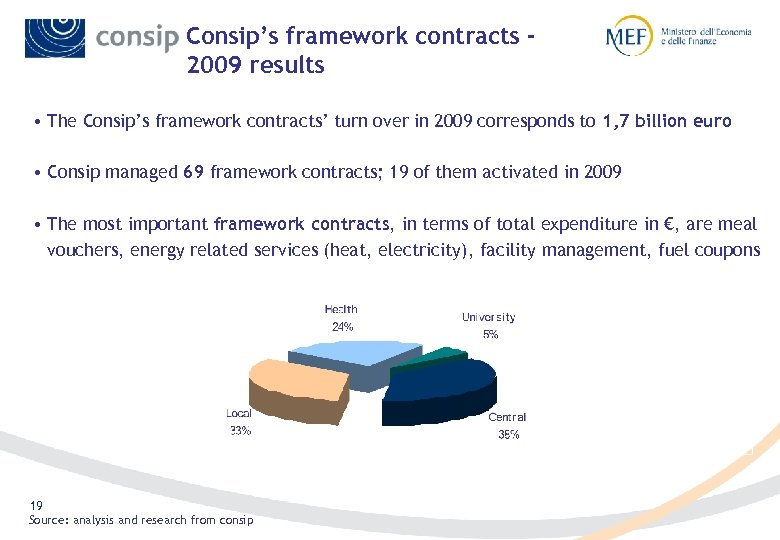
Consip’s framework contracts 2009 results • The Consip’s framework contracts’ turn over in 2009 corresponds to 1, 7 billion euro • Consip managed 69 framework contracts; 19 of them activated in 2009 • The most important framework contracts, in terms of total expenditure in €, are meal vouchers, energy related services (heat, electricity), facility management, fuel coupons 19 Source: analysis and research from consip
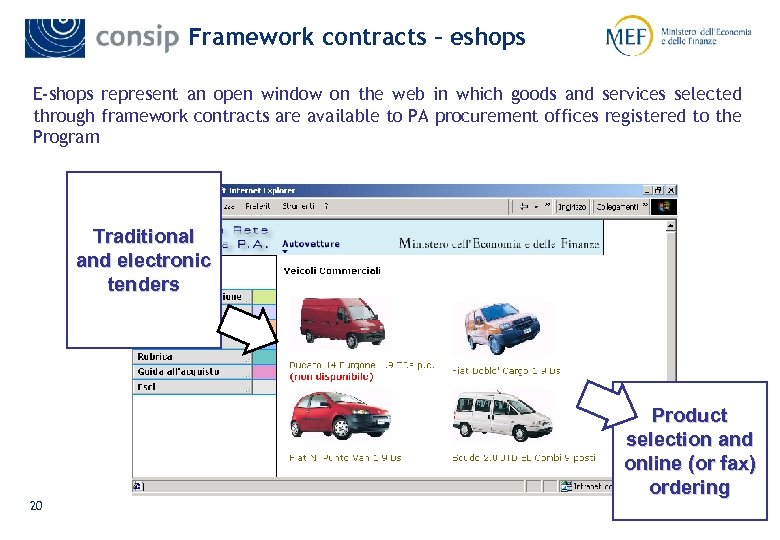
Framework contracts – eshops E-shops represent an open window on the web in which goods and services selected through framework contracts are available to PA procurement offices registered to the Program Traditional and electronic tenders 20 Product selection and online (or fax) ordering
Electronic tenders and marketplace - Decree 101/2002 • In particular, by the adoption of this Decree, new electronic awarding procedures are introduced for the first time in the italian legislative framework. These new methods do not replace the traditional awarding procedures, but they represent an alternative measure for the awarding authorities in the public procurement processes. • In particular the Decree provides for the Public Administration two different electronic goods and services purchasing techniques, to be performed in compliance with the transparency and non discrimination principles: • the electronic tender • the marketplace 21
Decree 101/2002 – The electronic tender 1. The Electronic tender, according to the provision set by the article 1. a) and b) of the Decree 101/2002 • is a procurement procedure with whom contracting authorities purchase goods and services both above and below the European threshold limit • and exactly a public contract awarding procedure exclusively performed through electronic devices in compliance with the provisions set out in the Decree itself. 2. Auction format is defined by the following elements: • Style of negotiation: Open - Blind (sealed bid) • Award criteria: Lowest price - More economically advantageous tender • Ranking algorithm: SUM Score = “Technical Score” + “Economical Score” RATIO Score = Economical bid/Technical Score • Type of negotiation: Continuous - Single round – Multiple round 22
The electronic auction – advantages and disadvantages Advantages (vs traditional auctions) 4 Transparency : 4 Each step is recorded; 4 Clearness and standardisation of procedures; 4 It is not possible to modify data recorded; 4 The procedure can be seen by hundreds of persons 4 Time reduction 4 Automation of awarding criteria evaluation, that can lead to choose to have no Awarding Commission 4 Closing steps (e. g. : notification to participants; signing of contract) can be performed on-line 4 Cost reduction 4 Facilitate participation 4 travel costs Disadvantages (vs traditional auctions) 4 Tenders can be contended on a minor number of parameters 23 4 IT equipment required
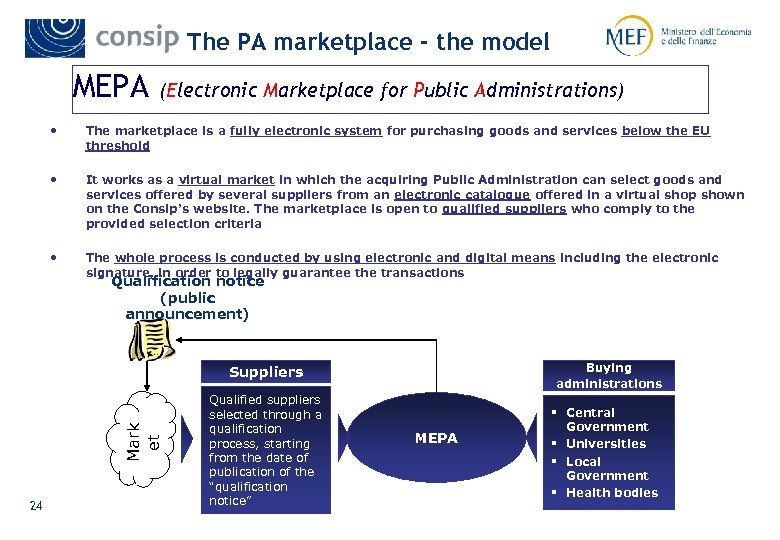
The PA marketplace - the model MEPA (Electronic Marketplace for Public Administrations) • The marketplace is a fully electronic system for purchasing goods and services below the EU threshold • It works as a virtual market in which the acquiring Public Administration can select goods and services offered by several suppliers from an electronic catalogue offered in a virtual shop shown on the Consip’s website. The marketplace is open to qualified suppliers who comply to the provided selection criteria • The whole process is conducted by using electronic and digital means including the electronic signature, in order to legally guarantee the transactions Qualification notice (public announcement) Buying administrations Mark et Suppliers 24 Qualified suppliers selected through a qualification process, starting from the date of publication of the “qualification notice” MEPA § Central Government § Universities § Local Government § Health bodies
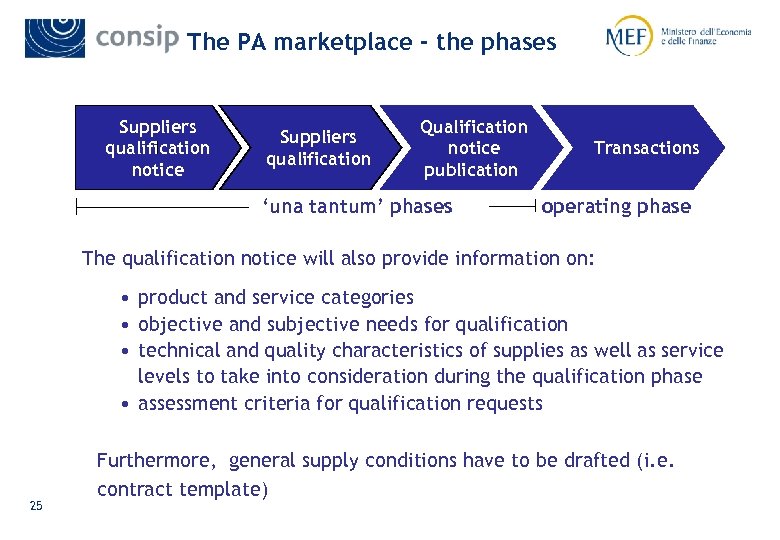
The PA marketplace - the phases Suppliers qualification notice Suppliers qualification Qualification notice publication ‘una tantum’ phases Transactions operating phase The qualification notice will also provide information on: • product and service categories • objective and subjective needs for qualification • technical and quality characteristics of supplies as well as service levels to take into consideration during the qualification phase • assessment criteria for qualification requests 25 Furthermore, general supply conditions have to be drafted (i. e. contract template)
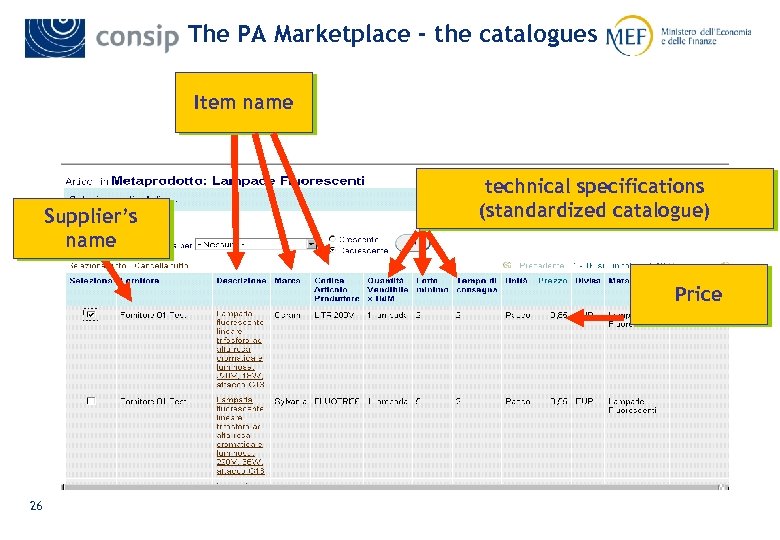
The PA Marketplace - the catalogues Item name Supplier’s name technical specifications (standardized catalogue) Price 26
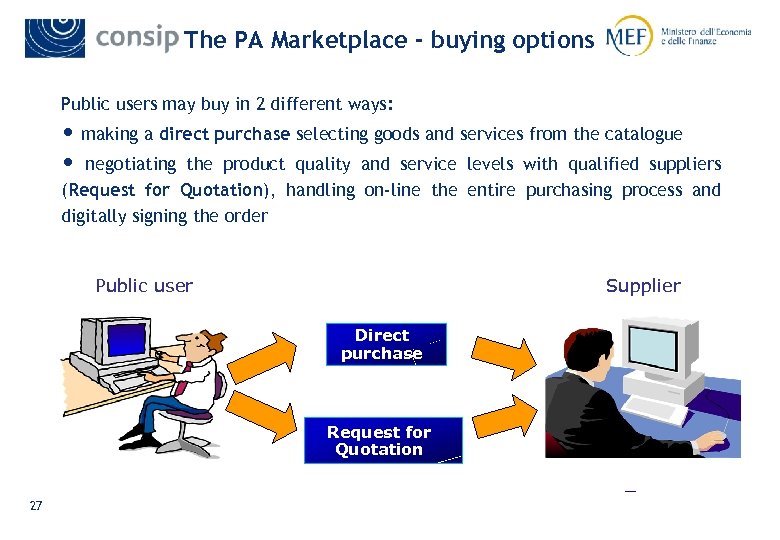
The PA Marketplace - buying options Public users may buy in 2 different ways: • making a direct purchase selecting goods and services from the catalogue • negotiating the product quality and service levels with qualified suppliers (Request for Quotation), handling on-line the entire purchasing process and digitally signing the order Public user Supplier Direct purchase Request for Quotation 27
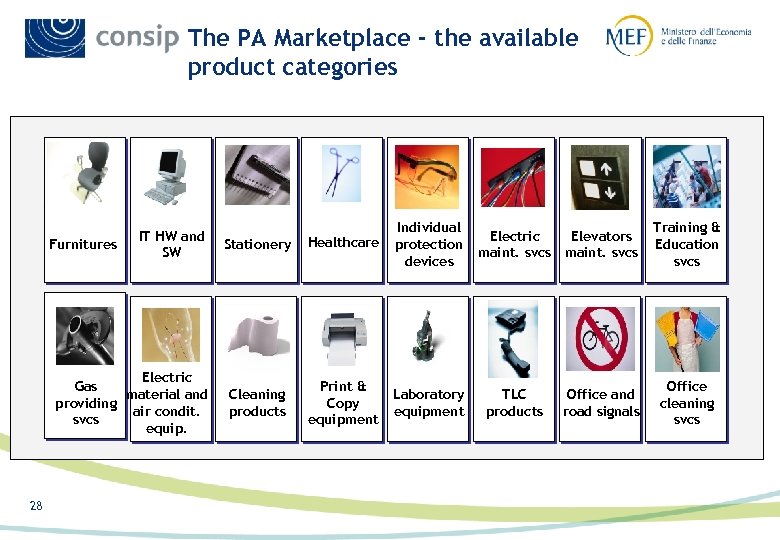
The PA Marketplace - the available product categories Furnitures IT HW and SW Electric Gas material and providing air condit. svcs equip. 28 Stationery Healthcare Individual protection devices Cleaning products Print & Copy equipment Laboratory equipment Electric Elevators maint. svcs TLC products Office and road signals Training & Education svcs Office cleaning svcs
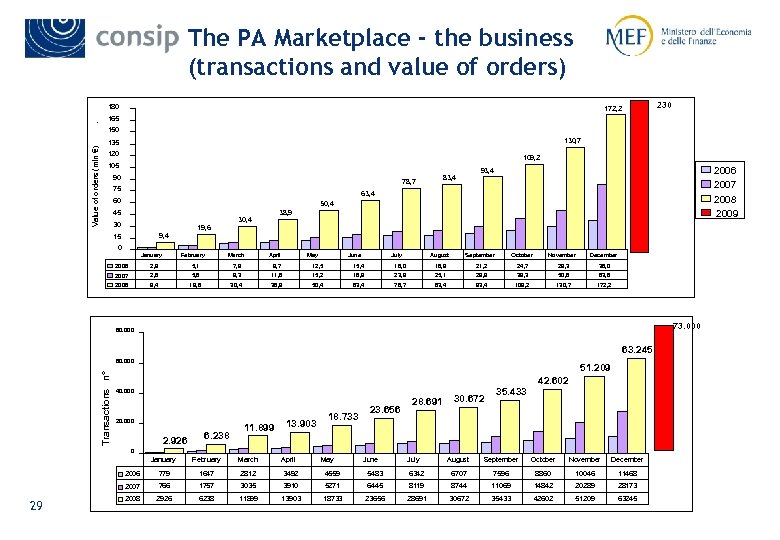
The PA Marketplace - the business (transactions and value of orders). 180 230 172, 2 165 Value of orders (mln €) 150 130, 7 135 120 109, 2 105 90 83, 4 78, 7 75 2006 2007 2008 2009 93, 4 60 50, 4 45 38, 9 30, 4 30 19, 6 9, 4 15 0 August September October 2006 January 2, 9 February 5, 1 March 7, 9 April 9, 7 May 12, 5 June 15, 4 July 18, 0 18, 9 21, 2 24, 7 November 29, 3 December 2007 2, 8 5, 8 9, 3 11, 6 15, 2 18, 9 23, 9 25, 1 29, 9 39, 3 50, 8 83, 6 2008 9, 4 19, 6 30, 4 38, 9 50, 4 63, 4 78, 7 83, 4 93, 4 109, 2 130, 7 172, 2 38, 0 73. 000 80. 000 63. 245 Transactions n° 60. 000 51. 209 40. 000 2. 926 6. 238 11. 899 13. 903 18. 733 23. 656 28. 691 30. 672 35. 433 42. 602 0 January February March 779 1647 2812 2007 766 1757 3035 3910 5271 6445 2008 2926 6238 11899 13903 18733 23656 2006 29 April 3492 May 4559 June 5483 July August September October November December 6707 7596 8860 10046 11468 8119 8744 11069 14842 20289 28173 28691 30672 35433 42602 51209 63245 6342
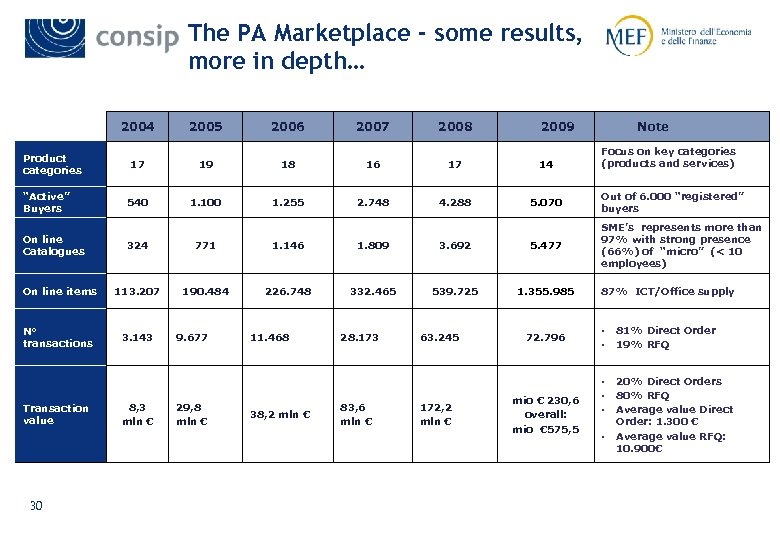
The PA Marketplace - some results, more in depth… 2004 Product categories “Active” Buyers On line Catalogues 2005 2006 2007 2008 2009 17 19 18 16 17 14 540 1. 100 1. 255 2. 748 4. 288 5. 070 Out of 6. 000 “registered” buyers SME’s represents more than 97% with strong presence (66%) of “micro” (< 10 employees) 324 771 1. 146 1. 809 3. 692 5. 477 On line items 113. 207 190. 484 226. 748 332. 465 539. 725 1. 355. 985 N° transactions 3. 143 9. 677 11. 468 28. 173 63. 245 72. 796 Note Focus on key categories (products and services) 87% ICT/Office supply § § § Transaction value 30 8, 3 mln € 29, 8 mln € 38, 2 mln € 83, 6 mln € 172, 2 mln € mio € 230, 6 overall: mio € 575, 5 § § § 81% Direct Order 19% RFQ 20% Direct Orders 80% RFQ Average value Direct Order: 1. 300 € Average value RFQ: 10. 900€
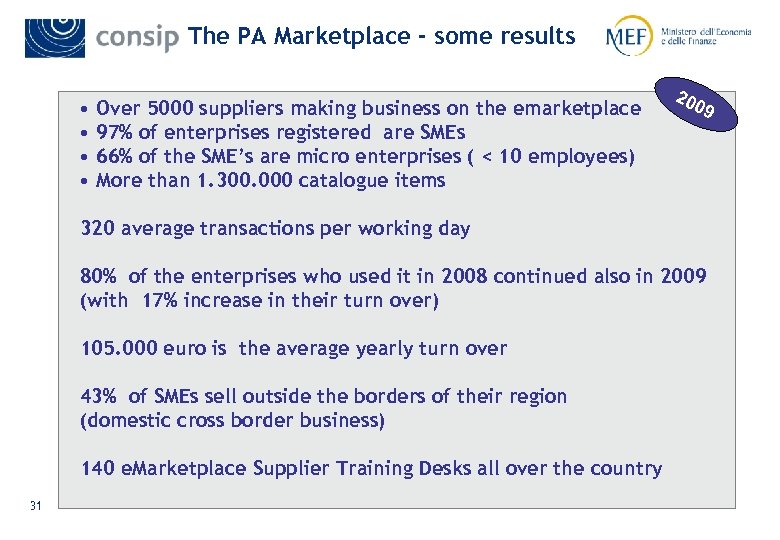
The PA Marketplace - some results • Over 5000 suppliers making business on the emarketplace • 97% of enterprises registered are SMEs • 66% of the SME’s are micro enterprises ( < 10 employees) • More than 1. 300. 000 catalogue items 20 09 320 average transactions per working day 80% of the enterprises who used it in 2008 continued also in 2009 (with 17% increase in their turn over) 105. 000 euro is the average yearly turn over 43% of SMEs sell outside the borders of their region (domestic cross border business) 140 e. Marketplace Supplier Training Desks all over the country 31
The PA Marketplace - The European e. Government Awards 2009 The Jury’s motivation: the MEPA winner in category 2 b “…as it is a highly innovative initiative. Its impact is high for government administrations but most importantly for SMEs as they can offer goods and services which are relevant for public administrations… The MEPA has also ensured user take-up through communication plans and training. More specifically through the setting up of training desks responding to specific needs shown by the enterprises using the system…” 32 This award given to Consip represents an acknowledgement to the MEPA for having improved and facilitated the access to public procurement to enterprises, especially SMEs. At the same time MEPA contributes to rewarding the valiant effort the Italian PA and suppliers are making More information on: www. epractice. eu/en/awards towards modernization.
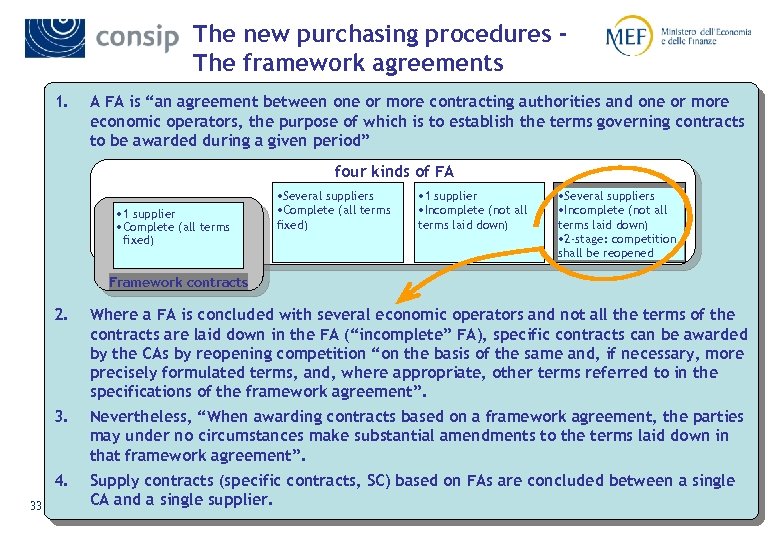
The new purchasing procedures The framework agreements 1. A FA is “an agreement between one or more contracting authorities and one or more economic operators, the purpose of which is to establish the terms governing contracts to be awarded during a given period” four kinds of FA • 1 supplier • Complete (all terms fixed) • Several suppliers • Complete (all terms fixed) • 1 supplier • Incomplete (not all terms laid down) • Several suppliers • Incomplete (not all terms laid down) • 2 -stage: competition shall be reopened Framework contracts 2. 3. Nevertheless, “When awarding contracts based on a framework agreement, the parties may under no circumstances make substantial amendments to the terms laid down in that framework agreement”. 4. 33 Where a FA is concluded with several economic operators and not all the terms of the contracts are laid down in the FA (“incomplete” FA), specific contracts can be awarded by the CAs by reopening competition “on the basis of the same and, if necessary, more precisely formulated terms, and, where appropriate, other terms referred to in the specifications of the framework agreement”. Supply contracts (specific contracts, SC) based on FAs are concluded between a single CA and a single supplier.
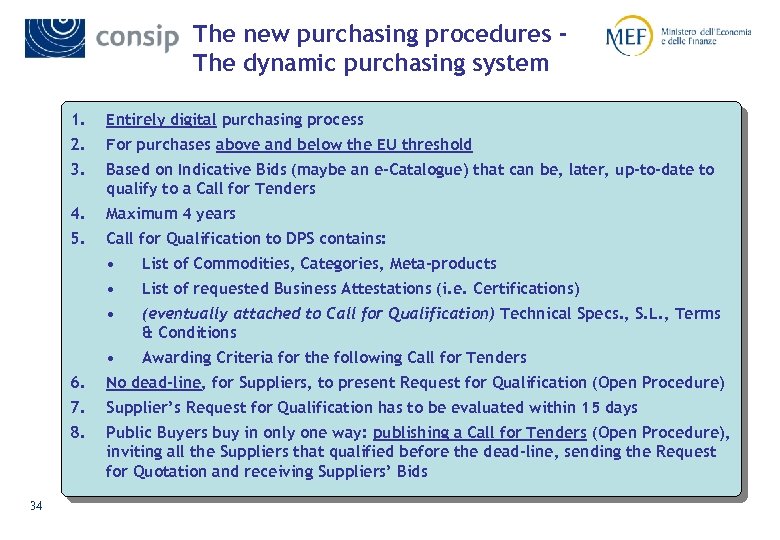
The new purchasing procedures The dynamic purchasing system 1. Entirely digital purchasing process 2. For purchases above and below the EU threshold 3. Based on Indicative Bids (maybe an e-Catalogue) that can be, later, up-to-date to qualify to a Call for Tenders 4. Maximum 4 years 5. Call for Qualification to DPS contains: • List of Commodities, Categories, Meta-products • List of requested Business Attestations (i. e. Certifications) • (eventually attached to Call for Qualification) Technical Specs. , S. L. , Terms & Conditions • Awarding Criteria for the following Call for Tenders 6. 7. Supplier’s Request for Qualification has to be evaluated within 15 days 8. 34 No dead-line, for Suppliers, to present Request for Qualification (Open Procedure) Public Buyers buy in only one way: publishing a Call for Tenders (Open Procedure), inviting all the Suppliers that qualified before the dead-line, sending the Request for Quotation and receiving Suppliers’ Bids
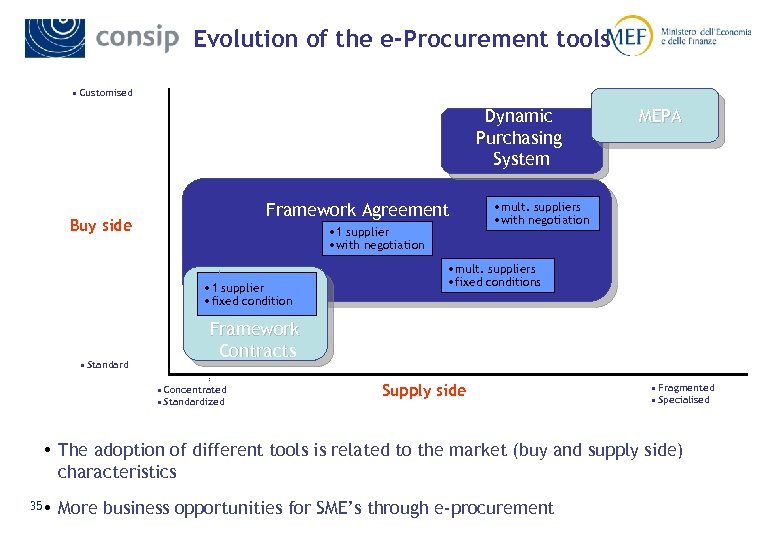
Evolution of the e-Procurement tools • Customised Dynamic Purchasing System Framework Agreement Buy side • 1 supplier • with negotiation • 1 supplier • fixed condition MEPA • mult. suppliers • with negotiation • mult. suppliers • fixed conditions Framework Contracts … • Standard • Concentrated • Standardized Supply side • Fragmented • Specialised • The adoption of different tools is related to the market (buy and supply side) characteristics 35 • More business opportunities for SME’s through e-procurement
Скачать презентацию Public e-Procurement in Italy Consip s role and e-Proc
0d091c6fbd2fa106c1b25fb552579ec3.ppt