 Скачать презентацию Pub Pol 751 -001 The Chinese Economy and
5e14d7a08791dd6e078ff60428b52055.ppt
- Количество слайдов: 53



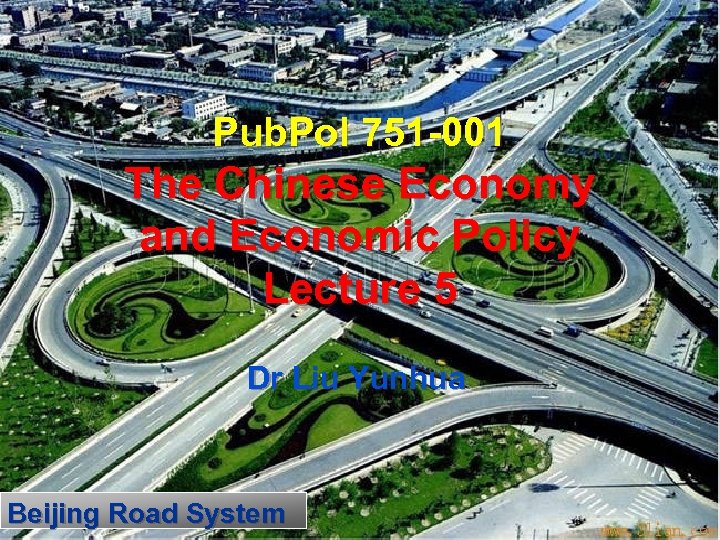
Pub. Pol 751 -001 The Chinese Economy and Economic Policy Lecture 5 Dr Liu Yunhua Beijing Road System
5. Policy for Local Government Operations and Infrastructure Construction 5. 1 The Role of Local Governments and Their Behavor Pattern 5. 2 Construction of Infrastructure and Push for Industrial Development 5. 3 Case: Decline of the World Largest Solar Energy Company: Sun. Tech
5. 1 The Role of Local Governments and Their Behavor Pattern The Government System of China The political system of China is a one party system, the Communist Party of China. It is a centrally controlled power system, with 23 provinces, 5 autonomous districts and 4 direct controlled municipalities, and Hong Kong and Macao Special Administrative Regions.
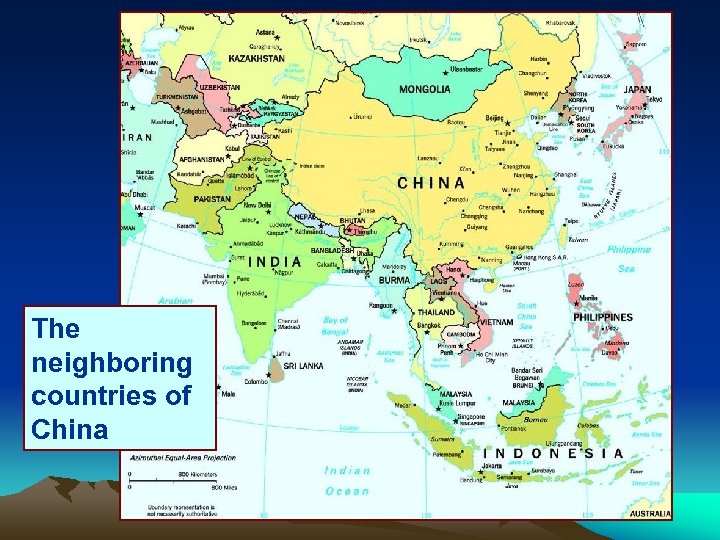
The neighboring countries of China
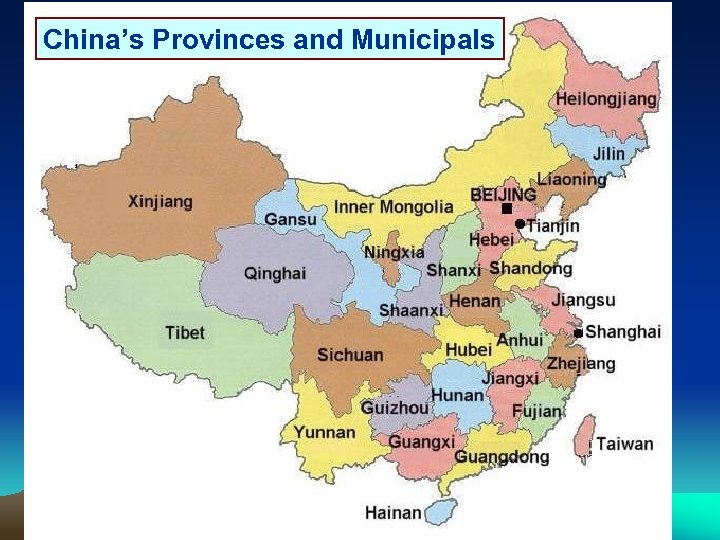
China’s Provinces and Municipals
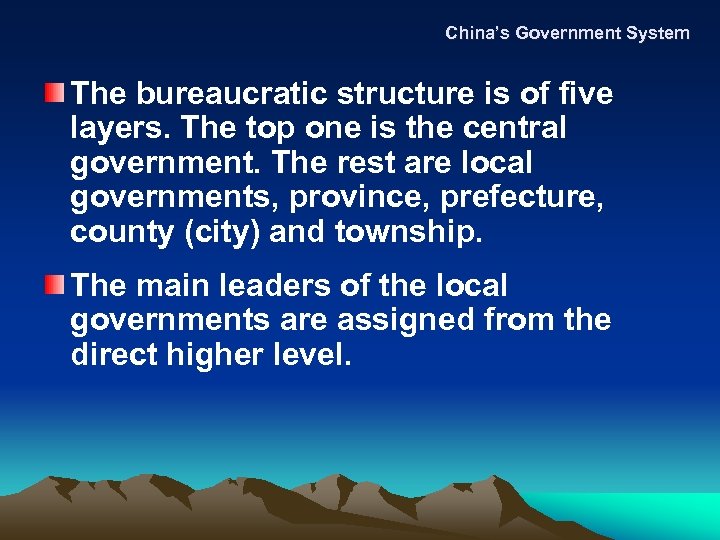
China’s Government System The bureaucratic structure is of five layers. The top one is the central government. The rest are local governments, province, prefecture, county (city) and township. The main leaders of the local governments are assigned from the direct higher level.
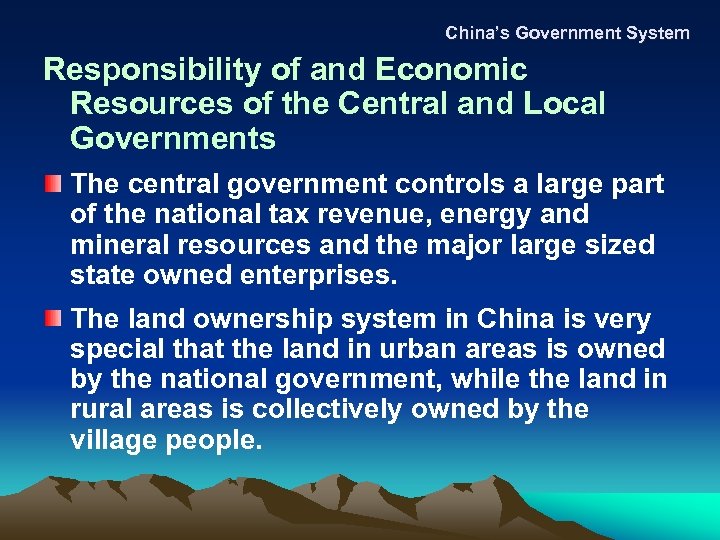
China’s Government System Responsibility of and Economic Resources of the Central and Local Governments The central government controls a large part of the national tax revenue, energy and mineral resources and the major large sized state owned enterprises. The land ownership system in China is very special that the land in urban areas is owned by the national government, while the land in rural areas is collectively owned by the village people.
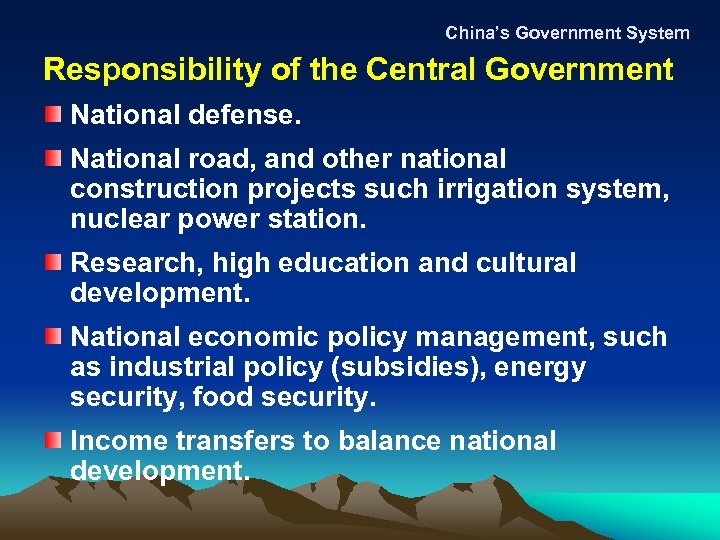
China’s Government System Responsibility of the Central Government National defense. National road, and other national construction projects such irrigation system, nuclear power station. Research, high education and cultural development. National economic policy management, such as industrial policy (subsidies), energy security, food security. Income transfers to balance national development.
China’s Government System Responsibility of the Local Governments Local infrastructure construction. Nine years national education, medical care, social security. Local economic development and employment. All other local social maintenances, such social order, safety, and so on.
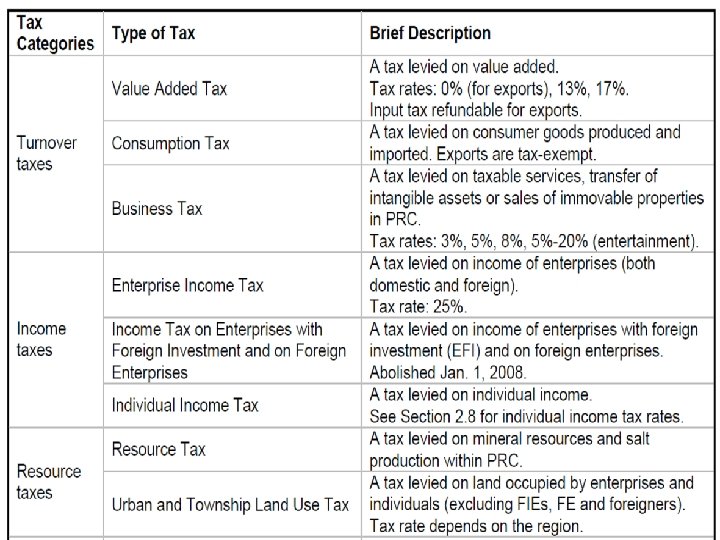
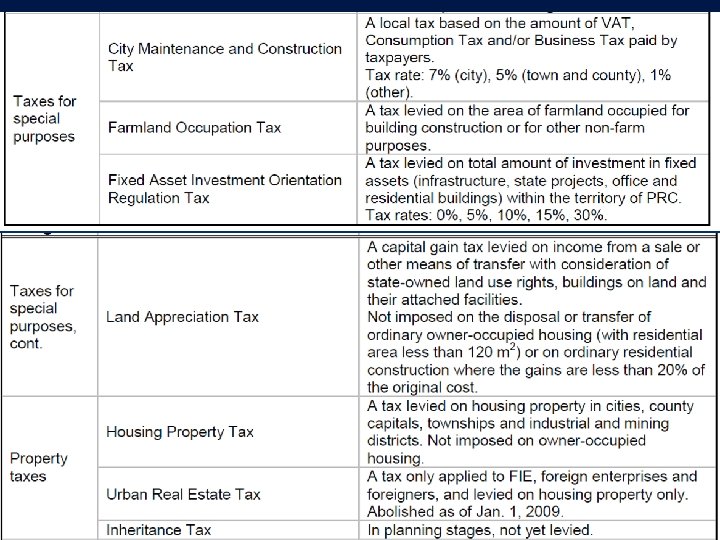
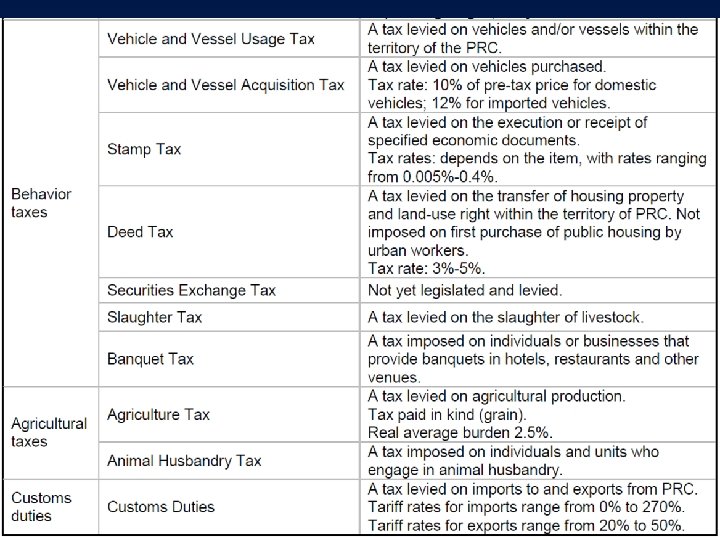
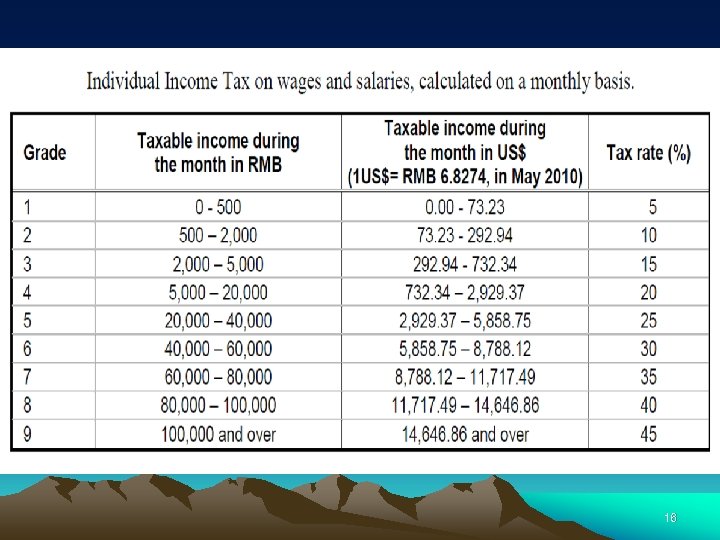
China’s Tax System China has a similar tax system to western market economy countries, with about 16 categories of them. The current tax system was mainly established in 1994 and reformed further in 2003 to accommodate the WTO member requirements. Started in 1 st January 2008, tax privilege for FDI investors was ended and the corporate income tax rate was united for all enterprises. 10
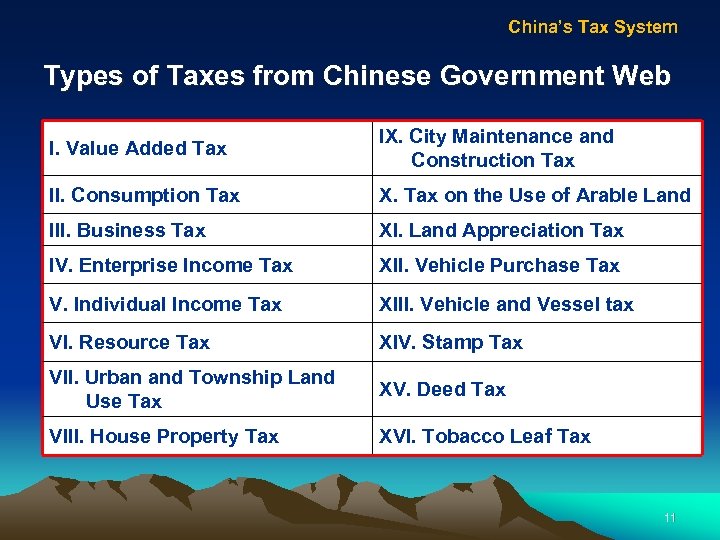
China’s Tax System Types of Taxes from Chinese Government Web I. Value Added Tax IX. City Maintenance and Construction Tax II. Consumption Tax X. Tax on the Use of Arable Land III. Business Tax XI. Land Appreciation Tax IV. Enterprise Income Tax XII. Vehicle Purchase Tax V. Individual Income Tax XIII. Vehicle and Vessel tax VI. Resource Tax XIV. Stamp Tax VII. Urban and Township Land Use Tax XV. Deed Tax VIII. House Property Tax XVI. Tobacco Leaf Tax 11
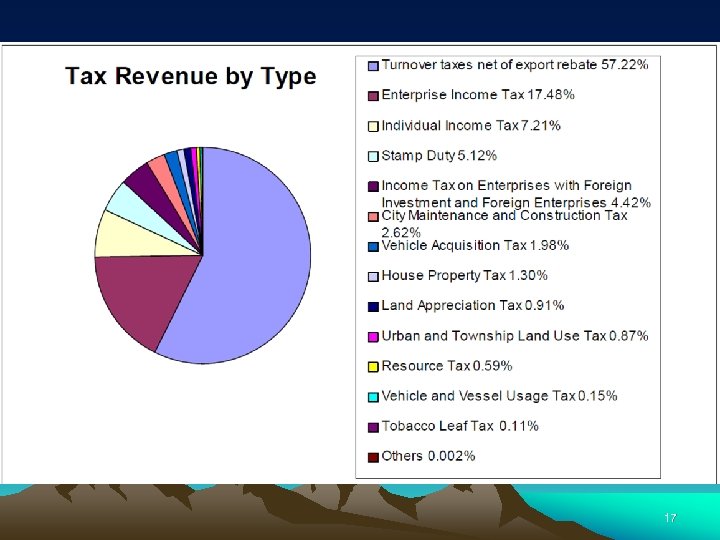
China’s Tax System The Chinese tax system is a mix of consumption, income, property, and other taxes. In 2007, 57. 2 percent of China’s total tax revenue (net of export tax rebate) came from consumption taxes, which consisted of a VAT (net of export rebate), business sales taxes and other consumption taxes; 29. 1 percent came from income taxes; 5. 7 percent came from various property taxes and taxes related to property investment; and the rest came from other forms of taxes. 12
13
14
15
16
17
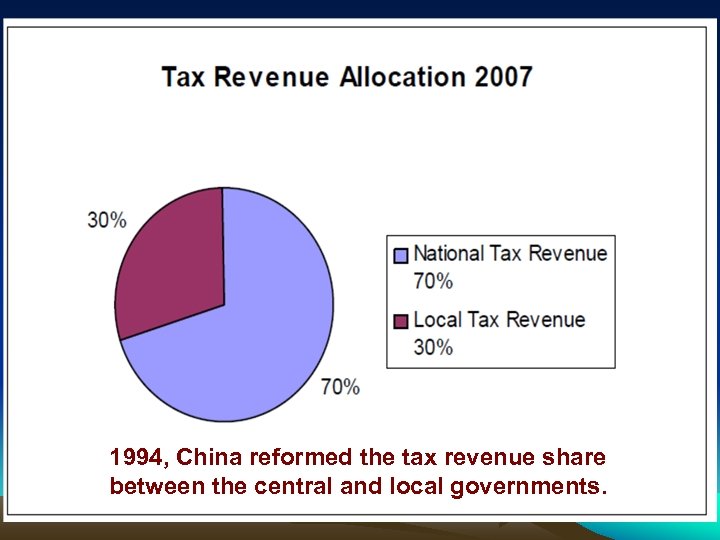
1994, China reformed the tax revenue share between the central and local governments. 18
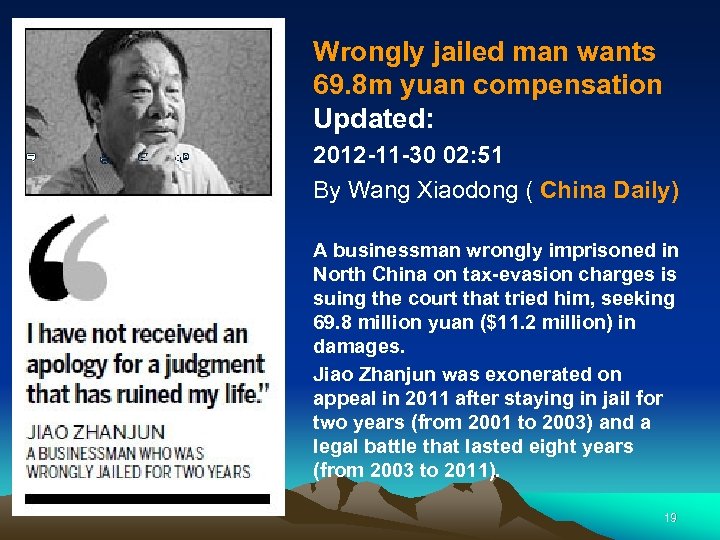
Wrongly jailed man wants 69. 8 m yuan compensation Updated: 2012 -11 -30 02: 51 By Wang Xiaodong ( China Daily) A businessman wrongly imprisoned in North China on tax-evasion charges is suing the court that tried him, seeking 69. 8 million yuan ($11. 2 million) in damages. Jiao Zhanjun was exonerated on appeal in 2011 after staying in jail for two years (from 2001 to 2003) and a legal battle that lasted eight years (from 2003 to 2011). 19
The Role of Local Governments The revenue of local governments in China comes from two sources, share of national tax, about 30%, and other local government revenues such as land sale, local SOEs, license fees. Duties of the local governments include maintaining all the social responsibilities such as medical care, education, social security, infrastructure, social order and economic growth. 20
The local government behavior pattern Since the promotion of government officers are based on their performance, mostly in economic growth, they will try all the possibilities to do their best. Resources over use, environment deterioration, overuse of loans, surfacial ways to increase GDP, all can be done. Managing land sales is an important way for local government revenue. 21
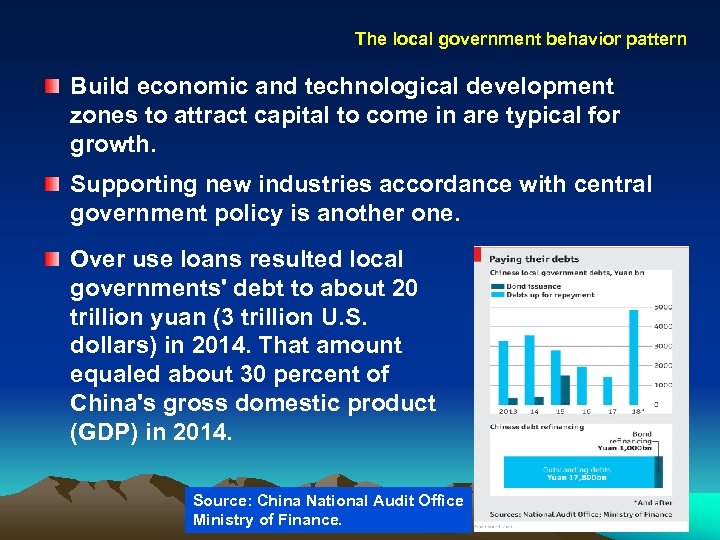
The local government behavior pattern Build economic and technological development zones to attract capital to come in are typical for growth. Supporting new industries accordance with central government policy is another one. Over use loans resulted local governments' debt to about 20 trillion yuan (3 trillion U. S. dollars) in 2014. That amount equaled about 30 percent of China's gross domestic product (GDP) in 2014. Source: China National Audit Office Ministry of Finance. 22
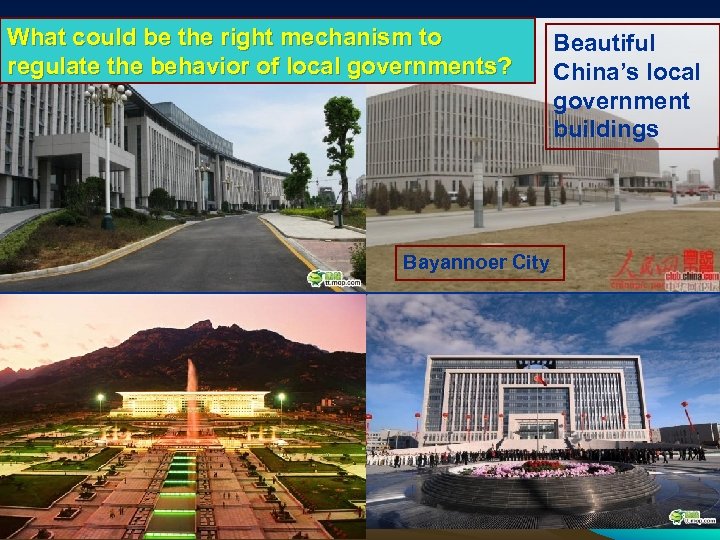
What could be the right mechanism to regulate the behavior of local governments? Beautiful China’s local government buildings Bayannoer City 23
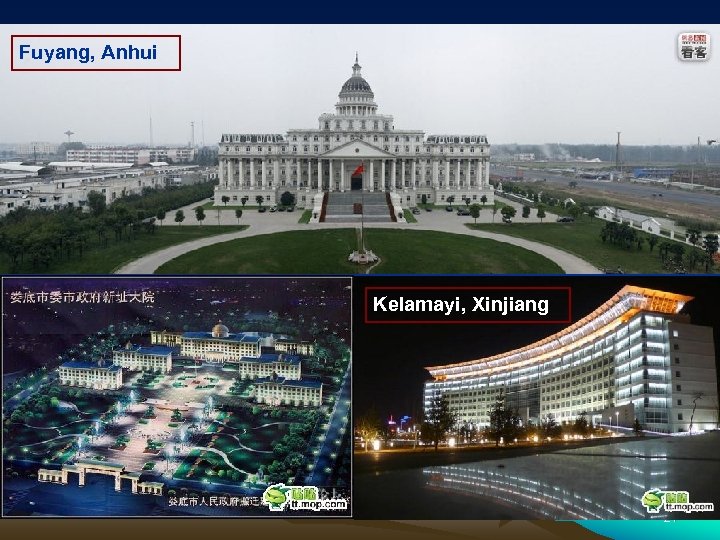
Fuyang, Anhui Kelamayi, Xinjiang 24
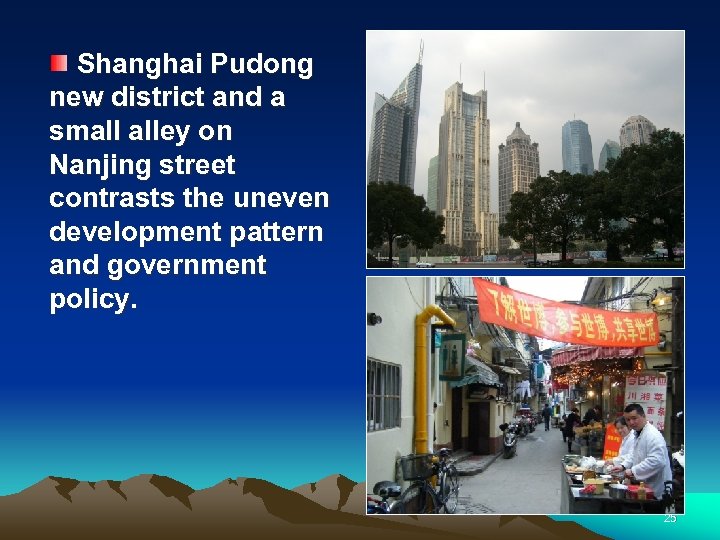
Shanghai Pudong new district and a small alley on Nanjing street contrasts the uneven development pattern and government policy. 25
Chinese Solar Panel Giant Is Tainted by Bankruptcy By KEITH BRADSHER, Published: March 20, 2013 HONG KONG — It was the Icarus of the solar power industry. And, on Wednesday, it fell to earth. Ø The main subsidiary of Suntech Power, one of the world’s largest makers of solar panels, collapsed into bankruptcy in a remarkable reversal for what had been part of a huge Chinese government effort to dominate renewable energy industries. Ø The bankruptcy is a sign of the worldwide consolidation of the solar industry, which has been crippled by a glut of products on world markets and Western tariffs on Chinese products. It also signals China’s unwillingness to continue to subsidize struggling manufacturers in the industry, which is contributing to the steep decline of its green energy pursuits. 26
Conclusion Ø Due to the nature of the local governments in China, Chinese economy has a very strong selfexpanding mechanism, but the quality of GDP need to be considered. Ø China’s per capita income and people’s looks fast improving living standard is in nominal. Ø The potentials for crisis in Chinese economy will be mainly in two aspects: excess production capacity and over investment in infrastructure, both may result in financial crisis. 27
Question: There were a few times that China faced the financial collapse very closely, why did it not happened? 28
5. 2 Infrastructure Construction and Push for Industrial Development § Infrastructure construction and pushing industrial development are two major tools for both central government and local government to stimulate the growth of economy. § During the past thirty five years process of development, Chinese economy was in a situation of demanding for both.
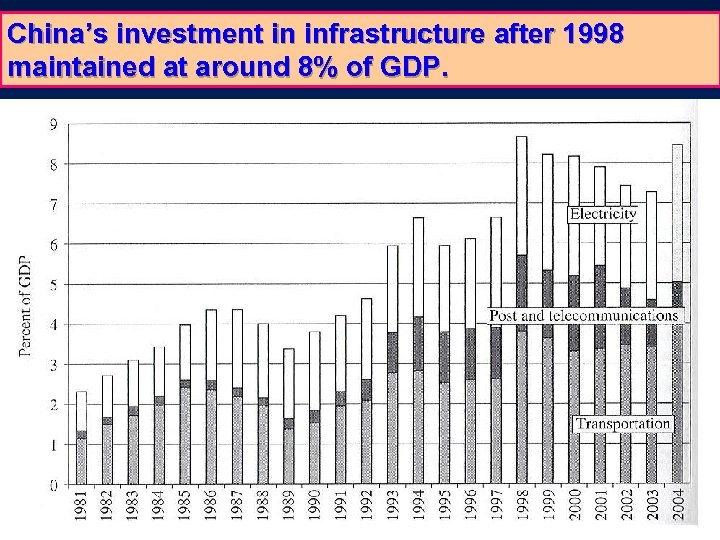
China’s investment in infrastructure after 1998 maintained at around 8% of GDP.
The main infrastructure China had developed in the past decade: Highways Railroads and Big Bridges High Speed Train Water System Telecommunications Electricity Industrial parks
Highways According to the strategic plan for highway development in 2005, by 2020, China will establish a national highway network, totaling 100, 000 kilometers, about the length in the United States today. China has maintained its second place in the world in terms of expressway lengths since 2001.
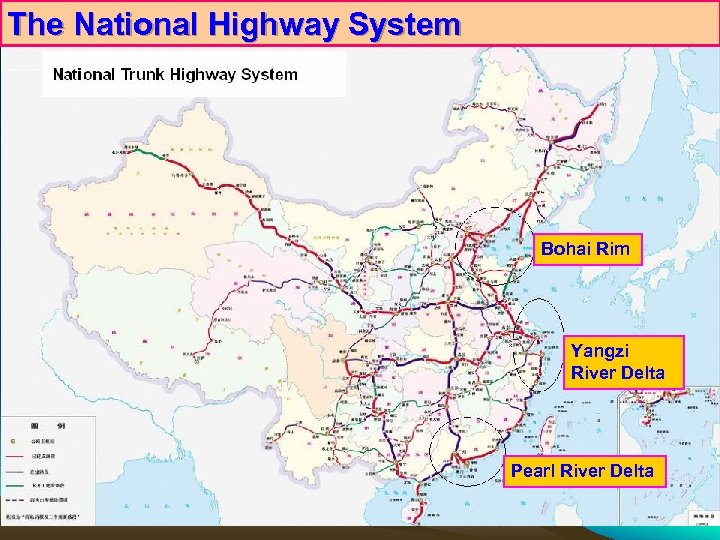
The National Highway System Bohai Rim Yangzi River Delta Pearl River Delta
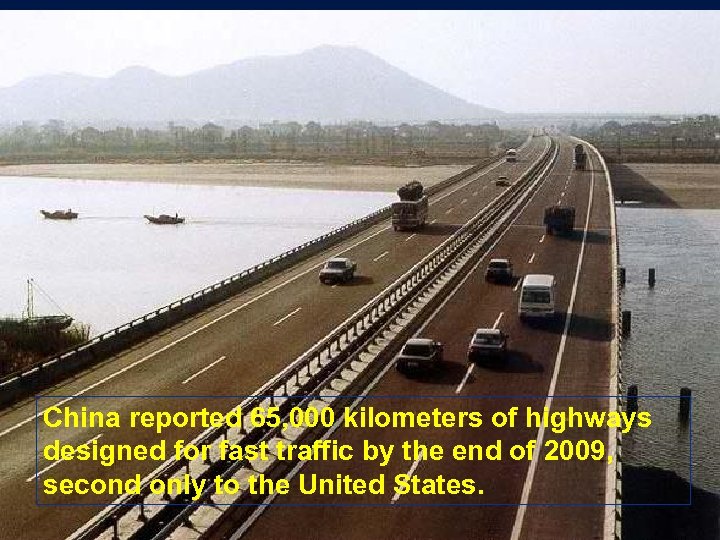
China reported 65, 000 kilometers of highways designed for fast traffic by the end of 2009, second only to the United States.
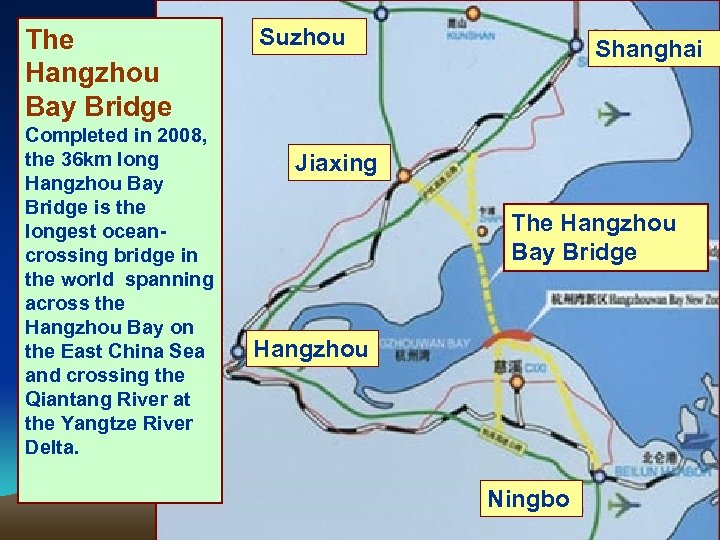
The Hangzhou Bay Bridge Completed in 2008, the 36 km long Hangzhou Bay Bridge is the longest oceancrossing bridge in the world spanning across the Hangzhou Bay on the East China Sea and crossing the Qiantang River at the Yangtze River Delta. Suzhou Shanghai Jiaxing The Hangzhou Bay Bridge Hangzhou Ningbo
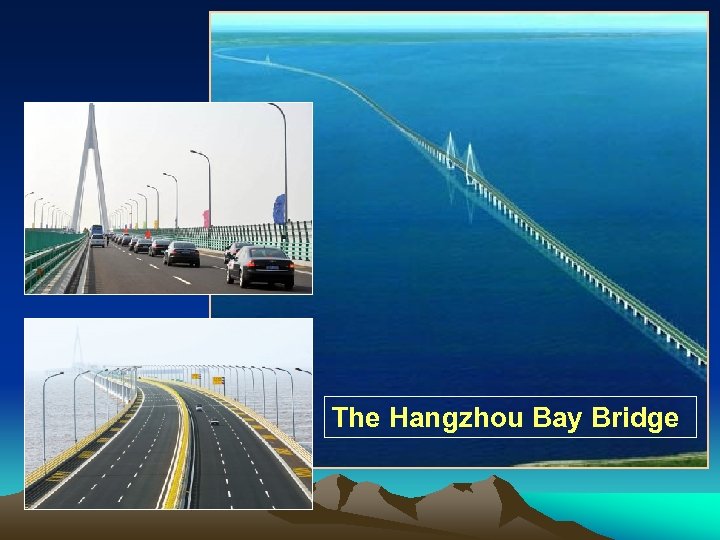
The Hangzhou Bay Bridge
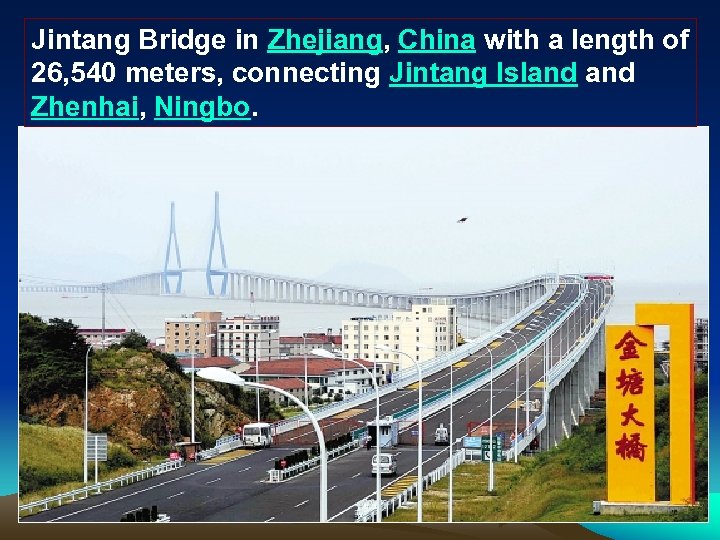
Jintang Bridge in Zhejiang, China with a length of 26, 540 meters, connecting Jintang Island Zhenhai, Ningbo.
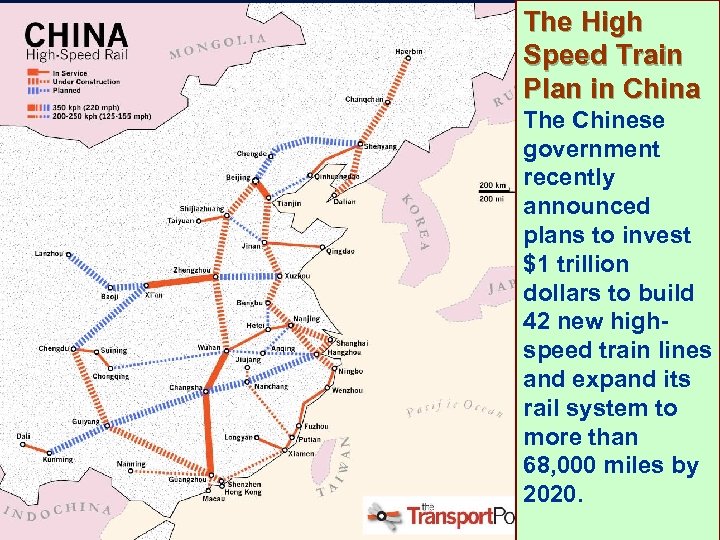
The High Speed Train Plan in China The Chinese government recently announced plans to invest $1 trillion dollars to build 42 new highspeed train lines and expand its rail system to more than 68, 000 miles by 2020.
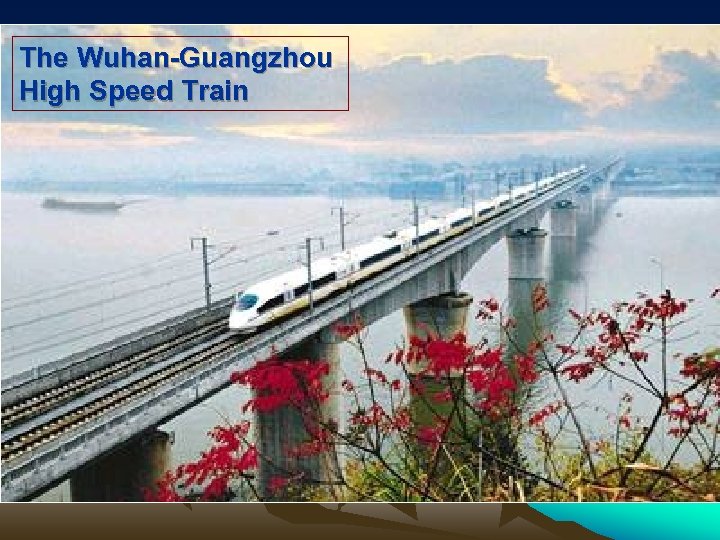
The Wuhan-Guangzhou High Speed Train
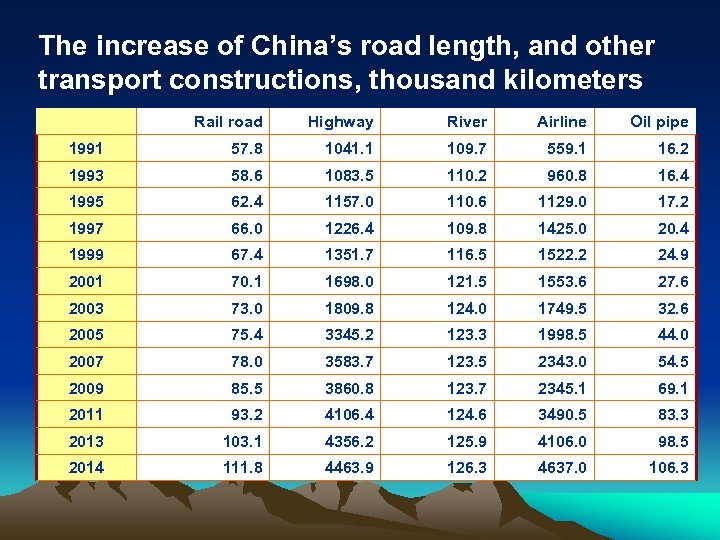
The increase of China’s road length, and other transport constructions, thousand kilometers Rail road Highway River Airline Oil pipe 1991 57. 8 1041. 1 109. 7 559. 1 16. 2 1993 58. 6 1083. 5 110. 2 960. 8 16. 4 1995 62. 4 1157. 0 110. 6 1129. 0 17. 2 1997 66. 0 1226. 4 109. 8 1425. 0 20. 4 1999 67. 4 1351. 7 116. 5 1522. 2 24. 9 2001 70. 1 1698. 0 121. 5 1553. 6 27. 6 2003 73. 0 1809. 8 124. 0 1749. 5 32. 6 2005 75. 4 3345. 2 123. 3 1998. 5 44. 0 2007 78. 0 3583. 7 123. 5 2343. 0 54. 5 2009 85. 5 3860. 8 123. 7 2345. 1 69. 1 2011 93. 2 4106. 4 124. 6 3490. 5 83. 3 2013 103. 1 4356. 2 125. 9 4106. 0 98. 5 2014 111. 8 4463. 9 126. 3 4637. 0 106. 3
Two more important tools for local government to promote industrial development in China: q. Construction of Industrial Parks and lend it out to firms at a cheap rate. Within every city, there is at least one industrial park. There are totally more than 7000 industrial parks in China. q. Capital subsidy to preferred industries such as high tech, clean energy, new materials.
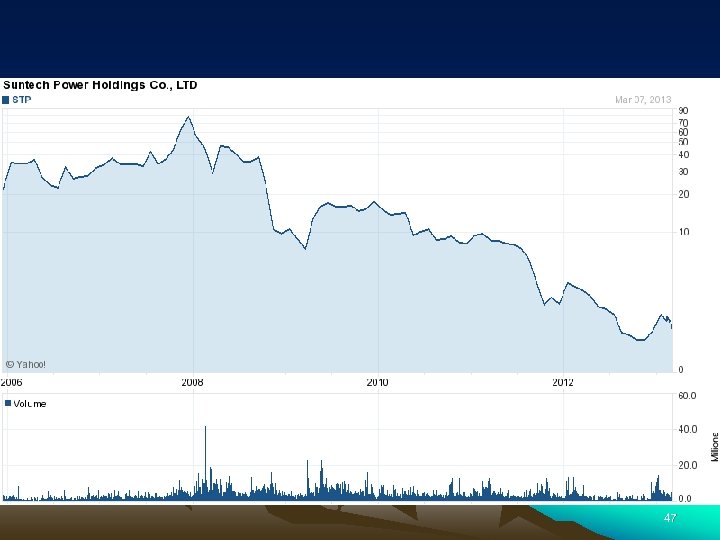
5. 3 Case: Decline of the World Largest Solar Power Company: Wuxi Suntech China has over 400 photovoltaic (PV) companies and produces approximately 23% of the photovoltaic products worldwide. In 2007 China produced 1700 MW of solar panels, nearly half of the world production of 3800 MW, although 99% was exported. As of 2012, China generates about 7 GW of power, with recent announcements that target an additional 10 GW of power by the end of 2013 with a target of 21 GW of power by the end of 2015. 42
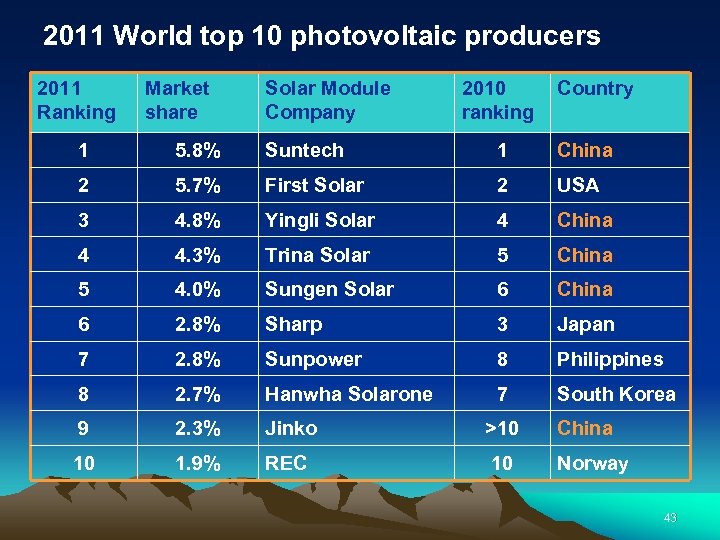
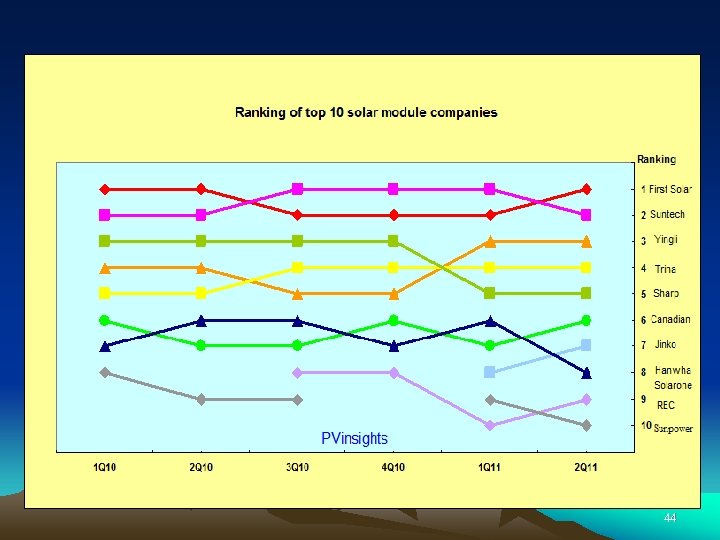
2011 World top 10 photovoltaic producers 2011 Ranking Market share Solar Module Company 2010 ranking Country 1 5. 8% Suntech 1 China 2 5. 7% First Solar 2 USA 3 4. 8% Yingli Solar 4 China 4 4. 3% Trina Solar 5 China 5 4. 0% Sungen Solar 6 China 6 2. 8% Sharp 3 Japan 7 2. 8% Sunpower 8 Philippines 8 2. 7% Hanwha Solarone 7 South Korea 9 2. 3% Jinko >10 China 10 1. 9% REC 10 Norway 43
44
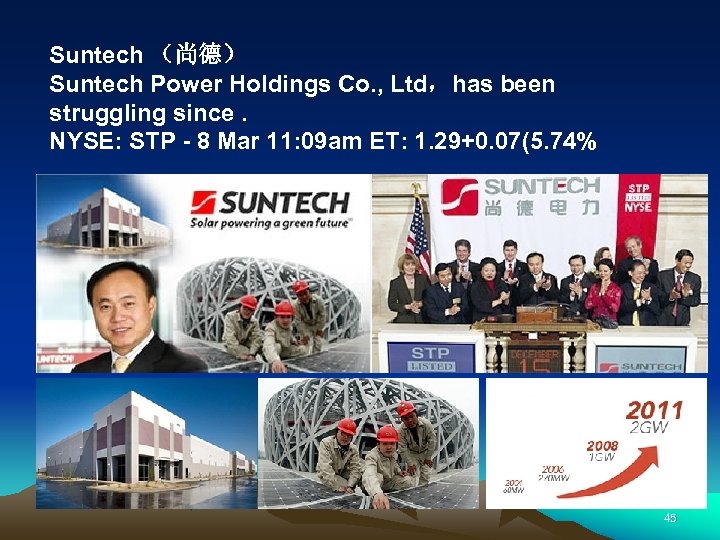
Suntech (尚德) Suntech Power Holdings Co. , Ltd,has been struggling since. NYSE: STP - 8 Mar 11: 09 am ET: 1. 29+0. 07(5. 74% 45
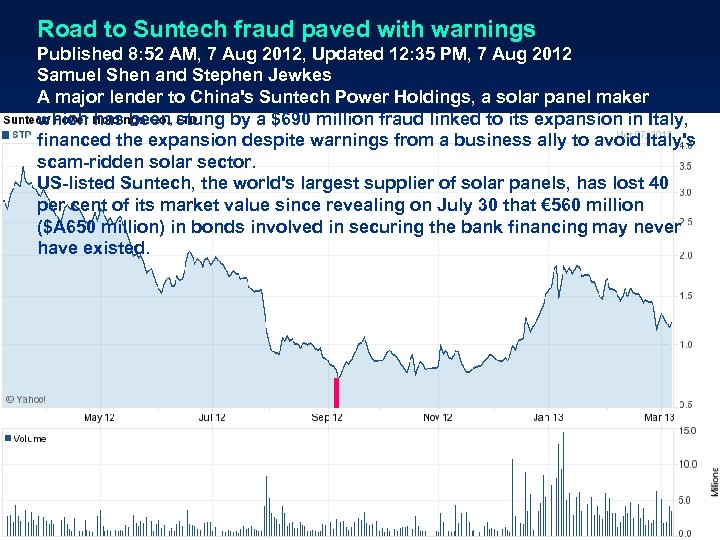
Road to Suntech fraud paved with warnings Published 8: 52 AM, 7 Aug 2012, Updated 12: 35 PM, 7 Aug 2012 Samuel Shen and Stephen Jewkes A major lender to China's Suntech Power Holdings, a solar panel maker which has been stung by a $690 million fraud linked to its expansion in Italy, financed the expansion despite warnings from a business ally to avoid Italy's scam-ridden solar sector. US-listed Suntech, the world's largest supplier of solar panels, has lost 40 per cent of its market value since revealing on July 30 that € 560 million ($A 650 million) in bonds involved in securing the bank financing may never have existed. 46
47
o September 2001 Suntech founded. Solar expert Dr. Zhengrong Shi founds Suntech in Wuxi, China. o December 2005 Initial Public Offering on NYSE. Suntech debuts on the New York Stock Exchange. o April 2006 Suntech wins Olympic arena contract. Suntech supplies modules for Beijing Bird Nest Stadium for 2008 games. o December 2006 Production expansion, Production capacity expands to 300 MW, ranking Suntech as the third largest global solar manufacturer. o December 2007 Nellis Air Force Base plant complete. Suntech is the lead module supplier for the largest photovoltaic solar plant in the Western Hemisphere. 48
o April 2008 Suntech named solar energy development company of the year. Frost & Sullivan recognizes Suntech for excellent products and performance. o March 2009 Suntech cells set efficiency record. Suntech Pluto efficiency reaches 19% for monocrystalline cells and 17% for polycrystalline cells. o January 2010 Suntech announces 1 st U. S. production line. Suntech selects Goodyear, Arizona for its first U. S. factory. o March 2011 2 Gigawatt production milestone. Suntech achieves a record 2 gigawatt solar cell and module production capacity. 49
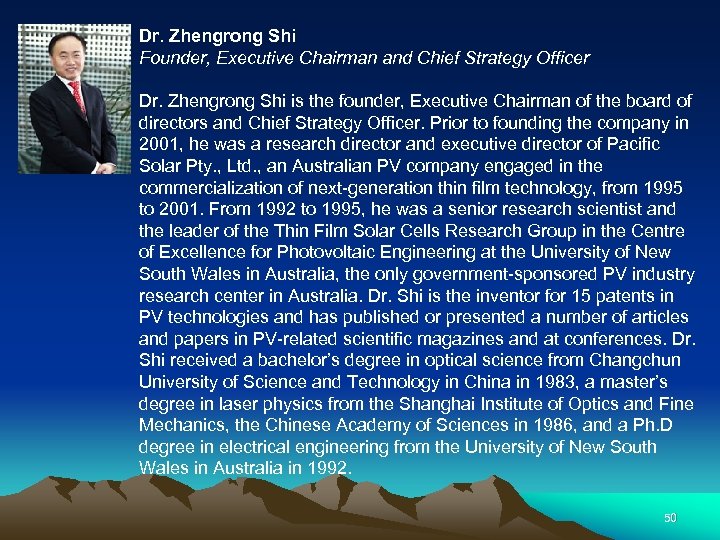
Dr. Zhengrong Shi Founder, Executive Chairman and Chief Strategy Officer Dr. Zhengrong Shi is the founder, Executive Chairman of the board of directors and Chief Strategy Officer. Prior to founding the company in 2001, he was a research director and executive director of Pacific Solar Pty. , Ltd. , an Australian PV company engaged in the commercialization of next-generation thin film technology, from 1995 to 2001. From 1992 to 1995, he was a senior research scientist and the leader of the Thin Film Solar Cells Research Group in the Centre of Excellence for Photovoltaic Engineering at the University of New South Wales in Australia, the only government-sponsored PV industry research center in Australia. Dr. Shi is the inventor for 15 patents in PV technologies and has published or presented a number of articles and papers in PV-related scientific magazines and at conferences. Dr. Shi received a bachelor’s degree in optical science from Changchun University of Science and Technology in China in 1983, a master’s degree in laser physics from the Shanghai Institute of Optics and Fine Mechanics, the Chinese Academy of Sciences in 1986, and a Ph. D degree in electrical engineering from the University of New South Wales in Australia in 1992. 50
Three main reasons for Suntech decline Government subsidy resulted too fast expansion. EU and US market shrink and protection. Company management failure. 51
Questions for Lecture 5: 1. How should we view the behavior pattern of local governments in China, and what could be the way to make the system more efficient? 2. Is there any cultural reason in environment pollution in China? 52

End
Скачать презентацию Pub Pol 751 -001 The Chinese Economy and
5e14d7a08791dd6e078ff60428b52055.ppt