


 Скачать презентацию pter 16 — Patterns in Economic Development r
dab4db95fece3ac87a71d84eac484c24.ppt
- Количество слайдов: 97
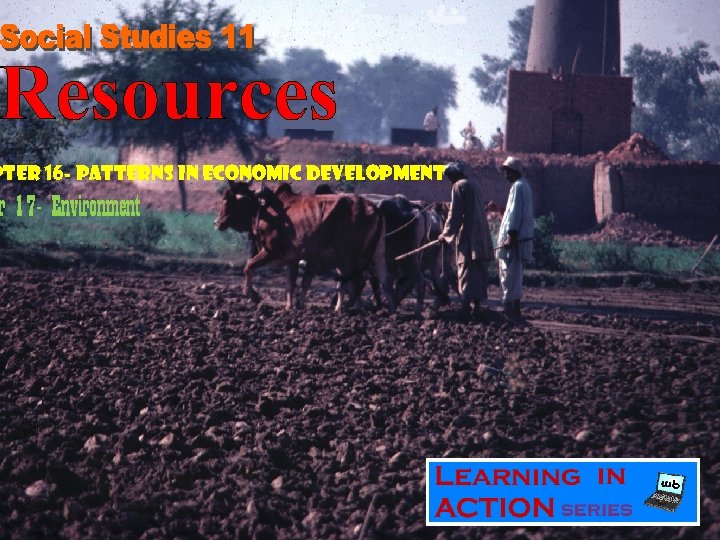 pter 16 - Patterns in Economic Development r 17 - Environment
 Resources ¢Resources are those things that man uses and is prepared to pay for. They may be tangible, like water or wood; or they may be intangible, like human skills. ¢This presentation will deal with the first category.
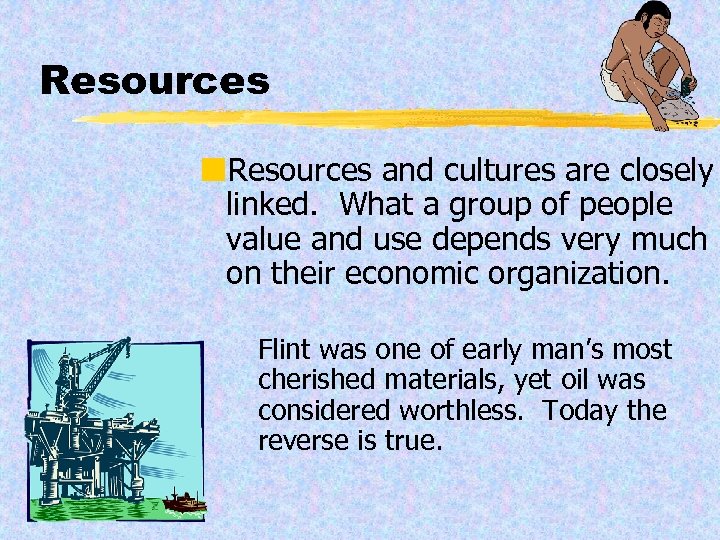 Resources ¢Resources and cultures are closely linked. What a group of people value and use depends very much on their economic organization. Flint was one of early man’s most cherished materials, yet oil was considered worthless. Today the reverse is true.
 Types of Resources
 Types of Resources Renewable & Non-Renewable § Resources may be replaceable or not. • If materials can be replaced within a life-time, we refer to them as renewable. These are organic – like wood or wheat. • Inorganic resources, like iron, or organic material produced over very long time spans, like coal or oil, cannot be replaced and are all regarded as non-renewable.
 Renewable Resources
 Renewable Resources ¢ Renewable resources are continually available if ¾The systems that produce them are not disrupted by natural change or man’s actions. ¾Stocks are not used up faster than they can be produced.
 Renewable Resources Air
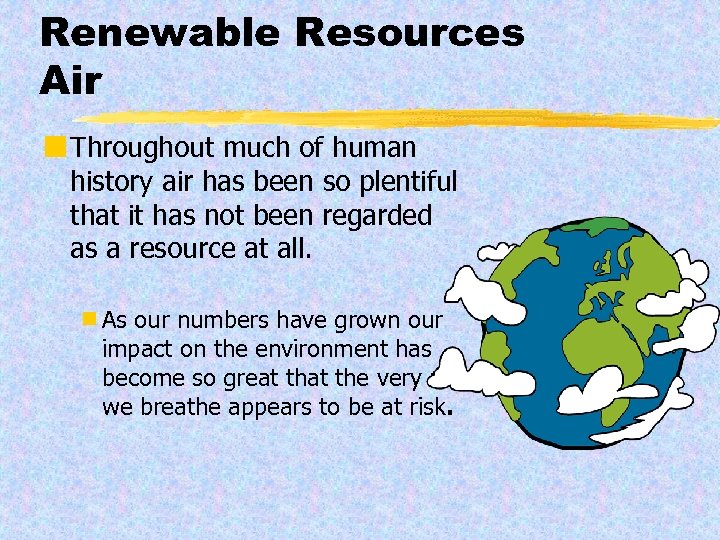 Renewable Resources Air ¢ Throughout much of human history air has been so plentiful that it has not been regarded as a resource at all. ¾As our numbers have grown our impact on the environment has become so great the very air we breathe appears to be at risk.
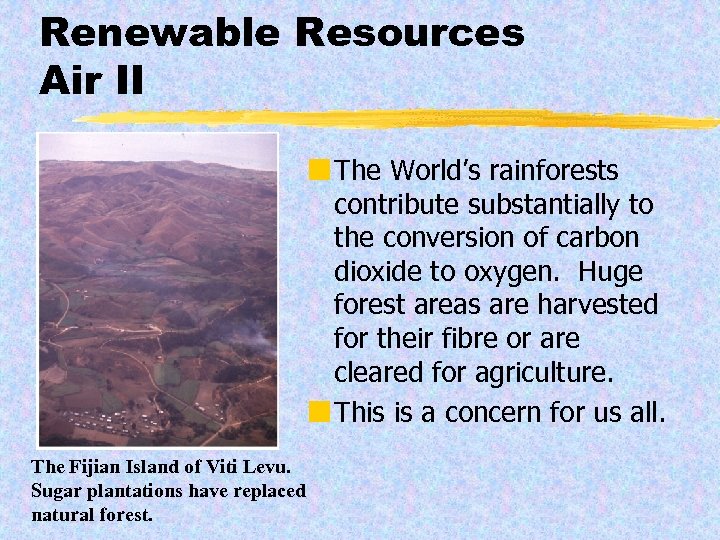 Renewable Resources Air II ¢ The World’s rainforests contribute substantially to the conversion of carbon dioxide to oxygen. Huge forest areas are harvested for their fibre or are cleared for agriculture. ¢ This is a concern for us all. The Fijian Island of Viti Levu. Sugar plantations have replaced natural forest.
 Renewable Resources Air III ¢ On a much smaller scale the air within our buildings is also a concern. The United Nations reports that “Every Year more than 3 million die from air pollution – more than 80% of them from indoor pollution”. ¾In the developed world we worry about air quality in our sealed skyscrapers as poor air quality is linked to viruses. ¾In the developing world, emissions from heating and cooking fires harm the lungs of young and old alike.
 Renewable Resources Water
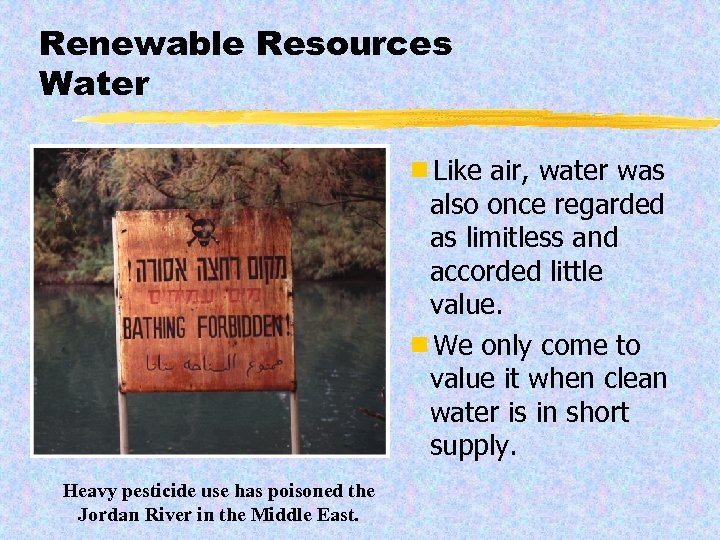 Renewable Resources Water ¾Like air, water was also once regarded as limitless and accorded little value. ¾We only come to value it when clean water is in short supply. Heavy pesticide use has poisoned the Jordan River in the Middle East.
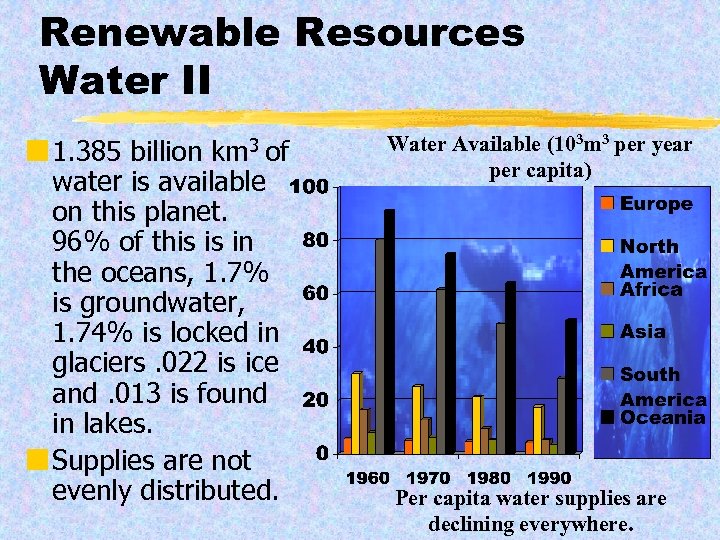 Renewable Resources Water II km 3 ¢ 1. 385 billion of water is available on this planet. 96% of this is in the oceans, 1. 7% is groundwater, 1. 74% is locked in glaciers. 022 is ice and. 013 is found in lakes. ¢ Supplies are not evenly distributed. Water Available (103 m 3 per year per capita) Per capita water supplies are declining everywhere.
 Renewable Resources Water III ¢ The drawing down of aquifers in the Western United States is resulting in significant increases in the cost of water to homes, agriculture and industry and a search for alternate water sources. ¢ The United Nations Human Development Report for 1998 indicates that global water availability had dropped from 17, 000 cubic meters per capita in 1950 to around 7, 000.
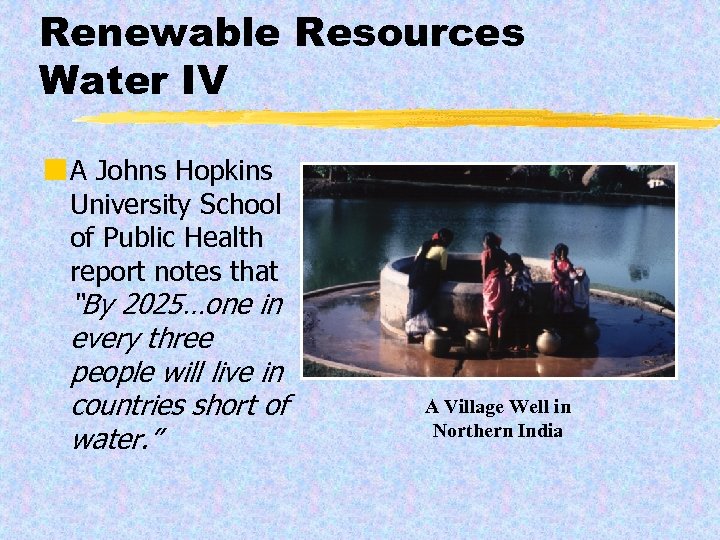 Renewable Resources Water IV ¢ A Johns Hopkins University School of Public Health report notes that “By 2025…one in every three people will live in countries short of water. ” A Village Well in Northern India
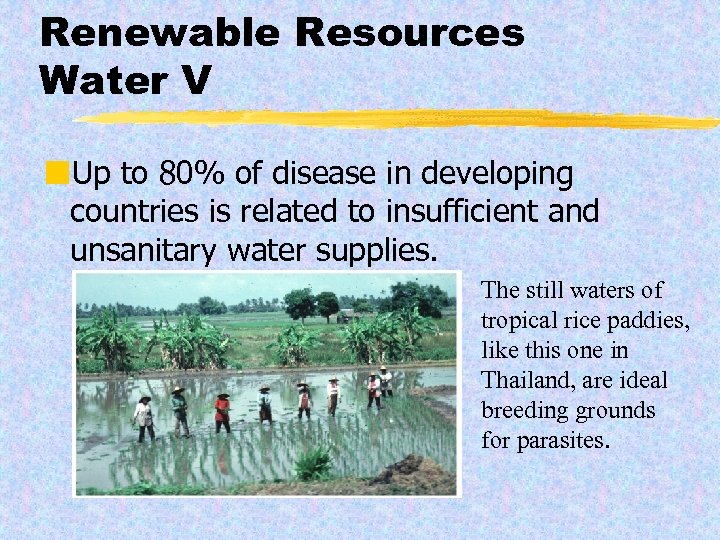 Renewable Resources Water V ¢Up to 80% of disease in developing countries is related to insufficient and unsanitary water supplies. The still waters of tropical rice paddies, like this one in Thailand, are ideal breeding grounds for parasites.
 Renewable Resources Water VI ¢ The Environmental News Network reported in 1998 that: ¾“Even within a country, competition for use can be fierce. The water in China’s Yellow River, for example, is under so much demand that the river has dried up before reaching the ocean. In 1996, when there was enough water, the government ordered farmers not to use it; a state-run oil field further downstream needed the water to operate. ”
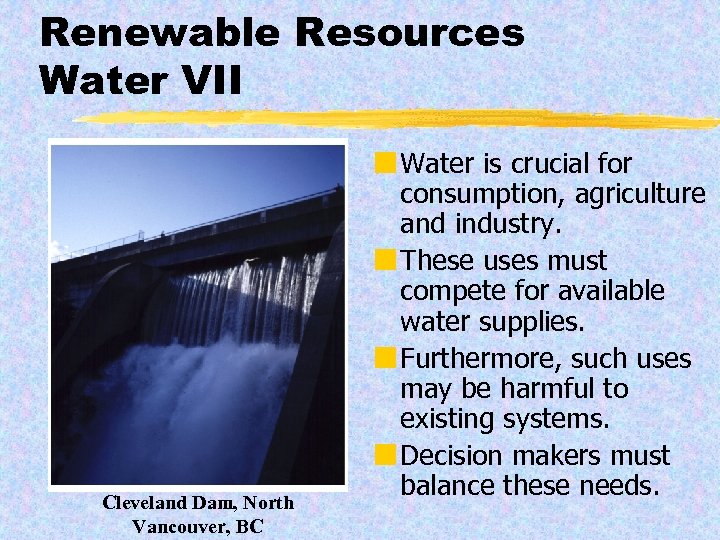 Renewable Resources Water VII Cleveland Dam, North Vancouver, BC ¢ Water is crucial for consumption, agriculture and industry. ¢ These uses must compete for available water supplies. ¢ Furthermore, such uses may be harmful to existing systems. ¢ Decision makers must balance these needs.
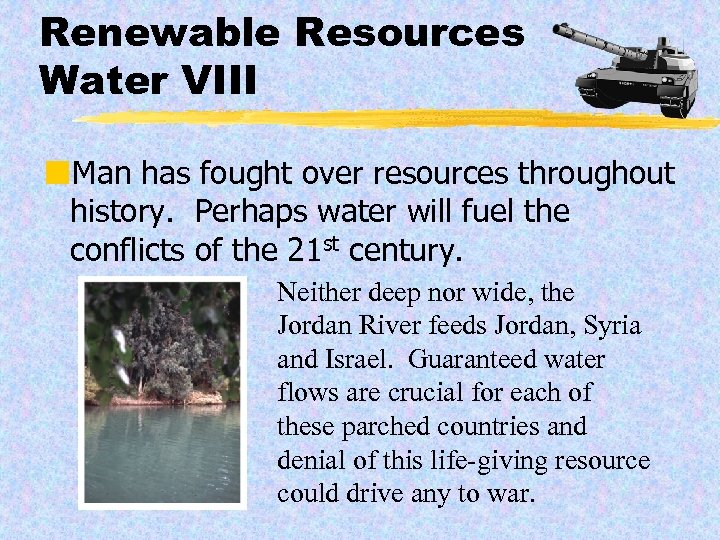 Renewable Resources Water VIII ¢Man has fought over resources throughout history. Perhaps water will fuel the conflicts of the 21 st century. Neither deep nor wide, the Jordan River feeds Jordan, Syria and Israel. Guaranteed water flows are crucial for each of these parched countries and denial of this life-giving resource could drive any to war.
 Renewable Resources Soil
 Renewable Resources Soil ¢ In their landmark 1955 ¢ “…the lesson of work, Carter and Dale history is as clear as a pointed out the huge sunny day on the impact that man has had on the landscape through Mediterranean, poor agricultural practices around whose shores since the beginning of the wreckage of so History. many civilizations lie. ” ¢ They indicate that soil Vernon Gill Carter & Tom Dale Topsoil and Civilization degradation played a leading role in the fall of many civilizations.
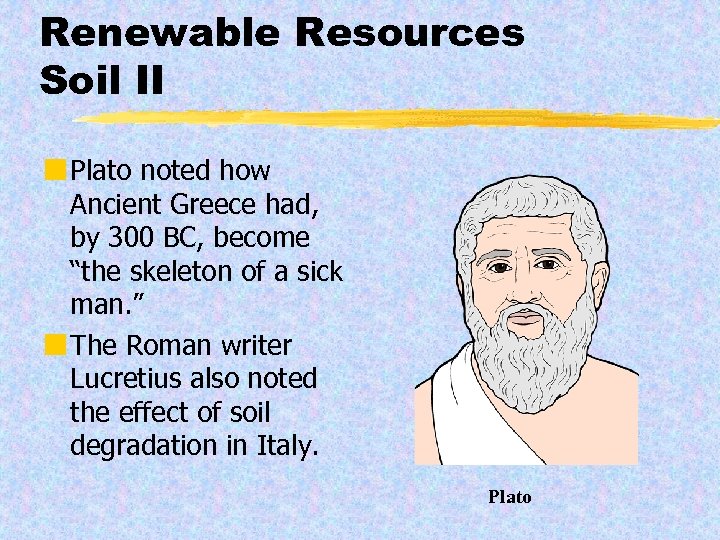 Renewable Resources Soil II ¢ Plato noted how Ancient Greece had, by 300 BC, become “the skeleton of a sick man. ” ¢ The Roman writer Lucretius also noted the effect of soil degradation in Italy. Plato
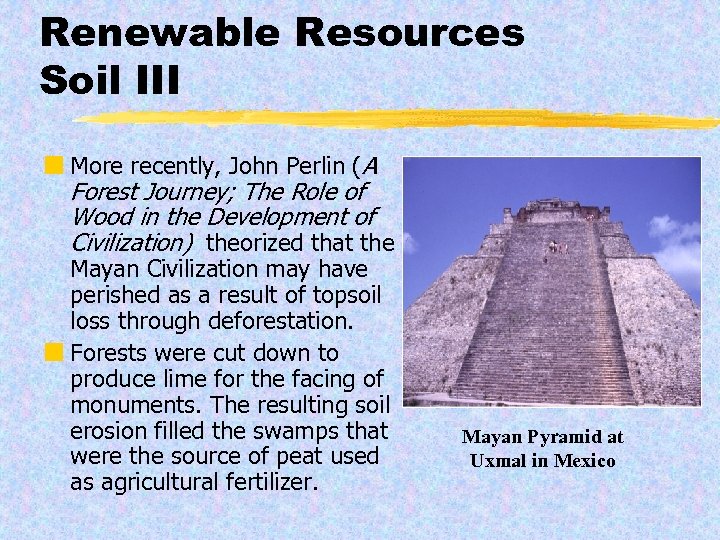 Renewable Resources Soil III ¢ More recently, John Perlin (A Forest Journey; The Role of Wood in the Development of Civilization) theorized that the Mayan Civilization may have perished as a result of topsoil loss through deforestation. ¢ Forests were cut down to produce lime for the facing of monuments. The resulting soil erosion filled the swamps that were the source of peat used as agricultural fertilizer. Mayan Pyramid at Uxmal in Mexico
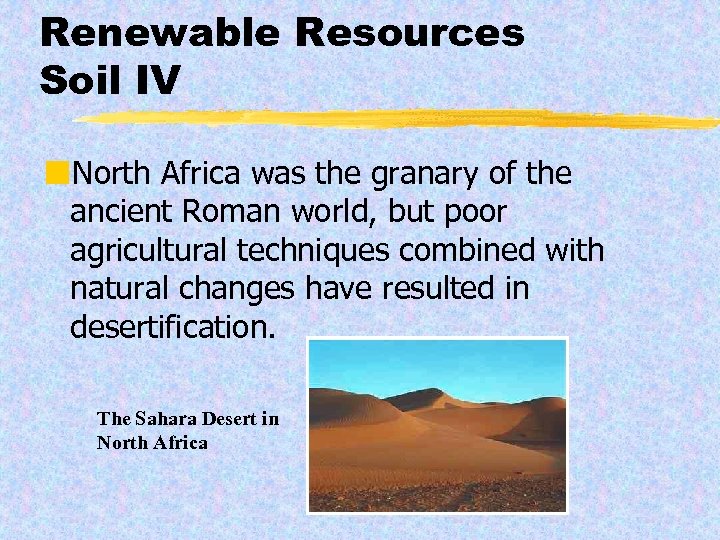 Renewable Resources Soil IV ¢North Africa was the granary of the ancient Roman world, but poor agricultural techniques combined with natural changes have resulted in desertification. The Sahara Desert in North Africa
 Renewable Resources Soil V ¢In Canada in a Changing World; Geography, Stewart Dunlop notes that about 1/5 of the world’s land supports 90% of its population. The rest is too hot, too cold, too dry, too steep, or is otherwise unsuitable for agriculture. ¢Our rising numbers are pressuring the little land that is available for growing food.
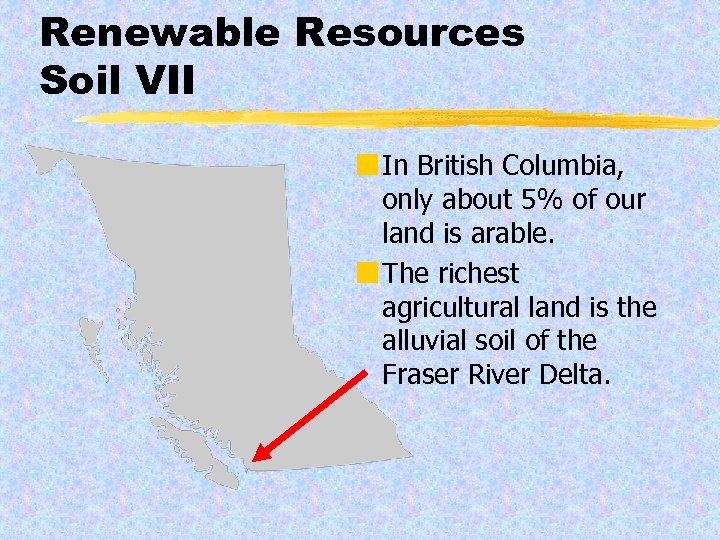 Renewable Resources Soil VII ¢ In British Columbia, only about 5% of our land is arable. ¢ The richest agricultural land is the alluvial soil of the Fraser River Delta.
 Renewable Resources Soil VIII ¢ The Fraser River delta is under considerable urban pressure, with much land already under concrete. ¢ Industrial, commercial and residential use generate much more revenue than farming. ¢ Though an agricultural land freeze was introduced in the early 1970’s, the gradual alienation of farm land continues. ¢ Farming and urban populations do not mix easily.
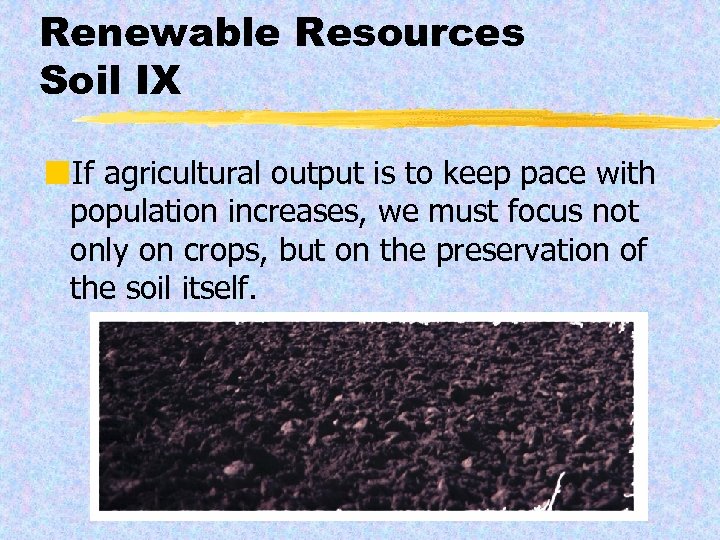 Renewable Resources Soil IX ¢If agricultural output is to keep pace with population increases, we must focus not only on crops, but on the preservation of the soil itself.
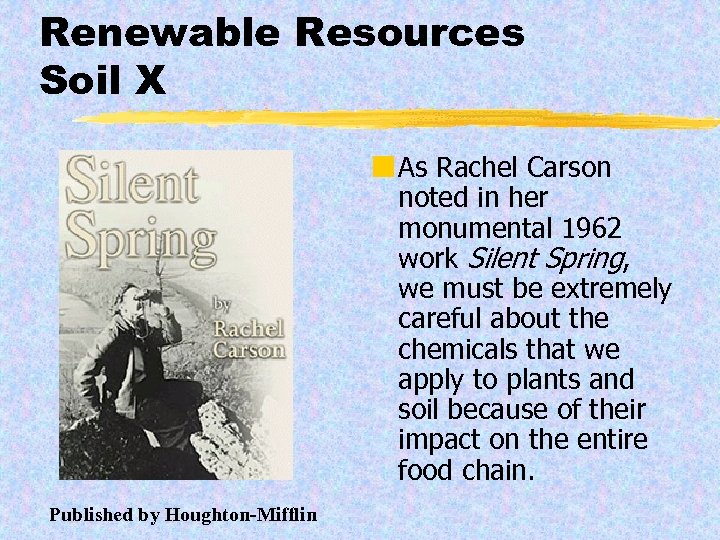 Renewable Resources Soil X ¢ As Rachel Carson noted in her monumental 1962 work Silent Spring, we must be extremely careful about the chemicals that we apply to plants and soil because of their impact on the entire food chain. Published by Houghton-Mifflin
 Renewable Resources Food
 Renewable Resources Food ¢Our most important resources are food and water, which meet the most basic of human needs. ¢Tremendous increases in food production have occurred over the past century, with more people now better fed than at any other time in history.
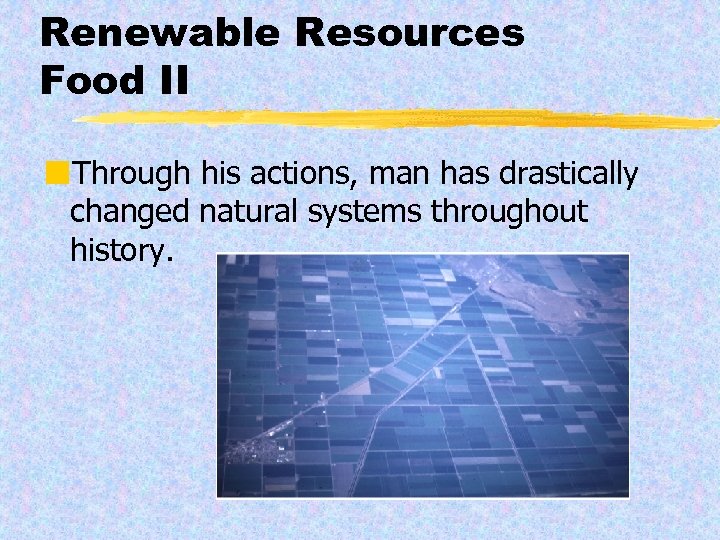 Renewable Resources Food II ¢Through his actions, man has drastically changed natural systems throughout history.
 Renewable Resources Food III ¢In the Nile, Huang Ho, Tigris-Euphrates, and Indus Rivers, early man replaced natural systems with agricultural production that has greatly simplified biological diversity. ¢This produced the food surpluses that made civilization possible.
 Renewable Resources Food IV ¢Food production has increased enormously. ¢Increases in population also mean that there also more hungry people than ever before. ¢As world populations rise, it is crucial that food production keeps pace.
 Renewable Resources The Green Revolution
 Renewable Resources Food – The Green Revolution ¢ Since the 1950’s huge increases in plant yields have been achieved by the development of hybrid plant varieties and the application of inorganic fertilizers and carefully controlled watering. ¢ Between 1925 and 1930 Mexico produced 700 kg of wheat per hectare. ¢ Between 1965 and 1969, as new high yield varieties were planted, it produced 2400 kg per hectare.
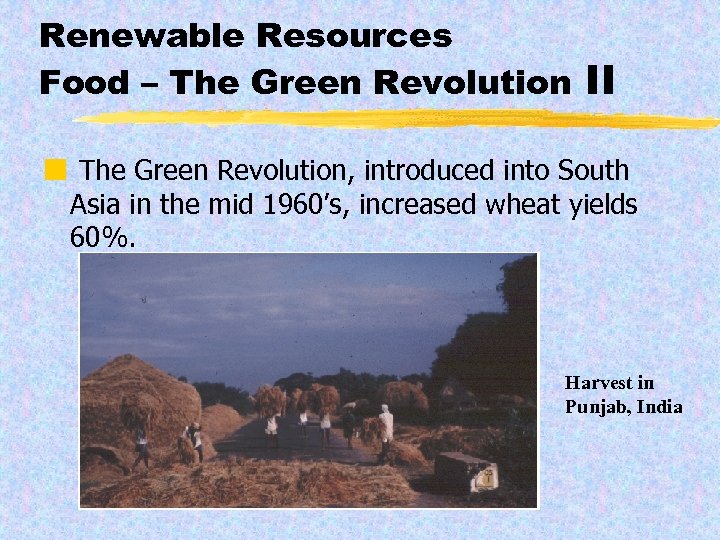 Renewable Resources Food – The Green Revolution II ¢ The Green Revolution, introduced into South Asia in the mid 1960’s, increased wheat yields 60%. Harvest in Punjab, India
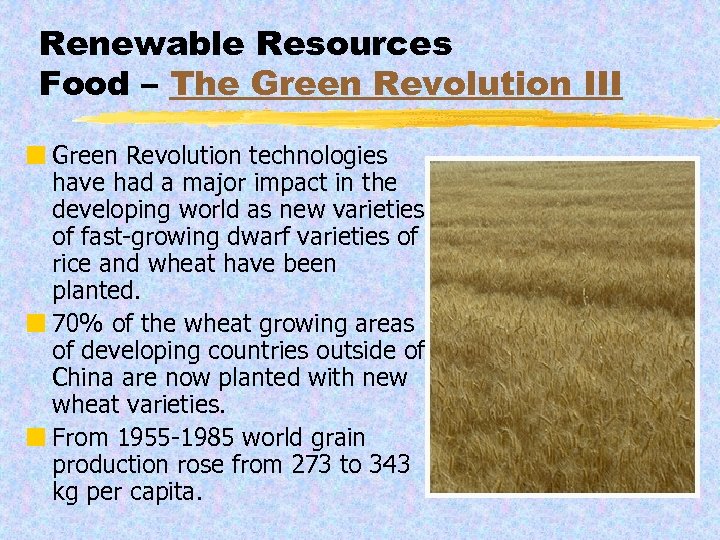 Renewable Resources Food – The Green Revolution III ¢ Green Revolution technologies have had a major impact in the developing world as new varieties of fast-growing dwarf varieties of rice and wheat have been planted. ¢ 70% of the wheat growing areas of developing countries outside of China are now planted with new wheat varieties. ¢ From 1955 -1985 world grain production rose from 273 to 343 kg per capita.
 Renewable Resources Food – The Green Revolution IV ¢ Genetic manipulation has resulted in hardier species that can be adapted to wide ranging conditions. ¢ Future varieties may produce high yields while offering more resistance to disease and insects, while requiring less fertilization. ¢ Triticale, a cross between wheat and rye, proves that some of these traits can be bred into plants. ¢ This grain grows in a variety of climates and in poor soils.
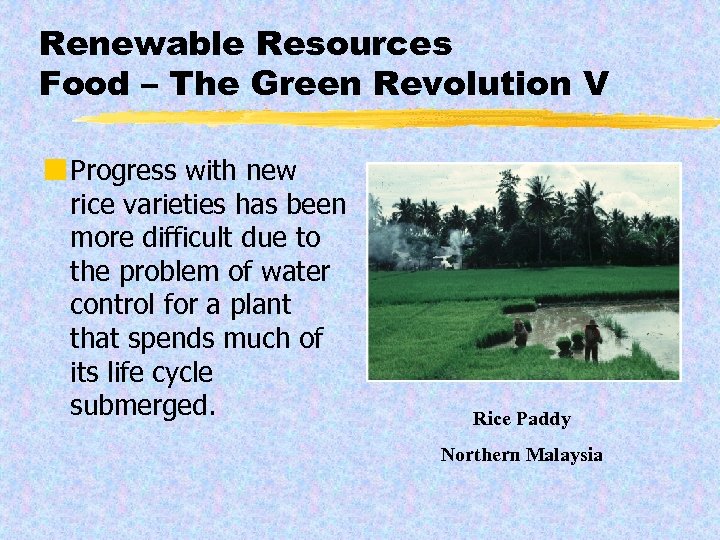 Renewable Resources Food – The Green Revolution V ¢ Progress with new rice varieties has been more difficult due to the problem of water control for a plant that spends much of its life cycle submerged. Rice Paddy Northern Malaysia
 Renewable Resources Food – The Green Revolution VI ¢However, seemingly miraculous increases in yield come at a price. ¾It takes 1. 2 barrels of oil to produce a ton of grain in developed countries – fully 700% more than was the case in 1950. ¾ 8% of the world’s oil production is now committed to “industrial agriculture”.
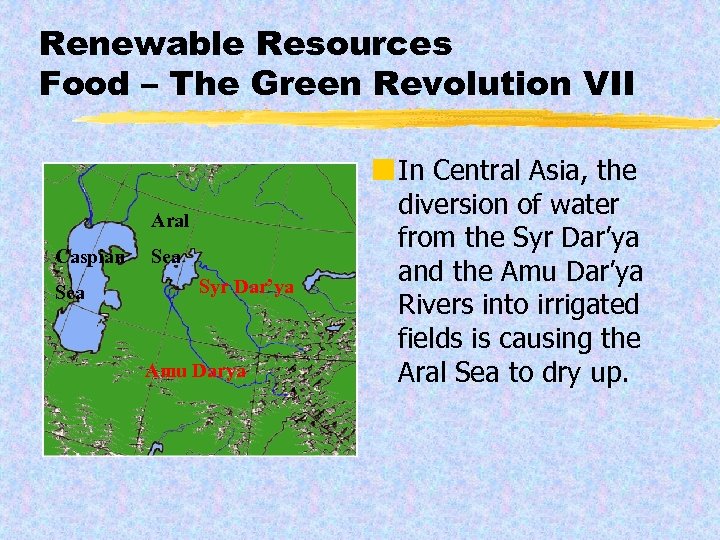 Renewable Resources Food – The Green Revolution VII Aral Caspian Sea Syr Dar’ya Amu Darya ¢ In Central Asia, the diversion of water from the Syr Dar’ya and the Amu Dar’ya Rivers into irrigated fields is causing the Aral Sea to dry up.
 Renewable Resources Food – The Green Revolution VIII ¾The costs of green revolution technology place it in the hands of the rich and agribusinesses. ¾The poor, who most need it, cannot afford it. ¾New varieties displace native crops and reduce genetic diversity. ¾Sometimes this involves growing export products instead of subsistence crops.
 Renewable Resources Food – a 2 nd Green Revolution ¢ Despite its drawbacks, the Green Revolution has been instrumental in staving off famine. ¢ We have learned from its failings and scientists now seek to move it into a second phase.
 Renewable Resources Food – a 2 nd Green Revolution II ¢Some scientists feel crops or animals might be bred with bioindicators or “marker genes. ” ¢For instance, a plant might be bred that changes colour when it is not getting enough water. ¢A farmer can then fine tune irrigation to avoid wasting water.
 Renewable Resources Food – a 2 nd Green Revolution III ¢ Other scientists want to produce apomictic plants, which reproduce asexually. ¢ Farmers could then produce their own seed. ¢ Another goal would be to replace annuals, like corn, wheat and rice with perennials.
 Renewable Resources Food – a 2 nd Green Revolution IV ¢ Transgenic crops could resist pests, insects and disease. ¢ One of the most exciting prospects for the future is the engineering of nitrogen-fixing crops and microorganisms. ¢ Since nitrogen is essential and expensive to add to soil, if the characteristics of nitrogen fixers, like legumes, could be given to other plants it would help world food production enormously.
 Renewable Resources The Blue Revolution
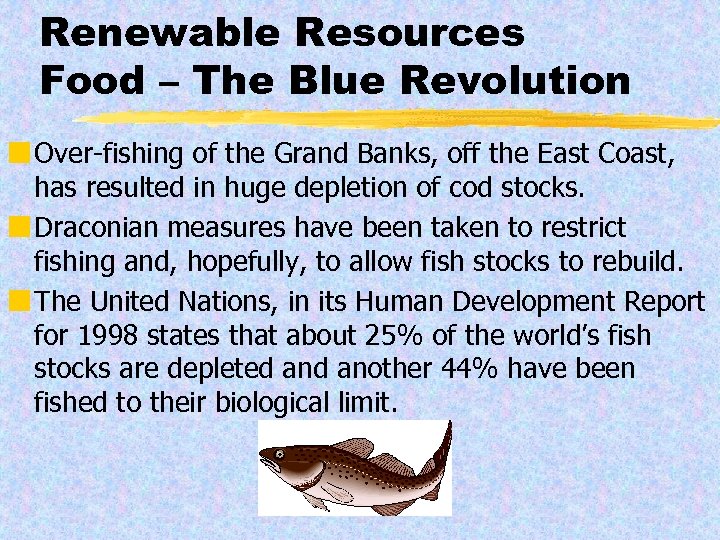 Renewable Resources Food – The Blue Revolution ¢ Over-fishing of the Grand Banks, off the East Coast, has resulted in huge depletion of cod stocks. ¢ Draconian measures have been taken to restrict fishing and, hopefully, to allow fish stocks to rebuild. ¢ The United Nations, in its Human Development Report for 1998 states that about 25% of the world’s fish stocks are depleted another 44% have been fished to their biological limit.
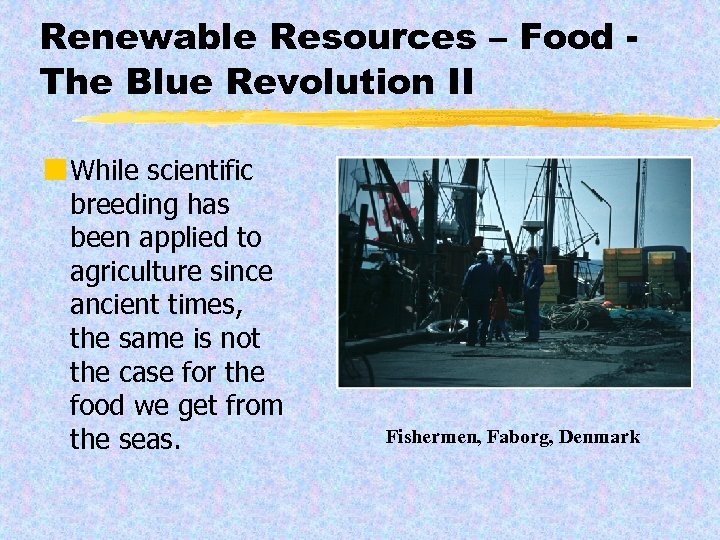 Renewable Resources – Food The Blue Revolution II ¢ While scientific breeding has been applied to agriculture since ancient times, the same is not the case for the food we get from the seas. Fishermen, Faborg, Denmark
 Renewable Resources – Food The Blue Revolution III ¢ In this regard we are barely out of the hunter-gatherer stage. ¢ Most of our research has gone into improving our harvests, without much thought to improving stocks.
 Renewable Resources – Food The Blue Revolution IV ¾The East Coast cod fishery is a particularly devastating example as fish location and large scale harvesting improved, depleted stocks to dangerously low levels and resulting in complete closure of this once abundant fishery.
 Renewable Resources – Food The Blue Revolution V ¢Aquaculture – the aquatic equivalent of agriculture – involves cultivating water species in controlled environments. ¾These environments could be ponds or lakes or pens within the ocean. ¢In 1990 only 15% of our seafood came from such sources, but we will likely rely on aquaculture much more heavily in the future.
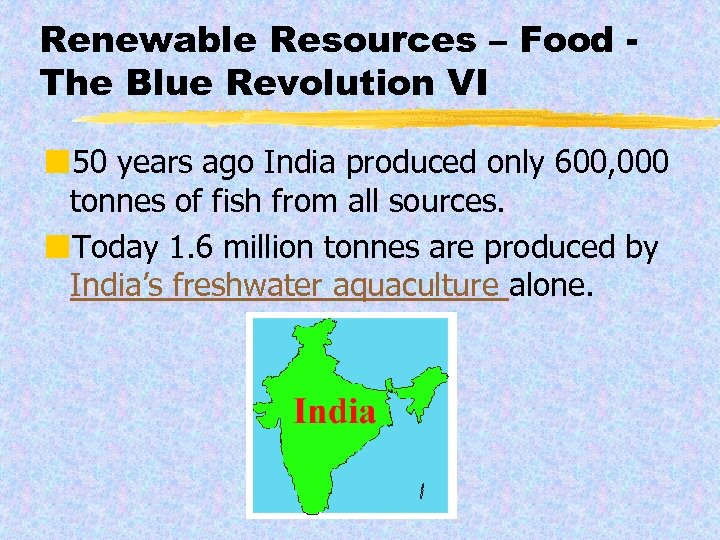 Renewable Resources – Food The Blue Revolution VI ¢ 50 years ago India produced only 600, 000 tonnes of fish from all sources. ¢Today 1. 6 million tonnes are produced by India’s freshwater aquaculture alone.
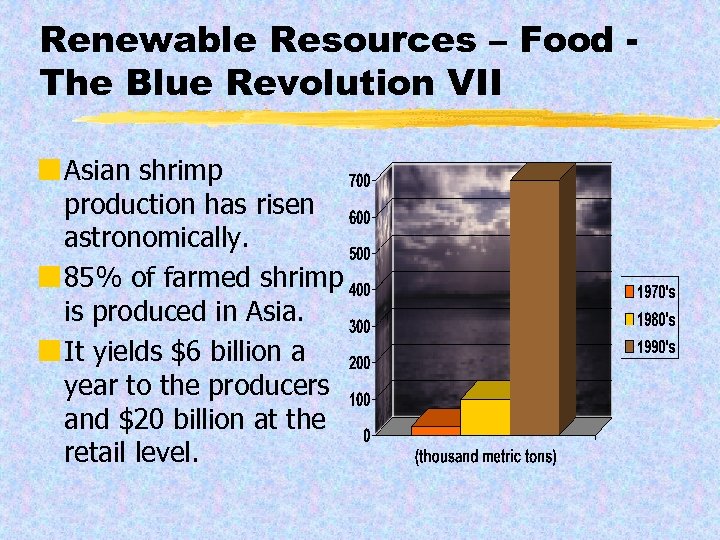 Renewable Resources – Food The Blue Revolution VII ¢ Asian shrimp production has risen astronomically. ¢ 85% of farmed shrimp is produced in Asia. ¢ It yields $6 billion a year to the producers and $20 billion at the retail level.
 Renewable Resources – Food The Blue Revolution VIII ¢ Aquaculture is also not without its problems¾Aquaculture techniques are in their infancy. ¾Water quality must be maintained or farmed stocks become sick within the pens that they foul with their own excrement. ¾Antibiotics are widely used to keep fish healthy – but there is concern that eating such fish might raise human tolerance to similar medication. ¾Some biologists warn that escaped farmed species may displace native fish.
 Renewable Resources – Food The Blue Revolution IX ¢ Further problems – ¾As in Agriculture, monocultures may replace varied species in particular areas. ¾In South-East Asia large areas of mangrove swamps were cleared for shrimp farming. Only 50% of the original mangrove areas in subtropical countries still remains. ¾Aquaculture may have the same effect on our oceans that agriculture has had on land. ¾Much food is produced, but at a substantial cost to natural systems. Is this a price we are willing to pay?
 Renewable Resources Industrial Crops
 Renewable Resources Industrial Crops ¢Our demand for industrial crops, such as timber and cotton, appear insatiable. ¢Concern has been raised over the changes to ecosystems as monocultures replace the natural variety of plant life. ¢Land use conflicts are inevitable. What is needed is balance – both in land use and in the techniques of agriculture or silviculture employed.
 Renewable Resources Industrial Crops II ¢Opposition to tropical deforestation and clear cutting of temperate forests has been vocal and policy makers have been forced to respond. ¾In Brazil, reserve areas are being set aside. ¾In British Columbia, new forest practices are being put in place which encourage selective cutting and support reforestation efforts.
 Renewable Resources Industrial Crops III ¢ Industrial crops, as well as food crops, are profiting from scientific research as scientists develop hardier plant varieties and look at intercropping techniques. ¢ It is hoped that the future will not see the devastating results of agricultural development like the Soviet “Virgin Lands” projects that brought ecological disaster to Central Asia.
 Non-Renewable Resources
 Non-Renewable Resources ¢These may be plentiful or may exist in only very small amounts and distribution of resources is uneven. ¢Their value to mankind has historically been determined by supply and demand.
 Non-Renewable Resources Probable & Proved Reserves ¢ Geologists’ rough estimates of the amount of a mineral in the earth’s crust provide the basis of our probable reserves. ¢ This is a measure of doubtful value. ¢ While it is clear that mineral resources continue to be discovered, over and above our known, or proved reserves, location and difficulty of extraction may make new discoveries uneconomical.
 Non-Renewable Resources R/P Ratio ¢ R/P Ratio is a measure of how proved reserves relate to consumption: R divided by P R = Reserves P = Production (consumption) On the basis of this figure, predictions are made as to the lifespan of a given resource. The predictions of the 1970’s and 1980’s that world oil stocks would dry up were made on this basis. It has not happened because new stocks were found. That stocks remain does not alter the fact that petroleum reserves are finite.
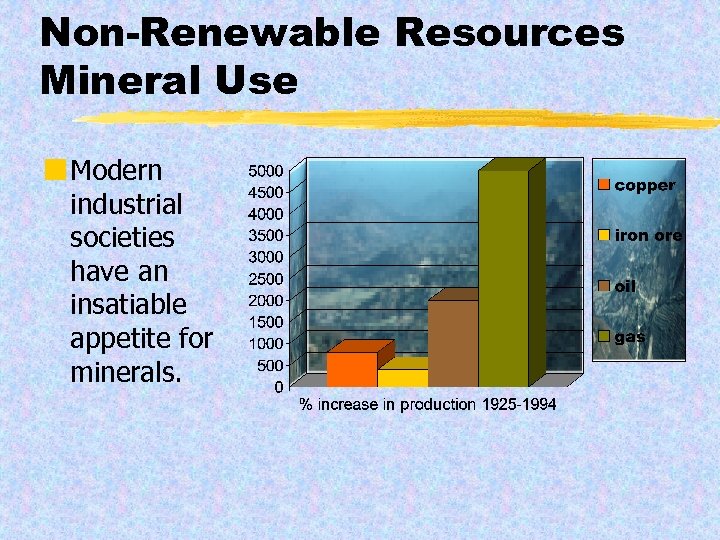 Non-Renewable Resources Mineral Use ¢ Modern industrial societies have an insatiable appetite for minerals.
 Non-Renewable Resources Mineral Use II ¢ One would expect that as these resources were depleted, costs would rise. This has not been the case. ¢ The real prices of these materials has actually fallen – by as much as 50% - between the 1970’s and 1990’s. ¢ Price is determined by the present cost of production and current supplies – not long term considerations. ¢ Market prices will only rise when existing supplies are depleted.
 Non-Renewable Resources Mineral Use III ¢Policy makers in government and business need to consider the long term if we are to avoid crippling mineral shortages in the future. ¢Work must begin now on substituting for goods that will be in short supply in the future.
 Oil – The Crucial Resource
 Oil – The Crucial Resource ¢Modern industrial economies are driven by petroleum products. ¾Oil is burned to produce electrical power. ¾Gasoline and other refined products power the internal combustion engines that power our transportation on land, sea and air.
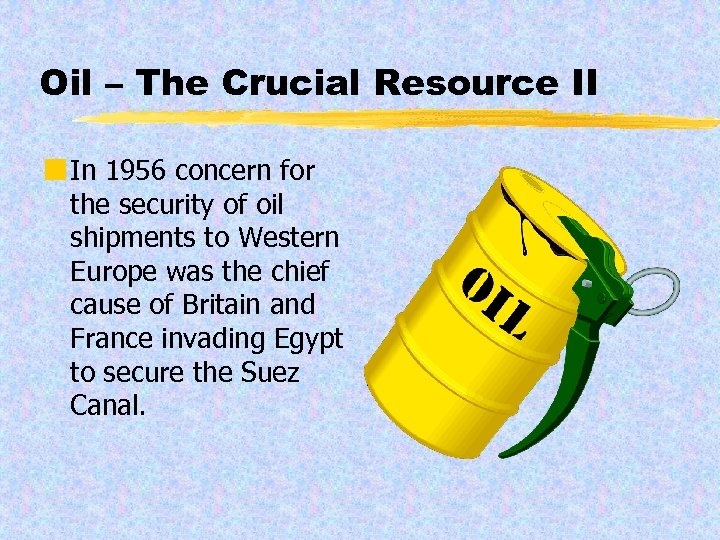 Oil – The Crucial Resource II ¢ In 1956 concern for the security of oil shipments to Western Europe was the chief cause of Britain and France invading Egypt to secure the Suez Canal.
 Oil – The Crucial Resource III ¢ During an oil embargo by Arab oil producers during the 1973 Yom Kippur War in the Middle East, Western nations were cut off from supplies in an attempt to prevent their assisting Israel. ¢ Fuel prices soared and supplies were so limited that gas stations restricted their hours and days of operation. ¢ The Gross National Product of the United States shrank and unemployment doubled.
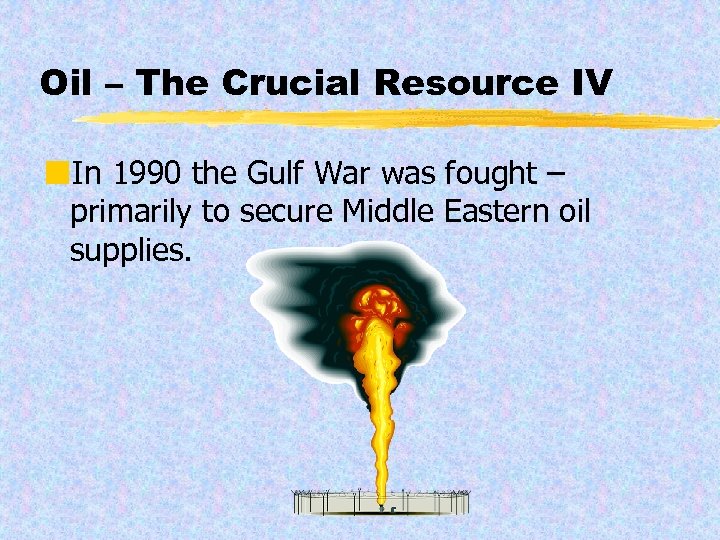 Oil – The Crucial Resource IV ¢In 1990 the Gulf War was fought – primarily to secure Middle Eastern oil supplies.
 Oil – The Crucial Resource V ¢ Oil is the single most important resource in industrial countries and it accounts for fully 40% of total primary energy demands. ¢ The International Energy Agency expects that global energy production will have to rise by more than 30% to meet increasing world demand – yet petroleum products are a nonrenewable resource and we have been drawing down supplies at an ever increasing rate during this century. ¢ Oil and gas reserves should last another 40 -65 years at current rates of consumption.
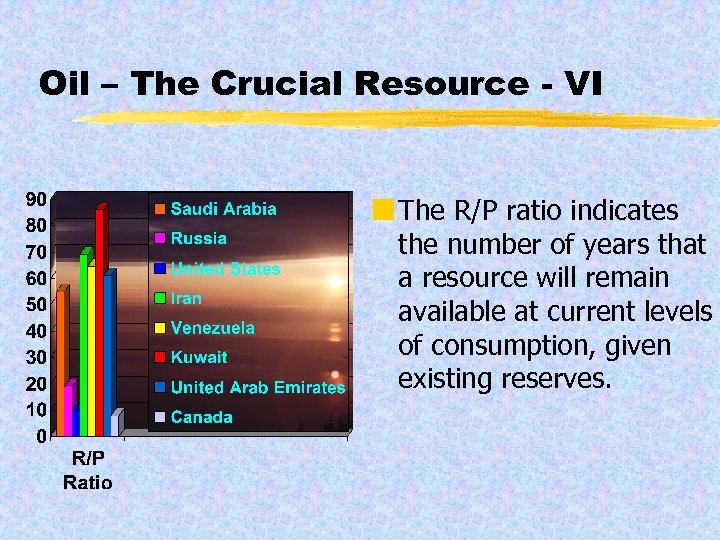 Oil – The Crucial Resource - VI ¢ The R/P ratio indicates the number of years that a resource will remain available at current levels of consumption, given existing reserves.
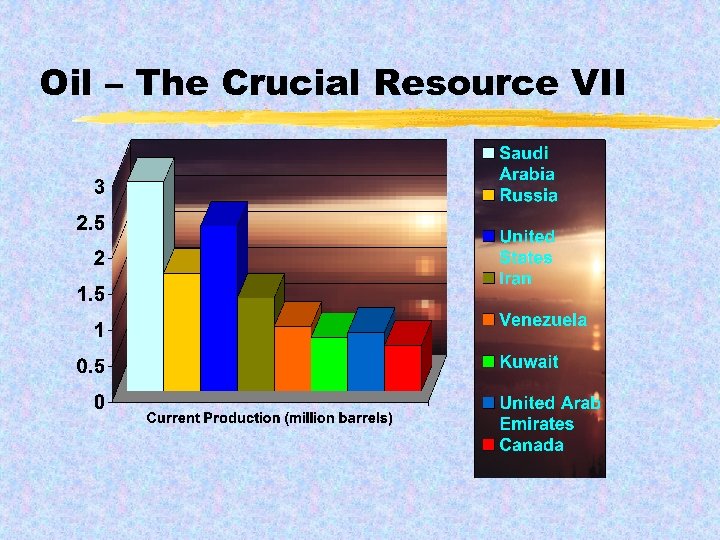 Oil – The Crucial Resource VII
 Distribution of Resources
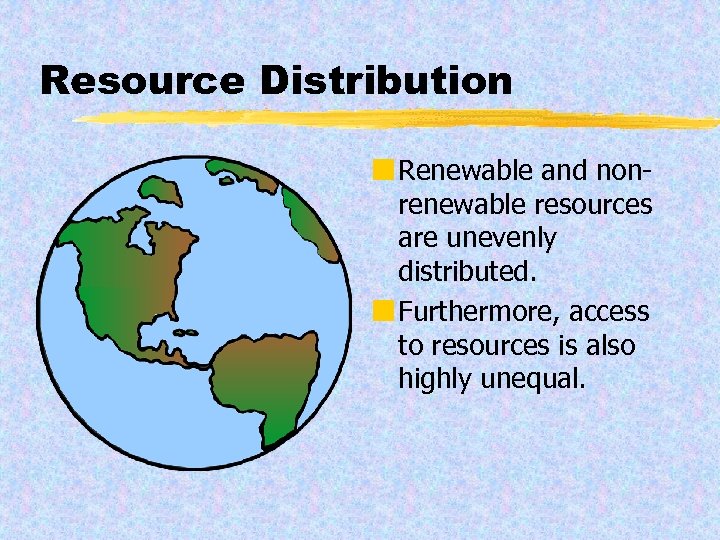 Resource Distribution ¢ Renewable and nonrenewable resources are unevenly distributed. ¢ Furthermore, access to resources is also highly unequal.
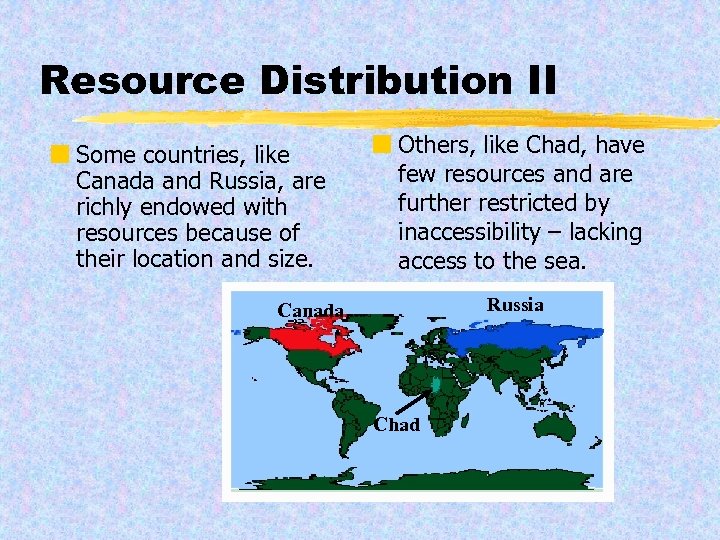 Resource Distribution II ¢ Some countries, like Canada and Russia, are richly endowed with resources because of their location and size. ¢ Others, like Chad, have few resources and are further restricted by inaccessibility – lacking access to the sea. Russia Canada Chad
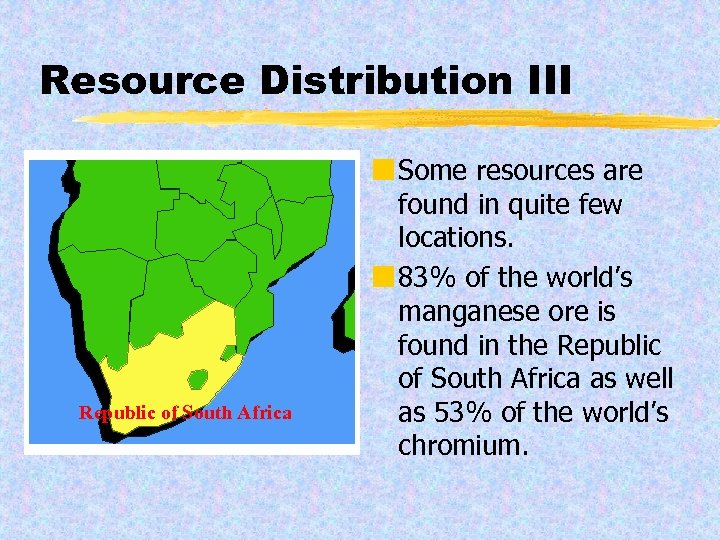 Resource Distribution III Republic of South Africa ¢ Some resources are found in quite few locations. ¢ 83% of the world’s manganese ore is found in the Republic of South Africa as well as 53% of the world’s chromium.
 Technological Change
 Technological Change ¢Production, consumption, and even the kinds of resources we use change with time. ¾Coal replaced wind and oil replaced coal in propelling ships. ¾Today, Ceramics and graphite replace steel in some applications and glass fibre replaces copper in telephone lines. ¾Further changes will inevitably occur, so current predictions of resource use may not remain valid.
 Technological Change II ¢As particular resources are depleted, their relative costs rise against potential alternatives, leading to changes in consumption. ¢Where alternatives do not currently exist, there is increasing research into new possibilities.
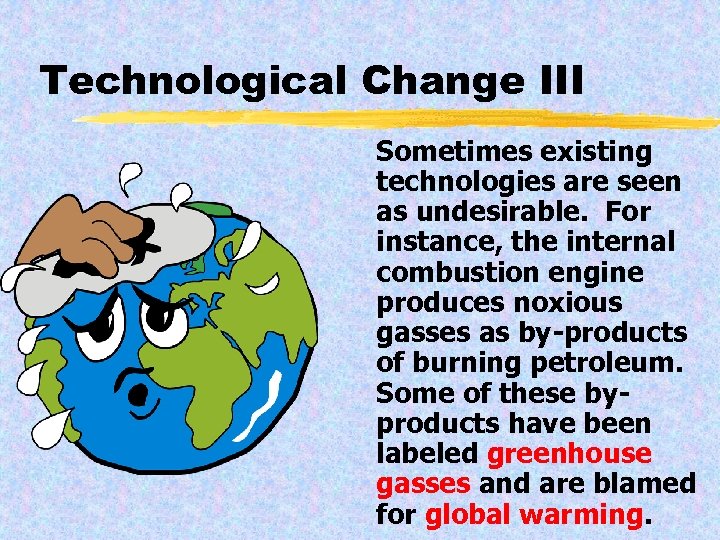 Technological Change III Sometimes existing technologies are seen as undesirable. For instance, the internal combustion engine produces noxious gasses as by-products of burning petroleum. Some of these byproducts have been labeled greenhouse gasses and are blamed for global warming.
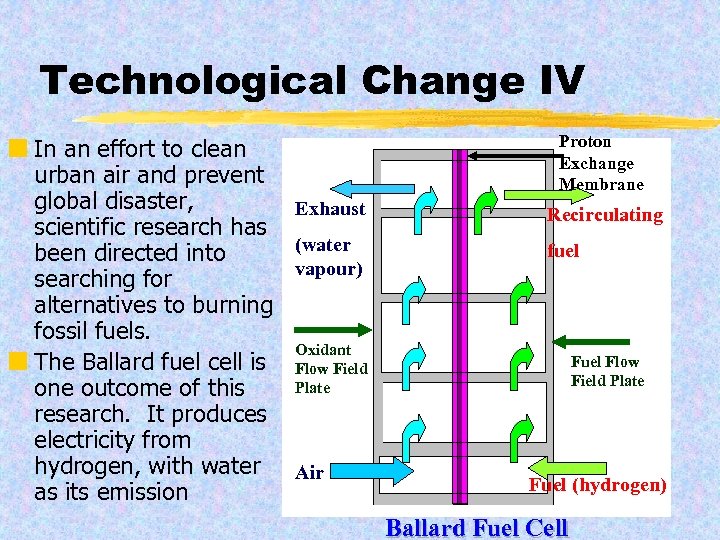 Technological Change IV ¢ In an effort to clean urban air and prevent global disaster, scientific research has been directed into searching for alternatives to burning fossil fuels. ¢ The Ballard fuel cell is one outcome of this research. It produces electricity from hydrogen, with water as its emission Proton Exchange Membrane Exhaust Recirculating (water vapour) fuel Oxidant Flow Field Plate Air Fuel Flow Field Plate Fuel (hydrogen) Ballard Fuel Cell
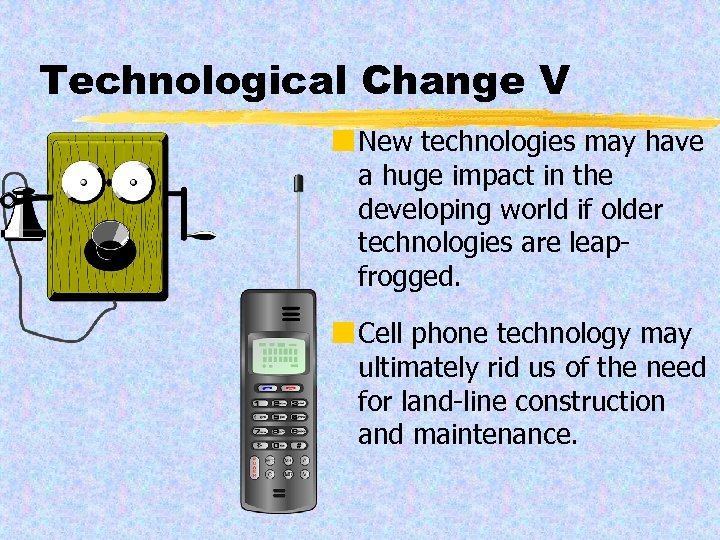 Technological Change V ¢ New technologies may have a huge impact in the developing world if older technologies are leapfrogged. ¢ Cell phone technology may ultimately rid us of the need for land-line construction and maintenance.
 Technological Change VI ¢ Despite more ecologically friendly technologies being developed, pollution in the developed and developing world is still a huge problem with global consequences in the case of greenhouse emissions that appear to be warming the globe. ¢ Specific plant or animal species rely on specific conditions to survive. ¢ Variations in temperature or precipitation can result in entire species disappearing.
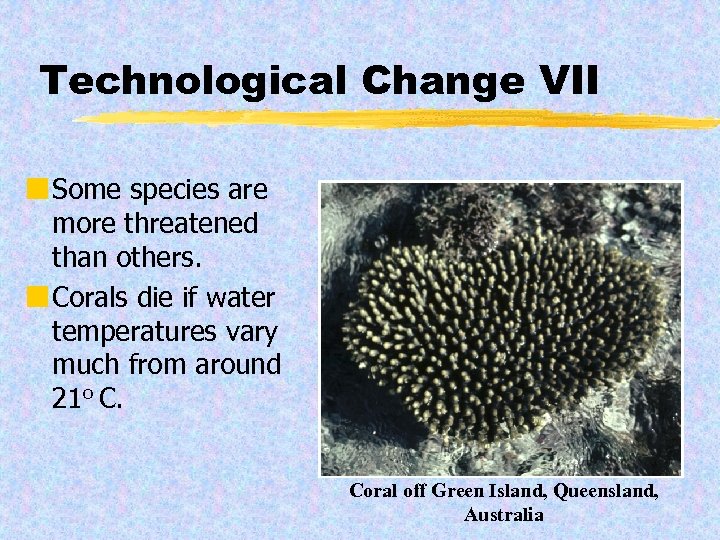 Technological Change VII ¢ Some species are more threatened than others. ¢ Corals die if water temperatures vary much from around 21 o C. Coral off Green Island, Queensland, Australia
 Technological Change VIII ¢ Ice ages and periods of warming have caused enormous changes in the flora or fauna of much of the earth’s surface. ¢ However, the natural changes brought by Man, such as global warming are occurring over a much shorter time span, making species adaptation more difficult.
 Conclusion ¢Clearly, technological change has negative and positive outcomes. However, standing still is not possible. ¢Scientists must continue to seek solutions to our resource problems that will also address ecological concerns. ¢Failure to do so will have disastrous consequences for civilization.
 Chapter 16 - Patterns in Economic Development ¢ Do Activity Sheet 16 -1, 16 -2, & 16 -3 ¢ Know “Industries”; “Core & Periphery”; “Traditional, Developing, Developed Economies” ¢ Do Text “Activities”: -Page 399 -#’s 1 -4 -Page 403 -#’s 1 -3 -Page 409 -#’s 1 -4 -Page 413 -#’s 1 -3 -Page 415 -#’s 1 -3
 Chapter 17 - Environment ¢Do “Activity Sheet” 17 -1, 17 -2, & 17 -3 ¢Do “Text Activities”: -Page 423 - #’s 1 -4 -Page 430 - #’s 1 -5 -Page 433 -#’s 1 -5 -Page 438 -#’s 1 -5 -Page 443 -#’s 1 -6
 Image Credits
 Image Credits Every effort has been made to credit images used in this presentation. All images not otherwise credited have been obtained from clip art collections or are believed to be in the public domain. The authors would be pleased to correct any omissions. Slide #1 Private collection, K. J. Benoy (Punjabi farm) Slide #10 Private collection, K. J. Benoy (Viti Levu, Fiji) Slide #13 Private collection, K. J. Benoy (Jordan River, Israel) Slide # 14 Private collection, K. J. Benoy (chart image, Vancouver Aquarium) ¢ Slide #16 Private collection, Ken Atkinson (village well in North India) ¢ Slide #17 Private collection, K. J. Benoy (Malaysian rice paddy) ¢ Slide #19 Private collection, K. J. Benoy (Cleveland Dam, North Vancouver) ¢ ¢
 Image Credits ¢ Slide #20 Private ¢ Slide #24 Private Uxmal, Mexico) ¢ Slide #33 Private farmland) ¢ Slide #38 Private North India) ¢ Slide #41 Private Paddy ¢ Slide #51 Private Denmark) ¢ Slide #56 Private at Suva, Fiji) collection, K. J. Benoy (Jordan River, Israel) collection, K. J. Benoy (Mayan Pyramid, Collection, K. J. Benoy (Californian collection, Ken Atkinson (Wheat harvest, collection, K. J. Benoy (Malaysian Rice collection, K. J. Benoy (Dock, Faborg, collection, K. J. Benoy (chart image, Sunset
 Image Credits ¢ Slide #67 Private collection, K. J. Benoy (chart image, Nepali countryside) ¢ Slide #89 Private collection, K. J. Benoy (Coral, Green Island, Queensland)