 Скачать презентацию Psychology What is cognitive psychology LO To describe
a16a3b7adf31abbe9795eebfd6df30a9.ppt
- Количество слайдов: 39



Psychology What is cognitive psychology? LO: To describe the cognitive approach
Psychology Cognitive tests • http: //www. youtube. com/watch? v=ue. Z 6 tvqhk 8 U&safe=active • Find the set of letters that doesn’t belong with the other sets. • A) cdef B) mnpo C) hikj D) vwyx
Psychology • Pairs • http: //faculty. washington. edu/chudler/stm 2. h tml • Write down what you ate for lunch everyday last week
Psychology
Psychology
Psychology • http: //xefer. com/maze-generator
Psychology • Sally Anne test
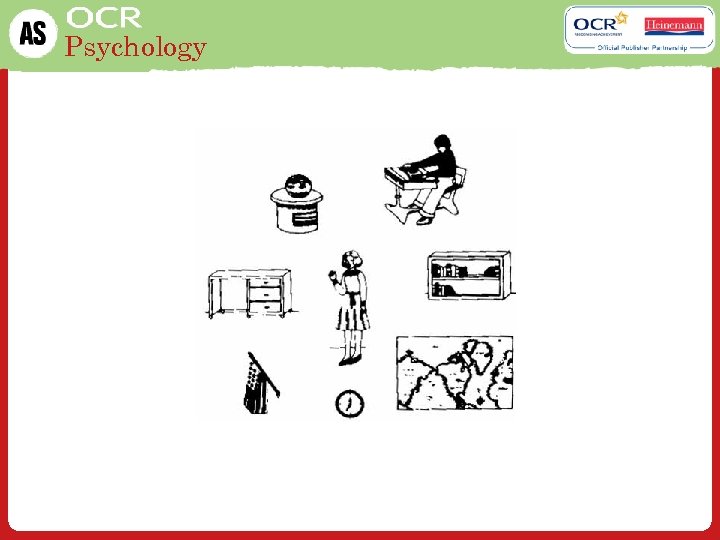
Psychology What sort of things were these tests testing?
Psychology Cognitive Psychology • Focuses on how we make sense of information • But where do we get the information in the first place?
Psychology The processes investigated in cognitive psychology include: 1. 2. 3. 4. Perception Language Memory Thinking
Psychology The experiment is the most popular way to investigate cognitive processes • What are some advantages of conducting an experiment on subjects? • What are some disadvantages of conducting an experiment on subjects?
Psychology A KEY QUESTION: • Are cognitive processes the product of NATURE or NURTURE? ?
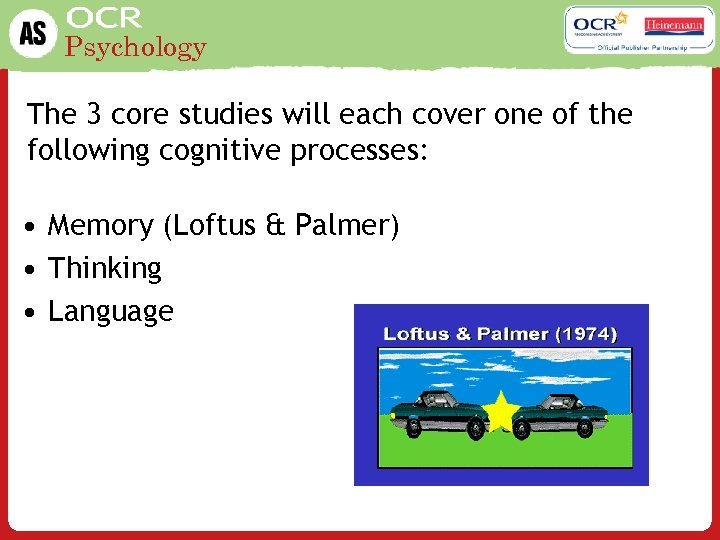
Psychology The 3 core studies will each cover one of the following cognitive processes: • Memory (Loftus & Palmer) • Thinking • Language
Psychology How can I improve my memory? • To describe the different types of memory and how it works
Psychology What do you remember of last summer? • How accurate do you think you are? • What might have affected your recall of it?
Psychology MEMORY • In psychology, memory is an organism's ability to store, retain, and subsequently retrieve information. • http: //www. youtube. com/watch? v=gr. Zuwo_Yl. Y 0&feature=related
Psychology • http: //www. youtube. com/watch? v=O-rnf. Dm. QEc. Y&safe=active • http: //www. youtube. com/watch? v=VQKt 58 ku. Enk • http: //www. guardian. co. uk/lifeandstyle/2012/jan/15/memory-gamesbrain-training-test • http: //www. telegraph. co. uk/educationadvice/9823789/Revi sion-techniques-The-secret-to-exam-revision-success. html • http: //www. telegraph. co. uk/educationadvice/9826494/Revi sion-techniques-How-to-learn-boring-facts. html
Psychology Types of Memory • A basic and generally accepted classification of memory is based on the duration of memory retention, and identifies three distinct types of memory: sensory memory, short term memory and long term memory.
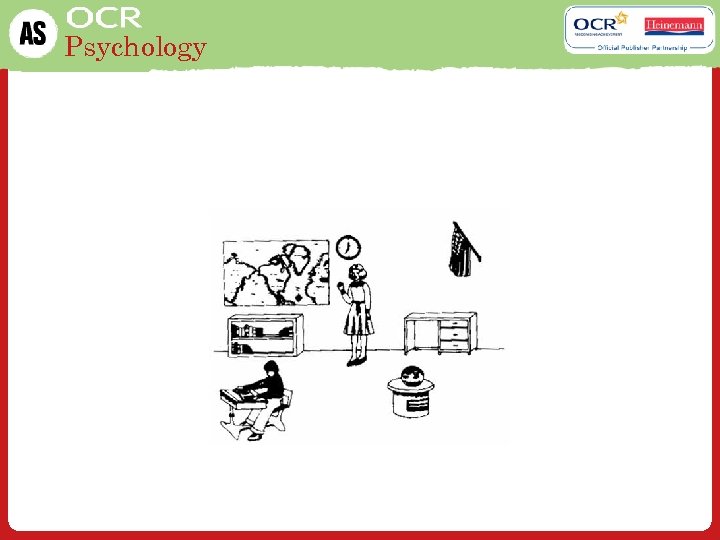
Psychology
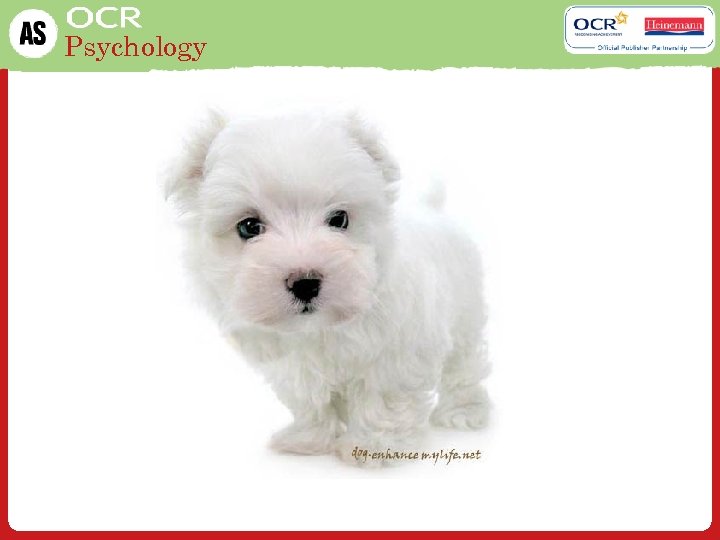
Psychology What did you see?
Psychology SENSORY MEMORY • Only lasts a second or 2 • The ability to see, recognise and remember what you saw with no rehearsal/practice • Very limited capacity
Psychology SHORT TERM MEMORY • Some of the information in sensory memory is then transferred to short-term memory • Short-term memory allows one to recall something from several seconds to as long as a minute without rehearsal/practice • Its capacity is also very limited
Psychology Short-term memory TASK: • Can you memorize the letters? • Get into pairs • TASK 1: Look at the letters for 5 seconds and try to memorise them. Recall • TASK 2: Look at the 2 nd set of letters for 5 seconds and try to memorise them. Recall • Which set of letters was easiest to remember? WHY?
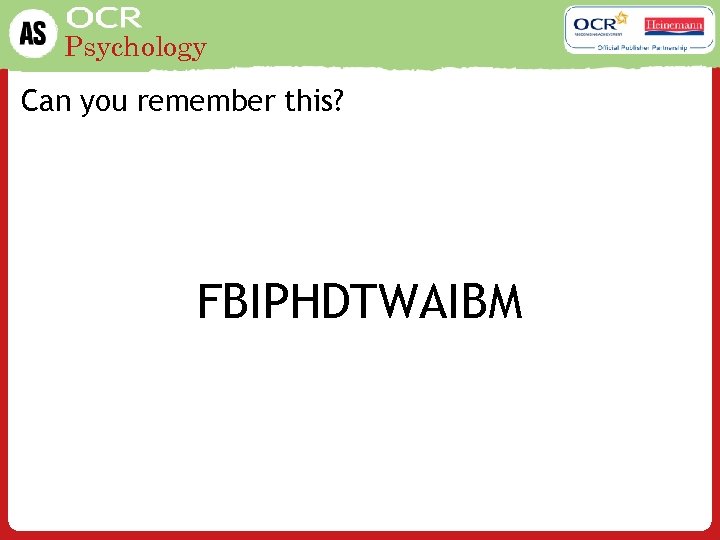
Psychology Can you remember this? FBIPHDTWAIBM
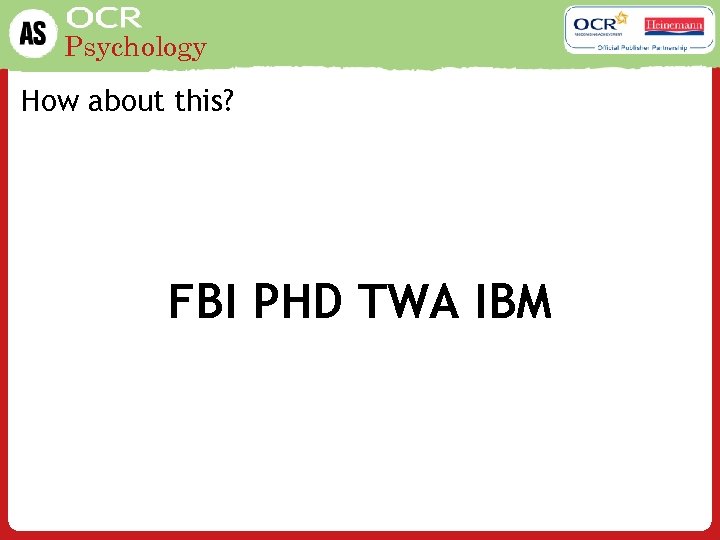
Psychology How about this? FBI PHD TWA IBM
Psychology Was that easier to remember? WHY? • CHUNKING • People can remember a great deal more letters when chunked or grouped • This is because they are able to chunk the information into meaningful groups of letters • 7± 2 items
Psychology LONG-TERM MEMORY • Can store much larger quantities of information for potentially unlimited duration (sometimes a whole life span).
Psychology What’s your telephone number? • We can remember telephone numbers for many years through repetition; this information is said to be stored in long-term memory
Psychology TASK: What factors can affect your memory? • • Diet Disease Age Drugs/Alcohol Exercise Environment, time of day, background noise http: //www. youtube. com/watch? v=OHl 7 Bew. J 0 y. U&feature=related
Psychology MODELS OF MEMORY • Models of memory provide abstract representations of how memory is believed to work • Multi-store (Atkinson-Shiffrin memory model)
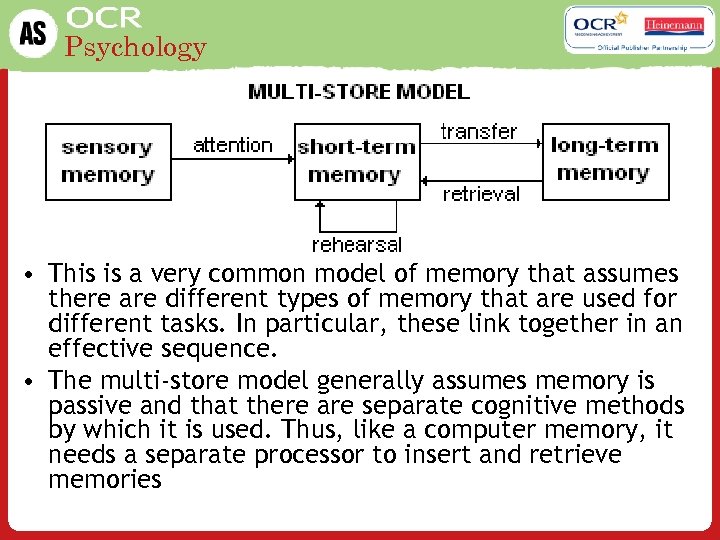
Psychology • This is a very common model of memory that assumes there are different types of memory that are used for different tasks. In particular, these link together in an effective sequence. • The multi-store model generally assumes memory is passive and that there are separate cognitive methods by which it is used. Thus, like a computer memory, it needs a separate processor to insert and retrieve memories
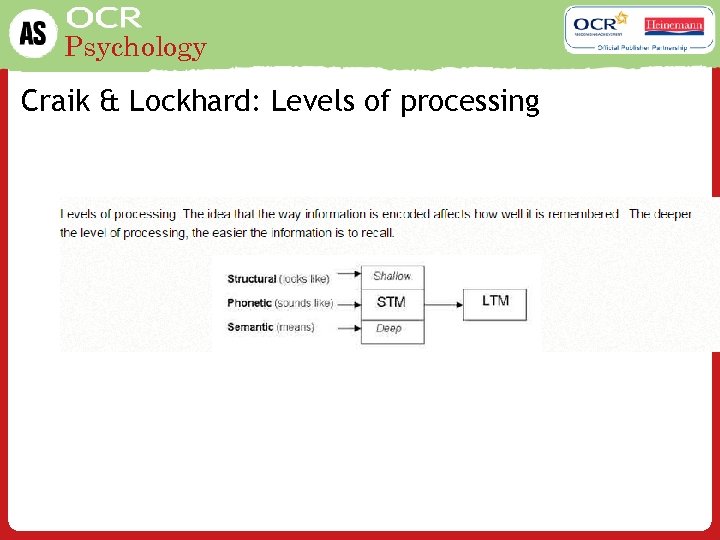
Psychology Craik & Lockhard: Levels of processing
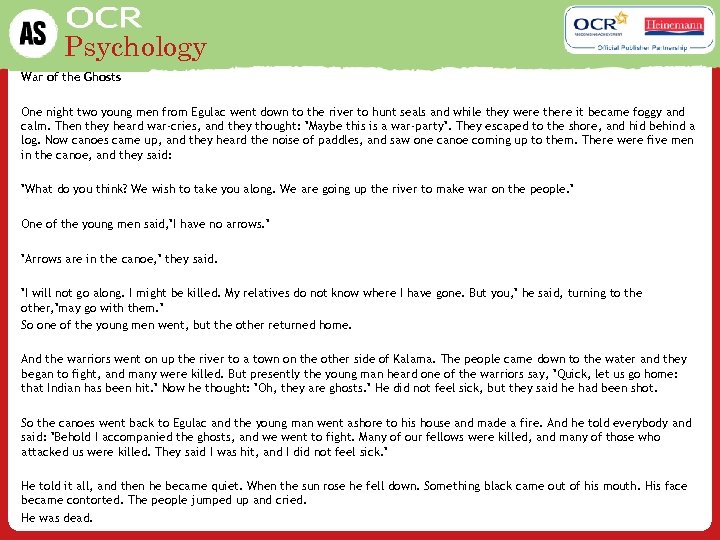
Psychology War of the Ghosts One night two young men from Egulac went down to the river to hunt seals and while they were there it became foggy and calm. Then they heard war-cries, and they thought: "Maybe this is a war-party". They escaped to the shore, and hid behind a log. Now canoes came up, and they heard the noise of paddles, and saw one canoe coming up to them. There were five men in the canoe, and they said: "What do you think? We wish to take you along. We are going up the river to make war on the people. " One of the young men said, "I have no arrows. " "Arrows are in the canoe, " they said. "I will not go along. I might be killed. My relatives do not know where I have gone. But you, " he said, turning to the other, "may go with them. " So one of the young men went, but the other returned home. And the warriors went on up the river to a town on the other side of Kalama. The people came down to the water and they began to fight, and many were killed. But presently the young man heard one of the warriors say, "Quick, let us go home: that Indian has been hit. " Now he thought: "Oh, they are ghosts. " He did not feel sick, but they said he had been shot. So the canoes went back to Egulac and the young man went ashore to his house and made a fire. And he told everybody and said: "Behold I accompanied the ghosts, and we went to fight. Many of our fellows were killed, and many of those who attacked us were killed. They said I was hit, and I did not feel sick. " He told it all, and then he became quiet. When the sun rose he fell down. Something black came out of his mouth. His face became contorted. The people jumped up and cried. He was dead.
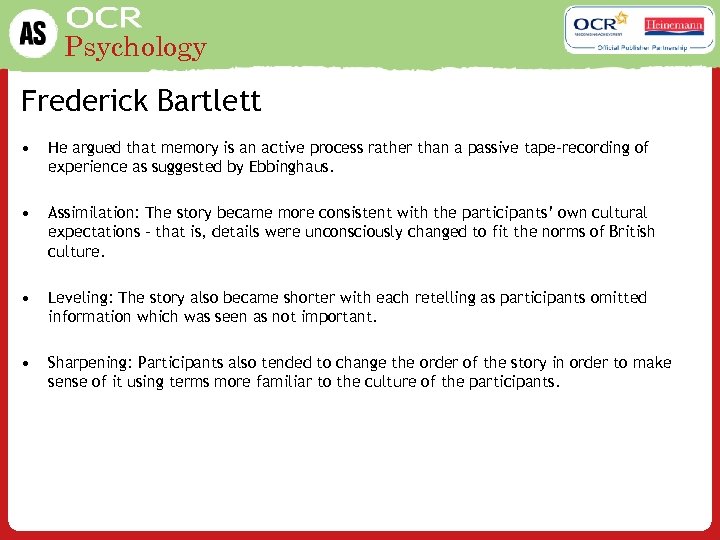
Psychology Frederick Bartlett • He argued that memory is an active process rather than a passive tape-recording of experience as suggested by Ebbinghaus. • Assimilation: The story became more consistent with the participants’ own cultural expectations - that is, details were unconsciously changed to fit the norms of British culture. • Leveling: The story also became shorter with each retelling as participants omitted information which was seen as not important. • Sharpening: Participants also tended to change the order of the story in order to make sense of it using terms more familiar to the culture of the participants.
Psychology Who can remember better? • http: //www. youtube. com/watch? v=TC 1 n. J 61 lh 4
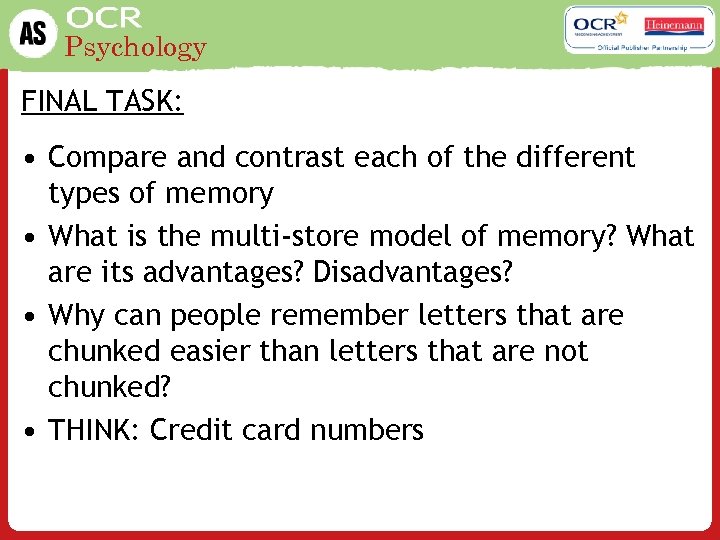
Psychology FINAL TASK: • Compare and contrast each of the different types of memory • What is the multi-store model of memory? What are its advantages? Disadvantages? • Why can people remember letters that are chunked easier than letters that are not chunked? • THINK: Credit card numbers
Psychology HOMEWORK: • Read the guardian article • Make notes on how to improve your long term memory – very useful! • • Exit pass 2 – 3 key things you learnt today 1 way you will apply this to your life 1 question you have about today’s lesson
Psychology PLENARY: • How good is your memory? • http: //www. bbc. co. uk/science/humanbody/mi nd/interactives/intelligenceandmemory/memor ytest/ • http: //www. bbc. co. uk/science/humanbody/mi nd/surveys/memory/ • What questions do you have about memory? • http: //www. bbc. co. uk/science/humanbody/mi nd/surveys/memory/questions. shtml
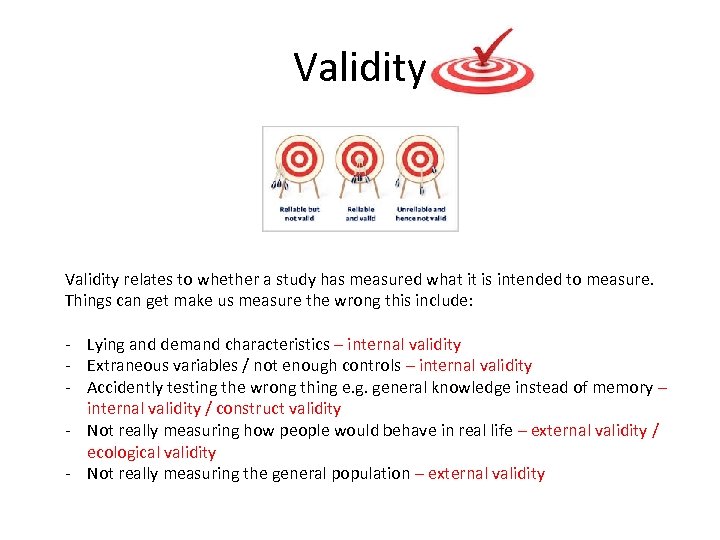
Validity relates to whether a study has measured what it is intended to measure. Things can get make us measure the wrong this include: - Lying and demand characteristics – internal validity - Extraneous variables / not enough controls – internal validity - Accidently testing the wrong thing e. g. general knowledge instead of memory – internal validity / construct validity - Not really measuring how people would behave in real life – external validity / ecological validity - Not really measuring the general population – external validity
Скачать презентацию Psychology What is cognitive psychology LO To describe
a16a3b7adf31abbe9795eebfd6df30a9.ppt