


 Скачать презентацию Psychology in Everyday Life David Myers Power Point
405bb74b4b1ed353e03ea52bea973d9c.ppt
- Количество слайдов: 75
 Psychology in Everyday Life David Myers Power. Point Slides Aneeq Ahmad Henderson State University Worth Publishers, © 2009
 Sensation and Perception Chapter 5
 Sensation & Perception How do we construct our representations of the external world? To represent the world, we must detect physical energy (a stimulus) from the environment and convert it into neural signals. This is a process called sensation. When we select, organize, and interpret our sensations, the process is called perception.
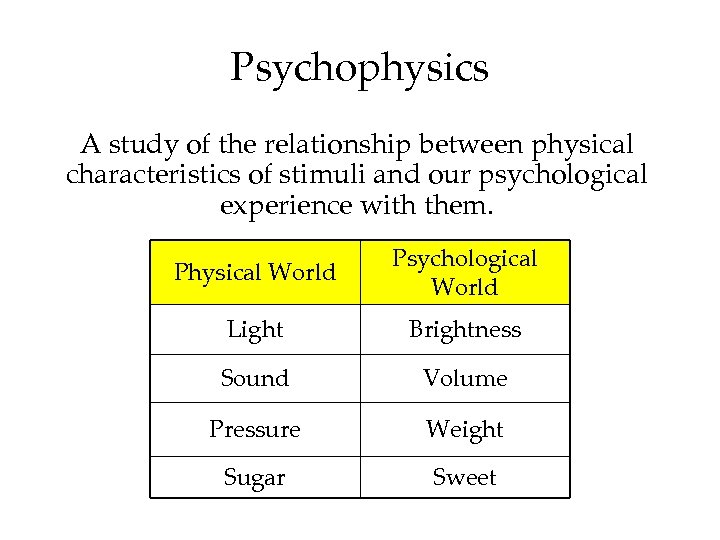 Psychophysics A study of the relationship between physical characteristics of stimuli and our psychological experience with them. Physical World Psychological World Light Brightness Sound Volume Pressure Weight Sugar Sweet
 Transduction In sensation, the transformation of stimulus energy (sights, sounds, smells) into neural impulses. Receive Transform Deliver
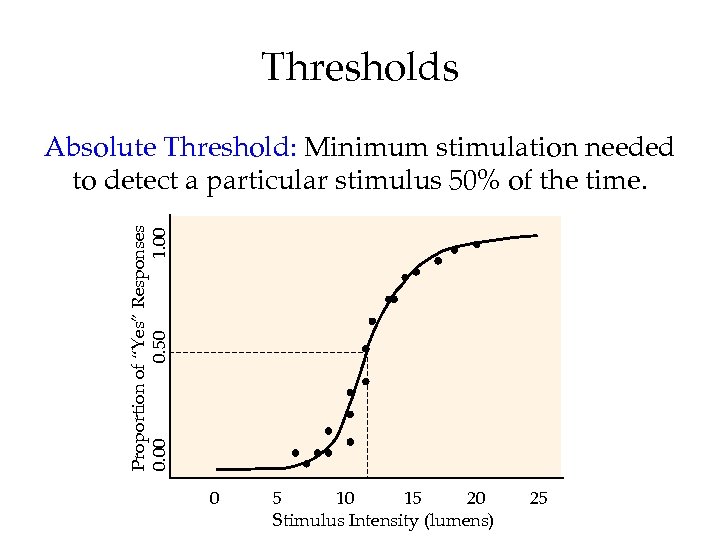 Thresholds Proportion of “Yes” Responses 0. 00 0. 50 1. 00 Absolute Threshold: Minimum stimulation needed to detect a particular stimulus 50% of the time. 0 5 10 15 20 Stimulus Intensity (lumens) 25
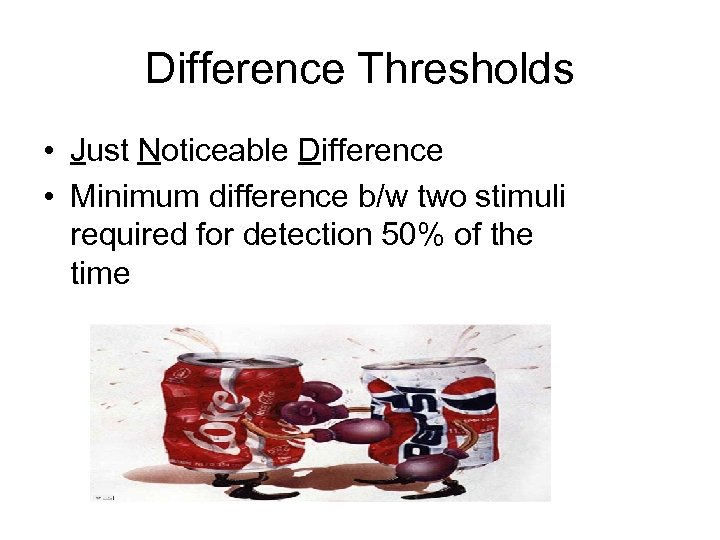 Difference Thresholds • Just Noticeable Difference • Minimum difference b/w two stimuli required for detection 50% of the time
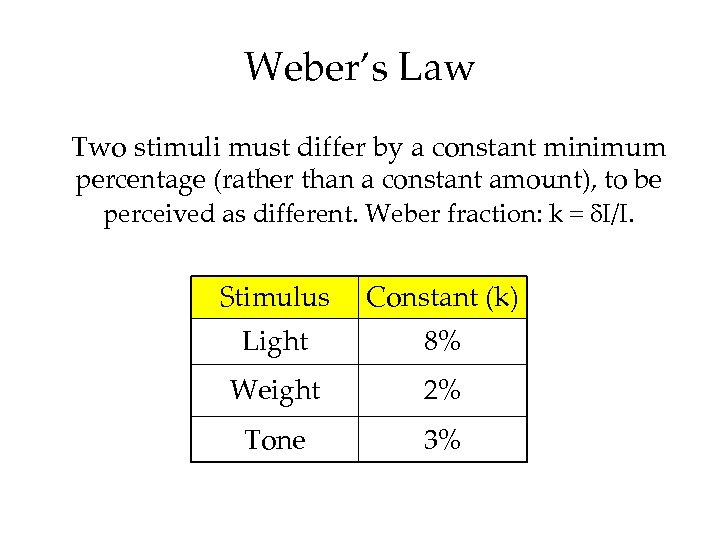 Weber’s Law Two stimuli must differ by a constant minimum percentage (rather than a constant amount), to be perceived as different. Weber fraction: k = d. I/I. Stimulus Constant (k) Light 8% Weight 2% Tone 3%
 Sensory Adaptation Diminished sensitivity as a consequence of constant stimulation. Put a band aid on your arm and after awhile you don’t sense it.
 Vision § The Stimulus Input: Light Energy § The Eye § Visual Information Processing
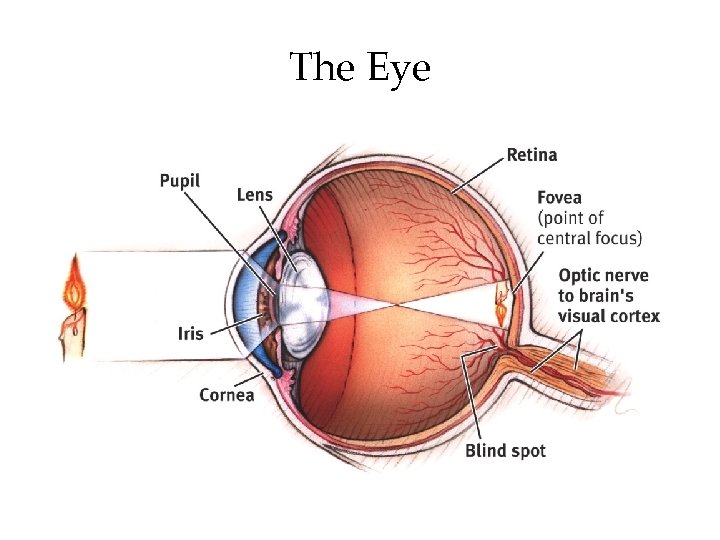 The Eye
 Parts of the eye 1. Cornea: Transparent tissue where light enters the eye. 2. Iris: Muscle that expands and contracts to change the size of the opening (pupil) for light. 3. Lens: Focuses the light rays on the retina. 4. Retina: Contains sensory receptors that process visual information and sends it to the brain.
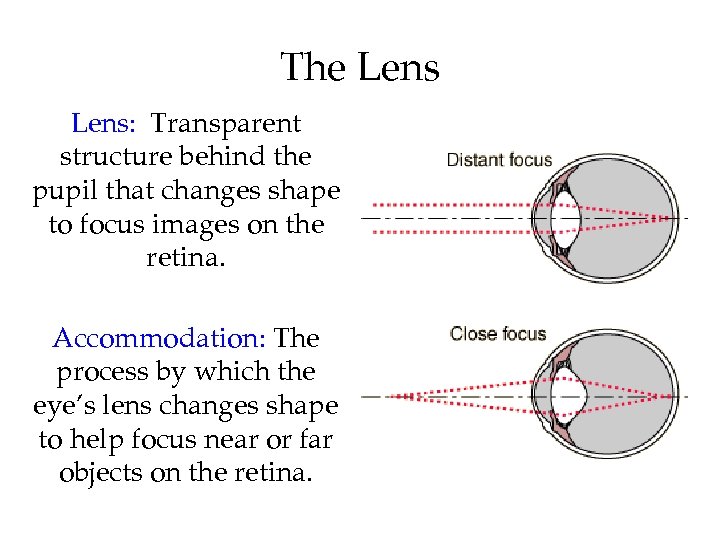 The Lens: Transparent structure behind the pupil that changes shape to focus images on the retina. Accommodation: The process by which the eye’s lens changes shape to help focus near or far objects on the retina.
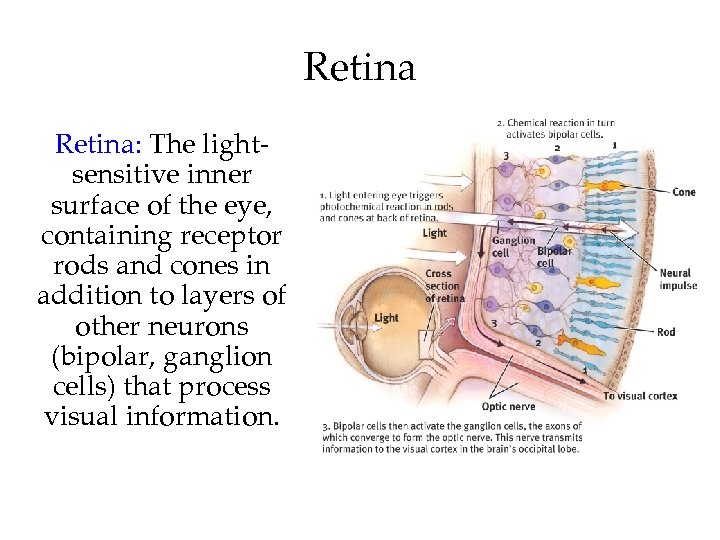 Retina: The lightsensitive inner surface of the eye, containing receptor rods and cones in addition to layers of other neurons (bipolar, ganglion cells) that process visual information.
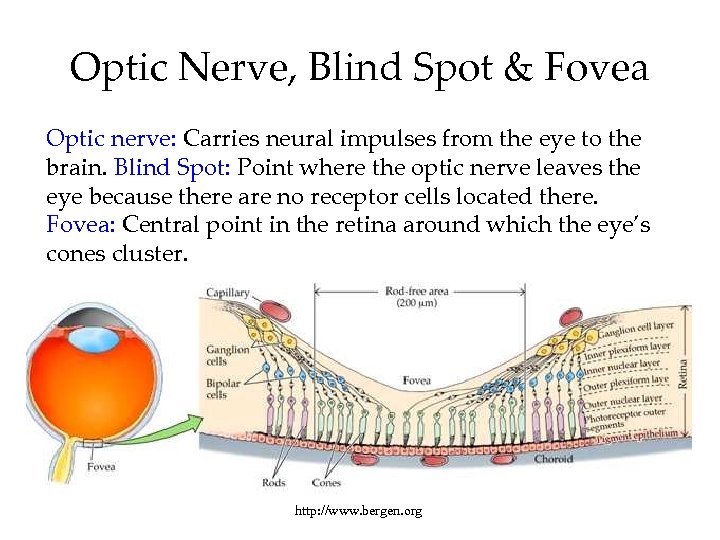 Optic Nerve, Blind Spot & Fovea Optic nerve: Carries neural impulses from the eye to the brain. Blind Spot: Point where the optic nerve leaves the eye because there are no receptor cells located there. Fovea: Central point in the retina around which the eye’s cones cluster. http: //www. bergen. org
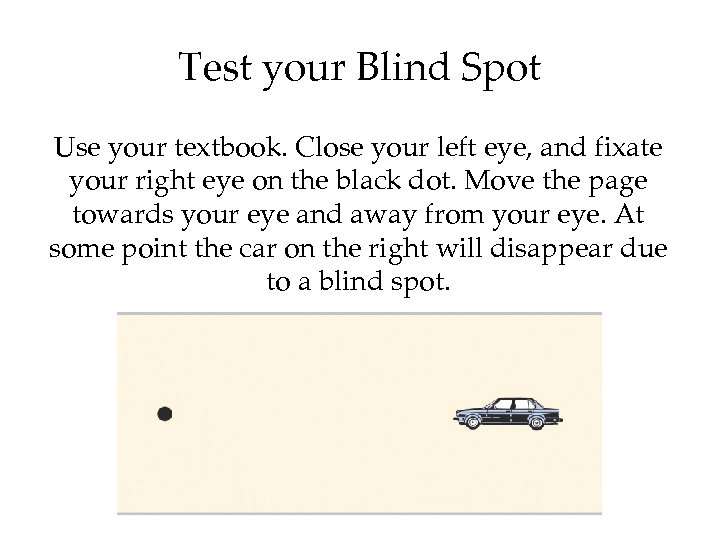 Test your Blind Spot Use your textbook. Close your left eye, and fixate your right eye on the black dot. Move the page towards your eye and away from your eye. At some point the car on the right will disappear due to a blind spot.
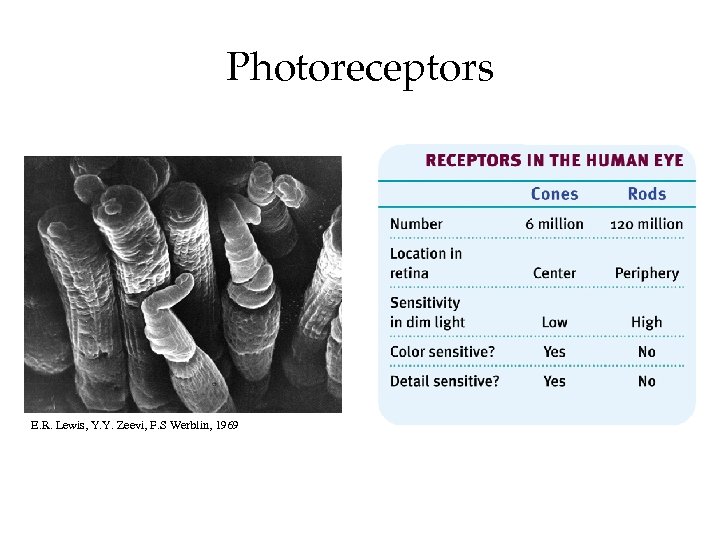 Photoreceptors E. R. Lewis, Y. Y. Zeevi, F. S Werblin, 1969
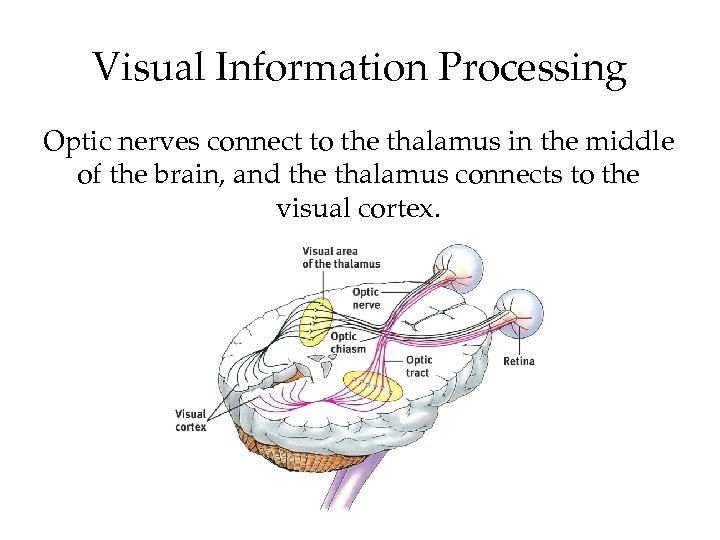 Visual Information Processing Optic nerves connect to the thalamus in the middle of the brain, and the thalamus connects to the visual cortex.
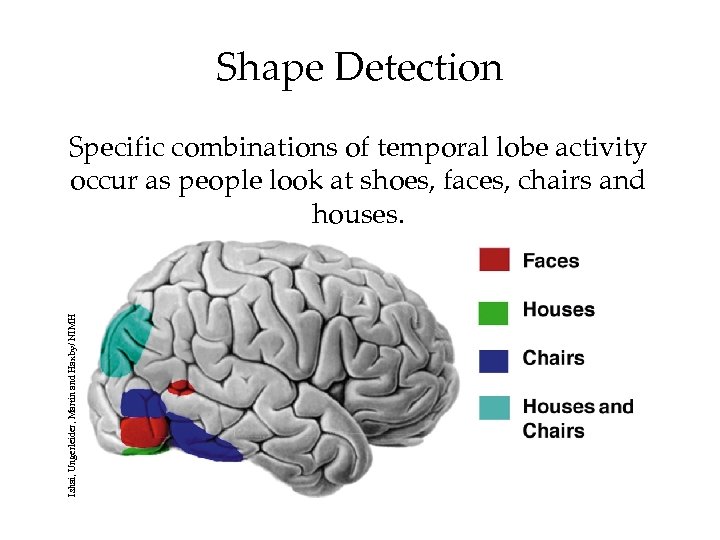 Shape Detection Ishai, Ungerleider, Martin and Haxby/ NIMH Specific combinations of temporal lobe activity occur as people look at shoes, faces, chairs and houses.
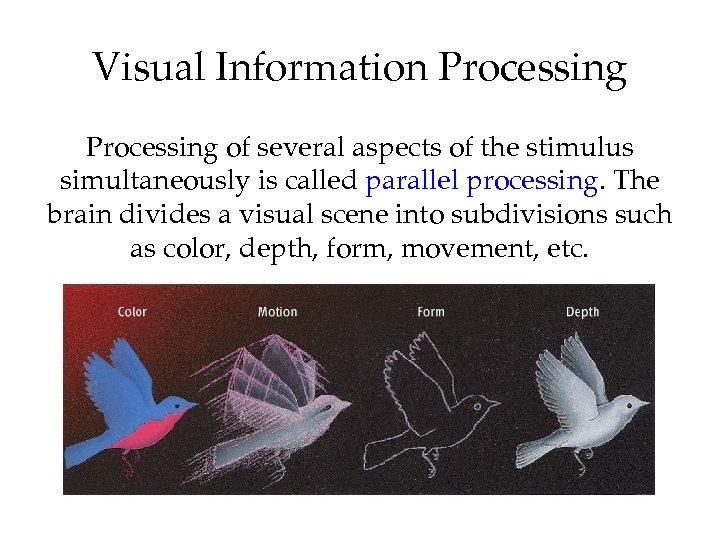 Visual Information Processing of several aspects of the stimulus simultaneously is called parallel processing. The brain divides a visual scene into subdivisions such as color, depth, form, movement, etc.
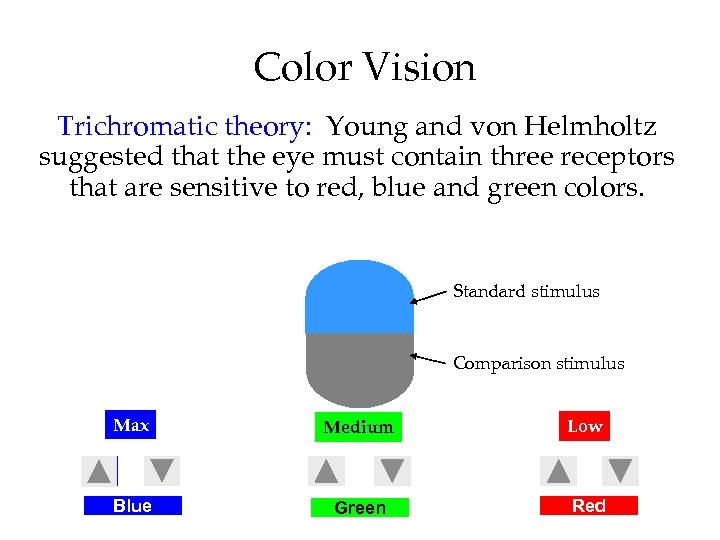 Color Vision Trichromatic theory: Young and von Helmholtz suggested that the eye must contain three receptors that are sensitive to red, blue and green colors. Standard stimulus Comparison stimulus Max Medium Low Blue Green Red
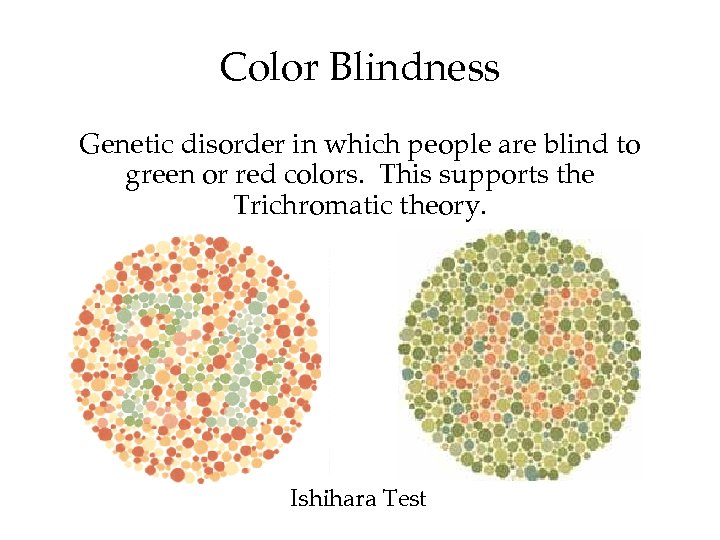 Color Blindness Genetic disorder in which people are blind to green or red colors. This supports the Trichromatic theory. Ishihara Test
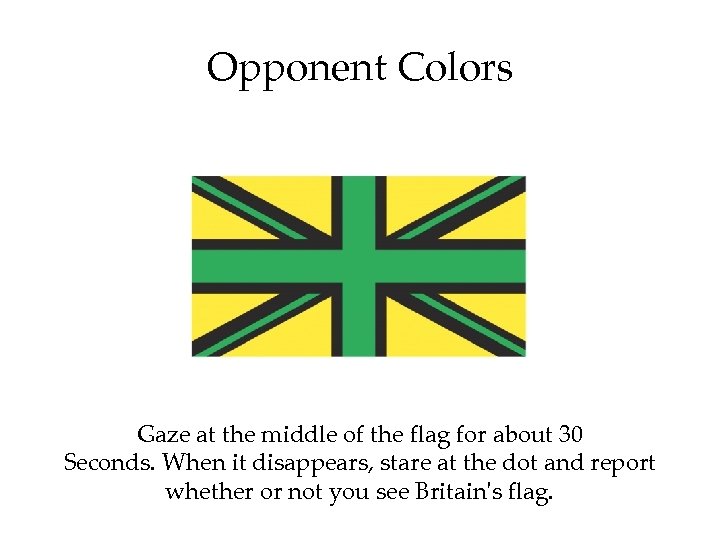 Opponent Colors Gaze at the middle of the flag for about 30 Seconds. When it disappears, stare at the dot and report whether or not you see Britain's flag.
 The Other Senses § Hearing § Touch § Pain § Taste § Smell § Body Position and Movement
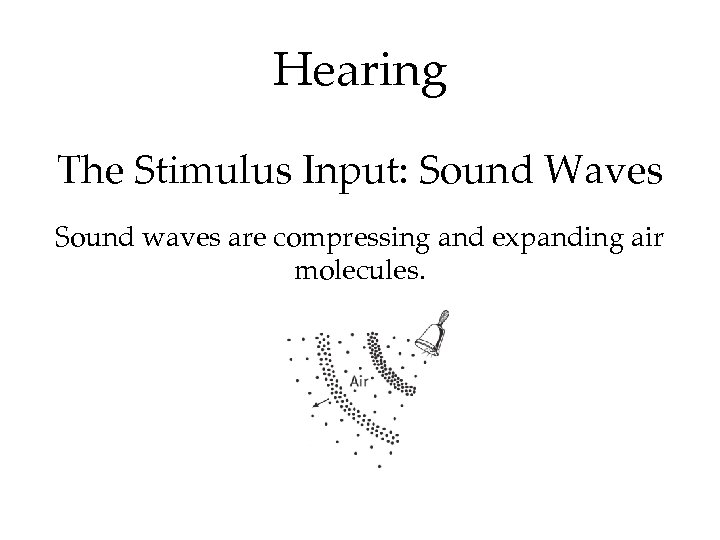 Hearing The Stimulus Input: Sound Waves Sound waves are compressing and expanding air molecules.
 Sound Characteristics 1. Frequency (pitch) 2. Intensity (loudness)
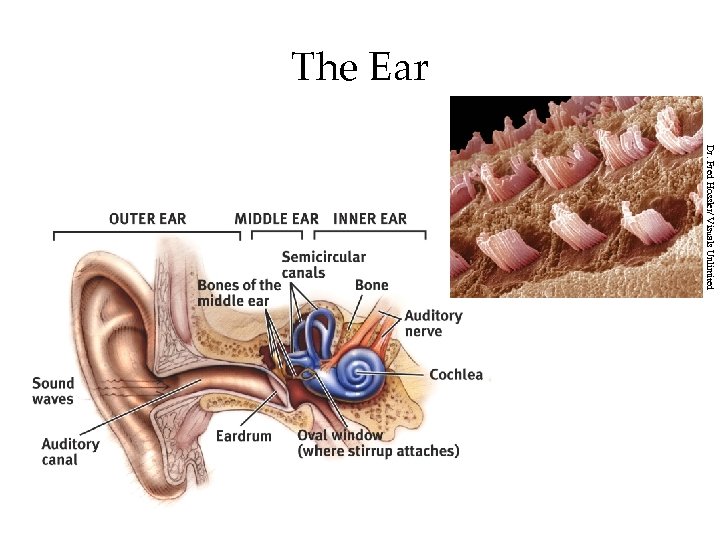 The Ear Dr. Fred Hossler/ Visuals Unlimited
 The Ear Outer Ear: Collects and sends sounds to the eardrum. Middle Ear: Chamber between eardrum and cochlea, the piston, containing three tiny bones (hammer, anvil, stirrup) that concentrate the vibrations of the eardrum on the cochlea’s oval window. Inner Ear: Innermost part of the ear, containing the cochlea, semicircular canals, and vestibular sacs.
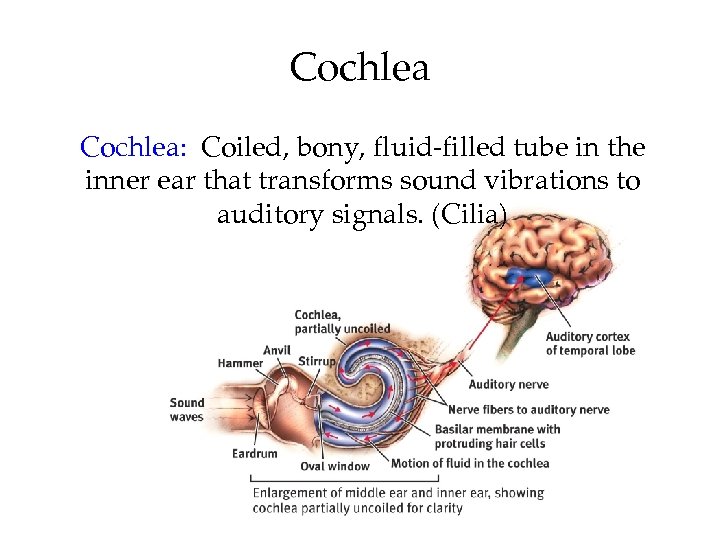 Cochlea: Coiled, bony, fluid-filled tube in the inner ear that transforms sound vibrations to auditory signals. (Cilia)
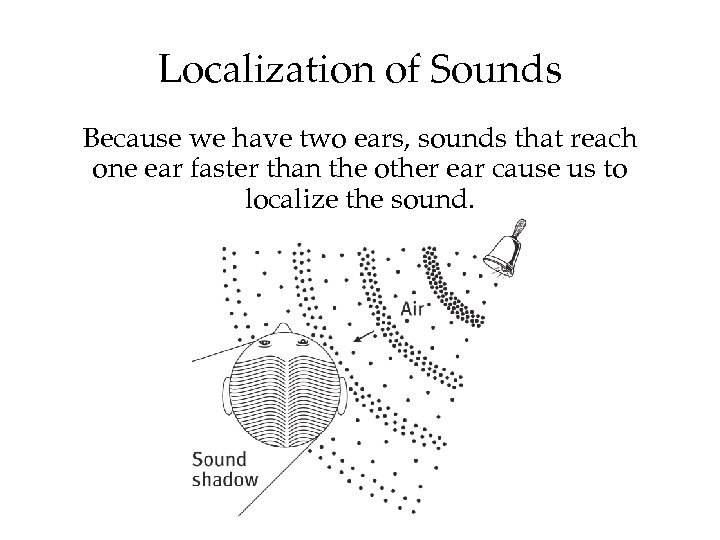 Localization of Sounds Because we have two ears, sounds that reach one ear faster than the other ear cause us to localize the sound.
 Localization of Sound 1. Intensity differences 2. Time differences as small as 1/100, 000 of a second can cause us to localize sound. The head acts as a “shadow” or partial sound barrier.
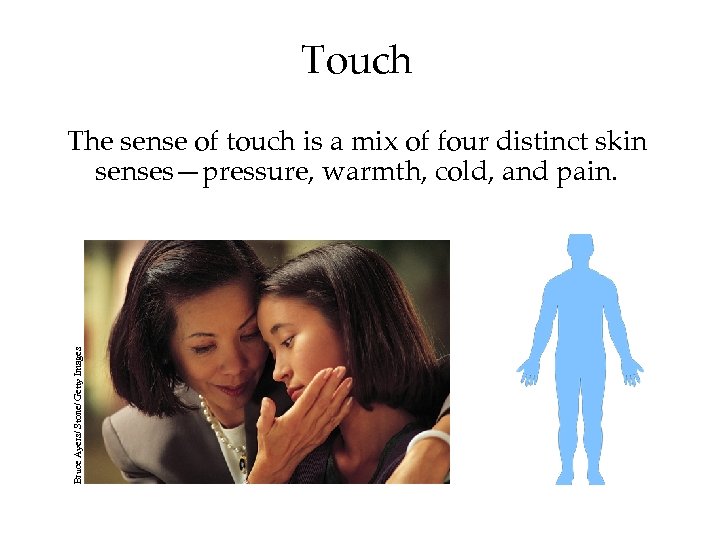 Touch Bruce Ayers/ Stone/ Getty Images The sense of touch is a mix of four distinct skin senses—pressure, warmth, cold, and pain.
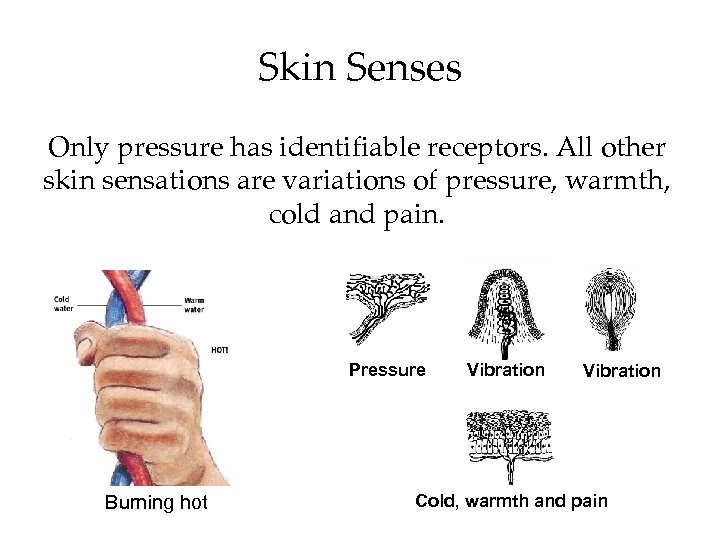 Skin Senses Only pressure has identifiable receptors. All other skin sensations are variations of pressure, warmth, cold and pain. Pressure Burning hot Vibration Cold, warmth and pain
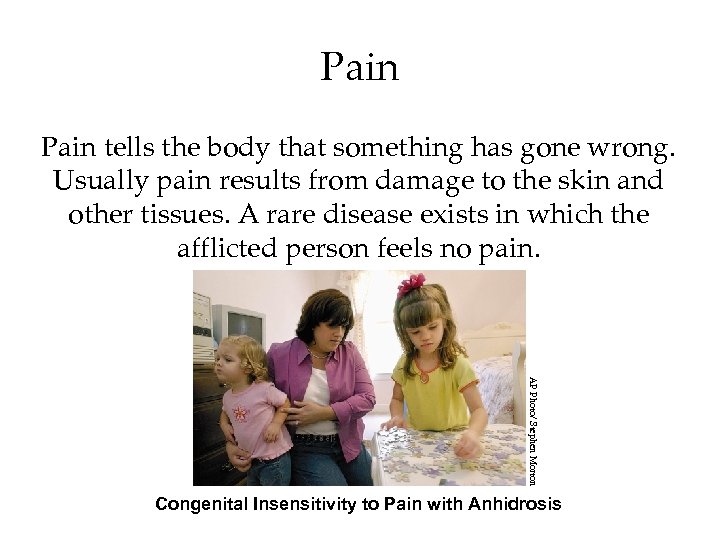 Pain tells the body that something has gone wrong. Usually pain results from damage to the skin and other tissues. A rare disease exists in which the afflicted person feels no pain. AP Photo/ Stephen Morton Congenital Insensitivity to Pain with Anhidrosis
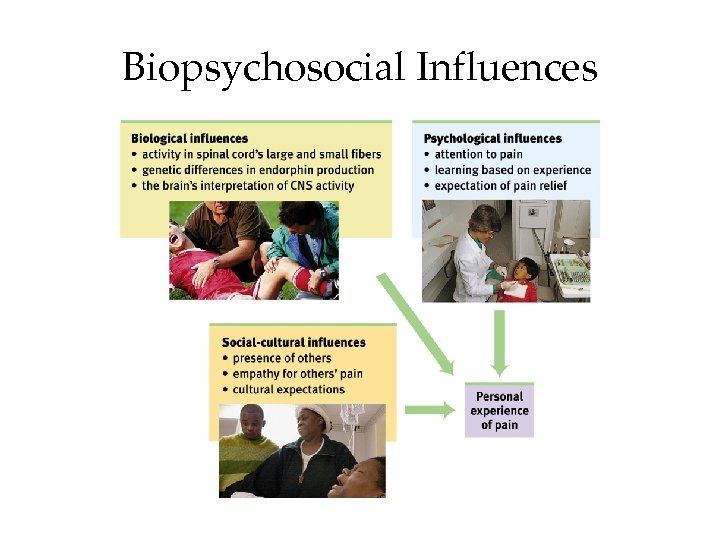 Biopsychosocial Influences
 Phantom Limb • After amputation 7 in 10 people feel pain or movement in limbs that no longer exist • Even those born without a limb sometimes feel sensations in the missing parts
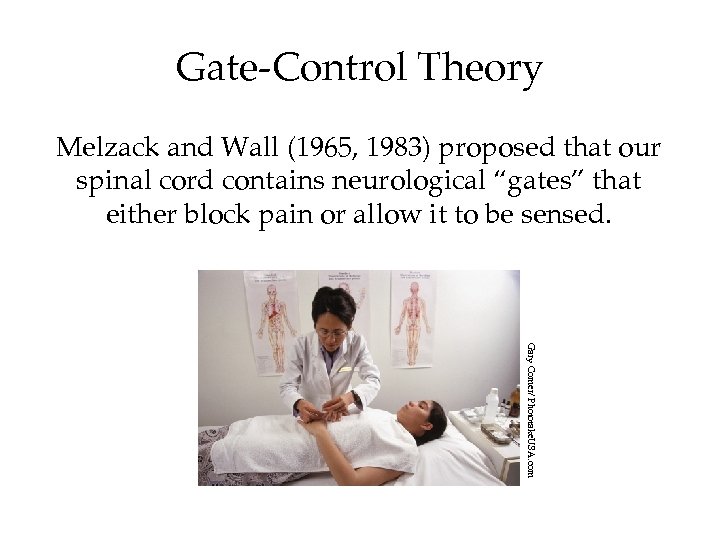 Gate-Control Theory Melzack and Wall (1965, 1983) proposed that our spinal cord contains neurological “gates” that either block pain or allow it to be sensed. Gary Comer/ Phototake. USA. com
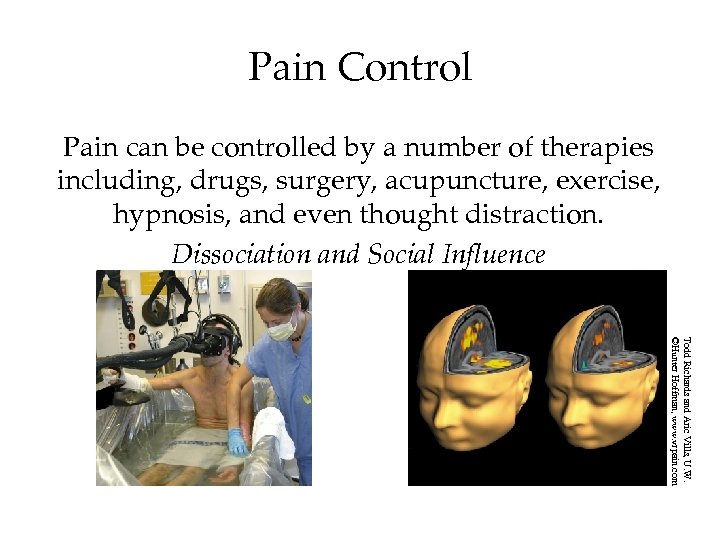 Pain Control Pain can be controlled by a number of therapies including, drugs, surgery, acupuncture, exercise, hypnosis, and even thought distraction. Dissociation and Social Influence Todd Richards and Aric Vills, U. W. ©Hunter Hoffman, www. vrpain. com
 Built in Pain Control Center • Endorphins • Distraction- Pain diverted to other stimuli Memories of Pain People usually overlook the duration of their pain and mostly focus on its peak moment and how they felt at the end.
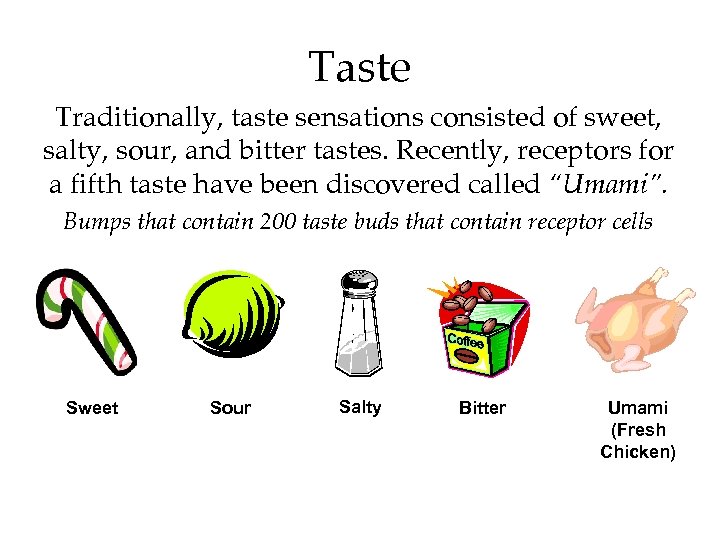 Taste Traditionally, taste sensations consisted of sweet, salty, sour, and bitter tastes. Recently, receptors for a fifth taste have been discovered called “Umami”. Bumps that contain 200 taste buds that contain receptor cells Sweet Sour Salty Bitter Umami (Fresh Chicken)
 Sensory Interaction When one sense affects another sense, sensory interaction takes place. So, the taste of strawberry interacts with its smell and its texture on the tongue to produce flavor. Eating when you have a cold
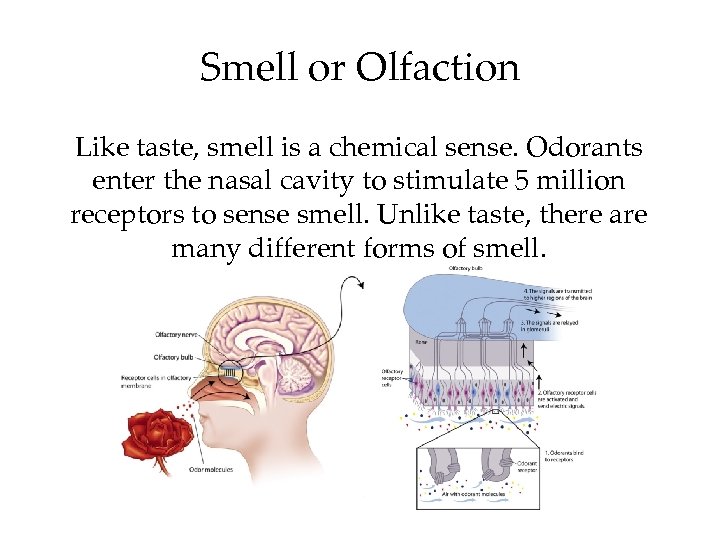 Smell or Olfaction Like taste, smell is a chemical sense. Odorants enter the nasal cavity to stimulate 5 million receptors to sense smell. Unlike taste, there are many different forms of smell.
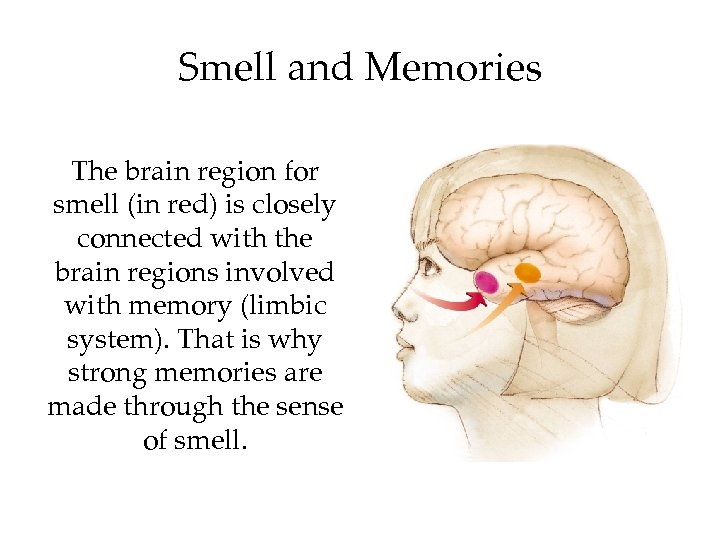 Smell and Memories The brain region for smell (in red) is closely connected with the brain regions involved with memory (limbic system). That is why strong memories are made through the sense of smell.
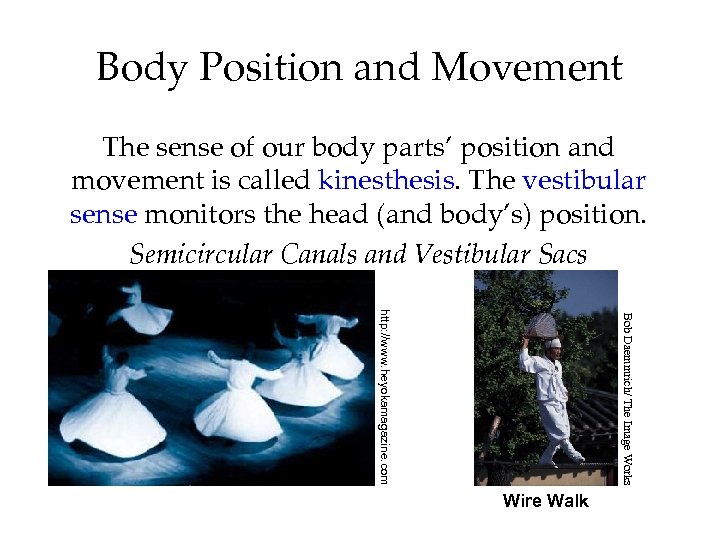 Body Position and Movement The sense of our body parts’ position and movement is called kinesthesis. The vestibular sense monitors the head (and body’s) position. Semicircular Canals and Vestibular Sacs Bob Daemmrich/ The Image Works http: //www. heyokamagazine. com Wire Walk
 Perceptual Organization § Form Perception § Depth Perception § Perceptual Constancy
 Perceptual Organization How do we form meaningful perceptions from sensory information? We organize it. Gestalt psychologists showed that a figure formed a “whole” different from its surroundings.
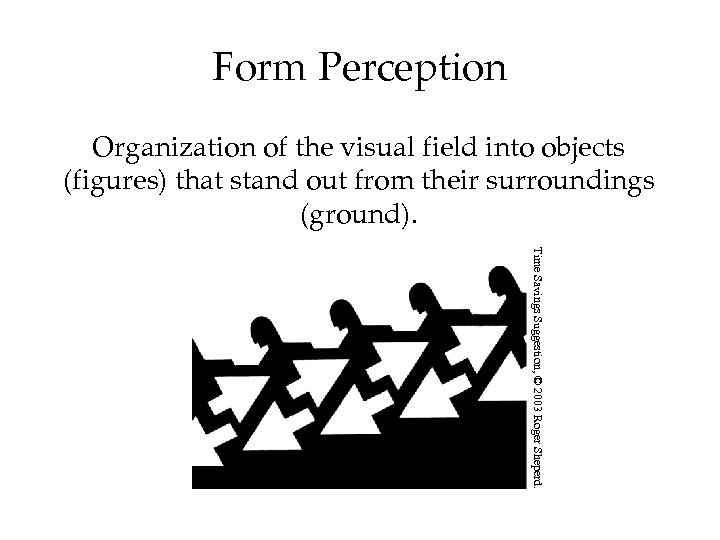 Form Perception Organization of the visual field into objects (figures) that stand out from their surroundings (ground). Time Savings Suggestion, © 2003 Roger Sheperd.
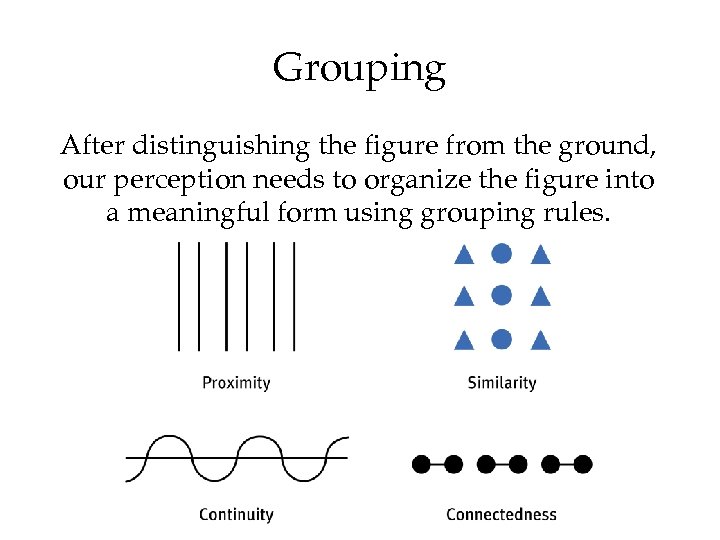 Grouping After distinguishing the figure from the ground, our perception needs to organize the figure into a meaningful form using grouping rules.
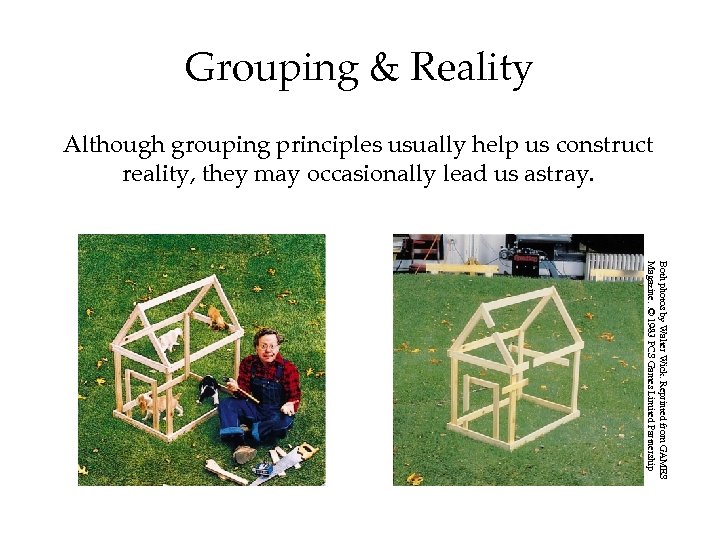 Grouping & Reality Although grouping principles usually help us construct reality, they may occasionally lead us astray. Both photos by Walter Wick. Reprinted from GAMES Magazine. . © 1983 PCS Games Limited Partnership
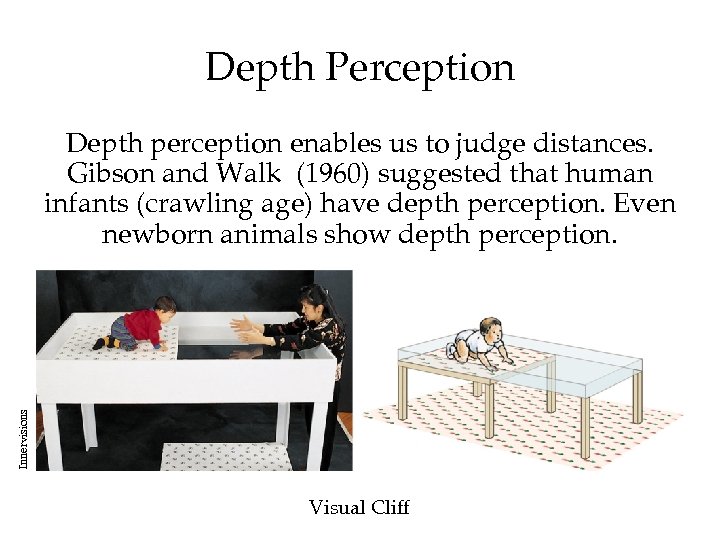 Depth Perception Innervisions Depth perception enables us to judge distances. Gibson and Walk (1960) suggested that human infants (crawling age) have depth perception. Even newborn animals show depth perception. Visual Cliff
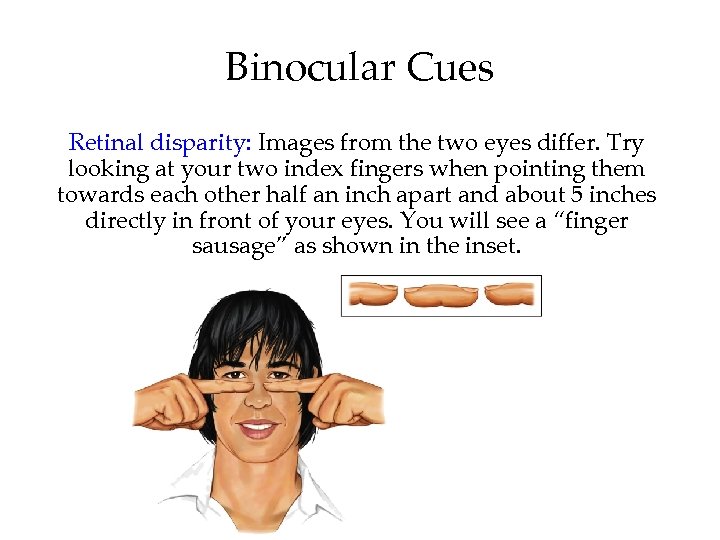 Binocular Cues Retinal disparity: Images from the two eyes differ. Try looking at your two index fingers when pointing them towards each other half an inch apart and about 5 inches directly in front of your eyes. You will see a “finger sausage” as shown in the inset.
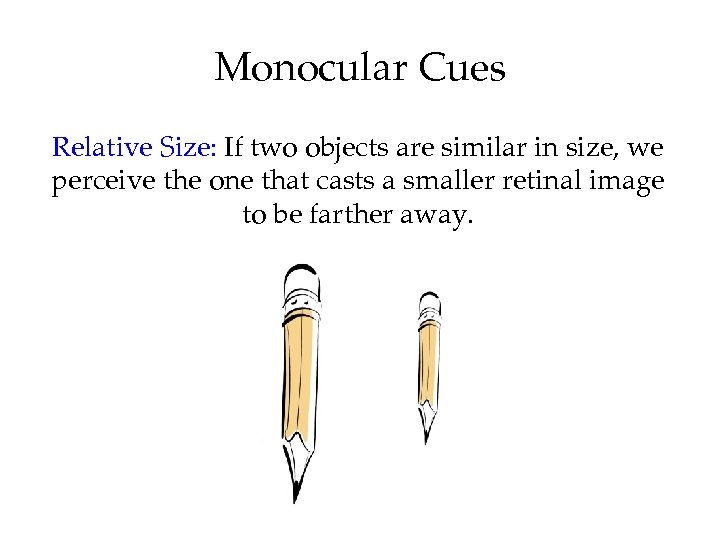 Monocular Cues Relative Size: If two objects are similar in size, we perceive the one that casts a smaller retinal image to be farther away.
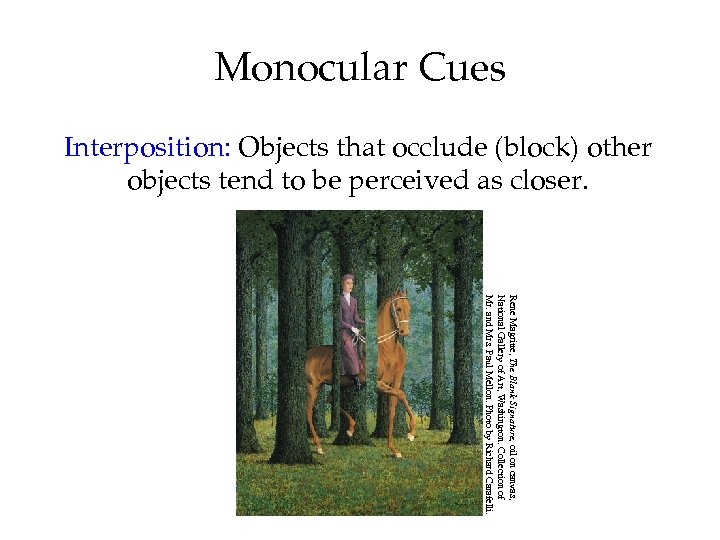 Monocular Cues Interposition: Objects that occlude (block) other objects tend to be perceived as closer. Rene Magritte, The Blank Signature, oil on canvas, National Gallery of Art, Washington. Collection of Mr. and Mrs. Paul Mellon. Photo by Richard Carafelli.
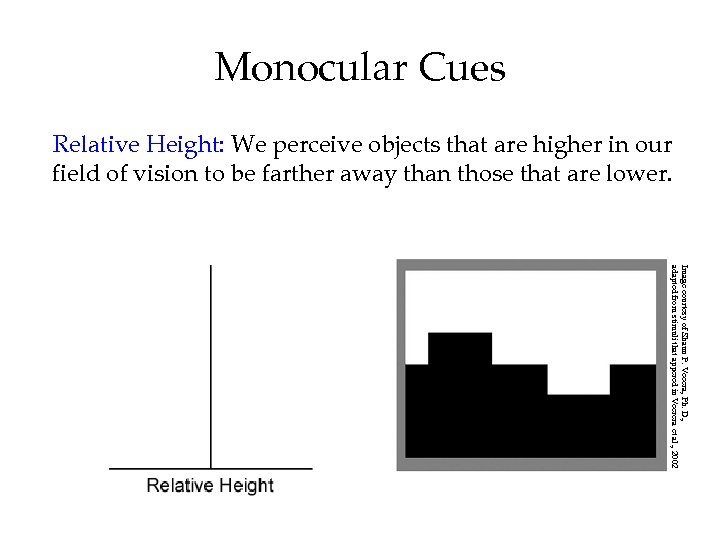 Monocular Cues Relative Height: We perceive objects that are higher in our field of vision to be farther away than those that are lower. Image courtesy of Shaun P. Vecera, Ph. D. , adapted from stimuli that appered in Vecrera et al. , 2002
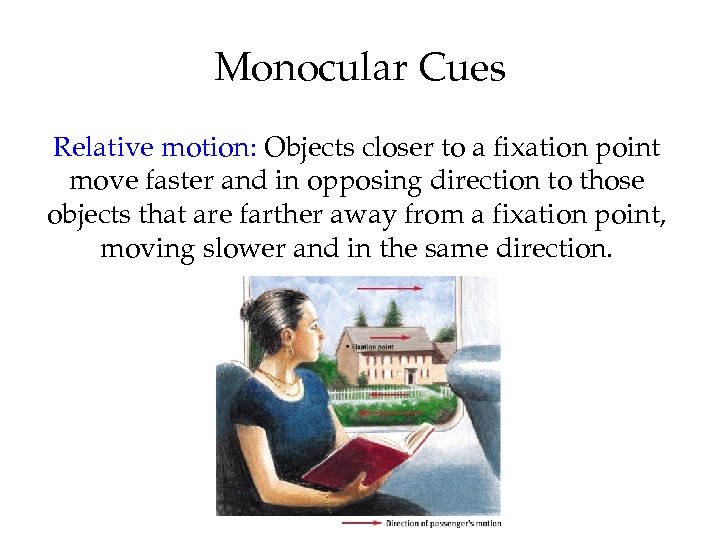 Monocular Cues Relative motion: Objects closer to a fixation point move faster and in opposing direction to those objects that are farther away from a fixation point, moving slower and in the same direction.
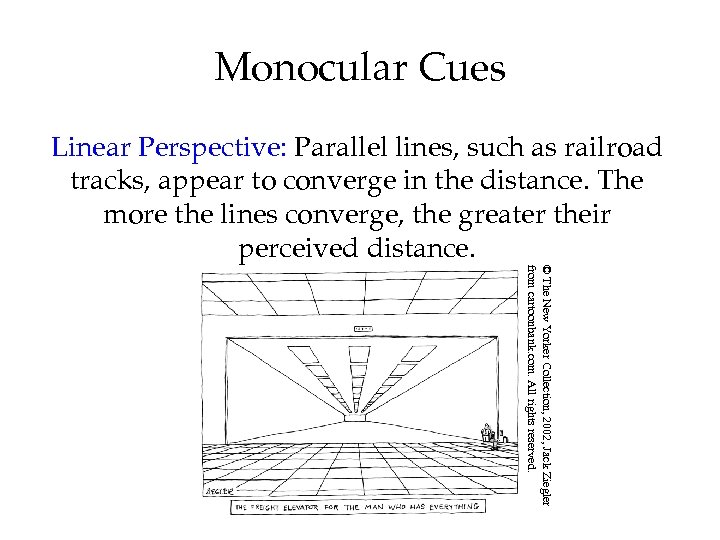 Monocular Cues Linear Perspective: Parallel lines, such as railroad tracks, appear to converge in the distance. The more the lines converge, the greater their perceived distance. © The New Yorker Collection, 2002, Jack Ziegler from cartoonbank. com. All rights reserved.
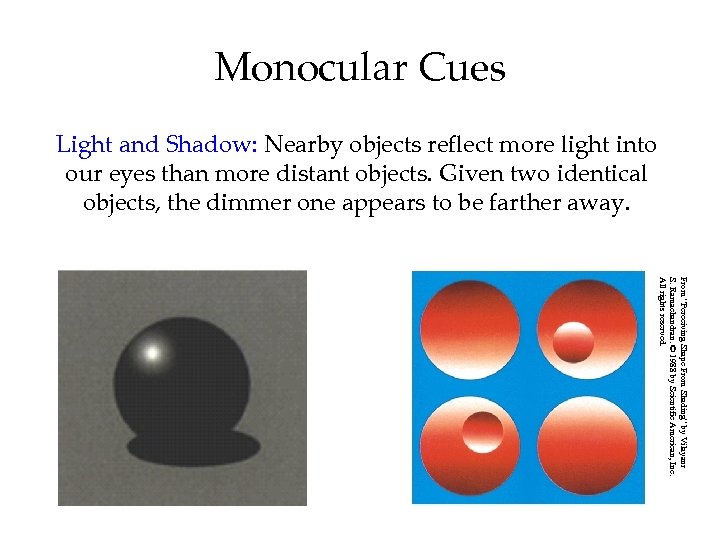 Monocular Cues Light and Shadow: Nearby objects reflect more light into our eyes than more distant objects. Given two identical objects, the dimmer one appears to be farther away. From “Perceiving Shape From Shading” by Vilayaur S. Ramachandran. © 1988 by Scientific American, Inc. All rights reserved.
 Perceptual Constancy Perceiving objects as unchanging even as illumination and retinal images change.
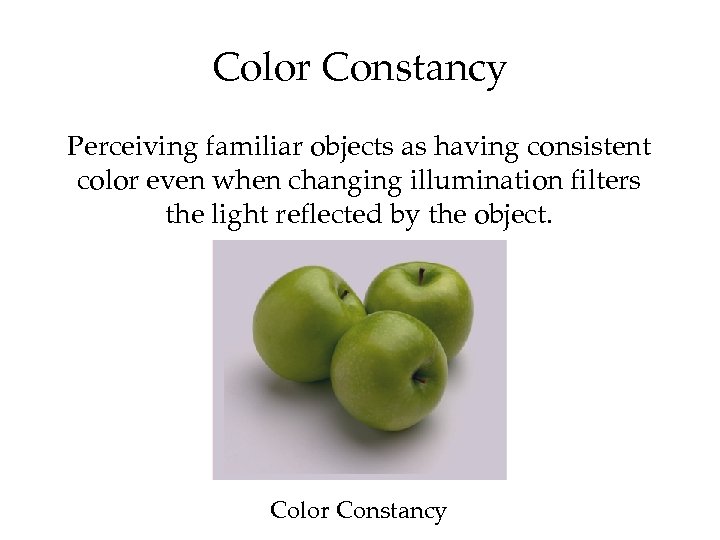 Color Constancy Perceiving familiar objects as having consistent color even when changing illumination filters the light reflected by the object. Color Constancy
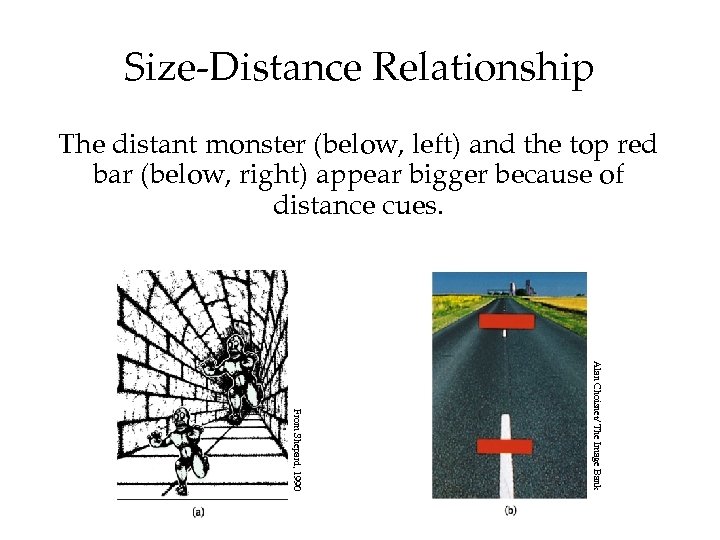 Size-Distance Relationship The distant monster (below, left) and the top red bar (below, right) appear bigger because of distance cues. Alan Choisnet/ The Image Bank From Shepard, 1990
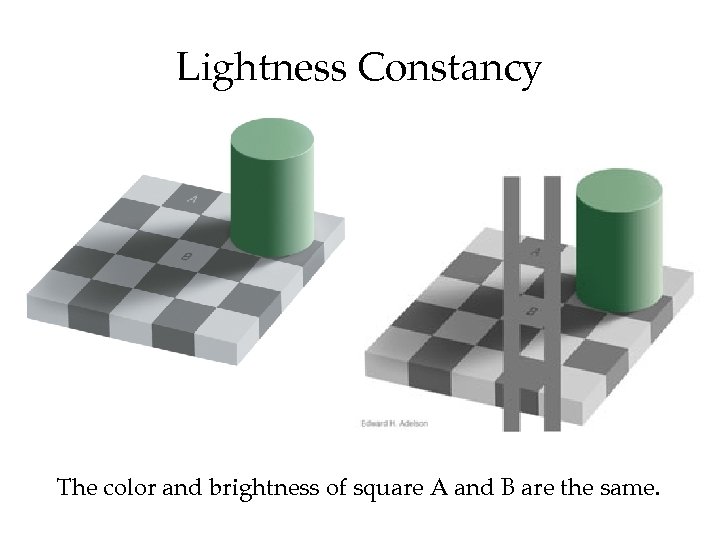 Co ur tes y Ed wa rd Ad els on Lightness Constancy The color and brightness of square A and B are the same.
 • Obviously A is a dark square in light and B is a light square in shadow, right? Can you believe that they are sending the identical level of light energy to your retina? Both A and B are identical shades of gray! Note that the organization of the scene into lighted areas and shadowed areas must play a role in determining the perceived lightness of the squares.
 Perceptual Interpretation § Sensory Deprivation and Restored Vision § Perceptual Adaptation § Perceptual Set
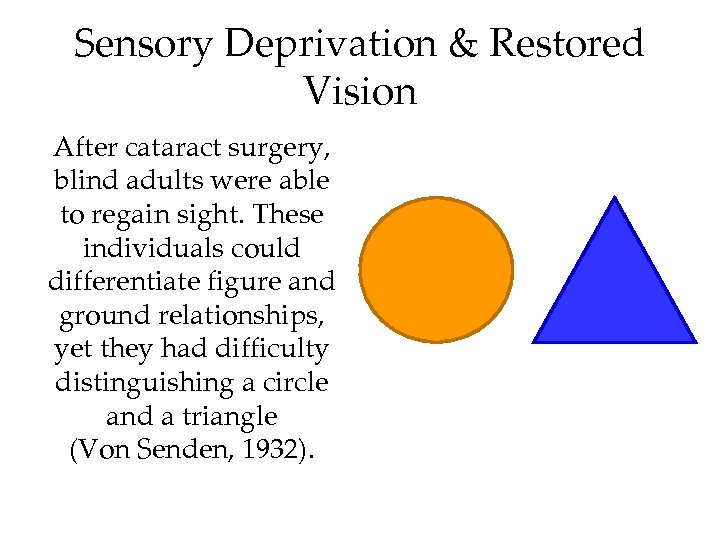 Sensory Deprivation & Restored Vision After cataract surgery, blind adults were able to regain sight. These individuals could differentiate figure and ground relationships, yet they had difficulty distinguishing a circle and a triangle (Von Senden, 1932).
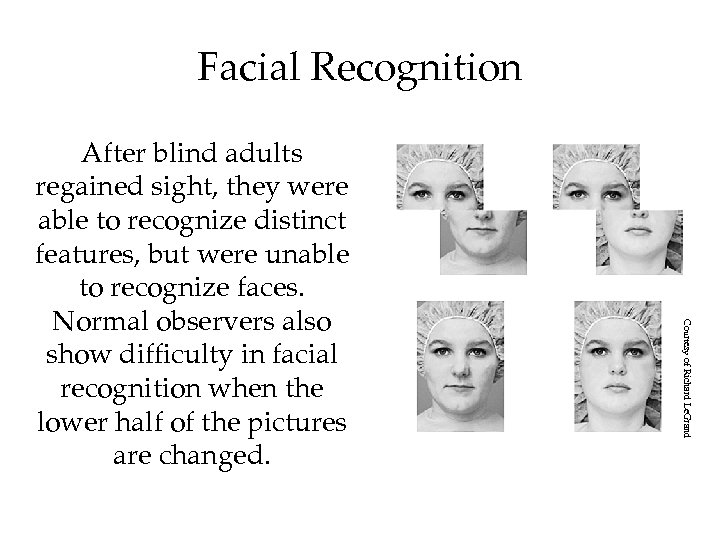 Facial Recognition Courtesy of Richard Le. Grand After blind adults regained sight, they were able to recognize distinct features, but were unable to recognize faces. Normal observers also show difficulty in facial recognition when the lower half of the pictures are changed.
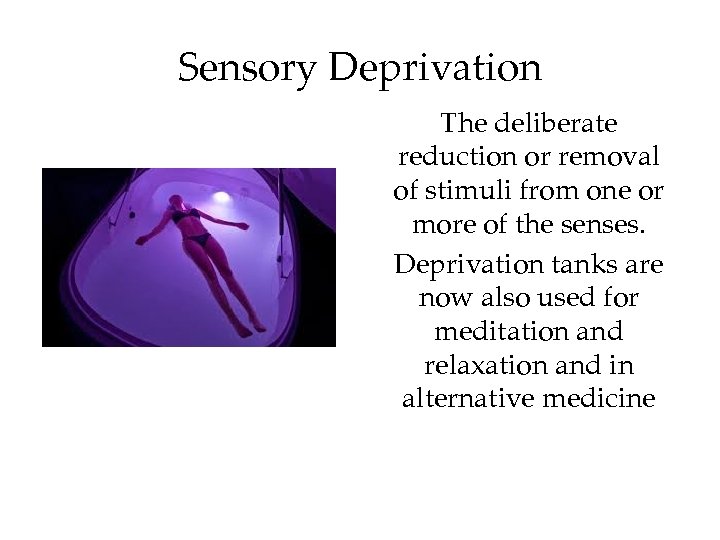 Sensory Deprivation The deliberate reduction or removal of stimuli from one or more of the senses. Deprivation tanks are now also used for meditation and relaxation and in alternative medicine
 Sensory Deprivation as a Form of Torture • According to CIA research and other agency interrogation materials sensory deprivation, is a remarkably simple concept. It can be inflicted by immobilizing individuals in small, soundproof rooms and fitting them with blacked-out goggles and earmuffs. “The first thing that happens is extraordinary hallucinations akin to mescaline, ” explained Mc. Coy. “I mean extreme hallucinations” of sight and sound. It is followed, in some cases within just two days, by what Mc. Coy called a “breakdown akin to psychosis. ” • extreme sensory deprivation techniques push people beyond the brink of what they can bear, physically and mentally.
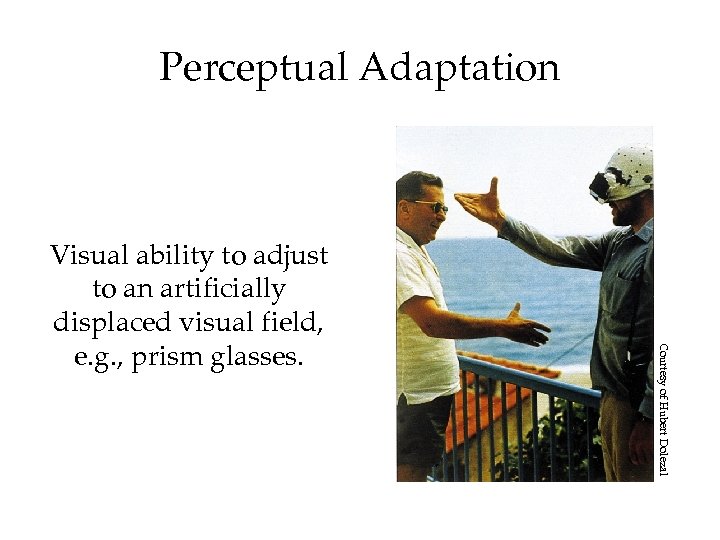 Perceptual Adaptation Courtesy of Hubert Dolezal Visual ability to adjust to an artificially displaced visual field, e. g. , prism glasses.
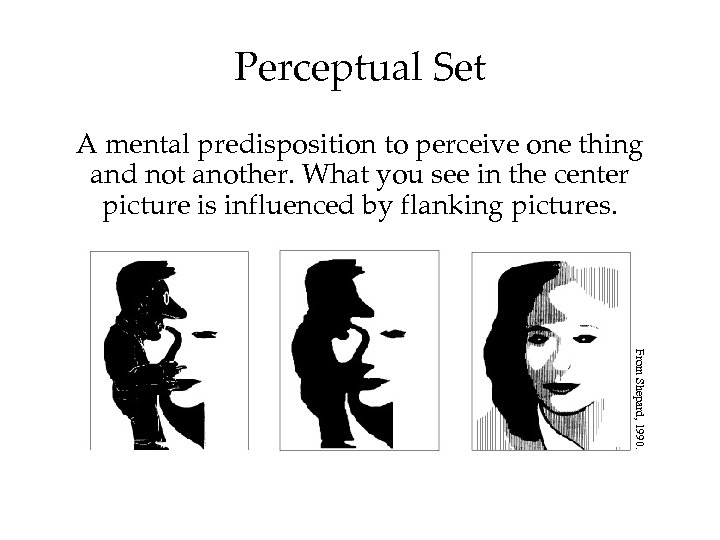 Perceptual Set A mental predisposition to perceive one thing and not another. What you see in the center picture is influenced by flanking pictures. From Shepard, 1990.
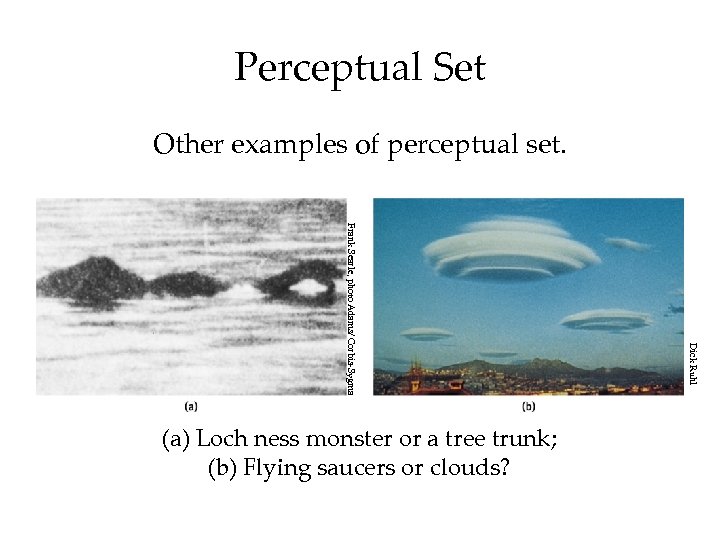 Perceptual Set Other examples of perceptual set. Dick Ruhl Frank Searle, photo Adams/ Corbis-Sygma (a) Loch ness monster or a tree trunk; (b) Flying saucers or clouds?
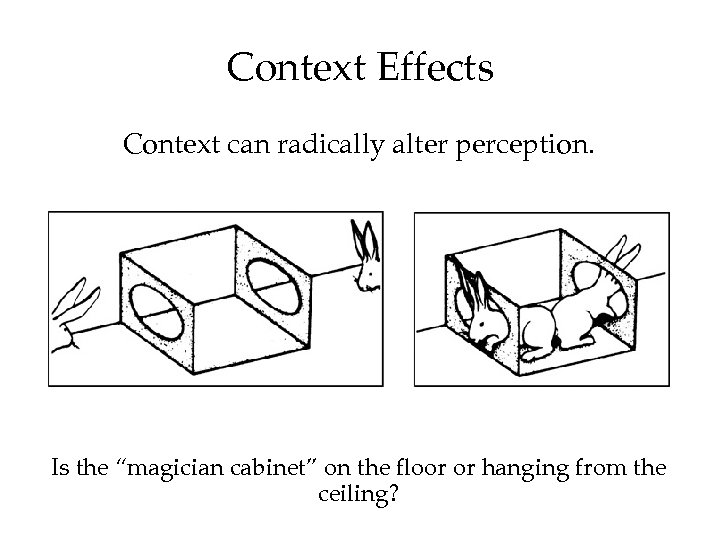 Context Effects Context can radically alter perception. Is the “magician cabinet” on the floor or hanging from the ceiling?
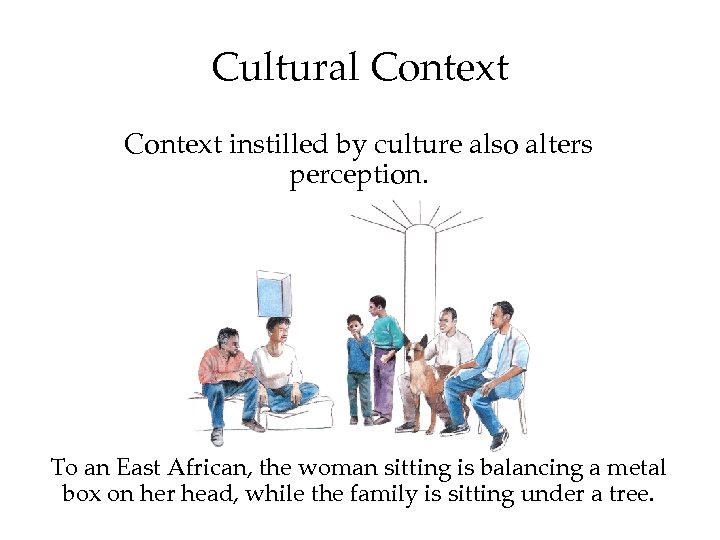 Cultural Context instilled by culture also alters perception. To an East African, the woman sitting is balancing a metal box on her head, while the family is sitting under a tree.
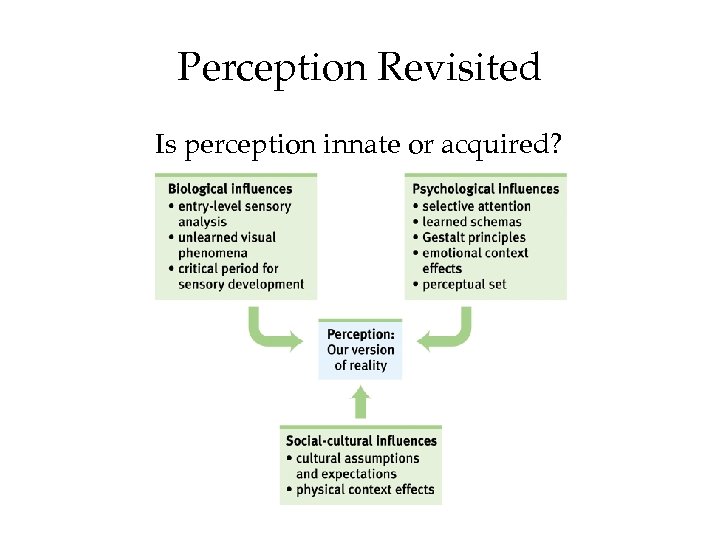 Perception Revisited Is perception innate or acquired?
 Is There Extrasensory Perception? Perception without sensory input is called extrasensory perception (ESP). A large percentage of scientists do not believe in ESP.
 Claims of ESP 1. Telepathy: Mind-to-mind communication. One person sending thoughts and the other receiving them. 2. Clairvoyance: Perception of remote events, such as sensing a friend’s house on fire. 3. Precognition: Perceiving future events, such as a political leader’s death.