


 Скачать презентацию Psychological Impact and Risk Communication Scientific Advice Crisis
ec52934af82002806dbe9965ef7392c1.ppt
- Количество слайдов: 22
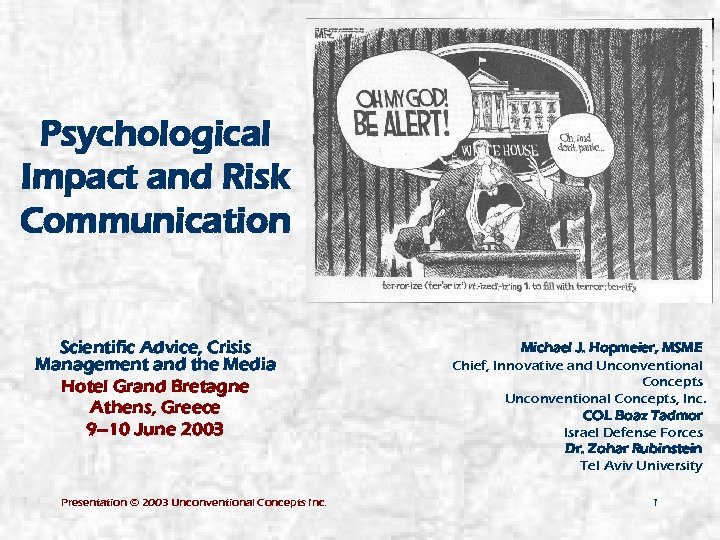 Psychological Impact and Risk Communication Scientific Advice, Crisis Management and the Media Hotel Grand Bretagne Athens, Greece 9– 10 June 2003 Presentation © 2003 Unconventional Concepts Inc. Michael J. Hopmeier, MSME Chief, Innovative and Unconventional Concepts, Inc. COL Boaz Tadmor Israel Defense Forces Dr. Zohar Rubinstein Tel Aviv University 1
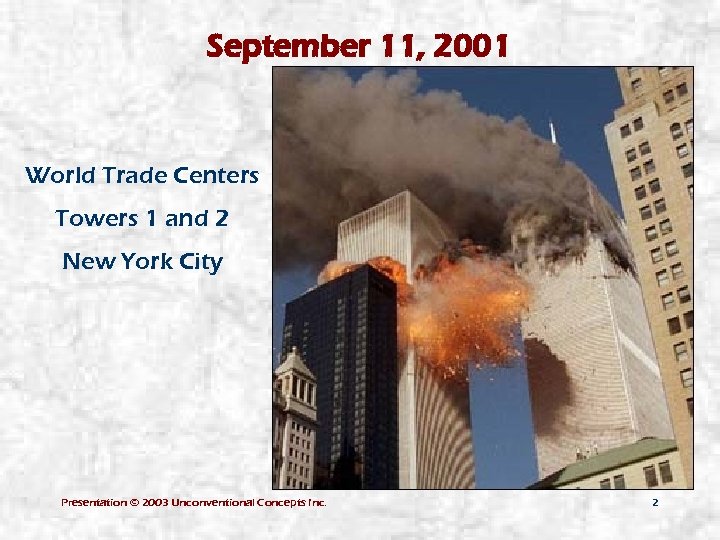 September 11, 2001 World Trade Centers Towers 1 and 2 New York City Presentation © 2003 Unconventional Concepts Inc. 2
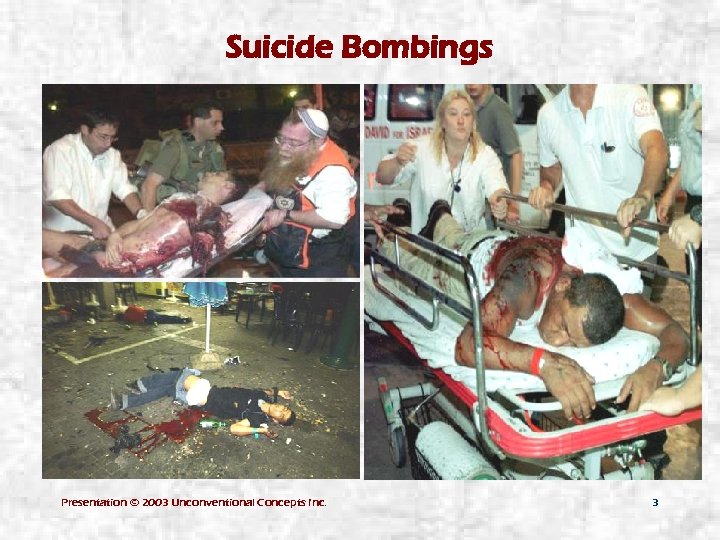 Suicide Bombings Presentation © 2003 Unconventional Concepts Inc. 3
 Psychological Definitions of Crisis/ Disaster Situations An external situation which presents a threat to a person or his/her relatives, interrupts the functional, cognitive and historical continuance amongst individuals, families, groups and the community. —Home Front Command Israel Defense Forces Presentation © 2003 Unconventional Concepts Inc. 4
 Psychological Trauma and Communication: Brief Overview 4 Orson Wells’ 1938 radio broadcast “War of the Worlds” resulted in pandemonium and paranoia 4 Coverage of recent terrorist events reveals that the media must strike a balance between informing the public and not contributing to psychological trauma Presentation © 2003 Unconventional Concepts Inc. 5
 PTSD and the Effects of Traumatic TV Images 4 Study by Ahern et al. (2002) found that people who were directly affected by the 9/11 terrorist attacks and who viewed disturbing TV images >7 times were 7 times more likely to develop PTSD 4 The same study found that 3. 6% who were not directly affected by the attacks still developed PTSD from repeatedly watching disturbing TV images 4 Previous studies with children with direct involvement in the Oklahoma City bombing and Gulf War suggest a causal link between PTSD and watching violent images of events on TV Presentation © 2003 Unconventional Concepts Inc. 6
 The Public Wants to “Do Something” 4 Although duct tape defense provides minimal physical protection, there is something to be said for the sense of psychological comfort created by having “done something” to prepare for a potential attack 4 However, a recent Harvard study found that 73% were aware of the posted high alert level (orange) but only 12% had developed an evacuation plan Presentation © 2003 Unconventional Concepts Inc. 7
 Presentation © 2003 Unconventional Concepts Inc. 8
 Before the 2003 Iraq War Israel Defense Forces 4 Distributed protective kits (including gas masks) to the entire Israeli population 4 Informed the public how to create protected and sealed spaces in dwellings 4 Created an efficient medicine distribution system and a nationwide alarm system Home Front Command 4 Launched an information campaign to educate the public on what to expect and how to cope Presentation © 2003 Unconventional Concepts Inc. 9
 Israeli Public Response 4 In spite of everything, as recently as 1 week before the outbreak of hostilities, compliance with safety directives was as low as 60% 4 The psychological impact of seeing the war progress and the nation’s emotional response (as measured by numerous polls) correlated almost perfectly Presentation © 2003 Unconventional Concepts Inc. 10
 Communication and Psychological Impact 4 There is unquestionably a link 4 Over 2, 000 studies in the past 30 years on children and exposure to TV violence find an increase in aggressive behavior 4 The long-term negative psychological effects of the media and disasters can be mitigated, but only with proper preparation Presentation © 2003 Unconventional Concepts Inc. 11
 Mitigation 4 Anticipate what the audience wants to hear to allay fears 4 Hurricane George in Puerto Rico in 1998 was an example of excellent communication with a constant flow of updated, accurate information 4 Communication clearly addressed the audience’s main concern: the hurricane’s impact on tourism, one of the island’s main industries Presentation © 2003 Unconventional Concepts Inc. 12
 Presentation © 2003 Unconventional Concepts Inc. 13
 Presentation © 2003 Unconventional Concepts Inc. 14
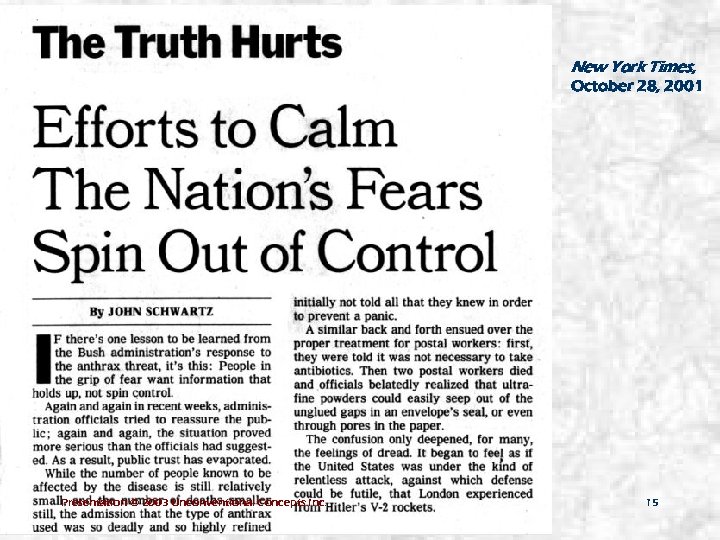 New York Times, October 28, 2001 Presentation © 2003 Unconventional Concepts Inc. 15
 Anthrax Scare Negative psychological effects—fear and paranoia—are more damaging than anthrax 4 In April 1997, 17 employees at the B'nai Brith National Headquarters went to D. C. - area hospitals after feeling ill—tests later proved the substance they encountered was not anthrax 4 In fall 2001, 35 people in a Maryland subway reported nausea, sore throat, and headache after exposure to hoax “liquid anthrax” —window-cleaning fluid 4“But in my opinion we need to protect the Americans not from anthrax, but from the feeling of fear. . . I'm serious. . . Panic is even worse than the disease. " —Benjamin Cherkassky, a senior scientist at Moscow's Central Institute of Epidemiology Presentation © 2003 Unconventional Concepts Inc. 16
 Anthrax Scare—Lessons Learned 4 Decisions had to be made rapidly in the absence of data 4 Access to subject matter experts was limited 4 No “textbook” experience to guide a response 4 Understanding of “risk” evolved as outbreak unfolded 4 Exaggerated or ambiguous risk assessment creates elevated fear and establishes a sense of distrust among the public for future warnings 4 Advising the public not to panic induces the opposite response 4 Need a coherent, rapid process for addressing scientific issues in the midst of a crisis Presentation © 2003 Unconventional Concepts Inc. 17
 Communication 4 It is both information and education! 4 It works both ways: to and from leadership 4 The principal source of intelligence and realtime planning information is the media! 4 The public depends on the media to provide background and guidance on how to react 4 It is vital both before and after an incident 4 It prepares the public so they understand what is happening 4 It gives them instruction on how to respond to what is happening Presentation © 2003 Unconventional Concepts Inc. 18
 “Principles for Intervention amongst Disaster Stricken Population” 4 “’Help them help themselves’—Create a feeling of competence 4 “Create minimal dependence on formal and external assistance 4 “Channel the negative responses to positive action 4 “What appears as panic stricken civilians is nothing other than unorganized activity, which can be organized” —Home Front Command Israel Defense Forces Presentation © 2003 Unconventional Concepts Inc. 19
 “Principles for Intervention amongst Disaster Stricken Population” 4 “Prevent or minimize secondary gains 4 “Utilize the population as a resource 4 “Secure initial success in order to build trust in the community and authorities 4 “Support the community with ongoing information 4 “What works in routine should work in an emergency” —Home Front Command Israel Defense Forces Presentation © 2003 Unconventional Concepts Inc. 20
 Summary 4 “Mob psychology” is the ruling factor 4 We do not have enough resources to provide for the public independently, so we must involve the public in its own protection 4 To do this, the members of the public must know how to protect themselves and be confident that they can 4 Using the media to educate people and quell their fears is the only practical way this can be done 4 Media should be considered on par with fire, police, and emergency medical personnel The media can be your enemy if you work with them-they will be if you don’t! Presentation © 2003 Unconventional Concepts Inc. 21
 And Finally. . . We must all hang together or, most assuredly, we shall surely hang separately! —Benjamin Franklin Presentation © 2003 Unconventional Concepts Inc. 22