


 Скачать презентацию Psychiatric Emergency Services in Los Angeles County Christina
60fa314f553ba34485f3cbf4da60cbbf.ppt
- Количество слайдов: 25
 Psychiatric Emergency Services in Los Angeles County Christina Ghaly, MD Roderick Shaner, MD Deputy Director, Strategic Planning Medical Director Department of Health Services Department of Mental Health July 26, 2012
 Outline • • • Evolution of PES services in LAC Problem Statement Overview of Challenges and Potential Solutions Data Initiatives Discussion
 Evolution of LAC MH Crisis Services • Division of responsibilities for emergency services in 1978 ▫ Hospital-based Psychiatric Emergency Services: DHS ▫ Psychiatric Mobile Response Teams: DMH ▫ Payment and Coordination mechanisms: Vague • Creation of DMH Emergency Outreach Bureau 2000 • Development of Alternative Crisis Services 2006
 4
4
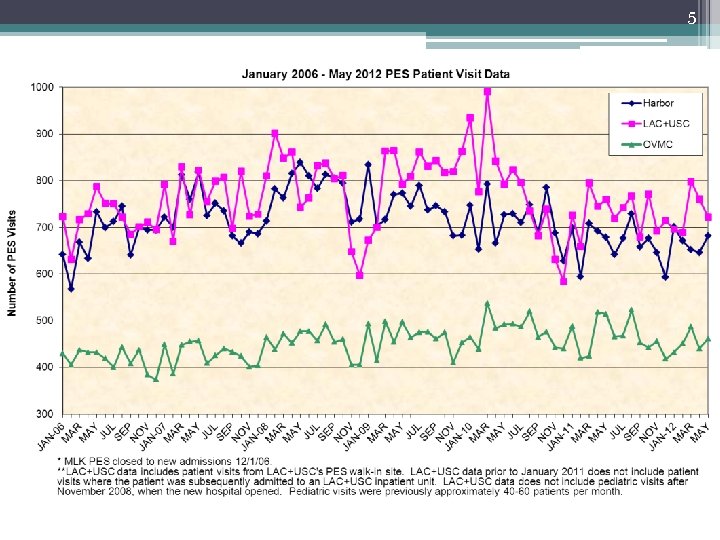 5
5
 Problem Statement • A variety of acute and longstanding challenges lead to PES overcrowding • We must intelligently identify and implement effective and practical solutions to these challenges in order to ensure high-quality crisis mental health services in LA county
 PES Challenges and Potential Solutions • Divided responsibilities: Integration of procedures for relevant agencies • Legal issues regarding involuntary treatment: Re-evaluation of procedures for detention, detainee transport, LPS conservatorship • PES over-use: Alternative crisis services: UCCs • Inpatient over-use: Changes in PES and inpatient internal processes, develop alternative residential approaches • Concerns about insufficient capacity: Develop consensus on PES and inpatient missions • Funding restrictions: MHSA changes
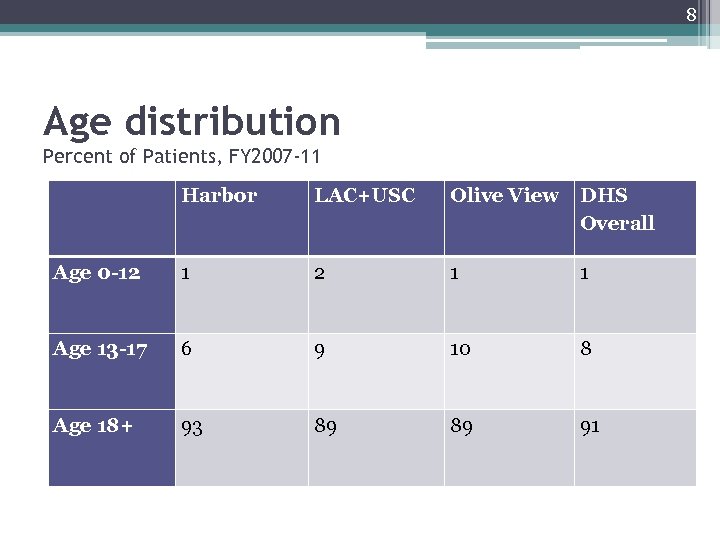 8 Age distribution Percent of Patients, FY 2007 -11 Harbor LAC+USC Olive View DHS Overall Age 0 -12 1 1 Age 13 -17 6 9 10 8 Age 18+ 93 89 89 91
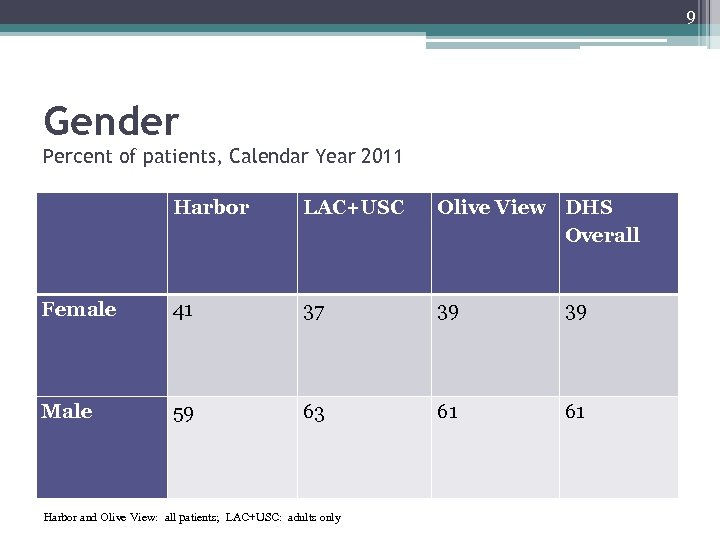 9 Gender Percent of patients, Calendar Year 2011 Harbor LAC+USC Olive View DHS Overall Female 41 37 39 39 Male 59 63 61 61 Harbor and Olive View: all patients; LAC+USC: adults only
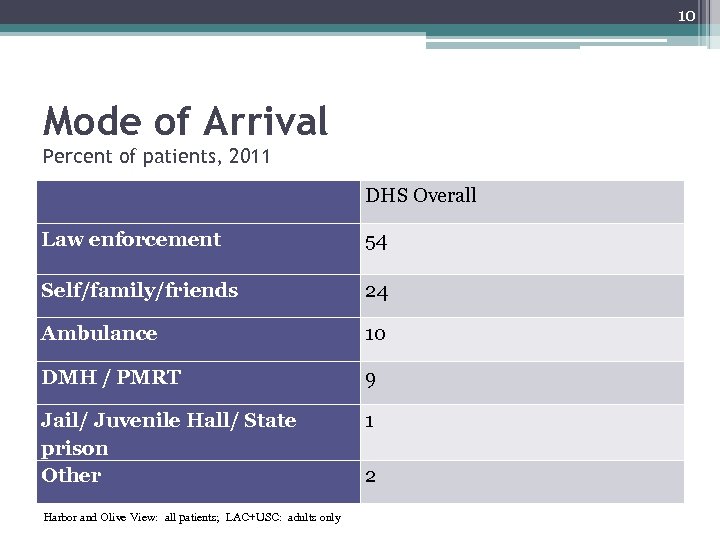 10 Mode of Arrival Percent of patients, 2011 DHS Overall Law enforcement 54 Self/family/friends 24 Ambulance 10 DMH / PMRT 9 Jail/ Juvenile Hall/ State prison Other 1 Harbor and Olive View: all patients; LAC+USC: adults only 2
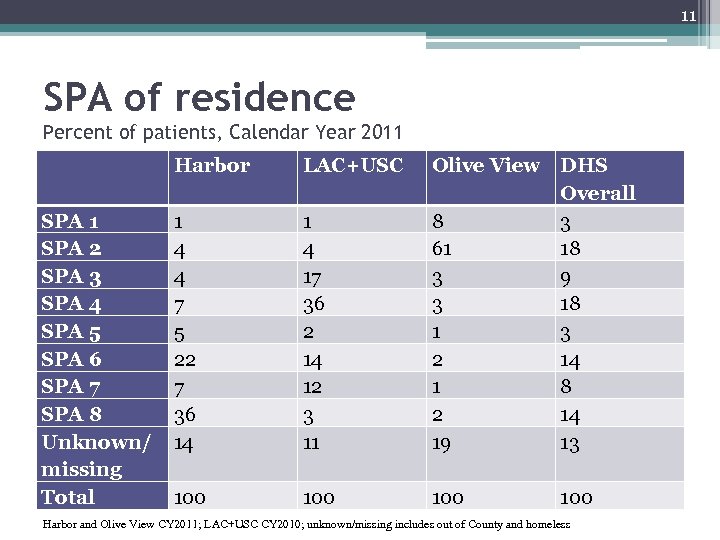 11 SPA of residence Percent of patients, Calendar Year 2011 Harbor LAC+USC SPA 1 SPA 2 SPA 3 SPA 4 SPA 5 SPA 6 SPA 7 SPA 8 Unknown/ missing Total 1 4 4 7 5 22 7 36 14 1 4 17 36 2 14 12 3 11 Olive View DHS Overall 8 3 61 18 3 9 3 18 1 3 2 14 1 8 2 14 19 13 100 100 Harbor and Olive View CY 2011; LAC+USC CY 2010; unknown/missing includes out of County and homeless
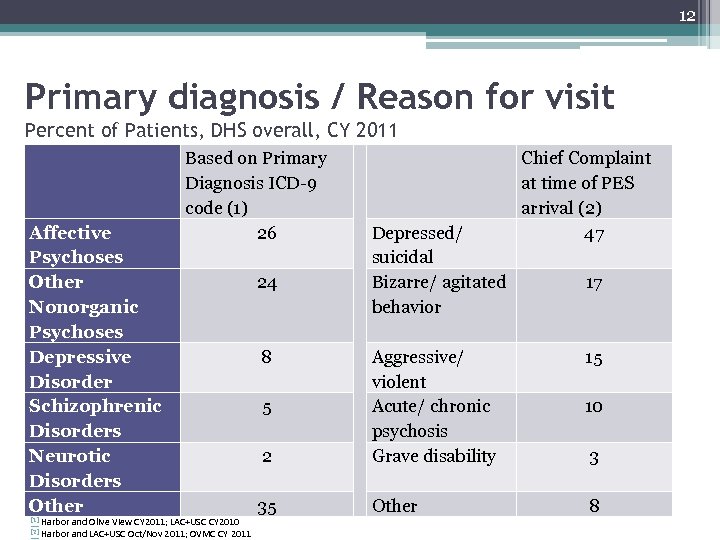 12 Primary diagnosis / Reason for visit Percent of Patients, DHS overall, CY 2011 Affective Psychoses Other Nonorganic Psychoses Depressive Disorder Schizophrenic Disorders Neurotic Disorders Other [1] [2] Based on Primary Diagnosis ICD-9 code (1) 26 Harbor and Olive View CY 2011; LAC+USC CY 2010 Harbor and LAC+USC Oct/Nov 2011; OVMC CY 2011 24 8 Depressed/ suicidal Bizarre/ agitated behavior Chief Complaint at time of PES arrival (2) 47 17 10 2 Aggressive/ violent Acute/ chronic psychosis Grave disability 35 Other 8 5 15 3
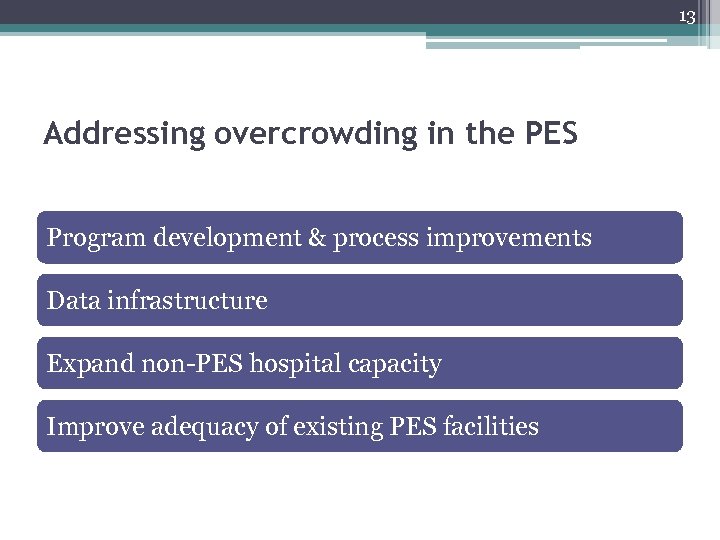 13 Addressing overcrowding in the PES Program development & process improvements Data infrastructure Expand non-PES hospital capacity Improve adequacy of existing PES facilities
 14 Program development / process improvements • Further invest in intensive case management programs for individuals that frequently utilize the PES • Streamline access into substance abuse rehabilitation programs • Improve coordination with DCFS • Increase DMH liaison activities • Engage with LPS-designated individuals regarding appropriate use of 5150 holds and range of potential destinations to which patients on holds may be transferred • Educate psych inpatient and PES staff to more rapidly discharge patients to open community-based facilities • Develop Post-hospitalization Placement Problem Comm.
 15 Program dev. / process improvements – con’t • Address operational issues that delay timely patient throughput ▫ Supplement social service staff ▫ Streamline ambulance crew drop-offs ▫ Streamline Hawkins discharge procedures ▫ Pilot adolescent transfer protocols ▫ Promote linkage with DMH FSPs • Reduce, where appropriate, interfacility variation in clinical practice patterns
 16 PES Outcomes Study – DMH/DHS Collaborative Effort • Study Aims: ▫ Describe the demographic, social, and clinical factors of PES pts ▫ Identify predictors associated with discharged vs. admitted PES pts ▫ Compare longitudinal outcomes of discharged vs. admitted PES pts • Study Design: ▫ Retrospective cohort of adult LA County residents seen in one of three LAC locked PESs from 2008 through 2010 ▫ Longitudinal utilization and clinical outcomes traced from 2008 through 2011
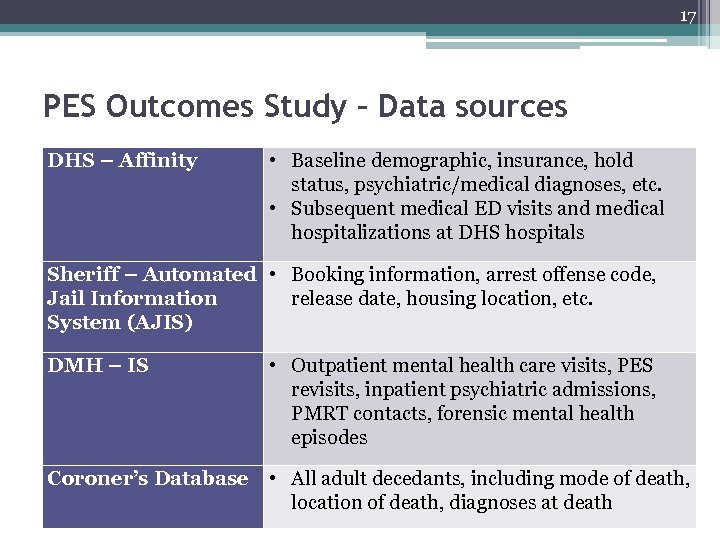 17 PES Outcomes Study – Data sources DHS – Affinity • Baseline demographic, insurance, hold status, psychiatric/medical diagnoses, etc. • Subsequent medical ED visits and medical hospitalizations at DHS hospitals Sheriff – Automated • Booking information, arrest offense code, Jail Information release date, housing location, etc. System (AJIS) DMH – IS • Outpatient mental health care visits, PES revisits, inpatient psychiatric admissions, PMRT contacts, forensic mental health episodes Coroner’s Database • All adult decedants, including mode of death, location of death, diagnoses at death
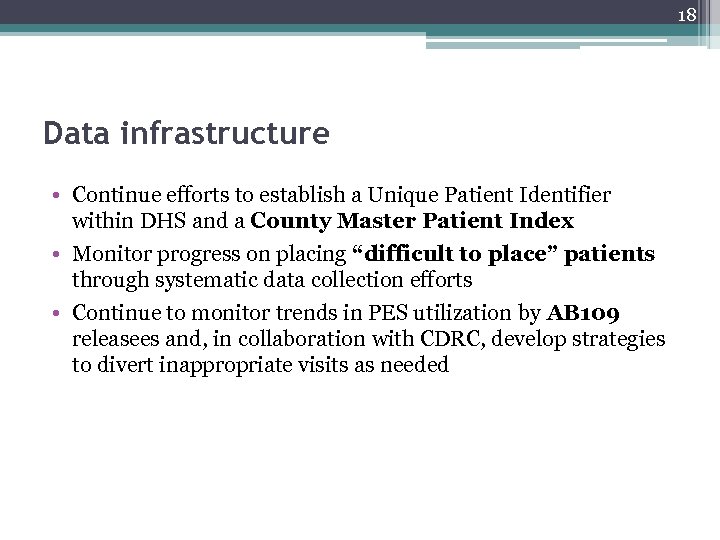 18 Data infrastructure • Continue efforts to establish a Unique Patient Identifier within DHS and a County Master Patient Index • Monitor progress on placing “difficult to place” patients through systematic data collection efforts • Continue to monitor trends in PES utilization by AB 109 releasees and, in collaboration with CDRC, develop strategies to divert inappropriate visits as needed
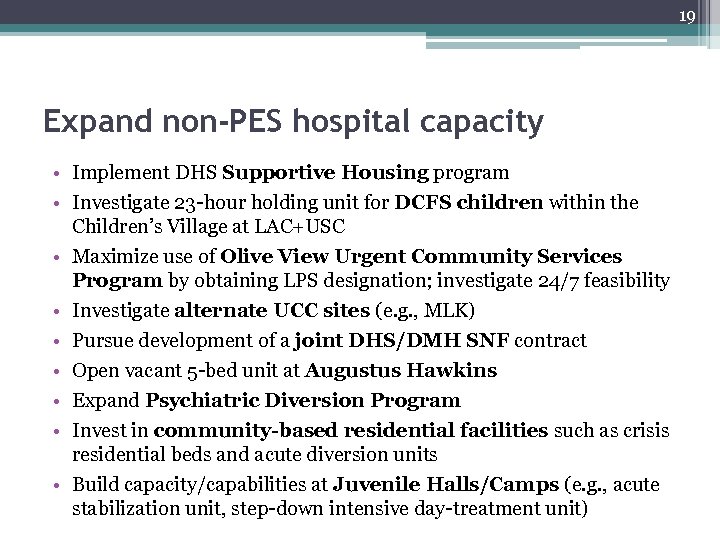 19 Expand non-PES hospital capacity • Implement DHS Supportive Housing program • Investigate 23 -hour holding unit for DCFS children within the Children’s Village at LAC+USC • Maximize use of Olive View Urgent Community Services Program by obtaining LPS designation; investigate 24/7 feasibility • Investigate alternate UCC sites (e. g. , MLK) • Pursue development of a joint DHS/DMH SNF contract • Open vacant 5 -bed unit at Augustus Hawkins • Expand Psychiatric Diversion Program • Invest in community-based residential facilities such as crisis residential beds and acute diversion units • Build capacity/capabilities at Juvenile Halls/Camps (e. g. , acute stabilization unit, step-down intensive day-treatment unit)
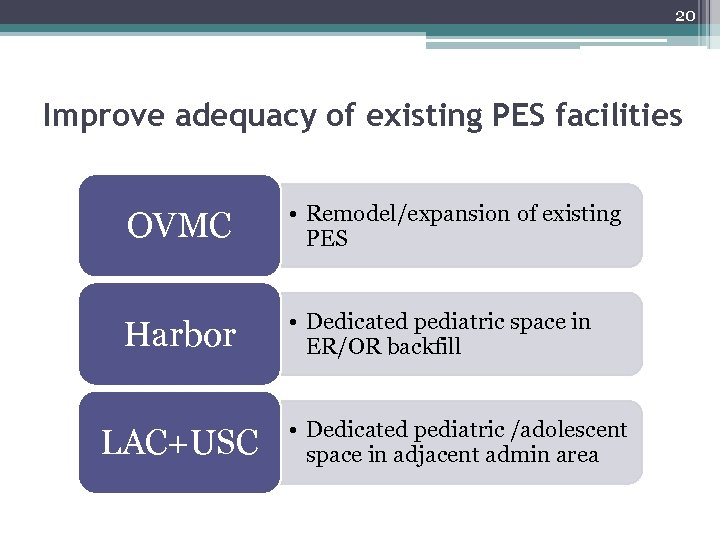 20 Improve adequacy of existing PES facilities OVMC • Remodel/expansion of existing PES Harbor • Dedicated pediatric space in ER/OR backfill LAC+USC • Dedicated pediatric /adolescent space in adjacent admin area
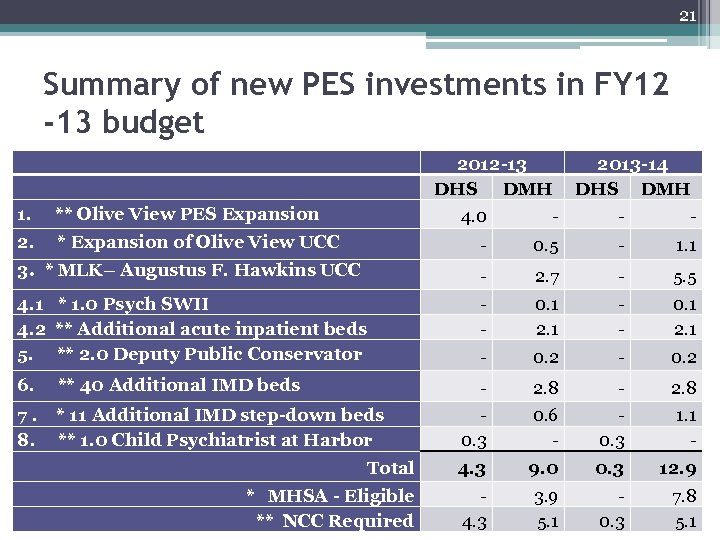 21 Summary of new PES investments in FY 12 -13 budget 2013 -14 2012 -13 DHS DMH 4. 0 - - - 1. ** Olive View PES Expansion 2. * Expansion of Olive View UCC - 0. 5 - 1. 1 3. * MLK– Augustus F. Hawkins UCC - 2. 7 - 5. 5 4. 1 * 1. 0 Psych SWII 4. 2 ** Additional acute inpatient beds 5. ** 2. 0 Deputy Public Conservator - 0. 1 2. 1 - 0. 2 - 2. 8 0. 3 0. 6 - 0. 3 1. 1 - 6. ** 40 Additional IMD beds 7. * 11 Additional IMD step-down beds 8. ** 1. 0 Child Psychiatrist at Harbor Total 4. 3 9. 0 0. 3 12. 9 * MHSA - Eligible - 3. 9 - 7. 8 ** NCC Required 4. 3 5. 1 0. 3 5. 1
 Discussion and Final Comments
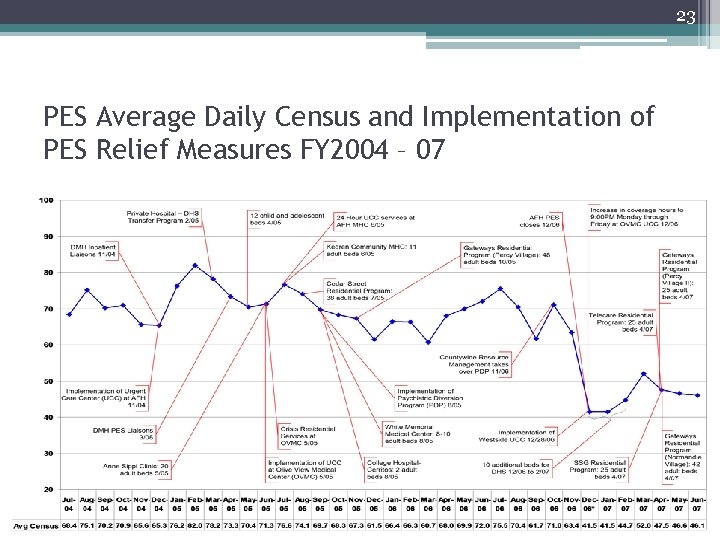 23 PES Average Daily Census and Implementation of PES Relief Measures FY 2004 – 07
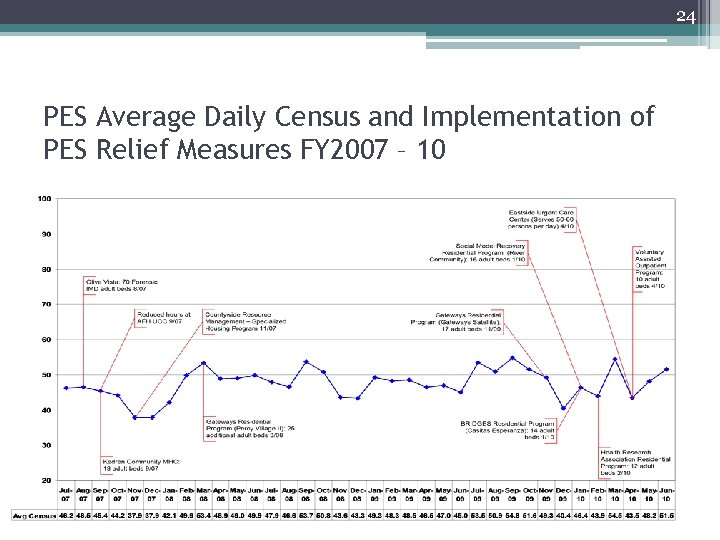 24 PES Average Daily Census and Implementation of PES Relief Measures FY 2007 – 10
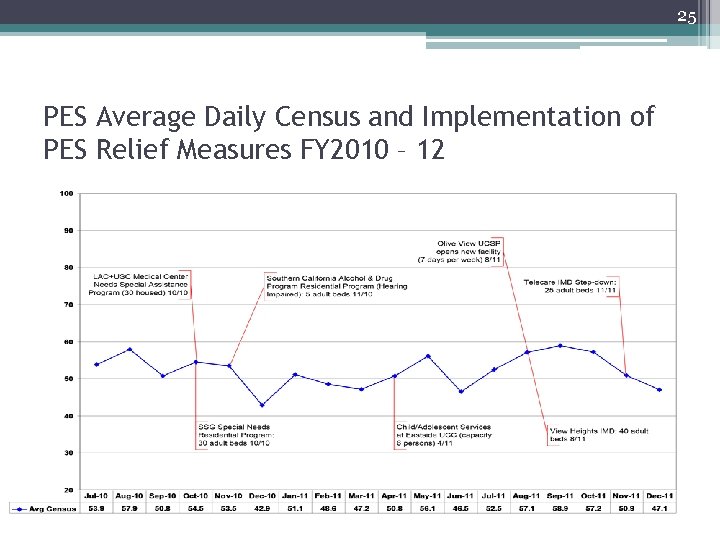 25 PES Average Daily Census and Implementation of PES Relief Measures FY 2010 – 12