 Скачать презентацию PSY 369 Psycholinguistics Some basic linguistic theory
82ade2128263fa4954a03c9147cb65c1.ppt
- Количество слайдов: 24



PSY 369: Psycholinguistics Some basic linguistic theory
Hello there! n Multiple levels of analysis n n Word order important (don’t say “There Hello!”) Each word composed of a sequence of sounds Sentence is uttered in a particular tone of voice (signified by the “!”, rather than a “Hello there? ”) Used to signal particular part of a social interaction (would say it at the beginning of the interaction, not when leaving or in the middle)
Levels of analysis n n n Phonology Morphology Syntax Semantics Pragmatics
Levels of analysis n n n Phonology Morphology Syntax Semantics Pragmatics
Phonology n The sounds of a language n Phonemes, allophones & phones n n Phonemes - abstract (mental) representations of the sound units in a language Allophones - different sounds that get categorized as the same phoneme Phones - a general term for the sounds used in languages Rules about how to put the sounds together
![Phonology allophones Listen to the ‘p’ sound pill [ph] spill [p] phonemes /p/ Rule:](https://present5.com/presentation/82ade2128263fa4954a03c9147cb65c1/image-6.jpg "Phonology allophones Listen to the ‘p’ sound pill [ph] spill [p] phonemes /p/ Rule:")
Phonology allophones Listen to the ‘p’ sound pill [ph] spill [p] phonemes /p/ Rule: If /p/ is used in word initial position you add aspiration (a puff of air), if word internal don’t aspirate
Finding phonemes n Substitution and minimal pairs n n Take a word (e. g, "tie" /ta. I/) and find the words that share the same sequence /a. I/, but contrast at their beginnings. If the switch in initial sound changes the meaning, it is evidence of separate phonemes n n pie, buy, tie, die, sigh, lie, my, guy, why, shy Gives us /p/ /b/ /t/ /d/ /s/ /l/ /m/ /g/ /w/ /sh/
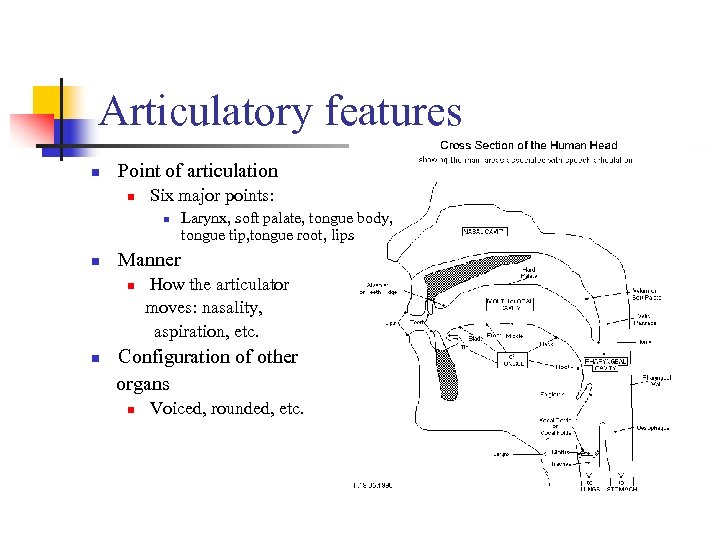
Articulatory features n Point of articulation n Six major points: n n Larynx, soft palate, tongue body, tongue tip, tongue root, lips Manner How the articulator moves: nasality, aspiration, etc. n Configuration of other organs n n Voiced, rounded, etc.
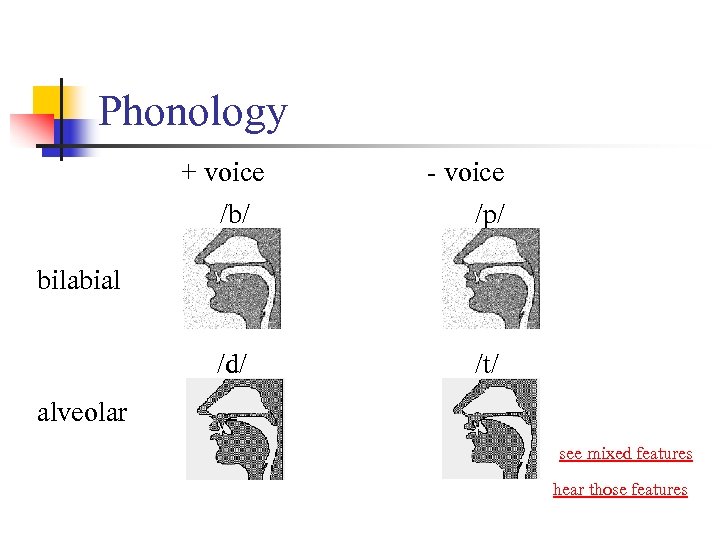
Phonology + voice /b/ - voice /p/ /d/ /t/ bilabial alveolar see mixed features hear those features

Phonemes: articulatory features full chart Symbols and sounds
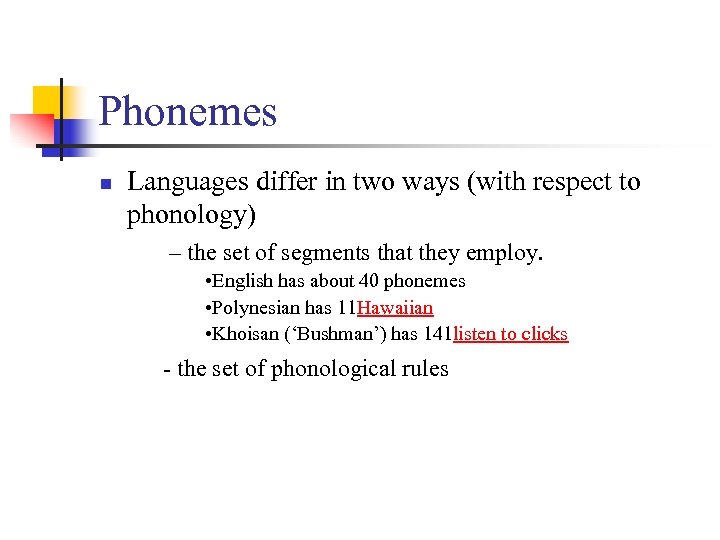
Phonemes n Languages differ in two ways (with respect to phonology) – the set of segments that they employ. • English has about 40 phonemes • Polynesian has 11 Hawaiian • Khoisan (‘Bushman’) has 141 listen to clicks - the set of phonological rules
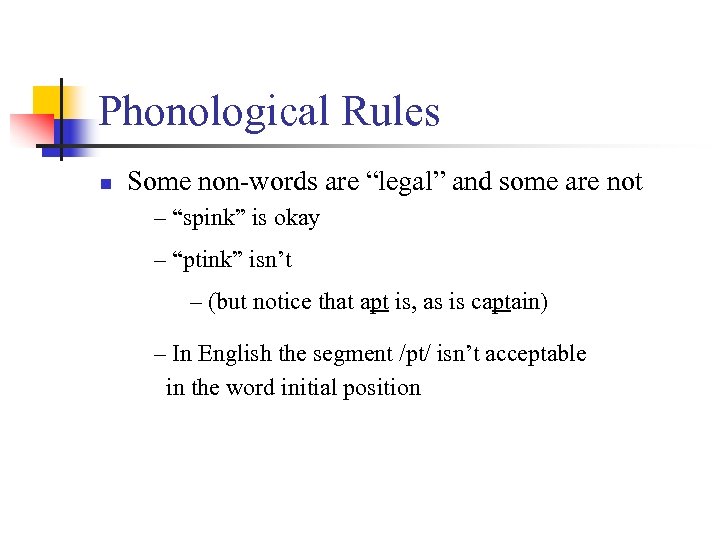
Phonological Rules n Some non-words are “legal” and some are not – “spink” is okay – “ptink” isn’t – (but notice that apt is, as is captain) – In English the segment /pt/ isn’t acceptable in the word initial position
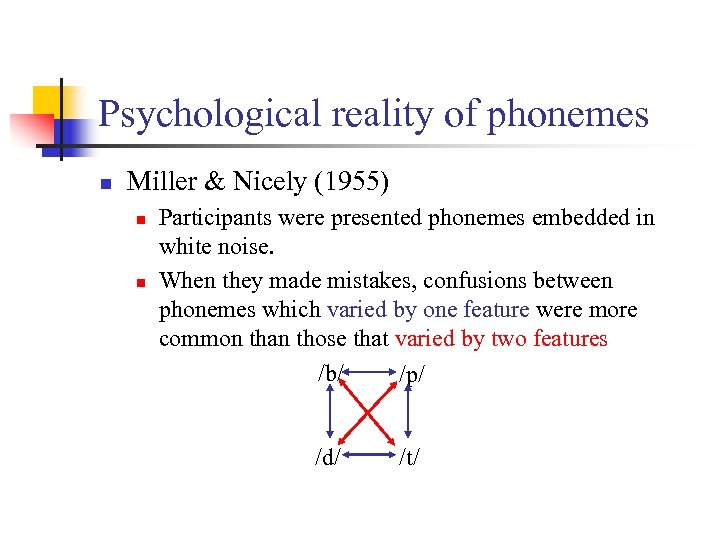
Psychological reality of phonemes n Miller & Nicely (1955) n n Participants were presented phonemes embedded in white noise. When they made mistakes, confusions between phonemes which varied by one feature were more common than those that varied by two features /b/ /p/ /d/ /t/
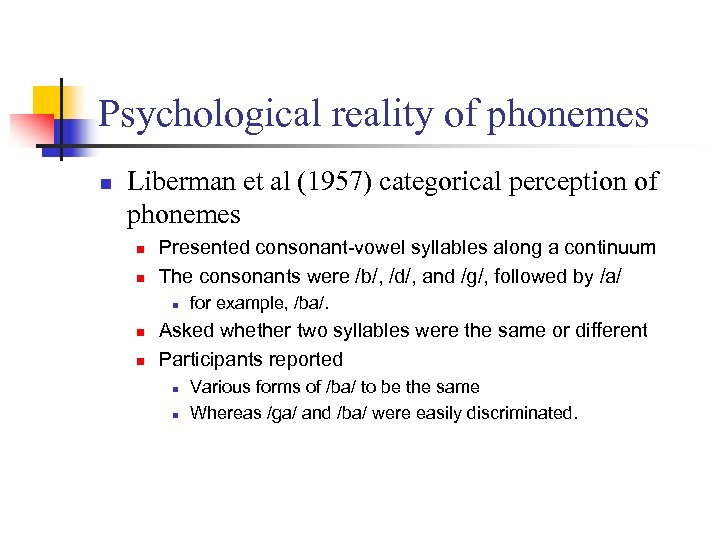
Psychological reality of phonemes n Liberman et al (1957) categorical perception of phonemes n n Presented consonant-vowel syllables along a continuum The consonants were /b/, /d/, and /g/, followed by /a/ n n n for example, /ba/. Asked whether two syllables were the same or different Participants reported n n Various forms of /ba/ to be the same Whereas /ga/ and /ba/ were easily discriminated.
Levels of analysis n n n Phonology Morphology Syntax Semantics Pragmatics
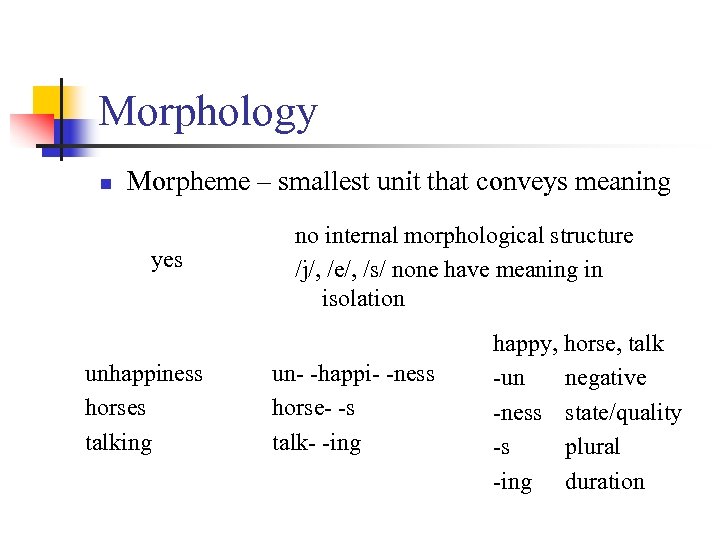
Morphology n Morpheme – smallest unit that conveys meaning yes unhappiness horses talking no internal morphological structure /j/, /e/, /s/ none have meaning in isolation un- -happi- -ness horse- -s talk- -ing happy, horse, talk -un negative -ness state/quality -s plural -ing duration
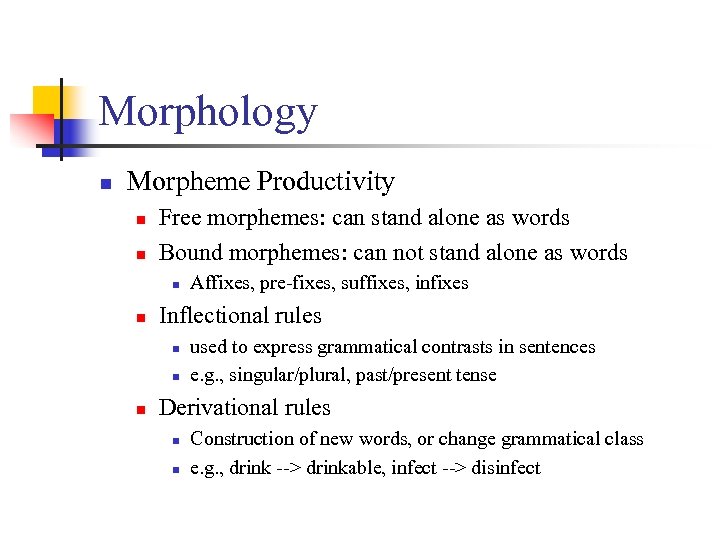
Morphology n Morpheme Productivity n n Free morphemes: can stand alone as words Bound morphemes: can not stand alone as words n n Inflectional rules n n n Affixes, pre-fixes, suffixes, infixes used to express grammatical contrasts in sentences e. g. , singular/plural, past/present tense Derivational rules n n Construction of new words, or change grammatical class e. g. , drink --> drinkable, infect --> disinfect
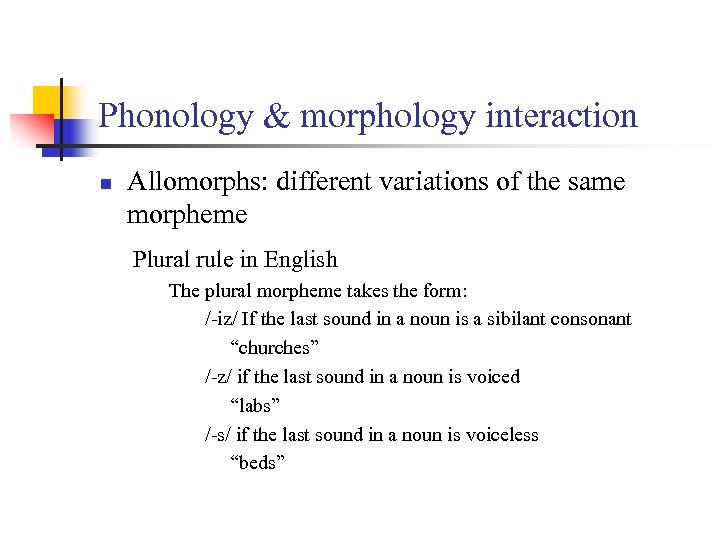
Phonology & morphology interaction n Allomorphs: different variations of the same morpheme Plural rule in English The plural morpheme takes the form: /-iz/ If the last sound in a noun is a sibilant consonant “churches” /-z/ if the last sound in a noun is voiced “labs” /-s/ if the last sound in a noun is voiceless “beds”
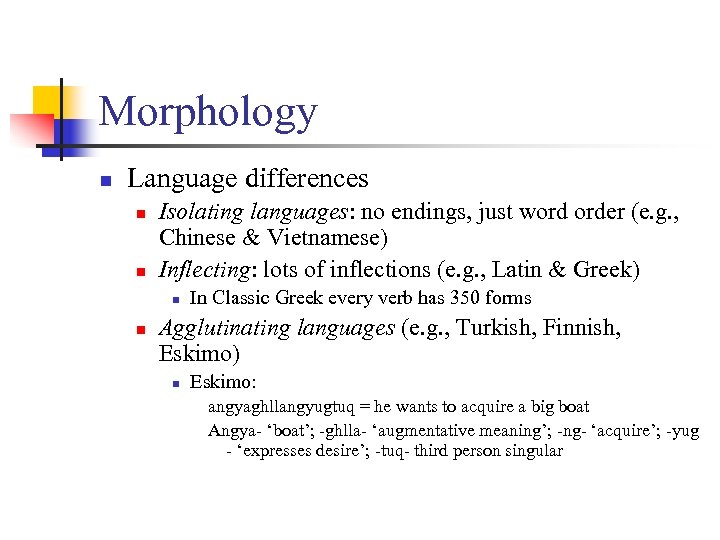
Morphology n Language differences n n Isolating languages: no endings, just word order (e. g. , Chinese & Vietnamese) Inflecting: lots of inflections (e. g. , Latin & Greek) n n In Classic Greek every verb has 350 forms Agglutinating languages (e. g. , Turkish, Finnish, Eskimo) n Eskimo: angyaghllangyugtuq = he wants to acquire a big boat Angya- ‘boat’; -ghlla- ‘augmentative meaning’; -ng- ‘acquire’; -yug - ‘expresses desire’; -tuq- third person singular
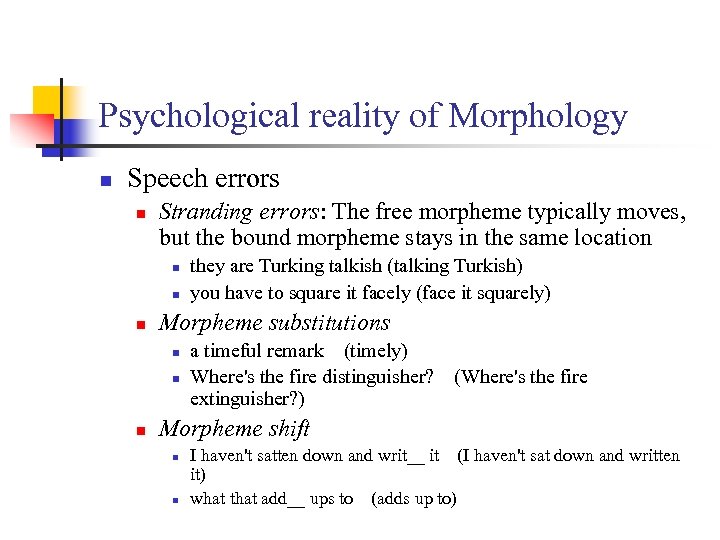
Psychological reality of Morphology n Speech errors n Stranding errors: The free morpheme typically moves, but the bound morpheme stays in the same location n Morpheme substitutions n n n they are Turking talkish (talking Turkish) you have to square it facely (face it squarely) a timeful remark (timely) Where's the fire distinguisher? (Where's the fire extinguisher? ) Morpheme shift n n I haven't satten down and writ__ it (I haven't sat down and written it) what that add__ ups to (adds up to)
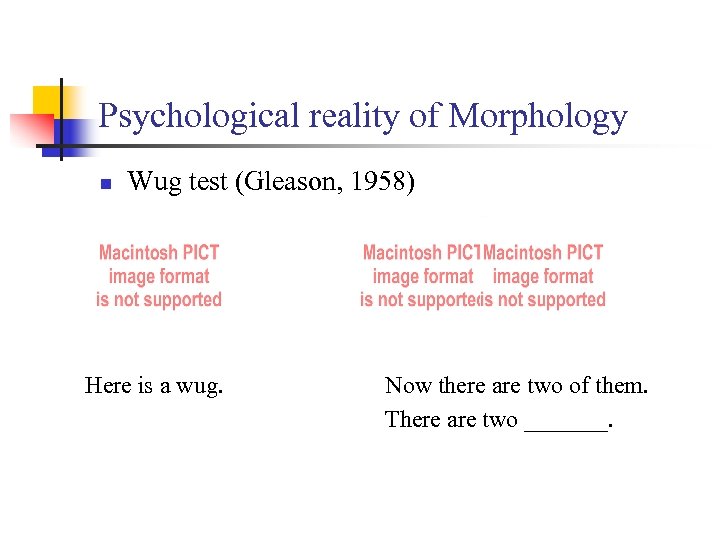
Psychological reality of Morphology n Wug test (Gleason, 1958) Here is a wug. Now there are two of them. There are two _______.
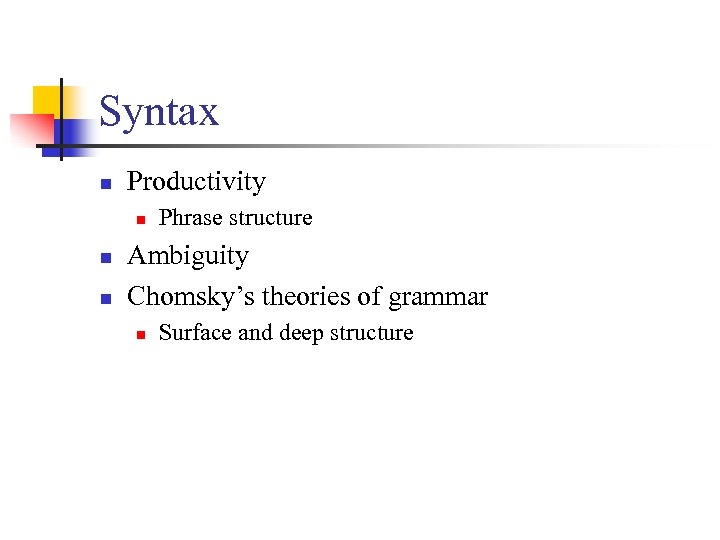
Syntax n Productivity n n n Phrase structure Ambiguity Chomsky’s theories of grammar n Surface and deep structure
semantics n Word level n n Polysemy Sentence level n Propositions
Pragmatics
Скачать презентацию PSY 369 Psycholinguistics Some basic linguistic theory
82ade2128263fa4954a03c9147cb65c1.ppt