


 Скачать презентацию PSY 369 Psycholinguistics Language Acquisition Announcements n
996c4c2a2bea351c5d1510b04c4b8dac.ppt
- Количество слайдов: 130
 PSY 369: Psycholinguistics Language Acquisition
 Announcements n n Language development section includes information from Chapter 3, pages 72 -87 Homework #2 due Feb 20 (moved from Feb 18)
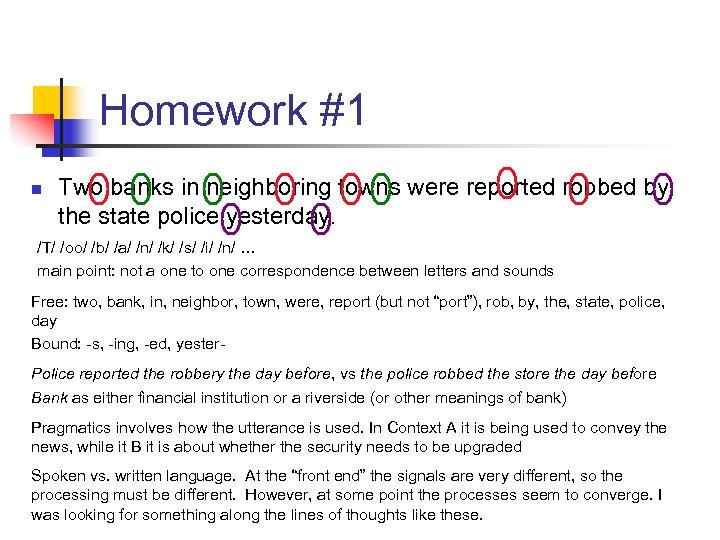 Homework #1 n Two banks in neighboring towns were reported robbed by the state police yesterday. /T/ /oo/ /b/ /a/ /n/ /k/ /s/ /i/ /n/ … main point: not a one to one correspondence between letters and sounds Free: two, bank, in, neighbor, town, were, report (but not “port”), rob, by, the, state, police, day Bound: -s, -ing, -ed, yester. Police reported the robbery the day before, vs the police robbed the store the day before Bank as either financial institution or a riverside (or other meanings of bank) Pragmatics involves how the utterance is used. In Context A it is being used to convey the news, while it B it is about whether the security needs to be upgraded Spoken vs. written language. At the “front end” the signals are very different, so the processing must be different. However, at some point the processes seem to converge. I was looking for something along the lines of thoughts like these.
 Acquiring language Dr. Cutting, language sure is complicated. How do you expect us to learn all this stuff? n Student in my psycholinguistics course
 Acquiring language Whadda’ ya mean, mommy. I can talk. I can understand what you say. What’s so hard? n Student in my psycholinguistics course n 2 year old
 Acquiring language n n How do we (humans) do it? How do we learn to use this complex behavior? Student in my psycholinguistics course n 2 year old
 Overview n Some of the major issues n Imitation vs Innateness n n Born to walk Born to talk? n n How much explicit teaching do we get? n Very little on syntax & phonology, some on meaning Commonalities across individuals, languages and cultures n Language is complex everywhere n n n Sounds, words, syntax, and more No primitive (simple) languages Language development is similar everywhere n Similar stages
 Different approaches n Behaviorist accounts Imitation (& conditioning) accounts e. g. , B. F. Skinner – children learn through imitation and reinforcement. n n n Nativist (Innateness) accounts o e. g. , Chomsky’s Language Acquisition Device (LAD) Language works by internalizing the rules of grammar to produce sentences. o They do this without practice, reinforcement, or adult modeling o Universal Grammar & Parameter setting o
 Different approaches n Cognitive hypotheses n n n Piaget – cognitive development drives language development Vygotsky – language and cognition are initially separate, but as each develop become tightly interconnected, with each influencing each other Social hypothesis n n e. g. , Bruner’s Language acquisition socialization system (LASS) – emphasized the social setting in acquiring language Exposure to language is not enough, learners must experience language in social/interactive contexts n E. g, child-directed speech, turn taking situations
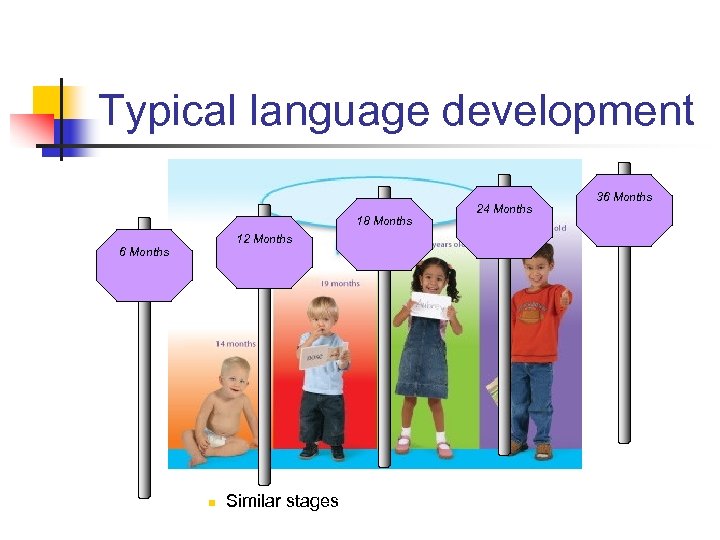 Typical language development 18 Months 12 Months 6 Months n Similar stages 24 Months 36 Months
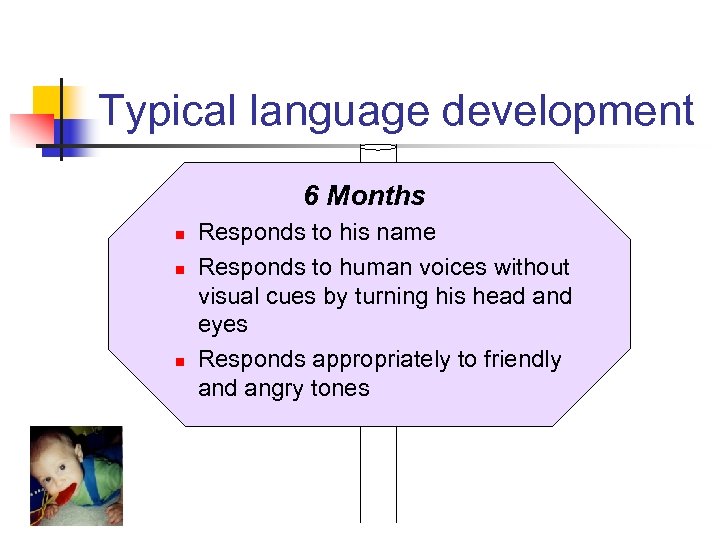 Typical language development 6 Months n n n Responds to his name Responds to human voices without visual cues by turning his head and eyes Responds appropriately to friendly and angry tones
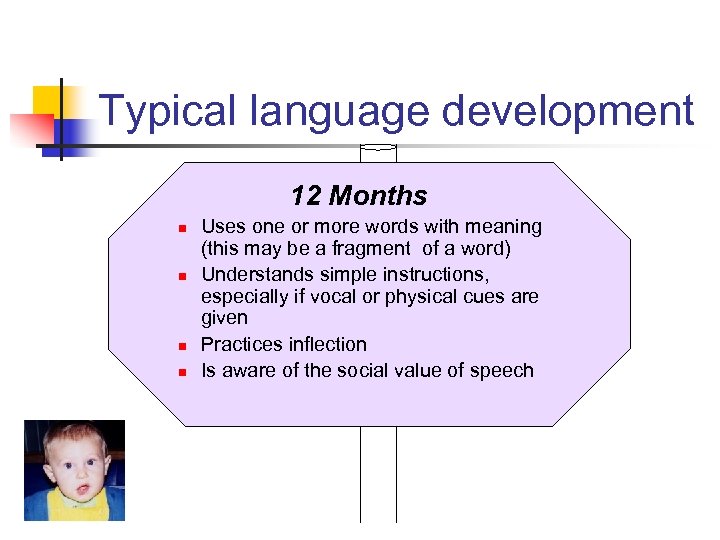 Typical language development 12 Months n n Uses one or more words with meaning (this may be a fragment of a word) Understands simple instructions, especially if vocal or physical cues are given Practices inflection Is aware of the social value of speech
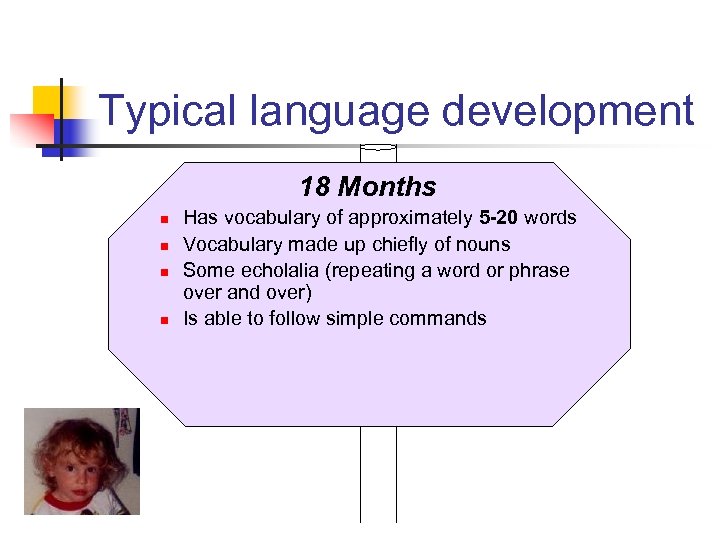 Typical language development 18 Months n n Has vocabulary of approximately 5 -20 words Vocabulary made up chiefly of nouns Some echolalia (repeating a word or phrase over and over) Is able to follow simple commands
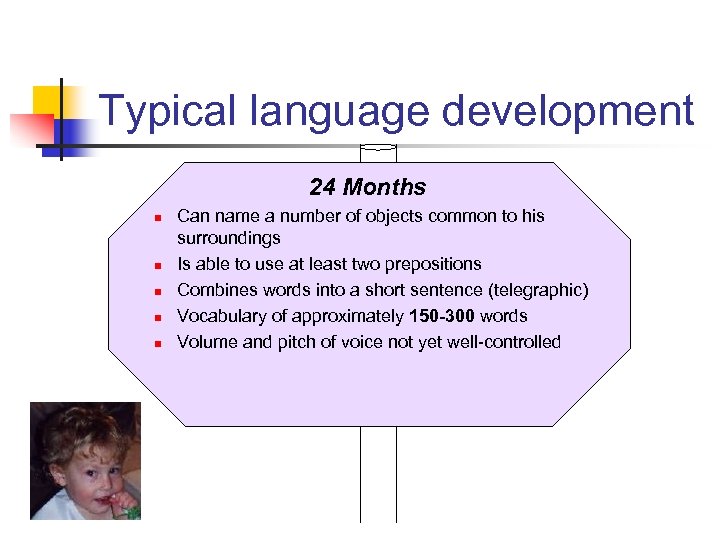 Typical language development 24 Months n n n Can name a number of objects common to his surroundings Is able to use at least two prepositions Combines words into a short sentence (telegraphic) Vocabulary of approximately 150 -300 words Volume and pitch of voice not yet well-controlled
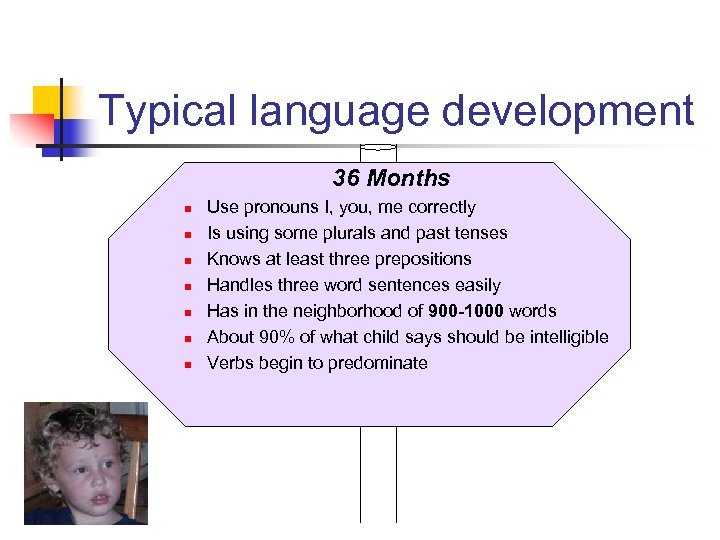 Typical language development 36 Months n n n n Use pronouns I, you, me correctly Is using some plurals and past tenses Knows at least three prepositions Handles three word sentences easily Has in the neighborhood of 900 -1000 words About 90% of what child says should be intelligible Verbs begin to predominate
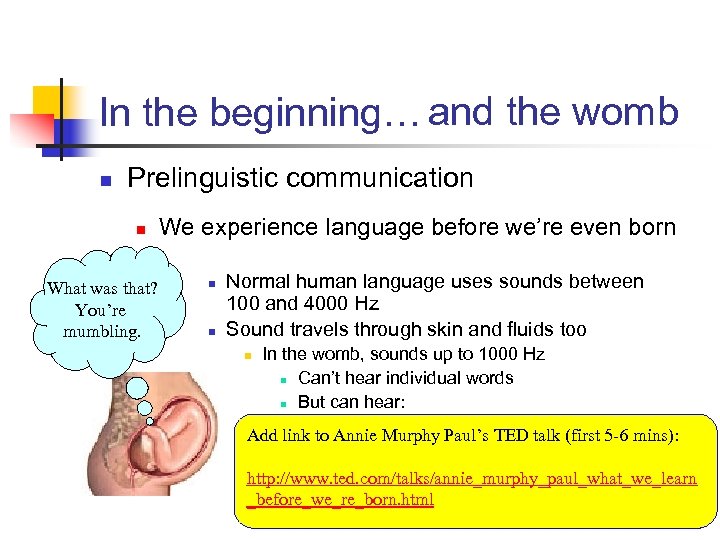 In the beginning… and the womb n Prelinguistic communication n What was that? You’re mumbling. We experience language before we’re even born n n Normal human language uses sounds between 100 and 4000 Hz Sound travels through skin and fluids too In the womb, sounds up to 1000 Hz n Can’t hear individual words n But can hear: n Intonation, durations, rhythm, stress Add link to Annie Murphy Paul’s TED talk (first 5 -6 mins): n http: //www. ted. com/talks/annie_murphy_paul_what_we_learn _before_we_re_born. html
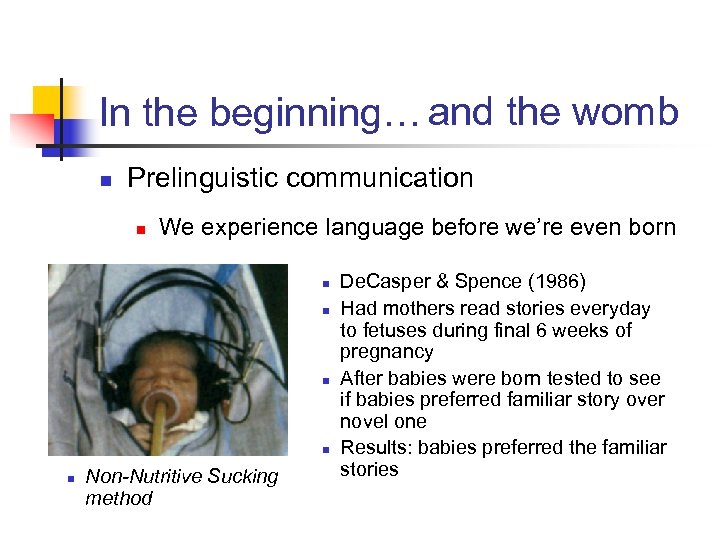 In the beginning… and the womb n Prelinguistic communication n We experience language before we’re even born n n Non-Nutritive Sucking method De. Casper & Spence (1986) Had mothers read stories everyday to fetuses during final 6 weeks of pregnancy After babies were born tested to see if babies preferred familiar story over novel one Results: babies preferred the familiar stories
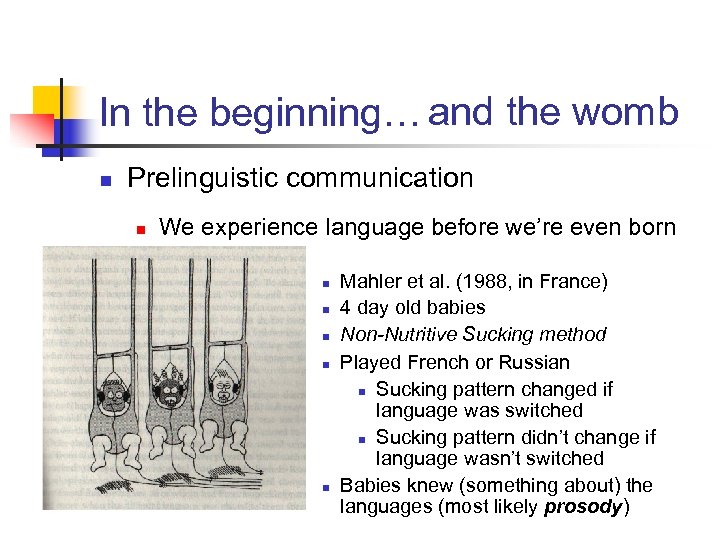 In the beginning… and the womb n Prelinguistic communication n We experience language before we’re even born n n Mahler et al. (1988, in France) 4 day old babies Non-Nutritive Sucking method Played French or Russian n Sucking pattern changed if language was switched n Sucking pattern didn’t change if language wasn’t switched Babies knew (something about) the languages (most likely prosody)
 In the beginning… and the womb n Prelinguistic communication n We experience language before we’re even born Fetal heart monitor n De. Casper, et al (1994)
 In the beginning… and the womb n Prelinguistic communication n We experience language before we’re even born Fetal heart monitor n n n De. Casper, et al (1994) Had mothers read stories everyday to fetuses during 34 -38 weeks of pregnancy After 38 th week, two stories were played to the fetuses (but mom couldn’t hear it) n n Same story Different story
 In the beginning… and the womb n Prelinguistic communication n We experience language before we’re even born Fetal heart monitor n n n De. Casper, et al (1994) Had mothers read stories everyday to fetuses during 34 -38 weeks of pregnancy After 38 th week, two stories were played to the fetuses (but mom couldn’t hear it) n n Same story Different story
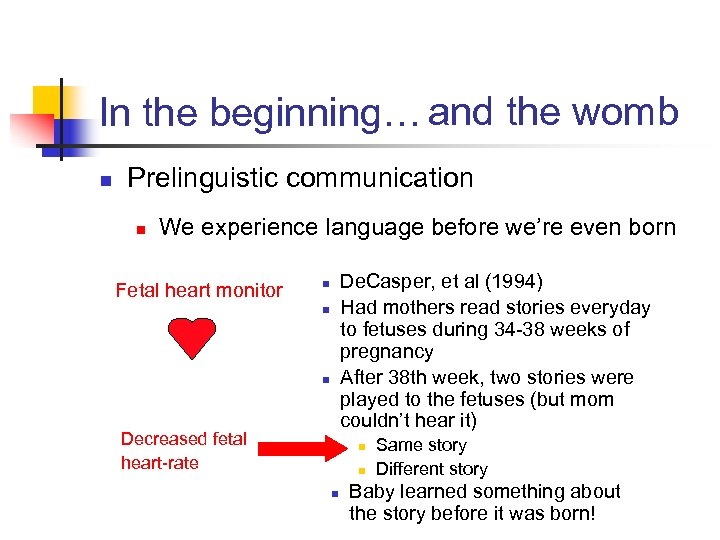 In the beginning… and the womb n Prelinguistic communication n We experience language before we’re even born Fetal heart monitor De. Casper, et al (1994) Had mothers read stories everyday to fetuses during 34 -38 weeks of pregnancy After 38 th week, two stories were played to the fetuses (but mom couldn’t hear it) n n n Decreased fetal heart-rate n n n Same story Different story Baby learned something about the story before it was born!
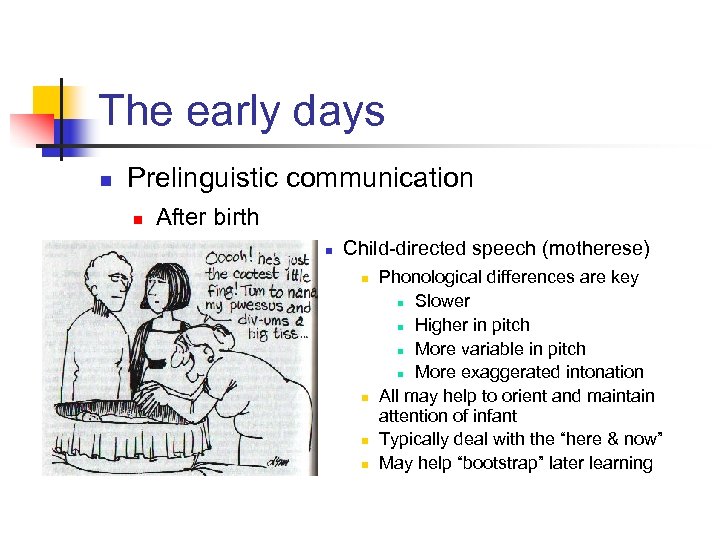 The early days n Prelinguistic communication n After birth n Child-directed speech (motherese) n n Phonological differences are key n Slower n Higher in pitch n More variable in pitch n More exaggerated intonation All may help to orient and maintain attention of infant Typically deal with the “here & now” May help “bootstrap” later learning
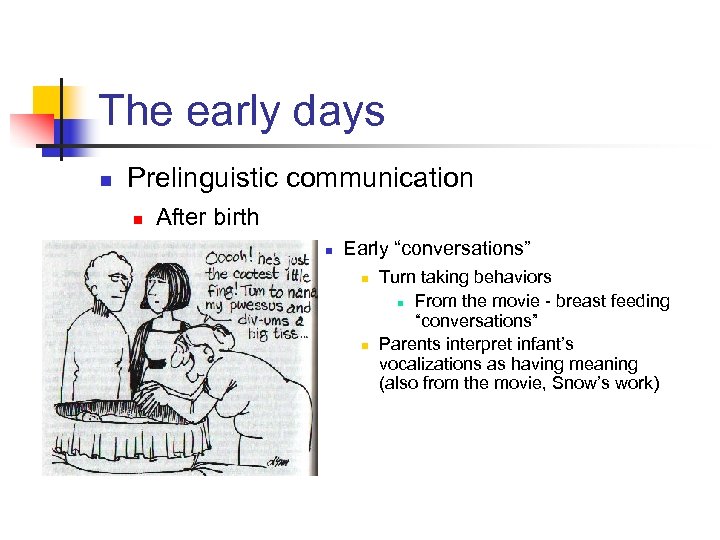 The early days n Prelinguistic communication n After birth n Early “conversations” n n Turn taking behaviors n From the movie - breast feeding “conversations” Parents interpret infant’s vocalizations as having meaning (also from the movie, Snow’s work)
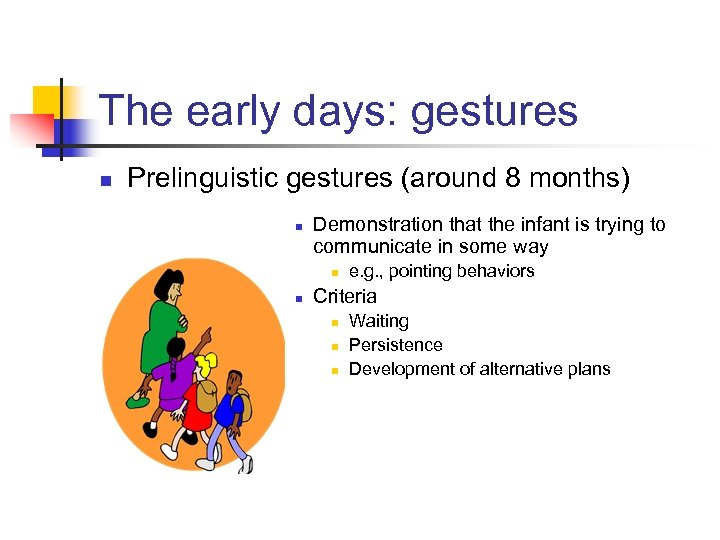 The early days: gestures n Prelinguistic gestures (around 8 months) n Demonstration that the infant is trying to communicate in some way n n e. g. , pointing behaviors Criteria n n n Waiting Persistence Development of alternative plans
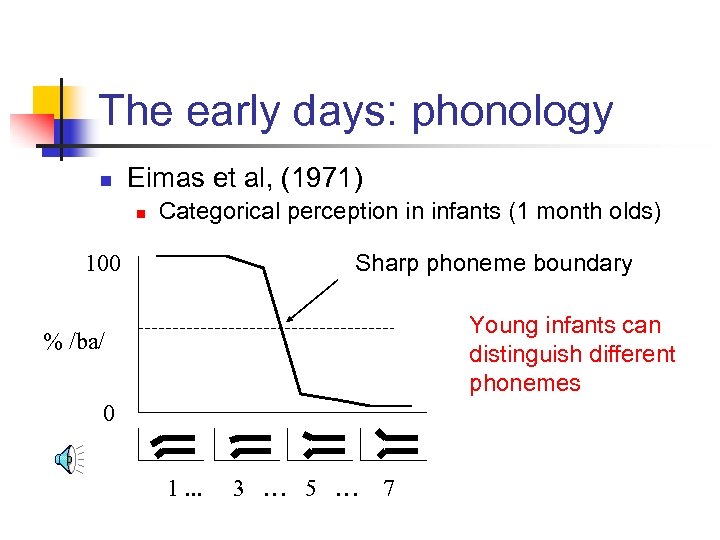 The early days: phonology n Eimas et al, (1971) n Categorical perception in infants (1 month olds) Sharp phoneme boundary 100 Young infants can distinguish different phonemes % /ba/ 0 1. . . 3 … 5 … 7
 The early days: phonology n Categorical perception in infants n A number of studies suggest that very young infants can perceive between a number of phonemic distinctions (e. g. , Kuhl & Meltzhoff, 1997) n n n Not limited to their language context However, as they age/experience their context language the ability to perceive some of these distinctions are lost (~10 to 12 months) Nature/nurture debate: n Are humans “pre-programmed” to distinguish speech sounds? Add link to Patricia Kuhl’s TED talk (~10 mins): http: //www. ted. com/talks/patricia_kuhl_the_linguistic_g enius_of_babies. html
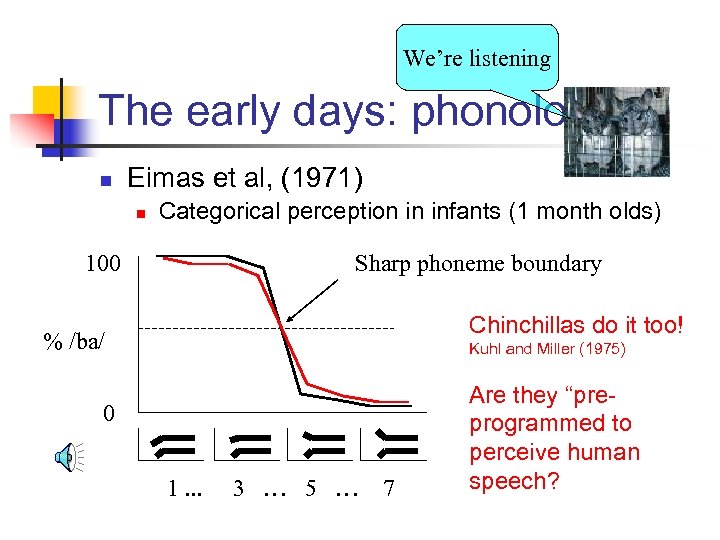 We’re listening The early days: phonology n Eimas et al, (1971) n Categorical perception in infants (1 month olds) 100 Sharp phoneme boundary Chinchillas do it too! % /ba/ Kuhl and Miller (1975) 0 1. . . 3 … 5 … 7 Are they “preprogrammed to perceive human speech?
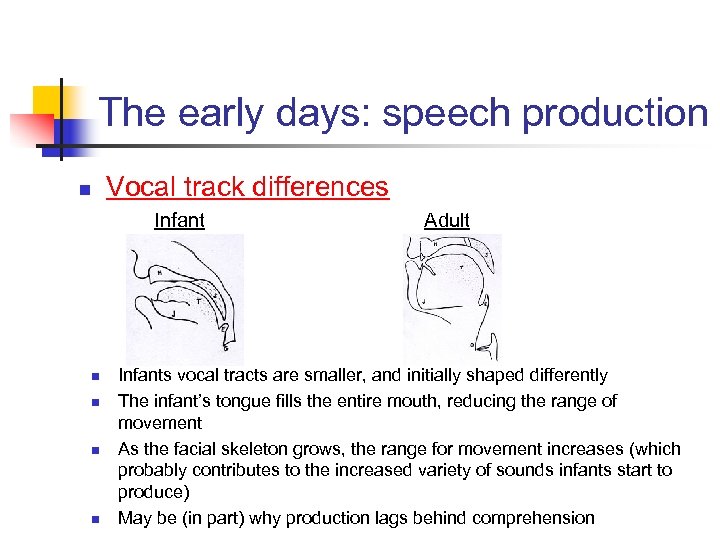 The early days: speech production n Vocal track differences Infant n n Adult Infants vocal tracts are smaller, and initially shaped differently The infant’s tongue fills the entire mouth, reducing the range of movement As the facial skeleton grows, the range for movement increases (which probably contributes to the increased variety of sounds infants start to produce) May be (in part) why production lags behind comprehension
 Speech production n The progression of cooing and babbling follows a universal pattern. n Role of both nature and nurture n n n Pre 6 weeks – “vegetative” sounds n n Nature/Biology plays an important role in the emergence of cooing & babbling. The form of the child’s vocalization is also affected by the linguistic environment. Cry, burp, sucking noises Post 6 week – “cooing” and later “babbling” Babbling & other videos
 Speech production n The progression of cooing and babbling follows a universal pattern. n Babies, until around 6 months old, can produce sounds/phonemes that their parents cannot produce or distinguish n 6 - 8 weeks: cooing n 4 - 6 months: babbling n Clear consonants and vowels are produced n “da”, “gi”
 Speech production n The progression of cooing and babbling follows a universal pattern. n Babies, until around 6 months old, can produce sounds/phonemes that their parents cannot produce or distinguish n 6 - 8 weeks: cooing n 4 - 6 months: babbling n 6 - 7 months: Reduplicated babbling n “dada”, “gigi”
 Speech production n The progression of cooing and babbling follows a universal pattern. n Babies, until around 6 months old, can produce sounds/phonemes that their parents cannot produce or distinguish n 6 - 8 weeks: cooing n 4 - 6 months: babbling n 6 - 7 months: Reduplicated babbling n 8 - 9 months: CVC clusters may appear n “bod”, “tat”
 Speech production n The progression of cooing and babbling follows a universal pattern. n Babies, until around 6 months old, can produce sounds/phonemes that their parents cannot produce or distinguish n 10 or 11 months: Variegated babbling n Combining “incomprehensible words” n n Intonation patterns n n “dab gogotah” May reflect phonological rules of spoken language context By 12 to 14 months some evidence of language specific phonological rules
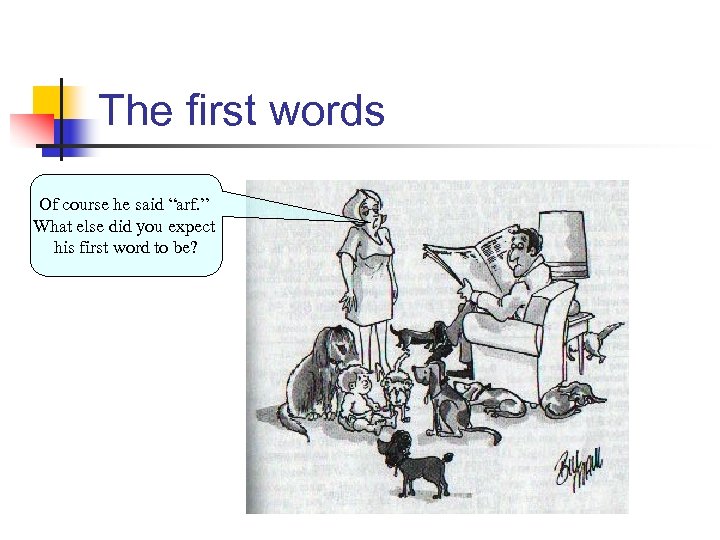 The first words Of course he said “arf. ” What else did you expect his first word to be?
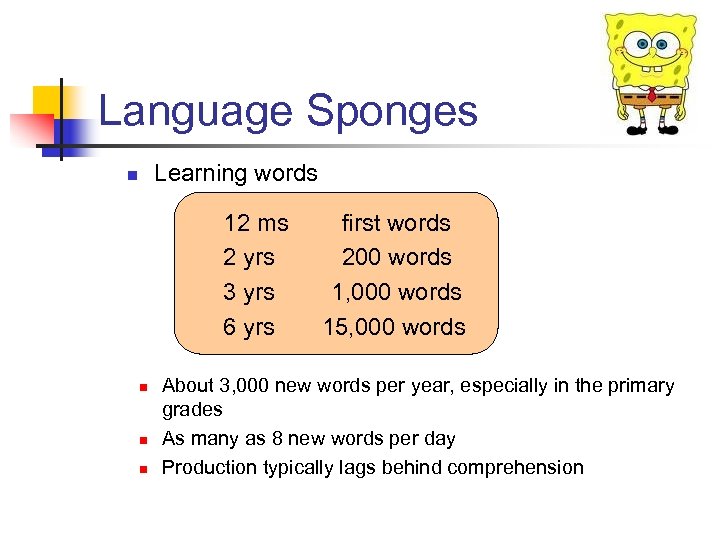 Language Sponges Learning words n 12 ms 2 yrs 3 yrs 6 yrs n n n first words 200 words 1, 000 words 15, 000 words About 3, 000 new words per year, especially in the primary grades As many as 8 new words per day Production typically lags behind comprehension
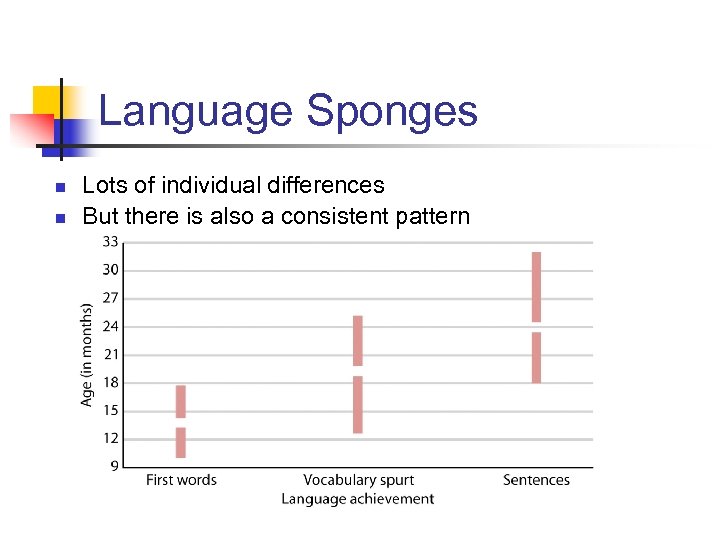 Language Sponges n n Lots of individual differences But there is also a consistent pattern
 Vocabulary growth n Methods used to study this n Observational data (60 s to present) n Diary studies n n Taped language samples (Roger Brown) n n Parents record their kids language development Small numbers of children (Eve, Adam, Sarah) Went to home every month made tape recordings Extensive study needed n Hard to kids to “say all the words you know” or “say a question” n Early phonological production isn’t like adult production, often need to take great care deciding what the child meant Large database CHILDES n Many kids, many languages, including children with language difficulties
 Language Sponges n Learning words n General patterns and observations n n Sounds Meaning n n n Proposed Strategies n Fast mapping n Whole object n Mutual exclusivity Learning Syntax Learning Morphology
 Early word learning n First words (Around 10 -15 months) n n Emergence of systematic, repeated productions of phonologically consistent forms 1 word stage typically lasts around 10 months Have learned first 50 words by 15 – 24 months Typically focused on the “here and now”
 Early word learning n First words (Around 10 -15 months) n Emergence of systematic, repeated productions of phonologically consistent forms n Idiomorphs - personalized words n n Developed in systematic ways Not simply imitation, rather are creative Learned importance of consistency of names “Adult words” - Typically context bound (relevant to the immediate environment) n n Important people, Objects that move, Objects that can be acted upon, Familiar actions Nouns typically appear before verbs
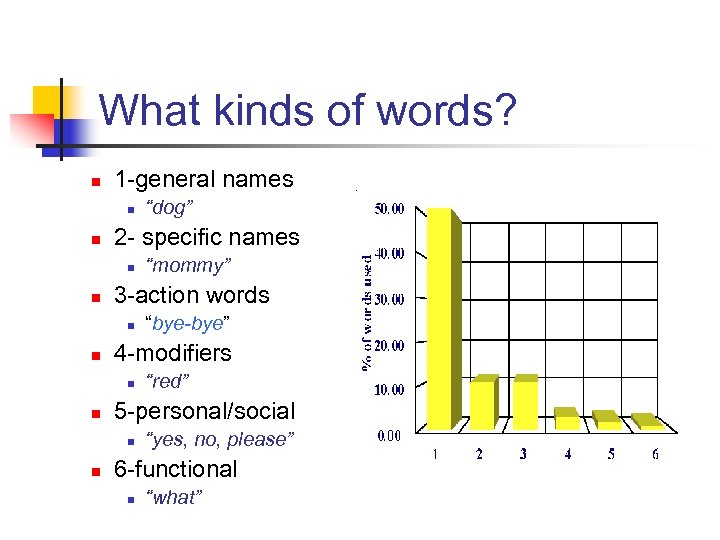 What kinds of words? n 1 -general names n n 2 - specific names n n “red” 5 -personal/social n n “bye-bye” 4 -modifiers n n “mommy” 3 -action words n n “dog” “yes, no, please” 6 -functional n “what”
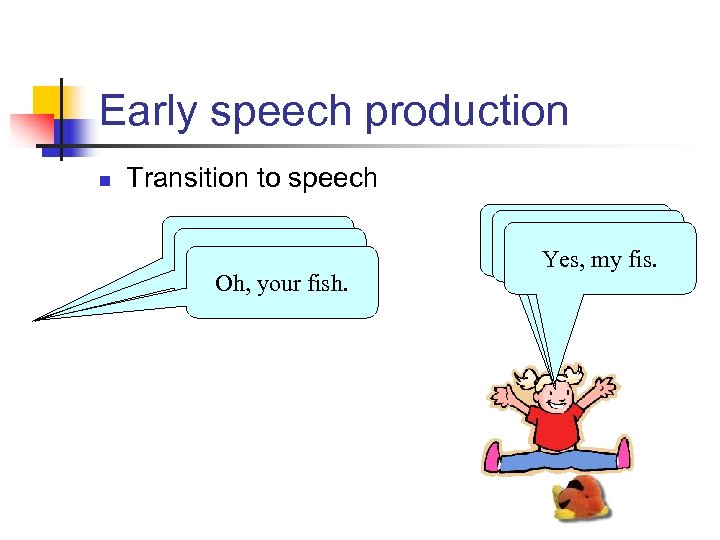 Early speech production n Transition to speech This Your fis? is your fis? Oh, your fish. No. …My fis! No. my fis. Yes, my fis.
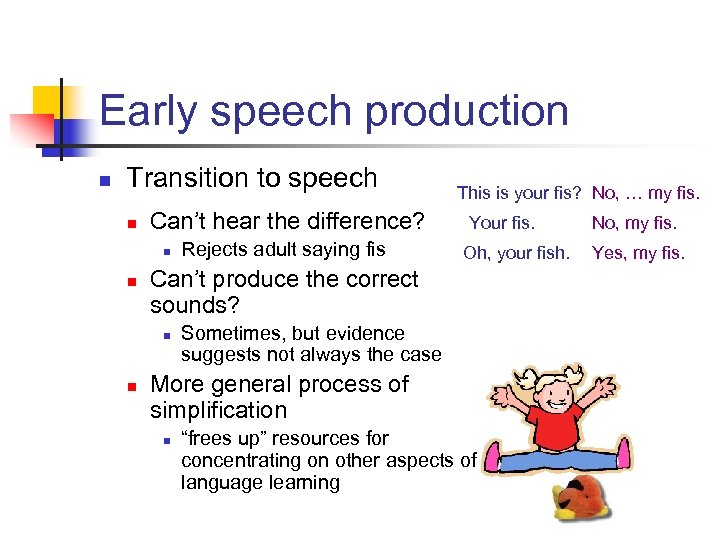 Early speech production n Transition to speech n Can’t hear the difference? n n Your fis. Oh, your fish. Can’t produce the correct sounds? n n Rejects adult saying fis This is your fis? No, … my fis. Sometimes, but evidence suggests not always the case More general process of simplification n “frees up” resources for concentrating on other aspects of language learning No, my fis. Yes, my fis.
 Early speech production n Transition to speech n individual diffs, but some common processes n Common Phonological processes n n Reduction n Delete sounds from words (“da” for dog) Coalescence n Combine different syllables into one syllable (“paf” for pacifier) Assimilation n Change one sound into a similar sound within the word (“fweet” for sweet) Reduplication n One syllable from a multi-syllabic word is repeated (“baba” for bottle)
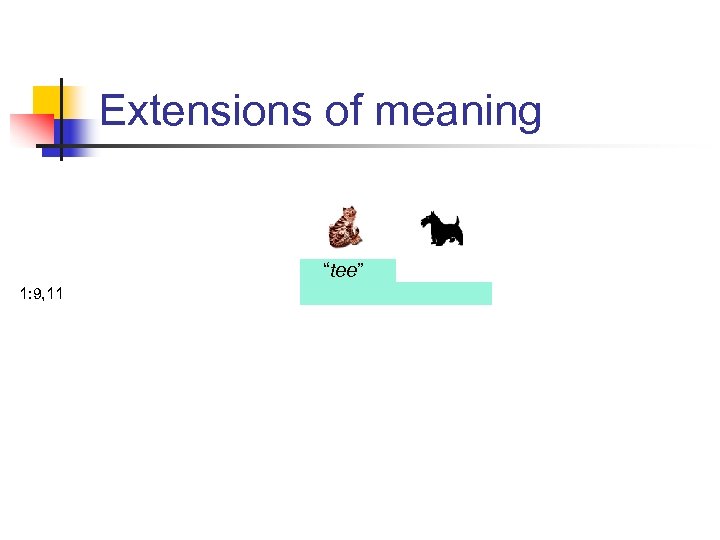
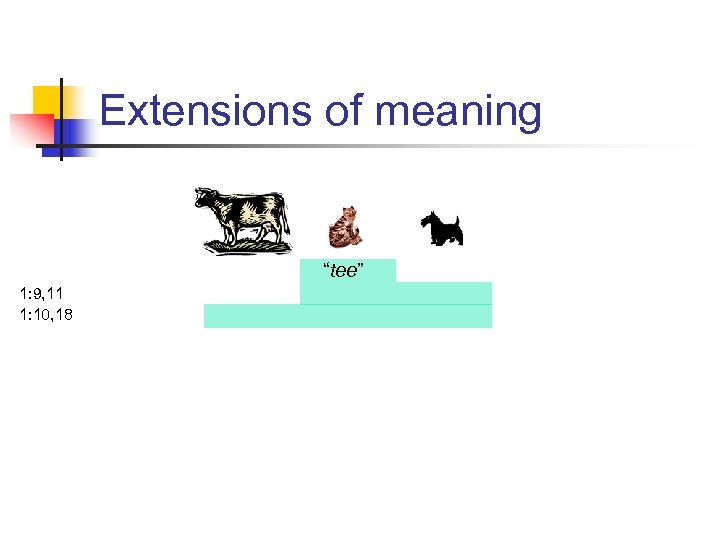
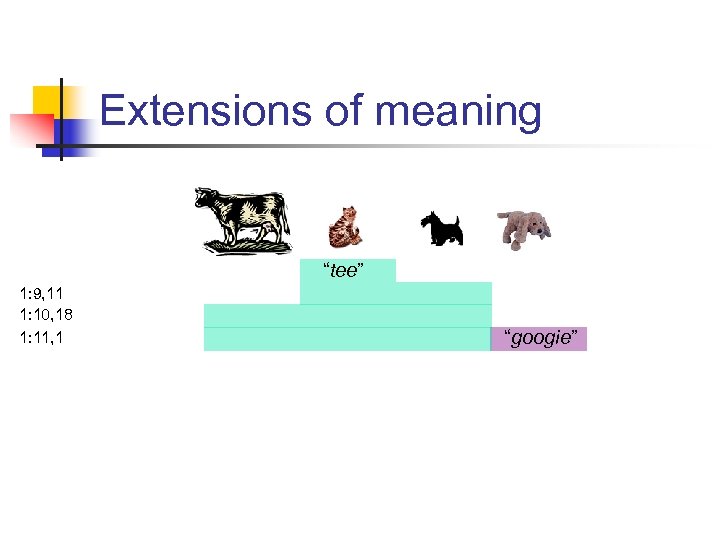
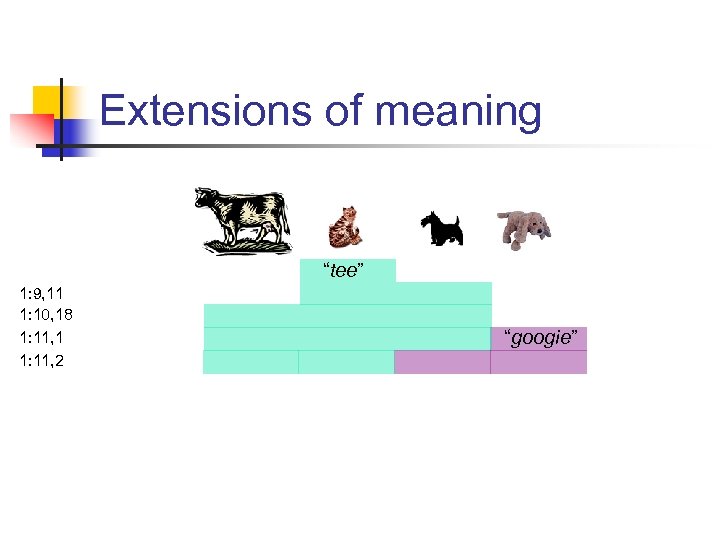
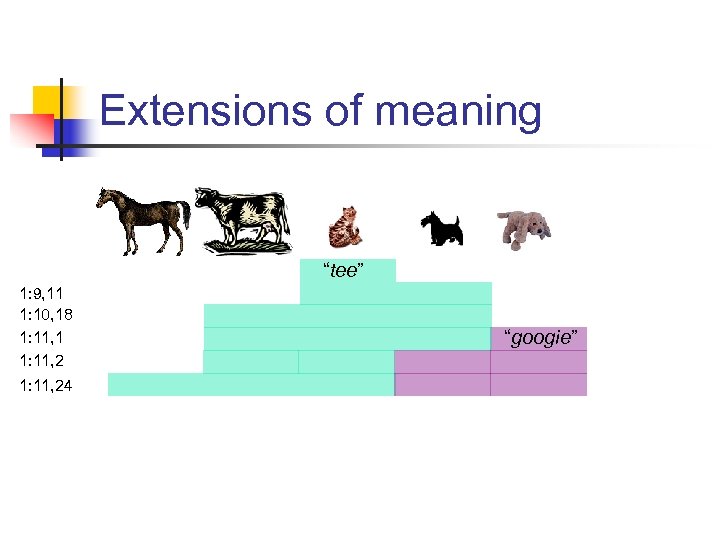
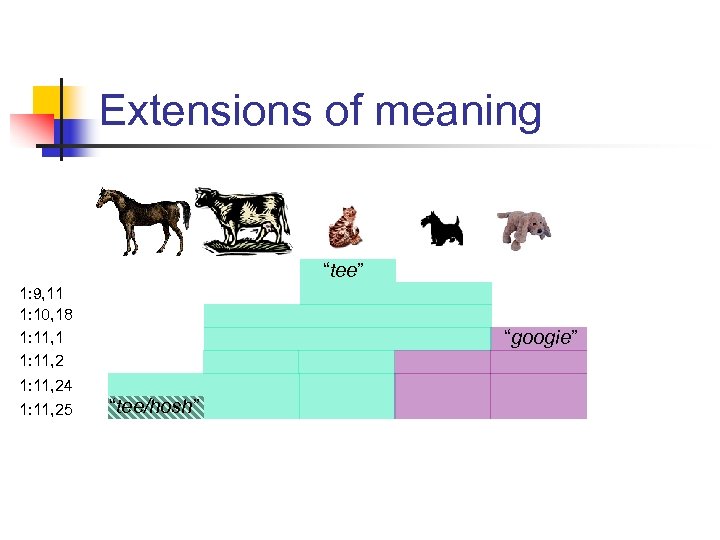
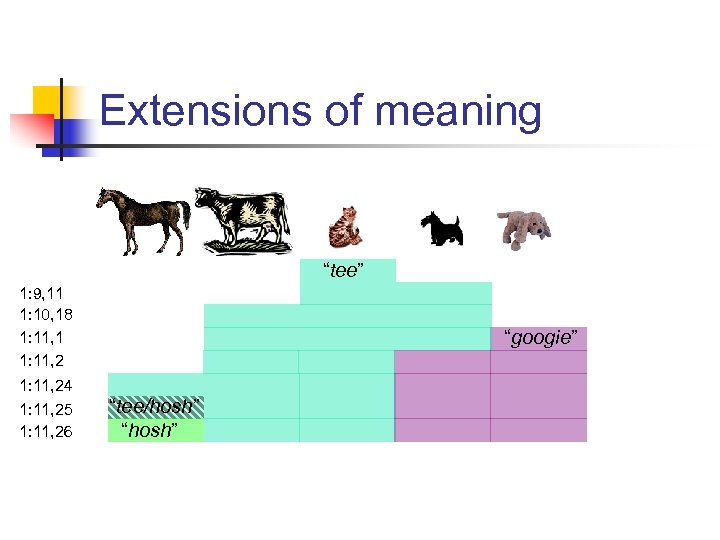
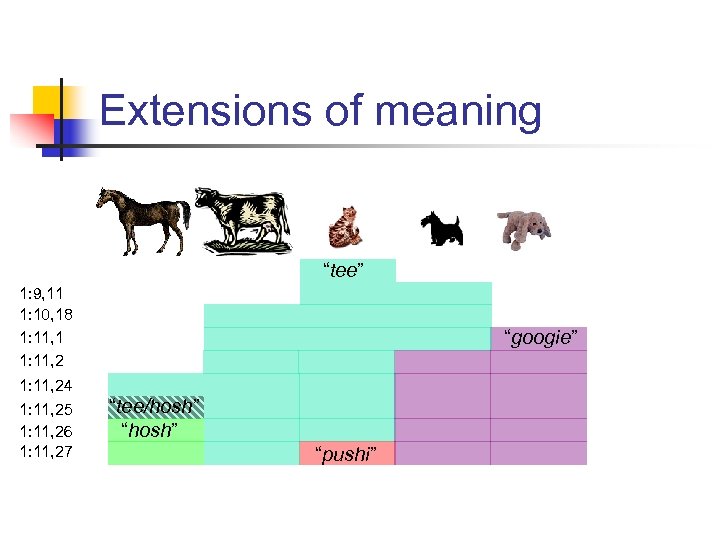
 Extensions of meaning n Applying the words to referents n Extension n n Finding the appropriate limits of the meaning of words Underextension n n Applying a word too narrowly Overextension n Applying a word too broadly
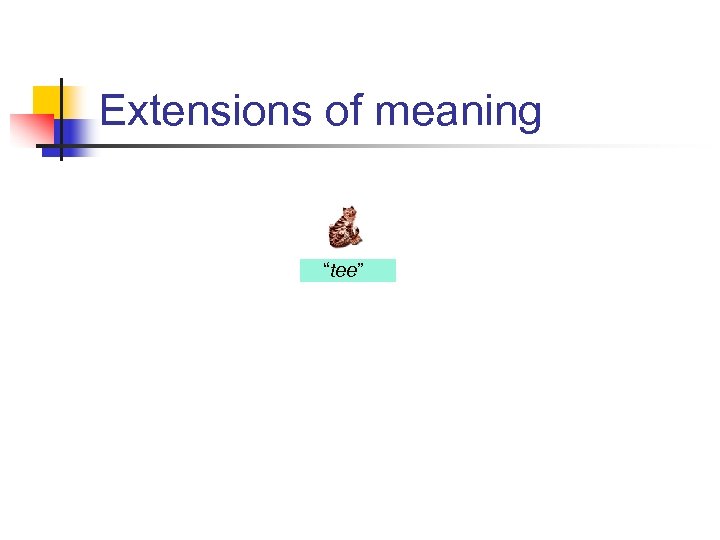 Extensions of meaning “tee”
 Extensions of meaning “tee” 1: 9, 11
 Extensions of meaning “tee” 1: 9, 11 1: 10, 18
 Extensions of meaning “tee” 1: 9, 11 1: 10, 18 1: 11, 1 “googie”
 Extensions of meaning “tee” 1: 9, 11 1: 10, 18 1: 11, 1 1: 11, 2 “googie”
 Extensions of meaning “tee” 1: 9, 11 1: 10, 18 1: 11, 1 1: 11, 24 “googie”
 Extensions of meaning “tee” 1: 9, 11 1: 10, 18 1: 11, 1 1: 11, 24 1: 11, 25 “googie” “tee/hosh”
 Extensions of meaning “tee” 1: 9, 11 1: 10, 18 1: 11, 1 1: 11, 24 1: 11, 25 1: 11, 26 “googie” “tee/hosh” “hosh”
 Extensions of meaning “tee” 1: 9, 11 1: 10, 18 1: 11, 1 1: 11, 24 1: 11, 25 1: 11, 26 1: 11, 27 “googie” “tee/hosh” “pushi”
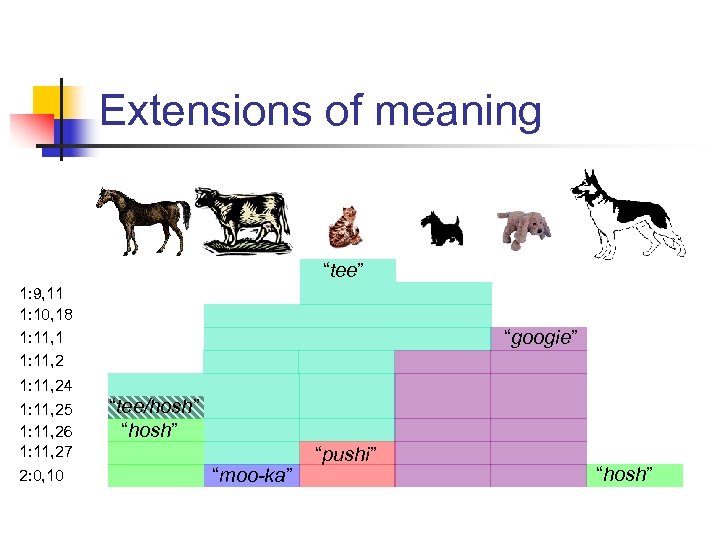 Extensions of meaning “tee” 1: 9, 11 1: 10, 18 1: 11, 1 1: 11, 24 1: 11, 25 1: 11, 26 1: 11, 27 2: 0, 10 “googie” “tee/hosh” “moo-ka” “pushi” “hosh”
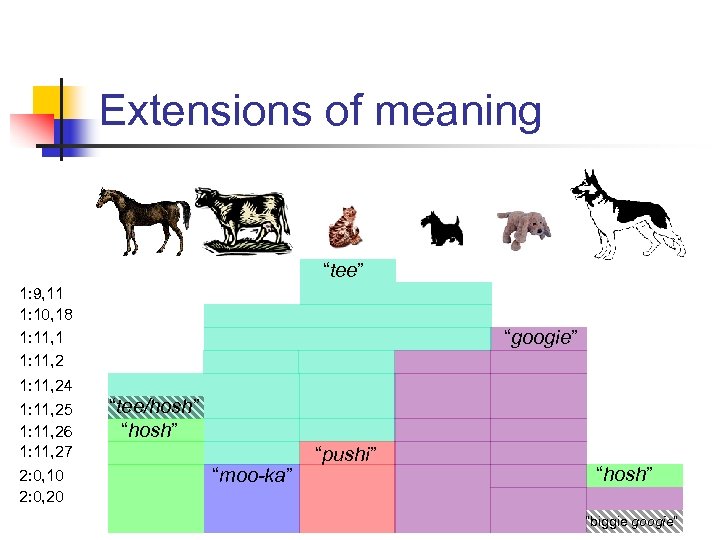 Extensions of meaning “tee” 1: 9, 11 1: 10, 18 1: 11, 1 1: 11, 24 1: 11, 25 1: 11, 26 1: 11, 27 2: 0, 10 2: 0, 20 “googie” “tee/hosh” “moo-ka” “pushi” “hosh” “biggie googie”
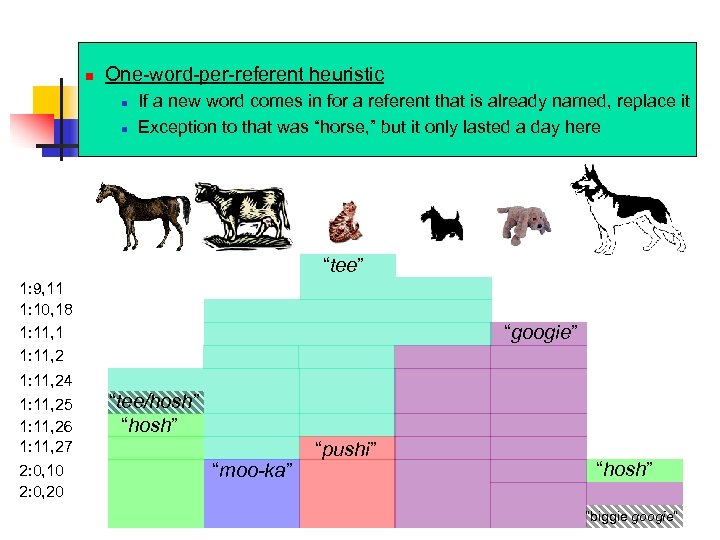 n One-word-per-referent heuristic Extensions of meaning n n If a new word comes in for a referent that is already named, replace it Exception to that was “horse, ” but it only lasted a day here “tee” 1: 9, 11 1: 10, 18 1: 11, 1 1: 11, 2 “googie” 1: 11, 24 1: 11, 25 1: 11, 26 1: 11, 27 2: 0, 10 2: 0, 20 “tee/hosh” “moo-ka” “pushi” “hosh” “biggie googie”
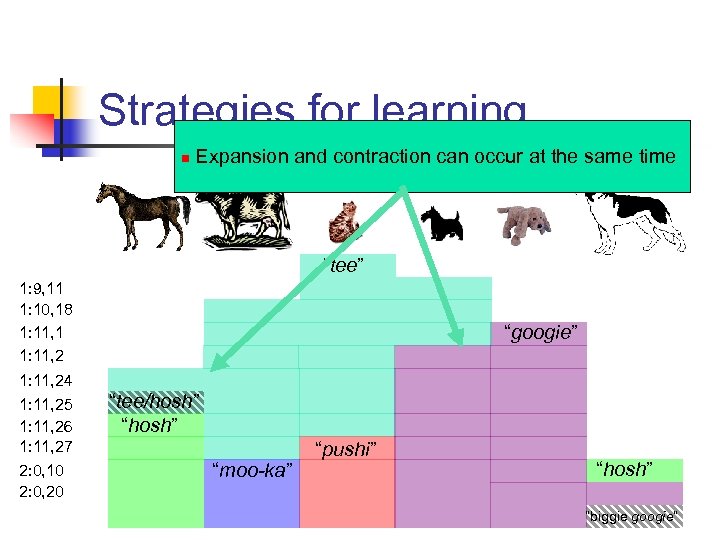 Strategies for learning n Expansion and contraction can occur at the same time “tee” 1: 9, 11 1: 10, 18 1: 11, 1 1: 11, 2 “googie” 1: 11, 24 1: 11, 25 1: 11, 26 1: 11, 27 2: 0, 10 2: 0, 20 “tee/hosh” “moo-ka” “pushi” “hosh” “biggie googie”
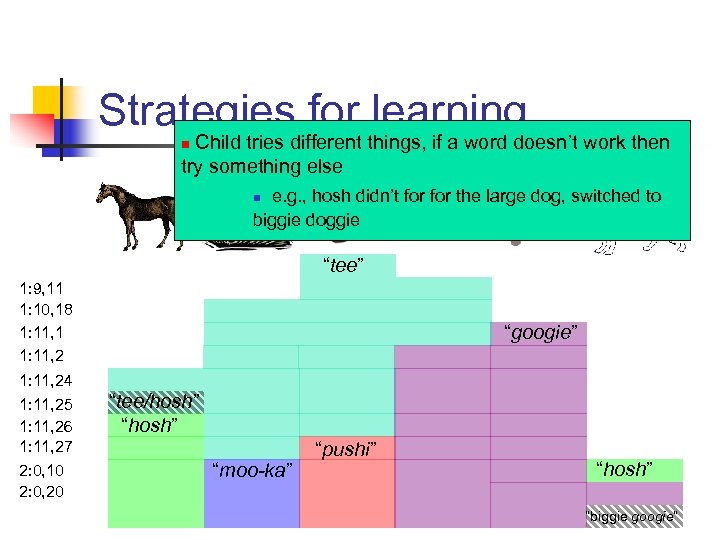 Strategies for learning Child tries different things, if a word doesn’t work then try something else n e. g. , hosh didn’t for the large dog, switched to biggie doggie n “tee” 1: 9, 11 1: 10, 18 1: 11, 1 1: 11, 2 “googie” 1: 11, 24 1: 11, 25 1: 11, 26 1: 11, 27 2: 0, 10 2: 0, 20 “tee/hosh” “moo-ka” “pushi” “hosh” “biggie googie”
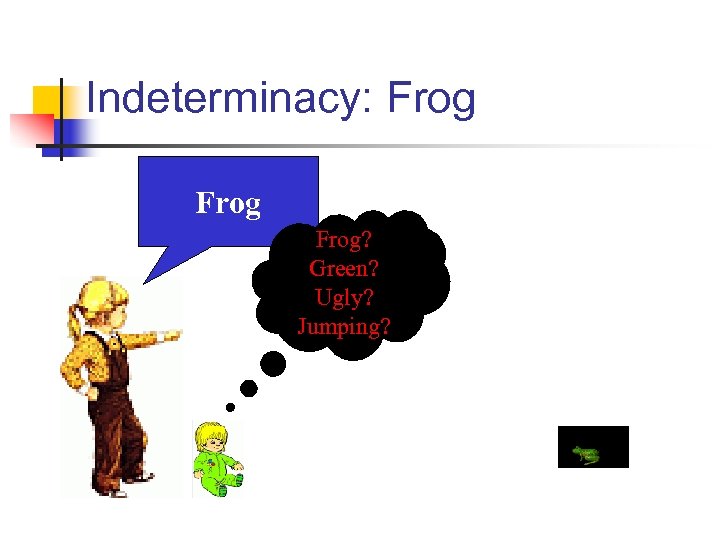 Indeterminacy: Frog? Green? Ugly? Jumping?
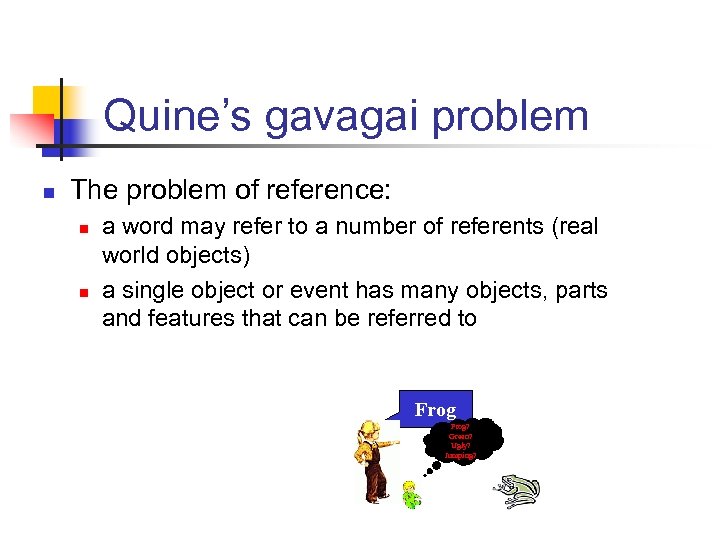 Quine’s gavagai problem n The problem of reference: n n a word may refer to a number of referents (real world objects) a single object or event has many objects, parts and features that can be referred to Frog? Green? Ugly? Jumping?
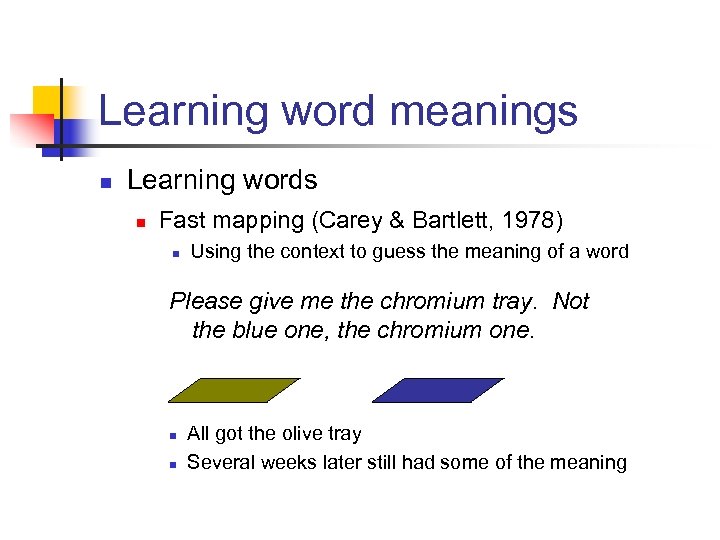 Learning word meanings n Learning words n Fast mapping (Carey & Bartlett, 1978) n Using the context to guess the meaning of a word Please give me the chromium tray. Not the blue one, the chromium one. n n All got the olive tray Several weeks later still had some of the meaning
 Constraints on Word Learning n Learning words n n Cognitive Constraints (Markman, 1989) Perhaps children are biased to entertain certain hypotheses about word meanings over others n n These first guesses save them from logical ambiguity Get them started out on the right track n n n Object-scope (whole object) constraint Taxonomic constraint Mutual exclusivity constraint
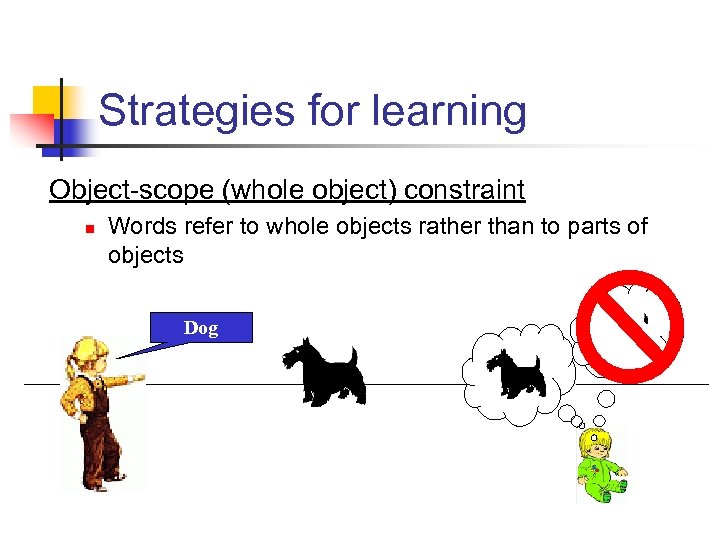 Strategies for learning Object-scope (whole object) constraint n Words refer to whole objects rather than to parts of objects Dog
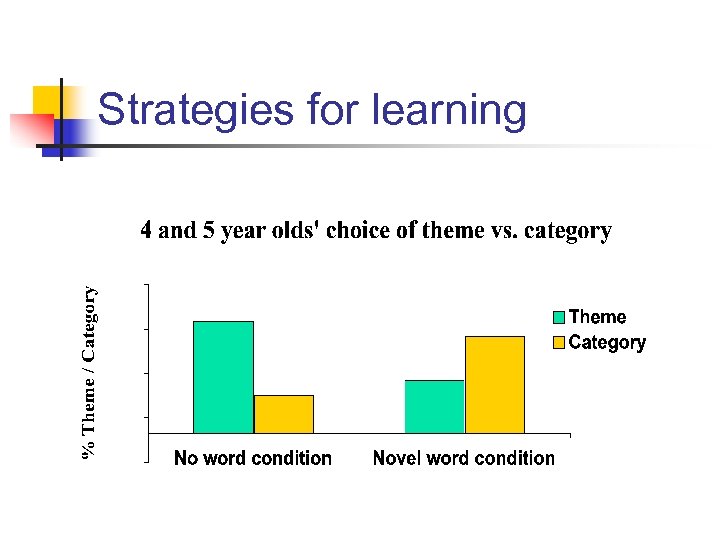
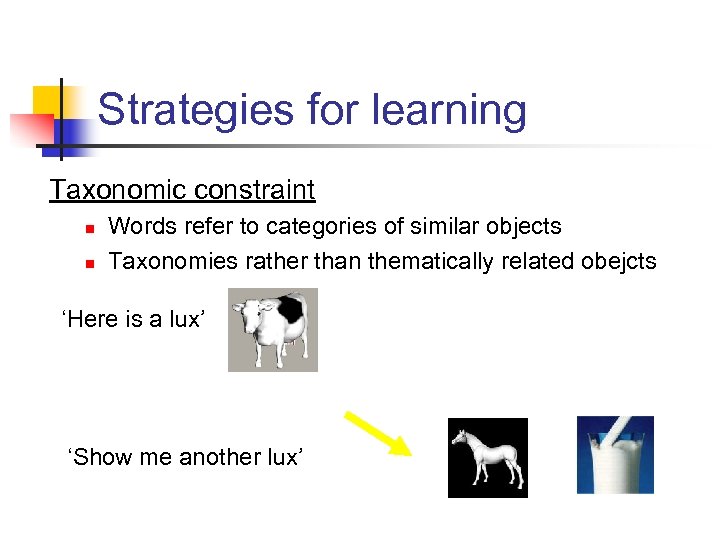 Strategies for learning Taxonomic constraint n n Words refer to categories of similar objects Taxonomies rather than thematically related obejcts ‘Here is a lux’ ‘Show me another lux’
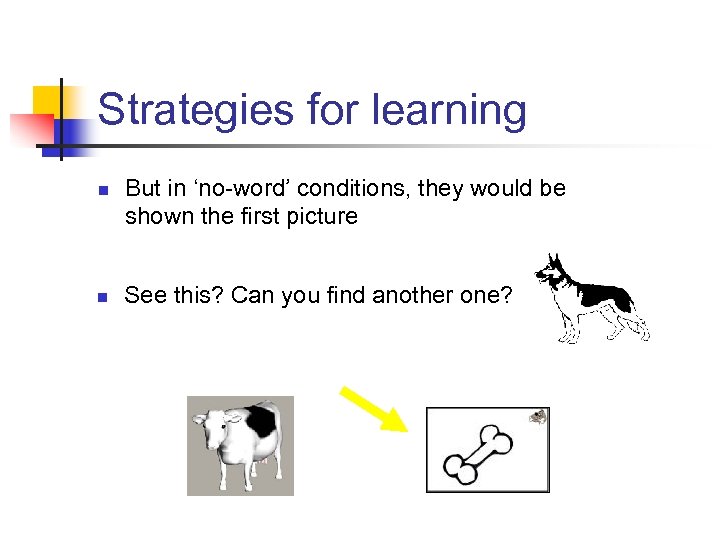 Strategies for learning n n But in ‘no-word’ conditions, they would be shown the first picture See this? Can you find another one?
 Strategies for learning
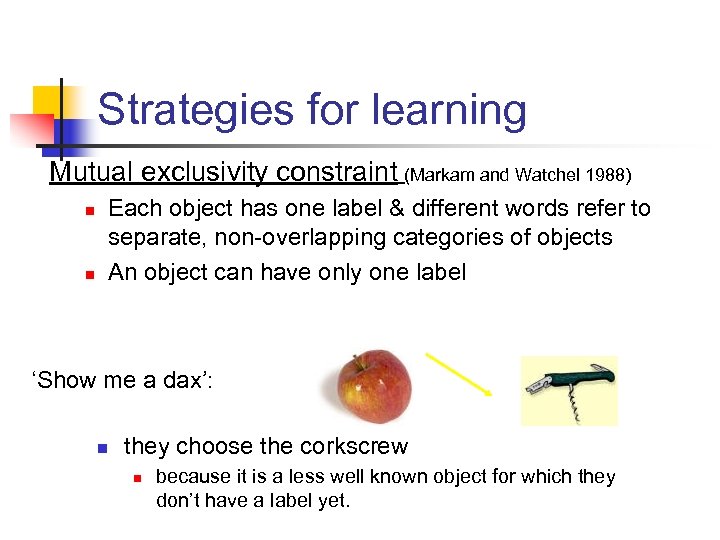 Strategies for learning Mutual exclusivity constraint (Markam and Watchel 1988) n n Each object has one label & different words refer to separate, non-overlapping categories of objects An object can have only one label ‘Show me a dax’: n they choose the corkscrew n because it is a less well known object for which they don’t have a label yet.
 Problem with constraints n Most of the constraints proposed apply only to object names. n n There have been cases where children have been observed violating these constraints n n What about verbs? (Nelson 1988) Using for example the word ‘car’ only to refer to ‘cars moving on the street from a certain location’ (Bloom 1973) The mutual exclusivity constraint would prevent children from learning subordinate and superordinate information (animal < dog < poodle)
 Language explosion continues n n The language explosion is not just the result of simple semantic development; the child is not just adding more words to his/her vocabulary. Child is mastering basic syntactic and morphological processes.
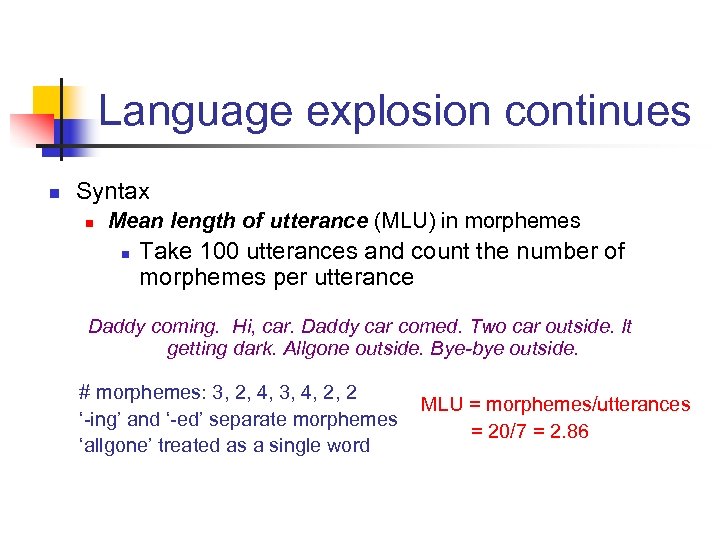 Language explosion continues n Syntax n Mean length of utterance (MLU) in morphemes n Take 100 utterances and count the number of morphemes per utterance Daddy coming. Hi, car. Daddy car comed. Two car outside. It getting dark. Allgone outside. Bye-bye outside. # morphemes: 3, 2, 4, 3, 4, 2, 2 ‘-ing’ and ‘-ed’ separate morphemes ‘allgone’ treated as a single word MLU = morphemes/utterances = 20/7 = 2. 86
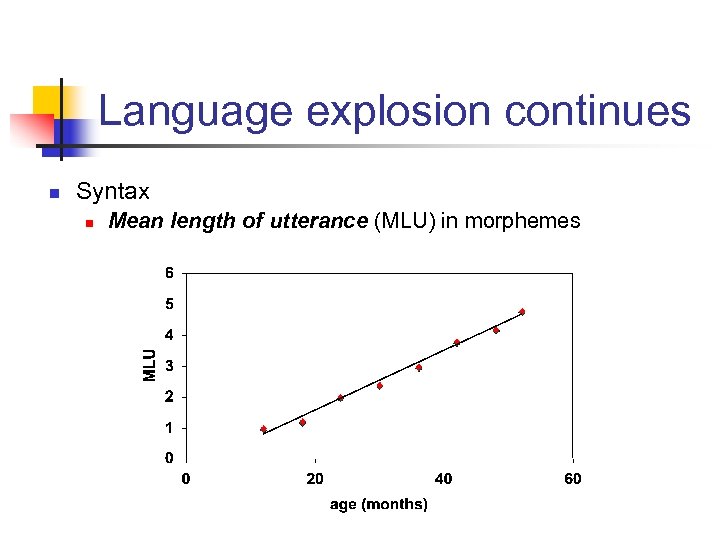 Language explosion continues n Syntax n Mean length of utterance (MLU) in morphemes
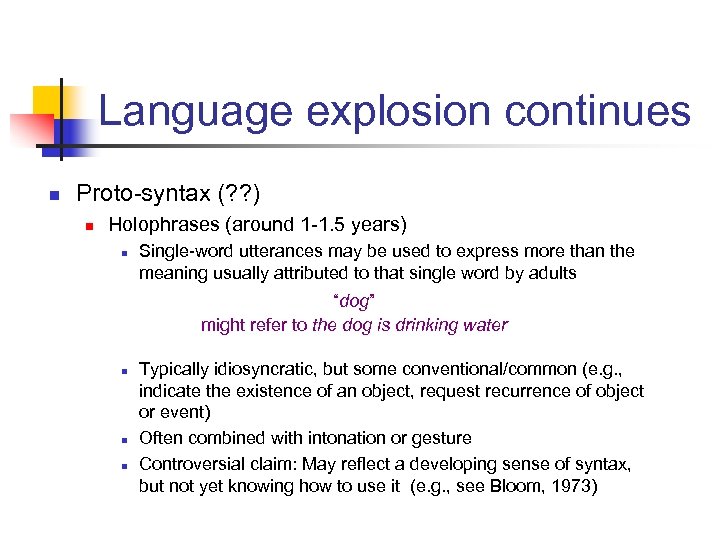 Language explosion continues n Proto-syntax (? ? ) n Holophrases (around 1 -1. 5 years) n Single-word utterances may be used to express more than the meaning usually attributed to that single word by adults “dog” might refer to the dog is drinking water n n n Typically idiosyncratic, but some conventional/common (e. g. , indicate the existence of an object, request recurrence of object or event) Often combined with intonation or gesture Controversial claim: May reflect a developing sense of syntax, but not yet knowing how to use it (e. g. , see Bloom, 1973)
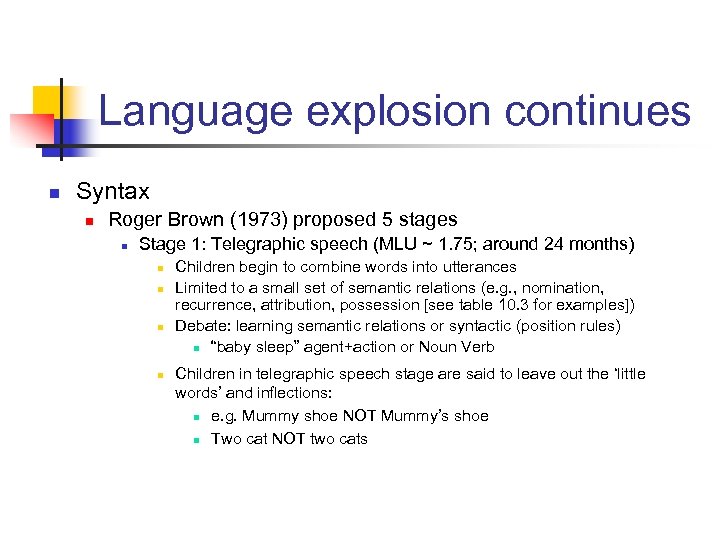 Language explosion continues n Syntax n Roger Brown (1973) proposed 5 stages n Stage 1: Telegraphic speech (MLU ~ 1. 75; around 24 months) n n Children begin to combine words into utterances Limited to a small set of semantic relations (e. g. , nomination, recurrence, attribution, possession [see table 10. 3 for examples]) Debate: learning semantic relations or syntactic (position rules) n “baby sleep” agent+action or Noun Verb Children in telegraphic speech stage are said to leave out the ‘little words’ and inflections: n e. g. Mummy shoe NOT Mummy’s shoe n Two cat NOT two cats
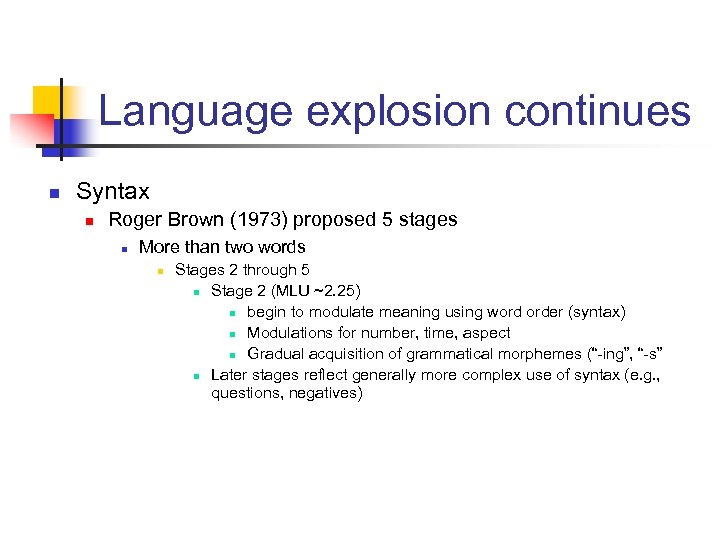 Language explosion continues n Syntax n Roger Brown (1973) proposed 5 stages n More than two words n Stages 2 through 5 n Stage 2 (MLU ~2. 25) n begin to modulate meaning using word order (syntax) n Modulations for number, time, aspect n Gradual acquisition of grammatical morphemes (“-ing”, “-s” n Later stages reflect generally more complex use of syntax (e. g. , questions, negatives)
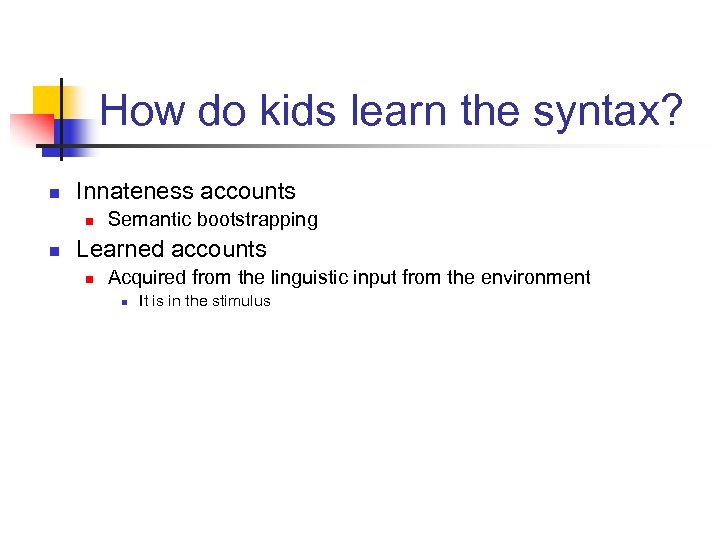 How do kids learn the syntax? n Innateness accounts n n Semantic bootstrapping Learned accounts n Acquired from the linguistic input from the environment n It is in the stimulus
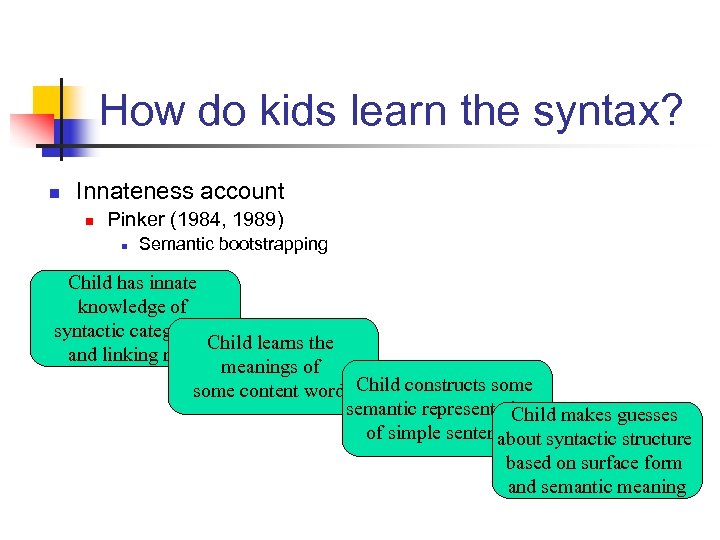 How do kids learn the syntax? n Innateness account n Pinker (1984, 1989) n Semantic bootstrapping Child has innate knowledge of syntactic categories Child learns the and linking rules meanings of some content words Child constructs some semantic representations makes guesses Child of simple sentences syntactic structure about based on surface form and semantic meaning
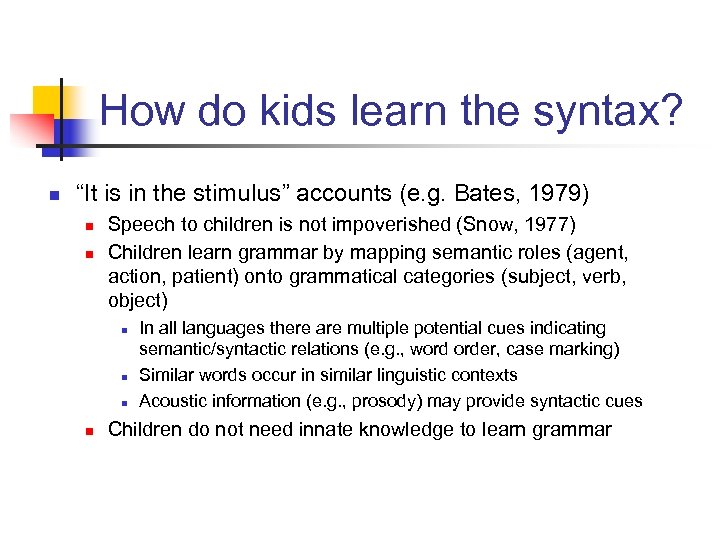 How do kids learn the syntax? n “It is in the stimulus” accounts (e. g. Bates, 1979) n n Speech to children is not impoverished (Snow, 1977) Children learn grammar by mapping semantic roles (agent, action, patient) onto grammatical categories (subject, verb, object) n n In all languages there are multiple potential cues indicating semantic/syntactic relations (e. g. , word order, case marking) Similar words occur in similar linguistic contexts Acoustic information (e. g. , prosody) may provide syntactic cues Children do not need innate knowledge to learn grammar
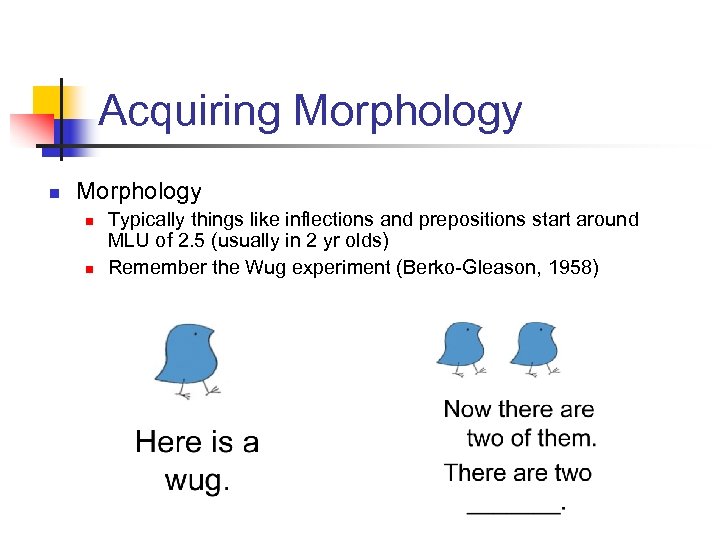 Acquiring Morphology n n Typically things like inflections and prepositions start around MLU of 2. 5 (usually in 2 yr olds) Remember the Wug experiment (Berko-Gleason, 1958)
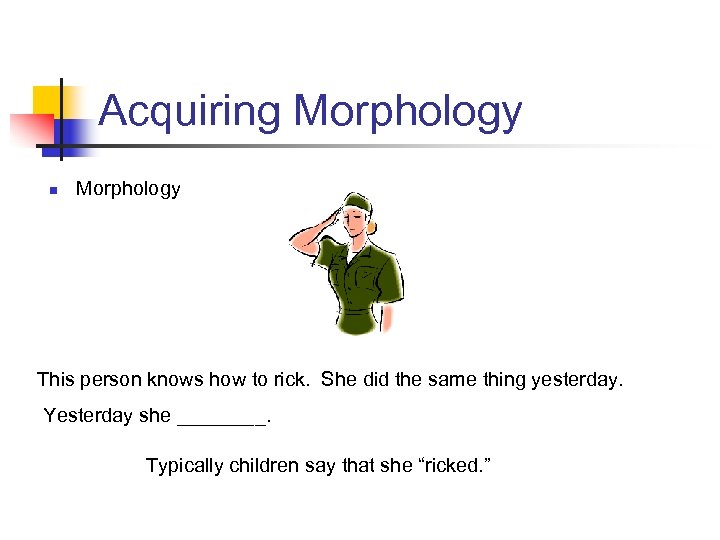 Acquiring Morphology n Morphology This person knows how to rick. She did the same thing yesterday. Yesterday she ____. Typically children say that she “ricked. ”
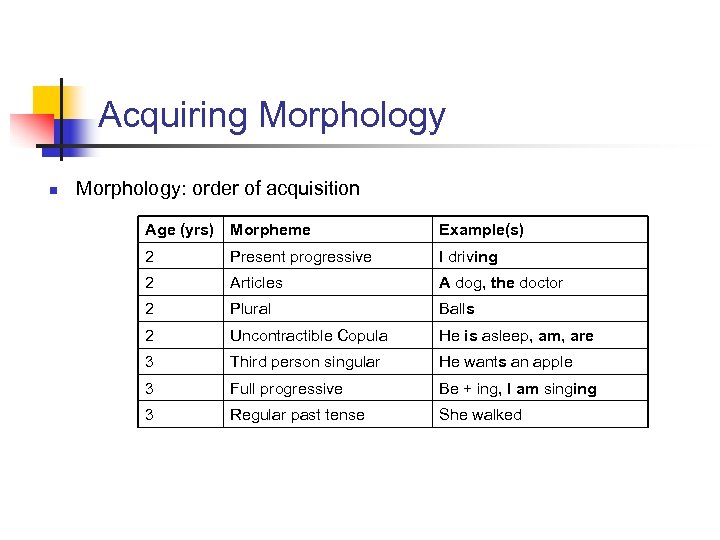 Acquiring Morphology n Morphology: order of acquisition Age (yrs) Morpheme Example(s) 2 Present progressive I driving 2 Articles A dog, the doctor 2 Plural Balls 2 Uncontractible Copula He is asleep, am, are 3 Third person singular He wants an apple 3 Full progressive Be + ing, I am singing 3 Regular past tense She walked
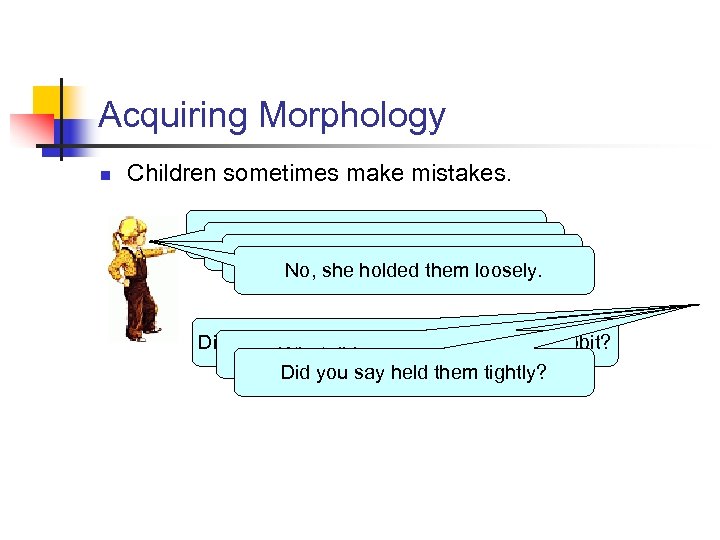 Acquiring Morphology n Children sometimes make mistakes. My teacher holded the baby rabbits. Yes She holded the baby rabbits. No, she holded them loosely. Did you say your teacher held the baby rabbit? What did you say she did? Did you say held them tightly?
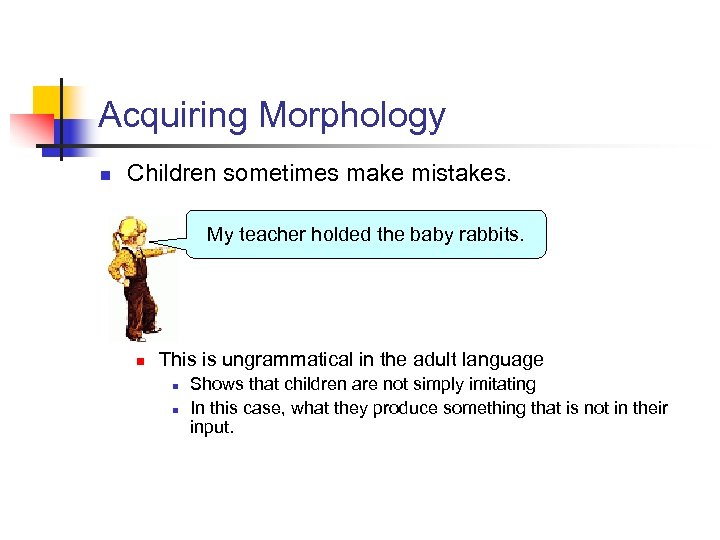 Acquiring Morphology n Children sometimes make mistakes. My teacher holded the baby rabbits. n This is ungrammatical in the adult language n n Shows that children are not simply imitating In this case, what they produce something that is not in their input.
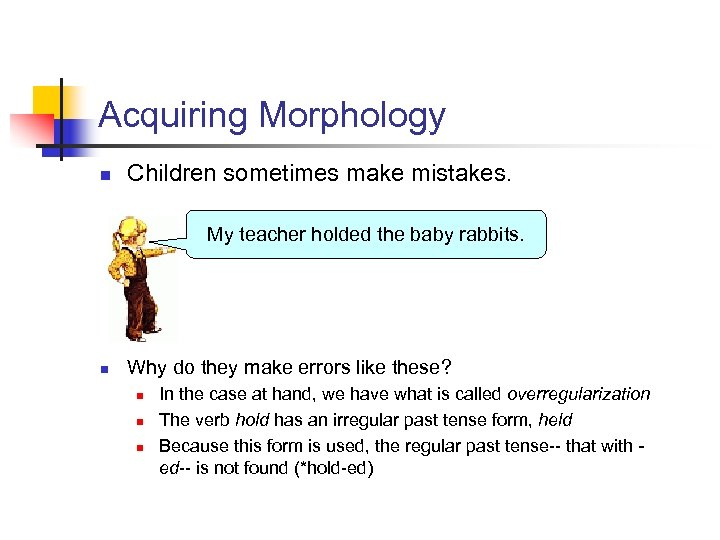 Acquiring Morphology n Children sometimes make mistakes. My teacher holded the baby rabbits. n Why do they make errors like these? n n n In the case at hand, we have what is called overregularization The verb hold has an irregular past tense form, held Because this form is used, the regular past tense-- that with ed-- is not found (*hold-ed)
 Acquiring Morphology n The case of verb past tense: n n Regular verb forms require no stored knowledge of the past tense form (wug test) n Past tense is accomplished by applying a past tense rule (e. g. , add -ed) to the verb stem With irregular verbs something must be memorized n Examples: n n n Horton heared a Who I finded Renée The alligator goed kerplunk
 Acquiring Morphology n The case of verb past tense: n Stages in the acquisition of irregular inflections n n With regular verbs, the default form -ed is used With irregulars, lists associating the verb with a particular form of the past tense have to be memorized: n n Past tense is -t when attached to leave, keep, etc. Is -> was Dig -> dug Has -> had
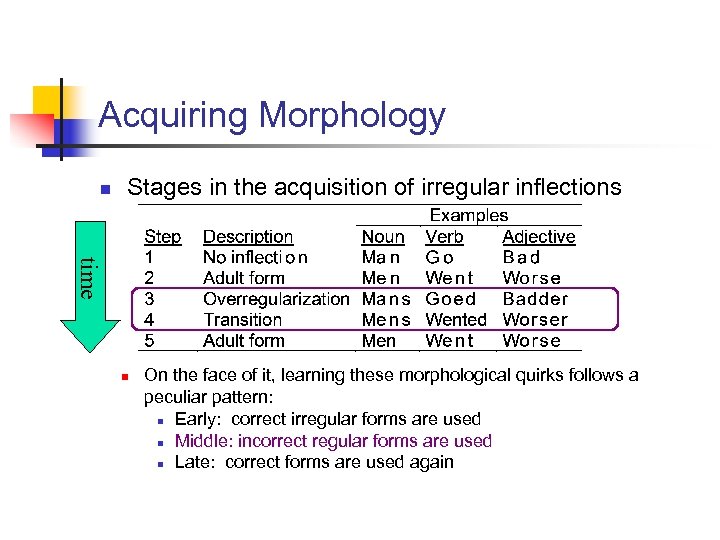 Acquiring Morphology n Stages in the acquisition of irregular inflections time n On the face of it, learning these morphological quirks follows a peculiar pattern: n Early: correct irregular forms are used n Middle: incorrect regular forms are used n Late: correct forms are used again
 Memory & Rules n Why do we find this type of pattern? n Memory and rules n The use of overregularized forms starts at around the same that the child is beginning to apply the default -ed rule successfully n n n Early: All forms-- whether regular or irregular-- are memorized Middle: The regular rule is learned, and in some cases overapplied Late: Irregulars are used based on memory, regulars use the rule (the idea is that if the word can provide its own past tense from memory, then the past tense rule is blocked)
 Memory & Rules n Why do we find this type of pattern? n Memory and rules n Other accounts n Maratsos (2000) – frequency explanation n It is possible to predict which verbs will be subject to overregularization n The more often an irregular form occurs in the input, the less likely the child is to use it as an overregularization n This is evidence that some part of overregularization occurs because of memory failures n Something about irregulars is unpredictable, hence has to be memorized
 What kind of “teaching” do kids get? n If language is learned (and not innate), how do kids do it? n n What kind of feedback do they get? Claim: Positive evidence is not sufficient for learning a language.
 What kind of “teaching” do kids get? n Are the kids even aware of mistakes? n The children are apparently aware of the fact that their forms are strange: n n Parent: Where’s Mommy? Child: Mommy goed to the store Parent: Mommy goed to the store? Child: NO! Daddy, I say it that way, not you
 Positive and negative evidence n What kind of feedback is available for learning? n n Positive evidence: Kids hear grammatical sentences Negative evidence: information that a given sentence is ungrammatical n Kids are not told which sentences are ungrammatical (no negative evidence) n Let’s consider no negative evidence further…
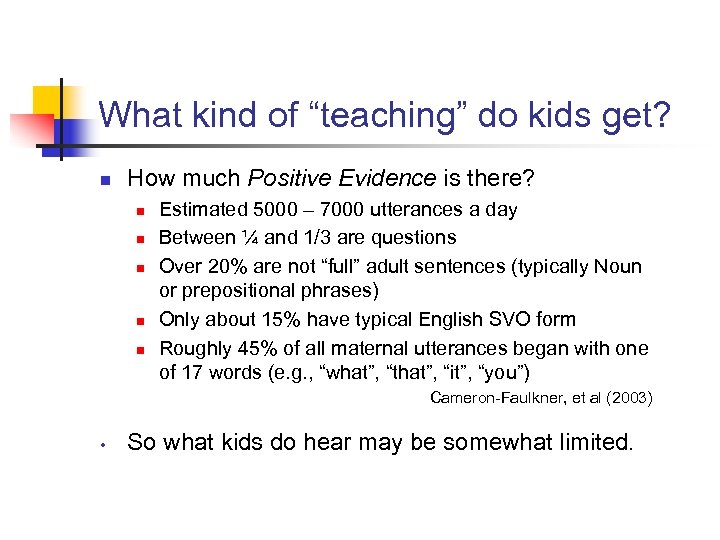 What kind of “teaching” do kids get? n How much Positive Evidence is there? n n n Estimated 5000 – 7000 utterances a day Between ¼ and 1/3 are questions Over 20% are not “full” adult sentences (typically Noun or prepositional phrases) Only about 15% have typical English SVO form Roughly 45% of all maternal utterances began with one of 17 words (e. g. , “what”, “that”, “it”, “you”) Cameron-Faulkner, et al (2003) • So what kids do hear may be somewhat limited.
 Negative evidence n Negative evidence could come in various conceivable forms. n n “The sentence Bill a cookie ate is not a sentence in English, Timmy. No sentence with SOV word order is. ” Upon hearing Bill a cookie ate, an adult might n Not understand n Look pained n Rephrase the ungrammatical sentence grammatically
 Kids resist instruction… Mc. Neill (1966) n n n Child: Nobody don’t like me. Adult: No, say ‘nobody likes me. ’ Child: Nobody don’t like me. [repeats eight times] n n Adult: No, now listen carefully; say ‘nobody likes me. ’ Child: Oh! Nobody don’t likes me.
 Kids resist instruction… Cazden (1972) (observation attributed to Jean Berko Gleason) n n n n Child: My teacher holded the baby rabbits and we patted them. Adult: Did you say your teacher held the baby rabbits? Child: Yes. Adult: What did you say she did? Child: She holded the baby rabbits and we patted them. Adult: Did you say she held them tightly? Child: No, she holded them loosely. So there doesn’t seem to be a lot of explicit negative evidence, and what there is the kids often resist
 Negative evidence via feedback? n Do kids get “implicit” negative evidence? n n Do adults understand grammatical sentences and not understand ungrammatical ones? Do adults respond positively to grammatical sentences and negatively to ungrammatical ones?
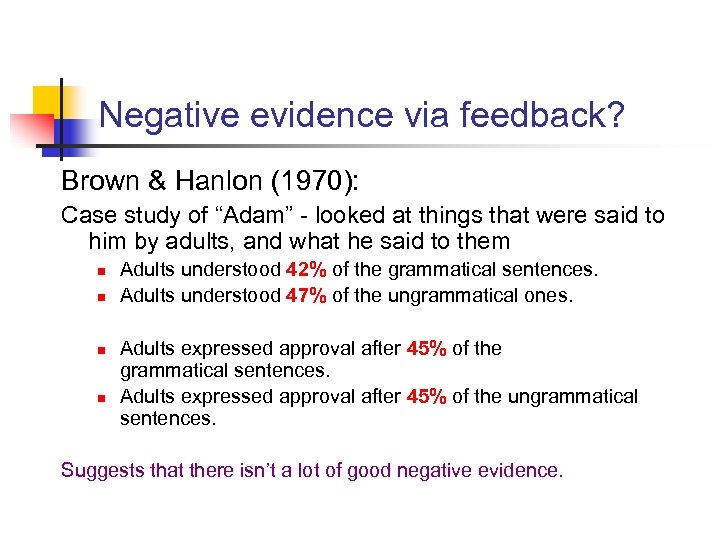 Negative evidence via feedback? Brown & Hanlon (1970): Case study of “Adam” - looked at things that were said to him by adults, and what he said to them n n Adults understood 42% of the grammatical sentences. Adults understood 47% of the ungrammatical ones. Adults expressed approval after 45% of the grammatical sentences. Adults expressed approval after 45% of the ungrammatical sentences. Suggests that there isn’t a lot of good negative evidence.
 In a way, it’s moot anyway… n One of the striking things about child language is how few errors they actually make. n n n For negative feedback to work, the kids have to make the errors (so that it can get the negative response). But they don’t make enough relevant kinds of errors to determine the complex grammar. Pinker, Marcus and others, conclude that much of this stuff must be innate. n But this isn’t the only view. There is an ongoing debate about whethere are rules, or whether these patterns of behavior can be learned based on the language evidence that is available to the kids
 Critical (sensitive) periods
 Critical (sensitive) periods n Certain behavior is developed more quickly within a critical period than outside of it. This period is biologically determined. n Examples: n Imprinting in ducks (Lorenz, ; Hess, 1973) n n n Ducklings will follow the first moving they see Only happens if they see something moving within the first few hours (after 32 hours it won’t happen) of hatching Binocular cells in humans n n Cells in visual system that respond only to input from both eyes. If these cells don’t get input from both eyes within first year of life, they don’t develop
 Critical (sensitive) periods n Certain behavior is developed more quickly within a critical period than outside of it. This period is biologically determined. n Some environmental input is necessary for normal development, but biology determines when the organism is responsive to that input. n That “when” is the critical period
 Critical period for language n Lenneberg (1967) proposed that there is a critical period for human language n It assumes that language acquisition must occur before the end of the critical period n Estimates range from 5 years up to onset of puberty
 Evidence for critical period for language n Feral Children n Children raised in the wild or with reduced exposure to human language What is the effect of this lack of exposure on language acquisition? Two classic cases n n Victor, the Wild Boy of Aveyron Genie
 Victor, The Wild Boy of Aveyron n Found in 1800 near the outskirts of Aveyron, France n n n Estimated to be about 7 -years-old Considered by some to be the first documented case of autism Neither spoke or responded to speech Taken to and studied by Dr. Jean-Marc-Gaspard Itard, and educator of deaf-mute and retarded children Never learned to speak and his receptive language ability was limited to a few simple commands. n Described by Itard as “an almost normal boy who could not speak”
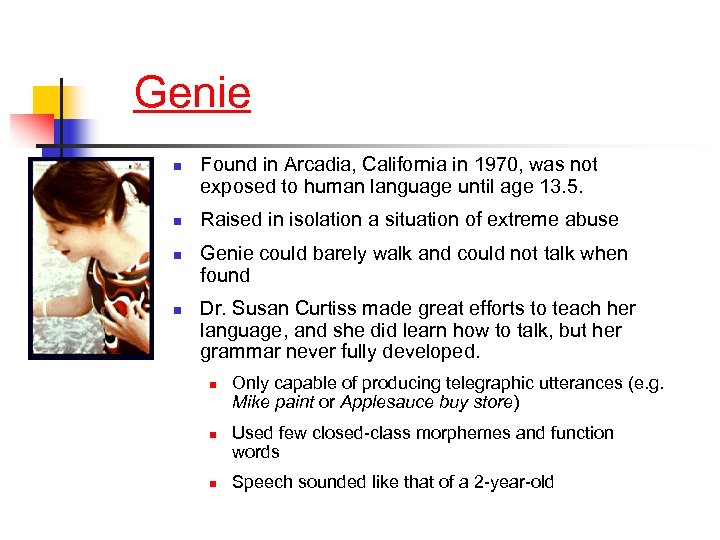 Genie n n Found in Arcadia, California in 1970, was not exposed to human language until age 13. 5. Raised in isolation a situation of extreme abuse Genie could barely walk and could not talk when found Dr. Susan Curtiss made great efforts to teach her language, and she did learn how to talk, but her grammar never fully developed. n n n Only capable of producing telegraphic utterances (e. g. Mike paint or Applesauce buy store) Used few closed-class morphemes and function words Speech sounded like that of a 2 -year-old
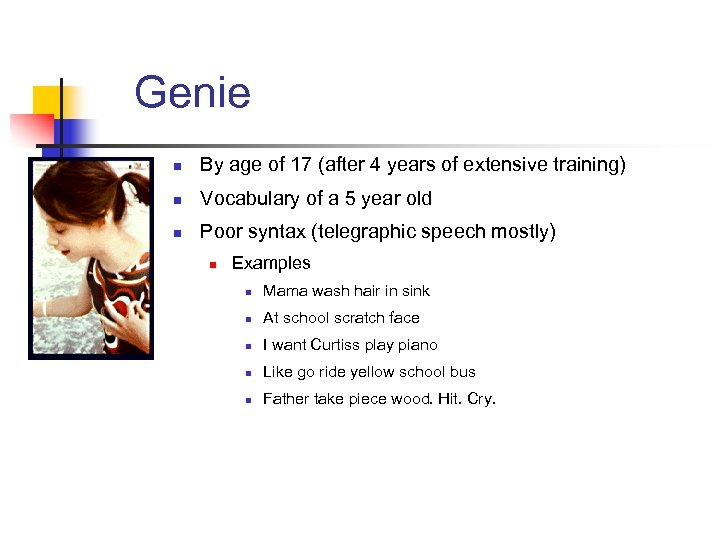 Genie n By age of 17 (after 4 years of extensive training) n Vocabulary of a 5 year old n Poor syntax (telegraphic speech mostly) n Examples n Mama wash hair in sink n At school scratch face n I want Curtiss play piano n Like go ride yellow school bus n Father take piece wood. Hit. Cry.
 What Do These Cases Tell Us? n Suggestive of the position that there is a critical period for first language learning (in particular for syntax and phonological development) n n If child is not exposed to language during early childhood (prior to the age of 6 or 7), then the ability to learn syntax will be impaired while other abilities are less strongly affected Not uncontroversial: Victor and Genie and children like them were deprived in many ways other than not being exposed to language n Genie stopped talking after age 30 and was institutionalized shortly afterward (Rymer, 1993)
 What Do These Cases Tell Us? n n Suggestive of the position that there is a critical period for first language learning (in particular for syntax and phonological development) Why? Nativist explanation (see pg 79 of text) Maturational explanation: “less is more”
 Second language learning n Learning a new language n n n What if we already know one language, but want to learn another? Adults learning another language typically have a persistent foreign accent – perhaps a critical period for phonology (Flege & Hillenbrand, 1984) Adults typically do better initially at learning a new language compared to kids, but kids typically do better over the long term (Krashen, Long, & Scarcella, 1982)
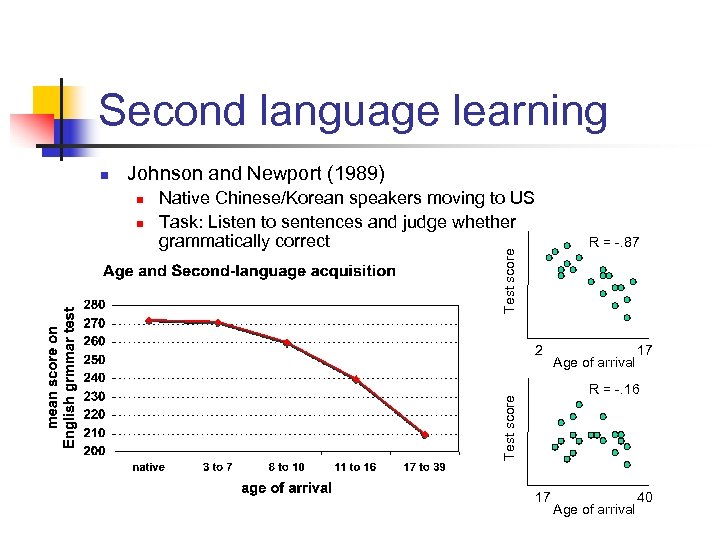 Second language learning Johnson and Newport (1989) n Native Chinese/Korean speakers moving to US Task: Listen to sentences and judge whether grammatically correct R = -. 87 Test score n 2 Age of arrival 17 R = -. 16 Test score n 17 Age of arrival 40
 Second language learning n Johnson and Newport (1989) n n n Native Chinese/Korean speakers moving to US Task: Listen to sentences and judge whether grammatically correct Concluded that around the age of 16 something happens Different factors operate on language acquisition before and after the age of 16 Birdsong and Molis (2001) n Replicated the Johnson and Newport study in Spanish/English speakers. n Did not find a discontinuity around the age of 16
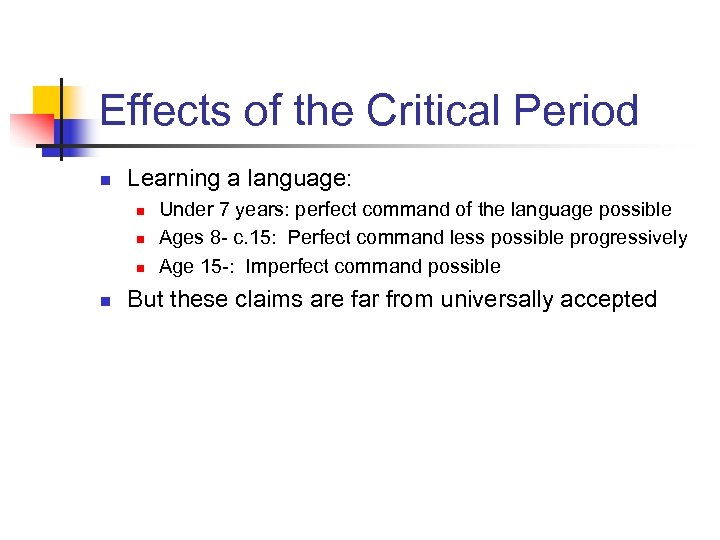 Effects of the Critical Period n Learning a language: n n Under 7 years: perfect command of the language possible Ages 8 - c. 15: Perfect command less possible progressively Age 15 -: Imperfect command possible But these claims are far from universally accepted
 Bilinguals & Polyglots n Many people speak more than one language n n Tucker (1999) - multilinguals outnumber monolinguals What is the impact of knowing/using more than one language? n n n Factors affecting second language acquisition? What does the lexicon look like? Interesting effects in bilinguals n Interference n Code switching n Cognitive advantages
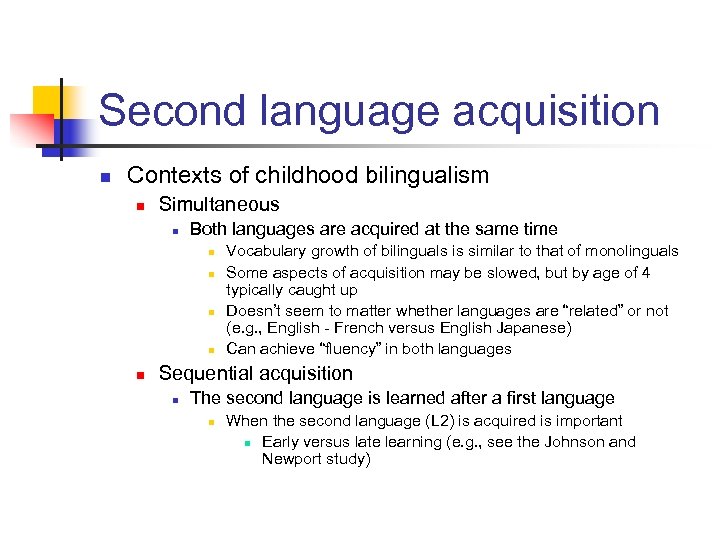 Second language acquisition n Contexts of childhood bilingualism n Simultaneous n Both languages are acquired at the same time n n n Vocabulary growth of bilinguals is similar to that of monolinguals Some aspects of acquisition may be slowed, but by age of 4 typically caught up Doesn’t seem to matter whether languages are “related” or not (e. g. , English - French versus English Japanese) Can achieve “fluency” in both languages Sequential acquisition n The second language is learned after a first language n When the second language (L 2) is acquired is important n Early versus late learning (e. g. , see the Johnson and Newport study)
 Second language acquisition n Frequency of usage of both languages n n n Mode of acquisition n n How often and in what contexts do you use the two languages “Use it or lose it” - language attrition Native bilingualism - growing up in a two language environment Immersion - schooling provided in a non-native language Submersion - one learner surrounded by non-native speakers Language dominance effects n Relative fluency of L 1 and L 2 may impact processing
 Bilingual Representations n How do we represent linguistic information in a bilingual lexicon? n n Probably depends on many of the factors just discussed Let’s look at some models and research focusing on the situation where L 1 is dominant relative to L 2
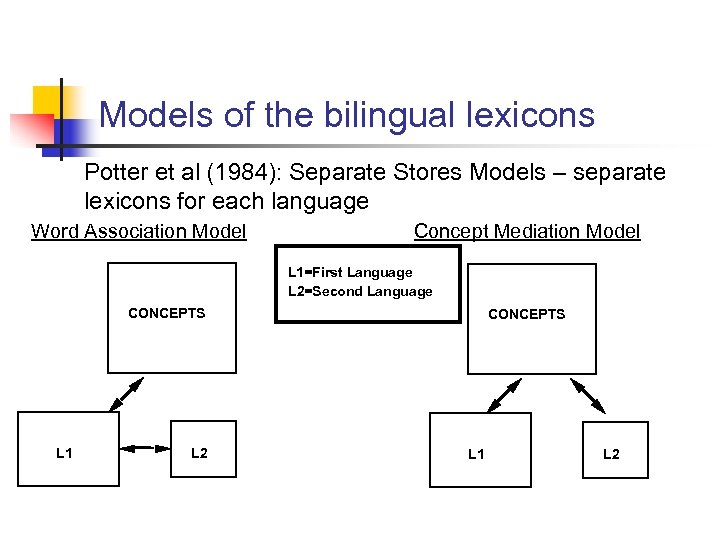 Models of the bilingual lexicons Potter et al (1984): Separate Stores Models – separate lexicons for each language Word Association Model Concept Mediation Model L 1=First Language L 2=Second Language CONCEPTS L 1 L 2
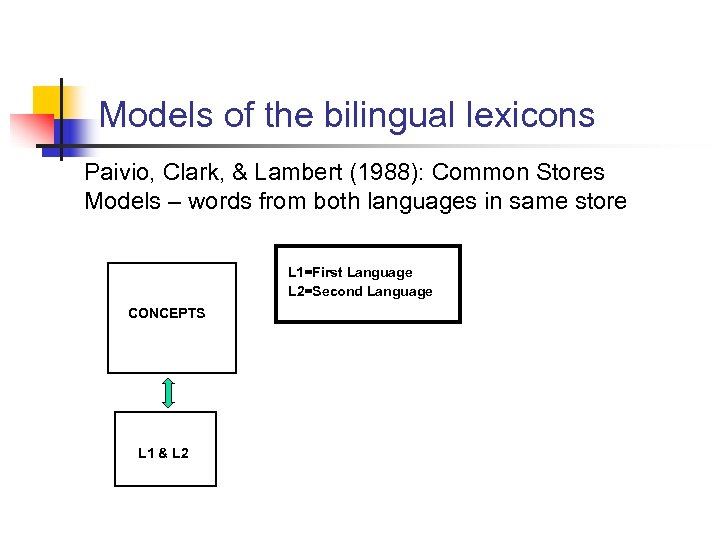 Models of the bilingual lexicons Paivio, Clark, & Lambert (1988): Common Stores Models – words from both languages in same store L 1=First Language L 2=Second Language CONCEPTS L 1 & L 2
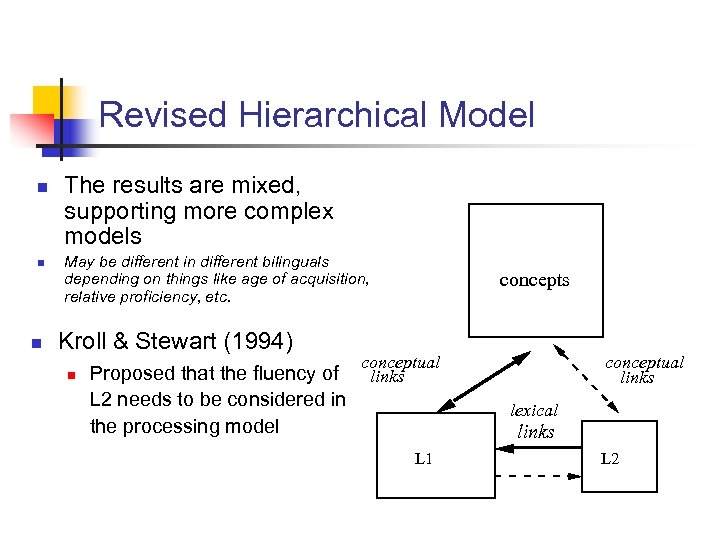 Revised Hierarchical Model n n n The results are mixed, supporting more complex models May be different in different bilinguals depending on things like age of acquisition, relative proficiency, etc. Kroll & Stewart (1994) n Proposed that the fluency of L 2 needs to be considered in the processing model concepts conceptual links lexical links L 1 L 2
 Interesting effects in bilinguals n n n Interference Code switching Cognitive advantages
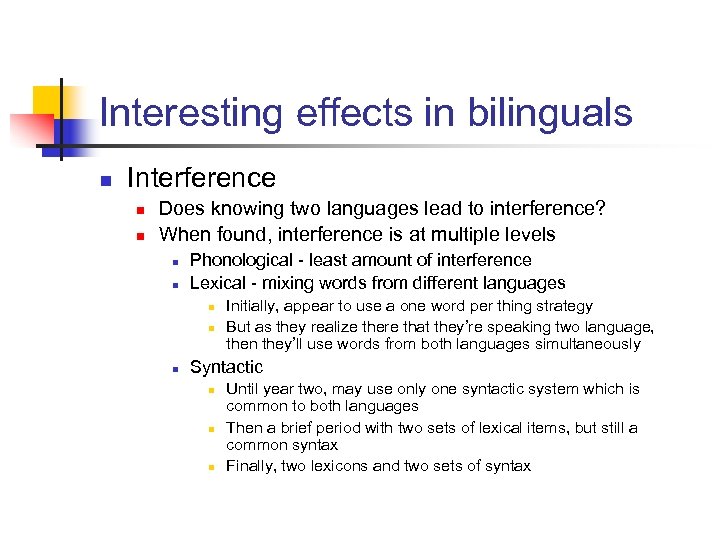 Interesting effects in bilinguals n Interference n n Does knowing two languages lead to interference? When found, interference is at multiple levels n n Phonological - least amount of interference Lexical - mixing words from different languages n n n Initially, appear to use a one word per thing strategy But as they realize there that they’re speaking two language, then they’ll use words from both languages simultaneously Syntactic n n n Until year two, may use only one syntactic system which is common to both languages Then a brief period with two sets of lexical items, but still a common syntax Finally, two lexicons and two sets of syntax
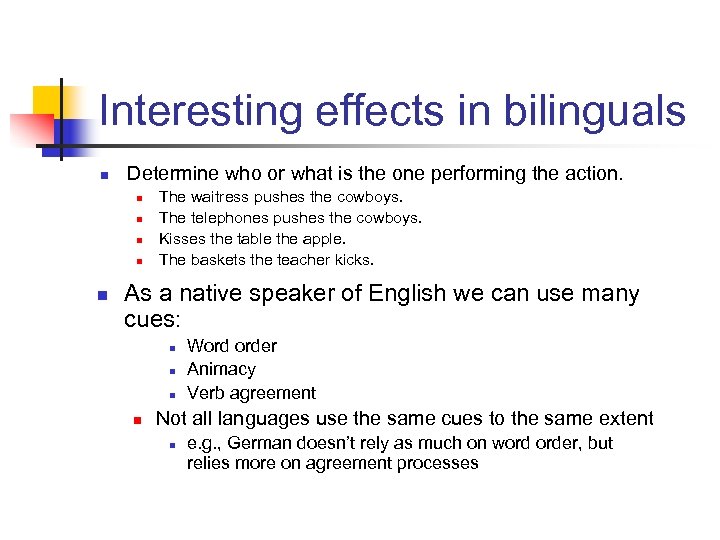 Interesting effects in bilinguals n Determine who or what is the one performing the action. n n n The waitress pushes the cowboys. The telephones pushes the cowboys. Kisses the table the apple. The baskets the teacher kicks. As a native speaker of English we can use many cues: n n Word order Animacy Verb agreement Not all languages use the same cues to the same extent n e. g. , German doesn’t rely as much on word order, but relies more on agreement processes
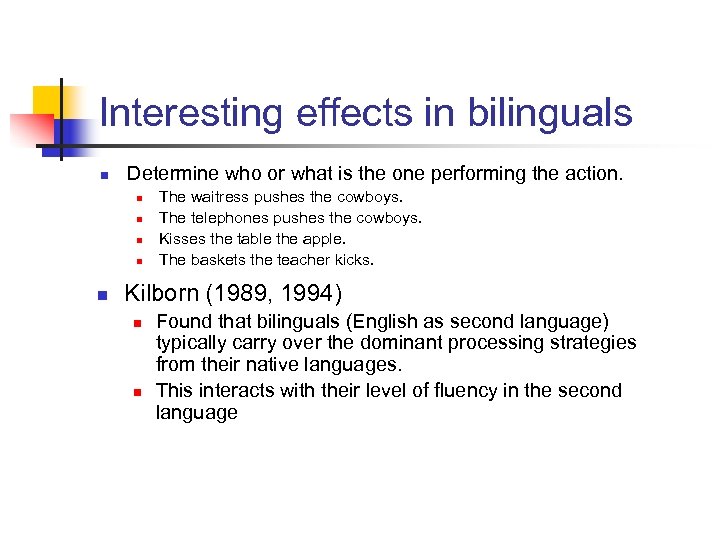 Interesting effects in bilinguals n Determine who or what is the one performing the action. n n n The waitress pushes the cowboys. The telephones pushes the cowboys. Kisses the table the apple. The baskets the teacher kicks. Kilborn (1989, 1994) n n Found that bilinguals (English as second language) typically carry over the dominant processing strategies from their native languages. This interacts with their level of fluency in the second language
 Code switching n When bilinguals substitute a word or phrase from one language with a phrase or word from another language “I want a motorcycle VERDE” n Switching is systematic, not random
 Code switching n When bilinguals substitute a word or phrase from one language with a phrase or word from another language “I want a motorcycle VERDE” n The Spanish adjective “verde” follows a grammatical rule that is observed by most bilingual speakers that code-switch “I want a VERDE motorcycle” n Would be incorrect n because language switching can occur only if the adjective is placed according to the rules of the language of the adjective n In this case, the adjective is in Spanish; therefore, the adjective must follow the Spanish grammatical rule that states that the noun must precede the adjective
 Code switching n When bilinguals substitute a word or phrase from one language with a phrase or word from another language “I want a motorcycle VERDE” n Generally, bilinguals take longer to read and comprehend sentences containing code-switched words n May be due to a “mental switch mechanism” that determines which of the bilingual’s two mental dictionaries are “on” or “off” during language comprehension. n This mental switch is responsible for selecting the appropriate mental dictionary to be employed during the comprehension of a sentence. n E. g. , if reading an English, a Spanish code-switched word is encountered, the mental switch must disable the English linguistic system, and enable the Spanish linguistic system.
 Code switching n When bilinguals substitute a word or phrase from one language with a phrase or word from another language “I want a motorcycle VERDE” n Generally, bilinguals take longer to read and comprehend sentences containing code-switched words n This time difference depends on similarity of the languages n n Chinese-English bilinguals take longer to recognize English codeswitched words in Chinese sentences only if the English words contain initial consonant-consonant (e. g. , flight) clusters, simply because the Chinese language lacks this phonotactic structure. Another current view suggests that language dominance (i. e. , which language is used more frequently) plays an important role in codeswitching
 Cognitive advantages n Some evidence suggest that being bilingual can have an impact on cognition outside of language n Bialystok and colleagues n n Bilinguals are very proficient at switching between languages Bilinguals also have to be good at suppressing the contextually inappropriate language