 Скачать презентацию Pseudorandomness Emanuele Viola Columbia University April 2008
43530f555093c9a1e432fa67a44393c5.ppt
- Количество слайдов: 29



Pseudorandomness Emanuele Viola Columbia University April 2008
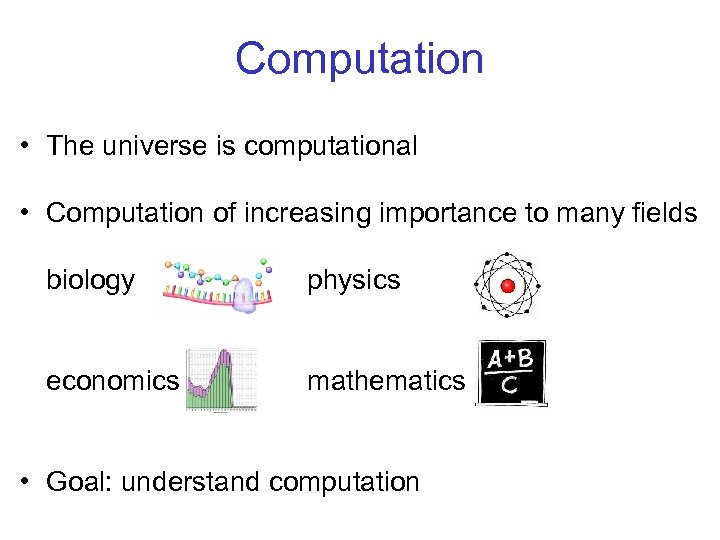
Computation • The universe is computational • Computation of increasing importance to many fields biology physics economics mathematics • Goal: understand computation
![Milestones • Uncomputability [Gödel, Turing, Church; 1930’s] • NP-completeness [Cook, Levin, Karp; 1970’s] P](https://present5.com/presentation/43530f555093c9a1e432fa67a44393c5/image-3.jpg "Milestones • Uncomputability [Gödel, Turing, Church; 1930’s] • NP-completeness [Cook, Levin, Karp; 1970’s] P")
Milestones • Uncomputability [Gödel, Turing, Church; 1930’s] • NP-completeness [Cook, Levin, Karp; 1970’s] P NP ? • Randomness […; today] P = RP ?
Pseudorandomness • Key to understanding randomness • Goal of Pseudorandomness: Construct objects that “look random” using little or no randomness • Example: Random 10 -digit number is prime with probab. 1/10 Challenge: Deterministic construction?
![Motivation for Pseudorandomness (1) • Algorithm design, Monte Carlo method • Breakthrough [Reingold 2004]](https://present5.com/presentation/43530f555093c9a1e432fa67a44393c5/image-5.jpg "Motivation for Pseudorandomness (1) • Algorithm design, Monte Carlo method • Breakthrough [Reingold 2004]")
Motivation for Pseudorandomness (1) • Algorithm design, Monte Carlo method • Breakthrough [Reingold 2004] Connectivity in logarithmic space (SL = L) • Breakthrough [Agrawal Kayal Saxena 2002] Primality in polynomial time (PRIMES P) • Originated from pseudorandomness
![Motivation for Pseudorandomness (2) [Shannon 1949; Goldwasser Micali 1984] • Cryptography Buy oil Cipher](https://present5.com/presentation/43530f555093c9a1e432fa67a44393c5/image-6.jpg "Motivation for Pseudorandomness (2) [Shannon 1949; Goldwasser Micali 1984] • Cryptography Buy oil Cipher")
Motivation for Pseudorandomness (2) [Shannon 1949; Goldwasser Micali 1984] • Cryptography Buy oil Cipher 110101101000011101001 • Security º cipher looks random to eavesdropper
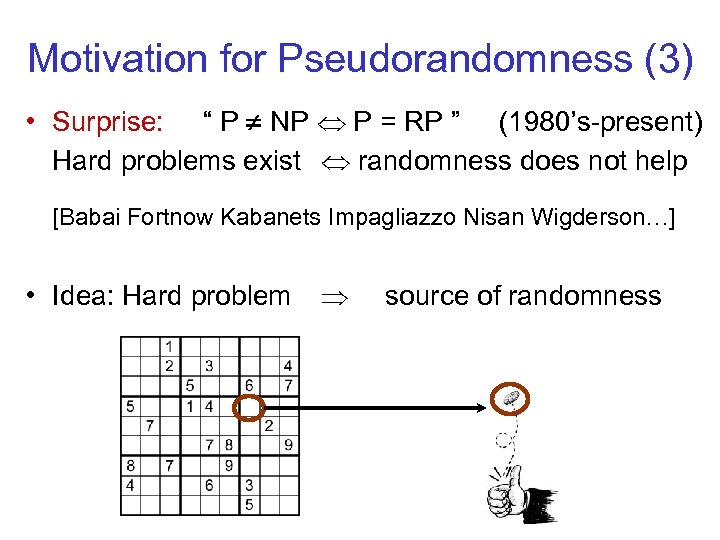
Motivation for Pseudorandomness (3) • Surprise: “ P NP P = RP ” (1980’s-present) Hard problems exist randomness does not help [Babai Fortnow Kabanets Impagliazzo Nisan Wigderson…] • Idea: Hard problem Þ source of randomness
Outline • Overview Motivation • Pseudorandom generators Examples Circuits Polynomials • Future directions
![Pseudorandom generator [Blum Micali; Yao; Nisan Wigderson] Gen • Efficient, deterministic • Short seed](https://present5.com/presentation/43530f555093c9a1e432fa67a44393c5/image-9.jpg "Pseudorandom generator [Blum Micali; Yao; Nisan Wigderson] Gen • Efficient, deterministic • Short seed")
Pseudorandom generator [Blum Micali; Yao; Nisan Wigderson] Gen • Efficient, deterministic • Short seed s(n) << n • Output “looks random”
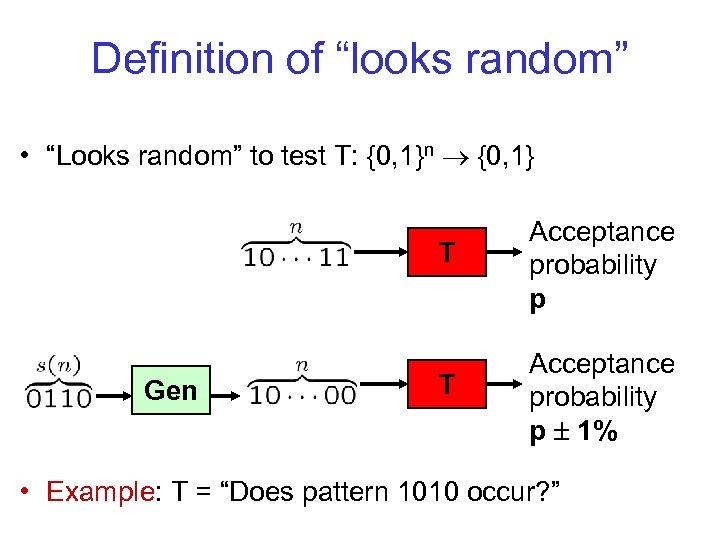
Definition of “looks random” • “Looks random” to test T: {0, 1}n ® {0, 1} T Gen Acceptance probability p T Acceptance probability p 1% • Example: T = “Does pattern 1010 occur? ”
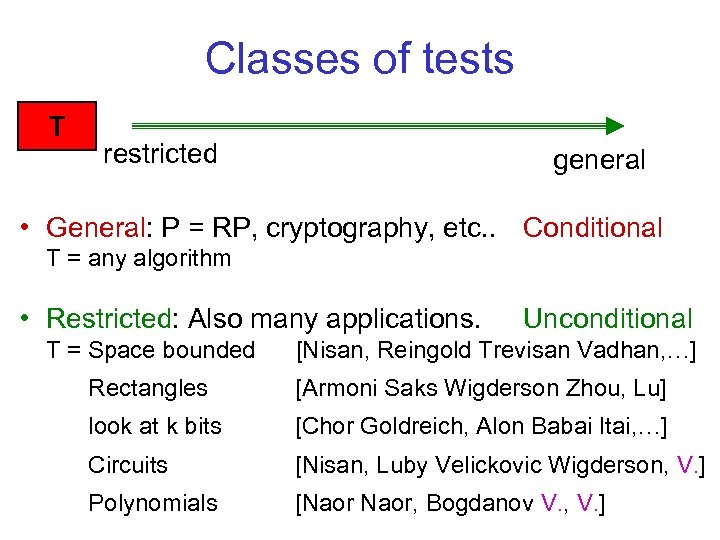
Classes of tests T restricted general • General: P = RP, cryptography, etc. . Conditional T = any algorithm • Restricted: Also many applications. T = Space bounded Unconditional [Nisan, Reingold Trevisan Vadhan, …] Rectangles [Armoni Saks Wigderson Zhou, Lu] look at k bits [Chor Goldreich, Alon Babai Itai, …] Circuits [Nisan, Luby Velickovic Wigderson, V. ] Polynomials [Naor, Bogdanov V. , V. ]
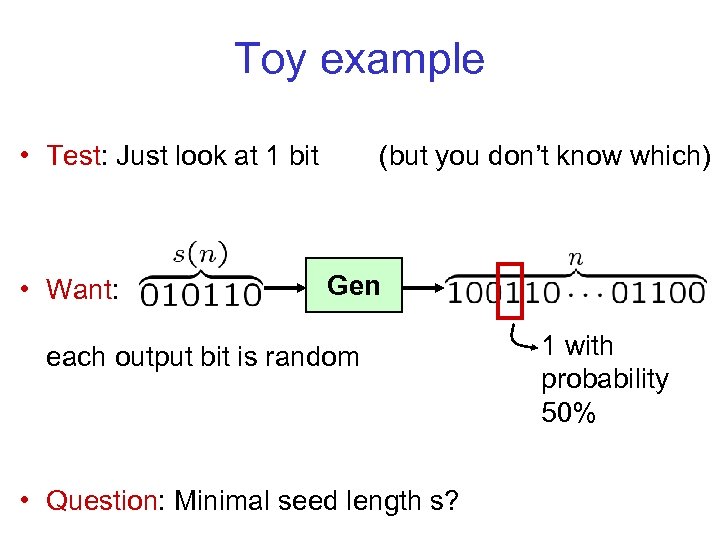
Toy example • Test: Just look at 1 bit • Want: (but you don’t know which) Gen each output bit is random • Question: Minimal seed length s? 1 with probability 50%
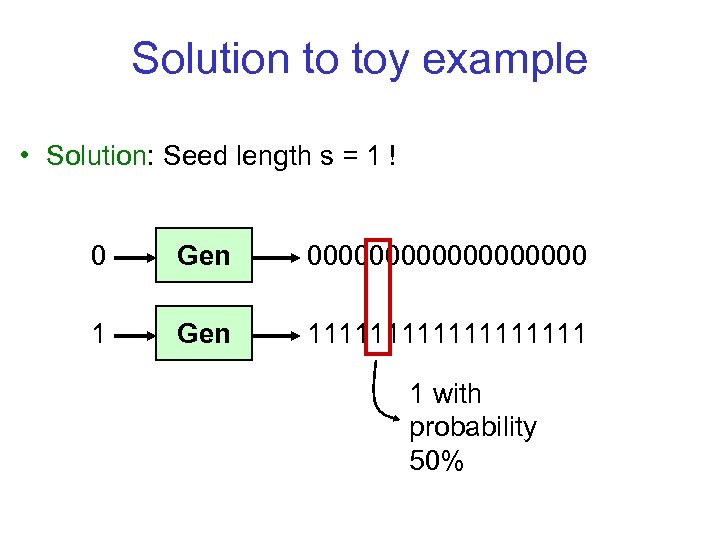
Solution to toy example • Solution: Seed length s = 1 ! 0 Gen 000000000 1 Gen 111111111 1 with probability 50%
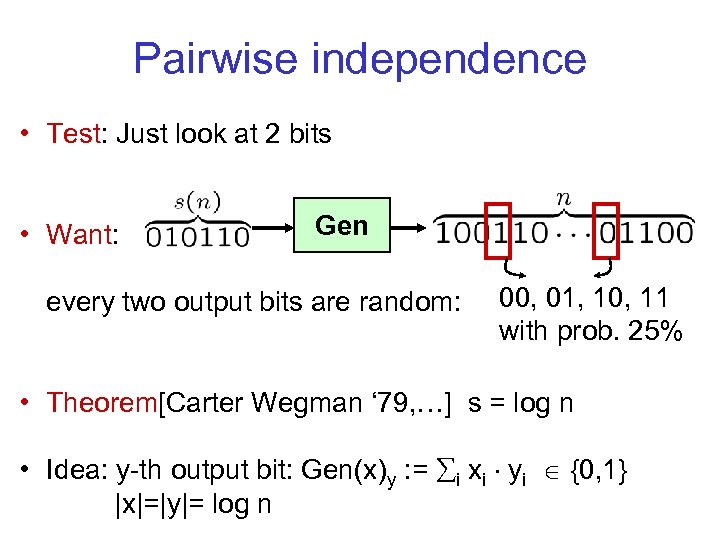
Pairwise independence • Test: Just look at 2 bits • Want: Gen every two output bits are random: 00, 01, 10, 11 with prob. 25% • Theorem[Carter Wegman ‘ 79, …] s = log n • Idea: y-th output bit: Gen(x)y : = åi xi yi {0, 1} |x|=|y|= log n
![Application to MAXCUT [Chor Goldreich, Alon Babai Itai] • Want: Cut in graph that](https://present5.com/presentation/43530f555093c9a1e432fa67a44393c5/image-15.jpg "Application to MAXCUT [Chor Goldreich, Alon Babai Itai] • Want: Cut in graph that")
Application to MAXCUT [Chor Goldreich, Alon Babai Itai] • Want: Cut in graph that maximizes edges crossing • Random cut: C(v) = 0, 1 with prob. 1/2 E[ # edges crossing] = å(u, v) Prob[C(u) C(v)] = |E|/2 • Pairwise independent cut suffices! Þ deterministic algorithm (try 2 log n = n cuts) • “The amazing power of pairwise independence”
Outline • Overview Motivation • Pseudorandom generators Examples Circuits Polynomials • Future directions
![Previous results for circuits • Theorem [Nisan ‘ 91]: Generator for constant-depth circuits with](https://present5.com/presentation/43530f555093c9a1e432fa67a44393c5/image-17.jpg "Previous results for circuits • Theorem [Nisan ‘ 91]: Generator for constant-depth circuits with")
Previous results for circuits • Theorem [Nisan ‘ 91]: Generator for constant-depth circuits with AND (/), OR (V) gates V / / / Depth V V V V Gen • Application to average-case “P vs NP” problem [Healy Vadhan V. ; SIAM J. Comp. STOC special issue]
![Our Results [V. ; SIAM J. Comp. , SIAM student paper prize 2006] •](https://present5.com/presentation/43530f555093c9a1e432fa67a44393c5/image-18.jpg "Our Results [V. ; SIAM J. Comp. , SIAM student paper prize 2006] •")
Our Results [V. ; SIAM J. Comp. , SIAM student paper prize 2006] • Theorem: Generator for constant-depth circuits with few Majority gates Majority / / / V V V V Gen • Richest circuit class for which pseudorandom generator is known
Outline • Overview Motivation • Pseudorandom generators Examples Circuits Polynomials • Future directions
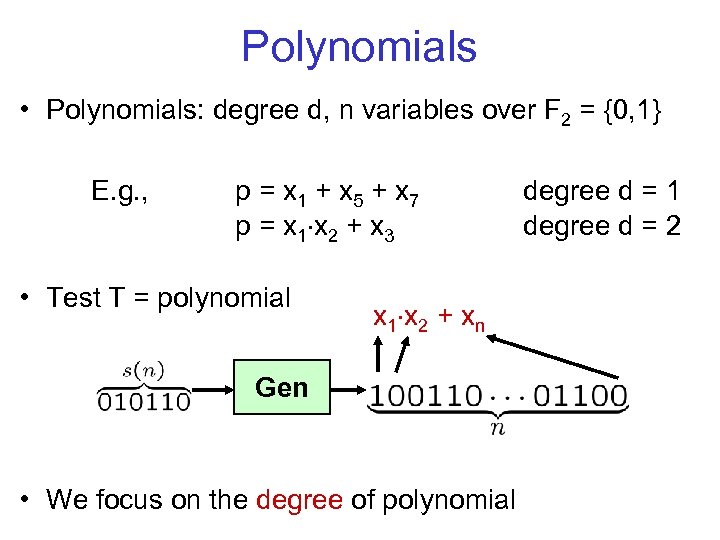
Polynomials • Polynomials: degree d, n variables over F 2 = {0, 1} E. g. , p = x 1 + x 5 + x 7 p = x 1 x 2 + x 3 • Test T = polynomial x 1 x 2 + xn Gen • We focus on the degree of polynomial degree d = 1 degree d = 2
![Previous results • Theorem[Naor ‘ 90]: Generator for linear polynomials, seed length s(n) =](https://present5.com/presentation/43530f555093c9a1e432fa67a44393c5/image-21.jpg "Previous results • Theorem[Naor ‘ 90]: Generator for linear polynomials, seed length s(n) =")
Previous results • Theorem[Naor ‘ 90]: Generator for linear polynomials, seed length s(n) = O(log n) • Myriad applications: matrix multiplication, PCP’s Expander graphs: (sparse yet highly connected) x {0, 1}n y = x + generator • For degree d ³ 2, no progress for 15 years
![Our results [Bogdanov V. ; FOCS ’ 07 special issue] • For degree d:](https://present5.com/presentation/43530f555093c9a1e432fa67a44393c5/image-22.jpg "Our results [Bogdanov V. ; FOCS ’ 07 special issue] • For degree d:")
Our results [Bogdanov V. ; FOCS ’ 07 special issue] • For degree d: Let L {0, 1}n look random to linear polynomials [NN] bit-wise XOR d independent copies of L: Generator : = L 1 + … + Ld • Theorem: (I) Unconditionally: Looks random to degree d=2, 3 (II) Under “Gowers inverse conjecture”: Any degree
![Recent developments after [BV] • Th. [Lovett]: The sum of 2 d generators for](https://present5.com/presentation/43530f555093c9a1e432fa67a44393c5/image-23.jpg "Recent developments after [BV] • Th. [Lovett]: The sum of 2 d generators for")
Recent developments after [BV] • Th. [Lovett]: The sum of 2 d generators for degree 1 looks random to degree d, unconditionally. – [BV] sums d copies • Progress on “Gowers inverse conjecture”: • Theorem[Green Tao]: True when |Field| > degree d – Proof uses techniques from [BV] • Theorem [Green Tao], [Lovett Meshulam Samorodnitsky]: False when Field = {0, 1}, degree = 4
![Our latest result [V. CCC ‘ 08] • Theorem: The sum of d generators](https://present5.com/presentation/43530f555093c9a1e432fa67a44393c5/image-24.jpg "Our latest result [V. CCC ‘ 08] • Theorem: The sum of d generators")
Our latest result [V. CCC ‘ 08] • Theorem: The sum of d generators for degree 1 looks random to polynomials of degree d. For every d and over any field. (Despite the Gowers inverse conjecture being false) • Improves on both [Bogdanov V. ] and [Lovett] • Also simpler proof
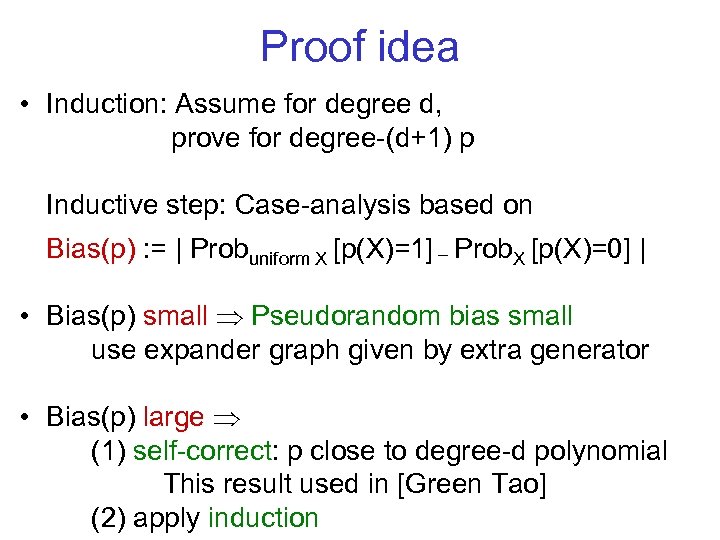
Proof idea • Induction: Assume for degree d, prove for degree-(d+1) p Inductive step: Case-analysis based on Bias(p) : = | Probuniform X [p(X)=1] – Prob. X [p(X)=0] | • Bias(p) small Þ Pseudorandom bias small use expander graph given by extra generator • Bias(p) large Þ (1) self-correct: p close to degree-d polynomial This result used in [Green Tao] (2) apply induction
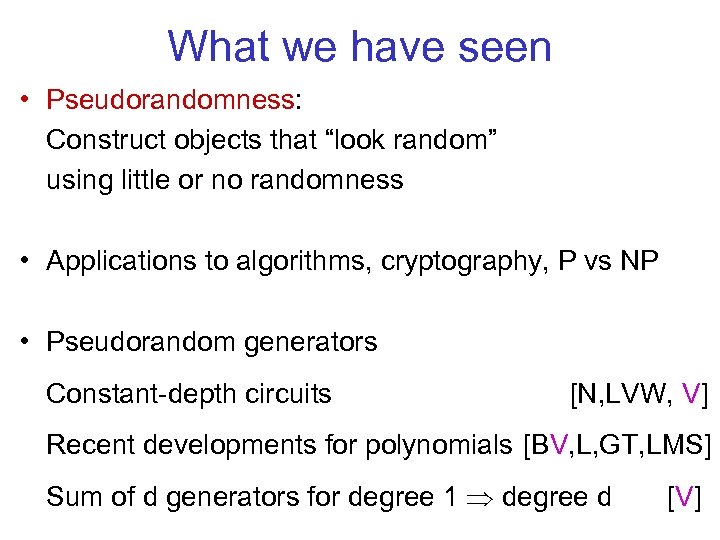
What we have seen • Pseudorandomness: Construct objects that “look random” using little or no randomness • Applications to algorithms, cryptography, P vs NP • Pseudorandom generators Constant-depth circuits [N, LVW, V] Recent developments for polynomials [BV, L, GT, LMS] Sum of d generators for degree 1 Þ degree d [V]
Outline • Overview Motivation • Pseudorandom generators Examples Circuits Polynomials • Future directions
Future directions (1) • Pseudorandomness Open: Generator for polynomials of degree log n? • Communication complexity Recent progress on long-standing problems [V. Wigderson, Sherstov, Lee Shraibman, David Pitassi V. ] • Computer science and economics Complexity of Nash Equilibria [Daskalakis Goldberg Papadimitriou, …] Mechanism design
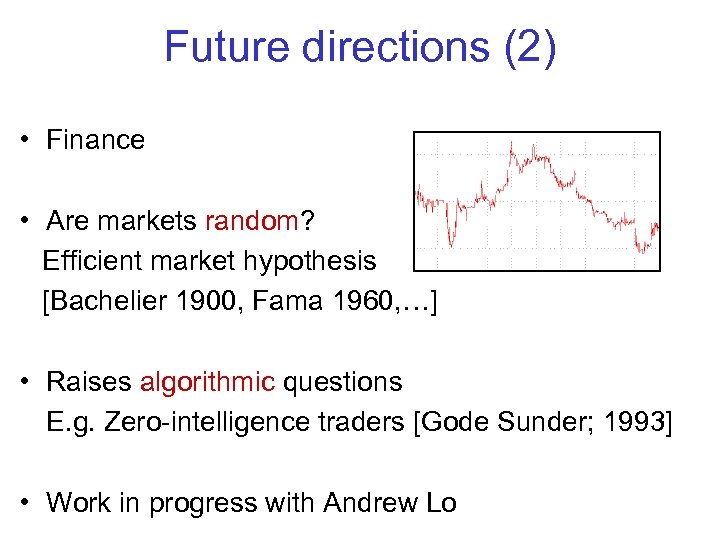
Future directions (2) • Finance • Are markets random? Efficient market hypothesis [Bachelier 1900, Fama 1960, …] • Raises algorithmic questions E. g. Zero-intelligence traders [Gode Sunder; 1993] • Work in progress with Andrew Lo
Скачать презентацию Pseudorandomness Emanuele Viola Columbia University April 2008
43530f555093c9a1e432fa67a44393c5.ppt