


 Скачать презентацию PRS Repertoire Project First Pass Conceptual Architecture 0
818c2d954bb30e87d82db200bd04d0ce.ppt
- Количество слайдов: 26
 PRS Repertoire Project First Pass Conceptual Architecture 0. 7 28 February 2002 TELECOM MEDIA NETWORKS
 Contents INTRODUCTION · Purpose of Document · Scope of this document · Description of the artefacts used in this document · Why do IS and TI artefacts overlap? · Document Control CONCEPTUAL ARCHITECTURE OVERVIEW · · · Strategic Concept Project Scope IS Services TI Services Architecture Assumptions DETAILED ARTEFACT DESCRIPTIONS · · · · Business Domains Actors Business Process Model Information Domains IS Services TI Services Computing Environments TELECOM MEDIA NETWORKS Conceptual Architecture 0. 5 © 2002 Cap Gemini Ernst & Young - All right reserved
 The PRS Repertoire Conceptual Architecture Introduction TELECOM MEDIA NETWORKS
 Purpose of this document Objectives This document is a deliverable from the Architecture stream of the PRS Repertoire project. The document is intended to do the following · Describe the Conceptual Architecture for the project The Conceptual Architecture is the description of what system is needed and is defined in terms of Services (groupings of requirements) and Information Domains. · Describe how this Conceptual Architecture has been developed. Scope of the Document The Conceptual Architecture described in this document is limited to the scope of the PRS Repertoire project as defined in the agreed scope document (currently “Scope for the Repertoire System”). This document is a first pass version of the Conceptual Architecture and is based upon the information available in the first iteration of the BRI and of the Use Case Model. TELECOM MEDIA NETWORKS Conceptual Architecture 0. 5 © 2002 Cap Gemini Ernst & Young - All right reserved
 Key Artefacts used in this Document. · Artefacts are components of a total architecture that communicate key architectural decisions or directions. · Services are a structured representation of requirements that forms the highest level of abstraction in architecture. · IS Services are services which embody business logic or automated processing · TI Services are services that provide common or infrastructure services · Information Domains are groups of coherent information elements. TELECOM MEDIA NETWORKS Conceptual Architecture 0. 5 © 2002 Cap Gemini Ernst & Young - All right reserved
 Why do IS And TI Artefacts overlap? IS Services represent 'lumps' of business logic and are resolved in the Physical Architecture into components such as sets of classes to be developed by a team, or development sub-projects, or data models, or static data and configuration items for business applications such as Clarify, or interfaces. TI Services represent 'lumps' of Infrastructure and are resolved in the Physical Architecture into components such as application run environments, application packages, hardware, OS, middleware and the mechanisms and standards used to link these components. Each set of services should be a complete description of the system from the point of view of the particular aspect area (i. e. IS or TI). Therefore - there are interrelations and overlaps between the two sets of services. A good check is that every IS Service needs a TI service as the application environment but an IS Service could actually be implemented across a number of TI Services and there are TI services that are required but not directly related to any particular IS service. The use of the two views ensures that nothing is missed in either aspect area. As an example, a personnel management system may involve an IS Service of ‘Personnel Management’ and TI Services of ‘On-Line Access’ and ‘Personnel Data Persistence’. The IS Service might be implemented as some custom code, the set of screens shown to the users and the data model. The ‘Online Access’ TI Service might require the implementation of an application server (which involves the Application package and some hardware) and a web server (a package and some hardware) whilst the ‘Personnel Data Persistence’ TI Service requires a DBMS package and a data server. The code and interfaces run on the application server and the web server and the data model is implemented on the data server. This is shown on the next page. TELECOM MEDIA NETWORKS Conceptual Architecture 0. 5 © 2002 Cap Gemini Ernst & Young - All right reserved
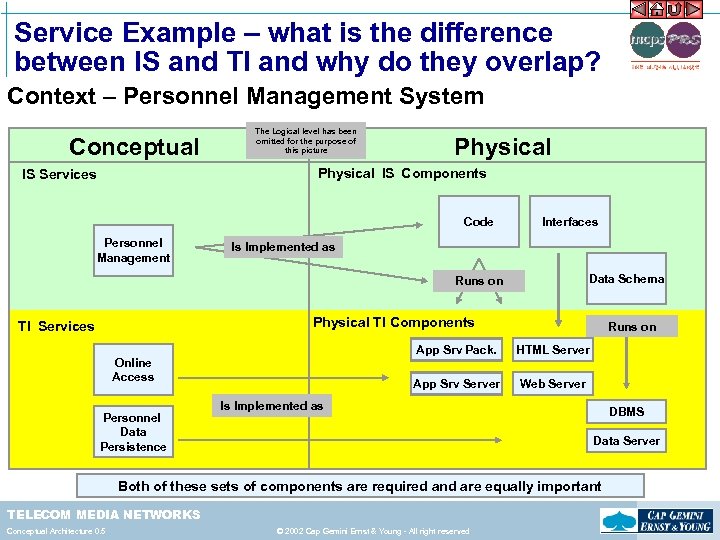 Service Example – what is the difference between IS and TI and why do they overlap? Context – Personnel Management System Conceptual The Logical level has been omitted for the purpose of this picture Physical IS Components IS Services Code Personnel Management Interfaces Is Implemented as Data Schema Runs on Physical TI Components TI Services App Srv Pack. HTML Server App Srv Server Online Access Personnel Data Persistence Runs on Web Server Is Implemented as DBMS Data Server Both of these sets of components are required and are equally important TELECOM MEDIA NETWORKS Conceptual Architecture 0. 5 © 2002 Cap Gemini Ernst & Young - All right reserved
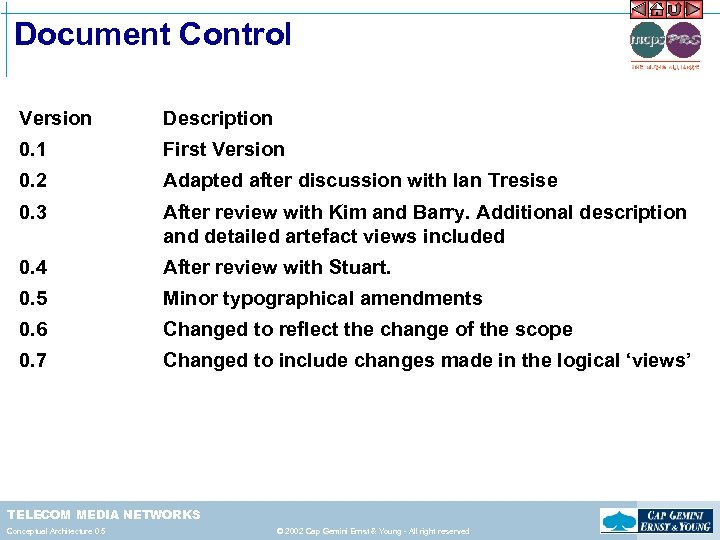 Document Control Version Description 0. 1 First Version 0. 2 Adapted after discussion with Ian Tresise 0. 3 After review with Kim and Barry. Additional description and detailed artefact views included 0. 4 After review with Stuart. 0. 5 Minor typographical amendments 0. 6 Changed to reflect the change of the scope 0. 7 Changed to include changes made in the logical ‘views’ TELECOM MEDIA NETWORKS Conceptual Architecture 0. 5 © 2002 Cap Gemini Ernst & Young - All right reserved
 The PRS Repertoire Conceptual Architecture Overview TELECOM MEDIA NETWORKS
 Introduction – the process we went through The Conceptual Architecture is based upon the following sources of information : · The strategy source documents identified in the Architecture Input File · The contents of the BRI first pass deliverable and the process model (I. e. actors and use-cases) derived from this. · An evaluation of the meaning of the IMJV concept within The Music Alliance First a simplified version of the business model of the parts of The Music Alliance relevant to this project was created. This was used as the basis for a description of the Services required of the architecture to meet the requirements as currently understood. This model was further developed to identify the IS and TI Services that describe the PRS Repertoire system. These artefacts are shown in overview in a ‘Big Picture’ of the entire system. This process and the Big Picture is shown in this section of the document. The artefacts of the Conceptual Architecture are described in all available detail in the next section of the document. TELECOM MEDIA NETWORKS Conceptual Architecture 0. 5 © 2002 Cap Gemini Ernst & Young - All right reserved
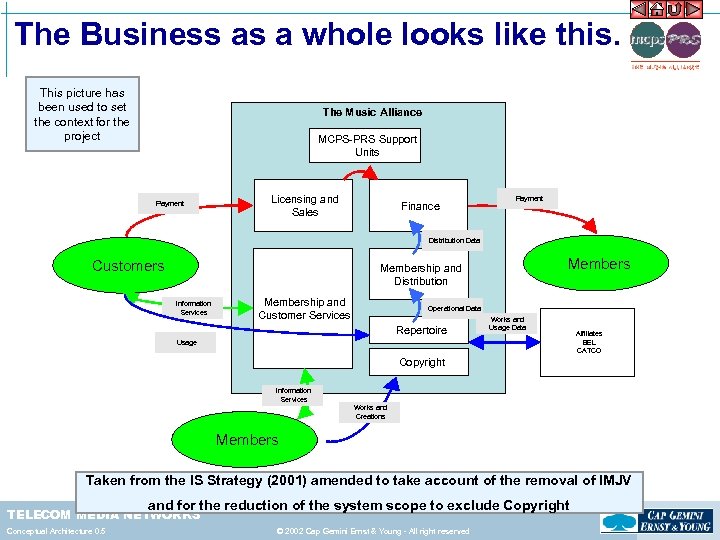 The Business as a whole looks like this. This picture has been used to set the context for the project The Music Alliance MCPS-PRS Support Units Payment Licensing and Sales Finance Payment Distribution Data Customers Membership and Distribution Information Services Membership and Customer Services Operational Data Repertoire Works and Usage Data Usage Affiliates BEL CATCO Copyright Information Services Works and Creations Members Taken from the IS Strategy (2001) amended to take account of the removal of IMJV and for the reduction of the system scope to exclude Copyright TELECOM MEDIA NETWORKS Conceptual Architecture 0. 5 © 2002 Cap Gemini Ernst & Young - All right reserved
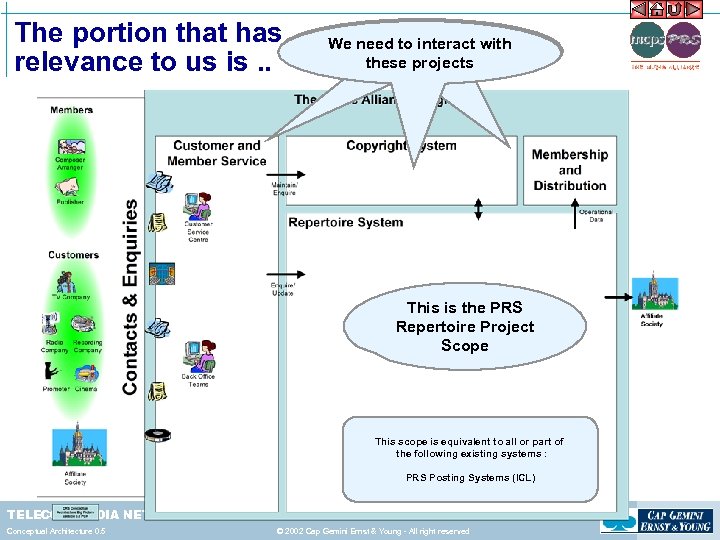 The portion that has relevance to us is. . We need to interact with these projects This is the PRS Repertoire Project Scope This scope is equivalent to all or part of the following existing systems : PRS Posting Systems (ICL) TELECOM MEDIA NETWORKS Conceptual Architecture 0. 5 © 2002 Cap Gemini Ernst & Young - All right reserved
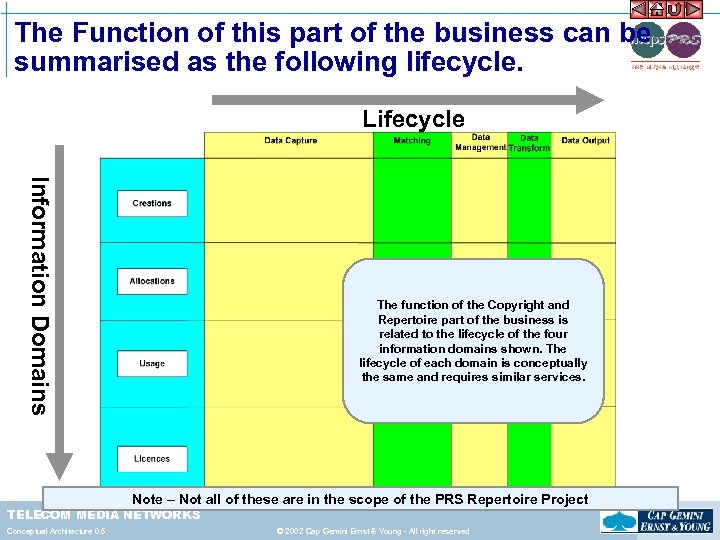 The Function of this part of the business can be summarised as the following lifecycle. Lifecycle Information Domains The function of the Copyright and Repertoire part of the business is related to the lifecycle of the four information domains shown. The lifecycle of each domain is conceptually the same and requires similar services. Note – Not all of these are in the scope of the PRS Repertoire Project TELECOM MEDIA NETWORKS Conceptual Architecture 0. 5 © 2002 Cap Gemini Ernst & Young - All right reserved
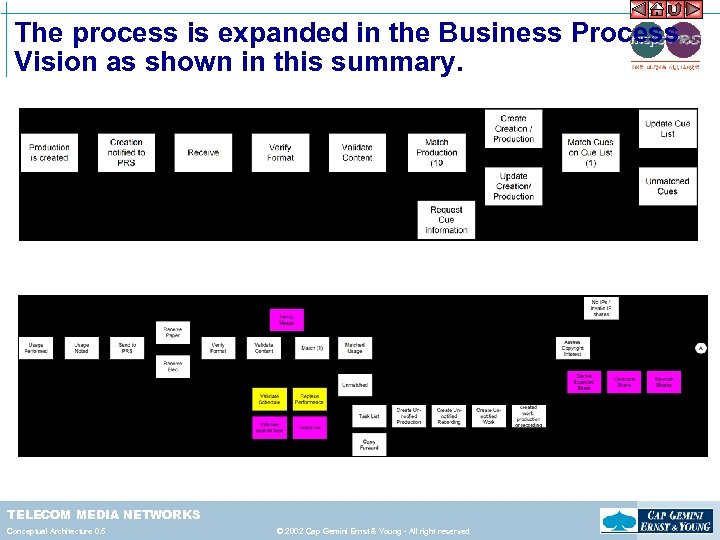 The process is expanded in the Business Process Vision as shown in this summary. TELECOM MEDIA NETWORKS Conceptual Architecture 0. 5 © 2002 Cap Gemini Ernst & Young - All right reserved
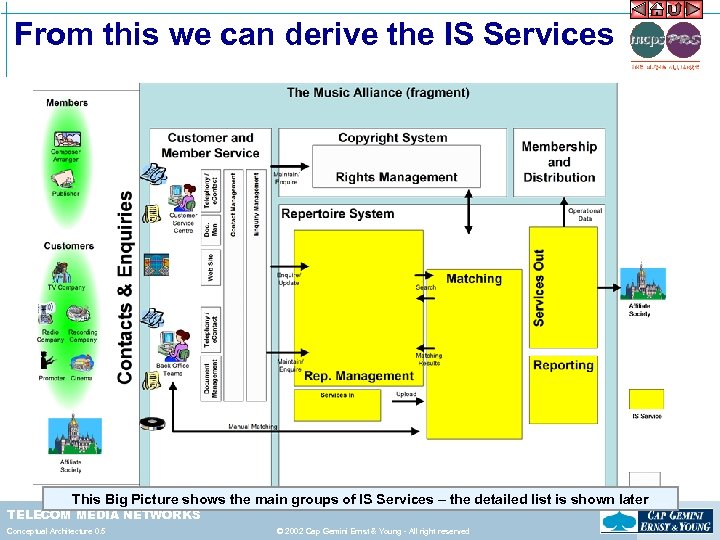 From this we can derive the IS Services This Big Picture shows the main groups of IS Services – the detailed list is shown later TELECOM MEDIA NETWORKS Conceptual Architecture 0. 5 © 2002 Cap Gemini Ernst & Young - All right reserved
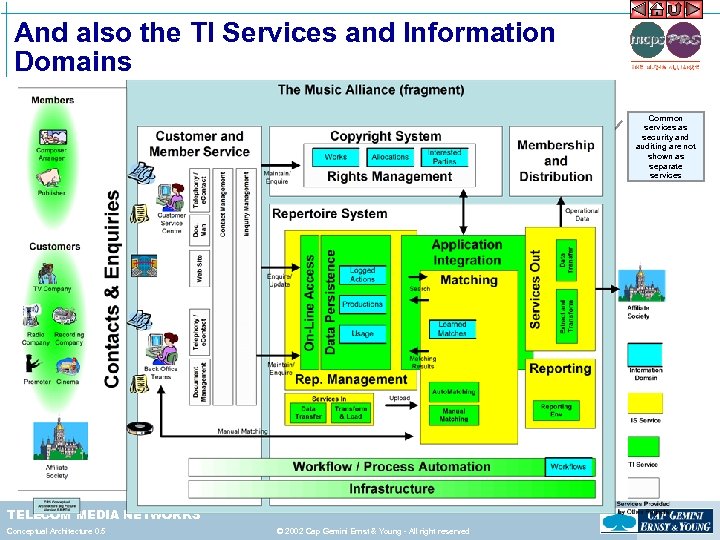 And also the TI Services and Information Domains Common services as security and auditing are not shown as separate services TELECOM MEDIA NETWORKS Conceptual Architecture 0. 5 © 2002 Cap Gemini Ernst & Young - All right reserved
 Assumptions · Assumptions The PRS Repertoire scope shown in the picture is correct The CSC is a separate project and will provide a single point of contact for incoming contacts. There will be back-office PRS Repertoire teams that are involved in manual matching, follow ups and forms processing etc. That ‘Contact Centre’ requirements (telephony, contact mgmt, enquiry mgmt etc) are common between the CSC and the PRS Repertoire back-office teams and the identification of these requirements and the design and implementation of the resulting systems are all part of the CSC project. The systems and user interface for member and customer access directly to Copyright and Repertoire information across the web will be provided by the e-business project. The requirements for this access are partially being derived in the PRS Repertoire project. The PRS Repertoire system will provide the mechanism to access the information to allow this. That the ‘matching’ infrastructure will be used for on-line searching as well Common services such as security and auditing are assumed to be an integral part of each and every service. TELECOM MEDIA NETWORKS Conceptual Architecture 0. 5 © 2002 Cap Gemini Ernst & Young - All right reserved
 The PRS Repertoire Conceptual Architecture Detailed Artefact Descriptions TELECOM MEDIA NETWORKS
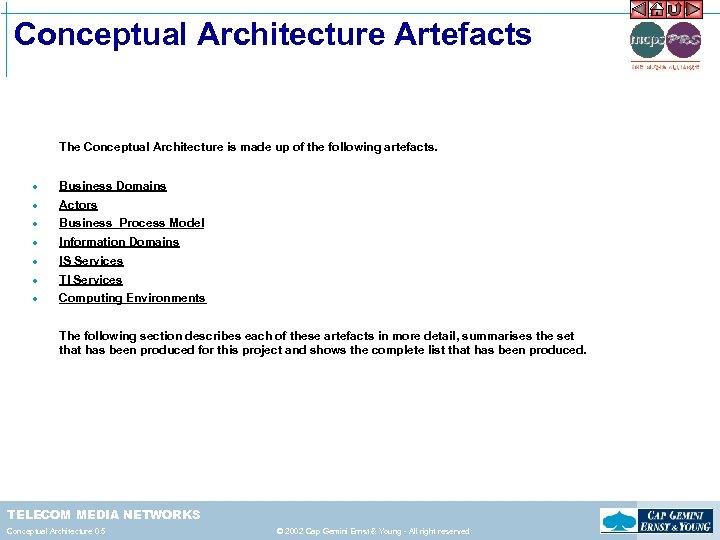 Conceptual Architecture Artefacts The Conceptual Architecture is made up of the following artefacts. · · · · Business Domains Actors Business Process Model Information Domains IS Services TI Services Computing Environments The following section describes each of these artefacts in more detail, summarises the set that has been produced for this project and shows the complete list that has been produced. TELECOM MEDIA NETWORKS Conceptual Architecture 0. 5 © 2002 Cap Gemini Ernst & Young - All right reserved
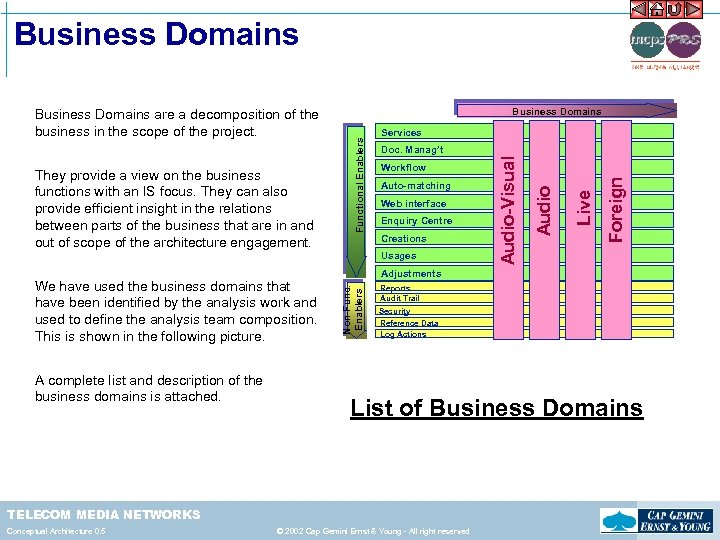 Business Domains Services Web interface Enquiry Centre Creations Usages A complete list and description of the business domains is attached. Adjustments Non-Func. Enablers We have used the business domains that have been identified by the analysis work and used to define the analysis team composition. This is shown in the following picture. Reports Audit Trail Security Secuity Reference Data Log Actions List of Business Domains TELECOM MEDIA NETWORKS Conceptual Architecture 0. 5 Foreign Auto-matching Live Workflow Audio Doc. Manag’t Audio-Visual They provide a view on the business functions with an IS focus. They can also provide efficient insight in the relations between parts of the business that are in and out of scope of the architecture engagement. Business Domains Functional Enablers Business Domains are a decomposition of the business in the scope of the project. © 2002 Cap Gemini Ernst & Young - All right reserved
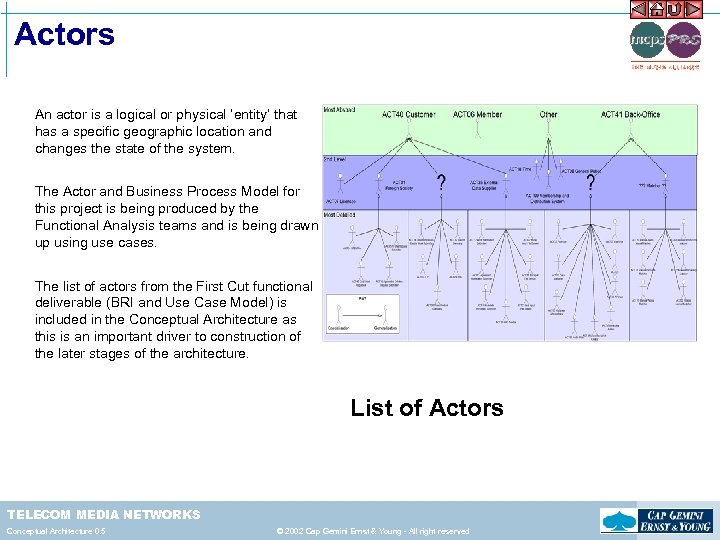 Actors An actor is a logical or physical ‘entity’ that has a specific geographic location and changes the state of the system. The Actor and Business Process Model for this project is being produced by the Functional Analysis teams and is being drawn up using use cases. The list of actors from the First Cut functional deliverable (BRI and Use Case Model) is included in the Conceptual Architecture as this is an important driver to construction of the later stages of the architecture. List of Actors TELECOM MEDIA NETWORKS Conceptual Architecture 0. 5 © 2002 Cap Gemini Ernst & Young - All right reserved
 Business Process Model The Business Process defines the processes inculcated in the IS Services. The Actor and Business Process Model for this project is being produced by the Functional Analysis teams and is being drawn up using use cases. The Conceptual Architecture includes a list of the Use Cases defined in the first pass functional deliverable to allow these to be referenced List of Use Cases TELECOM MEDIA NETWORKS Conceptual Architecture 0. 5 © 2002 Cap Gemini Ernst & Young - All right reserved
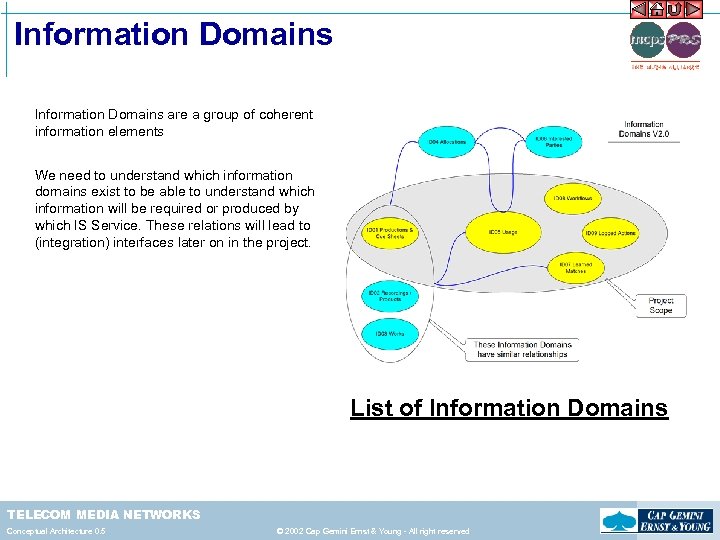 Information Domains are a group of coherent information elements We need to understand which information domains exist to be able to understand which information will be required or produced by which IS Service. These relations will lead to (integration) interfaces later on in the project. List of Information Domains TELECOM MEDIA NETWORKS Conceptual Architecture 0. 5 © 2002 Cap Gemini Ernst & Young - All right reserved
 IS Services A Service is a structured representation of requirements that forms the highest level of abstraction in architecture. The list of services describes the requirement in a way that can be used to produce an architecture and forms the segmentations that will be used in the rest of the work. An IS Service implements business logic. The derivation of these services is described in the ‘Overview’ section of this document. The detailed list of IS Services is based upon the list of functional groups identified in the Business Process Vision for the system List of IS Services TELECOM MEDIA NETWORKS Conceptual Architecture 0. 5 © 2002 Cap Gemini Ernst & Young - All right reserved
 TI Services A service is a structured representation of requirements that forms the highest level of abstraction in architecture. The list of services describes the requirement in a way that can be used to produce an architecture and forms the segmentations that will be used in the rest of the work. A TI Service implements infrastructure or common requirements The TI Services are based upon the functional groups identified in the Business Process Vision with the additions of the common services that the principles, the functional requirements and the logical views have shown are necessary. List of TI Services TELECOM MEDIA NETWORKS Conceptual Architecture 0. 5 © 2002 Cap Gemini Ernst & Young - All right reserved
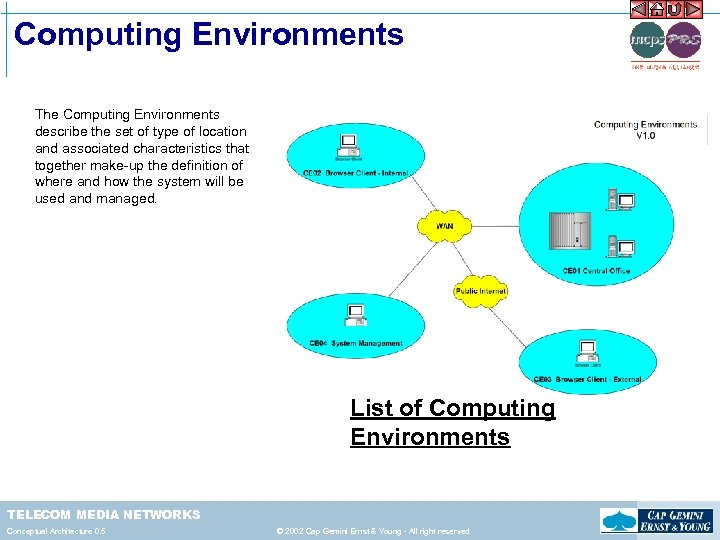 Computing Environments The Computing Environments describe the set of type of location and associated characteristics that together make-up the definition of where and how the system will be used and managed. List of Computing Environments TELECOM MEDIA NETWORKS Conceptual Architecture 0. 5 © 2002 Cap Gemini Ernst & Young - All right reserved