


 Скачать презентацию Providing a new HITSP standard XML input to
93fbfae271a5a19ad7b7d8bdbeff5515.ppt
- Количество слайдов: 11
 Providing a new HITSP standard XML input to Bio. Sense RT – The Beth Israel Deaconess Project W. Lane Chambers Healthcare Systems Consultant – SAIC and Robert F. Beckley, III Consultant - Beth Israel Deaconess 1
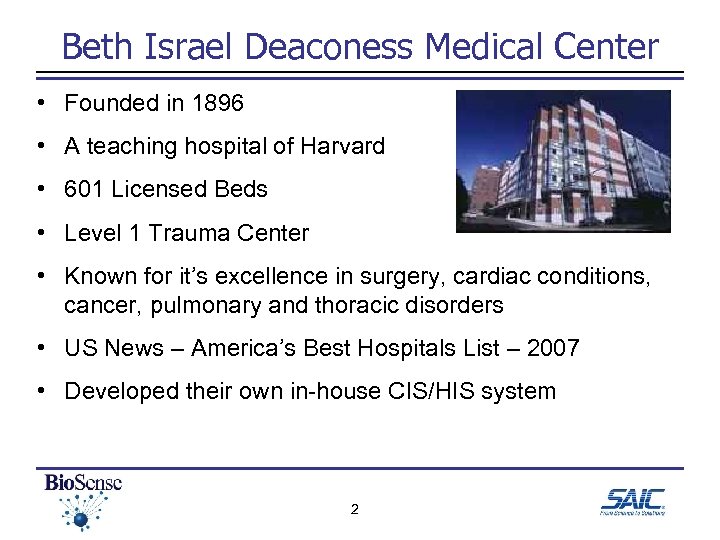 Beth Israel Deaconess Medical Center • Founded in 1896 • A teaching hospital of Harvard • 601 Licensed Beds • Level 1 Trauma Center • Known for it’s excellence in surgery, cardiac conditions, cancer, pulmonary and thoracic disorders • US News – America’s Best Hospitals List – 2007 • Developed their own in-house CIS/HIS system 2
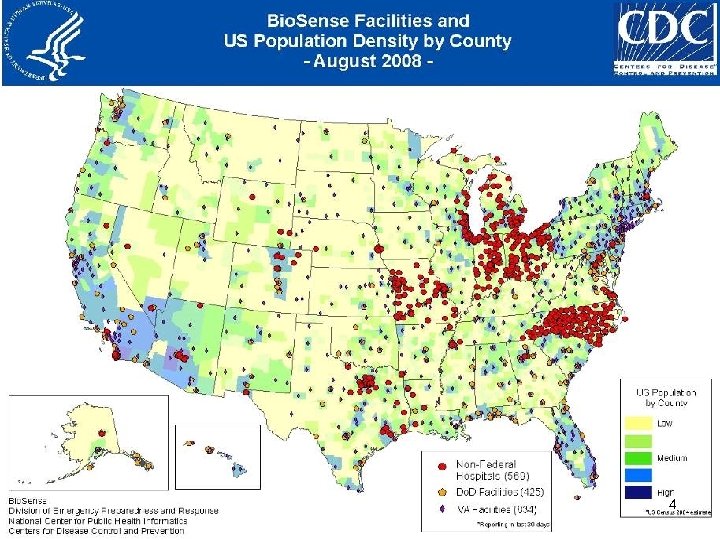
 CDC’s Bio. Sense is a national program intended to improve the nation’s capabilities for conducting real-time biosurveillance, and enabling health situational awareness through access to existing data from healthcare organizations across the country. • The Bio. Sense system collects over 1 million de-identified admission, census, emergency department, laboratory, radiology and pharmacy messages a day from healthcare providers across the US. • Data sources include: – State/regional surveillance systems – Local and regional hospitals and health care systems – National laboratories – Department of Defense (Do. D) – Department of Veterans Affairs (VA) • Beth Israel Deaconess (BIDMC) was one of the original 10 “vanguard” sites that began transmitting data real time to Bio. Sense in Dec. 2005 3
 4
4
 The Genesis of the XML Project • BIDMC was sending only ED data initially in a pipe-delimited flat file format • This data was being extracted from BIDMC’s integrated CIS/HIS system – no existing HL 7 API’s were needed or available • Bio. Sense and BIDMC wanted to increase the number of data types being transmitted to include ADT, Census, Lab, Radiology and Pharmacy • A new extract/API would need to be developed by BIDMC. John Halamka, CIO of Beth Israel Deaconess and Chair of the Healthcare Information Technology Standards Panel (HITSP) proposed that the development be a Bio. Sense proof of concept utilizing the emerging HITSP XML standards. • As a pilot for this new Bio. Sense input option, BIDMC committed to deliver the full set of Bio. Sense data types of interest in the new XM. 5
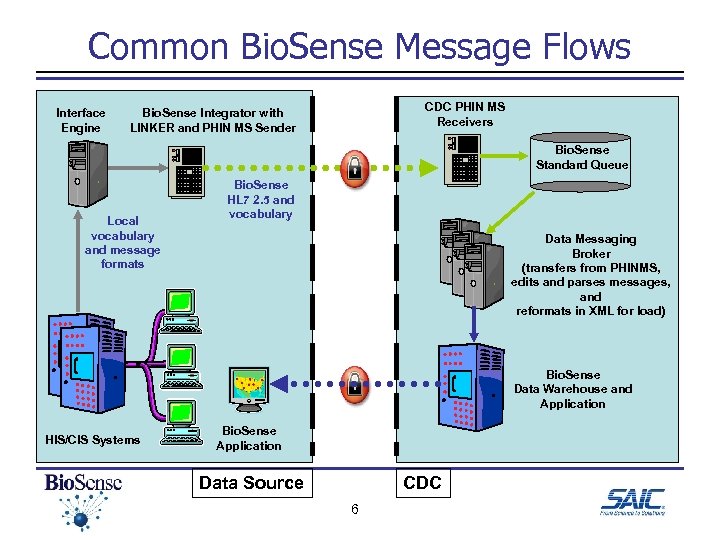 Common Bio. Sense Message Flows Interface Engine CDC PHIN MS Receivers Bio. Sense Integrator with LINKER and PHIN MS Sender Bio. Sense Standard Queue Local vocabulary and message formats Bio. Sense HL 7 2. 5 and vocabulary Data Messaging Broker (transfers from PHINMS, edits and parses messages, and reformats in XML for load) Bio. Sense Data Warehouse and Application HIS/CIS Systems Bio. Sense Application Data Source CDC 6
 Highlights of Required Changes • BIDMC – Develop extract routines for all new data types – Utilize LINKER (de-identification) functionality from original Bio. Sense API – Format output in Bio. Sense XML format • CDC – Create new Bio. Sense XML PHIN MS queue – Create new DMB route for XML which bypasses standard edits and reformatting functionality 7
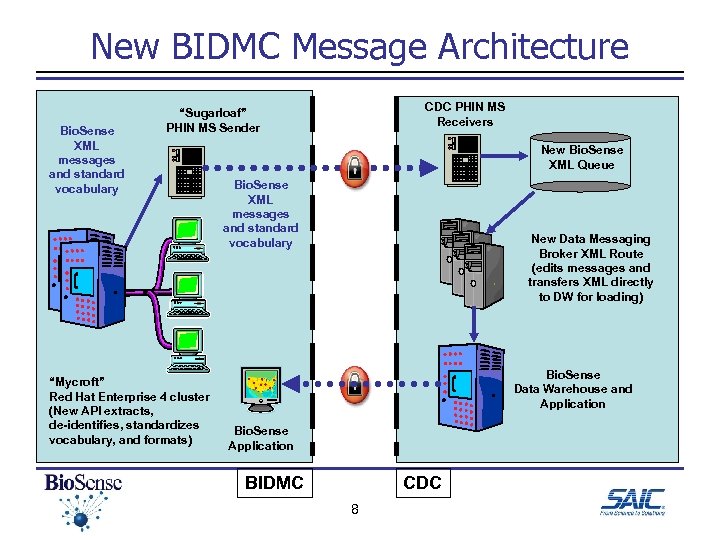 New BIDMC Message Architecture Bio. Sense XML messages and standard vocabulary CDC PHIN MS Receivers “Sugarloaf” PHIN MS Sender “Mycroft” Red Hat Enterprise 4 cluster (New API extracts, de-identifies, standardizes vocabulary, and formats) New Bio. Sense XML Queue Bio. Sense XML messages and standard vocabulary New Data Messaging Broker XML Route (edits messages and transfers XML directly to DW for loading) Bio. Sense Data Warehouse and Application Bio. Sense Application BIDMC CDC 8
 Recap of the Project • Initial (ED only) Activation – December 31, 2005 • Original plan was to activate new data types (ADT/Census, Lab, Radiology, and Pharmacy) in stages • Due to delays on the receiving side, the project opted to activate the new XML feed all at one time (big bang!) • BIDMC development and system testing were complete in late November 2007. • Integrated Testing (end to end) began on March 27, 2008 • Activation of the new feed occurred on May 2, 2008. • BIDMC is now one of the most comprehensive feeds of any Bio. Sense data source and sends ~ 5000 messages per day every 15 minutes, 24/7. 9
 Benefits of the Project • Bio. Sense has a second proven format for accepting data that other data sources might prefer to use in the future • BIDMC’s CIS/HIS now has a standard XML output for a wide variety of data/message types that can be leveraged for other external interoperability requirements in the future • The successful BIDMC/Bio. Sense link demonstrates the practicality and benefit of implementing HITSP standards to streamline the exchange of healthcare data 10
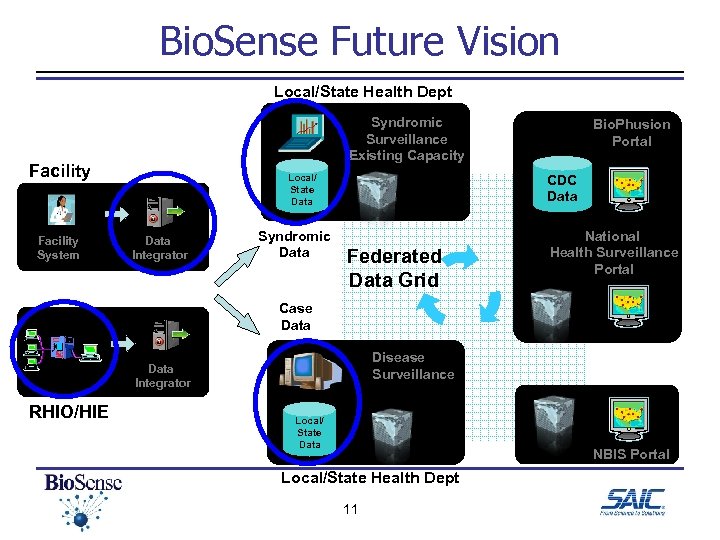 Bio. Sense Future Vision Local/State Health Dept Syndromic Surveillance Existing Capacity Facility System CDC Data Local/ State Data Integrator Syndromic Data Bio. Phusion Portal Federated Data Grid National Health Surveillance Portal Case Data Disease Surveillance Data Integrator RHIO/HIE Local/ State Data DHS NBIS Portal Local/State Health Dept 11